i
The Incidence of Blossom-end Rot in Relation to
Water-soluble Ca Concentration within Tomato Fruit as Affected by Ca Nutrition and Environmental Conditions
トマトの尻腐れ果発生と果実内の水溶性 Ca 分布に及ぼす Ca 栄養と環境条件の影響
September 2017
Tran Duy Vinh
Graduate School of
Environmental and Life Science
(Doctor‟s Course) OKAYAMA UNIVERSITY
i
ACKNOWLEDGEMENT
Finally, my Ph.D. course is going to finish as a result of unstoppable attempts during the recent years. This time has been one of best experiences in my life and makes me proud and grateful for the valuable lessons I have learned and people who have helped me. I would not have accomplished my thesis without the advice, support and sponsorship of following people.
My greatest appreciation is expressed to my beloved supervisor Prof. Yuichi YOSHIDA for his patient teaching, guidance, support and inspiration throughout my study in Laboratory of Flowering Control. I would also like to offer my special thanks to Prof.Tanjuro GOTO and Assoc. Professor. Ken-ichiro YATSUBA, my co-superviors for the great support and academic knowledge they taught me in the classes, seminars, and talks in person. Knowledge, advice, and recommendations by Assoc. Professor Yoshiyuki TANAKA were gratefully appreciated as a great help for me to better understand my research. What I have learned from these respectful teachers are always valuable lessons during my life. I wish I could convey and express enough how grateful I am to them.
My lab-mate Mr. Mitsuo OOYAMA deserves a grateful mention for his enthusiastic assistance. He helped me a lot in experimental design and chemical analysis manipulations and helpful discussions on research issues, especially in the beginning days. Our labmates with different generations from 2013 to 2017 gave me encouragement in keeping my progress on schedule. Time studying and enjoying together with the mentioned above would be unforgettable moments in my life.
Sincerely, I would like to acknowledge Okayama-Hue International Master‟s Program Sustainability in Rural and Environmental Systems which has brought me to Okayama University and fostered my dream of pursuing my Ph.D. education.
Last but very important, support and understanding from my family has been a great motivation in the last journey and continuously in next future steps.
ii CONTENTS
ACKNOWLEDGEMENT ... i
LIST OF FIGURES ... iv
LIST OF TABLES ... v
LIST OF ABBREVIATIONS ... vii
CHAPTER 1: GENERAL INTRODUCTION ... 1
CHAPTER 2: LITERATURE REVIEW ... 3
2.1. Functions of calcium ... 3
2.2. Blossom end rot and its relation to Ca deficiency ... 4
2.3. Calcium uptake, transport, and accumulation in fruit ... 6
2.4. Indirect factors involved in blossom end rot occurrence and fruit Ca deficiency ... 11
2.4.1. Drought, relative humidity, and salinity ... 11
2.4.2. Light and temperature ... 12
2.4.3. Interactions with mineral ions and mineral imbalance ... 13
2.4. Endogenous regulation of Ca transport ... 14
2.4.1. Auxins ... 14
2.4.2. Gibberellins ... 15
2.4.3. Abscisic acid ... 16
2.4.4. Cytokinins ... 19
2.4.5. Ethylene ... 19
CHAPTER 3: DETERMINATION OF CRITICAL CALCIUM LEVEL AND EFFECTS OF CALCIUM ABSORPTION AND SEASONAL CHANGE ON THE INCIDENCE OF BLOSSOM END ROT ... 20
3. 1. Introduction ... 20
3.2. Materials and methods ... 22
3. 3. Results and Discussion ... 24
3.3.1. Results ... 24
3.3.1.1. Environmental factors and apparent nutrient absoprtion ... 24
3.3.1.2. Plant and fruit growth ... 26
3.3.1.3. Incidence of blossom end rot as affected by Ca:K ratios in nutrient solution and seasonal change ... 28
3.3.1.4. Ca concentration in fractions in the distal part of fruit and their relationships to BER incidence ... 29
iii
3.3.1.5. Factors affecting water-soluble Ca concentration in the distal part of fruit and
BER incidence ... 32
3.3.2. Discussion ... 34
3.4. Concluding remarks ... 36
CHAPTER 4: COMPARATIVE ANALYSIS ON CULTIVAR SUSCEPTIBILITY TO BLOSSOM-END ROT IN RELATION TO CALCIUM TRANSPORT, PARTITIONING WITHIN FRUIT ... 38
4.1. Introduction ... 38
4.2. Materials and Methods ... 40
4.3. Results and Discussion ... 42
4.3.1. Results ... 42
4.3.1.1. Growing condition and apparent nutrient absorption ... 42
4.3.1.2. Plant and fruit growth ... 44
4.3.1.3. The susceptibility to BER among cultivars and its relationship to fruit growth .. 45
4.3.1.4. Water-soluble Ca in the distal portion and its relationship to BER incidence among cultivars ... 47
4.3.1.5. Ca transport into fruit ... 48
4.3.1.6. Distribution of Ca in fractions within differentiated tissues. ... 51
4.3.2. Discussion ... 53
4.4. Concluding remarks ... 56
CHAPTER 5: CONCLUSIONS AND RECOMMENDATIONS ... 58
5.1. Conclusions ... 58
5.2. Recommendations ... 59
LITERATURE CITED ... 60
iv
LIST OF FIGURES
Fig. 1. Changes in growth rate (g・day−1) of young fruits of „Momotaro Fight‟ and „Cindy Sweet‟ at 14 and 18 days after anthesis, respectively. Values with different letters in each cultivar are significantly different among seasons (n=12). *, *** indicate significant difference at P < 0.05 and P < 0.001 between two cultivars in each season, respectively. ... 27 Fig. 2. The averaged percentage of BER incidence in „Momotaro Fight‟ and „Cindy Sweet‟
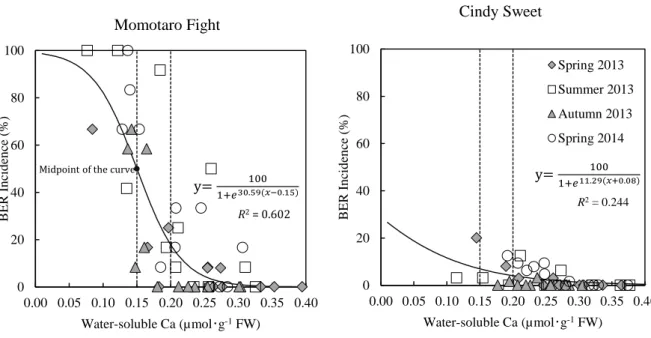
as affected by Ca concentrations in the supplied solutions and growing season. ** indicates significance at P < 0.01. ... 29 Fig. 3. Relationships between BER incidence (%) and mean value of water-soluble Ca concentration (µmol・g−1 FW) in the distal part of the young fruit in each truss. ... 31 Fig. 4. Relationship between fruit growth rate and BER incidence among cultivars. Results are mean values of three trusses of each cultivar in each treatment. **, *** indicate significance at P < 0.05 and 0.01, respectively. ... 46 Fig. 5. Relationship between fruit growth rate and Ca import into fruits among cultivars.
Results are mean values of three trusses of each cultivar in each treatment. **, *** indicate significance at P < 0.05 and 0.01, respectively. ... 49 Fig. 6. Relationship between water-soluble Ca and fruit growth rate among cultivars. Results are mean values of three trusses of each cultivar in each treatment. **, *** indicate significance at P < 0.05 and 0.01, respectively. ... 54
v
LIST OF TABLES
Table 1. Nutrient composition used for experimental treatments (mmol・L−1). ... 23 Table 2. Growing conditions and flowering of „Momotaro Fight‟ and „Cindy Sweet‟ in four experiments (February 2013 to June 2014). ... 25 Table 3. Effect of Ca concentration (me・L−1) in the supplied solutions on apparent Ca and K absorption (mmol/plant・day−1) of tomato plants in the four experiments (February 2013 to June 2014). Values are means of each plot during the experiments. ... 26 Table 4. Parameters of multiple regression in growth rate (g・day−1) of the young fruit of
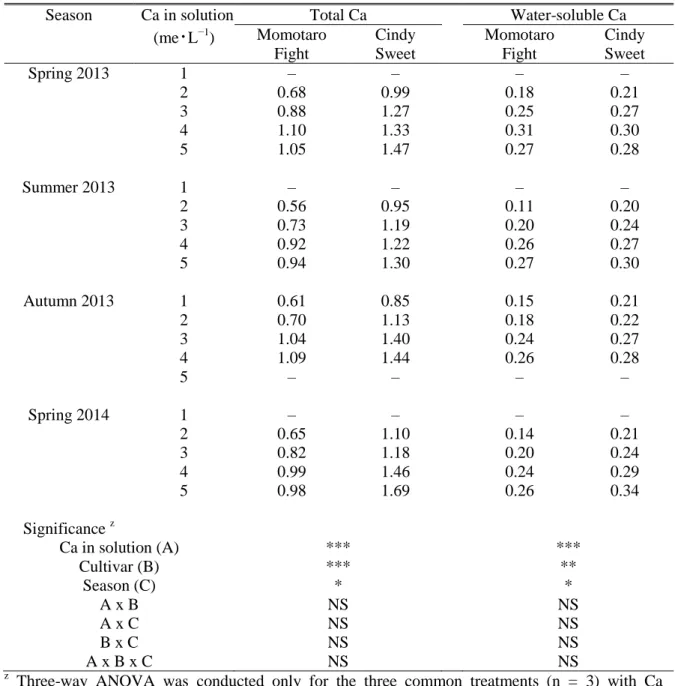
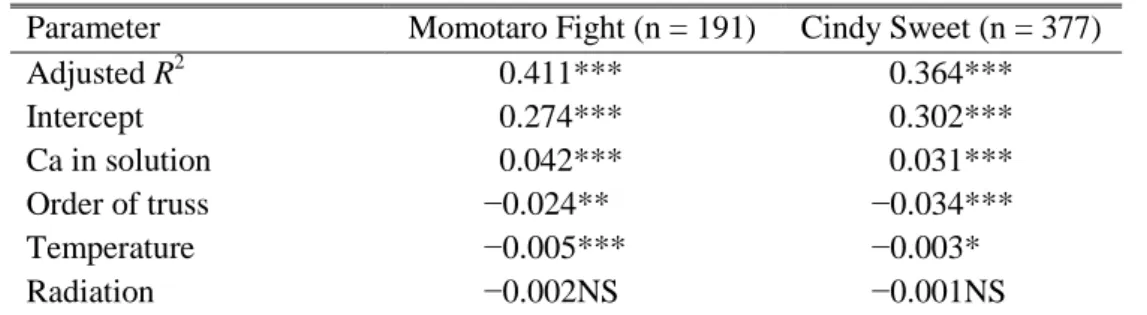
„Momotaro Fight‟ and „Cindy Sweet‟ against radiation (MJ・m−1・day−1) and temperature (°C)... 28 Table 5. Changes in total and water-soluble Ca concentrations (µmol・g−1 FW) in the distal part of the young fruit of „Momotaro Fight‟ and „Cindy Sweet‟. ... 30 Table 6. Parameters of linear multiple regression in water-soluble Ca concentration (µmol・ g−1 FW) in the distal part of fruit against Ca in solution (me・L−1), the order of truss, daily radiation (MJ・m−2・day−1) and temperature (°C). ... 33 Table 7. Parameters of linear multiple regression in water-soluble Ca concentration (µmol・
g−1 FW) in the distal part of fruit against apparent Ca absorption (mmol/plant・day −1) and rate of fruit growth (g・day−1). ... 33 Table 8. Parameters of linear multiple regression in the rate of BER incidence against mean values of water-soluble Ca concentration in the distal part of fruit (µmol・g−1 FW) and rate of fruit growth (g・day−1) in each truss. ... 33 Table 9. Nutrient composition (mmol) used to grow tomato plants during the experiments ... 41 Table 10. Growing condition and flowering of the five cultivars in two experiments (February to August 2015). ... 42 Table 11. Root absorption of macro-elements by the five cultivars in the two experiments.
Values are cumulative amounts (mmol・plant-1) during 4 weeks after the flowering of the first truss. ... 43
vi
Table 12. Rate of fruit growth (g・day-1) of the five cultivars treated with two Ca regimes in spring and summer 2015. ... 44 Table 13. Parameters of multiple regression in growth rate (g・day−1) of young fruit of
„Momotaro Fight‟ and „Cindy Sweet‟ against radiation (MJ・m−2・day−1) and temperature (°C)... 45 Table 14. The equations relating BER incidence (%) to fruit growth rate (g・day-1) and Ca concentration in nutrient solution (me・L-1) in each cultivar ... 47 Table 15. Water-soluble and total Ca (µmol・g-1FW) in distal portion of tomato fruits in the five cultivars ... 48 Table 16. The equations relating Ca transport (µmol・day-1/fruit) to fruit growth rate (g・
day-1) and Ca concentration in nutrient solution (me・L-1) in each cultivar ... 50 Table 17. Parameters of linear multiple regression in rate of Ca transport (µmol・day-1/fruit) into tomato fruit against Ca in solution (me・L-1), order of truss, temperature (oC) and solar radiation (MJ・m-2・day-1). ... 50 Table 18. Distribution of Ca in fractions (µmol・g-1) within tomato fruit ... 52
vii
LIST OF ABBREVIATIONS
BER : Blossom-end rot DAA : Days after anthesis Expt : Experiment
ABA : Abscisic acid GAs : Gibberellins
AAS : Atomic absorption spectrometry UV/VIS : Ultraviolet/visible
1
CHAPTER 1: GENERAL INTRODUCTION
Blossom-end rot (BER) of tomato is a problem that may cause considerable revenue loss in tomato production because of the reduction of fruit quality and marketability (Sun et al., 2013; Taylor et al., 2004), especially to susceptible cultivars. It was first reported by Galloway in 1888 (cited in Lyon et al. 1942) and has been the interest of numerous studies so far. However, the mechanisms involved still remain unclear (Adams and Ho, 1993; De Freitas et al., 2012b; Lyon et al., 1942; Saure, 2001, 2005; Sun et al., 2013).
BER has generally been reported as a calcium (Ca)-related physiological disorder as there is a well-established relationship between Ca deficiency and incidence of BER in fruit (Adams and Ho, 1993; De Freitas et al., 2014; Lyon et al., 1942; Malavolta et al., 1975; Paiva et al., 1998; Raleigh and Chucka, 1944; Taylor et al., 2004). Recent studies have reported that BER can be triggered by a cellular localized Ca deficiency. Its symptoms start by leaky membranes, cell plasmolysis and membrane breakdown (De Freitas and Mitcham, 2012; Ho and White, 2005).
Ca deficiency within tomato fruit could result from low Ca2+ availability in rooting medium, poor Ca2+ uptake by roots, insufficient Ca transport through vascular tissues, or irregular Ca partitioning in the fruits (De Freitas and Mitcham, 2012; Passam et al., 2007;
Saure, 2001). A variety of environmental and mineral factors such as drought, salinity, humidity, temperature and mineral imbalance that have found to affect whole plant Ca2+
uptake, Ca2+ loading along vessels and distribution to fruit and subsequently the susceptibility to BER disorder (Adams and Ho, 1993; Bradfield and Guttridge, 1984; De Freitas and Mitcham, 2012; Ho and White, 2005; Saure, 2001). Growth regulators also have been found to control many cellular processes that may affect Ca2+ uptake, transport
2
or partitioning in fruits, therefore indirectly interfere the roles of Ca and the susceptibility to BER (De Freitas et al., 2011; De Freitas and Mitcham, 2012; Ho and White, 2005; Saure, 2001, 2005). In addition, antagonistic competitions with other elements including ammonium (NH4+
), potassium (K+), magnesium (Mg2+) for root absorption may influence fruit susceptibility to BER occurrence as well (Dekock et al., 1979; De Freitas and Mitcham, 2012; Saure, 2001, 2005; Taylor and Locascio, 2004).
Even though the progress in understanding BER disorder has been made, the mechanisms involved in Ca transport and partitioning within tomato fruit have been still poorly understood (De Freitas et al., 2014). So far, there are the discrepancies in the threshold Ca2+ concentration in fruit that can accurately predict the development of BER (Ho and White, 2005; Yoshida et al., 2014). With belief that Ca fraction within fruit relevant to particular cell functions could be better predict the risk of BER development in tomato fruit, we found water-soluble Ca in distal half fruit tissue, the fraction representing for apoplastic Ca, cytoplasmic Ca2+ and loosely wall-bound Ca, that could better indicate the risk of BER development rather than total Ca that has majorly concerned in many previous works.
To accomplish these, the research will attempt to:
1) Determine the critical level of water-soluble Ca predictive for BER development 2) Evaluate the effect of Ca absorption, seasonal change and fruit growth rate on
water-soluble Ca and BER incidence
3) Examine the susceptibility among cultivars in relation to Ca transport, Ca partitioning and fruit growth rate as affected by Ca nutrition and seasonal change
3
CHAPTER 2: LITERATURE REVIEW 2.1. Functions of calcium
Calcium, a divalent alkaline, plays various structural roles in cell function through the maintenance of cell membrane integrity (Fageria, 2009; Jones and Lunt, 1967; White and Broadley, 2003), the presence of Ca in cell membrane signifies to the transport of ions and the stabilization of cell permselectivity through promoting ion uptake process or reducing harmful effects of interfering ions in the plant cell (Fageria, 2009). A lack of Ca concentration may result in deterioration of cell membranes by the loss of turgor and leakage of cell fluids because of losing semi-permeability and integrity. Several structural compounds requires the involvement of Ca, e.g. calcium pectate which is found in the middle of lamella, acting as a cementing agent in the cell wall of plant cells or calcium oxalate which typically develops within intravacuolar membrane chambers of specialized cells, or promoting the formation of mitochondria (Fageria, 2009; Jones and Lunt, 1967).
In addition, calcium is required to catalyze enzymes in hydrolysis reactions of adenosine triphosphate (ATP) and phospholipids (Fageria, 2009; Jones and Lunt, 1967).
The presence of an adequate distribution of calcium in plant tissues is important to nutrient balance maintenance in plant tissues. Calcium has been found to have beneficial effects on plant vigor and stiffness of straw and also on grain and seed formation (Fageria, 2009). The presence of adequate amount of Ca in the rhizosphere significantly contributes to reducing many biotic and abiotic stresses, e.g. Ca distribution may increase the resistance to infection of bacteria and fungi (Jones and Lunt, 1967). Lack of Ca2+ may trigger over 30 physiological plant disorders and therefore cause revenue loss in crop production (Behling et al., 1989). As reported in published papers, blossom-end rot in tomato is also attributed as one of the Ca-related physiological disorders.
4
In plant, based on different solubility as well as different physiological functionality, the total calcium can be separated into several fractions. Water-soluble calcium is associated with water-soluble compounds such as organic acids, chlorides, and nitrates;
exchangeable Ca is absorbed on pectins and proteins or existing in tightly bound forms such as Ca phosphates, carbonates and oxalates (Saure, 2005).
2.2. Blossom end rot and its relation to Ca deficiency
Externally, the first of BER symptom is the appearance one or more tiny lesions on the surface at or near the blossom-end of the fruit, eventually becoming dark brown, depressed and leathery necrosis of the distal part of the placenta and the adjacent pericarp (De Freitas and Mitcham, 2012; Saure, 2001, 2005). In addition, another form of BER may occur as an internal browning and blacking of tissues inside the outer wall of the fruit including some seeds (Adams and Ho, 1992; Saure, 2001; Taylor and Locascio, 2004). In ultrastructural examinations on symptoms of cells in BER affected area, disruption of plasma membrane and tonoplast, wavy-shaped cell walls or cell plasmolysis were found whilst normal structure or less severity were observed in cells near necrotic BER area (Suzuki et al, 2000). The time when BER is triggered may be different but mostly reported to occur at about the second week after anthesis (Saure, 2001; Taylor and Locascio, 2004).
Blossom-end rot was first reported by Galloway (1888, cited in Lyon et al. 1942) and known as black-rot of tomato. Early investigators such as Queen (1905, cited in Lyon et al.
1942) and Rolf (1913, cited in Geraldson 1955) believed that BER was caused by bacteria and fungi. Later, no organisms were demonstrated to be involved in the initial stage of the rot (Lyon et al., 1942). In 1937, a brief review of previous researches was summarized by Robbins (1937) that BER development was most often associated with low soil moisture, other limiting factors involved to BER development such as over-watering the soil, the
5
attendant lack of gaseous exchange in the soil following heavy watering, the stacking of tomato plants, the use of unbalanced fertilizers high in potassium and ammonium salts and the transfer of tomato plants from a shaded to non-shaded greenhouse resulted in an increase of BER incidence. In addition, Robbins (1937) believed that BER was definitely associated with high osmotic pressures of nutrient solution, and vigorously vegetative plants were more susceptible to BER incidence than plants grown less vigorously. Since effects of Ca nutrition on risk of BER occurrence was found in the 1940s (Lyon et al., 1942; Raleigh and Chucka, 1944), the disorder has been attributed to an inadequacy of Ca2+ (Adams and Ho, 1992, 1993; Bangerth, 1979; Dekock et al., 1979; De Freitas and Mitcham, 2012; Mestre et al., 2012; Millikan et al., 1971; Saure, 2001, 2005; Taylor and Locascio, 2004). Indeed, Ca deficiency has majorly recognized as the primary cause in many scientific reports and technical papers (Saure, 2001). However, equal or even higher Ca2+ concentration was occasionally observed in BER affected fruits than that in healthy fruit (Ho and White, 2005; Saure, 2001). The critical Ca2+ level below which BER is likely to be triggered was reported, but they all differed (Bradfield and Guttridge, 1984; Raleigh and Chucka, 1944; Saure, 2001). Even though role of Ca on the risk of BER development was doubted but the evidence from observations that Ca-salt application as a dust or spray to tomato plants, especially if grown in Ca2+ substrates-deficient substrates, may reduce the risk of BER development in tomatoes (Dekock et al., 1979; De Freitas and Mitcham, 2012;
Saure, 2001) could not be disclaimed. Besides, the negative correlation between fruit Ca level and the rate of BER widely reported has supported the role of Ca on fruit susceptibility to the disorder.
6
2.3. Calcium uptake, transport, and accumulation in fruit
The transport of Ca2+ along from soil or hydroponic solution – root – fruit pathway is controlled by many factors, probably including calcium availability in root media, root activities, abundance or efficiency of functional conducting vessels, cation exchange capacity along Ca transport pathway and Ca partitioning in tomato fruit (De Freitas and Mitcham, 2012).
Ca availability in root substrate is required as a supply input for root uptake. In soil or hydroponic solution, Ca availability is dependent on the level of free Ca2+ which is the form available to plants. In soil culture, its availability in soil is mostly affected by soil acidity. Increasing soil acidity is associated with increased availability of Ca2+ within soil solution, therefore being more interactive with root but increasing rate of Ca2+ leaching (De Freitas and Mitcham, 2012; Taylor and Locascio, 2004). However, BER may frequently occur even as Ca2+ of root substrate is fully adequate (Adams and Ho, 1993).
Plants obtain Ca primarily from soil or hydroponic solution through the root system (Taylor and Locascio, 2004; White and Broadley, 2003). It is usually accepted that the transport of mineral nutrients from roots to aerial parts of the plant mainly takes place in functional xylem vessels (Bangerth, 1979; Banuelos et al., 1987; De Freitas and Mitcham, 2012; Saure, 2001, 2005; Taylor and Locascio, 2004; White and Broadley, 2003). Calcium absorption is highly related with water uptake through the driving force from transpiration during daytime or root pressure in nighttime (De Freitas et al., 2011, 2012b, Saure, 2001, 2005; Tachibana, 1991; Taylor and Locascio, 2004; White and Broadley, 2003). Ca travels into root xylems via two pathways, including apoplastic and symplastic routes and controlled by root growth and activities (Alfocea et al., 2000; De Freitas and Mitcham, 2012; Ho and White, 2005; Taylor and Locascio, 2004; Verbist et al., 2012; White and Broadley, 2003). Particularly, through apoplastic route Ca2+ passively moves through cell
7
wall and intercellular spaces, towards the endodermal cells together with water in response to the water potential gradient present across root cortical tissue (Alfocea et al., 2000; Ho and White, 2005; Karley and White, 2009; Taylor and Locascio, 2004; White and Broadley, 2003). The symplastic pathway for loading Ca2+ towards the endodermal cells is controlled by epidermal cells, Ca moves from cell to cell through plasmodesma across root cortical tissue (Aloni, 1987; De Freitas and Mitcham, 2012; Haynes, 1980; Taylor and Locascio, 2004; Verbist et al., 2012; White and Broadley, 2003). In both cases, Ca2+ must enter the symplast before they can enter the vascular cylinder, because of the presence of the Casparian strip (Aloni, 1987; De Freitas and Mitcham, 2012; Haynes, 1980; Saure, 2001, 2005; Taylor and Locascio, 2004). In the apoplast, the transport of Ca2+ depends on the adsorption and desorption of Ca2+ from active exchange sites within cell walls. The apoplastic conductivity of Ca may be potentially reduced if high cation exchange capacity is present in cell wall matrix of root cortical tissues (De Freitas and Mitcham, 2012). Also, root pressure may increase osmotic potential, therefore promoting water and mineral absorption and transport from the roots towards leaves and fruit as a result of positive hydrostatic pressure in the xylem (Saure, 2005). Additionally, the polarity of Ca transport may be considered as a driving force facilitating mineral nutrients and water from roots upwards leaves and fruit (Saure, 2005).
After reaching the stele, Ca2+ is loaded together with the mass flow by a very sophisticated xylem vessel system which favors input and output fluxes of ions and water to supply Ca to other parts of the plant. Similar to the dynamics of Ca2+ movement in the root apoplast, the conductivity of Ca in the xylem sap along the vascular tissues from root toward leaves or fruit is also highly correlated with exchange capacity present in xylem cell walls (Alfocea et al., 2000; Saure, 2005; Tachibana, 1991). Together with rates of leaf
8
and fruit transpiration and growth, Ca content in the xylem sap in peduncle will decide Ca amounts distributed to fruit and leaves.
Regardless of the roles of cation exchange capacity in the vascular tissue of tomato plant, functionality and abundance of Ca-translocating vessels and xylem/phloem ratio are also important (De Freitas and Mitcham, 2012). As a result of functional vessel differentiation, xylem/phloem ratio is much higher in leaves than in fruit, therefore transpiration rates and mass accumulation per plant are much higher in leaves than in fruit (Ho and White 2005; De Freitas et al. 2011) and preferentially generating high competition of leaves for available Ca2+ which explains the much higher Ca2+ accumulation frequently observed in leaves compared to fruit (De Freitas and Mitcham, 2012). Ca2+ is translocated together with water into fruit however fruit water uptake which mainly decides fruit growth is preferentially phloemic. Particularly phloemic water uptake of fruit may account for 76 – 84% of total water uptake whilst its xylemic water only occupies 10 – 24% at early growth and development of fruit, although xylem sap was believed as the main source of Ca required to prevent blossom end rot (De Freitas et al., 2011; Johnson et al., 1992). Besides, the xylemic water uptake of fruit may reduce due to loss of xylem functionality and the decrease of water potential gradient during fruit growth and development (Drazeta et al., 2004; De Freitas and Mitcham, 2012; Johnson et al., 1992). In addition, calcium transport to fruit is potentially affected by the cell-wall Ca2+ binding capacity and symplastic by the tissue at the peduncle end of the fruit, an abundance of functional xylem vessels connecting peduncle and distal fruit tissues, as well as the hydrostatic gradient required for Ca transport towards the distal tissue.
In the fruit, the concentration of Ca declines from the proximal to the distal end of the fruit and may vary between different fruits and different cultivars (Nonami et al., 1995;
Saure, 2005). In fruit, the distal placenta and locular tissues had lowest Ca content and
9
appeared to be the site of earliest symptoms of BER (Adams and Ho, 1992), eventually extending to larger areas or even whole fruit in severe cases (Ho and White, 2005; White and Broadley, 2003). The mechanisms by which Ca distribution or partitioning in fruit are not yet clear but can be potentially involved by Ca2+ binding capacity and symplastic Ca2+
uptake in the peduncle end tissue, abundance of functional xylem vessels from peduncle to distal fruit tissue, as well as the driving force required for Ca transport from peduncle to distal fruit tissue (De Freitas and Mitcham, 2012). Ca deficiency is mostly likely to occur at vigorous fruit growth period as a result of dilution of Ca content in the fruit due to the lag of suppliable Ca amount behind the rapid increase of fruit mass(Saure, 2005). The maximum relative growth rate of tomato fruits was reported at 12 to 15 days after anthesis, the supply of Ca is required to prevent BER in that period (Saure, 2001; Taylor and Locascio, 2004).
Along the transport route, part of Ca2+ may be absorbed by negatively charged particles in the cell wall of xylem vessel and apoplastic environment, consequently reducing Ca2+ amount translocated into distal fruit tissue (De Freitas and Mitcham, 2012;
White and Broadley, 2003). The abundance of functional xylem vessels in the fruit, which may strongly correlated with the level of Ca2+ concentration at distal end tissue and risk of BER development, has been found to be higher in the peduncle end tissue than that in the distal end tissue. During fruit growth and development, the number of functional xylem vessels may be reduced in both peduncle and distal end tissues (De Freitas et al., 2011; Ho and White, 2005). In addition to effects of the Ca2+ binding matrix, the deterioration of xylem functionality during fruit growth and development defines low Ca2+ concentration in distal end tissue of tomato fruit where is most susceptible to BER occurrence. Importantly, effects of xylem functionality or Ca2+ binding capacity may be meaningless if there is no presence of hydrostatic gradient known as driving force transporting Ca from the peduncle
10
end to distal end tissue (De Freitas and Mitcham, 2012). The decreasing hydrostatic gradient was associated with a reduction of translocation of xylemic water into the distal end tissues. In the fruit, the hydrostatic gradient was affected by solute partitioning between the fruit symplast and the apoplast which may influence the rate of Ca2+ transport to fruit (De Freitas and Mitcham, 2012). Besides, Ca oxalate precipitate may aggravate Ca2+ along transport pathway (Bangerth, 1979).
The total fruit tissue Ca2+ content can influence the Ca2+ concentration in different pools in the cell and consequently the fruit susceptibility to BER disorder (De Freitas and Mitcham, 2012). In cells, cell wall usually accounts for 60 – 75% of total fruit tissues Ca2+
content as a result of the domination of apoplastic Ca2+ translocation, another fraction of Ca2+ through symplastic influx will be stored cellular organelles, e.g. the vacuole which occupies 90% of the cell‟s volume and contains 1 – 10 mM Ca2+ (De Freitas and Mitcham, 2012; White and Broadley, 2003); the endoplasmic may have 1 – 5mM Ca2+; chloroplast and mitochondria may store from 0.1 to 10 µM and 0.2 to 1.2 µM, respectively (De Freitas and Mitcham, 2012). In cells, apoplastic calcium is required for the maintenance of proper plasma membrane structure and function through generating links with phosphate and carboxylate groups of phospholipids and proteins at the membrane surfaces (De Freitas and Mitcham, 2012) and shows high importance in defining the fruit susceptibility to BER occurrence (De Freitas et al., 2012a, 2012b; Ho and White, 2005; Taylor and Locascio, 2004). The mechanisms by which Ca2+ moves across pools of Ca2+ or transforms are potentially involved to cell wall Ca2+ binding capacity, activities of Ca2+ channels, Ca2+
ATPase and Ca2+ present in cellular membranes, as well as the formation of insoluble Ca2+
compounds (De Freitas and Mitcham, 2012; White and Broadley, 2003).
11
2.4. Indirect factors involved in blossom end rot occurrence and fruit Ca deficiency
It has been widely accepted that BER of tomato is likely to be induced by not only Ca deficiency but also a variety of factors which disturb the distribution of Ca in the fruit tissues (Dekock et al., 1979; Saure, 2001).
2.4.1. Drought, relative humidity, and salinity
Water stress, relative humidity and salinity have been reported to remarkably increase the risk of BER development by restricting Ca2+ uptake and/or reducing transpiration rate which is known as driving force of transport of Ca2+ together with water flow to fruit (Adams and Ho, 1993; De Freitas et al., 2011; Taylor and Locascio, 2004). It is well known that water stress is associated with the increased risk of BER occurrence (Adams and Ho, 1992; Dekock et al., 1979; Taylor and Locascio, 2004) by restricting water uptake which is the solvent for Ca2+ flux, therefore depressing Ca translocation along vascular vessels and then causing a lack of Ca in fruit required for cell structure maintenance.
The effect of high salinity is probably to cause an osmotic effect on roots depressing Ca2+ uptake by restricting water uptake, therefore reducing total Ca content of the fruit (Adams and Ho, 1993; Taylor and Locascio, 2004). The high saline condition may increase levels of reactive oxygen species in the apoplast at the time of BER development (De Freitas and Mitcham, 2012), therefore increasing the probability of BER development.
High relative humidity has been reported to both promote or reduce BER incidence (Taylor and Locascio, 2004). Adams and Ho (1993) found that increasing relative humidity may elevate fruit Ca content and decrease that in leaves by reducing transpiration rate and
12
pointed out the high rate of transpiration should be avoided to meet the Ca2+ requirement for rapid fruit growth. The experiment by Tadesse et. al (2001) on sweet pepper showed that low relative humidity reduced the incidence of BER and increased Ca concentration in fruits (Taylor and Locascio 2004). Low humidity at night time reduced Ca content and increased the risk of BER development (Adams and Ho, 1992; Bradfield and Guttridge, 1984)
2.4.2. Light and temperature
The effects of light and temperature on the BER occurrence usually occur simultaneously. Ca uptake was highly correlated with solar radiation and root temperature (Adams and Ho, 1993; Taylor and Locascio, 2004) that have been known as factors favoring photosynthesis rates and may result in accelerated fruit enlargement which may dilute Ca content within the fruit and therefore increasing probability of BER development (Adams and Ho, 1993; De Freitas and Mitcham, 2012; Saure, 2001, 2005; Taylor and Locascio, 2004). Increasing light intensity and temperature can lead to a reduction of relative humidity, as mentioned above, which can increase the fruit susceptibility to BER occurrence. Root temperature may affect fruit Ca uptake through the intervention to root uptake and transpiration rates of leaves and fruit. Adams and Ho (1993) pointed that root Ca uptake increased at a temperature from 14 – 26oC, but decreased at lower or higher temperatures. Ca together with water uptake was stimulated as transpiration increased with solar radiation but the rate of absorbed Ca to water may be differed. Low temperatures was reported to have a negative effect on root pressure which is associated with Ca transport (Taylor and Locascio, 2004).
13
2.4.3. Interactions with mineral ions and mineral imbalance
The complex interactive effects between Ca and mineral ions may influence Ca uptake and partially define fruit Ca concentration intake, therefore, affecting the probability of BER development due to promotion or reduction of Ca2+ uptake (Ho and White, 2005). High level of K, Mg, and K were postulated to depress Ca uptake but their depressive effect depends on their concentration in the soil solution (Bangerth, 1979). The increase of K level from 5 to 10 mmol.L-1in hydroponic solution were reported to promote the incidence of BER and reduce Ca uptake whereas increasing Ca concentration had no effects on K uptake (Bar-Tal and Pressman, 1996). Freitas and Micham (2012) reviewed that high levels of K+ and Mg2+ could potentially disturb membrane structure and functions due to replacing Ca2+ on binding sites at plasma membrane but not role of Ca2+, leading to a leaky plasma membrane and further increasing risk to BER development.
The presence of antagonistic ions may not only restrict root Ca intake but also probably result in stimulation of fruit growth. Application of NH4+
-N fertilizers or higher NH4+
/NO3-
ratios in soil or hydroponic solution were reported to increase the rate and severity of BER occurrence probably due to interfering root Ca2+ uptake. High level of nitrogen in soil or hydroponic solution may stimulate root growth or favor vegetative growth which can enhance the competition for Ca2+ intake due to higher transpiration rate compared to fruit. Besides, high nitrogen may promote fruit growth and its enlargement may dilute fruit Ca content and therefore increasing the risk to BER development (Ho et al.
1999, Sauce 2001; Ho and White 2005).
As for mineral balance fed to tomato root system, optimizing the mineral composition of the feed, avoiding high salinity (i.e. <5 dS.m-1) or excessive NH4+
(i.e
<10% total N, K+ and Mg2+ concentrations, whilst maintaining adequate Ca2+
concentration are required for adequate root Ca2+ uptake (Ho and White, 2005).
14
The effects of mineral imbalance on BER incidence have been noted in several papers. Accordingly, nutrient concentration ratio such as N/Ca2+, K/Ca2+, Mg2+/Ca2+ has been suggested as more precise parameters to predict the risk of BER development than total Ca2+ concentration alone (De Freitas and Mitcham, 2012).
2.4. Endogenous regulation of Ca transport
Growth regulators such as auxins, gibberellins (GAs), abscisic acid (ABA), cytokinins, ethylene, etc. are involved in many cell processes in tomato plants, therefore they can be potentially implicated to root Ca2+ uptake, transport and partitioning in tomato fruit, therefore affecting the fruit susceptibility to BER disorder (De Freitas and Mitcham, 2012; Saure, 2001, 2005)
2.4.1. Auxins
Mechanisms by which auxins are involved to Ca transport and fruit susceptibility to BER occurrence are not well documented (De Freitas and Mitcham, 2012; Saure, 2001).
Auxins have been found to control and induce the differentiation of xylem vessels along the plant, promoting continuous development of sophisticated xylem bundle network, hence increasing Ca amount loading to the fruit (Aloni et al., 2006; Ye, 2002). The experiment by Banuelos and coworkers (1987) showed that tomato fruit treated with auxin transport inhibitors such as 2,3,5-triiodobenzoic acid (TIBA) and chlorofluorenolmethyl ester (CME) resulted in an inhibition of acropetal Ca2+ transport and increased probability of BER development (Banuelos et al., 1987).
Even though little information of the effects of auxin transport on the fruit susceptibility to BER development has been reported, but it is possible that basipetal auxin
15
movement in the plant increases root activity and enhancing plant and fruit Ca2+ uptake, thus reducing risk of BER occurrence (Aloni et al., 2006; De Freitas and Mitcham, 2012;
Ye, 2002)
2.4.2. Gibberellins
The symptoms of BER often appear during the early stages of cell expansion and fruit enlargement when gibberellins are biosynthesized with a high rate (De Freitas et al., 2012b; Saure, 2005). Rapid cell and fruit expansion promoted by the presence of high gibberellins level can lead to dilution of fruit Ca content. In some papers, high rate of gibberellins was reported as a primary cause of Ca-deficiency development in fruit (Saure, 2001, 2005), therefore increasing the probability of BER development. Early reports showed that tomato plants treated with gibberellins had a higher incidence of BER than control plants (Bangerth, 1979). De Freitas and collaborators (2012) concluded that BER could be induced or prevented by treating tomato plants with GAs or with GA biosynthesis inhibitor (prohexadione calcium), respectively. Tomato treated with gibberellins biosynthesis inhibitor did not have BER affected fruits but reached 30% if treated with deionized water (De Freitas et al., 2012b) whist tomato plants grown under low Ca condition and treated weekly with gibberellins triggered 100% BER after 50 days after pollination (De Freitas et al., 2012b). Presence of high level of gibberellins may have a negative effect on xylem functionality by inhibiting conducting vessel differentiation (De Freitas and Mitcham, 2012). The placental and pericarp tissues in the fruit of plants treated with gibberellins biosynthesis inhibitor had higher number of functional xylem vessels at the early stage of fruit growth (De Freitas et al., 2012b) representing higher Ca amount accumulated in the whole fruit whilst the lowest water-soluble apoplastic Ca concentration and the highest membrane leakage values were observed in the pericarp of fruits treated
16
with GA dosages. Freitas and colleagues (2013) suggested that externally applied GAs or internally synthesized GA may inhibit the formation and/or maintenance of functional xylem vessels in the fruit during the early stages of growth and development, therefore increasing the risk of BER development.
On the other hand, high gibberellins have also been found to increase cuticle deposition of tomato fruit which can decrease transpiration rate of tomato fruit, reducing water and Ca uptake through xylem conductivity, thereby aggravating the susceptibility to BER occurrence (De Freitas et al., 2012b).
2.4.3. Abscisic acid
Abscisic acid is well documented for its roles to the reduction of leaf transpiration by triggering stomatal closure (Bangerth, 1979; De Freitas et al., 2011; Taiz and Zeiger, 2002).
Often, leaves are much dominant in the competition for Ca2+ available in xylem sap than fruits due to higher transpiration rate (Saure, 2001, 2005). Therefore, it is possible that inhibiting leaf transpiration rate may reduce xylemic water flow to leaves and increase fruit Ca uptake which is believed to a reduction of BER risk. In the experiment by De Freitas and collaborators on susceptible cultivars to BER occurrence, fruit ranged from 30% to 45% with BER symptoms in the water control plots and was completely prevented in ABA-treated plants (De Freitas et al., 2011). Plants treated with ABA resulted in the increase of total and apoplastic water-soluble Ca concentrations in the fruit and the decrease of that in leaves. As a result of controlling stomatal closure, an increase of ABA dosage in tomato plant is associated with the decrease of leaf transpiration rate and the increase of plant water potential, significantly ameliorating Ca amount loading into fruit and contributing to lowering probability of BER development (De Freitas et al., 2011; De Freitas and Mitcham, 2012). The treatment of ABA also affects xylem functionality by
17
reducing phloem/xylem ratio in the fruit whilst increasing number of functional xylem vessels at early stages of fruit growth and development (De Freitas et al., 2011; De Freitas and Mitcham, 2012). The phloem/xylem ratio of sap uptake to fruits on tomato plants treated with ABA was reduced by promoting the abundance of xylem vessels to fruit, compared to water-treated plants, suggesting a stimulation of xylemic Ca influx to fruit (De Freitas et al., 2011). ABA-treated fruit showed lower phloem sap uptake and higher xylem sap uptake than water-treated fruit (De Freitas et al., 2011).
Evidently, it is possible that spraying tomato plants with ABA can be a potential tool for prevention of BER ad plant water loss (De Freitas et al., 2011; De Freitas and Mitcham, 2012). Stem water potential was consistently higher in ABA-treated plants than in water- treated plants during fruit growth and development. The average leaf stomatal conductance was lower in ABA-treated plants than in water-treated plants during fruit growth and development. At the stage of fruit enlargement, Ca concentration was higher in blossom end fruit tissue on plants treated with ABA than in blossom-end fruit tissue on plants treated with water. ABA treatment maintained higher apoplastic water-soluble Ca concentrations in the pericarp tissue (De Freitas et al., 2011). Fruit treated with ABA showed a higher number of vascular bundles in the placenta and pericarp tissue early in fruit development, both at the blossom end and the peduncle end of the fruit. ABA-treated fruit also showed a more regular and homogenous distribution of vascular bundles in the placenta and pericarp tissue, compared with water-treated fruits. The result obtained probably contributed to understanding role of ABA in indirectly defining Ca concentration in the blossom end tissue of tomato fruit via the involvement to controlling the ratio of phloem/xylem fruit water uptake and the result in higher abundance of functional xylem vessels that reached the blossom end tissue of the tomato fruit, allowing more Ca translocated to this region. In all cases, the higher total Ca accumulation in the blossom
18
end tissue of tomato fruit contributed to higher Ca concentration in the apoplast, which has been shown to be required for proper membrane function, eventually resulting in the lower membrane leakage and prevention of BER observed in ABA-treated fruit (De Freitas et al., 2011, 2014; De Freitas and Mitcham, 2012).
ABA treatment decreased leaf Ca uptake and proportionally led to the reduction in leaf conductance which supports the idea that over Ca uptake into the plant is determined primarily by leaf transpiration and that leaves passively accumulate Ca. Fruit water balance is the result of water influxes through the phloem and xylem vascular tissues, fruit growth and water efflux by transpiration. Xylem water uptake into fruit is higher at early stages of growth but decrease thereafter, possibly due to a reduction in the number of conducting xylem vessels in the fruit and low fruit transpiration. Although fruit water influx becomes more phloemic than xylemic during growth and development, xylemic water is the only source of Ca to fruits (De Freitas et al., 2011; Ho and White, 2005). Therefore approaches to increasing fruit Ca concentration should focus on increasing xylemic water uptake to the fruit by maintaining a higher number of functional xylem vessel in the fruit, increasing fruit transpiration and decreasing the phloem/xylem ratio of fruit water uptake.
Tomato plants treated with ABA have a higher number of vascular bundles through which water and Ca move from the plant to the fruit and to the blossom end region in the fruit. It is possible that ABA, in conjunction with other growth regulators, triggers a cascade of events leading to xylem vessel development in the fruit. Alternatively, the higher number of vascular bundles observed in tomato fruit treated with ABA may be a response to the maintenance of a hydrostatic gradient in the apoplast, which is responsible for the dye movement from the peduncle to blossom end region in the fruit.
Fruit Ca uptake is believed to be exclusively dependent on xylemic water flow to the fruit, the increase in abundance of functional xylem vessels or the maintenance of the
19
hydrostatic gradient in tomato fruit by ABA in fundamental to increased Ca accumulation and prevention of BER development in tomato fruit.
2.4.4. Cytokinins
Cytokinin is known as a plant phytohormone responsible for cell division in higher plants and stimulating leaf expansion. Vigorous leaf growth may promote the dominance of leaves in competing Ca2+ available in the xylem vessels, raising the negative effect on fruit Ca uptake, thereby contributing to increased risk of BER occurrence.
Alternatively, together with auxins, cytokinin is also considered essential for vascular formation and differentiation (Ye, 2002) which significantly affects functionality and abundance of xylems vessels that have been known to promote Ca transport to tomato fruit. Cytokinin was also known to play important roles in shaping root architecture and regulating vascular differentiation (Aloni et al., 2006), therefore promoting Ca uptake and transport to the shoot (Bangerth, 1979). According to Freitas and Micham, it is possible that depending on cytokinin level and location in the plant at specific stages of growth and development, it may reduce or increase Ca uptake to fruit tissues and fruit susceptibility to the disorder (De Freitas and Mitcham, 2012).
2.4.5. Ethylene
Little information is known about the relation between ethylene production and risk of BER occurrence. Taylor and Locascio (2004) believed that Ca deficiency may cause increased ethylene production and carotenoid biosynthesis that may explain the early ripening of BER affected fruits. Therefore, it is possible that ethylene can play a role in Ca movement and distribution in plant and fruit.
20
CHAPTER 3: DETERMINATION OF CRITICAL CALCIUM LEVEL AND EFFECTS OF CALCIUM ABSORPTION AND SEASONAL CHANGE ON THE INCIDENCE OF BLOSSOM END ROT
3. 1. Introduction
Blossom-end rot (BER) has generally been reported as a calcium (Ca)-related physiological disorder as there is a well-established relationship between Ca deficiency and incidence of BER in fruit (Adams and Ho, 1993; De Freitas et al., 2014; Lyon et al., 1942; Malavolta et al., 1975; Paiva et al., 1998; Raleigh and Chucka, 1944; Taylor et al., 2004). Recent studies have reported that BER can be triggered by a cellular localized Ca deficiency. Its symptoms start by leaky membranes, cell plasmolysis and membrane breakdown (De Freitas and Mitcham, 2012; Ho and White, 2005).
The occurrence of BER is influenced by various factors including cultivar and environmental factors (Adams and Ho, 1992; Ho et al., 1993; Ho and White, 2005;
Yoshida et al., 2014). It has been reported that BER is enhanced by water stress (Adams and Ho, 1993; Ho and White, 2005; Kataoka et al., 2017; Pill et al., 1978; Robbins, 1937), high temperature and high light intensity (Adams and Ho, 1993; De Freitas and Mitcham, 2012; Ho et al., 1993; Ho and White, 2005; Ho, 1989; Yoshida et al., 2014). The previous works also showed that the susceptibility to BER disorder differed among cultivars. For example, large fruit-sized cultivars often exhibit frequent BER occurrence meanwhile cherry tomatoes are rarely affected (Ho and White, 2005). These environmental or genetic factors may lead to a reduction of Ca uptake into either the root or fruit, or inadequate Ca transport within plant or fruit, which finally result in the development of BER. However, the involvement of multiple factors in BER and their interactions are overly complicated. It has not been fully elucidated that how each factor leads to Ca deficiency, or to what extent the factor affects Ca deficiency and BER occurrence.
21
Rapid fruit expansion is believed as a dominant factor to dilute fruit Ca concentration and increase fruit susceptibility to BER during the fruit enlarging period (Dekock et al., 1982; De Freitas and Mitcham, 2012; Ooyama et al., 2016; Wui and Takano, 1995). Fruit growth is favored under certain conditions of high temperature and solar radiation, perhaps due to accelerated metabolism and increased photoassimilate supply to the fruit (Ho et al., 1993; Ho and White, 2005). Rapid fruit expansion may result in a lag in Ca transport to the distal fruit tissue along with an increase in Ca demand (De Freitas and Mitcham, 2012; Ho and White, 2005; Saure, 2005). However, there is a lack of evidence of clarifying how fruit growth rate relates to the susceptibility to BER. A comparison between two different fruit- sized cultivars will give us a good opportunity to evaluate the effect of fruit growth on BER development.
However, it is difficult to evaluate the effect properly if cultivars have different responses to critical Ca level in developing BER symptoms. Unlike most works that concerned total Ca within fruit tissues (Ho and White, 2005), we found that water-soluble Ca representing apoplastic Ca, cytoplasmic Ca and loosely wall-bound Ca in the distal part of tomato fruit was potentially most related to the physiological process of BER development in a large sized tomato cultivar „House Momotaro‟ (Yoshida et al., 2014).
The large-sized cultivar had a threshold value of water-soluble Ca 0.15 to 0.20 µmol・g-1 FW in the distal part of the young fruit, for BER development. In a further study on medium-sized cultivar „Cindy Sweet‟, we demonstrated that it showed similar threshold value of water-soluble Ca to the large-sized cultivar, even though it is less susceptible for BER (Ooyama et al., 2016). Therefore, a comparative analysis of different fruit-sized cultivars, which showed a commonly critical Ca level, will provide accurate information on the development of BER.
22
In the present study, two different fruit-sized cultivars, „Momotaro Fight‟ which is similar to „House Momotaro‟ and „Cindy Sweet‟, characterized with different susceptibility to BER disorder were examined to clarify the effect of fruit growth rate on the susceptibility to BER. In addition, we attempted to investigate the seasonal changes of fruit growth and water-soluble Ca level, and their relation to BER incidence by four croppings.
3.2. Materials and methods
Four experiments were carried out in a plastic house (6 m wide × 19 m long × 4 m high) in the Faculty of Agriculture, Okayama University from February 2013 to June 2014, which included spring (February–June), summer (April–July) and autumn of 2013 (September–November) and spring 2014 (March–June). To control growing conditions, the temperature in the plastic house was maintained above 10 °C by a warm-air heater and adequate ventilation was applied with fans and windows when the temperature exceeded 28 °C.
Two tomato (Solanum lycopersicum L.) cultivars including a large round fruiting cultivar „Momotaro Fight‟ (Takii, Kyoto, Japan) and a medium-sized fruiting cultivar
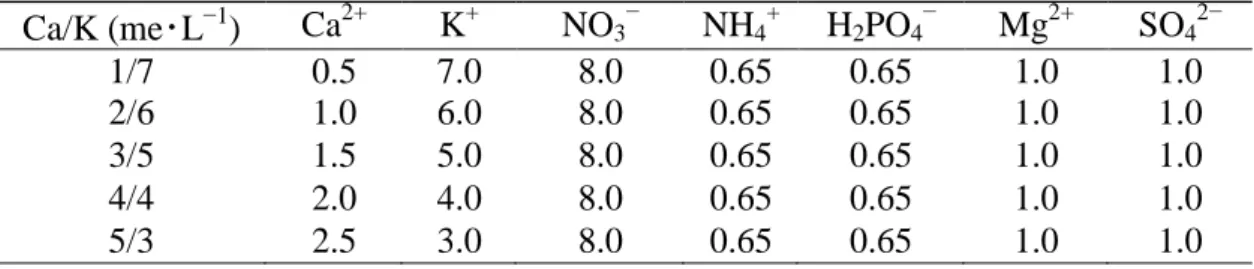
„Cindy Sweet‟ (Sakata Seed, Yokohama, Japan), that are characterized with different susceptibility to BER disorder, were examined. The seeds were sown on vermiculite moistened with water and then transplanted to rock wool cubes (75mm × 75 mm × 65 mm, Nitto Boseki Co. Ltd., Tokyo, Japan) when the third true leaf had emerged. Seedlings were fertigated daily with modified Hoagland solution (4/4 of Ca/potassium (K) in Table 1; Hoagland and Arnon, 1950) after germination. Treatments were applied to plants when their first flowers were visible. Tomato plants were hydroponically nourished on NFT troughs (1.8 m long and 0.3 m wide) with modified nutrient solutions containing 1/7 to 5/3
23
(me・L−1) of Ca/K by replacing Ca nitrate [Ca(NO3)2] and K nitrate (KNO3)appropriately (Table 1). Solutions with ratios ranging from 2/6 to 5/3 were applied in the experiments during spring 2013, summer 2013 and spring 2014 and Ca/K ratios of 1/7 to 4/4 were applied in autumn 2013 in order to develop the variation in BER incidence as affected by different levels of Ca nutrition (Table 2). Tap water containing 0.2 mmol・L−1 Ca and 0.1 mmol・L−1 magnesium (Mg) with EC value of 8–10 mS・m−1 was used for the preparation of the nutrient solution. The EC of the nutrient solution was in the range of 120-130 mS・
m−1.
Table 1. Nutrient composition used for experimental treatments (mmol・L−1).
Ca/K (me・L−1) Ca2+ K+ NO3− NH4+ H2PO4− Mg2+ SO42−
1/7 0.5 7.0 8.0 0.65 0.65 1.0 1.0
2/6 1.0 6.0 8.0 0.65 0.65 1.0 1.0
3/5 1.5 5.0 8.0 0.65 0.65 1.0 1.0
4/4 2.0 4.0 8.0 0.65 0.65 1.0 1.0
5/3 2.5 3.0 8.0 0.65 0.65 1.0 1.0
Net ion fluxes were determined via measurement of the rate of depletion in the solution as shown in the following equation:
A = [(Vo × Co) + (Va × Ca)] – (V1 × C1)
where Vo, V1 and Va are solution volumes and Co, C1 and Ca are concentrations of ions at the beginning and end of measurements and added during the measurement, respectively.
Root uptake of Ca and other minerals was determined weekly.
On each NFT trough, four plants of „Momotaro Fight‟ and eight of „Cindy Sweet‟ were placed 15 cm apart and trained alternately into two rows 50 cm apart. Each nutrient solution was circularly supplied from a small tank containing 6 L of nutrient solution (0.5 L per plant), which was automatically filled with the nutrient solution from a large tank via
24
a float switch. The nutrient solution was circulated for 15 min per h during the day (06:00–
18:00 h) and 15 min per 3 h at night (18:00–06:00 h) by a time switch. The sympodial shoot of each plant was pinched, leaving two leaves above the third truss.
Date of anthesis was recorded for all flowers on each truss of 12 plants in each experimental plot. A 15 mg・L−1 solution of 2-methyl-4-chlorophenoxyacetic acid (4-CPA) was sprayed to guarantee uniform fruit set period. Dates of visible BER symptom were recorded and the incidence of BER calculated as a percentage by dividing the number of BER-affected fruits by the total number of fruit on each truss of tomato plants in each plot.
The second fruit of each truss was sampled for Ca extraction at 14 and 18 days after anthesis for „Momotaro Fight‟ and „Cindy Sweet‟ in the four experiments, respectively. Ca in the distal part of fruit was sequentially extracted to water-, sodium chloride (NaCl)- and hydrochloric acid (HCl)-soluble Ca fractions that served as representatives for (1) apoplastic and cytoplasmic Ca2+, loosely wall-bound Ca; (2) Ca pectate in cell wall; and (3) insoluble Ca phosphate and Ca oxalate, respectively. The procedure for fractionated Ca extractions was done as described in Yoshida et al. (2014). Ca concentration was determined using atomic absorption spectrometry (SPCA-6210, Shimadzu, Kyoto, Japan) and described as µmol・g−1 FW. Microsoft Excel spreadsheets and the program R were used for data analysis.
3. 3. Results and Discussion 3.3.1. Results
3.3.1.1. Environmental factors and apparent nutrient absoprtion
Values of environmental factors, including temperature, solar radiation and day length, were averaged during the interval of treatment (from the anthesis of the first flower to the end of fruit sampling) in each experiment (Table 2). Mean temperatures were 24.2, 29.7,
25
21.4 and 22.2oC in spring, summer and autumn 2013 and spring 2014, respectively. On average, solar radiation was only lower in autumn 2013 compared to other seasons.
Table 2. Growing conditions and flowering of „Momotaro Fight‟ and „Cindy Sweet‟ in four experiments (February 2013 to June 2014).
Expt 1 Spring 2013
Expt 2 Summer 2013
Expt 3 Autumn 2013
Expt 4 Spring 2014
Sowing date 10 Feb 15 Apr 28 Aug 14 Mar
Planting date 12 Mar 6 May 13 Sep 1 Apr
Start of treatment 9 Apr 25 May 5 Oct 29 Apr
Range of Ca (me・L−1)z 2–5 2–5 1–4 2–5
1st truss
Momotaro Fight 14 Apr 30 May 9 Oct 5 May
Cindy Sweet 10 Apr 27 May 7 Oct 29 Apr
2nd truss
Momotaro Fight 23 Apr 6 Jun 20 Oct 11 May
Cindy Sweet 18 Apr 2 Jun 11 Oct 5 May
3rd truss
Momotaro Fight 3 May 12 Jun 29 Oct 19 May
Cindy Sweet 25 Apr 7 Jun 20 Oct 11 May
Air temperature (°C) 24.2 29.7 21.4 22.2
Solar radiation (MJ・m−2・ day−1)
13.0 11.2 5.3 12.2
Day length (h)y 13.6 14.2 12.1 13.7
z Concentration of Ca in supplied nutrient solutions, see Table 1.
y Sunrise to sunset in Okayama (National Astronomical Observatory of Japan)
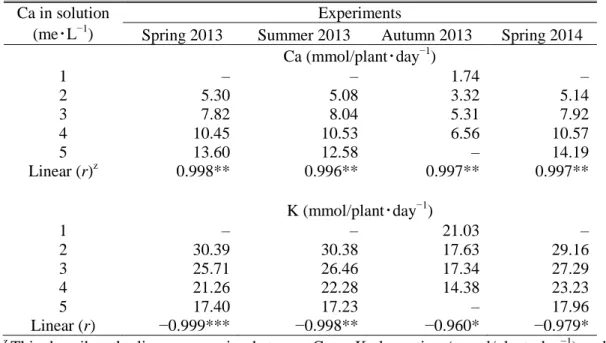
Plants of the two cultivars were grown under the same rhizosphere conditions to allow determination of the difference in susceptibility of fruits between cultivars. Similar to our previous report (Yoshida et al., 2014), increased Ca/K ratio in the nutrient solution significantly increased Ca absorption but decreased K absorption (Table 3). The varied Ca/K ratios in the nutrient solutions did not affect plant absorption of water and other major elements (data not shown). Among growing seasons, the differences in the
26
absorption of Ca and other elements were small except for autumn 2013 when the absorbed amount was ca. 60% of the other three seasons.
Table 3. Effect of Ca concentration (me・L−1) in the supplied solutions on apparent Ca and K absorption (mmol/plant・day−1) of tomato plants in the four experiments (February 2013 to June 2014). Values are means of each plot during the experiments.
Ca in solution Experiments
(me・L−1) Spring 2013 Summer 2013 Autumn 2013 Spring 2014 Ca (mmol/plant・day−1)
1 – – 1.74 –
2 5.30 5.08 3.32 5.14
3 7.82 8.04 5.31 7.92
4 10.45 10.53 6.56 10.57
5 13.60 12.58 – 14.19
Linear (r)z 0.998** 0.996** 0.997** 0.997**
K (mmol/plant・day−1)
1 – – 21.03 –
2 30.39 30.38 17.63 29.16
3 25.71 26.46 17.34 27.29
4 21.26 22.28 14.38 23.23
5 17.40 17.23 – 17.96
Linear (r) −0.999*** −0.998** −0.960* −0.979*
z This describes the linear regression between Ca or K absorption (mmol/plant・day−1) and Ca concentration in nutrient solution (mmol.L-1). *, **, *** indicate significance at P < 0.05, P <
0.01 and P < 0.001, respectively.
3.3.1.2. Plant and fruit growth
There was no difference in vegetative growth of tomato plants among the plots supplied with different solutions. Seasonally, the least vigorous growth was in autumn 2013 and the other experiments showed only small differences. The varied Ca/K ratios in the nutrient solution did not significantly affect flowering and rate of fruit growth within each cultivar (data not shown).