Studies on the Seasonal Migration and
Reproducton of the Spotted Mackerel,
Pneumatophorus tapeinocephalus (BLEEKER)
著者
TANOUE Toyotaka
journal or
publication title
鹿児島大学水産学部紀要=Memoirs of Faculty of
Fisheries Kagoshima University
volume
15
page range
91-175
別言語のタイトル
ゴマサバの回遊および繁殖に関する研究
Mem. Fac. Fish., Kagoshima Univ. Vol. 15, pp. 91— 175(1966).
Studies on the Seasonal Migration and Reproduction
of the Spotted Mackerel, Pneumatophorus
tapeinocephalus (Bleeker)
Toyotaka Tanoue*
Abstract
The studies on the ecology and the fishing condition of the spottedmackerelhave been made by
the writer in the coastal sea of Japan and the East China Sea since 1961.
In the following papers somedescriptions have been made of the migration of the fish, 4~450mm. in fork length, distributing in the sea areas mentioned above, the sex differentiation and growthof the gonads of the young fish, 5~300 mm. in fork length and the seasonal changes in the gonads of the adult fish caught in the southwestern seaof Kagoshima and its vicinity.
Contents Page Introduction 91 I. Migration 93 1. Methods of investigation 93 2. Geographical distribution 94 3. Vertical distribution 101
II. Spawning period and spawning ground 108
1. Methods of investigation 108
2. Results of larvae collection 109
3. Spawning period and conditions of spawning grounds 113 III. Sex differentiation and growth of gonads 116
1. Material and methods 116
2. Indifferent gonad 118
3. Ovary 119
4. Testis 122
5. Sex ratio and gonad length 125
IV. Seasonal variations in the gonads of adult fish • 126
1. Material and methods 126
2. Anatomical features of gonads 126
3. Histological features of ovaries 132
4. Histological features of testes 134
V. Discussion 135
VI. Summary 140
References 142
Introduction
The mackerels found swimming in the waters adjacent to Japan can be divided into two species, namely, the common Japanese mackerel, Pneumatophorus japonicus (Houttuyn),
and the spotted mackerel, Pneumatophorus tapeinocephalus (Bleeker). Hitherto the swim-* Laboratory of Fishing Gear and Technique, Faculty of Fisheries, Kagoshima University
ming areas of the former have been fixed as the Japan Sea, the Pacific coastal waters of
Tohoku district and the northern region of the East China Sea, while that of the latter, as
the coastal waters of Chiba Prefecture and the Pacific Ocean south of Chiba Prefecture.
As the spotted mackerel is one of the fishes important to the coastal fisheries in Japan,
numerous investigations on the ecology of this fish have been made until now by many
researchers.
According to the reports of Tanoue (1952, ,57),1),2) MORITA (1953,
554),3)'4) Tsujita (1954),5) Mori and Nishikawa (1955),6) Uda and Otsubo (1956),7)
and KANAMORI (1956),8) the distribution pattern of P. tapeinocephalus in the East China Sea shows a relationship to temperatures between 18.0^-24.0°C, formed when the
Kuro-shio current flowing northward along the continental slope is mixed with the cold water
coming from the Yellow Sea. TANOUE (1958),9) showed that schools of P. tapeinocephalus
migrated in the Tsushima warm current northward or northeastward from the southern regions of the East China Sea, following a gradual rise in the surface water temperature in the north sea during the spring. In summer they arrived at the eastern sea area off Saishu Island and off the San-in district.
Some observations were made on the seasonal changes in the gonads of P. tapeinocephalus
caught in the waters around the Osumi islands and the East China Sea by KOKUBU
(1954),10) Murakami (1954),u)Kokubu and Takahashi (1955),12) Tanoue (1956),13)
Enami (1958, '61)14)'15) and Tanoue, Kurata and Tokudome (1960).16) These authors
have clarified that the spawning begins in the southern part (30"^27°N. lat.) of the fishing
ground of the East China Sea at the end of January and continues to take place along the
continental shelf until May ; and that in the sea around the Osumi Islands it takes place
from the end of January to June. According to TATEISHI (1956),17) Tateishi, Ko and
MlZUE (1957),18) the ovaries of P. tapeinocephalus caught in the East China Sea in May
contain a large number of oocytes of nearly full size. In the ovaries of the fish caught in
June young oocytes and empty follicles are found.
Concerning the relation between the
distribution of the larvae of the spotted mackerel and the water temperature, YABE
(1957),19)Hotta (1957),20)Imai (1958)21, Uchida (1958),22) Tanoue (1960, '61)23)'24)
reported that in the East China Sea and the sea area around the Osumi Islands the larvae
were collected only at the waters where the temperature was higher than 17 C.
In spite
of numerous reports on the ecology of P. tapeinocephalus, only a little has been elucidated
as to the habits, migration and spawning of this fish. Moreover, on the ecology of this fish
in the Pacific Ocean no investigations have been done so far, except those of the present
author.
In order to clarify the seasonal migration and the spawning behavior of P. ta
peinocephalus the present author has made studies since 1961 on the sea conditions of
fishing grounds, the fork length composition in every fishing ground, and the distribution
of larvae. In addition to these, anatomical and histological observations were done by
him on the fish, 4^450mm. in fork length, in order to clarify the growth and differentia
tion as well as the seasonal change of their gonads.Before going further, the writer wishes to express his hearty gratitude to Prof. T.
KAWA-MURA, Faculty of Science, Hiroshima University, for his kind guidance in this study, and
Tanoue : Seasonal Migration and Reproduction of the Spotted Mackerel. 93
and Dr. M. NlSHIOKA of the same university for their support in carrying out the present work. He also is deeply grateful to Dr. T. MoRIWAKI, Suzugamine Womens Collage and to Dr. S. TATEISHI, Faculty of Fisheries, Nagasaki University for assistance on the his tological study, to Prof. T. Tanaka, Prof. T. Fujita, Prof. S. Imai, Prof. T. Morita, Assist. Prof. S. Enami, and Inst. N. HlGO, Faculty of Fisheries, Kagoshima University, for
their valuable aid in many ways. Furthermore thanks should be offered to Mr. T.
Hashi-GUCHI, Miyazaki Fisheries Exp. Station, Mr. Y. KURATA, Tokyo Fish. Exp. Station, Mr. T. HANADO, Chiba Fish. Exp. Station, Mr. S. YAMASAKI, Shimane Fish. Exp. Station,
Mr. T. NAKAHARA, Yamaguchi Fish. Exp. Station and Mr. S. Ueno, Kagoshima Fish.
Exp. Station for their kind help in collecting material, and to captain S. UEDA and the first officer T. Imai of the 'Kagoshima Maru', and to captain T. HENMI of the 'Keiten Maru', and to captain K. TAKAHASHI and the members of the 'Shiroyama Maru', the
training ships belonging to the Faculty of Fisheries, Kagoshima University, for their co
operations in the present study.
I. Migration 1. Methods of investigation
In order to clarify the seasonal migration of the spotted mackerel in the sea area adjacent to the sea of Japan, oceanographical observations have been carried out on the training ships of the Faculty of Fisheries Kagoshima University, 'Kagoshima Maru' (1037 gross
tons), 'Keiten Maru' (267 gross tons) and 'Shiroyama Maru' (18 gross tons) in the Pacific
Ocean off Shionomisaki and southward, the sea around the Osumi Islands and in the East
China sea since February, 1961. About 7000 specimens of the spotted mackerel were
Fig. 1. Dark pigment spots (dps) of the ventral portion and interneurai spnics^is; of
collected in Amami Oshima, Kagoshima, Aburatsu, Goto, Senzaki, Tosa-shimizu, Muroto,
Wakayama, Shizuoka, the Izu Islands, Tateyama and Katsu-ura. These specimens were identified as this species by the presence of one or both of the following two morphologi
cal characteristics : 1) dark pigment spots over the ventral portions and 2) more than 17
interneural spines (Fig. 1). Measurments were made on the fork length, body weight and
gonad weight.
As an instrument for the research of the swimming layer, the fish finder of Furuno
Electrical Co. Ltd. having 28 KC. frequency and equipped with a wet paper recording
system was used.
2.
Geographical distribution
The distribution of spotted mackerels, as shown in figure 2, covers the following sea areas:
the northern land shelf of Formosa, the East China Sea, the sea areas around the Osumi
Islands and Kyushu, the eastern sea area of Saishu Island, the sea area along the San-in
district, the Pacific Ocean area spreading along the shore from Chiba Prefecture to Shikoku and around the Izu Islands. Spotted mackerels are caught with the following kinds of
fishing tackle : a purse seine, a long line, a Hanezuri pole line and a lift net. The southern
limit of adults caught by a long line and a purse seine lies at the sea area near Kameyama
Island off Formosa (Chen, Lin and Sheu, 1959).25)
a. Fishing Season
i) Adult fish
The fishing season of each fishing ground is presented in figure 3.. In the eastern sea of
Formosa and in the sea area around the Uotsuri Islands, spotted mackerels appear late in autumn, remain there during winter and spring and then disappear. In the southern parts
of the East China Sea they are found swimming from the late autumn to the early summer of the next year in a wide range on the continental shelf between 30 and 26 N. lat. It is certain that spotted mackerels appear first in the northern part of this range, between 29° and 30° N. lat., early in October.
During the following three months, November to January, they are found everywhere
in the range of 27° 30'—28° 30'N. lat. and 123°~125°E. long.
While in February
they are still found in the southern end of this range, in March they begin to migrate
northward and in April they appear in the northern part, where they remain until the early June. About the middle of this month they usually begin to disappear from the northern part, and no fish are found at the end of this month. In the sea areas around the Osumi Islands and along the shore of Kagoshima district spotted mackerels are found swimming through the four seasons, although the catches in summer and winter are less than those in spring and autumn. In spring they appear in the northern sea area of Yaku
Island and in the area around Tane Island. Early in summer they approach the coast near Sata Cape* In midsummer they are caught in the deep layer of the northern sea area
of Yaku Island and on the bank situated west of Kuchino-erabu Island. In autumn and
125 1. Northern sea off formosa 2. Sea area around Uotsuri Isl. 3. East China Sea 4. Inshore sea of Amami Oshima 5. Sea around Osumi Isls. 6. Southern sea olf Goto Isls. 7. Eastern sea off Saishu Isl. 125' 130 130 135 135 140 a off Ashizuri Cape shore sea of Wakayama Prefect, a area around Izu Isls. tern sea off Chiba Prefect, off San-in districts 140 Fig. 2-1. Geographical features of spotted mackerel fishing grounds. ^^^ : Juvenile mackerel fishing ground HH& . Adult mackerel fishing ground > 2! O c. a. c CO •a o
1. Westward of Gaja Island 3. Sea off Miyanoura 5. South of Mage Island 7. North of Tane Island 9. Westward of Mt. Kaimon
11. Kagoshima Bay and westward of Sata Cape
129°
130"
131"
132
Fig. 2-2. Geographical features of spotted mackerel fishing grounds in the sea around
Kagoshima Prefecture.
2. Sea off Kumano 4. North of Yaku Island 6. Umekichi Bank 8. Sea around the Uji Isls. 10. South of the Koshiki Isls.
Izu Islands Saishu Island Goto Islands Ashizuri Cape Osumi Islands E. China Sea Formosa ^WWtTt/ZJi i i i i i i t2z3ffBS Jan.Feb.Mar.Apr.May Jun.Jul.Aug.Sep.Oct.Nov.Dec.
Fig. 3. Fishing season in every fishing ground
• H : Chief fishing period
Tanoue : Seasonal Migration and Reproduction of the Spotted Mackerel. 97
Umekichi Bank. In June and July they are in the southern sea area of the Goto Islands and in the waters around the Danjo Islands. In July, they are found swimming in the eastern sea area of Saishu Island, staying there until October. In the late October, they begin to disappear from that area ; no fish remain in the late November. On the other hand, in the Pacific Ocean area along the coast of Shikoku, spotted mackerels are caught during the term from April to August; they are done with a Hanezuri pole line and a long line in the sea area off Ashizuri Cape and with a Hanezuri pole line in the area off Muroto
Cape. From the middle of June to the beginning of August the catches are especially rich
there. In the sea around the Izu Islands, they are found through the four seasons. In autumn and winter they are caught in the waters off Miyake Island and Hachijo Island,
while in spring and summer they are found in a wide sea area spreading from Oshima
Island to Kozu Island.
ii) Young fish
One of the habits most characteristic of spotted mackerels is that they are apt to associate in a dense school. Very young fiish which are 30^60 mm. in fork length aggregate in schools and swim along the shore of Amami Island early in March. They are found in the coastal waters of Kagoshima in the mid-March ; they are caught with a dip net. Young fish are often caught in waters very close to a shore line ; occasionally, even inside of
harbours. Early in summer, young fish, 100~~200 mm. in fork length, appear around Kyushu and in the Pacific Ocean areas along Shikoku, Wakayama, Izu and Chiba. They
seem to stay there until December or somewhat later. Throughout all the winter season they are caught in the coastal waters of southern Kyushu and in the East China Sea.
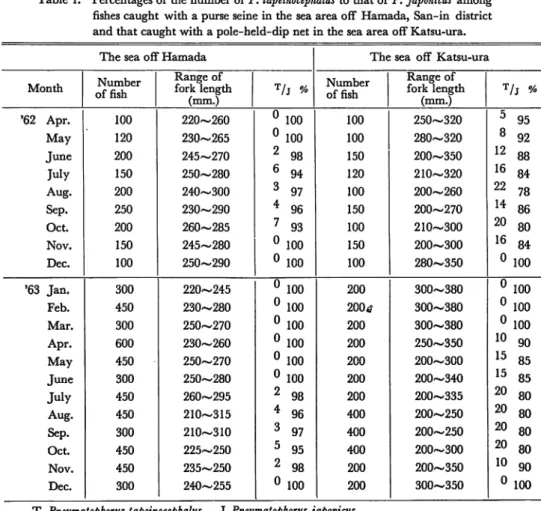
In the sea areas off San-in district and Chiba Prefecture, two Kinds of young mackerels, P. japonicus and P. tapeinocephalus are caught with a fishing net. The numerical ratios of P. tapeinocephalus to P. japonicus in the catches which were caught with a purse seine in the sea area off San-in district and with a pole-held-dip-net in the waters off Chiba Prefecture in 1962 and 1963 are presented in table I. The ratio in the sea area off San-in district is about 5 : 95 from July to November, while about 20 : 80 in the waters off Chiba Pre
fecture in spring, summer and autumn.
b. Age composition of the fish in each fishing ground
The fork lengths of spotted mackerels caught in each fishing ground are shown with
histograms in figure 4. Accordingto previouspapers of the present author (1955, '56) ''
and those of TAKESHITA and MlO (1958)28) and TAKANO (1961),29) the age of spotted
mackerels can be presumed from their fork lengths, as shown in table 2.In the southern area of the East China Sea from autumn to spring most fish are com
posed of 1-year-old fish; a small number of them are of 2-year-old ones. Late in
autumn some young fish born this year make their appearance. In spring in the sea area around Kagoshima and the Osumi Islands the fish are mostly 1 or 2 years old; there are a small number of 3-or 4-year old fish among them. During the months from summer to
winter in the same area spotted mackerels are mostly 1 year old and a small number of
Table 1. Percentages of the number of P. tapeinocephalus to that of P. japonicus among
fishes caught with a purse seine in the sea area off Hamada, San-in district
and that caught with a pole-held-dip net in the sea area off Katsu-ura.
The sea off Hamada The' sea off Katsu-urgi
Month Number offish Range of fork length (mm.) T/j % Number offish Range of fork length (mm.) t/j % '62 Apr. 100 220-260 0 100 100 250-320 5 95 May 120 230-265 0 100 100 280-320 8 92 June 200 245-270 2 98 150 200-350 12 88 July 150 250-280 6 94 120 210-320 16 84 Aug. 200 240-300 3 97 100 200-260 22 78 Sep. 250 230-290 4 96 150 200-270 14 86 Oct. 200 260-285 7 93 100 210-300 20 80 Nov. 150 245-280 0 100 150 200-300 16 84 Dec. 100 250-290 0 100 100 280-350 0 100 '63 Jan. 300 220-245 0 100 200 300-380 0 100 Feb. 450 230-280 0 100 200tf 300-380 0 100 Mar. 300 250-270 0 100 200 300-380 0 100 Apr. 600 230-260 0 100 200 250—350 10 90 May 450 250—270 0 100 200 200-300 15 85 June 300 250-280 0 100 200 200-340 15 85 July 450 260-295 2 98 200 200-335 2° 80 Aug. 450 210-315 4 96 400 200-250 20 80 Sep. 300 210-310 3 97 400 200-250 2° 80 Oct. 450 225-250 5 95 400 200-300 20 80 Nov. 450 235-250 2 98 200 200-350 10 90 Dec. 300 240—255 0 100 200 300-350 0 100
T, Pneumatophorus tapeinocephalus J, Pneumatophorus japonicus
Table 2. Ranges in fork length of P. tapeinocephalus in each age group.
Age Range of fork length (mm.) 1 2 3 4 281-350 351-400 401-428
429-Tanoue : Seasonal Migration and Reproduction of the Spotted Mackerel.
100
20 22 24 26 28 30 32 34 36 38
Fork length (cm)
1 . East China Sea
1 60 3 20 100,- °
60-2°LbLl
10 12 14 16 18 20 22 24 26 28 30 32 34 36 38 40 42 44 10 12 14 16 18 20 22 24 26 28 30 32 34 36 38Fork length (en)
2. Osumi Islands 28 30 32 34 36 38 40 42 Fork length (cm) 3. Goto Islands 10 12 14 16 18 20 22 24 26 Fork length (cm) 6 . Wakayama 60 20 20 22 24 26 28 Fork length (cm) 4 . San-in district 99
Z 20
Lk
12 14 16 18 « 60 s 5 20 20 22 24 26 28 Fork length (cm) 1 Izu Islands h 60 a 3 20 12 14 16 18 20 22 24 Fork length (cm) 8. Chiba 26 38 40 12 14 16 18 20 22 Fork length (cm) 9. Suruga Bay 24 26Fig. 4. Histograms showing the fork length composition of spotted mackerels in every fishing ground.
1. East China Sea
a. Oct.,'64; number of individuals, 194; Purse seine b. Mar., '63; number of individuals, 420; Pole and line 2. Sea around the Osumi Islands
c. Apr.,'63; number of individuals, 225; Four-boats lift net d. Nov., '63; number of individuals, 275; Purse seine
e. Apr., '63; number of individuals, 560; Long line
f. May. '64; number of individuals, 180; Four-boats lift net g. Oct.,'64; number of individuals, 124; Purse seine h. Nov., '64; number of individuals, 80; Pole and line
i. July,'64; number of individuals, 204; Long line j. Dec,'64; number of individuals, 160; Long line 3. Southern sea of the Goto Islands
k. June,'62; number of individuals, 220; Pole and line
4. Sea off San-in districts
1. June, '63 ; number of individuals, 295; Purse seine 5. Sea off Ashizuri Cape
m. May,'63; number of individuals, 132; Four-boats lift net n. July,'63; number of individuals, 127 ; Four-boats lift net o. July,'63; number of individuals, 346; Pole and line 6. Inshore sea of Wakayama
p. May,'62; number of individuals, 144; Stick held dip net q. Aug.,'62; number of individuals, 130; Stick held dip net r. Oct.,'62; number of individuals, 100; Stick held dip net
7. Sea area around the Izu Islands
s. June,'62; number of individuals, 132; Stick held dip net t. Oct.,'62; number of individuals, 210; Stick held dip net u. May, '62; number of individuals, 350; Stick held dip net 8. Eastern sea off Chiba
v. July,'62; number of individuals, 156; Stick held dip net w. Sep.,'63; number of individuals, 150; Stick held clip net 9. Suruga Bay
Tanoue : Seasonal Migration and Reproduction of the Spotted Mackerel. 101
until winter. In the sea area around the Goto Islands, the fish found in June and July are
mostly 1 year old. There are also a small number of 2-year-old fish and a few
3-year-old ones. From summer to autumn some young fish born this year appear. From summer to autumn young fish born this year are found swimming in the sea area off San-in district. Off Ashizuri Cape from late spring to summer most fish are composed of 1-year-old fish ; a small number of them are of 2-year-old fish and a few 3-year-old fish. From spring to late autumn young fish born this year are found. In the inshore sea of Wakayama Prefecture from spring to autumn all the spotted mackerels are those born this year. In spring, in the sea area around the Izu Islands the fish are mostly 1 year old ; there are a
small number of 2-year-old ones among them. From summer to late autumn young fish
born this year are found swimming in the same area. In the eastern sea off Chiba Pre
fecture spotted mackerels are mostly composed of new born fish ; a few of them are 1
year old.
As the conclusion of the results obtained through the above mentioned investigations, the geographical distribution of spotted mackerels of each age can be summarized as fol lows ; new born fish appear in spring both in the sea area around Kyushu, in the Pacific Ocean along Shikoku district, Wakayama Prefecture, Shizuoka Prefecture and Chiba Pre
fecture and Chiba Prefecture and around the Izu Islands, and stay there until autumn.
From late autumn to winter they are found in the inshore sea area off Kyushu and in the
East China Sea. From winter to spring 1-year-old fish appear in the southern East China Sea, the Osumi Islands and the Izu Islands. From summer to early autumn they are
found in the eastern sea area off Saishu Island, in the sea area around the Osumi Islands
and the Izu Islands and in the sea area off Ashizuri Cape ; late in autumn they are found
around the Osumi Islands, in the southern East China Sea and around the Izu Islands.
2-year-old fish are swimming from winter to spring in the southern East China Sea,
around the Osumi Islands and the Izu Islands. In summer they are found in the sea areas
around the Osumi Islands, south of the Goto Islands, east of Saishu Island, off Ashizuri
Cape and around the Izu Islands. 3-year-old fish and those of somewhat older age are found swimming around the Osumi Islands from spring to early summer ; a few of them
are found in the sea areas south of the Goto Islands, off Ashizuri Cape and around the
Izu Islands.
3. Vertical distribution a. Seasonal change
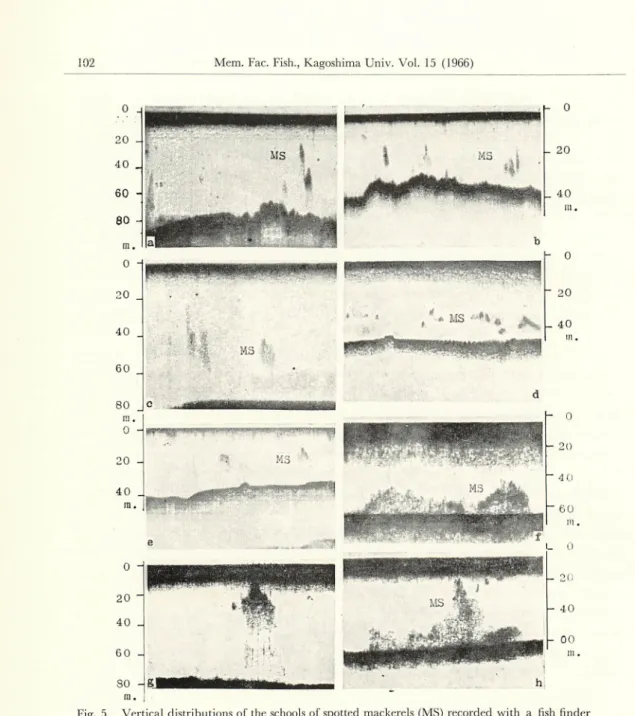
The vertical distribution of spotted mackerel schools in each fishing ground was explored with a fish finder attached to a training or fishing ship. It was also determined by measur
ing the depth of the hooks of a long line through the catenary counting equation
(YOSHI-HARA, 1954)30) and the length of the line of a line and hook.
The vertical distributions recorded with a fish finder in the sea area around Kagoshima district and the Osumi Islands in different months are shown in figure 5 and table 3. The vertical distributions found with a pole and line, a long line and a trawl net in different months were as follows. In the sea area, 90^110 m. in depth, lying in the north of Yaku
20
40
60
SO
ra.
iiii iiimi mfiiiii iTiffTDiwimirnrw WBSBMBMHffiSRUffiSBM
4000
111.
Fig. 5. Vertical distributions of the schools of spotted mackerels (MS) recorded with a fish finder
at daytime in the sea area around the Osumi Islands and the sea off Mt. Kaimon in differ
ent months.
a. The vertical distributional range recorded on the 8 th April, 1962, showing the schools distributed in the layer between 20m. and 70m. in depth, in the sea area of 80~90m. in depth, in the north of Tane Island. These schools were composed of fish which were 360
~420mm. in fork length.
b. The vertical distributional range recorded on the 15th June, 1964, showing the schools distributed in the layer between 12m. and 25 m. in depth, in the sea area of 30~40m. in
depth, in the south of Mage Island. These schools were composed of fish which were 300
—380 mm. in fork length.
c. The vertical distributional range recorded on the 18 th October, 1963, showing the schools distributed in the layer between 40m. and 60m. in depth, in the sea area of 80m. in depth, in the north of Yaku Island. These schools were composed of fish which were
Tanoue : Seasonal Migration and Reproduction of the Spotted Mackerel. 103
300—360 mm. in fork length.
d. The vertical distributional range recorded on the 28th June, 1964, showing the schools distributed in the layer between 30m. and 45m. in depth, in the sea area of 50m. in depth,
in the west of Sata Cape. These schools were composed of fish which were 340—430 mm.
in fork length.
e. The vertical distributional range recorded on the 12th September, 1963, showing the
schools distributed in the layer between 18m. and 25m. in depth, in the sea area of 45 m. in depth, in the west of Mt. Kaimon. These schools were composed of fish which were 200—
260mm. in fork length.
f. The vertical distributional range recorded on the 20th December, 1964, showing the
schools distributed in the layer between 45m. and 60m. in depth, in the sea area of 60m. in depth, in the west of Mt. Kaimon. These schools were composed of fish which were 240—
300mm. in fork length.
g. The vertical distribution of the schools recorded with a fish-finder in the sea area near Mage Island at a. m. zero o'clock in May 10th, 1964. The distributional range was situated between 20m. and the 40m. in depth. These schools were composed of fish which were 300
—400mm. in fork length,
h. The vertical distribution of the schools recorded at the sea area westward of Mt. Kaimon at p.m. ten o'clock in October 20th, 1963. The distribution range was situated between 15m.
in depth and the bottom. These schools were composed of fish which were 220—290mm. in
fork length.
Island, schools of spotted mackerels, 300^360 mm. in fork length, were caught in Sep
tember, 1962-^1964, with a pole and line in the layer between 80m. and 90m. in depth.
In the same season on the sea bank situated west of Gaja Island, schools of spotted mack
erels, 340~370mm. in fork length, were caught with a bottom long line in the layer bet
ween 80m. and 90m. in depth. In the sea area off Kumano at the east side of Tane Island,
schools of fish, 330^-400mm. in fork length, are caught with a long line in March and
April every year. These schools are distributed in the layer between 50m. and 80m. in
depth. At 28°N. lat. 124 E. long, in the East China Sea, schools of fish, 260~330mm.
in fork length, were caught with a trawl net near the bottom in June and August, 1963
and 1964. In the sea area 100~~150m. in depth, lying in the west of Ashizuri Cape,
schools of fish, 320^-390mm. in fork length, are caught from May to July every year
with a long line. These schools are distributed in the layer between 40m. and 60m. in
depth.Table 3. Vertical area in which spotted mackerels were recorded with a fish finder
or caught with a long-line, at day time in each fishing ground.
Fishing ground DePth of
water (m.) Fishing season
Number of times Vertical area (m.) Fork length (mm.)
North of Tane Island 80-110 Mar.—April 26 40-70 340—425
North of Yaku Island 85—115 April—May Oct. —Nov. 25 10 28-45 40-65 295-400 325-380
South of Mage Island 25-60 May —June 20 20-40 320-415 West of Mt. Kaimon 50-75 Sept. —Oct.
8
j 45—60
250—30030-50.7 N 131-09'. 5 E / \ ^ - 50 11 \ ^ 6 vo 1 / " ^ ^ / / 4 / / / / Q. / / (U / • a / i • 100-30~-55.0 N 131-12C5 E
Fig. 6-a."^ Fishing ground north of Tane Island
a* Q> 0 30e-37'.7 N 130-43'. 7 E 150-48'. 5 E30-39'. 6 N 1 1 1 j ^ ^ .•.r^ 24.0 " . 10 ^ - ^
^
^V0
^^^
..-34.5 " ^-—'
25•;-»•* ^/•••••
50Tanoue : Seasonal Migration and Reproduction of the Spotted MackereL
30-28.0 N
130-29'. 8 E 130-30:7 S305*5U K
Fig. 6-c. Fishing ground north of Yaku Island
30-27.0 N
130-36'. 0 E
30-r29.5 N
130-35'. 5 E
Fig. 6-d. Fishing ground north of Miyanoura
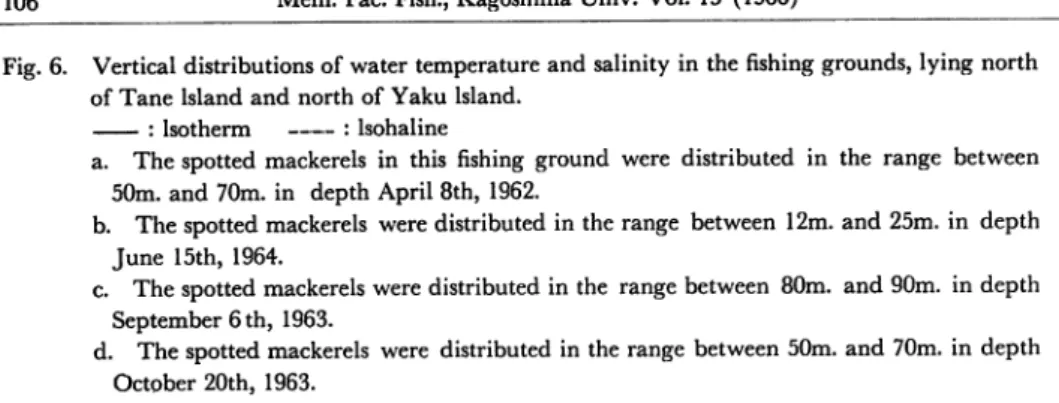
Fig. 6. Vertical distributions of water temperature and salinity in the fishing grounds, lying north
of Tane Island and north of Yaku Island.
: Isotherm : lsohaline
a. The spotted mackerels in this fishing ground were distributed in the range between
50m. and 70m. in depth April 8th, 1962.
b. The spottedmackerels weredistributed in the range between 12m. and 25m. in depth June 15th, 1964.
c. The spotted mackerels were distributed in the range between 80m. and 90m. in depth September 6 th, 1963.
d. The spotted mackerels were distributed in the range between 50m. and 70m. in depth
October 20th, 1963.
The vertical distribution of young fish, 100^150mm. in fork length, seems to be near
the sea surface, as they are nearly always found swimming in the regions where the water
is about 5 meters deep.
Judging from the above mentioned results, in spring the range of vertical distribution
of the adult fish is situated in the layer between 40m. and 70m. in depth, and from late
spring to early summer the schools are distributed in the layer between 20m. and 40m. in
depth. In summer some schools are distributed near bottom, about 80^90m. in depth.
From autumn to winter the schools are found in the layer between 50m. and 60m. in
depth.
The vertical distribution of schools of spotted mackerels at night was recorded with a fish finder. It is shown in figure 5. In spring the vertical distribution found with a pole
and line in the fishing ground, north of Yaku Island is in the layer between the surface and 30m. in depth ; in autumn it is between 10m. and 45m. in depth. Besides this, in the seas
areas north of Tane Island and off Sata Cape, schools of spotted mackerels are distributed
at night in spring in the layer between the surface and 30m. in depth.
b. Water temperature and salinity
The vertical shifting of water temperature and salinity in the fishing grounds north of Tane Island, south of Mage Island, north of Yaku Island and off Miyanoura is shown in
figure 6. The ranges of watertemperature and salinity in the vertical area where schools of
spotted mackerels were recorded with a fish finder or found with a pole and line in each
fishing ground are presented in table 4. In the waters north of Tane Island the lowest Table 4. Ranges in water temperature and salinity in the vertical area where spotted
mackerels were recorded with a fish finder or caught with a pole and line
in each fishing ground.
Fishing ground Number of times Vertical area
(m.)
Water temp. (°c)
Salinity (%)
North of Tane Island North of Yaku Island
South of Mage Island The sea off Miyanoura
15 30 20 6 50-70 30-70 20—40 30-60 17—20 20-23 22—25 23-25 34. 5-34.8 34.4-34. 7 34. 6-34.8 34.4-34.7
Tanoue : Seasonal Migration and Reproduction of the Spotted Mackerel. 27-28'0 N 2^-42'.0 N ^ 124-51'. 0 E 12£-00'.0 E 10 25
__ 17.o-^
l^ / o |' I' o A / i y • c\j *s 50" J \
/ o8
^..-34.1 •"
atf
\
...-'
' r\ -'V*.^•8 "'
S 75 ,-' o. ,*\'" \ „-";. M.9
-Q /V\
100 \ \\\ '•
'"- X.g...
150 i \ ^ L \ \ \ \ \ \ \ \ • \ \ 1 • \ \' *•*..
200 \i / 1
/
Fig. 7-a. Fishing ground of East China Sea
28-32.0 H
124-52'. 0 E
28-00.0 N 126-33'. 0 E
Fig. 7-b. Fishing ground of East China Sea
?
J3
-p
28°-40'.0 N
124-00'. 0 E 29-24.0 M
Fig. 7-c. Fishing ground of East China Sea
Fig. 7. Vertical distributions of water temperature and salinity in the fishing grounds lying south of the East China Sea.
: Isotherm : Isohaline
a. The spotted mackerels were distributed in the range between 25m. in depth and the
bottom, and caught by a pole line in February., 1961.
b. The spotted mackerels were distributed in the range near the bottom in July, 1961. c. The spotted mackerels were distributed in the range near the bottom in June, 1964.
water temperature was 17°C in the beginning of April. The range in water temperature in the other three fishing grounds was from 20 to 25°C, the deviation being small. The
range in salinity in each of the four fishing grounds was from 34.4 to 34.8 %o. The verti cal distribution of water temperature and salinity in the southern fishing ground of the East China Sea and the waters off Ashizuri Cape is shown in figures 7 and 8, respectively. The ranges of water temperature in these two fishing grounds were from 17 to 23°C, and
from 17 to 19°C, respectively. The ranges of salinity were 34.0~34.6 %o and 34.5~
34.6 %o, respectively.
Judging from these results, it is clear that the spotted mackerels are distributed in the area where the water temperature is 17~25°C, and the salinity 34.0~34.8 %<?.
II. Spawning period and spawning ground 1. Methods of investigation
Tanoue : Seasonal Migration and Reproduction of the Spotted Mackerel. 32-34'.0 N 132-55'. 0 E ^ 50 100 -32-40.0 N 132-52'.0 K 109
Fig. 8. Vertical distributions of water temperature and salinity in the fishing ground off Ashizuri
in May, 1962.
: Isotherm : Isohaline
The spotted mackerels in this ground were distributed in the layer between 40m. and 80m. in depth. The schools were composed offish which were 300—410mm. in fork length.
author assumed the spawning period and spawning ground on the basis of the appearance period and distribution range of larvae, correlating these with the area where adult fish were caught. Two types of larvae nets were used for the purpose of collecting larvae smaller than 25mm. in total length. One was 1.5m. in diameter and 3.5m. in length (the cod-end was lm. in length and composed of a silk netting No. 54 GG). This 1.5m. net was hauled in the surface layer. The other was 1.0m. in diameter and 2.8m. in length
(the cod-end was 0.8m. in length and composed of the same kind of silk netting). This
1.0m. net was hauled in the middle layers, 10m., 20m., 30m., 40m. and 50m. in depth. When hauling, the larvae nets were used in the combination of 2 or 3 sets ; the middle layer net being submerged with a 21kg. depressor. Nets were hauled for 20 minutes at a speed of 2~2.5 knots. The depth of a sunken net was measured with a depth counter, type A-295 made by Tsurumi Seiki Machine Manufacturing Factory or with the equation related to the rope length hauling the net and the angle of the rope line to the horizontal
line (Tanoue, 1960).23)
The larvae which were more than 25mm. in total length were caught with a seine or a dip net. They were also collected even from the stomachs of skipjacks, Katsuwonus pelamis.
2. Results of larva collecttion
Results of collecting larvae are presented in table 5 ; the hauling and collecting points
are shown in figure 9. In the sea near Kagoshima collection of larvae was possible from the
middle of February to late inJune. They were collected from every layer between surface
and 40m. in depth, while they were not found at the depth of 50m. In February and
March, almost the same number of larvae was caught at each of the surface and the depths
of 10m. and 20m. But from April to June the number of larvae caught at the depths of
10m. and 20m. was bigger than that of larvae caught at the surface. The distribution of
the total lengths of these larvae is shown in figure 10 ; the total lengths was between 4.6~
25mm. More than 85% of them were those with total lengths of less than 15mm., while
those with total lengths of more than 20mm. were very few. Almost no difference was
Fig. 9. Sea areas (circlets) where a larva net was towed and the areas (black spots) where
larvae were collected.
found among the total lengths of larvae caught at different depths.
In the sea areas lying from Kagoshima to Shionomisaki a larva net was hauled early in
March, 1962. In the sea area between Tane Island and Aburatsu, larvae with total lengths
of 6.0~~11.0mm. were collected at the surface and the depth of 10m. No larvae were
collected in the sea north of Aburatsu. In May, 1961, in the sea off Aburatsu and Ashizuri and in Tosa bay a larva net was hauled at the depths of 10m. and 20m., and
larvae with the total lengths of 6~~20mm. were collected, the largest number being at
the 20m. depth. In the southern East China Sea, larvae with the total lengths of 4.8~ 20mm. were collected both at the surface and the 20m. depth ; the number of larvae
Tanoue : Seasonal Migration and Reproduction of the Spotted Mackerel.
Table 5. Results of larva collections and the ranges in water temperature in the sea
area where larvae were collected, during the months from February to June,
1961~1964.
a. The coastal sea of Kagoshima Prefecture
Ill
N'umber of individuals Range of total
length (mm.) c f 10m. 30m. 20 m. 40 m. Water Depth Surf. 10 m. 20 m. 30 m. 40 m. 50 m. temp. (°c) Feb. Total Times Means 98 30 3.3 85 30 2.8 30 30 2.0 32 20 1.6 9 20 0.5 0 15 0 4.8 5.0 5.0 12.0 12.0 12.0 17.0 19. 1 Mar. Total Times Means 116 45 2.9 223 40 5.6 67 30 2. 1 39 30 1.3 17 30 0.6 0 20 ° 5.0 4.8 5. 5 16.0 17.0 10.5 16.8 20.4 Apr. Total Times Means 44 32 1.4 67 32 2. 1 59 30 1. 1 28 25 1. 1 5 25 0.2 0 18 0 6.0 5. 2 6.0 11.0 15.4 13.0 18.6 21.6 May Total Times Means 30 35 0.8 81 35 2.3 102 35 2.9 23 30 0.8 8 30 0.2 0 15 0 5. 6 4. 8 6. 2 16.4 20.2 18.0 19.6 23.6 June Total Times Means 18 25 0.7 50 25 2.0 61 25 2.4 33 25 1.3 4 20 0.2 0 20 0 6. 2 6. 0 5. 0 12.0 12.0 11.5 21.0 24.0
b. The sea off Ashizur Cape
N'umber of individuals Range o
Surf. f total lcn 10 m. gth (mm.) 20 m. Water temp. Depth Surf. 10m. 20 m. (°c) May Total Times Means 11 8 1.4 20 8 2.5 26 8 3.2 4.3 16.7 6.0 13.5 6.0 12.0 19.4 21. 1
c. The East China Sea (N. lat. 28-29% E. long. 124~127°)
Number of individuals Range of total
Surf. length (mm.) 10m. Water temp. Depth Surf. !0m. (°c) May Total 12 94 Times 7 7 Means 1.7 13.4 4.8 17.0 6.0 20.0 17.0 22.3 June Total 23 15 Times 9 9 Means 2.6 1.7 4.8 20.0 6.0 18.0 20.0 23.0
Total : total number of larvae
Times : number of times of collections performed Means : average number of larvae per one collection
Fig. 11. 200 180 160 140 j 120 •H 4-1 •h ioo O 80 u i 60 3 Z 40 . 20 1 6 11 16 21 S 5 i I S 5 10 15 20 25 Total length (mm} Fig. 10. Histogram represents the distribu
tion of lengths of the larvae collected with a larva net.
18 19 20 21 22 Water temperature ( °C) 23 24 40 -/-"~°\ 30 _ -p o 3 20 o o U \ alio o i 1 1 i Nj 34.00 34.20 34.40 34.60 s s s S 34.19 34.39 34.59 34.79 34.80 33.00 5 34.99 35.19 Salinity (%)
Tanoue : Seasonal Migration and Reproduction fo the Spotted Mackerel. 113
collected at the 20m. depth was bigger than that at the surface. In the sea area around
the Tokara Islands, schools of larvae with the total lengths of 30~60mm. were collected
with a dip net during the period from early in March to April. These schools were found
in shallow water near seashores. In the same season they were found around Amami Island.
In the bay of Shibushi, larvae with the total lengths of 30~40mm. were caught with a
seine net in March and April. In the coastal sea of Aki, Kochi Prefecture, larvae with
the total lengths of 20~30mm. were caught with a seine net early in April. On the other
hand, a larger number of larvae with the total lengths of 15~40mm. were collected from
the stomachs of some skipjacks, Katsuwonus pelamis, caught in the sea area lying from the
west of the Okinawa Islands to the Tokara Islands in March and June.
The ranges of water temperature and salinity in the coastal sea of Kagoshima, where
larvae were collected, are shown in figure 11. The water temperature range was within
16~24°C and the salinity range 34.2'^34.9 %o the monthly difference in salinity being
small.The relationship between water temperatures and the percentages of the largest catches
of larvae in each of five months from February to June is shown in figure 12. The majority
of larvae were collected at the water temperature higher than 17°C, though in February
and March they were collected at such a low temperature as 16°C. A large number of larvae were collected at the water temperature 18~20°C in April and at 21~23°C in
May and June. In the East China Sea and the sea off Ashizuri Cape, larvae were collected
at 16^23°C and 20~21°C, respectively.
50 •5^C^ Junelllll^f
50 May 50.^S^Ife*
Apr. 50~^«Sv^M^*
Mar. 50 &Sv^\\vvmWvtf i i Feb. • i i 16 17 18 19 20 21 22 23 24 Water temperature (°c)3. Spawning period and conditions of spawning grounds
Judging from the location where adult fishes were caught and the area where larvae were
found, the geographical distribution of spawning grounds of spotted mackerels is con
sidered to be as shown in figure 13. The spawning begins to occur in the northern sea area
of Formosa, the sea around Uotsuri Island and the sea area of the continental shelf spread
ing between N. lat. 26" and 29°, from January to March. Afterwards, the spawning
ground moves gradually to the northern sea area ; spawning takes place in the sea area
spreading from N. lat. 28° to N. lat. 30", from May to June. The spawning ground is
70~100m. in depth of water. In the coastal sea area of Kagoshima Prefecture, schools of adult fish are found in the north of Yaku Island, on the bank lying west of Yaku Island and in the southern sea off Tane Island, from January to March. Therefore, it is assumed
that spawning begins in these sea areas. In March large fish appear in the north of Tane
Island and spawning takes place. From May to June, schools of adult fish stay and their
spawning takes place in the waters near shores in the west and south of Mage Island, west
of Sata Cape, around the Uji Islands and south of the Koshiki Islands. The spawning
grounds of the Uji and Koshiki Islands are 80~100m. in depth, while those of Mage
Island and Sata Cape are 40m. in depth.
130 140 141
Fig. 13. Geographical features of the spotted mackerel spawning grounds.
As shown in figure 14, these spawning grounds are confined to the sea area where a
Tanoue : Seasonal Migration and Reproduction of the Spotted Mackerel. Current-velocity (Kt.) 0 . 2 0.4 0.6 0 . 8 1 . 0 1.2 1 . 4 E •P P. « P 3 0 - 3 6 . 0 N 130-07'. 0 E 100 -150
Fig. 14. Vertical distributions of the
current velocities in three fish
ing grounds situated north of
Yaku Island (2, 4), south oi
Mage Island (1,3) and west of Sata Cape (5).
2 : April, '63 1 and 5: May, '63 3 and 4 : June, '63
3 0 - 4 4 . 0 N
130-0010 E
Fig. 15.-a. Umekichi Bank
30-28.0 N
130-29'.8 £ 130-30'. 6 E
Fig. 15.-b. North of Yaku Island
Fig. 15. Vertical distributions of water temperature and salinity in February 20 th, 1963, in the
sea area on the Umekichi Bank and those in March 3rd, 1963, in the fishing ground
situated north of Yaku Island. : Isotherm : lsohaline a. Umekichi Bank
Spotted mackerels are distributed in the range between 30m. and. 70m. in depth.
b. North of Yaku Island
Spotted mackerels are distributed in the range between 25m. and 50m. in depth.
In the sea area off Ashizuri at the Pacific Ocean side of Kochi Prefecture, the spawning period is assumed to be from February to June, according to the time of appearance of both
adults and larvae. The spawning ground is located mainly at a depth of about 100m. The sea area off Muroto may be another spawning ground.
From the data in figures 6, to 8 the ranges of water temperature and salinity in the
spawning areas as follows ; Fishing ground
The East China Sea
The sea around Tane Isl. and Yaku Isl.
The sea off Ashizuri Cape
Water temperature Salinity
(°c) (%0
17~23 34.0~34.6
17~23 34.4~34.8
17~19 34.2~34.6
The records of water temperature and salinity of Umekichi Bank in the west of Yaku Island where large fish are abundantly found in February and those of the fishing grounds in the sea around Yaku Island in March are shown in figure 15. In these fishing grounds,
Tanoue : Seasonal Migration and Reproduction of the Spotted Mackerel. 117 the water temperature and salinity of the sea area shallower than 100m. were 17~21°C,
34.5—34.8 %o, respectively.
According to the above observations, it is presumed that the spawning of spotted mack
erels takes place in the sea area where the water temperature is 17~23°C and the salinity is 34.0—34.8%..
III. Sex differentiation and growth of gonads
1. Material and methods
For the purpose to examine the sex differentiation and growth of the gonads of spotted mackerels, histological observations were made by the use of fish which were more than 5mm. in total length. These fish were collected with a larva net, a stick-held dip net, a dip net, a purse seine and a beach seine. Some of them were preserved in 15—20^
formalin solution, and the others were done in 70 % alcohol after being fixed with Bouin's
fluid for 12 hours. The gonads of young fish which were more than 30mm. in total length
were fixed with Bouin's fluid for 24 hours. By the ordinary paraffin method serial sec
tions were made at 8 to 10 M in thickness. The sections were stained with Delafield's hematoxylin and eosin. The size of the gonads of fish, 5~299mm. in fork length are
shown in table 6.
2 Indifferent gonads
The gonads of larvae immediately after hatching are quite minute, transparent and in visible to the naked eye. By microscopic observation, it was ascertained that the gonads
are of cylinder shape. They are symmetrically coupled at both left and right sides and
suspended with their mesogonium from the dorsal coelomic wall into the coelom; they are situated at the dorsal side of the intestine and along both sides of the rudiment of air bladder. The posterior ends of both gonads are united into one and connected to the cloaca. The surface of the gonad is covered with coelomic epithelium. This epithelium and primordial germ cells adjoined at the inner side of the epithelium make up the germi nal epithelium. The interior part is filled with stroma cells.
a. The gonads of the larvae, 5—30mm. in total length
The indifferent gonads of the larvae, 5—9mm. in total length, are very slender. Each of them is suspended in the coelom by a comparatively thick mesogonium. In a transverse section it is ellipsoidal; there is a primordial germ cell having clear cytoplasm. The pri mordial germ cell is surrounded with stroma cells. The primordial germ cell is about 13 A
in diameter (Plate I, Fig. 1).
The indifferent gonads of larvae, 10—30mm. in total length, are generally larger than
those of the above described ones (Plate I, Figs. 2 to 3). They are lanceolate in a transverse
section. Germ cells are two or three in number. At the interior of the end-tip portion of the gonad, a vigorous increase of stroma cells is occurring. Moreover, germ cells are found at the base of the mesogonium and at the part adjoining the inner side of the peritoneal
Table 6. Ranges in length, width and thickness of the gonads of
fish, 5—299mm. in fork length.
a. Indifferent gonads of iish, 5-99mm. in total leiigth Total length Number
of fish
Length Width Thickness
(mm.) Range
(mm.)
Mean
(mm.)
Range Mean Range Mean
fo) w 5 - 9 25 — — — 18- 25 21 7-11 8 10-19 28 — — — 22- 53 39 7-13 9 20-29 26 — — — 34- 78 61 10-14 12 30-39 35 — — — 68-110 83 10-16 13 40-49 36 — — — 78-130 113 12—18 16 50-59 47 7.6-12.5 9 100-125 110 14-21 17 60-69 53 11.0-16.2 13 130-162 140 16-25 21 70-79 55 13.0-19.0 15 141-184 159 18-34 28 80-89 45 16.0-22. 0 19 130-188 165 26-48 34 90-99 35 18.0-24.6 21 150-220 194 36—52 38 b. Testes and ovaries of fish, 80—229 mm. in fork length
Total length
Sex
Number
of fish
Length Width Thickness
(mm.) Range Mean (mm.) (mm.) Range (mm.) Range (mm.) 80- 99 * # 15 20 14-23 21 15-25 23 0. 1 - 0 . 3 0. 05-0. 1 0. 02-0.05 0.01-0.02 100-119 * # 40 50 20-29 24 22-31 26 0.1 - 0 . 5 0. 05-0. 2 0.05-0. 2 0.01-0.08 120-139 * # 34 30 25-36 33 27-37 31 0.3 - 0 . 8 0.2 - 0 . 4 0. 1 - 0 . 3 0. 05-0. 1 140-159 * £ 25 30 34-41 38 32~43 39 0.6 - 1 . 5 0.3 - 0 . 6 0. 1 - 0 . 5 0. 05-0. 2 160-179 * £ 25 25 40-51 45 38-53 46 1.0 - 2 . 0 0.5 - 1 . 0 0.3 - 1 . 0 0. 1 - 0 . 3 180-199 * # 30 35 43-57 51 41-58 53 1.5 - 2 . 3 0.5 - 1 . 5 0.5 - 1 . 5 0. 1 - 0 . 5 200-219 * # 50 50 48-64 55 50-62 55 1.5 - 3 . 5 1.0 - 2 . 0 1.0 - 1 . 5 0.3 - 0 . 6 220-239 * * 50 50 55-71 63 56-73 64 2.0 - 4 . 0 1.0 - 3 . 0 1.0 - 2 . 5 0.3 - 0 . 7 240-259 * * 30 25 59-78 71 62-80 73 2.0 - 4 . 0 1.0 - 3 . 0 1.0 - 2 . 5 0.4 - 0 . 8 260-279 * * 40 45
68-89
80
!
3.0 -5.0
66-91 79 1.5 - 4 . 0 1.0 - 3 . 0 0.5 - 1 . 0 280-299 «• ® 26 25 78-100 87 3.0 - 6 . 075-96
85
|
2.0 -4.0
0.6 - 1 . 51.0 - 3 . 0Tanoue : Seasonal Migration and Reproduction of the Spotted Mackerel. 119 epithelium which covers the abdominal wall of the rudiment of air bladder. The surface
of the indifferent gonad is wrapped with flat peritoneal epithelium, and the germ cells are
obviously situated at the inner side of it and covered with the epithelium which is flattened
considerably. As the germ cells are found at the part near the base of the gonad and .the
number of germ cells in the gonad is very few at this stage, it is assumed that germ cells
wander into the gonad from other parts than the area where the gonads are to be formed.
The germ cells at this stage are about 6~~7U in diameter.
b. The gonads of larvae, 40—90mm. in fork length
As compared with the gonads described above, those of the larvae with the fork lengths
of 40—50mm., are enlarged both in length and width and show an increase in the numberof germ cells; in a cross section there are several germ cells. The germ cells are about
4—6 A in diameter (Plate I, Figs. 4 to 5). In the gonad it becomes possible to discern the
peritoneal epithelium, the germ cells, the follicular cells surrounding the germ cells and the
stroma cells filling up the inner portion of the gonad. The increase of the stroma cells is
not so vigorous at the part near the mesogonium but it is quite active at the part far from the latter. In the gonads of larvae which are more than 60mm. in fork length, an increase can be seen not only in length and width but also in thickness, reaching 10mm. in length, 0.1mm. in width and 0.02mm. in thickness. In a cross section of the gonad in this stage
the germinal epithelium becomes distinctly noticeable, and the gonad is observed to be
constituted with the peritoneal epithelium, germ cells and the follicular cells surrounding
the latter. The peritoneal epithelium consists of cuboidal cells, and the follicular cells are
extremely flattened. The germ cells are widely scattered; they are large and approxi
mately global. The cytoplasm is abundant and clear, and the nucleus is generally large and polymorphic, and not densely stained with hematoxylin.
During this stage, at the part near the mesogonium on the surface facing the mesentely of the gonad, a longitudinal depression of the peritoneal epithelium into the interior
takes place (Plate I, Figs. 6 to 7). The gonocoel proceeds to be formed from this
depression. A remarkable increase of stroma cells is brought forth out of this part towards the circumference, and causes almost all the increase in the thickness of the gonad. The nuclei of stroma cells are oval in shape, the nuclear membrane is densely stained with hematoxylin, while the cytoplasm is not so dense.
In a cross section, the width of mesogonium is one-fourth to one-third of that of the gonad, while the former is about the same as the latter in thickness. The peritoneal epi thelium of the mesogonium is connected with that of the air bladder; a small number of stroma cells are contained in the interior of the mesogonium and the differentiation into a connective tissue is observed. A lot of blood capillaries are contained in this tissue. The stroma cells in the mesogonium are connected with those in the gonad. When spotted mackerels reach the fork lengths of 70—80 mm., or the fork lengths of more or less
100mm. in some cases, the differentiation of the gonad into an ovary or a testis begins to
take place. When this stage is reached, the gonocoel is developed in the interior of the gonad, the longitudinal mouth of which becomes fused and the connection between the
gonocoel and coelom is thus cut out by this fusion (Plate I, Fig. 8). In some cases, the
gonocoel is extremely enlarged, and in others it is left as a slit-like cavity. The former is
considered to be the first step in the differentiation of an ovary, and the latter, of a testis.
3. Ovary
a* The first stage
This stage can be seen in the ovaries of spotted mackerels with the fork lengths of 80—
115mm. (Plate II, Figs. 9 to 10). The gonad is a short cylinder; in a transverse section it is elliptically elongated and contains a wide ovocoel. The epithelial cells surrounding the ovocoel form a one-layered cuboidal epithelium, which has no folds at the inner surface. Oogonia are arranged at the outside of this epithelium. Each oogonium is a large-sized cell of almost spherical shape, being about 4—6 U in diameter, and has a polymorphic nucleus. Each oogonium is surrounded with one layer of follicular cells. The oogonia contained in each cross section of the gonad are ten or thereabouts in number at first, but gradually the number increases. The layer containing oogonia is surrounded with stroma cells which constitute a connective tissue. Many blood vessels are distributed in this layer of the connective tissue, while no oogonia are contained in this layer. Accordingly the oogonia containing layer and the connective tissue layer can be discerned clearly from each other. The surface of the ovary is wrapped with one layer of flattened peritoneal epi thelium. With the gradual growth of the ovary, the ovocoel becomes extremely enlarged,
leaving the wall even and smooth; in accordance with this, the number of the oogonia
increases.
b. The second stage
This stage is shown by the ovaries of spotted mackerels with the fork lengths of 80—
130mm. (Plate II, Figs. 11 to 13). The ovary and the ovocoel become enlarged, with
a simultaneous increase of oogonia in size and number. The wall of the ovocoel forms
some small protuberances thrusting into the cavity. During this stage, the cuboidal epi
thelial cells surrounding the ovocoel become flattened cells. The formation of protuber
ances has almost nothing to do with the connective tissue layer surrounding the layer of oogonia. There is a distinct difference between these two layers. Near the mesovarium,
this connective tissue layer is connected with the connective tissue in the mesovarium.
While the number of protuberances in the ovocoel is small, being about ten at first in a
transverse section, this number conspicuously increases in accordance with the growth of
the ovary. The number of oogonia increases through vigorous divisions. The oogonia during this stage are about 6—'8A in diameter.
c. The third stage
This is the stage to be applied to the ovaries of young fish with the fork lengths of 130
—150mm. (Plate III, Figs. 14 to 15). The ovaries are still semitransparent and of thread
like shape, when observed with the naked eye. In a cross section, the gonad is elliptical and the ovocoel is large. In this stage, the protuberances thrusting into the ovocoel are not so high, their height being nearly the same as the width at their basal parts.
Transfor-Tanoue : Seasonal Migration and Reproductionof the Spotted Mackerel. 121
mation of some oogonia into oocytes occurs here and there. One to eight oocytes con
tained in one protuberance or lobe and besides them there are a few oogonia in the same
lobe. Each oocyte has a spherical nucleus, in which a network of chromatin is observable. One or two oocytes begin to swell up, when observed in a transverse section of each lobe.
The ooplasm of such oocytes is densely stained with hematoxylin. This shows that yolk
formation has started. The oocytes at this stage is about 12—20 A in diameter.
d. The fourth stage
This is the state to be applied to the ovaries of the young fish with the fork lengths of
160—200mm. (Plate III, figs. 16 to 17). The ovaries are milky white and a little cylindri
cal, being larger then the testes of fish of the same fork length. The interior of the ovary
is filled up with hypertrophied oocytes which are on their way to the yolk formation. The
ovocoelbecomes narrow, owing to the vigorous stretching of protuberances into the cavity. Each lobe contains hypertrophied oocytes which are arranged in orderly fashion and closely upon the wall. The space between the lobes becomes extremely narrow and looks
like a slit. The nucleus of each oocyte becomes a large vesicle and has minute chromatin grains in chromatin filaments. The ooplasm is densely stained with hematoxylin. A small number of oogonia are observed at the tip and the side wall in each protuberance. The surface of the ovary is covered with a membrane consisting of the peritoneal epithelium and a connective tissue. Each oocyte is about 20—50 A in diameter. The follicle cells
of the oocyte become clearly visible. e. The fifth stage
This is the state to be applied to the ovaries of fish which are more than 210mm. in
fork length. (Plate IV, Figs. 18 to 19). A cross section of the ovary shows nearly the same
structures as was observed in the former stage. But oocytes are larger; some of them are approximately 0.07mm. in diameter. The nucleus of oocytes is vesicular and contained a
lot of peripheral nucleoli which are attached to the nuclear membrane. The interior of the nucleus is clear. Ooplasm is densely stained with hematoxylin.
In the ovaries of young females with the fork lengths of 240—270mm., oocytes reach 0.18—0.25mm. in diameter. Yolk vesicles begin to appear in the ooplasm, while the ooplasm is not stained as densely as was in the former stage. The egg membrane (zona
radiata) becomes thickened. In the ovaries of young fish with the fork lengths of 280 —
290mm., oocytes become 0.3—0.5mm. in diameter, and yolk globules are observed in
those ooplasm (Plate IV, Fig. 20). The yolk globules are quite minute at first and stained
with Haidenhain's iron hematoxylin. They are distributed in the outer region of the
ooplasm of a few large oocytes. These large oocytes are found among numerous younger ones contained in each lobe. The nucleus is spherical and contained peripheral nucleoli densely stained with hematoxylin. The chromatin filaments are becoming achromatic.
The egg membrane (zona radiata) is clearly composed of two layers.
In the ovaries of females with the fork lengths of more than 300mm., oocytes sometimes
reach 0.5—0.65mm. in diameter. (Plate IV, Fig. 21). The nuclei of these oocytes are
semi-lunar in shape. Yolk globules in the ooplasm are on the way to fusion. These are
matured ova.
f. Ovarian eggs
Eggs found in the ovaries of matured females are divided into seven stages, according
to the degree of maturation. Eggs of these stages are shown in plate V, figures 22 to 30. i) Chromatin nucleolus stage.
The eggs of this stage belong to the smallest oocytes in the ovaries of matured females. They are less than 0.07mm. in diameter. The ooplasm around the globular nucleus is rather thin. Although chromatin nucleoli are found in the nucleus, no true nucleoli are
observable. The ooplasm is densely stained with hematoxylin.
ii) Peripheral nucleolus stage.
The oocytes of this stage are 0.07—'0.15mm. in diameter. The ooplasm becomes enlarged, and is densely stained with hematoxylin early in this stage at least. True nucleoli are arranged in contact with the inner surface of the nuclear membrane. The nucleus is
almost globular, although the shape of oocytes is polygonal. When oocytes grow larger
than 0.1mm. in diameter, the outer layer of ooplasm is not so densely stained with he matoxylin as in the above described oocytes, while the inner layer is still densely stained. The oocytes become almost globular.
iii) Yolk vesicle stage.
The oocytes of this stage are 0.16—0.25mm. in diameter. Yolk vesicles are observed in the ooplasm. They appear near the peripheral portion of the ooplasm at first, and soon
increase in number and become enlarged, filling up the ooplasm. The egg membrane begins to become thickened. The ooplasm is not densely stained with hematoxylin. The nucleoli situated along the nuclear membrane increase in number.
iv) Early yolk globule stage.
The oocytes are 0.25—0.5mm. in diameter. Some yolk globules appear in the pe ripheral portion of the ooplasm and gradually increase in number and size. Eventually they are distributed all over the ooplasm. They are quite densely stained with Haidenhain's iron hematoxylin. The nucleoli are found even in the interior of the nucleus, besides the peripheral position. The egg membrane becomes more thickened.
v) Late yolk globule stage.
The oocytes are 0.45—0.7mm. in diameter. Large yolk globules completely fill up the ooplasm. The egg membrane becomes thickened and makes distinct double layers. In this stage, there are some oocytes containing large vesicles in the ooplasm.
vi) Migrating nucleus stage.
The oocytes are 0.5—0.75mm. in diameter: they are nearly the same in size as in the previous stage. The nucleus is found near of the pole of the oocyte, and shows a semi-lunar shape. The yolk globules become enlarged.
vii) Matured stage.
The eggs are 0.7—1.15mm. in diameter. The yolk globules begin to be resolved into liquid. The nuclear membrane disappears. The follicles become exfoliated from the