Doctoral Thesis
STUDY ON THE INDOOR THERMAL ENVIRONMENT AND ENERGY CONSUMPTION OF MULTI-UNIT
RESIDENCES IN CHINA
MEINAN WANG
TOKYO METROPOLITAN UNIVERSITY
2017.9
Doctoral Thesis
STUDY ON THE INDOOR THERMAL ENVIRONMENT AND ENERGY CONSUMPTION OF MULTI-UNIT
RESIDENCES IN CHINA
By
Meinan WANG
Supervised by
Prof. Nobuyuki SUNAGA
Department of Architecture and Building Engineering Graduate School of Urban Environmental Sciences
Tokyo Metropolitan University
September, 2017
I
CONTENTS
CHAPTER 1 INTRODUCTION ... 1
1.1 Background of Research... 1
1.1.1 The problems facing China ... 1
1.1.2 Energy consumption status of urban multi-unit residence in China ... 3
1.1.3 The process of energy saving of urban multi-unit residence in China ... 5
1.2 Literature review ... 7
1.2.1 Energy consumption statistics ... 7
1.2.2 Optimization design of envelope structure ... 9
1.2.3 Air conditioning usage pattern ... 11
1.2.4 Indoor thermal environment ... 12
1.3 Limitation of Existing Research ... 15
1.4 Research Objectives ... 16
1.4.1 Research purpose and content ... 16
1.4.2 Innovation of this research ... 17
1.5 Structure of This Thesis ... 18
CHAPTER 2 LITERATURE SURVEY ON MULTI-UNIT RESIDENCES BASED ON DIFFERENT CLIMATE ZONES ... 23
2.1 Introduction ... 23
2.2 Thermal Design Zoning for Buildings in China ... 24
2.2.1 Climate zoning ... 24
2.2.2 Climate characteristics and requirements for architectural design ... 25
2.3 Comparison of literature survey in different climate zones ... 28
2.3.1 Literature classification ... 28
2.3.2 Residential attribute ... 30
2.3.3 Envelope structure... 33
2.3.4 Heating methods and equipment ... 35
2.3.5 Indoor thermal environment ... 38
2.3.6 Energy consumption ... 40
2.4 Conclusion ... 41
CHAPTER 3 FIELD INVESTIGATION OF INDOOR THERMAL ENVIRONMENT AND ENERGY CONSUMPTION IN MULTI-UNIT RESIDENCES IN WINTER ... 49
3.1 Introduction ... 49
II
3.2 Investigation Summary ... 50
3.2.1 Selection of investigation cities ... 50
3.2.2 Field measurement summary ... 52
3.2.3 Questionnaire summary ... 58
3.3 Investigation Results ... 60
3.3.1 Measured results in Harbin ... 60
3.3.2 Measured results in Qingdao ... 82
3.3.3 Measured results in Hangzhou ... 104
3.4 Conclusion ... 125
CHAPTER 4 FIELD INVESTIGATION OF INDOOR THERMAL ENVIRONMENT AND ENERGY CONSUMPTION IN MULTI-UNIT RESIDENCES IN SUMMER ... 129
4.1 Introduction ... 129
4.2 Investigation Summary ... 130
4.2.1 Selection of investigation cities ... 130
4.2.2 Field measurement summary ... 131
4.2.3 Questionnaire summary ... 137
4.3 Investigation Results ... 138
4.3.1 Measured results in Qingdao ... 138
4.3.2 Measured results in Hangzhou ... 154
4.3.3 Measured results in Guangzhou ... 179
4.4 Conclusion ... 205
CHAPTER 5 SIMULATION STUDY ON THE ENERGY SAVING POTENTIAL OF CURRENT CONDITIONS AND INFLUENTIAL PARAMETER IN DIFFERENT CLIMATE ZONES ... 211
5.1 Introduction ... 211
5.2 Methodology and Settings ... 212
5.2.1 Selection of simulation software ... 212
5.2.2 Selection of simulation cities ... 212
5.2.3 Simulation model and conditions ... 213
5.2.4 Cases for simulation ... 216
5.3 Simulation Results Analysis ... 219
5.3.1 Comparison of simulation, literature survey and field investigation results ... 219
5.3.2 Comparison of current case, current case/standard ST and national standard case ... 221
III
5.3.3 Comparison of energy demand for different cases ... 223
5.3.4 Comparison of indoor thermal environment for different cases ... 229
5.4 Conclusion ... 235
CHAPTER 6 COMPARISON ANALYSIS OF INVESTIGATION AND SIMULATION RESULTS IN DIFFERENT CLIMATE ZONES ... 239
6.1 Introduction ... 239
6.2 Comparison of results in different climate zones ... 240
6.2.1 Comparison of investigation results in winter ... 241
6.2.2 Comparison of investigation results in summer ... 248
6.2.3 Comparison of simulation results ... 252
6.2.4 Comparison of improvement proposals in different climate zones... 254
6.3 Conclusion ... 256
CHAPTER 7 CONCLUSION ... 259
7.1 Summry of This Paper ... 260
7.2 Future issues and prospects ... 266
ACKNOWLEDGEMENTS ... 267
Appendix ... 269
IV
CHAPTER 1 INTRODUCTION
1
CHAPTER 1 INTRODUCTION
1.1 Background of Research 1.1.1 The problems facing China (1) Global climate change
Today tackling the risk of global climate change is the most significant and serious environmental problem. Currently, the global average temperature increased and a large range of snow and ice melted. In 2007, the Intergovernmental Panel on Climate Change (IPCC) released the assessment report and pointed out that the global average temperature has raised 0.13ºC every decade over the past 50 years. However, the climate warming is mainly caused by greenhouse gas emissions. With the rapid increase of global energy consumption, the emissions of environmental pollutants such as carbon dioxide, nitrogen oxides and dust particles also increased year by year. Meanwhile the impact of fossil energy on environmental pollution and global climate is becoming increasingly serious.
According to the data from global carbon planning organization showed in Figure 1-1
(1), the total emission of carbon dioxide in China in 2013 has exceeded the combined emissions of the US and Europe, accounting for 29% of the total emission all over the world and ranking the 1st in the world. However, the emission control in the construction field is critical among all major fields of carbon emission reduction, and building energy consumption must be reduced to control emissions in the construction field.
Figure 1-1 Global carbon emissions ranking in 2013 China
29%
USA EU 15%
10%
India Russian 9%
federation 5%
Japan 4%
German 2%
Korea 2%
Iran 2%
Saudi Arabia 1%
others 21%
Percentage of global total
CHAPTER 1 INTRODUCTION
2
(2) Energy shortages
In addition, energy shortages have also become one of the most complex challenges facing China. With the increasing of energy consumption all over the world, building energy consumption of developed and developing countries both accounts for a sizeable proportion among the total energy consumption of a country. Table 1-1 shows that building energy consumption of some developed countries in the world accounted for about 30~40% of total energy consumption; while building energy consumption of China also accounted for 27.6% of total energy consumption
(2).
Table 1-1 The proportion of building energy consumption in total energy consumption (%) Nation USA UK Germany Sweden Dutch Canada Japan China Proportion 33.3 34.3 32.8 33.9 33.9 31.8 20.3 27.6
At the same time, the energy consumption of urban residential buildings takes bigger share than that of rural and urban non-residential building in the building sector
(3), as shown in Figure 1-1. Recent economic growth and improvements in living standards have led to greater demands for comfortable and healthy living environments. The heating range is gradually moving southward, also increasingly for use of air conditioning. However, it will inevitably be accompanied by an increase in energy consumption. The urban residential buildings should reduce the energy consumption to be duty-bound as energy-hungry.
Figure 1-2 Energy use in buildings in China (Note: Mtoe refers million tons of oil equivalents)
Therefore, energy conservation of unban residential building is the inevitable requirement to decrease energy consumption, reduce carbon emissions and achieve social sustainable development.
0 100 200 300 400
2000 2001 2002 2003 2004 2005 2006 2007 2008 Energy use in building in China (Mtoe)
Year Rural building
Urban non-residential building Urban residential building
CHAPTER 1 INTRODUCTION
3
1.1.2 Energy consumption status of urban multi-unit residence in China
The demand for energy in China is rising fast with the rapid development of economic construction, the total energy consumption has been ranked 2nd in the world, the second-biggest customer after the United States, the energy supply is confronting the tremendous pressure. In recent years, the building energy consumption in China has been ranked the first among all kinds of energy consumption. According to statistics, the proportion of building energy consumption in total energy consumption increased from 10% in the late 1970s to 27.6% in recent years, the research of China National Construction Ministry of Science and Technology Company showed that the proportion of building energy consumption in China will further rise to about 35%
(2). At the same time, energy consumption of urban multi-unit residence takes bigger share than that of rural and public in the building sector. The construction area of many new established multi-unit residence annually in China is up to 1.6 billion to 2 billion square meters, much more than all the developed countries 'established construction area combined, of which more than 95% of new multi-unit residences are high energy-consuming building.
Therefore, reducing the energy consumption of urban multi-unit residence to alleviate the energy shortage and achieve the sustainable development strategy in China has an important role. And the obvious characteristics of energy consumption status of urban multi-unit residence in China are as follows:
1) The thermal insulation performance of external envelope of urban multi-unit residence has obvious difference with that of developed countries, Table 1-2 compared the energy-saving building technology index of different countries
(4~7).
Table 1-2 Comparison of energy saving building technology index(U-value) Nation Exterior wall
(W/m2k)
Exterior window (W/m2k)
Roof (W/m2k)
China Beijing 1.16 4.0 0.8
Harbin 0.52 2.5 0.5
USA (Similar to Beijing )
0.32(Internal insulation)
/0.45(External insulation) 2.04 0.19
Canada Similar to Beijing 0.38 2.86 0.23
Similar to Harbin 0.27 2.22 0.17
Russia Similar to Beijing 0.8 2.75 0.57
Similar to Harbin 0.55 2.35 0.4
Germany Berlin 0.50 1.5 0.22
Britain 0.45 Double glazing 0.45
Sweden 0.17 2.0 0.12
Denmark 0.30 2.9 0.15
Japan Hokkaido 0.46*
Tokyo 0.87*
*Average U-value of exterior envelope.
CHAPTER 1 INTRODUCTION
4
It can be seen that the average thermal insulation level of multi-unit residence exterior wall in China is just one-third of European developed countries on the same latitude; accordingly the building energy consumption will become 2-3 times higher.
2) In northern China, large district heating area and long heating period with no household heat metering and moderating system, continuous heating 24 hours a day, and residents pay by heating area that not to measure heat metering and not to regulate the heat; along with the heavily use of low-efficiency small boilers, those make the energy consumption of heating in winter of northern area large and thus causes great waste.
3) With the improvement of living standard, the popularity rate of air conditioning is becoming higher and higher, and the proportion of air-conditioning energy consumption of residential buildings in summer rapidly increases along with it. According to the National Bureau of Statistics
(3), by the end of 2012, the number of urban residential air conditioners owned per 100 households grew to about 127 units as shown in the Figure 1-3. This number has quadrupled since 2001. Because of the large power consumption and the centralized use of air conditioning, the air conditioning load of some cities in summer even accounted for more than 50% of the peak load. Since 2010, although the annual power generation amount in China increased by 8%, there exists power shortage phenomenon in many cities such as Shanghai, Guangzhou and others in summer.
Figure 1-3 Popularization of air conditioning
4) In addition to heating and energy consumption of air conditioning, urban multi-unit residential energy consumption in China including lighting, cooking, household appliances, hot water supply and other aspects is also increasing gradually.
According to the analysis of urban multi-unit residential energy consumption status, energy saving of urban multi-unit residence has become an inevitable requirement of economy, social sustainable development and ecological environment construction in China.
0 20 40 60 80 100 120 140
2000 2002 2004 2006 2008 2010 2012
Units
Years
Popularization of air conditioning
CHAPTER 1 INTRODUCTION
5
1.1.3 The process of energy saving of urban multi-unit residence in China
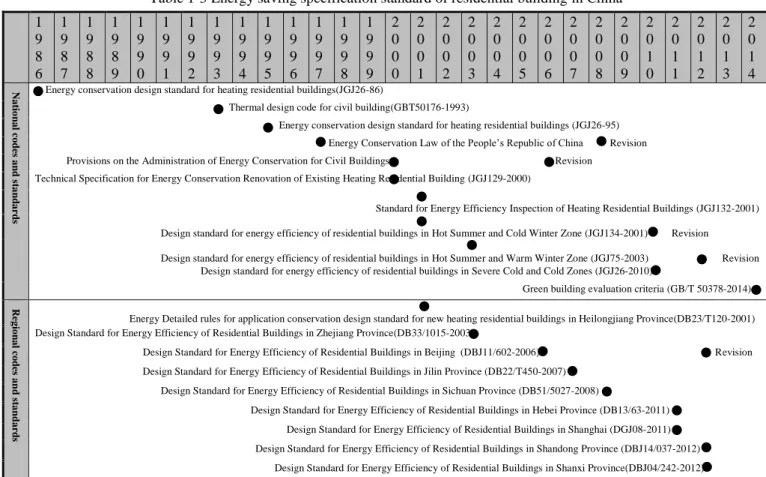
The building energy conservation work of China began in 1980s, started late than developed countries. Considering that the energy saving of residential building, economic development and people's living standard are closely interconnected, China government has taken a series of relevant measures in recent years. Table 1-3 shows the energy saving specification standard of residential building in China. Since 1986, energy saving of multi-unit residence has been raised to a new height of national implementation resources and sustainable development strategy as understanding and fixed position at the national macro level. At the same time, the government also constantly perfect the energy saving regulations and develop the national and regional energy saving design standards, scale up efforts to the development and application of building energy-saving technology work. Since 2001, the multi-unit residence energy saving design standards of different climatic zones have been promulgated and implemented. A new energy saving objective of multi-unit residence was developed in 2005: the building energy consumption would reduce by 25% than that of traditional multi-unit residence through the envelope structure, and then achieved the 50% decrement of total energy consumption of multi- unit residence combined with the equipment energy saving method. Beijing, Shanghai and northern cold-weather cities have also developed local standards and expanded building energy saving work combined their actual condition. Although China continued to make further steady efforts to the residential building energy saving, there are still a lot of problems. For example, the relevant standards cannot cover all over the country and different types construction;
specifications and standards do not have strong implementation; the key energy-saving
technologies and products are in urgent need of development; most of new established multi-
unit residence do not adopt energy-saving materials; the existing buildings have almost not ever
been energy-saving reformed; energy-saving awareness of residents is relatively weak and so on.
CHAPTER 1 INTRODUCTION
6
Table 1-3 Energy saving specification standard of residential building in China 1
9 8 6
1 9 8 7
1 9 8 8
1 9 8 9
1 9 9 0
1 9 9 1
1 9 9 2
1 9 9 3
1 9 9 4
1 9 9 5
1 9 9 6
1 9 9 7
1 9 9 8
1 9 9 9
2 0 0 0
2 0 0 1
2 0 0 2
2 0 0 3
2 0 0 4
2 0 0 5
2 0 0 6
2 0 0 7
2 0 0 8
2 0 0 9
2 0 1 0
2 0 1 1
2 0 1 2
2 0 1 3
2 0 1 4
National codes and standards
Energy conservation design standard for heating residential buildings(JGJ26-86)
Thermal design code for civil building(GBT50176-1993)
Energy conservation design standard for heating residential buildings (JGJ26-95) Energy Conservation Law of the People’s Republic of China Revision Provisions on the Administration of Energy Conservation for Civil Buildings Revision
Technical Specification for Energy Conservation Renovation of Existing Heating Residential Building (JGJ129-2000)
Standard for Energy Efficiency Inspection of Heating Residential Buildings (JGJ132-2001) Design standard for energy efficiency of residential buildings in Hot Summer and Cold Winter Zone (JGJ134-2001) Revision
Design standard for energy efficiency of residential buildings in Hot Summer and Warm Winter Zone (JGJ75-2003) Revision Design standard for energy efficiency of residential buildings in Severe Cold and Cold Zones (JGJ26-2010)
Green building evaluation criteria (GB/T 50378-2014)
Regional codes and standards
Energy Detailed rules for application conservation design standard for new heating residential buildings in Heilongjiang Province(DB23/T120-2001) Design Standard for Energy Efficiency of Residential Buildings in Zhejiang Province(DB33/1015-2003)
Design Standard for Energy Efficiency of Residential Buildings in Beijing (DBJ11/602-2006) Revision Design Standard for Energy Efficiency of Residential Buildings in Jilin Province (DB22/T450-2007)
Design Standard for Energy Efficiency of Residential Buildings in Sichuan Province (DB51/5027-2008)
Design Standard for Energy Efficiency of Residential Buildings in Hebei Province (DB13/63-2011) Design Standard for Energy Efficiency of Residential Buildings in Shanghai (DGJ08-2011) Design Standard for Energy Efficiency of Residential Buildings in Shandong Province (DBJ14/037-2012)
Design Standard for Energy Efficiency of Residential Buildings in Shanxi Province(DBJ04/242-2012)
CHAPTER 1 INTRODUCTION
7
1.2 Literature review
With the proportion of building energy consumption in total energy consumption has increased year by year, building energy conservation has been widely attached more importance in China. At the same time, because of improvement of people's living standard, the requirements to indoor thermal comfort of residence were also improved to a certain extent, so some researchers started the related study. For the multi-unit residences of typical cities, the energy consumption statistics, optimization design of envelope insulation structure, the use pattern of air conditioning as well as the measurement and analysis of indoor thermal environment were conducted, which can establish the foundation for the promotion of energy saving technology and improvement of indoor thermal environment.
1.2.1 Energy consumption statistics
The energy consumption survey in China started in 1980s. "Building Energy Efficiency
Economic and Technological Policy Research Group of China" composed by Tu and others has
investigated and researched the actual condition of work progress of China's building energy
consumption, building thermal environment and building energy efficiency for the first time in
1989
(8). In 1998~1999, sampling survey of more than 200 residences in Hubei area was carried
out by Hu
(9). The results showed that the thermal comfort problems of residence in summer was
more serious than that in winter, the total power consumption and air-conditioning power
consumption of investigated residences were 9.0~36.9kWh/(m
2·a) and 1.0~9.8 kWh/(m
2·a),
respectively. In 2001, the survey analysis of air conditioning power condition of 780 residences
was carried out by Long
(10), the average monthly electricity consumption of each residence in air
conditioning season and transition season were 191kwh and 98kwh respectively, and the growth
trend of air conditioning power consumption of residence in the future was also predicted. In
2003, the field measurement and questionnaire of energy use situation in winter of 100
residences in Changsha city was carried out by Li
(11)from Hunan University, which analyzed
the relationships among the formation of energy use structure and the basic condition of the
residential building, the requirement to thermal comfort of human-being, the living habits, the
household income level, the local climate characteristics, the regional energy policy and other
factors. From 2004 to 2006, Yu etc. surveyed the residential energy consumption in five
different cities and compared with the energy consumption in Japan
(12). Results showed that the
energy consumption gap is quite large in different regions. The annual energy consumption in
Pangyang which located in Severe Cold Zone was the largest, and that in Changsha which
located in Hot Summer and Cold Winter Zone was the least. Compared with that in Japan, the
average annual energy consumption in five cities was about 9GJ/ household larger in China. In
2006, Wan measured the energy of air conditioning in six residences in Shanghai
(13). Results
CHAPTER 1 INTRODUCTION
8
showed that the daily consumption of air conditioning fluctuated at random, and the peak air load occurs at 19~ 22, the daily energy consumption of air-conditioning is 11.4kWh. In 2007, the energy measurement was also conducted in two residences in Beijing by Wan
(14). The results showed that the energy consumption of air conditioning accounted the largest part in the total in the whole year, followed by cooking and hot water. The energy consumption of air conditioning heating and refrigerator had higher correlation with outdoor temperature, while less correlation for cooking and hot water energy consumption. In order to understand the behavior and energy consumption characteristics of air conditioning in multi-unit residences, Li
(15)investigated the operation status and energy consumption of 69 households in Beijing by setting one power meter for each air conditioning in the summer of 2011. The results show that the air conditioning energy consumption of households varies from 6kWh to 596kWh with the average of 161kWh.The average full-load runtime for each air conditioning is about 0.61h per day.
Average energy consumption intensity of air conditioning per floor area is 2.0kWh/m
2. The differences of energy consumption of air conditioning in different households are very large.
The air conditioning operating pattern is the most important influencing factor of the energy consumption. In 2012, the influencing factors of annual energy consumption in Shanghai were analyzed by SHI
(16). The results show that the quantity of air conditioning, floor area, residential age, energy saving consciousness and so on had great influence on the total energy consumption of residential building.
As mentioned above, the energy consumption survey in China started relatively late, the
development scope was limited to some southern large and medium-sized cities such as
Shanghai. Energy consumption survey mainly depended on the two ways of questionnaire and
measurement revolved the energy consumption of air conditioning. The energy consumption
gap was quite large in different regions. And the energy consumption of air conditioning
accounted the largest part in the total in the whole year especially in southern cities. The air
conditioning operating pattern was the most important influencing factor of the energy
consumption. The total annual energy consumption in northern cities was greater than that in
southern cities in China.
CHAPTER 1 INTRODUCTION
9
1.2.2 Optimization design of envelope structure
Regarding the energy saving technology aspects of envelope structure, many researchers have carried on the related research with the aid of simulation software.
In 2005, based on the thermal calculation of software-TRNSYS, H. Yoshino (et al) simulated the annual energy consumption of urban residential buildings in Beijing and Shanghai
(17), and the influence of wall insulation was also studied. It demonstrated that the thermal insulation properties of an exterior wall are better for developing an effective improvement in Beijing. The annual load decreases to 26% when the thermal insulation property of exterior wall is improved to the Canadian R2000 standard level. However, the effect of wall thermal insulation was not so significant in Shanghai in comparison with that of Beijing. Improving the thermal insulation properties moderately, achieving the appropriate ventilation and solar shading would be the effective energy conservation solutions in Shanghai. In the same year, Pu
(18)simulated and calculated the air conditioning load and energy consumption in Shenzhen. The results showed that the shading coefficient of glass had the greatest impact on the air conditioning load and annual energy consumption in Shenzhen. Compared with ordinary 3mm dummy glass, the air conditioning load of Low-e insulated glazing can be reduced by about 20%. In 2007, Wei
(19)revealed that composite wall materials such as 200mm aerated concrete wall and polystyrene board thermal insulation had a significant role in reducing residential building energy consumption in Hot Summer and Cold Winter Zone. Aiming at the problem of energy saving reconstruction of existing multi-unit residences in Xi'an city, Wang
(20)carried out the simulation and calculation of energy consumption in 2007. The calculation and analysis results showed that the prioritized energy saving measures of the existing buildings should be promoted as follows:
increasing sun visor to the south, adopting the double glazing window and increasing the
thermal insulation layer of polystyrene board for the wall. In 2008, Geng studied the influence
of shading condition on the energy consumption of air conditioning in Shanghai
(21). Results
showed that the shading effect using the shading blinds with reflecting plate was more
significant than the traditional shading effect;The best daylighting point occurred when the
shading coefficient was 0.7, the ratio of upper reflecting plate was 75% namely. In 2010, the
energy simulation was conducted by Cai to analyze the envelope performance of residential
building on the annual air-conditioning heating energy consumption in Shanghai
(22). Results
showed that in residential buildings, the energy consumption used for cooling and heating
accounts for 60%~70% of the total energy consumption. Increasing the thickness of insulation
layer of exterior wall can effectively reduce the heating energy consumption, but it was not
significant to reduce the cooling energy consumption. Using the movable shading can
effectively reduce the cooling energy consumption. In 2011, Fu researched the influence of
external window on low energy resident building consumption in Nanjing by the DeST
(23).
CHAPTER 1 INTRODUCTION
10
Results showed that he influence of heat transfer coefficient of exterior window on heating energy consumption in winter was larger than energy consumption of air conditioning in summer. On the basis of 50% energy-saving design, the 30% energy saving can be achieved when the shading coefficient of exterior window in summer was reduced to 0.15 and the heat transfer coefficient was reduced to 0.97W/m
2k. In 2012, Li
(24)studied the comprehensive effect of the window-wall ratio and type of window glass on heating energy consumption in Lhasa, and drew the conclusion that compared with single glass, a larger south window-wall ratio resulted in a better heating energy saving effect for double and low-e glass.
On the basis of above literatures, it can be summarized that the most of the previous studies on optimization design of envelope structure were focused on the C zone and HSCW zone and based on previous national energy conservation standards which have been implemented since 2001 and the energy saving target was set as 50%. Researchers mainly focused on the influence of external envelope structures including the external walls, windows and shading condition on residential energy consumption. The influence of exterior wall insulation on heating energy consumption was significant, but had little influence on energy consumption of air conditioning.
The influence of parameters in different areas was different.
CHAPTER 1 INTRODUCTION
11
1.2.3 Air conditioning usage pattern
The use pattern of air conditioning has a direct impact on energy consumption of residential buildings. The use pattern of air conditioning is controlled by the random behavior of indoor occupants; the air conditioning behavior of occupants depends on the occupants' energy saving awareness.
In 2006, Zhu Guangjun
(25)used the building energy consumption simulation software DeST to simulate a residential building in Shanghai area; the impacts of various factors of the air- conditioning operation pattern on the air conditioning energy consumption for residential heating were analyzed. The simulation results showed that each 1ºC reduction of the setting temperature of air conditioning in winter could reduce by about 10% energy consumption, and each 1ºC increase of the control temperature of air conditioning in summer could reduce by about 5% energy consumption. In 2007, Li
(26)from Tsinghua University tested the air conditioning energy consumption of a residential building in summer in Beijing. The results showed that indoor air conditioning temperature had a greater impact on the energy consumption of air conditioning, the air conditioning setting temperature increased from 25 to 26ºC, the air-conditioning energy consumption decreased by 23%, the close of inner door during the operation of air conditioning can decrease 40% air conditioning energy consumption. In 2011, Li
(27)analyzed the behavior patterns of people and energy consumption condition in residential building of Hot Summer and Cold Winter Zone in detail by the collected more than and 900 questionnaires from large sample of household survey. The results showed that in the residential building of Hot Summer and Cold Winter Zone, the significant effect level of opening time of air conditioning, the setting temperature of air conditioning, switching behavior of air conditioning, open window for ventilation at night, floor area on the building energy consumption in summer decreased in turn, which illustrated that the use pattern of air conditioning and occupant behavior are the important factors affecting the energy consumption of residential buildings in this region. In 2015, Cheng took the residential building in Shanghai as research object, the occupant behavior on the residential air handing unit was investigated with real electricity consumption and energy simulation
(28). The results showed that the occupant behavior affected the residential energy of AHU, the energy consumption mainly distributed at night; environmental uncertainty led to deviation between reality and simulation.
Questionnaire of occupant behavior also impacted the energy simulation.
At present, the research on air conditioning usage pattern is less. And the research mainly
focused on the influence of setting temperature of air conditioning, switching behavior of
occupant on the energy consumption. Especially, the setting temperature of air conditioning can
directly affect the indoor thermal environment quality and residential energy consumption.
CHAPTER 1 INTRODUCTION
12
1.2.4 Indoor thermal environment
The indoor temperature of residences can directly affect the human body's thermal sensation, and also indirectly reflects the residential heating and use condition of air conditioning equipment. Therefore, the grasp of residential indoor thermal environment can not only improve the thermal comfort condition of residents, but also can promote the implementation of energy- saving measures of residential buildings to a certain extent.
Under the support of the government, the experts and scholars in Japan carried out the measurement analysis and survey research on a variety of residential forms under the different climatic conditions. For example, in 2001, Yoshino Hiroshi investigated and measured on the residential indoor environment characteristics and occupants’ health condition in high insulation and high airtight buildings
(29). At the same time, the indoor thermal environment of residential buildings of some cities in China were also investigated and measured, which played an important role to grasp the residential building indoor thermal environment situations in different zones.
The survey on residential indoor thermal environment in China started in 1990s. Xia
(30)from Tsinghua University carried out the indoor physical parameters’ measurement and questionnaire investigation of 88 typical multi-unit residences in Beijing in 1998. The results showed the measured thermal sensation TSV value was lower than PMV value, which indicated that the people that are investigated has a higher ability to withstand heat.
In 2002, Wang
(31)from carried out the field survey of the indoor thermal environment and thermal sensation of residents in winter for 66 residences in Harbin. The thermal sensation questionnaires filled by 120 residents were collected. The results showed that, in accordance with the ISO7730 and ASHRAE55-1992 comfort standard, the thermal environment of nearly 77.5% residents was in the comfort range, but the acceptance rate of thermal environment was up to 91.7%. The acceptable operation temperature of 80% residents was 18~25.5ºC. In 2003, the results of field study on thermal comfort in Harbin were analyzed and summarized ulteriorly by Wang
(32). The results showed that the thermal neutral temperature of residents in Harbin was 21.5ºC. The temperature sensitivity of male is lower than female. Thermal neutral temperature of male was lower than female by 1ºC, and female relatively prefer warmer thermal environment.
Li ever conducted the questionnaire survey and the field measurement about indoor thermal environment in urban multi-unit residences in August 2002 and January 2003 in Changsha, respectively
(33). The questionnaire mainly investigated the building characteristic, occupants’
life style, energy consumption of residences and the subjective prediction of indoor thermal
environment. The influence of residential height, house plans, occupants’ living habits as well
as consumption concept on indoor thermal environment were analyzed. The indoor thermal
CHAPTER 1 INTRODUCTION
13
environment was evaluated as well. Results showed that the comfort zone of indoor thermal environment in winter and summer in Changsha is 16.8~20.ET* and 24.7~27.7ET*, respectively (Icl=1.5clo in winter and 0.25clo in summer, M=58W/m
2).
In 2003, Zhong
(34)measured the winter indoor environment parameters of non-heating residential buildings in Hot Summer and Cold Winter Zone. The results showed that about 80%
of the time of the indoor temperature in winter was not up to the human health requirements of the temperature 12ºC. It was concluded that the room tightness is the main basis for selecting heating mode and equipment in winter in this area.
Investigations of indoor thermal environment in winter were carried out in Harbin, Beijing, Xi’an, Shanghai and Hong Kong of China by Yoshino from 2003
(35). The results showed that the indoor thermal condition in heating usage zone is good, such as Harbin, Beijing and Xi’an.
Since the district heating system are used in these cities, the indoor average temperatures were 19.8ºC in Harbin, 20.4ºC in Beijing and 20.4ºC in Xi’an, respectively. The differences between living room and bedroom are very small. However, the indoor thermal comfort is strongly affected by the outdoor climate in non-heating usage zone, occupants use heating individually to warm their houses such as Shanghai and Hong Kong. It is expected that the poor indoor environment will be improved in near future by growth of the economy and increase of the demand for comfortable thermal environment. Therefore, the performance of the residential buildings, with better thermal insulation and air tightness must be more important for energy conservation.
From 2004, with the investigation scale expansion, Yoshino conducted the field measurement and questionnaire survey in the urban areas of nine major cities
(36). The measurement showed that winter indoor temperatures in Harbin, Urumqi, Beijing and Xi’an remain at a relatively stable level near 20.8ºC due to the central heating system installed. However in the other cities lacking central heating systems, indoor temperatures fluctuated as a function of the change of outdoor temperature. On the other hand, summer indoor evening temperatures in Shanghai, Changsha, Chongqing and Hong Kong were higher than the comfort zone of ASHRAE.
Therefore it is expected that energy use for space heating and cooling in the southern China will increase in the near future because of occupants’ requirement for comfortable indoor environment. Based on the results yielded by this study, in Beijing the calculation of space heating and cooling loads indicated that the energy used to heat indoor spaces can be halved by installing thermal insulation and properly sealing the building.
Ding conducted the field study about thermal comfort of residential buildings in summer in
Dongguan
(37)in 2006. It was suggested that the setting temperature of air conditioning that was
set as 26~27ºC could satisfy more than 70% occupants' thermal comfort. From the comparison
of investigation, it was suggested that having lived long in the high humid-hot climate zone, the
CHAPTER 1 INTRODUCTION
14
thermal expectation and thermal adaptability had an important influence on the subjective value of indoor thermal environment. Taking into account the energy saving, increasing the indoor design temperature and humidity properly also would fulfill the need of thermal comfort.
Zhu carried out the field investigations from 2011 to 2012 year to study the indoor thermal environment, thermal sensation and adaptation measures of Dalian apartment’s residents in winter
(38). Different Thermal comfort apparatuses were used to test the environment parameters, subjective questionnaires about thermal sensation from 102 residents of 36 residences were collected at the same time. The results showed that acceptability to the thermal environment was 93.2%. The neutral and expected temperature was 20.44ºC and 20.81ºC, respectively. The 80%
acceptable temperature range was 17.38~24.28ºC, of which 57% subjects thought that humidification measures should be taken because of the dryness in the room.
In 2013, Gao researched the indoor thermal environment in old industrial regions of Harbin
(39). Results showed that although there was district heating system, the indoor thermal environment was not optimistic in the old residences especially the residences used more than 30 years. The indoor temperature was low, with an average of 17.2 ºC. Frost appears due to the aging and its own performance issues of windows. Even some residential indoor appear phenomenon of moldy and condensation.
With the improvement of people's living standard, researchers paid more and more attention
to the thermal environment in multi-unit residential buildings, especially in the Cold Zone and
Hot Summer and Cold Winter Zone. Because of the different heating methods, compared the
colder zones where had district heating system, the indoor thermal comfort urgent need to
improve improved in the southern cities where occupants use heating individually to warm their
houses. In addition, although there was district heating system in Severe Cold Zone and Cold
Zone, the indoor thermal environment should also be improved in the old residences.
CHAPTER 1 INTRODUCTION
15
1.3 Limitation of Existing Research
As mentioned above, it can be seen that the related research on multi-unit residences in China has made great progress, especially in the pursuit of energy saving of residential building and evaluation of indoor thermal environment. However, under the research background that the legal framework and scope for energy saving is in the early stage, so the previous research has some limitations and needs further more in-depth study:
1) Narrow research scope
The development scope was limited to some single climate zones and large cities, few researches that simultaneously compared and considered the difference in requirements of different climate zones in China.
2) Single research target
The previous research usually only focused on a single aspect, but there was few researches that simultaneously considered the comprehensive improvement of indoor thermal environment and energy saving.
3) Under the conditions of old standard
Most simulation studies have been conducted based on previous national standards of 2001 (energy saving target -50%), less discussion of new current standards after 2011 (energy saving targets -65%).
4) Lack of some influencing factors evaluation
Most simulation studies focused on the influence of external envelope structures including the external walls, windows and shading condition, few studies on the setting temperatures and the air tightness.
5) Less comparative analysis
There was almost no simulation study that simultaneously compared the thermal performance
of residential buildings of actual conditions, national standard and improvement cases.
CHAPTER 1 INTRODUCTION
16
1.4 Research Objectives
1.4.1 Research purpose and content
The purpose of this study is to grasp the status of indoor thermal environments and identify the actual energy demand of multi-unit residences as well as the influence of building performance parameters on the energy consumption and comfortable indoor thermal environment in different climate zones in China. And then the feasible solutions are sought to improve the indoor thermal environment and reduce energy consumption. Finally, a good balance between the environmental quality and the energy saving in multi-unit residences is attempted to achieve. The main contents include three parts as follows:
(1) The related articles of residential buildings published in China over the past 15 years have been classified and analyzed through literature review. The current research status of multi-unit residences in different climate zones was summarized.
(2) A field investigation was conducted in different climate zones in China, including field measurements and questionnaires survey. The excellent technical measures in multi-unit residences in different zones were compared and analyzed. At the same time, the current weak links of multi-unit residences’ energy consumption and the indoor thermal environment have been also identified.
(3) Building envelope is the key point of residential building energy conservation, and is also a necessary condition to determine indoor thermal comfort. This research compiled different parameters and performed dynamic building energy simulations to study annual energy demand and indoor thermal environment in five climate zones of China. The effects of building design parameters on energy performance and indoor thermal environment were estimated.
On such basis, rational improvement proposals and measures have been put forward to
improve the comfort of indoor thermal environments and energy conservation in multi-unit
residences in China. It is expected to have a guiding significance for reducing energy
consumption and improving indoor thermal comfort for Chinese multi-unit residences in the
future.
CHAPTER 1 INTRODUCTION
17
1.4.2 Innovation of this research
The innovations of this research are mainly as follows:
1) The multi-unit residences in multiple climate zones was studied simultaneously on the basis of considering the difference in requirements to the indoor environment and energy saving in five climate zones in China.
2) The requirement of both indoor thermal comfort and energy saving was considered in this research.
3) This research discussed on the basis of new standard which was implemented after 2011 and the energy saving targets was set as 65%.
4) The influence of two less studied parameters –air tightness and setting temperature on the energy demand and indoor thermal comfort were researched in this thesis.
5) This research simulated and compared the thermal performance of residential buildings of
actual conditions, national standard and improvement cases simultaneously.
CHAPTER 1 INTRODUCTION
18
1.5 Structure of This Thesis
This paper is mainly divided into seven chapters, and structure frame of full thesis was shown in Figure 1-4.
Figure 1-4 Structure frame of thesis Background
• The energy and environmental problems facing China
• Energy consumption status and energy saving process of urban multi-unit residence
Literature reviews
• Energy consumption statistics • Air conditioning usage pattern
• Optimization design of envelope structure • Indoor thermal environment
Limitation of existing research Research objectives
• Research purpose and contents
• Innovation of this research
1.Introduction
Climate zoning in China
• Climate zoning
• Climate characteristics and requirements
Results summary in different zones
• Attribute • Envelope structure • Heating methods
• Indoor thermal environment • Energy consumption
2. Literature survey
Field measurement
• T and RH distribution • ASHRAE comfort zone
• PMV • Vertical temperature difference • WBGT
Questionnaire survey
• Icl • TSV • Thermal neutral temperature
• TCV • T and RH distribution • Occupation condition
• Energy consumption
3 and 4. Field investigation
Comparison with literature, investigation Comparison of status, standard, improvement
Comparison of energy demand
• Wall insulation • Window insulation
• Air tightness • Setting temperature
Comparison of thermal comfort
• Wall insulation • Window insulation
• Air tightness • Setting temperature
5. Simulation study
Comparison of investigation results
• Heating methods and service time • Indoor thermal environment
• Clothing insulation • Thermal neutral temperature • Energy consumption
Comparison of simulation results
• Air tightness • Wall insulation • Window insulation and shading
• Optimization design of envelope structure • Indoor thermal environment
Comparison of improvement proposals
6. Comparison analysis
7. Conclusion
CHAPTER 1 INTRODUCTION
19
The specific ideas and chapters were shown as follows:
Chapter 1 described the background, previous research status, the purpose and the
significance as well as the major research approach of this study.
Chapter 2 summarized the results of relevant literature published in the past 15 years based
on different climate zones. Through reviewing about 99 articles, the data recorded in each article was extracted and statistically analyzed.
Chapter 3 researched the actual conditions of indoor thermal environments and energy
consumption in winter in multi-unit residences in three colder climate zones in China via field measurement and questionnaire analysis. On the basis of survey results, rational improvement proposals and measures had been put forward to improve the comfort of indoor thermal environments and energy conservation in multi-unit residences in winter.
Chapter 4 researched the actual conditions of indoor thermal environments and energy
consumption in summer in multi-unit residences in three hotter climate zones in China. Then the rational improvement proposals and measures had been put forward to improve the comfort of indoor thermal environments and energy conservation in multi-unit residences in summer.
Chapter 5 compiled four different parameters and performed simulations based on new
energy saving standard. The energy saving potential of current conditions was analyzed.
Meanwhile, the influential parameter on energy demand and indoor thermal comfort was clarified in all five climate zones.
Chapter 6
compared the results of literature survey, field investigation and simulation study, and analyzed the reasons for different results in different climate zones.
Chapter 7 summarized the conclusions of each chapter and put forward the direction of
future research.
CHAPTER 1 INTRODUCTION
20
References
(1)Josep G. Canadell, Robert Dickinson, et al: ESSP Report No.1, The Global Carbon Project, Sep 2013.
(2)Shanqing YU. Standardization of building energy efficiency, China Standardization, 2000(1):15~18 (3)National Bureau of Statistics of the People’s Republic of China: China Statistical Yearbook, 2013.
(4)Junfu CAI, Residential Energy Efficiency Design, China Architecture & Building Press, 1991.
(5)Fengxiang TU, Zhanying DI, Zhenyu ZHANG. Recent progress in building energy efficiency standards in Britain, France and Germany, Building energy conservation, 2002(37):131~138
(6)Paul Waide, Benoit Lebot, Mark Hinnells. Appliance energy standards in Europe Buildings, 1997(26):45~67
(7)Alan K. Meier. Observed energy savings from appliance efficiency standards, Energy and Buildings, 1997(26):111~117
(8)Ministry of national construction. Outline of the fifteen energy plan of the Ministry of construction, Construction technique, 2002, Vol.31, No.8: 1~6.
(9)Pingfang Hu, Zhangning Jiang,Yuhan Leng. Investigation of thermal environment and energy consumption for Hubei residences, Journal of HV&AC, 2004, 34(6):21~22.
(10)W D Long, T Zhong,B H Zhang. Situation and trends of residential building environment services in Shanghai, Proceedings of the 2003-4th International Symposium on heating, Ventilating and Air conditioning. Beijing: Tsinghua University Press, pp493~498, 2003.
(11)Nianping Li. Investigation and analysis on summer energy structure of residential buildings in Changsha, Journal of HV&AC, pp14~17, Vol.34, No.5, 2004.
(12)Liang YU, Hiroshi YOSHINO, Research on energy consumption of urban apartment buildings in China, J. Environ. Eng., AIJ, pp.183-190, Vol73, No.624, 2008.
(13)Xudong WAN, Jingchao XIE,Yaohua ZHAO, Survey and measurement result analysis on the thermal environment and energy consumption of urban residential buildings, Energy Conservation Technology, 2008, 26(147):68~74.
(14)Xudong WAN, Investigation and numerical simulation of indoor thermal environment and energy consumption in residential buildings, Master Thesis of Beijing University of Technology, 2009.
(15)Li Zhaojian, Xie Deqiang, Jiang Hongbin, Wei Xing. Testing Study on Operating Behavior and Energy Consumption of Air Conditioners in Residential Buildings in Beijing, Journal of HV&AC, pp15~20,Vol.44, No.2,2014.
(16)Xiaofei SHI, Ying PEI, Investigation and analysis on the influence factors affecting residential energy consumption in Shanghai, Energy Saving Technology, Vol.40, No.251, 2012.
(17)Hiroshi Yoshino, Yasuko Yoshino, Qingyuan Zhang: Indoor thermal environment and energy saving for urban residential buildings in China, Energy and Buildings 38(2006), pp.1308-1319.
(18)Zengwen PU. Influence of Low-e glass on air conditioning load and building energy consumption, Journal of HV&AC, pp119~121, Vol.35, No.8, 2005.
CHAPTER 1 INTRODUCTION
21
(19)Caixin Wei: Energy consumption simulation and analysis on the technical economy of air conditioning schemes of residential buildings in Hot Summer and Cold Winter Zone, Master Thesis, Dong Hua University, 2007.
(20)Weihao WANG, Dongyang WANG, Xilian LUO, Energy Consumption Simulation and Energy Saving Analysis on Envelope of Existing Building, Building science. 2007, 23(2):22~26.
(21)Jianguo Geng, Research on the indoor daylighting environment and energy consumption of Shanghai shaded residential building, Master thesis of Tongji University of Technology,2008.
(22)Longjun CAI, Lingfeng YAO, Envelope Performance of Residential Building on the Annual Air- conditioning Heating Energy Consumption in Shanghai, Construction Conserves Energy, 2010, (2):19~23.
(23)Heng FU, Influence of external window on low energy resident building consumption, Master thesis of Nanjing University of Technology,2011.
(24)En LI, Yasunori AKASHI, Daisuke SUMIYOSHI, Passive design strategy on residential buildings for sustainable development of Lhasa, Journal of Environmental Engineering. AIJ, July 2013 pp.471-480.
(25)Guangjun Zhu, Xiaoliang Zhang. Effects of Operation Mode of Air Conditioning on Energy Consumption of Heating and Air Conditioning in Residential Buildings, Journal of Chongqing Jianzhu University,2006,128(5):119~121.
(26)Zhaojian LI, YiJiang, Qingfan Wei. Survey and analysis on influence of environment parameters and residents’ behaviors on air conditioning energy consumption in a residential building, Journal of HV&AC, pp67~71,Vol.37, No.8,2007.
(27)Nan LI. Impacts of human behavior on energy consumption of residential buildings in China’s Hot Summer and Cold Winter Zone, Doctor Thesis, Chongqing University, 2011.
(28)Xuan CHENG, Case study on influence of occupant behavior on residential air handing unit and energy consumption, Building Science,Vol.31,No.10,2015.
(29)Hiroshi Yoshino, Haihong Lou, Indoor Thermal Environment of Residential Buildings in Three Cities of China, Journal of Asian Architecture and Building Engineering,2002,1(1):01.
(30)Yizai Xia,Rongyi Zhao,Yi Jiang. Study on thermal comfort of residential environment in Beijing, Journal of HV&AC, pp1~5, Vol.29, No.2, 2000.
(31)Zhaojun WANG, Xiukui FANG, Leming LIAN. Field study on thermal comfort of winter residents in Harbin, Journal of Harbin Institute of Technology, 2002, 34(4):500~504.
(32)Zhaojun WANG, Analysis on the results of thermal comfort field study in residential buildings in Harbin, Building Energy & Environment, 2004, 23(3):5~8.
(33)Li Nianping, Pan Yougui, Hiroshi Yoshino. Field Measurement and Analysis of Indoor Thermal Environment of Changsha Urban Residential Buildings, Journal of Building Energy &Environment, 2004, 23(1):94~98.
CHAPTER 1 INTRODUCTION
22
(34)Ke ZHONG, Qi WANG, Selection of winter heating mode in Hot Summer and Cold Winter Zone, Journal of HV&AC, pp70~73, Vol.32, No.12, 2004.
(35)Hiroshi Yoshino, S. Guan, Y.F. Lun, Indoor thermal environment of urban residential buildings in China: winter investigation in five major cities, Energy and Buildings 36(2004), pp.1227-1233.
(36)Hiroshi Yoshino, Yasuko Yoshino, Qingyuan Zhang: Indoor thermal environment and energy saving for urban residential buildings in China, Energy and Buildings 38(2006), pp.1308-1319.
(37)Ding Xiujuan, Zheng Qinghong, Hu Qinghua, Li Kuishan. Investigation of Thermal Environment of Residential Buildings in Dong Guan, Journal of Building Energy & Environment, 2007, 26(5):82~85.
(38)Zhu Peisheng, Guo Fei, Zhu Tong, Liu Shuguo. Field Investigation of Dalian Apartment Thermal Environments and Thermal Adaptation in winter, Journal of Low Temperature Architecture Technology, 2013, 183(9):127~129.
(39)Feng GAO, The research of residence indoor thermal environment in old industrial regions of Harbin and it’s optimizational design, Master thesis of Xi'an University Of Architecture And Technology,2014.
CHAPTER 2 LITERATURE SURVEY ON MULTI-UNIT RESIDENCES BASED ON DIFFERENT CLIMATE ZONES
23
CHAPTER 2 LITERATURE SURVEY ON MULTI-UNIT RESIDENCES BASED ON DIFFERENT CLIMATE ZONES
2.1 Introduction
In order to fully understand the current status of research on the residential building in China,
this chapter has compiled and analysed the related literature about residential building published
in the past 15 years. These literatures survey was conducted based on the five different climate
zones and different cities in China. Statistics include residential performance, the main heating
cooling equipment, residential comfort and energy consumption and so on. Through reviewing
about 99 articles, the data recorded in each article was extracted and statistically analyzed.
CHAPTER 2 LITERATURE SURVEY ON MULTI-UNIT RESIDENCES BASED ON DIFFERENT CLIMATE ZONES
24
2.2 Thermal Design Zoning for Buildings in China 2.2.1 Climate zoning
Compared with public buildings, the internal heating power and building volume of residential buildings are relatively low, so the thermal performance of residential building is more dependent on the external meteorological environment. Compared with the regions at the same latitude all over the world, China is partial to hot in summer and cold in winter. Many regions in China need the heating in winter and cooling in summer, so the energy consumption problem is more serious.
China is within the middle and low latitudes of the northern hemisphere, the land area stretches between the latitudes of 18◦N and 53◦N. The maximum solar altitudes vary a great deal, and there is a large diversity in climates, especially for the temperature distributions during winter. Different climatic conditions also have different requirements on the design of residential buildings.
Figure 2-1 Building thermal design division (GB50176-93)
In order to make the civil building thermal design adapt to the regional climate, implement
energy conservation and environmental protection policies, improve the residential building
thermal environment and raise the heating and cooling energy efficiency, China adopted
corresponding thermal design specification requirements《Code for thermal design of civil
buildings-GB50176》
(1). According to this code, China was divided into five different climatic
zones from north to south, which are Severe Cold (SC) Zone, Cold (C) Zone, Hot Summer and
Cold Winter (HSCW) Zone, Hot Summer and Warm Winter (HSWW) Zone and Temperate (T)
Zone, respectively. One of the most important characteristics of the Chinese climate is that
CHAPTER 2 LITERATURE SURVEY ON MULTI-UNIT RESIDENCES BASED ON DIFFERENT CLIMATE ZONES
25
winter and summer have long durations. Climate- responsive building strategies that are appropriate for each zone need to be implemented.
Building thermal zoning standards and design requirements have been showed in Table 2-1.
The average temperature of the coldest month and the hottest month are taken as the key indicator of subzone, the number of days of Daily Mean Temperature (DMT) ≤5ºC and ≥25ºC are taken as an auxiliary criterion. Different climatic zones have different design requirements of heat preservation in winter and heat protection in summer.
Table 2-1 Building thermal zoning standards and design requirements
Zone Name
Zoning Standard
Design requirements
Main Auxiliary
Severe Cold Average temperature of the coldest month is ≤-10ºC
The number of days of DMT ≤5ºC is ≥145
Must fully meet the requirements of heat preservation in winter;
Generally do not consider the heat protection in summer
Cold
Average temperature of the coldest month is
0~-10ºC
The number of days of DMT≤5ºC is 90~145
Meet the requirements of heat preservation in winter;
Consider the heat protection in summer in some areas
Hot Summer and Cold Winter
Average temperature of the coldest month is
0~-10ºC
Average temperature of the hottest month is
25~30ºC
The number of days of DMT≤5ºC is 0~90;
The number of days of DMT≥25ºC is 40~100
Must meet the requirements of heat protection in summer;
Consider the heat preservation in winter
Hot Summer and Warm Winter
Average temperature of the coldest month is
>10ºC
Average temperature of the hottest month is
25~29ºC
The number of days of DMT≥25ºC is 100~200;
Must fully meet the requirements of heat protection in summer;
Generally do not consider the heat preservation in winter
Temperate
Average temperature of the coldest month is
0~-13ºC
Average temperature of the hottest month is
18~25ºC
The number of days of DMT≤5ºC is 0~90;
Consider heat preservation in winter in some areas;
Generally do not consider the heat protection in summer
2.2.2 Climate characteristics and requirements for architectural design
In order to distinguish the influence otherness of climate conditions in different zones of
China on the building, clarity the basic elements of building in each climate zone, and provide
the climate parameters of building, China formulated the 《Standard of climatic regionalization
CHAPTER 2 LITERATURE SURVEY ON MULTI-UNIT RESIDENCES BASED ON DIFFERENT CLIMATE ZONES
26