1. Introduction
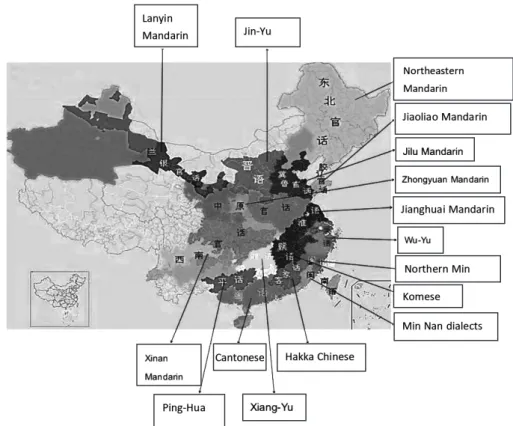
Handan is a provincial city in Hebei Province, China. The city is located in the southwest of Hebei province with a total area of 1,2073.8 square kilometers. At the 2018 census, its popula- tion was 10.575 million inhabitants. In Handan the following three dialects are spoken: i) Jin-Yu spoken in urban and central western area, ii) Ji-Lu spoken in northern part, and iii) Central Plains Mandarin in south. Throughout China, 63.05 million people speak Jin-Yu ( 晋语 ) in the area including other cities like Taiyuan. Qiu, Guantao, and Guangping Counties use Ji-Lu Man- darin ( 冀鲁官话 ), a sub-dialect of Handan, which more than 90 million population apply. Deming and Wei Counties belong to Central Plains Mandarin area ( 中原官话 ), which is similar with Mandarin, and almost 186 million people are using it (see Figure 1). Handan language has di- versity within the same language. Between villages dialectal difference exists.
Figure 1. The map of dialects of Mandarin Chinese, modified from a map on http://www.sohu.com/a/232754336_431310
Vowel Shift and Coda Deletion in Handan Dialect of Chinese
Sumiyo Nishiguchi, Xu Han, and Lining Chen
There are mainly 16 dialects of Chinese. As you can see from the figure, the color part refers to each dialect. The grey part like Tibet, people in there use Tibetan. Tibetan is not a division of Chinese and is an individual language without any connection with Chinese pronunciation or character. From the map, Hebei is located in the top part of China. Because Handan is close to Shanxi, Henan, and Shandong provinces, their languages also have affected Handan language.
That’s the reason Handan people speak Jin-Yu, Ji-Lu Mandarin, and Central Plain Mandarin.
Between Mandarin and Handan, we have observed significant differences in pronunciations, tones, and vocabularies. The outline of this paper is as follows: section 2 introduces sound alter- nations between Mandarin and Handan, section 3 demonstrates tone alternation and the different vocabulary, and section 4 provides Optimality Theoretic analysis on phonological differences.
2. Phonological Difference between Mandarin and Handan
There exist the following phonological differences between Mandarin and Handan languag- es: i) the alternations in vowel quality (section 2.1), ii) the change of consonants (section 2.2), and iii) the coda deletion (section 2.3).
2.1 Vowel Quality
In Handan dialect of Mandarin Chinese, the vowel quality alters from Mandarin in that /i/ is substituted with /e/ as shown in the examples (1) and (2).
/i/->/e/
(1) 吃 了 吗
a. Chī-lè ma? (Mandarin) eat-perf q
/ʈʂʰiləma/
“Did you eat?”
b. Chē-lè ma? (Handan) eat-perf q
/ʈʂʰeləma/
“Did you eat?”
/ai/->/je/
(2) 麦子
a. mài zì (Mandarin) /maitsɨ/
“wheat”
b. miē de (Handan) /mjede/
“wheat”
Moreover, there is another vowel variation observed. It seems /a/ in Mandarin is pronounced /o/ in Handan always especially among older generations who preserve Handan language.
/a/ -> /o/
(3) 咋啦
a. Zǎ la? (Mandarin)
what perf
/zala/
“What’s up?”
b. Zōu la? (Handan)
what perf
/zola/
“What’s up?”
(4) 大姐
a. dà jiě (Mandarin) /tatɕie/
“Eldest sister”
b. dǒ jìè (Handan) /totɕie/
“Eldest sister”
(5) 麻将
a. má jiàng (Mandarin) /maɹ̩ŋ/
“Mahjong”
b. mòu jiang (Handan) /moɹ̩ŋ/
“Mahjong”
(6) 大人
a. dà rén (Mandarin) /taɻən/
“adult”
b. dǒu rèn (Handan) /toɻən/
“adult”
(7) 傻子
a. shǎ zi (Mandarin) /shatsɨ/
“stupid”
b. shōu de (Handan)
/shodə/
“stupid”
2.2 Consonant Change
Some consonants are substituted with other consonants in Handan dialect.
/ts/->/d/ An affricate to a stop
(8) 麦子
a. mài zì (Mandarin) /maitsɨ/
“wheat”
b. miē de (Handan) /mjedə/
“wheat”
(9) 猴子
a. hόu zì (Mandarin) /houtsɨ/
“monkey”
b. hòu de (Handan) /houdə/
“monkey”
(10) 傻子
a. shǎ zì (Mandarin) /shatsɨ/
“stupid”
b. shōu de (Handan) /shodə/
“stupid”
(11) 桃子
a. táo zì (Mandarin) /taotsɨ/
b. tào de (Handan) /taodə/
“peach”
(12) 桌子
a. zhuō zì (Mandarin) /zhuotsɨ/
“desk”
b. zhuō de (Handan) /zhuodə/
“desk”
2.3 Coda /n/ Deletion
The coda consonant /n/ is deleted, as pointed out in Yin (1995), creating open syllable struc- ture in Handan. Although /n/ is deleted in coda position, a velar nasal /ng/ in coda is allowed as in Mandarin.
(13) 多少 钱
a. Duō shǎo qián? (Mandarin) /tuo shao tɕʰien/
how.much money
“How much?”
b. Duō shào qià? (Handan) /tuo shao tɕʰja/
how.much money
“How much?”
(14) 邯郸
a. Hān dān (Mandarin) /handan/
“Handan”
b. Hà da (Handan) /hada/
“Handan”
(15) 光盘
a. guāng pán (Mandarin) /guaŋpan/
“CD”
b. guāng pà (Handan) /guaŋpa/
“CD”
(16) 眼镜
a. yǎn jìng (Mandarin) /jantɕiŋ/
“glasses”
b. yā jìng (Handan) /jatɕiŋ/
“glasses”
(17) 换
a. huàn (Mandarin)
/huan/
“transfer”
b. huǎ (Handan)
/hua/
“transfer”
(18) 现金
a. xiàn jīn (Mandarin) /ɕiantɕin/
“Cash”
b. xiá jīn (Handan) /ɕiatɕin/
“Cash”
While the coda consonant /n/ undergoes deletion, the velar nasal /ŋ/ is preserved, even though the tone alternates between the third and the first.
(19) 北京
a. Běi jīng (Mandarin) /beiɕiŋ/
“Beijing”
b. Bēi jīng (Handan) /beiɕiŋ/
“Beijing”
3. Other Differences 3.1 Tone Change
There is tone change in Handan dialect. For example, the fourth tone in Mandarin is alternat- ed to either the third or the second tone in Handan.
Tone change from the 4th to the 3rd:
(20) 换
a. huàn (Mandarin) /huan/
“transfer”
b. huǎ (Handan)
/hua/
“transfer”
(21) 正好
a. zhèng hǎo (Mandarin) /ʈʂəŋhao/
“Just enough”
b. zhěng hào (Handan)
/ʈʂəŋhao/
“Just enough”
(22) 现金
a. xiàn jīn (Mandarin) /ɕientɕiŋ/
“Cash”
b. xiá jīn (Handan) /ɕiatɕiŋ/
“Cash”
(23) 面粉
a. miàn fěn (Mandarin) /miɛnfən/
“Flour”
b. miǎn fèn (Handan) /miɛnfən/
“Flour”
(24) 大姐
a. dà jiě (Mandarin) /tatɕie/
“Eldest sister”
b. dǒu jìe (Handan) /totɕie/
“Eldest sister”
(25) 二姐
a. èr jiě (Mandarin) /ɚɕie/
“Second sister”
b. ěr jiè (Handan) /ɚɕie/
“Second sister”
Tone change from the 2nd to the 4th:
(26) 情况
a. qíng kuàng (Mandarin) /tɕʰiŋkuaŋ/
“situation”
b. qìng kuǎng (Handan) /tɕʰiŋkuaŋ/
“situation”
(27) 羊肉
a. yáng ròu (Mandarin)
/jaŋrou/
“mutton”
b. yàng ròu (Handan) /jaŋrou/
“mutton”
(28) 皮鞋
a. pí xié (Mandarin) /piɕie/
“leather shoes”
b. pì xiè (Handan) /piɕie/
“leather shoes”
(29) 朋友
a. péng yǒu (Mandarin) /pəŋyou/
“friend”
b. pèng yǒu (Handan) /pəŋyou/
“friend”
Tone change from the 4th to the 2nd and also from the 3rd to the 1st:
(30) 兄弟姐妹
a. xiōng dì jiě mèi (Mandarin) /ɕioŋtiɕiemei/
“Brother(s) and sister(s)”
b. xiōng dí jiē mèi (Handan) /ɕioŋtiɕiemei/
“Brother(s) and sister(s)”
(31) 眼镜
a. yǎn jìng (Mandarin) /janɕiŋ/
“glasses”
b. yā jìng (Handan) /jaɕiŋ/
“glasses”
To sum, the following tone variations have been observed between Mandarin and Handan: i)
from the 4th to the 3rd, ii) from the 2nd to the 4th, iii) from the 4th to the 2nd, and iv) from the
3rd to the 1st.
3.2 Vocabulary
Finally, there is a unique vocabulary in Handan. The exclamative “Fe!” does not have any counterpart in Mandarin.
(32) Fe! (Handan)
/fa/
“Ouch! (It hurts)”
4. Optimality Theoretic Analysis
This section provides analysis on the two outstanding features of Handan dialect, namely the coda /n/ deletion in section 2.3 and the vowel shift in section 2.1.
4.1 NO CODA
While closed syllable structure is allowed in Mandarin as in /qian/ which has consonant- vowel-vowel-consonant (CVVC) structure, Handan prefers open syllables with CV(V) structure.
Although a velar nasal /ng/ is allowed as in yà jìng /jatɕiŋ/ and it is the only coda consonant in Handan, open syllables are more significantly preferred than in Mandarin. In Optimality Theo- retic analysis following Prince and Smolensky (1993) (also see McCarthy (2002)), we assume that the universal constraint called No Coda given in (33) which prohibits closed syllables is highly ranked in Handan. No Coda outranks a faithfulness constraint MAX IO in (34), which prohibits deletion in output, assuming that the input is /qian/. In view of the coda deletion, the constraint ranking in Handan appears to be NO-CODA >> MAX-IO.
(33) NO-CODA
*C]
σ('Syllables are open')
(Kager 1999) (34) MAX-IO
Input segments must have output correspondents ('No deletion')
(ibid.) (35)
Input : / qian / NO - CODA MAX IO
☞ / qi / *
/ qian / *
As shown in tableau (35), the possible output /qian/ is penalized by NO-CODA as indicated by an asterisk, which makes /qia/ survive the competition even though it is penalized by MAX IO at the next stage.
4.2 Vowel Shift
The low vowel /a/ in Mandarin is raised to a close-mid /o/ in Handan. In view of vowel
raising, Orgun (1995) assumes a constraint NO /a/ given in (36) which predicts either a vowel shift or deletion (also see Kirchner 1996). The vowel shift reveals that NO /a/ outranks the identity constraint which preserves the same vowel /a/ in (37), as the tableau in (38) shows.
(36) NO /a/
/a/ not allowed in open syllables.
(Orgun 1995) (37) IDENT IO[a]
Correspondent segments have identical values for /a/.
(Kager 1999) (38)
Input : / tatɕie / NO / a / IDENT IO [ a ]
/ tatɕie / *
☞ / totɕie / *
5. Conclusion
As a junction of the four provinces, Handan dialect has developed its own unique pronunci- ation and vocabulary while being influenced by Ji-Lu Mandarin, Jin-Yu and Mandarin. With the development of the times, more and more young people have begun to work in urban areas. The consequence has made Handan dialect become more similar to Mandarin. As the language used by 10 million people in this land, Handan dialect has gradually developed its own characteristics and practicality during the evolution. Handan dialect exhibits unique characteristics that need to be analyzed. Among them, the coda deletion that creates open syllable structure and the vowel raising are predictable and similar phenomena occur in other languages in the world. Other features of Handan dialect, namely, consonant shift and tone change should be analyzed in future work.
References
Kager, Rene (1999) Optimality Theory. Cambridge University Press, Cambridge.
Kirchner, Robert (1996) Synchronic Chain Shifts in Optimality Theory. Linguistic Inquiry 27(2), 341-350.
Lee, Wai-Sum and Eric Zee (2003) Standard Chinese (Beijing). Journal of the International Phonetic Association. 33 (1), 109–112.
McCarthy, John J. (2002) A Thematic Guide to Optimality Theory. Cambridge University Press, Cambridge.
Orgun, Cemil O. (1995) Correspondence and Identity Constraints in Two-level Optimality. Theory. J. Camacho, L.
Choueiri, and M. Watanabe eds., Proceedings of the West Coast Conference on Formal Linguistics 14, 399-413 Prince, Alan and Paul Smolensky (1993) Optimality Theory. ms. Rutgers University.
Yin, Dacang (1995) Handan Fangyan De Yuyin Tedian Jiqi Xingcheng (Characteristics and Formation of Handan lan- guage). Journal of Hebei Normal University (Social Science). 18(2), 55-60.
ⅰ
http://www.hd.gov.cn/zjhd/hdgk/zhgk/201712/t20171220_733140.html
ⅱ
https://baike.baidu.com/item/冀鲁官话/1115905?fr=aladdin
https://baike.baidu.com/item/中原官话/1115854?fr=aladdin#reference-[1]-763471-wrap
ⅲ