An Econometric Analysis
Inthiphone Xaiyavong* and Chris Czerkawski
(Received on April 23, 2014)
Abstract
The paper reviews the recent conduct of monetary policy and the central bank’s rule-based behaviour in Lao PDR. Using different policy rules, we test whether the Bank of Lao PDR (BOL) reacts to changes in inflation, output gap and exchange rate in a consistent and predictable manner. Our results indicate that, during the period from 1986 to 2011, the BOL used real mon- etary aggregates as the main policy instrument, implying that its monetary policy tends to suffer from instability in the demand for money either due to high degree of dollarization and persistent changes resulting from financial innovation.
Keywords: monetary policy rules, inflation, Lao PDR
1. Introduction
A monetary policy rule, defined by Taylor (2001), is a contingency plan that specifies the circumstances under which a central bank should change the instruments of monetary policy.
The author also emphasizes that simply specifying a target does not constitute a policy rule.
Depending on the instrument used, the policy rule can be an interest rate rule (a Taylor rule.), monetary-based rule (a McCallum rule.), or exchange-rate rule (a Ball rule.). Operating under a monetary rule imposes accountability and transparency upon a central bank as the policymakers must be specific about the rationale behind their policy actions (Poole, 1999). The record of the decisions will then contain information from which future decision-makers can learn.
The analysis of monetary policy rules in developing countries has become increasingly important after economic reforms and subsequent transitions to new policy regimes. By mid-
* Inthiphone Xaiyavong (corresponding author): Graduate School of Economic Sciences, Hiroshima Shudo University, Asaminami-ku, Hiroshima, 731-3195, Japan. E-mail: ning.inthiphone@yahoo.
com. Chris Czerkawski, Graduate School of Economic Sciences, Hiroshima Shudo University, Asaminami-ku, Hiroshima, 731-3195, Japan. E-mail: [email protected]
2008, a growing number of developing economies had adopted inflation targeting which can deliver low and stable inflation (Aizenman et al., 2011). However, there are limited studies on monetary policy rules for emerging and developing countries. Most of them focused on coun- tries having an inflation-targeting framework. By taking inflation targeting into considerration, Yazgan and Yilmazkuday (2007) demonstrate that the forward-looking Taylor rule provides a reasonable description of central bank behavior in Israel and Turkey. Torres (2003) examines Taylor-type monetary policy rules for Mexico and finds that its monetary policy had been con- sistent with that of an inflation-targeting regime. Some studies find a high responsiveness of policy rates to changes in the exchange rate and the foreign interest rate. Using a standard open economy reaction function, Mohanty and Klau (2004) show that in many emerging market economies the interest rate responds strongly to exchange rate shocks. Malik (2007) estimates a vector autoregressive model to identify the objectives of monetary policy in Pakistan and shows that monetary policy there depends on the foreign interest rate. Berument and Tasci (2004) estimate a forward-looking monetary policy rule for Turkey and find that the Turkish Central Bank responds to changes in foreign exchange reserves and output.
This paper examines the conduct of monetary policy in Lao PDR from 1986 to 2011. It focuses in particular on the Bank of Lao PDR’s responses to inflation, output gaps, and real exchange rates based on models of Taylor rule, McCallum rule, and Ball rule. The empirical estimation of alternative rules for monetary policy is important to test the hypothesis that, in financially less developed economies, monetary targeting rules can provide an effective descrip- tion of the behaviour of the monetary authorities and of their stated objectives in Lao PDR.
This study contributes to the literature in two ways. Firstly, the great bulk of the research in this area is concerned with inflation targeting in emerging markets or advanced industrial countries and relatively less research addresses the particular features of inflation targeting in least developed countries (LDCs). There are many reasons that LDCs may differ from indus- trial countries in the approach to inflation targeting. These reasons include different institu- tional arrangements, especially those relating to the credibility and political independence of the central bank, different inflation and macro-economic histories, and different levels of financial development. Aghion et al. (2009) show that countries with relatively less developed financial sectors are more likely to suffer output losses associated with exchange rate volatility. In this case, greater concern for real exchange rate volatility may lead central banks in LDCs——coun- tries with lower levels of financial development than industrial countries——to follow a mone- tary policy rule (Taylor rule) that captures some form of target inflation, output deviations from
the natural rate, and real exchange rate fluctuations.
Secondly, our emphasis is on introducing real exchange rate fluctuations into the inflation- targeting and monetary aggregate-targeting framework. Real exchange rates are likely to play an important role in the formulation of optimal monetary policy in LDCs. Including the exchange rate in the central bank’s reaction function does not contradict its objectives, if exchange rate stabilization is a precondition for both output stabilization and reducing inflation to a targeted level, as Taylor (2001) discusses. Studies investigating monetary policy rules in emerging-market economies find that central banks follow some rule-based monetary policy and that an open-economy version of the Taylor rule describes much of the variation in short-term interest rates (Calderón and Schmidt-Hebbel, 2003; Minella et al., 2003; Taylor, 2001).
The rest of this paper is organized as follows. Section 2 describes the developments of financial and real sectors in Lao PDR. Section 3 specifies the different empirical models used in evaluating monetary policy rules, while Section 4 presents the results of our empirical estima- tions. Section 5 concludes and draws some policy implications from the Lao case.
2. Economic background of Lao PDR
Economic growth and financial development can stimulate each other (Calderón and Liu, 2003). Financial development supports economic growth by mobilising household and foreign savings for investment by firms; ensuring that these funds are allocated to the most productive use; and spreading risk and providing liquidity so that firms can operate the new capacity effi- ciently. When the economy is growing, there is an increasing demand for financial services that induces an expansion in the financial sector. This section discusses about the development of the financial sector in Laos and how it is linked to the real sector.
2.1 Development of financial sector
The development of financial sector in Lao PDR can be examined by observing trends of monetary and credit aggregates which are the traditional measures of financial development and deepening. They are proxy measures of savings and credit intermediation in an economy and are expected to increase in response to improved price signalling, represented primarily by the establishment of positive real interest rates. Positive real interest rates stimulate greater finan- cial saving, significantly increasing monetization of the economy, and financial intermediation.
The simplest indicator is the money/GDP ratio, which measures the degree of monetization
in the economy. Money provides valuable payment and saving services. The reserve money1) reflects the former and broad money the latter. Reserve money balances should rise in line with economic transactions (ignoring technical developments), but broad money should rise at a faster pace, if financial deepening is occurring. As bank deposits finance credit, they can serve as an indicator of the level of financial intermediation in an economy. However, it is preferable to directly measure credit intermediation. “Private sector credit,” which focuses on credit given to the “productive” sector, is used in this study.
The analysis of monetary aggregates, domestic credit, and inflation in Lao PDR over the period 1989–2011 can be summarized as follows (Diagram 1.a). First, reserve money was sta- ble, or increased moderately, as a proportion of GDP. Second, broad money (in terms of GDP) increased rapidly. Third, domestic credit to private sector credit grew rapidly since 2007. This analysis suggests that financial deepening was significant in Lao PDR. Private sector credit expanded rapidly, while transaction-based money increased moderately since 2007. As Lao PDR undertook significant financial liberalization measures2) (Otani and Pham, 1996), which affected retail and wholesale banking services, during the period under consideration, these may
1) Reserve money is defined as the portion of the commercial banks’ reserves that are maintained in accounts with their central bank plus the total currency circulating in the public.
2) These include permission of interest payments on foreign currency deposits at banks, and the establish- ment of market determination policy for interest rates.
Source: Author’s compilation using data from IMF CD, “International Financial Statistics, 2011” and Bank of Lao PDR, “Annual Report 2011” for diagram 1.a; and from UNCTAD online database for diagram 1.b.
Diagram 1: Evolution of monetary aggregates, domestic credit, and inflation, 1989–2011 a. Broad money, reserve money, domestic credit b. Inflation rate (%)
61
36
13 10 6 7 2013
28 91
128
25 8 1115
10 7 7 5 8 0 6 8 4 0
20 40 60 80 100 120 140
1989 1991 1993 1995 1997 1999 2001 2003 2005 2007 2009 2011
9 7
14 14 19
16 17 20 19
24 32
40
0 5 10 15 20 25 30 35 40 45
1989 1991 1993 1995 1997 1999 2001 2003 2005 2007 2009 2011
% GDP
Broad money Reserve money
Domestic credit to private sector
partly account for the widespread financial deepening.
Despite a rapid increase in money supply, inflation rate in Lao PDR is under control, except for the period of Asian financial crisis. Inflation rate increased from 13% in 1996 to 128% in 1999. Since then, inflation rate has been relatively low. This favorable outcome is in part due to a more stabilized regional and global economy and an increased effectiveness of monetary policy in Laos.
Nonetheless, there are two main issues related to the conduct of monetary policy in Laos (IMF, 2012). First, there are multiple monetary targets which are difficult to achieve. For instance, despite limited foreign exchange reserve, the Bank of Lao PDR has maintained exchange rate volatility against the U.S. dollar and the Thai baht within 5% band. Such exchange rate control is one of the main reasons behind the persistence of dollarization in Laos, where foreign currency deposit accounted for about 46% of broad money (M2) in 2012. Sec- ond, the BOL lacks full operational independence to set monetary policy objective. To operate a monetary policy, the BOL first needs to prepare the national monetary-policy plan; then the BOL submits the policy plan to the Ministry of Finance; and finally, the policy plan is submitted to the National Assembly for approval.
2.2 Development of real sector in Lao PDR
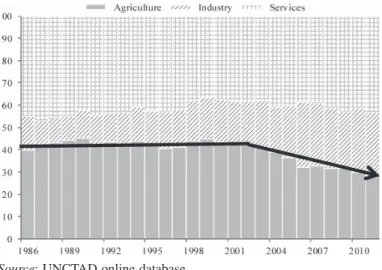
Lao PDR’s economy has grown at an average rate of about 6.4% per annum over the period 1986–2011. With a steady rise in population (about 2.2% per annum), GDP per capita grew about 4.2%, mirroring the trend in GDP. The Lao economy has experienced slow economic transition from agricultural-based growth to industrial-based growth. The share of agriculture to GDP decreased from 43% in 2001 to 28% of GDP in 2011, while the share of industry to GDP rose from 19% to 28% in the same period (Diagram 2). The share of services to GDP remained unchanged over the period 1986–2011, recorded around 42%.
Sectoral analyses covering key sectors such as agriculture; manufacturing and services are provided in Table 1 to gain better understanding about some of the sources of growth for the Lao economy. Agriculture contributed 44% of the GDP growth recorded in the period 1986–1990, although it dropped to 35% in the period 2001–2011. About 80% of the total population is engaging in farming and the overwhelming majority of them are the poor located in rural areas.
Agriculture can play a significant role in sustaining economic growth and improving the quality of life of Lao people, but it is largely characterized by subsistence rice farming and low produc- tivity.
The industrial sector has performed very well. It has achieved an impressive growth record of 11% on average, and accounts for 19% of GDP (Table 1). The industrial sector gradually contributed to GDP growth, rising from 12% in 1986–1990 to 25% in 2001–2011. The rapid growth of industrial sector is mainly driven by the resource sector, including mineral and electric- ity sectors. The country needs to invest and train more skilled labour in the manufacturing sector. This will help the country diversify from its heavy export reliance on the mineral and electricity sectors.
Services account for a large share of GDP (over 42%), and performance has been moder- ately strong, with growth around 7% on average (Table 1). Tourism is widely cited as an area of high growth potential in services for Lao PDR, but the present, poor information base pre- cludes any detailed analysis. Using World Development Indicator figures for cross-country
Table 1: Development of Laos real GDP by sector, period averages
Agriculture Industry Services
GDP growth
rate
Average growth
rate
Contribution to GDP
growth
Average growth
rate
Contribution to GDP
growth
Average growth
rate
Contribution to GDP
growth
1986–1990 4.5 3.7 43.7 8.5 12.2 3.2 44.1
1991–2000 6.2 4.7 42.7 10.2 16.0 6.0 41.3
2001–2011 7.2 3.3 34.6 12.0 25.0 9.4 40.4
1986–2011 6.0 3.9 39.7 10.6 18.7 6.9 41.6
Source: UNCTAD online database.
Source: UNCTAD online database.
Diagram 2: Sector share to GDP (%)
comparisons, however, it is clear that during 1995–2009 Lao PDR attracts only a tiny fraction of the tourists received by its neighbours which is about 3.9% of Thailand and 15.3% of Vietnam on average. Improving tourist infrastructure and service quality could allow Lao PDR to tap into these large regional tourist flows as part o f a multi-country visit.
3. Model specification and data
In this study, we investigate three types of monetary policy rules, including interest-rate based rule, monetary-based rule, and exchange-rate based rule. These three types are referred to as the Taylor rule (Taylor, 2001), the McCallum rule (McCallum, 1988), and the Ball rule (Ball, 1998), respectively. The key difference among them is the choice of the instrument in the central bank’s reaction function in response to changes in inflation, output, and exchange rate.
Since 1986, the Lao economy experienced both sharp fluctuations in the main macroeconomic variables and structural changes. Given this unstable nature of the economic environment in Lao PDR, the task of estimating a monetary policy rule is complicated. No single policy-rule equation is likely to capture fully all the aspects of central bank behaviour over the period 1986–2011.
3.1 Taylor rule
The Taylor rule is a monetary policy rule that prescribes how a central bank should adjust its interest rate policy instrument in a systematic manner in response to developments in inflation and macroeconomic activity. It provides a useful framework for the analysis of historical policy and for the econometric evaluation of specific alternative strategies that a central bank can use as the basis for its interest rate decisions. Following Taylor (2001), an empirical model of Taylor rule can be expressed as follows:
it=φ φ π φ0+ 1 t+ 2yt+φ3et+φ4et-1+φ5it-1+εt (1) where the subscript t−1 indicates the lagged values of the variables and φ0 is the constant term.
εt is the error term, assumed to be independently and identically distributed with zero mean and constant variance. it is one-year nominal interest rate on time deposit. πt is inflation rate, based on consumer price index. yt is output gap, measured by the deviation of real GDP from potential GDP, and et represents the growth of the real exchange rate, kip/US dollar.
The key variable is inflation rate (πt). Its coefficient, φ1, is expected to be positive and
greater than one. A 1% increase in inflation should prompt the central bank to raise the nominal interest rate by more than 1% in order to cool down an overheated economy. Since the real interest rate is defined as the nominal interest rate minus inflation, the real interest rate should be increased.
Other variables are controlled. The coefficient on output gap (yt), φ2, is expected to be positive. The output gap is a gauge of how far the economy is from its productive potential. It helps guide policy because it is an important determinant of inflation developments. A positive output gap implies an overheating economy and upward pressure on inflation. By contrast, a negative output gap implies a slack economy and downward pressure on inflation. A positive output gap might prompt policymakers to cool an overheating economy by raising policy rates, while a negative output gap might prompt monetary stimulus. Therefore, greater output gap is associated with higher short-term interest rate and vice versa.
The coefficient on growth of real exchange rate (et), φ3, is expected to be negative. An increase in the real exchange rate would call on the central bank to lower the short-term interest rate, which presumably would represent a relaxing of monetary policy.
The coefficient on lagged growth of real exchange rate (et-1), φ4, is expected to be positive and greater than the absolute value of φ3. That is, the initial interest-rate reaction to the current growth of real exchange rate (et), is partially offset by the next period of growth of real exchange rate (et-1).
3.2 McCallum rule
The McCallum rule uses the growth rate of monetary base as an instrument, rather than the short-term interest rate. The short-term interest rate has not been the most important instrument in conducting monetary policy in Lao PDR. Uncertainty in measuring real expected interest rates, shallow financial markets, and large shocks to investment or net exports may make mone- tary aggregates a preferred instrument. Esanov et al. (2005) argues that directly estimating the original McCallum rule has a major statistical disadvantage because it drops a large number of observations so as to average the velocity of money over the four-year period. Due to this drawback, the author estimates a modified McCallum rule in which the interest-rate instrument from of a Taylor-type rule is replaced by changes in a real monetary aggregate. Following Esanov et al. (2005), an empirical model of McCallum rule can be formulized as follows:
mt=β0+β π β π1 t+ 2 t-1+β3yt+β4et+β5et-1+β6mt-1+εt (2)
where the subscript t−1 indicates the lagged values of the variables. εt is the error term, assumed to be independently and identically distributed with zero mean and constant variance.
The term β0 is the constant, expected to be positive. It represents an increase in money supply in response to the autonomous component of money demand.
The coefficient on inflation rate (πt), β1, is expected to be negative. The central bank responds to an increase in inflation by reducing the money supply. In contrast, the coefficient on the lag one year of inflation rate (πt-1), β2, is expected to be positive and β1 ≤ β2, implying a stable correction process.
Other variables are also controlled. The output gap (yt) is used to assess economic condi- tions in order to set an appropriate stance for monetary policy. The coefficient on yt, β3, is expected to be negative as the central bank follows the policy of smoothing output fluctuations.
The coefficient on growth of real exchange rate (et), β4, is expected to be negative. A depreciation of exchange rate (an increase in the growth of real exchange rate) would call on the central bank to lower the growth of money stock, which presumably would represent a tightening of monetary policy.
The coefficient on lagged growth of real exchange rate (et-1), β5, is expected to be positive and greater than the absolute value of β4. That is, the initial money-growth reaction to the cur- rent growth of real exchange rate (et), is partially offset by the next period of real exchange rate (et-1).
3.3 Ball rule
The Ball rule uses the weighted average of the exchange rate and the interest rate as an instrument of monetary policy. Ball (1998) argues that interest-rate-based Taylor rules are inef- ficient. He stresses that monetary policy affects the economy through the exchange rate as well as through interest rate channels. Ball constructs a simple model having an open-economy IS curve, a Phillips curve, and a link between the interest and exchange rates. Following Esanov et al. (2005), an empirical model of Ball rule can be modified as follows:
θit+ -
(
1 θ)
et=αyt+β π δ(
t+ et-1)
+t (3) where θ is a weight that depends on the calibration of the model, δ is the effect of an exchange rate appreciation on inflation, and both α and β depend on calibrations of the model. The cali- bration parameters from Ball (1998) were used. For a robustness test, we use different weights and check their effect on the estimated coefficients.3.4 Data Description
In the empirical analysis, we use annual data from 1986 to 2011. The starting point of the sample period is determined by the introduction of a New Economic Mechanism which trans- forms the centrally-planned economy to a market-oriented one. Data on real money growth and interest rate are obtained from the BOL’s annual economic report. Interest rate is proxied by the one-year time deposit of the commercial bank.
Data on real GDP and nominal exchange rate were obtained from the Penn World Table, version 7. We then estimate the output gap which is measured by the difference between (log of) real GDP and its long term trend, proxied by (log of) Hodrick–Prescott trend. Real exchange rate is measured by real exchange rate of Lao kip against the U.S. dollar. Data on inflation are obtained from the World Bank’s World Development Indicator Database. Consumer price index (CPI) inflation is measured by year-to-year changes in CPI.
4. Empirical results
4.1 Estimation results
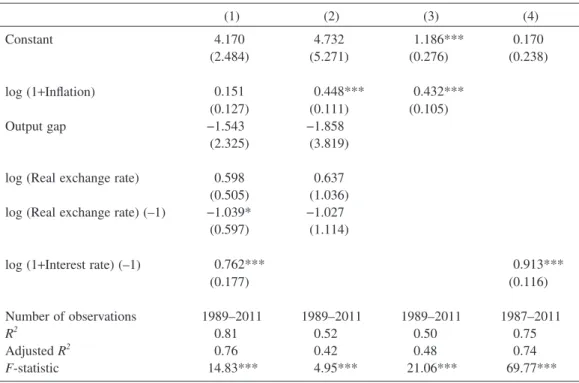
First, we estimate an open-economy version of the Taylor rule in column 1 of Table 2. All the coefficients have the expected signs, although only the lagged interest rate term is significant.
Based on equation (1), we calculate the long-run response of the central bank which is expressed as follows:
φ φ
φ
LR=
-15
1 (4)
where φLR is the long-run response on inflation and φ1 is the estimated coefficient for year- to-year inflation. We calculate a long-run response of about 0.64 so that the Taylor principle, i.e., φLR>1, does not hold. According to our estimations, the BOL reacts to a 1% increase of inflation with less than a 1% increase in the short-term nominal interest rate and hence, causes a decrease in the real interest rate. The impact of lagged interest rate on current interest rate is stronger when all variables, except lagged interest rate, are excluded, shown in column 4 of Table 2.
The estimation results suggest that a Taylor rule specified in a dynamic model does not describe well the interest-rate setting behaviour of the BOL, although a Taylor rule specified in a static model provides somewhat more promising evidence. As shown in column 2 of Table 2, inflation becomes statistically significant at 1% level when the lagged interest rate is dropped out
of the model. That is, the explanatory power of inflation increases in the static model (a model without lagged interest rate). Moreover, the explanatory power of the model specified in col- umn 2 is relatively low. Both R2 and adjusted R2 fall from 0.81 and 0.76 in column 1 to 0.52 and 0.42, respectively, in column 2. The impact of inflation on interest rate in static model is also confirmed by column 3 when only inflation rate is included into the model. The estimated impacts of inflation on interest rate in columns 2 and 3 are still less than one.
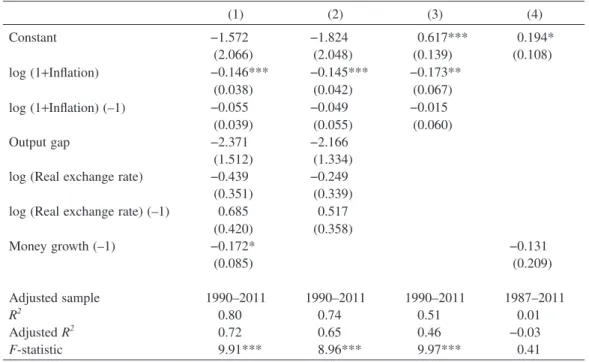
As shown in column 1 of Table 3, a modified McCallum rule explains the behaviour of the BOL better than an interest-rate-based rule. The estimated coefficients have the expected signs, except lagged money growth. The measure of the output gap is still statistically insignificant.
The impact of inflation on interest rate is statistically significant at 1%. This result is robust in static models. When lagged growth of money stock was dropped, the estimated coefficient on inflation in absolute term slightly decreases from 0.146 (Table 3, column 1) to 0.145 (Table 3, column 2). When all other independent variables were dropped out of the model, however, the estimated coefficient on inflation is larger (Table 3, column 3). This indicates that failing to control other variables can bias the estimation of inflation on money growth.
Table 2: Testing a Taylor rule for Lao PDR
(1) (2) (3) (4)
Constant 4.170 4.732 1.186*** 0.170
(2.484) (5.271) (0.276) (0.238)
log (1+Inflation) 0.151 0.448*** 0.432***
(0.127) (0.111) (0.105)
Output gap −1.543 −1.858
(2.325) (3.819)
log (Real exchange rate) 0.598 0.637
(0.505) (1.036)
log (Real exchange rate) (–1) −1.039* −1.027
(0.597) (1.114)
log (1+Interest rate) (–1) 0.762*** 0.913***
(0.177) (0.116)
Number of observations 1989–2011 1989–2011 1989–2011 1987–2011
R2 0.81 0.52 0.50 0.75
Adjusted R2 0.76 0.42 0.48 0.74
F-statistic 14.83*** 4.95*** 21.06*** 69.77***
Source: Author’s estimation.
Overall, our estimation result suggests that the Bank of Lao PDR has been targeting mon- etary aggregates in its policy decisions. Similar interpretation of monetary policy is also found by Esanov et al. (2005) for Russia and Tran (2009) for Vietnam. At times of high inflationary pressure, the Bank of Russia and the State Bank of Vietnam responded by reducing real monetary aggregates. The cumulative impact of current and lagged inflation on money growth is −0.201 for our empirical result which is between −0.078 for Esanov et al. (2005) and −0.29 for Tran (2009). Moreover, our result is not sensitive to model specifications.
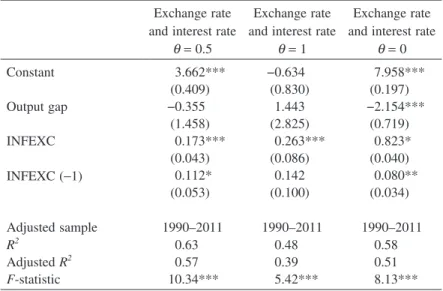
Estimation results for the open-economy Ball model are mixed. When exchange rate and interest rate are set to have equal weight with θ = 0.5, both the weighted average of current infla- tion rate and lagged one-year real exchange rate (INFEXC) and the weighted average of lagged inflation rate and lagged two-year real exchange rate (INFEXC (–1)) are statistically significant at 1% and 10% level, respectively (Table 4, column 1). The accumulated impact of the weighted average of inflation rate and real exchange rate on the weighted average of exchange rate and interest rate is about 0.285 (0.173 + 0.112), implying that a 10% increase in the weighted average of inflation rate and real exchange rate raises the weighted average of exchange rate and interest
Table 3: Testing a McCallum rule for Lao PDR
(1) (2) (3) (4)
Constant −1.572 −1.824 0.617*** 0.194*
(2.066) (2.048) (0.139) (0.108)
log (1+Inflation) −0.146*** −0.145*** −0.173**
(0.038) (0.042) (0.067)
log (1+Inflation) (–1) −0.055 −0.049 −0.015
(0.039) (0.055) (0.060)
Output gap −2.371 −2.166
(1.512) (1.334)
log (Real exchange rate) −0.439 −0.249
(0.351) (0.339)
log (Real exchange rate) (–1) 0.685 0.517
(0.420) (0.358)
Money growth (–1) −0.172* −0.131
(0.085) (0.209)
Adjusted sample 1990–2011 1990–2011 1990–2011 1987–2011
R2 0.80 0.74 0.51 0.01
Adjusted R2 0.72 0.65 0.46 −0.03
F-statistic 9.91*** 8.96*** 9.97*** 0.41
Source: Author’s estimation.
rate by 2.85%. The estimated coefficient on output gap is negative, but is not statistically sig- nificant.
When θ is equal to 1, only INFEXC is statistically significant at 1% level with the magni- tude of 0.263 (Table 4, column 2). When θ is equal to 0, both INFEXC and INFEXC (–1) are statistically significant, but the estimated coefficient on INFEXC is 0.823 (Table 4, column 3), which is much larger than its estimated coefficients for the cases of θ =0 5. and θ =1. In the empirical model of Ball rule (equation (3)), only real exchange rate is used as a monetary target when θ is set to 0. The large coefficient on INFEXC implies that the real exchange rate is highly responsive to INFEXC. In particular, a 10% increase in the weighted average of inflation rate and real exchange rate raises the real kip-dollar rate by 8.23%. However, attaching a 100%
to the real exchange rate is unrealistic given the central bank’s limited foreign exchange reserves.
Nevertheless, these results may indicate actual targeting of the exchange rate by the Bank of Lao PDR in the sample period.
4.2 Recursive residual tests for structural breaks
Among the three empirical models of monetary policy rules, the model of McCallum rule is preferred to explain the monetary policy rule conducted by the BOL and is subject to test for
Table 4: Testing a Ball rule for Lao PDR Exchange rate
and interest rate
Exchange rate and interest rate
Exchange rate and interest rate θ = 0.5 θ = 1 θ = 0
Constant 3.662*** −0.634 7.958***
(0.409) (0.830) (0.197)
Output gap −0.355 1.443 −2.154***
(1.458) (2.825) (0.719)
INFEXC 0.173*** 0.263*** 0.823*
(0.043) (0.086) (0.040)
INFEXC (-1) 0.112* 0.142 0.080**
(0.053) (0.100) (0.034)
Adjusted sample 1990–2011 1990–2011 1990–2011
R2 0.63 0.48 0.58
Adjusted R2 0.57 0.39 0.51
F-statistic 10.34*** 5.42*** 8.13***
Note: INFEXC = log (1+Inflation) + 0.5*log (Real exchange rate) (-1).
INFEXC (-1) = log (1+Inflation) (-1) + 0.5*log (Real exchange rate) (-2).
Source: Author’s estimation.
parameter stability. As indicated by Hansen (1992), estimated parameters of a time series may vary over time. Parameter stability tests are of particular importance, because unstable param- eters can lead to model mis-specification, which can bias the results. Pesaran and Pesaran (1997) suggest applying the cumulative sum of recursive residuals (CUSUM) and the CUSUM of square (CUSUMSQ) tests proposed by Brown et al. (1975) to assess the parameter constancy.
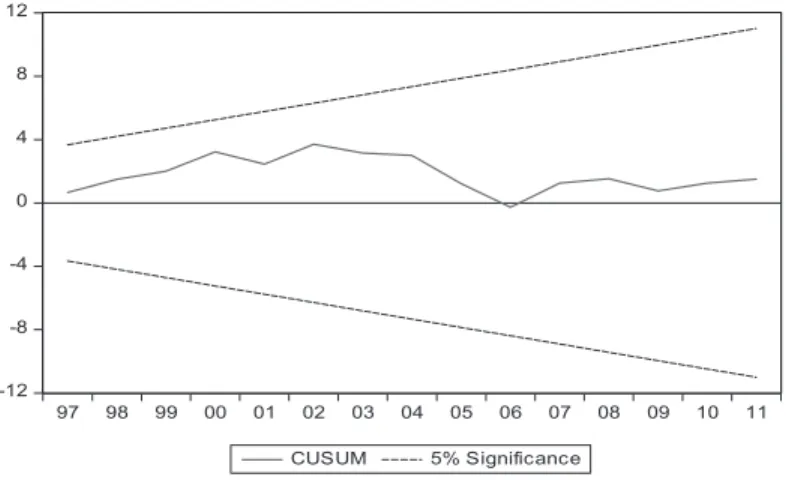
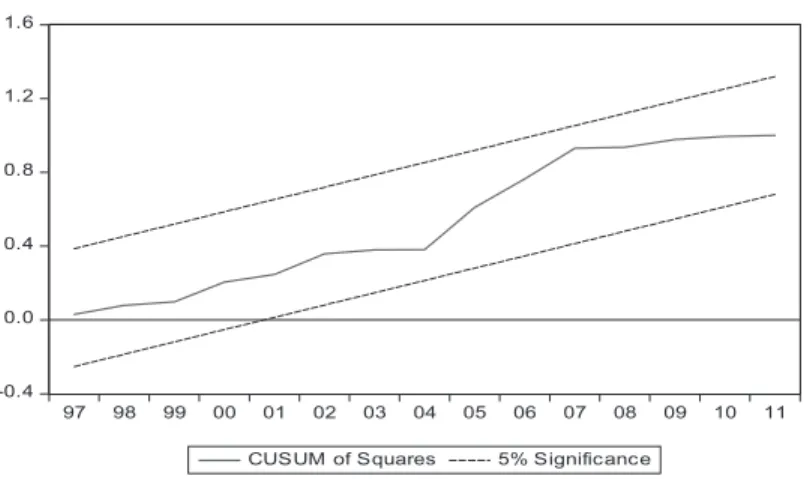
Both the CUSUM and CUSUMSQ tests plot the cumulative sum together with 5% critical lines.
Parameter instability is found if the cumulative sum goes outside the area between the two criti- cal lines. So, movement of the sample CUSUM and CUSUMSQ tests outside the critical lines is suggestive of coefficient instability.
The model of McCallum rule specified in equation (2) was estimated by ordinary least squares and the residual was subject to the CUSUM and CUSUMSQ tests. Diagrams 3 and 4 plot the CUSUM and CUSUMSQ tests. The results from the CUSUM and CUSUMSQ clearly indicate the absence of any instability of the coefficients because the plot of the CUSUM statis- tics is confined within the 5% critical bounds of parameter stability.
As a further check on parameter stability, the one-step forecast test allowing for the identi- fication of the specific point of break in the data series was conducted. The test result is pre- sented in Diagram 5. The upper portion of the graph (right vertical axis) reports the recursive residuals and standard errors while the lower portion (left vertical axis) shows the probability values for those sample points where the hypothesis of parameter stability would be rejected at
Source: Author’s estimation.
Diagram 3: Recursive CUSUM test on McCallum rule
-12 -8 -4 0 4 8 12
97 98 99 00 01 02 03 04 05 06 07 08 09 10 11
CUSUM 5% Significance
the 5, 10 and 15% levels. The point with p-value less than 5% corresponds to those points where the recursive residuals go outside the standard error bounds. In this case, the graph will sometime show dramatic jumps as the postulated equation tries to digest a structural break. As shown in Diagram 5, the one-step forecast test shows some instability of the coefficients, but the deviation seems to be transitory as the plot of one-step forecast returns toward the criterion bands. Therefore, the results of the one-step forecast test statistics generally corroborate those of the CUSUM and CUSUMSQ tests. This indicates that the structure of the parameters have not diverged abnormally over the period of the analysis.
Source: Author’s estimation.
Diagram 4: Recursive CUSUMSQ test on McCallum rule
-0.4 0.0 0.4 0.8 1.2 1.6
97 98 99 00 01 02 03 04 05 06 07 08 09 10 11
CUSUM of Squares 5% Significance
.000 .025 .050 .075 .100 .125 .150
-.4 -.2 .0 .2 .4
97 98 99 00 01 02 03 04 05 06 07 08 09 10 11 One-Step Probability
Recursive Residuals
Source: Author’s estimation.
Diagram 5: Recursive one-step forecast test on McCallum rule
To summarize, the econometric results show that the parameters estimated for the McCallum rule are stable, and that the inflation rate is a significant determinant of the real money growth in the Lao economy.
5. Conclusion
The paper reviews the conduct of monetary policy and the central bank’s rule-based behav- iour in Lao PDR. We test whether the Bank of Lao PDR reacts to inflation, the output gap, and changes in the exchange rate, in three types of monetary policy rules, namely the Taylor rule, McCallum rule, and Ball rule. Our results indicate that during the period from 1986 to 2011, the Bank of Lao PDR tends to follow the McCallum rule by using monetary aggregates as the main policy instrument to fight inflation. The response of money growth to inflation in Lao PDR is in line with other empirical studies on the conduct of monetary policy in developing countries. The rule calling for a constant growth rate of the money stock has many desirable features (Poole, 1999). First, it is easy for the public to understand. Second, the rate of infla- tion cannot take off toward plus infinity or minus infinity if money growth is held constant.
Third, interest rates are free to fluctuate in response to changing market conditions. Nonethe- less, a factor that complicates the use of the money stock as a policy instrument is the potential for instability in the demand for money either due to temporary disturbances or due to persistent changes resulting from financial innovation (Orphanides, 2007).
Lao PDR’s reliance on money targeting is in sharp contrast with the recent experience of other emerging market countries for which an interest rate rule describes well the behaviour of the monetary authority. Of course, our results are backward looking in the sense that they reflect relationships that exist to this point in the data. The experience of other emerging market countries indicates that the evolution of forward-looking behaviour among Laotian economic agents enhanced by the strengthening of the credibility of the Bank of Lao PDR and the improve- ment of its policy instruments as well as the deepening of Lao PDR’s financial markets may enable the Bank of Lao PDR to pursue an interest-rate policy rule.
References
Aghion, P., Bacchetta, P., Ranciere, R., & Rogoff, K. (2009). Exchange rate volatility and productivity growth: The role of financial development. Journal of Monetary Economics, 56, 494–513.
Aizenman, J., Hutchison, M., & Noy, I. (2011). Inflation targeting and real exchange rates in emerging
markets. World Development, 39(5), 712–724.
Ball, L. (1998). Policy rules for open economies. NBER Working Paper, 6760. Cambridge.
Bank of Lao PDR (BOL). (2011). Annual Report 2011. Vientiane: Bank of Lao PDR.
Berument, H., & Tasc, I. H. (2004). Monetary policy rules in pracetice: Evidence from Turkey. International Journal of Fiance and Economics, 9(1), 33–38.
Brown, R. L., Durbin, J., & Evans, J. M. (1975). Techniques for testing the constancy of regression relation- ships over time. Journal of the Royal Statistical Society, Series B, 37, 149–163.
Calderón, C., & Schmidt-Hebbel, K. (2003). “Macroeconomic policies and performance in Latin America,”
Journal of International Money and Finance, 22, 895–923.
Calderón, C., & Liu, L. (2003). The direction of causality between financial development and economic growth. Journal of Development Economics, 72(1), 321–334.
Esanov, A., Merkl, C., & de Souza, L. (2005). Monetary policy rules for Russia. Journal of Comparative Economics, 33, 484–499.
Hansen, B. E. (1992). Tests for parameter instability in regressions with I(1) processes. Journal of Business and Economic Statistics, 100, 321–335.
International Monetary Fund (IMF). (2012, October). Lao People’s Democratic Republic. Staff Report for the 2012 Article IV Consultation. Washington, D.C.: International Monetary Fund.
Joshua, A. M., & Ilan, N. (2011). Inflation targeting and real exchange rates in emerging markets. World Development, 39(5), 712–724.
Malik, W. (2007). Monetary policy objectives in Pakistan. PIDE Working Paper, 35. Pakistan Institute of Development Economics.
McCallum, B. T. (1988). Robustness Properties of rule for monetary policy. Carnegie-Rochester Conference Series for Public Policy, 29, 173–203.
Minella, A., Freitas, P., Goldfajn, I., & Muinhos, M. (2003). Inflation targeting in Brazil: Constructing cred- ibility under exchange rate volatility. Journal of International Money and Finance, 22, 1015–1040.
Mohanty, M., & Klau, M. (2004). Monetary policy rules in emerging market economies: Issues and Evi- dence. BIS Working Paper, 149. Monetary and Economic Department, Bank of International Settle- ments.
Orphanides, A. (2007, January). Taylor Rules. Finance and Economics Discussion Series, No.18. Washington, D.C.: Federal Reserve Board.
Otani, I., & Pham, C. D. (1996, May). The Lao People’s Democratic Republic: Systemic Transformation and Adjustment. Occasional Paper No. 137. Washington DC: International Monetary Fund.
Pesaran, M., & Pesaran, B. (1997). Working with Micro¯t 4.0: An interactive econometric software. Oxford University Press, Oxford.
Philippe, A., Philippe, B., Romain, R., & Kenneth, R. (2009). Exchange rate volatility and productivity growth: The role of financial development. Journal of Monetary Economics, 56(4), 494–513.
Poole, W. (1999). Monetary Policy Rules? Review. Federal Reserve Bank of St. Louis.
Taylor, J. B. (2001). Using monetary policy rules in emerging market economies. In: Stabilization and Monetary Policy: The International Experience, proceedings of a conference at the Bank of Mexico.
Torres, A. (2003). Monetary policy and interest rates: Evidence from Mexico. The North American Journal of Economics and Finance, 14(3), 357–379.
Tran, K. (2009). Monetary Policy in Vietnam: Evidence from a Structural VAR. World Bank.
Yazgan, M., & Yilmazkuday, H. (2007). Monetary policy rules in practice: Evidence from Turkey and Israel.
Applied Financial Economics, 17(1), 1–18.