Remarks on Relative Clauses in English Conversation:
Relevance of Speech Act Participants to Preferred Clause Types
*Yoshiharu K
UMAGAI1. Introduction
Relative clauses in conversation (Fox, 1987; Fox & Thompson 1990;
Fox & Thompson; 2007) appear to exhibit a unique characteristic in that the preferred and frequent clause type is object relative. This is contrastive to the frequent occurrence of subject relative clauses in written texts (Keenan, 1975) and oral narratives (Kumagai, 2012). Through a comparative analysis of the relative clause distribution in several types of texts, I will argue that a higher frequency of speech act participants inside the conversational relative clause can explain the seemingly puzzling characteristic found in conversation. Thus, the primacy of object-relative clauses in conversation does not constitute a serious counterexample to the Accessibility Hierarchy proposed by Keenan & Comrie (1977: 66), which indicates the general primacy of subject relatives in natural languages.
The structure of this article is as follows. The next section will outline the theory of relativizability of N(oun) P(hrase) in English and other languages (Keenan & Comrie, 1977), and apply the insight to the actual distribution patterns in several types of texts in English, by citing Keenan (1975) and Kumagai (2012). It will be clarified, as the Accessibility Hierarchy predicts, a subject NP is most accessible to relativization, that the subject relative is the most frequent type of relative clause and that the syntactically simple text may include a higher rate of subject relatives compared with other types.
In Section 3, the findings in the previous section will be compared with the
insights drawn from a series of works on relative clauses in conversation (Fox,
1987; Fox & Thompson, 1990; Fox & Thompson, 2007). I will argue that the
seemingly remarkable difference between conversation and other genres of
texts in terms of the preferred relative clause types must be partially relevant
to the high frequency of speech act participants (i.e., speaker and hearer) in conversational data. The differences among different referential expressions (including speech act participants and other entities) can best be captured by the Nominal Hierarchy, another typological generalization that exhibits the likelihood of a certain entity to become an agent or patient (Dixon, 1994:
85). Finally, I will address some potential problems regarding the category
“conversation” and point to the necessity of a study based on finer-grained sets of data for the purpose of a valid generalization on relativizability in discourse.
2. Relativization: Theoretical Background and its Applicability to Linguistic Data
2.1. Relativizability of NP
The research by Keenan & Comrie (1977) is a well-known cross-linguistic study on the relativizability of NPs in different grammatical roles. According to Keenan & Comrie (1977), the ease with which NP can be relativized in natural languages may be represented in the following implicational scale:
The Accessibility Hierarchy (based on Keenan & Comrie (1977: 66)) Subject > Direct Object > Indirect Object > Oblique > Genitive > Object of
Comparative
Here “subject” means that a relative pronoun has the grammatical role of a subject inside a relative clause (e.g., the man who came from New Zealand).
Such an NP is more accessible or relativizable than, for example, an NP with
a direct object role (e.g., the man (who(m)) I met yesterday). The NP category
on the left side of “>” is more accessible to relativization compared with any
other NP category on the right side. Thus, “subject” is the most accessible
NP type. Furthermore, if a language has a strategy of relativizing indirect
object, then such a language can also relativize any other NPs that are more
accessible than indirect objects (i.e., subjects and direct objects).
On the other hand, even if a language can relativize indirect objects, this fact alone cannot imply or guarantee the relativizability of NPs that are less accessible than indirect objects (i.e., obliques, genitives, or objects of comparatives). Keenan & Comrie (1997) also argue that if two NP positions that are not immediately ordered in the scale are relativizable (e.g., subject and genitive), then all NP positions between these two categories (i.e., direct object, indirect object, and oblique) must also be sensitive to relativization.
Furthermore and more importantly, any language that can relativize any NP at all can at least relativize subjects.
2.2. Preferred Clause Types in Written Texts and Narratives
The claim that the subject NP is most accessible to relativization in any language may make us believe that the subject should be the easiest and most natural grammatical role for relativization. Although NPs in any syntactic roles are relativizable in English, some NPs appear to be more frequently and easily relativized than other NPs, depending on their syntactic roles.
In order to check the validity of such an intuition and its consistency with the Accessibility Hierarchy, Keenan (1975) compared the actual frequency patterns of relative clauses in different types of texts. Keenan’s predictions are as follows: (i) the most accessible relative clauses in the Accessibility Hierarchy must conform to the most frequent relatives in a given text (p.
139) and (ii) the differences in the frequency of relative clauses, if they exist, should be ascribed to the syntactic complexity of a given text. In other words, the simpler the texts, the greater the proportion of relative clauses on the left side of the Accessibility Hierarchy (p. 141).
1Keenan selected four different types of written texts in British English.
For the sources of syntactically simple English, he chose several newspaper articles from the Sun and the Daily Mirror, which are popular tabloids that
“have lots of pictures, large headlines, short sentences, frequent paragraphs, and are obviously designed for ‘snapshot’ reading” (p. 141). In addition, George Orwell’s Animal Farm was chosen because, according to Keenan,
“there is very general agreement that Orwell’s sentences, which often present
the world as seen through the eyes of the ‘lower animals,’ are syntactically
simple” (p. 141). For the sources of English with complex sentence structures, Keenan selected To the Lighthouse by Virginia Woolf and several works by noted philosopher Peter F. Strawson.
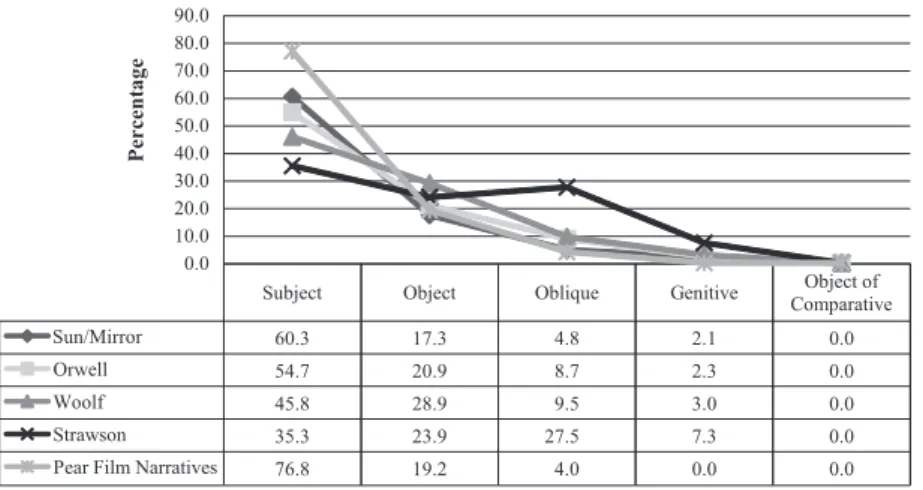
Figure 1 illustrates Keenan’s analysis of the relative clauses in the four types of texts, together with the result from a similar analysis by Kumagai (2012) of several spontaneous narratives of the Pear Film. The data were collected from the oral and spontaneous recounting tasks of a short film by 20 female and 18 male speakers of American English:
2Subject Object Oblique Genitive Object of Comparative Sun/Mirror 60.3 17.3 4.8 2.1 0.0
Orwell 54.7 20.9 8.7 2.3 0.0
Woolf 45.8 28.9 9.5 3.0 0.0
Strawson 35.3 23.9 27.5 7.3 0.0 Pear Film Narratives 76.8 19.2 4.0 0.0 0.0
0.0 10.0 20.0 30.0 40.0 50.0 60.0 70.0 80.0 90.0
Percentage
Frequency of Relative Clause Types in Different Types of Texts
Figure 1. Preferred Relative Clause Types in Different Kinds of Texts.3 Based on Keenan (1975): Figures 4 (p. 144) and 5 (p. 146),
and Kumagai (2012): Tables 7 and 8 (p. 52).4
It appears to be fairly clear from Keenan’s analysis that as the text becomes complex or highly structured, the ratio of subject relatives to object relatives becomes smaller. In the simple text groups (Sun/Mirror and Orwell), the ratio of subject relatives to object relatives is much higher than that in the complex text groups (Woolf and Strawson).
Likewise, the analysis of the Pear Film narratives, which are considered as
containing fairly simple clauses, clearly indicates subject relatives’ primacy
in frequency and a higher proportion of subject relatives to object relatives
(approximately 4:1).
To sum up, the subject relative clause corresponds to the most frequent type of relative clause, regardless of the complexity of texts. As the text becomes more complex, the ratio of subject relative clauses becomes smaller.
It can safely be said that these results support Keenan’s two predictions.
One important difference between the simple (Sun/Mirror, Orwell, and Pear Film narratives) and complex (Woolf and Strawson) data appears to lie in the higher ratio of non-argument relative clauses in the complex data, especially the oblique relative clauses in Strawson.
3. Relative Clauses in Conversation:
the Primacy of Object Relatives
Because we have found fairly consistent patterns of relative clause distribution in written texts of different degrees of complexity as well as in spontaneous oral narratives, this insight appears to be easily applicable to other types of texts. Unfortunately, however, the distribution of relative clauses in conversation appears to challenge this view. More specifically, a high frequency of object relatives to subject relatives has been reported in several representative studies.
For example, Fox (1987) investigated 92 relative clauses that appeared in various types of conversational data. The result is contrastive to the results in Figure 1 because the ratio of subject relatives (transitive: 10, intransitive:
36) to object relatives (46) is exactly the same (p. 858). In Fox & Thompson (1990), they culled 414 relative clauses from various types of conversational corpora. Out of these data, they analyzed 269 relative clauses with nonhuman heads. In addition, the ratio of subject to object relatives is again remarkably different. In fact, the ratio of object relatives is higher: 34% (91) for subject relatives (transitive: 23, intransitive: 68) and 56% (151) for object relatives (p. 302). Further, Fox & Thompson (2007) examined a total of 300 relative clauses in which 195 tokens were object relatives (including some adverbs).
This means that more than 50% of the analyzed relative clauses are non-
subject (especially, object) relatives (p. 296). If the subject relatives are
used, then the majority of the cases are intransitive clauses. Fox hints at a similarity in relative clauses between the object and intransitive subject (i.e., ergativity).
Let us consider the discussion by Fox. Fox argues that the distribution patterns of relative clauses in conversation are partly due to what she calls the “special discourse functions” of conversational relative clauses (Fox, 1987: 859, 861). Although one main purpose of relative clause formation is to restrict the range of reference of the head noun, typically by means of a highly transitive relative clause with a definite object (e.g., I saw the dog that bit the cat (Fox, 1987: 858)), the relative clause in conversation is more likely to involve a non-definite head noun with a less transitive predicate.
Fox argues that these relative clauses are specifically used for stabilizing or justifying the reference of a head NP by relating it to a referentially more familiar entity and to a less transitive predicate (= (1)), or by means of an intransitive and stative predicate (= (2)):
(1) This man who I have for linguistics is really too much.
(2) She’s married to this guy who’s really quiet.
((1), (2) = Fox (1987: 859))
In (1), the newly introduced and referentially vague head noun (this man) is related to the speaker in the conversation. The hearer can thus easily establish reference of the head noun with the help of a more definite and visible entity.
The predicate (have) indicates only a low degree of transitivity and hardly signifies a complex meaning related to the head noun. Likewise, in (2), the relative clause indicates a permanent property of the head noun and does not explicate any relation to another discourse entity. These characteristics appear to be contrastive to those found in the typical restrictive and identifying relative clause (e.g., the dog that bit the cat). The stabilization process is considered an important function in object as well as in the intransitive subject relatives, so that the newly introduced and/or referentially vague entity is to be further mentioned as a topic.
However, the results reported in Fox and Fox & Thompson sound
counter-intuitive, even if the special discourse function as characterized by Fox (1987) is factually correct. If the characterization in Figure 1 is valid, then syntactically complex and carefully thought-out texts should contain a higher percentage of object relatives than the simpler texts. Why is the trait amenable to relative clauses in a structurally complex text actually found in
“naturally-occurring conversations among friends and/or relatives” (Fox, 1987: 857)?
As for spontaneous oral narratives, Kumagai (2012) reports that the relative clauses in the Pear Film narratives are not significantly different from those in conversation, in view of a low degree of transitivity of predicates inside the subject and object relative clauses, and of a frequent use of pronominal subjects as anchors (in the sense of Prince (1981)) in object relatives. However, in the narratives, many of the relative clauses are used as identifying relative clauses for the purposes of re-introducing previously mentioned characters. In addition, the head NPs tend to be more concrete entities than those in conversations, even if they are introduced into narratives as new referents.
5Thus, questions remain as to why conversations have a higher frequency of object relatives, because spoken language (including conversation and narrative) is assumed to be less complex than well thought-out written language (Prince, 1981; Lambrecht, 1994) in a number of respects (including the pragmatic properties of subjects and the degree of transitivity).
4. Solution: Relevance of Speech Act Participants to Relativizability
There is a tendency to regard conversational data as more spontaneous,
simpler, and more natural than well thought-out written texts. However,
conversational data may not be as simple as we believe. Granting its simple
syntactic structure, low transitivity, and tendency of using non-lexical
subjects, conversation appears complex in other respects. For example, Labov
(1972: 377–378) points out the complexity of conversation in terms of the use
of tense, modality, and negation. Likewise, Biber & Conrad (2009: 92–96)
mention the frequent use of modal expressions, complement-taking verbs, and finite adverbial clauses in conversation. These observations indicate that although a speaker may codify a propositional meaning into a fairly simple syntactic structure, he/she tends to add to it various types of meanings related to his/her attitude or stance. I will argue that another but related characteristic must be taken into account in order to understand the seemingly different distribution of relative clauses in conversation.
A difference between conversation and other types of texts is partly reflected in the frequency in which speech act participants are codified in relative clauses. The relative clauses in conversation are more likely than other genres of texts (including spoken narratives) to contain speech act participants in the form of pronominal expressions (i.e., I and you). The speech act participants are likely to be found in the object relative clauses in which they serve to justify the reference of the head noun as a subject as well as an anchor (e.g., This man who I have for linguistics is really too much). In contrast, relative clauses in other genres of texts tend to contain pronominal and lexical NP expressions that refer to entities in the story, rather than the hearer (reader) or speaker (writer).
Interestingly, this difference corresponds to the degree in which certain nominal expressions can serve as the subject (which is typically likely to become an agent of an event) or object (typically, a patient). This is illustrated in Figure 2:
1st person 2nd person Demonstratives Proper Common nouns pronouns pronouns 3rd person nouns
pronouns Human Animate Inanimate
more likely to be in A than in O function Figure 2. The Nominal Hierarchy (Dixon, 1994: 85).
Although the likeliness for entities to become agent or patient may not be
directly related to the difference in the distribution of relative clauses, this
hierarchy can tell us that, as pointed out by Kumagai (2012: 63), there is a
referential “distance” between speech act participants (1st and 2nd person
pronouns) and other types of referential expressions. In narrative tasks, each narrator was required to talk about what happened in the fictional world.
In such cases, he/she must have had difficulties relating the characters and objects to themselves or to the interviewer.
6A similar line of argument should apply to newspaper articles and novels, let alone scholastic articles. The tendency of conversation to develop with speech act participants (I, you) as pivots (and in the case of relative clauses, as anchors and subjects) must, at least partly, have reflected the primacy of object relatives. On the other hand, the narratives analyzed by Kumagai (and possibly, the texts examined by Keenan) tend to develop through the use of 3rd person pronouns, proper nouns, and/or common nouns. It is this difference that appears to give conversational data a different property.
Since the characteristic in conversation, as adduced to by Fox and Fox &
Thompson, is found to originate from the types of frequent referents that serve to develop the content of the text, and since the properties of referential expressions can be independently captured by the Nominal Hierarchy, the assumed “unique” property in conversation does not constitute a serious counterexample to the Accessibility Hierarchy. Therefore, there is no need to reconsider the formulation of the hierarchy itself, as Fox (1987) intended to propose.
5. Concluding Remarks
5.1. Summary
The characteristics of relative clauses in the texts of conversation are neither puzzling nor counter-intuitive. In fact, the results reflect an important difference between conversation and other types of texts, in terms of the methods the texts are developed. In conversation, the contents are developed on the basis of the viewpoints of the speaker and hearer. In other types of texts, they are developed by entities that appear in the texts rather than the speech act participants.
In written texts and narratives, the subject relative clause is considered
as the most frequent type of relative clause, regardless of the complexity of texts. As the text becomes more complex structurally, the frequency of subject relative clauses tends to become low. The complex data may exhibit a higher ratio of non-argument relative clauses.
5.2. Potential Problems in the Category “Conversation” and Proposal for Further Study
Finally, I would like to propose that the category “conversation” should be reconsidered for the discourse analysis because the category sometimes appears to contain too many intricate and diverse matters that should have been sorted out beforehand. In their studies of relative clauses, Fox and Fox
& Thompson appear to emphasize the quantity rather than the quality or uniformity of the sampled data. In addition, the important properties of the data are sometimes underspecified and often, no reference is made to the contents of data. The data in Fox (1987) includes face-to-face conversations as well as phone conversations (both two-party and multi-party conversations).
Fox & Thompson (1990: 297–298) were explicit on the variety of participant types, the locations and time span where the data was collected, and the manners of the conversations:
“Our relative clauses were culled from transcripts of naturally-occurring conversations, recorded and transcribed by a variety of people, in different parts of the U.S. over a span of approximately 20 years. All of the participants in these conversations are native speakers of American English, as far as this can be determined. Many have had at least some college education. The data base includes both telephone and face-to-face conversations: many involve just two participants, but there are several with more than two.”
Fox and Thompson (2007: 296) also emphasized the variety of the data
examined. This was contrastive to the methodology taken in Keenan (1975)
and Kumagai (2012):
“Our data were culled by examining 36 audio- and video-taped American English conversations among people who were friends and family members of each other, ranging in length from 5 minutes to 1 hour. The conversations exhibit diversity in the age of the participants, region of the country, and date of recording.”
Thus, a further study will be necessary based on finer-grained sets of conversational data in order to check the validity of the claims in the present study. However, it is beyond the scope of the present study; therefore, it has to be explored elsewhere. I have assumed that in spite of the potential problem in the methodology by Fox and Fox & Thompson, the results gathered from their studies are reliable enough and indispensable. Furthermore, I have sought one possible solution to the primacy of object relatives in conversation in terms of the Nominal Hierarchy, without challenging the insight from the Accessibility Hierarchy and Figure 1.
Acknowledgments
Part of this research was presented in the linguistic colloquium held at Aichi Prefectural University on February 29, 2012, which was organized by the APU Higher Institute for Linguistic Research & Language Education. I wish to thank the audience for their invaluable comments, which helped me greatly improve the contents of this paper. This study was supported by JSPS KAKENHI, Grant Number 21520511.
Notes
1 Keenan made some other predictions (pp. 146–147); however, they were not directly related to the present study.
2 For the details of the analyzed data, see Chafe’s (1980) film, which can be viewed at http://pearstories.org/.
3 According to Keenan, there were 421 relative clauses in the corpus of the Sun and the Daily Mirror, 344 in Orwell’s Animal Farm, 675 in Woolf’s To the Lighthouse, and 798 in the collected works by Strawson. Note that the results in Keenan’s study include relative adverbials, which have been excluded from Figure 1. Thus, the total percentage of relative clauses in the four types of texts was less than 100%. In the case of the Pear Film narratives (where 151 relative clauses (female: 98 and male:
53) were analyzed), I have excluded relative adverbials from text counts from the beginning. In Figure 1, the indirect object category is combined with the oblique category because the former behaves in the same way as the latter in English.
4 There was little difference among speakers in the preferred types of relative clauses in the Pear Film narratives. For two male speakers, the ratio of subject relatives to object relatives was small, and for only one speaker, the frequency of object relatives was higher than that of subject relatives. For three females, the ratio of subject relatives to object relatives was small or equal, and for one speaker, the frequency of object relatives was higher than that of subject relatives. Since there was no difference between male and female speakers in the overall distribution patterns of relative clauses, the results for both types of speakers are totaled in Figure 1.
5 Unfortunately, Keenan did not mention the internal properties of the relative clauses that he analyzed.
6 Even though the object relatives in the Pear Film narratives tend to include pronominal subjects, just as in conversation, most of them refer to already mentioned characters and objects in the film. Furthermore, it is unusual to use the narrator or interviewer in the subject positions of relative clauses. They appear to be limited to the cases in which the head NP is not referentially concrete (e.g., all, the first man, something, the first thing). In this sense, the use of speech act participants appears to be similar to that in conversation. However, such cases are unusual in the narratives:
(i) That was a--ll that you saw of the man with goat. (F12)
(ii) And he’s got a hat on, so does the first man that I described. (F17)
(iii) So maybe you can see {laugh begins} something that {laugh ends} I didn’t.
(F1)
(iv) A--nd the first thing I noticed .. was .. the sound of the man picking .. pears. (F4)
References
Biber, Douglas & Susan M. Conrad. 2009. Register, genre, and style. Cambridge:
Cambridge University Press.
Chafe, Wallace L. (ed.). 1980. The Pear stories: Cognitive, cultural, and linguistic aspects of narrative production. Norwood, NJ: Ablex.
Dixon, R. M. W. 1994. Ergativity. Cambridge: Cambridge University Press.
Fox, Barbara A. 1987. The noun phrase accessibility hierarchy revisited: Subject primacy or the absolutive hypothesis? Language 63. 856–870.
Fox, Barbara A. & Sandra A. Thompson. 1990. A discourse explanation of the grammar
of relative clauses in English conversation. Language 66. 297–316.
Fox, Barbara A. & Sandra A. Thompson. 2007. Relative clauses in English conversation:
Relativizers, frequency, and the notion of construction. Studies in Language 31(2).
293–326.
Keenan, Edward L. 1975. Variation in universal grammar. In Ralph W. Fasold & Roger W. Shuy (eds.), Analyzing variation in language, 136–148. Washington, D.C.:
Georgetown University Press.
Keenan, Edward L. & Bernard Comrie. 1977. Noun phrase accessibility and universal grammar. Linguistic Inquiry 8(1). 63–99.
Kumagai, Yoshiharu. 2012. Relative clauses in narratives and conversations: Properties of head NPs and preferred clause types. Mulberry 61. 45–66.
Labov, William. 1972. Language in the inner city: Studies in the Black English Vernacular. Philadelphia, PA: University of Pennsylvania Press.
Lambrecht, Kund. 1994. Information structure and sentence form: Topic, focus, and the mental representations of discourse referents. Cambridge: Cambridge University Press.
Prince, Ellen. 1981. Toward a taxonomy of given-new information. In Peter Cole (ed.), Radical pragmatics, 223–255. New York: Academic Press.
会話における英語関係詞節の特徴:
発話行為参加者の存在と頻出関係詞節との関連
熊 谷 吉 治
会話に現れる関係詞節には、他の文体にない顕著な特徴があると言われて いる(Fox, 1987; Fox & Thompson, 1990; Fox & Thompson, 2007)。実際、会話 では目的格の関係詞節が最も頻繁に使われるのに対し、様々な難易度レベル の書き言葉(Keenan, 1975)や映画のあらすじを語ったナラティブ(Kumagai, 2012)では、主格の関係詞節が最も多く使われている。
このような差が生じる理由を説明するため、異なる文体における関係詞節 の内部構造を詳細に調査し比較を行った。その結果、会話では話し手(“I”) と聞き手(“You”)という発話行為参加者(Speech Act Participants)が、関係 詞節内の主語として先行詞の指示内容を安定化させる機能を果たす傾向が強 く、このような語用論的特徴が目的格関係詞節の頻度に関連していることを 示した。
書き言葉やナラティブでは、話し手や聞き手が関係詞節内に現れる頻度が 会話よりも低い。したがって、目的格関係詞節が会話において最も好まれる 関係詞節タイプであるとしても、自然言語における主格関係詞節の優位性を 示したAccessibility Hierarchy(Keenan & Comrie, 1977: 66)に対する重大な 反例になるとは言えない。会話における関係詞節の特徴は、どのような種類 の人(1〜3人称)やもの(固有名詞〜普通名詞)が出来事の動作主や非動 作主になりやすいかを示したNominal Hierarchy(Dixon, 1994: 85)の自然な 帰結だと考えるべきである。
最後に、「会話」というカテゴリーは他の文体に比べて複雑な言語的・社 会的要因を含んでいること、そして会話資料が常に単純な統語的構造をして いるとは限らない点を指摘し、会話資料を分析する上でのデータの取り扱い について具体的な提言を行った。