India : How is it Possible to be Neutral?
著者(英) Akihiko Akamatsu
journal or
publication title
Senri Ethnological Studies
volume 96
page range 159‑174
year 2017‑12‑15
URL http://doi.org/10.15021/00008678
159
Edited by Minoru Mio, Koichi Fujita, Kazuo Tomozawa and Toshie Awaya
Doxography and Perspectivism in Premodern India:
How is it Possible to be Neutral?
Akihiko Akamatsu
Kyoto University
1. Introduction
This paper elucidates the notion of neutrality held by the people of premodern India, which is attested in Jain philosophical texts, characterized as “doxography.” First, I must explain why the problem of neutrality was chosen as this paper’s subject. When I first heard of “peaceful development,” I had extreme doubts about the topic, thinking that development is unlikely to be peaceful. Are not peace and development two contradictory concepts? This skepticism might not be difficult to understand for those familiar with Indian thought, particularly its ancient form. It is the pravṛtti-nivṛtti contradiction that comes to mind when hearing of the “peaceful development” concept. As Greg Bailey (1985: 17) observes, “The ancient Indians considered the words pravṛtti and nivṛtti to refer both to a distinctive ideology and the life-style informed by that ideology.”
Moreover, Bailey presents the following description taken from the Mahābhārata 13,129.16–28, which includes “the central features of both ideologies”:
The norm characterized by pravṛtti is intended for householders. It is auspicious for all beings, therefore I will speak about it.
For one who is desirous of prosperity, gifts should repeatedly be given within the limits of one’s capacity. And one should sacrifice repeatedly and perform the rite of prosperity. The supreme dharma must be enacted zealously by humans. In conformity with dharma, wealth should be collected and that money which is obtained in accord with dharma can be distinguished in three ways. With one portion [of the money] the person desirous of prosperity should cultivate the interests of dharma, with another portion the interests of sense indulgence (kāma) and one portion should be made to accumulate.
Another norm is characterized by nivṛtti and it is called «liberation» (mokṣa). I will tell you about its associated life-style... For those who desire liberation, the dharma of loosening the bonds of desire is approved, as also [the practice] of not residing in the same village [every night] and compassion towards all beings. Nor should there be attachment to a bowl, to water, nor to the three staves [of an ascetic], nor to a bed, nor to a fire, nor to a place of refuge.
He [the ascetic] is one whose intellect is always directed towards the soul, is one who
is absorbed in Brahma, intent upon Brahma and continually occupied with yoga and the analysis of matter (sāṁkhyā). Always sleeping at the base of a tree, camping in deserted houses and resting on sandbanks in rivers, he holds no fondness for river banks.
[Hence] that twice-born one is freed from all attachments and the bonds of affection.
He is wholly occupied with the nature of the self and wanders around [absorbed] only in the self. He becomes motionless, fasts in accord with the ritual appropriate for liberation and wanders around controlled. He is the eternal dharma...
Such is the dharma of the knower of mokṣa which is described in the Vedas...
1). (Bailey 1985: 19–20)
The literal meaning of pravṛtti is “act of going forward.” The noun derived from the verb pra-vṛt-, which implies “activity oriented towards external attempts.” Contrary to pravṛtti, nivṛtti is an “act of returning and stopping,” derived from ni-vṛt-. It implies
“abandonment or cessation of all activity.”
2)As Bailey summarizes:
The description of pravṛtti centres on the value and uses of wealth and it connects wealth with the sacrifice. Wealth is not acquired merely for the sake of accumulation as in the West, but to sustain the universe via the custom of gift-exchange, .... Nivṛtti here is quite the opposite of this. Its ideology and associated life-style is quite simply attuned to the attainment of mokṣa. Everything is rendered subservient to this one goal.” (Bailey 1985:
20)
It therefore follows, as a matter of course, that “development” falls into the category of pravṛtti and “peace” into the category of nivṛtti. Peace and development are clearly contradictory, and “one cannot adhere to the one without abandonment of the other”
( Bailey 1985 : 20). Put in the strongest terms, then, peace cannot be achieved without abandoning development, and development cannot be accomplished without abandoning peace. Were this the conclusion of my paper, I could regrettably contribute no more to this topic.
Anyway, I should discuss why I chose to consider neutrality. By attentively reading the above -quoted passage taken from the Mahābhārata by Bailey, one might notice that pravṛtti and nivṛtti are construed as alternatives: pravṛtti is intended for householders who desire prosperity and nivṛtti for ascetics who desire liberation. That the two terms are alternatives means not only that they are mutually exclusive but also that each can be neutral when regarded from the different perspective of the other. Indeed, householders and ascetics, holding mutually different perspectives, live together harmoniously in India.
Thus, a householder’s perspective and an ascetic’s perspective coexist. Furthermore, people thus regard their own proper goals as prosperity or as liberation based on their life stage – Brahmacarya (student life), Gṛhastha (household life), Vanaprastha (retired life), Sannyāsa (renounced life) – in the Āśrama system.
It should be possible to treat relativizing one’s own perspective and regarding it as
neutral as a unique Indian argumentative style. Texts in this style are necessarily
introduced here as “doxographies,” although the term might be considered somewhat
strange.
3)If “historiography of philosophy” is a genealogical description of doctrines’
historical development – as in Aristotle’s description of philosophy, from its beginnings to Plato, in Book I of Metaphysics – then “doxography” is an approach showing almost no interest in doctrines’ historical spread and development. Rather, it treats the doctrines of each school as closed, ahistorical systems, and attempts to find a place for them amid contrasts between ways of thinking and viewpoints held by other parties. First, I introduce representative examples of such doxographies and clarify the unique perspectives found in them. Then, I consider perspectives related to neutrality, devoting attention to Jainist perspectivism as the background to such perspectives’ formation.
Here, I employ the texts of Jain monks Mallavādin (5
th/6
thcentury), Haribhadra (8
thcentury), Guṇaratna (14
thcentury), and Yaśovijaya (17
thcentury) to clarify the special characteristics of these perspectives.
2. On Doxography and Perspectives
The Sanskrit term Bhāratīya darśana is used in India today to mean “Indian philosophy.”
Bhāratīya means “of Bhārata,” which is an ancient name for India, while darśana, directly translated, means “seeing” (a noun derived from the verb root “dṛś-,” meaning “to see”). I have the word “darśana” in mind when using “viewpoint” in this paper. “Among Western historians of Indian philosophy,” however, “the terminological and conceptual correlation between philosophy and darśana is not normally accepted” (Halbfass 1988:
263). The reason, perhaps, lies in the fact that darśana, a term corresponding with “view,”
carries a strong nuance of intuitive insight; of enlightenment. There is, consequently, no clear separation between this concept and a religious view. Therefore, the term is thought to lack logic and objectivity, which are essential elements for Western philosophy. Indian scholars, however, have been known to appreciate this as a peculiarly Indian “viewpoint”
that while differing from Western “philosophy” rivals or surpasses it, taking up this term deliberately and imbuing it with worth.
The term darśana can be found in the titles of several sources referred to in this paper as “doxographies.” Among the most important, the oldest text of its type, is the Ṣaḍdarśanasamuccaya (meaning “Compilation of Six [Major] Darśanas”) by Haribhadra (8
thcentury). The Sarvadarśanasaṃgraha (meaning “Compendium of All Darśanas”), written by Mādhava (14
thcentury), might be designated as another particularly famous text. The important chapters of the latter became famous when a German translation by Paul Deussen (1845–1919) introduced into his Allegemeine Geschichte der Philosophie (1894–1917, 6 vols). However, an earlier translation into English exists. The text was probably used by Henry Thomas Colebrooke (1765–1837) as a systematic introduction to Indian “philosophy” for western readers. Consequently, the nature of the “Indian philosophy” first introduced to Europe principally relied on the Sarvadarśanasaṃgraha.
Here, I wish to first examine Haribhadra’s Ṣaḍdarśanasamuccaya. Haribhadra was a
scholar-monk who belonged to the Śvetāmbara (White-clad) sect of Jainism (a religion
that arose simultaneously with Buddhism, around the 6
thcentury BC). According to later
Jain tradition, he composed as many as 1400 works in his life. The extant works that can
be traced to him alone number around 90. Although some disagreement arises over dating his period of activity, the 8
thcentury apparently prevails among the field’s scholars.
4)The Anekāntajayapatākā (“The Victory Banner of Non-One-Sidedness”) is regarded as his main work. The “Non-One-Sidedness (anekānta)” of the title manifests the Jainist attitude to abstain from establishing a one-sided doctrine and to treat other schools’ views without refutation by admitting the existence of multiple viewpoints.
Haribhadra, himself, alternately refers to this attitude as “accumulation” (saṃhāravāda) or “mixed” (saṃkīrṇavāda), exhibiting intention to integrate multiple opposing philosophical perspectives. The Ṣaḍdarśanasamuccaya arguably has the same intent:
formatted as a digest or list of the doctrines of multiple contemporary philosophical schools, it attempts to present an integrated view based on “Non-One-Sidedness.” This work comprises 87 verses. Almost at the work’s beginning, Haribhadra states the following:
The wise should know that there are only six darśanas to be treated in this text, out of regard for the fundamental difference between deities (devatā) and principles (tattva).
Bauddha, Naiyāyika, Sāṃkhya, Jain, Vaiśeṣika, and Jaiminīya (Mīmāṃsaka)—these are the names of the six darśanas.
5)As for the devatā, the personified deities that are the subjects of faith in each school or sect, Sugata is devatā for the Bauddhas, Śiva for the Naiyāyikas, Īśvara for some Sāṃkhyas (some others are atheists), and Jinendra, i.e., Mahāvīra, for the Jains. The Vaiśeṣikas, like the Naiyāyikas, take Śiva as their deity. Regarding ontology, however, the Vaiśeṣikas classify all things that exist into six categories (padārtha), whereas the Naiyāyikas enumerate 16 padārthas. Therefore, these two schools differ. In contrast, the Mīmāṃsakas do not accept the existence of a personified deity: as atheists (nāstika), they differ from the other schools.
Within the book as a whole and this specific quotation, darśana might be taken to mean the “viewpoints” or “systems” of the various schools. By discussing the distinctions between theoretical systems – indicating the standards for classification – and seemingly assigning no special position to the doctrine of his own (Jain) philosophical position, Haribhadra ‘s philosophical approach arguably admits the multiplicity of perspectives.
This does not mean, however, that no problematic points exist throughout the text. For instance, the Yoga and the Vedānta are not included in the six systems. Moreover, the systems taken up by Haribhadra in his book do not add up to only six; at the end of the text, the Lokāyata system, which developed as a materialist philosophy in ancient India, is added.
If the purpose of Haribhadra’s text is, as indicated in the first verse, to “present summaries of the doctrine of each school,” then omitting to mention the ancient Yogic and Vedāntic doctrines, which carried on the Upaniṣad tradition, can only be regarded as strange. In fact, not only this work but also later texts created within Jainism, which is classified within the “doxography” genre, do not treat either as independent systems.
Within the text, however, verses 78 and 79 explain the reason for separately
summarizing Lokāyata doctrines at the end: Vaiśeṣika and Naiyāyika are sometimes treated together as one school. In such cases, the Lokāyata system may be presented as separate. Why, then, is Lokāyata not treated from the beginning as a seventh theory? An answer to this question may lie in the text: all six original darśanas might be classified as āstika (orthodox), whereas Lokāyata is nāstika (heterodox), insisting that “there is no Self (jīva), no liberation (nirvṛti); there is no dharma and adharma (both being regarded as imperceptible causes of transmigration by the orthodox), and no retribution for good and evil deeds (puṇya-pāpa).”
6)Therefore, this doctrine is incompatible with a classification method in which the existence of deity (devatā) and principle (tattva) are standard. Althoughit isnot yet clear why the separation of the Lokāyata system is seen, I will proceed with my examination. For purposes of comparison, I wish to examine here another “doxography” described earlier: Mādhava’s Sarvadarśanasaṃgraha.
Mādhava is widely known to have been Advaita-Vedāntin. His work comprises 16 chapters, the first three of which contain views related to (1) the Cārvākas (or Lokāyatas), (2) the Bauddhas, and (3) the Jainas, which are all anti-Vedic, heterodox schools from the Vedāntic perspective. The next two chapters explore (4) Rāmānuja’s and (5) Madhva’s systems, which are Vedāntic schools, but not Advaitan. Next, four systems of sectarian Hinduism are discussed: those of (6) the Nakulīśapāśupatas, (7) the Śaivas, (8) the Pratyabhijñās (the Śaivas of Kāsimīra), and (9) the Raseśvaras. Subsequently, the views of the six classical schools are treated: (10) the Vaiśesikas, (11) the Naiyāyikas, (12) the Mīmāṃsakas, (13) the Pāṇinīyas, (14) the Sāṃkhyas, and (15) the Yogas.
Finally, Mādhava describes his own school’s view: (16) Śaṅkara’s Advaita-Vedāntic philosophy.
Chapters (1)–(3) consider anti-Vedic, unorthodox schools. Chapters (4) and (5) cover two schools of thought that belong to Vedānta, yet simultaneously oppose Advaita.
Chapters (6)–(9) concern Tantric Hindu sects, while chapters (10)–(16) consider classical schools. In discussing each school’s systems, the author’s uniqueness clearly lies in distinguishing religious sects from the schools preserving classical systems. Although Mādhava places his own sect’s teachings last, he places the theories of Rāmānuja (11
thcentury) and Madhva (13
thcentury) before the various Hindu sects, and near the unorthodox sects. He then places Sāmkhya and Yoga immediately before Advaita, perhaps because they are not substantially opposed to it, even though they insist on a dualism (dvaita). One cannot fail to notice the strong subjectivity in the ordering of each school’s views. Although it is also a “doxography,” the previously examined Ṣaḍdarśanasamuccaya summarizes the various sects’ doctrines from a very different perspective. Though Mādhava summarizes the various sects’ doctrines with intent to treat them comprehensively, he places his own school (Advaita) at one extreme and ranks other schools’ teachings by their degree of conflict with his own system. In contrast with this method of ordering, Haribhadra, in the Ṣaḍdarśanasamuccaya, writes from a circumspective position, attempting to view all systems, including his own (Jainism), as mutually equidistant.
After making such a clear distinction, we should not proceed without first checking
if such a perspective is actually possible and, if so, how it could have been practiced by
the Jains.
3. On Neutrality
One commentary on Haribhadra’s Ṣaḍdarśanasamuccaya, called Tarkarahasyadīpikā (“The Lamp Illuminating the Secrets of Logic”), was written by Guṇaratna, a figure who was active in the 14
thcentury. His period of activity overlaps that of Mādhava, author of Sarvadarśanasaṃgraha. In his commentary, Guṇaratna often emphasizes the importance of “not being partial to one’s own darśana and maintaining neutrality”
(svadarśanapakṣapātaṃ parihṛtya mādhyasthyam avalambamānaḥ). For example, in the third chapter (completing his discussion of the Sāmkhyas) and immediately before the beginning of the fourth chapter (on his own Jainism), Guṇaratna states the following.
We must always examine every view repeatedly by hundreds of modes of reasoning, abandoning partiality and maintaining neutrality. The wise should respect only the view that seems to conform to reason and that does not have the faintest whiff of inconsistency.
As has been said [by Haribhadra]:
“I do not favor Mahāvīra [founder of Jainism], nor do I hold any dislike towards people like Kapila [founder of the Sāṃkhya system]. What is important is to have confidence in the person whose statements are in accord with reason.”
7)This verse of Haribhadra is also cited in the preface of Tarkarahasyadīpikā (p.8, ll.
17–18). It is explicitly stated there that the citation is from the same author’s Lokatattvanirṇaya. The idea of “being neutral” (mādhyasthyam) is repeated in the commentary on the 58
thverse, at the end of the fourth chapter on Jain teachings (p.256, ll. 17–19), and at the end of the text itself (p.310, ll. 10–12).
This is certainly an expression of perspectivism that sees all views, including one’s own, as equidistant. More than anything, this notion is apparently given clear expression through “neutrality” (mādhyasthyam),
8)described by Yaśovijaya (1624–1688) as the 16
thof the 32 moral and intellectual virtues in his Jñānasāra.
1. sthīyatām anupālambhaṃ madhyasthenāntarātmanā / kutarkakarkarakṣepais tyajyatāṃ bālacāpalam //
Keep no reproach by the neutral spirits. Abandon a childish rash act by renouncing pebbles of irrational arguments. (16.1)
2. manovatso yuktigavīṃ madhyasthasyānudhāvati / tām ākarṣati pucchena tucchāgrahamanaḥkapiḥ //
The calf of mind of the neutral runs after the cow of logical reasoning. The monkey of mind, being attached to worthless, draws the cow towards it by its tail. (16.2)
3. nayeṣu svārthasatyesu mogheṣu paracālena / samaśīlaṃ mano yasya sa madhyastho mahāmuniḥ //
Viewpoints that are true for their own position are useless for others’ acts. One whose
mind is always even on such viewpoints is the neutral and the great Muni. (16.3)
4. svasvakarmakṛtāveśāḥ svasvakarmabhujo narāḥ / na rāgaṃ nāpi ca dveṣaṃ madhyasthas teṣu gacchati //
People are attached to the results produced by their own acts and enjoy their own retribution. The neutral goes with having neither attachment nor aversion to them. (16.4) 5. manaḥ syād vyāpṛtaṃ yāvat paradoṣaguṇagrahe /
kāryaṃ vyagraṃ varaṃ tāvan madhyasthenātmabhāvane //
Even when the mind is engaged in the vices and virtues of other people, the neutral should concentrate solely on his own soul. (16.5)
6. vibhinnā api panthānaḥ samudraṃ saritām iva /
madhyasthānāṃ paraṃ brahma prāpnuvanty ekam akṣayam //
As the different routes of the rivers stream into one and the same ocean, the ways of the neutral, although different, reach the one and indestructible absolute Brahman. (16.6) 7. svāgamaṃ rāgamātreṇa dveṣamātrāt parāgamam /
na śrayāmas tyajāmo vā kintu madhyasthayā dṛśā //
It is not only because we love our traditional doctrine that we depend on it. It is not only because we hate others’ doctrine that we reject it; but it is because we adopt a neutral attitude. (16.7)
8. madhyasthayā dṛśā sarveṣv apunarbandhakādiṣu / cārisañjīvinīcāranyāyād āśasmahe hitam //
We adopt a neutral attitude in the hope that this will lead to well-being (hita), just as someone who knows that one among a group of herbs is restorative but does not know which one it is, acts reasonably if they swallow the entire lot. (16.8) (Ganeri 2008: 4) Yaśovijaya Gaṇi was born in Gujarat in 1624 and died there in 1688. The Gujarat of his day was “home to a diverse trading population, including Arab, Farsi, Tartar, Armenian, Dutch, French and English mercantile communities” (Desai 1910: 54). He considered himself Haribhadra’s successor. According to Dundas (2004: 131), “it was Haribhadra’s reputation for being influenced only by the logical cogency of doctrines and viewpoints (anekāntavāda) that appears to have shaped Yaśovijaya’s irenic but also critical attitude towards other sects and traditions.”
Jonardon Ganeri elucidates the verses presented above as follows:
Neutrality is explained in terms of the dispassionate use of reason: a person who embodies this virtue follows wherever reason leads, rather than using reason only to defend prior opinions to which they have already been attracted. Yaśovijaya stresses that neutrality is not an end in itself but rather a means to another end. .... As we can see from this example (16.8), philosophy is thought of as a medicine for the soul, the value of a doctrine to be judged by its effectiveness in curing the soul of its ailments. That is why it can be reasonable to endorse several philosophical views simultaneously, just as one can take a variety of complementary medicines. (Ganeri 2008: 4)
However, is it possible to see all views, including one’s own, in a neutral or
objective way? Is it not impossible for a sect’s proponent to maintain neutrality on its
teachings from inside the sect itself, making this either mere paraphrased egocentrism or mere rhetoric? Such criticisms are readily conceivable.
In fact, Haribhadra orders the chapters of Ṣaḍdarśanasamuccaya as Bauddha–
Naiyāyika–Sāṃkhya–Jain–Vaiśesika–Mīmāṃsaka–Lokāyata, thus placing the Jain system directly in the middle, with three systems both before and after. It seems that “being neutral” means “standing in the middle,” with the Jain sect at the center. It must be said that this neutrality, even if it cannot be called egocentrism, occupies a gray area, such that it is eventually impossible to hold one truly objective position towards all other views. Still, the Jain tradition offers a perspective that might make such a position possible.
4. On Perspectivism
Mallavādin was a scholar-monk of Śvetāmbara in the 5
thor 6
thcentury, preceding both Haribhadra and Guṇaratna. His Dvādaśāranayacakra (“The Twelve Spoked Wheel of Perspectives”) does not survive today as an independent work, but we can understand its general contents from the text of Siṃhasūri’s 7
thcentury commentary, the Nyāyāgamānusārinī (“Logical Investigations”). The text is extremely important for understanding the beginnings of the ancient Indian philosophical tradition. The 6
thcentury was a time when the various schools’ traditions had just begun to form. Early commentaries on each of the basic scriptures (sūtras) were just being created. Mallavādin describes the thought of Bhartṛhari (5
thcentury), of the grammarian school, and Dignāga (c. 480–540 AD), originator of the Buddhist logical school.
As its title indicates, the Dvādaśāranayacakra attempts to systematize perspectives or viewpoints. Mallavādin was the first to formulate the so-called naya-system – the viewpoint-system through which judgments are made – and applying it to the various doctrines of the other schools. If the previously examined “doxographies” attempted to summarize and holistically grasp each school’s teachings, then this text systematically classifies “viewpoints” as structures that underlie and produce each school’s statements, seeking to explain how these engender each school’s teachings. “Even if what is seen is one, there are various ways of seeing”
9)are the words of the grammarian-scholar and linguistic philosopher Bhartṛhari. Mallavādin apparently envisions this text as continuing the Indian “perspectivism” tradition this thought inspired. Wilhelm Halbfass, who seems to have held Mallavādin’s thought in high esteem, comments as follows:
Mallavādin’s scheme systematizes and radicalizes the traditional Jaina perspectivism,
evaluates views of other schools as relative and valid in a limited way, and accepts all of
these as equally legitimate and limited approaches to reality. Instead of trying to establish
the sheer falsity of individual doctrines, Jainism attempts to expose them in their
one-sidedness and interdependence and to relegate them to their position in a totality of
complementary perspectives. It does not negate them; it claims to include and transcend
them in its own comprehensive framework. Mallavādin’s “ontology” is thus inseparable
from his inclusivistic and perspectivistic doxography. This implies that it is often difficult
to distinguish between doxographic presentation and systematic reconstruction and extrapolation. (Halbfass 1992: 171)
The traditional Jain perspectivism Halbfass describes here is generally designated as
“Jain relativism.” Their ideological approach of “Non-One-Sidedness,” described previously as the Jain approach, is also called syādvāda. Matters might be viewed from diverse perspectives, and judgments towards things might only take the form of statements, such as “when viewed from perspective p (syād), x is y,” a notion upon which Jainism has insisted since its founding by Mahāvīra. Mallavādin enumerates and systematizes 12 possibilities for this “perspective p,” advocating their concrete application to the beliefs of all schools and the statements of thinkers prevailing at the time.
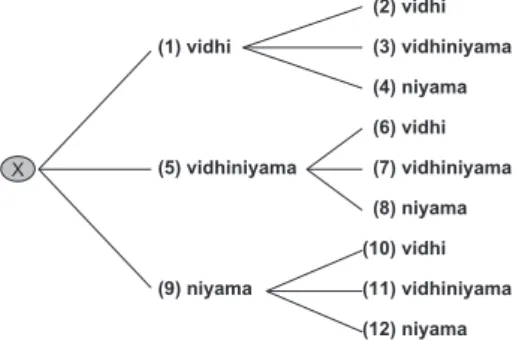
There is insufficient space here to thoroughly explain Mallavādin’s discussion of these various perspectives. Therefore, this brief explanation of its basic framework must suffice. Mallavādin insists that, in this world, some things change and diversify whereas others remain perpetually unchanged. The notion of the “twelve perspectives” is an attempt to explain this claim’s formation based on one’s perspective. Mallavādin first presents ideas of vidhi (affirmation) and niyama (restriction) as two fundamental means of appropriately adopting perspectives from which to view things. The question of how best to understand these two is quite complex; for present purposes, it suffices to see the former as a “substantive” and the latter as an “epistemic” means of handling things.
According to Mallavādin, there are three perspectives from which things might be viewed: the vidhi perspective (V), the niyama perspective (N), and a perspective for which vidhi and niyama coexist (W). These three perspectives are, in fact, three types of epistemological perspectives towards particular things. Nevertheless, when they are transformed into ontological perspectives, three more perspectives become possible for each. Consequently, a list of all twelve perspectives would comprise V, VV, VW, VN, W, WV, WW, WN, N, NV, NW, and NN (See Figure 1).
Figure 1 Twelve Perspectives
(2) vidhi (3) vidhiniyama (4) niyama (6) vidhi (7) vidhiniyama (8) niyama (10) vidhi (11) vidhiniyama (12) niyama X
(1) vidhi
(5) vidhiniyama
(9) niyama