Ritual Application of Mensuration Rules in India : An Edition of Gan?esa's
Kun?d?asiddhyudahr?ti with Mathematical Commentary
著者(英) Takao Hayashi
journal or
publication title
Bulletin of the National Museum of Ethnology
volume 12
number 1
page range 199‑224
year 1987‑09‑05
URL http://doi.org/10.15021/00004356
H AYASHI R itual A pplication of M en su ration R ules in lnd ia
Ritual Application of Mensuration Rules in India:
An Edition of Gatiega's Kundasiddhyudahrti with
Mathematical Commentary
Takao HAYASHI*
1. INTRODUCTION 1. Kundasiddhyudahrti 2. Author
3. Kunda
4. Place-value system 5. Quotations
6. Editions of the MatzVapakundasiddhi 7. Manuscript
8. Apparatus
9. Symbols used in the text 2. TEXT
1. caturasrakundam 2. yonikunclam 3. ardhacandrakundam 4. tryasrakundam 5. vrttakundam
6. 1. visama4adasrikunclain 6. 2. samasadasrikundam
7. padmakundam 8. 1. vi§amastasrikundam 8. 2. samastasrikundam 3. COMMENTARY
0. Introductory remarks 1. Square kunda
2. Kuryla shaped like a vulva.
3. Semicircular kunda 4. Triangular kunda 5. Circular kunda
6. 1. Irregular hexagonal kunda 6. 2. Regular hexagonal kunda 7. Kuryla shaped like a lotus 8. 1. Irregular octagonal kunda 8. 2. Regular octagonal kw*
4. APPENDIX: Marglapakwylasiddhi 31-47 (on kunda)
ABBREVIATIONS KSU: Kundasiddhyudahrti of Gariega.
L: Lilavati of Bhaskara.
MKS: Manclapakundasiddhi of Vitchaladiksita.
1. INTRODUCTION
1. 1. Kundasiddhyudahrti
The Kundasiddhyudahrti is a prose commentary on nine verses (39-47) of
* Dept. of Mechanical Engineering, Doshisha University, Kyoto .
199
国立民族学博物 館研 究報 告 12巻 1号
Vitthaladiksita's Mandapakundasiddhi, and deals with the mensuration of eight kinds of kundas. The KSU is interesting to the student of the history of Indian mathematics as well as to the student of Hinduism because the work, which contains many citations from the Lilavati of Bhaskara, shows us how the traditional mathematics (ganita) was employed in a field other than mathematics and astrono- my (jyotisa).
1.2. Author
The KSU was written by Gar.i6a, son of Sridhara, in Nandigramal) (Nandod, Gujarat) some time between A.D. 1619, when Vitthaladiksita composed his KMS [RAGHAVAN 1968: 182], and A.D. 1836, when the manuscript used for the present edition of the KSU was copied (see 1.7. below). We know a Ganega, who wrote a commentary called Siromaniprakaa upon the SiddhantaSiromani of Bhaskara in Nandigrama in the early seventeenth century; but his father was KeAava [PINGREE 1971: 106b-107a, 1981: 126]. Keiava was in turn the grandson of the famous GarieSa (born A.D. 1507), who wrote no less than ten works on jyotisa, including the Buddhivilasini, a popular commentary on the L [PINGREE 1971: 94-106]. The existence of abundant citations in the KSU from the Lilavati shows that our Gariega also was versed well in the traditional mathematics, although we cannot trace his lineage beyond his father.
1. 3. Kunda
Kundas are pits on the ground for holding ceremonial fire in religious cere- monies. They are classified into eight according to their shapes : caturasra (square), yoni (vulva), ardhavalaya (semi-circle) or ardhacandra (half-moon), tryasra (triangle), vrtta (circle), saclasri (hexagon), padma (lotus), and ast:cisri (octagon). On a certain ceremonial spot, for example, these eight kunc/as are arranged on the eight cardinal points surrounding a central vedi (fire-altar). The arrangement in that case starts from the east and proceeds clockwise in the above order; and the ninth kunc/a, which is either caturasra or vrtta, is placed in the north-east by east [MKS 31-32].
Every kw/a has to measure, without regard to its shape, an area determined according to the number of havanas (oblations) in the particular ceremony in which it is used2). A failure in the measurement of kundas is said to cause something unfavourable to the yajamana (sacrificer)3). Thus arises a mathematical problem :
to draw those geometrical figures with reasonable exactness in area by means of
1) See the concluding verse of the KSU (p. 110 below).
2) See Sec. 3.0 below.
3) Vitthaladilqita, in commenting upon the irregular hexagonal kw* (MKS 43), cites a half Sloka:
manalhikye bhaved rogo manahine daridratal
(In the case of excess of area, there will be a disease;
in the case of defect of area, there will be poverty.)
200
HAYASHI Ritual Application of Mensuration Rules in India
a rope (sutra) and a pair of compasses (karkata). The nine verses (39-47) of the MKS give a solution to this problem, while Ganega carries out computations of
the areas of the kundas obtained.
1. 4. Place-value system
Gariega uses a place-value system, in which eight units make the next higher unit, for fractions of the linear measure angula (finger breadth). This simply results from the table of linear measures used in the MKS itself4):
1 hasta = 24 angulas, 1 angula = 8 yavas, 1 yava = 8 yrdcas, 1 yaka = 8 /ilssas, 1 liksa = 8 balagras, etc.
Similar tables are recorded in various works such as the Brhatsarnhird [VARAHAMIHIRA 1968: 57, 1-2] , Ganitasarasamgraha [MAHAVIRA 1963: 1, 25-31], and the Puranas5). The MKS takes the above table to be a variable system; that is, the hasta is defined as one-fifth of the total height of an individual yajamana with his hands stretched upwards6). It may be pointed out in this
connection that Gariega does not seem to follow any principle when he obtains approximations of fractions: he sometimes carries out his computations down to the fourth place (beilagra) below the angula, but is usually satisfied with the second place (Aka). Again, he seems, in a few cases, to count fractions as a unit when they are no less than half, but usually cuts them without regard to their magni- tudes.
1. 5. Quotations
Garjeia's computations of the areas are based exclusively on the mensuration rules of the Liltivati. He cites the following rules:
1) algorithm for squaring a number (L 19) [in Sec. 1];
2) algorithm for taking the square root (L 22) [in Sec. 2];
4) MKS 3-4:
krtordhvabahoh samabhiigatasya kartub garainiah prapadocchritasya/
yo va sa hasto 'sya jinarniako 'pi syad angula tattadibharpiaka ye//
yavo ytika ca liksa ca balagram caivarnalayah/
krtamustih karo ratnir aratnir akanisthikall
(One-fifth of <the total height of> the sacrificer, who is standing on tiptoes on a plane surface of the earth with his hands stretched upwards, is a hasta (cubit), and a twenty-fourth of it
shall be an angula (finger breadth). One-eighth of each of yava, yukci, liksa, baldgra, etc. is <the
measure of> its succeeding one. A kara (cubit), with the fist clenched, is a ratni, and a ratni,
without the little finger, is an aratni.)
5) Velyupureiva, chap. 101, 115-127; Matsyapureina, chap. 258, 17-18; and [3HojA 1966: chap.
9, 4-5]. cf. also [KIRFEL 1920: 331].
6) See footnote 4 above.
国立民族学博物館研究報告 12巻 1号
3) sides of a right triangle (L 136), c,----,Ia2+b2 [in Sec. 2]
c2 — a2 [in Sec. 8. 2];
4) avadhcis (L 165) and perpendicular (L 166) of a triangle,
= [a — (b + c) (b — c) I a] 12 a2= [a+ (b +c)(b — c) 1 a]l2 h=,/b2—a22 =,/c2—ai2
[in Secs. 6. 1, 6. 2, and 8. 1];
5) area of a triangle (L 166),
S -= a/112 [in Secs. 2, 4, 6. 1, and 8. 1];
6) area of a rectangle (L 173),
S ab [in Secs. 1, 8. 1, and 8. 2];
7) area of an equi-perpendicular quadrilateral
(L 173),
c)I2 [in Secs. 6. 2 and 8. 2];
8) perpendicular of an equi-perpendicular
quadrilateral (L 184) ,
h,---perpendicular of the triangle formed by b, (c— a), and d [in Sec.
8. 2];
9) circumference of a circle (L 199), c----.(3927•)/1250 [in Sec. 2];
10) area of a circle,
S=cd14 (L 201) [in Sec. 2]
S-= (3927•d2) /5000 (L 203)
[in Secs. 2, 3, 5, and 7];
11) Sara of a segment of a circle (L 204), b =[d — (d + a) (d — a) ]/2 [in Sec. 6. 2] ;
12) sides of circumscribed regular polygons (L 206-208), a3= (1039234)/120000 (triangle) [in Sec. 6. 1]
a8=(45922.d)/120000 (octagon) [in Secs. 8. 1 and 8. 2].
1. 6. Editions of the Manclapakundasiddhi
The MKS has been published at least six times. In editing the KSU, we consulted 3) and 6). The other editions have not been available to us7).
1) With the author's own commentary. Lithograph edition. Benares 1875.
2) As the first work in the Kundagranthavindati. Bombay 1887.
3) With the author's own commentary and Mahadeyamigra's Hindi commen-.
tary. KM' 1908.
7) The information given here has been obtained from [RAGHAVAN 1968: 182-183] and [GUPTA 1981: 96].
202
HAYASHI Ritual Application of Mensuration Rules in India
4) With a Hindi commentary. Bombay : Venkateswara Steam Press, 1916.
5) With B. Pathak's Sanskrit and Hindi Commentaries. Benares : Hitchintak
Press, 1926.
6) With Vayunandamigra's Hindi commentary. Under the title, Kunclaman-
dapasiddhi. Varansi; Master Khelaclilal Sarnkataprasad Samskrt Pusta- kalaya, 1980 (7th printing; first printing 1936?).
1. 7. Manuscript
Government Oriental Manuscripts Library, Madras, D 13403. Title : ketraganita8). Script: Devanagari. Ff. 1-8. Complete. 9 to 10 lines to a page.
About 40 akaras to a line. Paper, 24.5 x 10 cm. Bound in modern book form together with a Tithinirnaya (D 3120). Every leaf is slightly injured by worms, but there is no difficulty in reading. Contains no geometrical figures; but the phrases such as "darganam", "darganam patraprsthe", "darganam purvapatre",
"tatra ksetradarian am yatha", etc. indicate that the original text did have ones.
The date of the ms. is known from the colophon, which reads :
sarlwat 1894 a§vinakrsria matigalavara -=2 November 1836.
1. 8. Apparatus
In the ms., the nasals standing before a consonant are almost always expressed by the anusvara, and the labial nasal 'in' at fullstops also follows the same convention in most cases. We have corrected them without mention. The ms. uses the letter 'v' for '13' in the words lamba, bahih, brhat, and subodha; we have given their correct forms in the text. We have also corrected silently the reduplication of consonants after 'r', which occurs in the words ardha, iirdhva, paryanta, vartate, and vardhana. We have also corrected freely irregular sandhi. Other corrections are mentioned in the footnotes. The dancda for punctuation is rarely used in the present ms. We have supplied it according to the context.
1. 9. Symbols used in the text
<A> indicate that A has been supplied by the present editor.
[A] indicate that A is physically damaged or lost.
2. TEXT : KUNDASIDDHYUDAHRTI OF GANESA
. .
( 1 b) grigurur j ayatitaram/
griganegam mahalaksmim natva kurve samasatah/
ganegabhidhadaivajna<h> kunclasiddher udahrtim//
8) This title seems to have been employed by the cataloguer simply as indicating the field of the work [RAGHAVAN 1969: 155b, 268b]. We have taken "kundasiddhyudahrti" to be the
title of the work on the basis of the expression, "kurve...kurjdasiddher udahrtim," in the
introductory verse.
203
国立民族学博物館研究報告 12巻 1号
2. 1. caturasrakunclam
dvighnavyasam9) iti (MKS 39)/
darganam (See Fig. 1)/
ksetraphalam adhikrtyocyate/ tatra
samairutau tulyacaturbhuje ca tathayate10) tadbhujakotighata (L 173) iti bhaskaroktya/ prakrte samagrutitulyacaturbhujasyasya bhujakoti 24/24/
anayor ghate bhujavarga eva bhavati11)/ atas tulyacaturbhuje bhujavarga eva ksetraphalam iti tatparyarthabl
sthapyo 'ntyavarga (L 19)
ityadina tatha krte sati jatam ekahastaksetraphalam 576//
2. 2. yonikundam
atha yonikundam aha/
ksetre jinarnge puratab'2) iara<m>ian iti (MKS 40)/
atra jinamga13)-24-ksetrasya gararnga 5 ete sviyaradarngenafiguladyenanenal4) 0/1/2 yuta jata ekahastayonikuncle vardhanankab 5/1/2/ ayam eva dvyadigunati san dvyadihaste bhavet/ evam sarvatra/ darianam yatha (See Fig. 2)/
atra ksetraphalam/ atra purvagrad yamyottararekhaprantadvayagamisatra- dvayottham15) ekam tribhujam/ bhumis tu yamyottararekhaiva/ tatha yamyo- ttarasutragrat parvapararekhapagcimantagamisatradvayottham18) aparam/ (2a) vrttardhadvayabhyam ekarn vrttam ca/ evam ksetratrayam/
parvaparayamyottararekhasampatad17) iirdh<v>arn caturasraparvabhuja- vadhi pragapararekhamanam angu<lani> 12/ idarn vardhanafikena 5/1/2 yutam jato labdhaar> 17/1/2/
lambagunam bharnyardharn spastarn tribhuje phalam bhavatiti (L 166) bhaskaroktya bharnyardharn 12 lambena nighnarn jatam uparitryasraksetra-
phalam 205/718)/ athadhabsthaksetraphalam18)/ tatra yamyottarapragapara- satrasampatad20) adhagcaturasrasya pagcimabhujavadhi parvapararekhamanam afi<gulani> 12/ ayam evadhahsthasya21) lambabl bhilmyardharp22) tad eva 12/ atrapi
lambagunam (L 166)
ityadina ksetraphalam 144/ atha vrttardhadvayaphalam/ tatra vrttaksetre paridhigunitavyasapadab phalam (L 201)
ityadina phalanayanartham paridhivyasajtianaya pragaparayamyottararekha- sampatac23) caturasrasya yamyabhujavadhy athavottarabhujavadhi yamyotta- rasutramanam eko bhujal-A/ tanmanarn yamyottarasatrardhatulyam afigulani
12/ evam ca tasmat sarnpatac24) caturbhujasya pagcimabhujavadhi purvapa-
9) nyasam in the ms. 10) tathayane. 11) namati. 12) tu parah for puratah. 13) jinamia.
14) -angulodinanena. 15) -dvayorddham. 16) -dvayocham. 17) -sayanad for -sarupatad 18) 20/5/7. 19) athadhasra- for athadhahstha-. 20) -sampadanad. 21) evadhasrasya.
22) Inserts pari before tad. 23) samyanac. 24) sarpparmac.
204
HAYASHI Ritual Application of Mensuration Rules in India
rarekhamanam 12 aparo bhujab/ saiva kotih 12/ vrttardhaprantadvayaga- mibhujakotiprantasprktiryaksatram karnahl evam jata<m> caturbhujantahpa- titryasram/ tatra karnajriana (2 b) ya
tatkrtyor yogapadarn karna (L 136)
iti bhuja-12-koti-12-vargayor 144/144 yogo 'yam 288/ asmat tyaktva25) (L 22)
ityadina padam jatab karnab 16/7/6/1/26) ayam evoddistavrttaksetre vyasab/
aknat paridhyanayanarn
vyase bhanandagnihata27) (L 199)
ityadina/ vyasab 16/7/6/1/ ayam bhanandagni-3927-hatab 66643/7/4/728) khabanasarya29)-1250-bhakto jatab. paridhih 53/2/4/ atah pararn ksetraphala- nayanam
vrttaksetre paridhigunitavyasapadah39) phalam (L 201)
ityadina/ paridhina gomutrikaya31) gunito vyasab 904/6/ asya caturtharn.g<o>
jatam uddistavrttaksetre phalam 226/1/4/ eva<m> trayanam yoge jatam ekahastayonikuncle ksetraphalam 576/0/4//32)
athava
vyasasya varge bhanavagninighna33) (L 203)
ityadina vrttaksetre phalam/ tatra vyasah 16/7/6/1/ asya vargah 288/0/0/2 bhanavagni-3927-gunah 1130991/2/5/634) paficasahasrabhakto jatam ksetrapha- lam tad eva 226/1/4/35)
atra likhyacatustayam adhikarn tan na dosaya/ uktam ca svalpantaratvad avahuya yogad
iti vacanat/ iti yonikunclam//
2. 3. ardhacandrakunclam
athardhavalayam/
svagata<m>gayutesubhagahineti36) (MKS 41)/
atrapi jinarpgaksetrasyesvamg<a>h 4/6/3/1/5/37)/ ayam svagatarnkna 0/0/3/0/4 yutah 4/6/6/2/1/ anenaiva dharitri 24 hind (3a) 19/1/1/5/7/ anena vyasardhena
"madhya<n>" na-ma parvaparadaksinottara<siltra>sarnpatat "krtavrttadale 'grato" "jiva-<m> vidadhatv indudalarn" bhavati/ darianam (See Fig. 3)/
vyasardharn dvighnarn38) jato vyasab 38/2/3</3/6>/ vyasasya vargab 1467/
1/5/4/339) bhanavagninighna<b> 5761740/1/6/4/5/49) ayam paficasahasrabhakto jatam vrtte phalam 1152/2/6/2/ etad vrttaksetraphalam/ asyardham jatam
vrttardhaksetraphalam 576/1 /3</l>//
2. 4. tryasrakunclam
atha trya<sra>kundam/
25) panktam for tyaktva. 26) 16/7/6/11, corrected. 27) va- for bha-. 28) 6642/5/5.
29) -vana- for -bdna-. 30) -gunitah vyasapadah. 31) gilmtitrikaya. 32) 516/0/4.
33) -hata for -nighna. 34) 1130990/0/5/16. 35) 2/6/1/41. 36) -bhage§v iti. 37) 9 for 6.
38) dvi in margin. 39) 14/6/7/1/5/4/3. 40) 57/61/740/1/6/4/5.
205
国立民族学博物館研究報告 12巻 1号
vahnyarngarn41) purato nidhayeti (verse 42ab)/
atra ksetraphalam/ tatra caturvimgangulatmake madhyasiltre vahnyarniam41) astagula<ni> samyojya jato lambah 32/ caturasrapaicimabhuje 24 caturth- aingadvayam satsadatigulatmakam sarnyojya jata bhrih 36/
lamba42)-32-gupam bhrimyardhain <1>8 spastain tribhuje phalarn bhavatiti (L 166) jatarn ksetraphalam 576//
2. 5. vrttakundam atha vrttakundam/
vigvarngaih svajinamgakena sahitair iti (MKS 42cd)/
atra caturvirniatidhabhaktaksetrasya trayodagarngah 13/ ete svajinai*akenan- kenaliguladyena43) 0/4/2/5/344) sahita ja.tam vyasardham 13/4/2/5/3/ anena vyasardhena sampatat krte vrtte vrttakukidarn45) bhavati/ darianam (See Fig. 5)/
ksetraphalarn vyasardham drigukiam 27/0/50(3b)2/6/ vyasasya varge 733/4/146) bhanavagninighne 2880516 paricasahasrabhakte jatarn ksetraphalam 576/0/6//
2. 6. 1. visamasadasrikundam atha sadasrikundam/
bhakte ksetre jinamiair dhrt<i>mitalavakaih svaksigailarniayuktair iti (MKS43)I
atra jinarngaksetrasya dhrtyarngah47) 18/ ete svaksigailamgena 0/2 yuta jatain vyasardham 18/248)/ anena vyasardhena krte mandala "indudiktah"48)/
tenaiva vyasardhamitakarkatenendudiktah50) krtasatcihnesv ekam ekam hitva satrani dadyat/ madhyamgadosarn naie "netraramyarn sadasrarp" bhavati/
tatha krte sati darianarn patraprsthe (See Fig. 6. 1)/
atra mahattrikokladvayam nispannam/ tad yatha—ekam uttaragram anyad daksikiagram/ uttaradikto vahnidikparyantam61) eko bhujah/ evam cottara- dikto nairrtirn yavad aparah/ nairrtim arabhyagneyi<m> yavat trtiyah62)/
uttaragrad arabhya trtiyabhujaparyantamadhyasatrarn lambah/ evam eva digvaiparityenaparam/
tatradau53) vrttantastribhujasya bhujajrianam/ vrttavyase 36/4 "tridvyarik- agninabhagcandrair" 54) hate 3793189/455) "khakhakhabhrarkasambhakte"
(L 206-208) jatarp trayanam bhujanarn manam 31 /4/7/ atra trtiyabhujarn
41) vahvamiarn. 42) lambab. 43) -anguloddina. 44) 02 for 2. 45) vrttarn kunclarn.
46) 1 for 7. 47) dhrtyamiah. 48) 180/2/0. 49) corrected in margin.
50) -znitikarkatendudiksii, corrected in margin. 51) vahir- for vahni-. 52) tritiyah.
53) Here is mistakenly repeated a long passage, which actually belongs to the next section (2.6.2).
The repetition begins: "rekhadvayarn kuryat"; and ends: "phalarn tad eva". The words,
"rekha" and "phalarn tad eva"
, have been encircled.
54) -agnir nabhai-. 55) 1793/89/4.
206
HAYASHI Ritual Application of Mensuration Rules in India
bhumim prakalpyanyau bhujau bhujav iti prakalpya lamba aniyate/ "tribhuje bhujayor yogah 63/1/6 tadantaraguno 0/0 bhuva 31/4/7 hrtah" (L 165) phalam 0/0/ labdhena56) bhar dvist<h>aikatrona 31/4/7 'nyatra yuta 31/4/7 dalita jate57) avadhe 15/6/3/4/ svavadhakrti<h> 249</>6/2/3/ bhuja-31/4/7-krtih
999/1/1/6/158)/ antaram 749/2/7/3/159)/ millam jato lambah 27/3/0/ ayam caturthamiono vyasa eva lamba iti siddham/ lambena 27/3/0 bhamyardham 15/6/3/4 gunitam ja[ta](4b)m uddistatribhuje ksetre phalam 432/5/
athasya mahattribhujasya trisv api bhujesu trip" tryasrani bahihsagrany60) eva lagnani santi/ ekam uttarato 'gnidiggamibhujalagnam dvitiyam uttarato nirrtidiggamibhujasaktam trtiyam nairrtidikto 'gnidiggamibhujasamlagnam/
tatraikasya tribhujasya phalam aniya trigunam vidhaya purvaphale samyojya ksetraphalam syat/
tatra trtiyatribhuje mahattribhujalambad bahirbhatarn vyasaturlyakhancla-
<m> lambarapam pratyaksato drgyate 'to vyasacaturthamgo laghutribhuje lambah 9/1/0/ binamis tu mahattribhujasya trtiyabhujatrtlyamgah/ yato mahattribhujasya trtiyabhujad bahirbhatam yal laghutribhujam tasya da[ks]i- Kan nirrtau bhujadvayaprantau mahattribhujasya tredhavibhaktasya madhya- khanclaprantalagnau pratyaksato dr[gyete a]tah sa eva tanmanam 10/4/2/261)/ atrapi lambena 9/1/0 bhamyardharn 5/2/1/1 gunitam jatam bahi[rbh]iitatribhuje ksetraphalam 48/0/4/262)/
trayanam tribhujanam samatvado) idam trigunam 144/1/4/6/ (5a) idam purvaphale 'smin 432/564) yojitam 576/6/4Q6> purn.arti phalam//
2. 6. 2. samasadasrikundam
atha prakarantarena sadasrikunclam ucyate/
athava jinabhaktakunclamanad iti (MKS 44)/
jinabhaktakunclamanasya tithibhaga<h> 15 sva-15-khabhupa-160-bhagena 0/0/6 hinati 14/7/2/ jatam vyasardham65) 14/7/2/ anena krte <vrtte> vidhudiktati samasaclbhujaih sadasram jatam darganam ca (See Fig. 6. 2)/
atra piirvaparam parasparasamlagnam visamacaturbhujadvayam drgyate/
atra vyasatulya bhah 29/6/4/ mukham tu purvaparartipam vyasardhatulyam 14/7/2/ yato yena vyasardhena vrttam krtam tenaiva vyasardhena vidhudiktah samasaclbhuja dattah santy ato vyasardhatulyam66) mukham eko bhujah kalpitati/ lamba<h> svamukhad67) yamyottararekhavadhih/ atha68) mukhad bahir bhiltam69) yad vyasardhakhanclam iararaparn dhanuravadhi70) vartate tanma.nam aniya vyasardhad apaniya lambamanam syat/ tadanayanam yatha
jyavyasayogantareti (L 204)/
jya- 1 4/ 7/2-vyasa71)-29/6/ 4-yoga-44/5/6-ntara72)- 1 4/ 7/2-ghata-666/4/5-malam 25/
56) dvi before bhur, corrected. 57) jato. 58) 991/0/1. 59) 749/2/6/5. 60) -sagany.
61) 0/4/2/3. 62) 3 for 2. 63) samatvana. 64) 3 for 2. 65) masardham.
66) vyasarddhe tulyam. 67) sumukhad. 68) atatha, to deleted. 69) varhir, first r deleted.
70) -avadhir. 71) vyasah. 72) ntarah.
207
国立民族学博物館研究報告 12巻 1号
6/4/ vyasah 29/6/4 tadanati 4/0/0 da(5b)litati 2/0/0 Sarah syat/ anena garena vyasardharn 14/7/2 hinam jato lambati 12/7/2/ "caturbhuje 'nyatra samanala- mbe lambena 12/7</>2 nighnain ku-29/6/473)-mukhai-<1>4/7/2-kya-44/5/6- khanclarn" (L 173) 22/2/774) nighnarn <2>88/4/5 jatam ekavisamacaturbhujasya ksetraphalam/ dvigunam 577</1> / evam ekahasta ekangula<m> 1 ekayava cantararn patatiti sthulam//
athavordh<v>asthabhujasampatadvayad adha<b>sthabhujasampatadvaya- vadhi parvaparam rekhadvayam kuryat/ evam krte sati caturbhujasya yamyottararn bhujadvayarn parimrjya vyasasya catvari khanclani samanantarani jayante/ tayo rekhayor yad yamyottararekhaya saha sarnpatadvayarn tasmad yad yamyottarabhujasarnpatadvayavadhi yad vyasaturyakhanclamanarn savadha 7/3/5/ yamyottaragatavyasagranilprtarn vyasardhamanarp bhujadvayarn kartja- rapanj bhujah 14/7/2/ tatati
svavadhabhujakrtyor antaramillarn prajayate lamba (L 166) ity anenapi sa eva lambab 12/7/2/ evam lambam aniya
caturbhuje 'nyatra (L 173)
ityadind phalam tad eva 288/4/5//
2. 7. padmakunclam
atha padmakunclam aim/
astainSac ca yata iti (MKS 45)/
ksetrasyastamarnga(6a)vrddhya caturasrantaraptavrttacatustayam75) kuryat/
palicamavrttam svasydstatri<m>aankna76) 0/0/5 unitena parvavyasardhena77) 14/7/3 vrttarn kuryat/ darganarn ca purvapatre78) (See Fig. 7)//
atha ksetraphalanayanam/ tatra caturthavrttavyasab 2479)/ asma-cl vyasasya varga (L 203)
ityadina jatarn caturthavrttiyarn ksetraphalam 452/3/1/ paficamavrttavyasaki 29/6/6/ asmad api
vyasasya varga (L 203)
ityadina ksetraphalam 699/4/1/ anayor antarardham 123/4/4 parvaksetraphale yojitam athava paticamavrttaksetraphale hinam jatarn ksetraphalam 575/7/5/
yukatrayi namati na dosaya//
2. 8. 1. visamastasrikundam
athastasrikundam ana/
ksetre jinarnga99) iti (MKS 46)/
jinarnsaksetrasyastadaiarngai1281) 18 "svastadvibhagena82) 0/5/1/1 yutaib"
18/5/1/1/ anena vyasardhena krt<e> "vrtte vidigdigor antarato 'stasatrais trtiyayuktaiti" nama cihnadvayam vihaya trtiyayuktair arthac caturthayuktair
73) 2/9/6/4. 74) 22/7/2. 75) caturasramanyapta, 76) -atngenana, first na deleted.
77) kunitena 2/7/3 yutapiirva- for iinitena piirva-. 78) silrya- for pava-. 79) 14.
80) jinana. 81) -dagaingati. 82) sva§tasvi- for svastadvi-.
208
H AY AsH I R itual A pplication of M ensuration R u les in lndia
ity arthah/ iti krte 'stakone darianam ca (See Fig. 8. 1)//
atha ksetraphalam/ tatra vyasardham 18/5/1/1 (6b) dvigunam jato vy-asati 37/2/2<12>183) "dvidvi nandesusagaraih84) 45922 vrttavyase 37/2/2/283) samahate85) 1712<2>08/7/4/486) khakhakhabhrarka-120000-sambhakte" (L 207- 208) labdham astasriksetraspastabrhadbhujamanam 14/2/1/1/ atra purvapara- yamyottararekhadvayacatuhsampatan madhye brhadbhujatulyam samacaturbhu- jam nispannam/ tasya yamyottarasanmukham87) yat88) parvapaicimabhuja- dvayarn tadagra<d> vrttasarnpatavadhi yad rekhakhanclarn tadyojitam89) daksinottarayatam kotidvayam jayate/ tadrekhakhandanayanartham upaya<h>/
astasrabhujah karnah99)/ tadagran madhyacaturbhujasya konavadhi niyamaria rekha kotibl caturbhujakonasaktakotyagrat karnasya dvitiyaprantagamisutram bhujah/ bhujakotyoh91) <sa>mana<tva>m pratyaksato drgyate/ bhujakotyor yo vargayogah sa karnavarga iti ganite pratipaditam/ tasmat karnavargad ekasya varge 'panite92) 'nyataro 'vagisyate/ tasya mularn bhujakotimanam syat/
prakrte bhujakotyoh samariatvat karnavargardhamialam eva bhujako(7a)timanam syat/ tasmad astasribhujatulyasya karn.asya 14/2/1/1 vargo 'yam 203/4/4/
ardham 101/6/2/ asmat phalam jatam bhujakotimanam 10/1/93) etad eva parvoddistarekhalhandam/ idam uddistamadhyasthacaturbhujasya yamyottara- dinmukhaparvapakimabhujaprantayor yojyam/ ato dvigunam vidhaya 20/2 madhyacaturbhujasyastasribhujatulyasya parvapaicimabhujayoh. 14/2/1/1 yojitarn jatam daksMottaradifimukham kotidvayam 34/4/1/1/ ubhayaparive
'stasribhujo bhujah . 14/2/1/1/ evam jatam yamyottarayatam ayatacaturbhujam/
asya bhujakotyor hananam "tathayate" (L 173) syad iti jatam ksetraphalam 492/3/6/7/ asmad ayatacaturbhujantahpatidaksinottarapargvadvayasthatribhu- jadvayasya phalam anlya iodhyam/ tatra ksetradarganam yatha (See Fig. 8. 1)/
mahabhujo bhujah 14/2/1/1/ pilrv<od>distarekhakhancladvayam bhujadvitayam/
asya ksetraphalanayanam/ "tribhuje bhujayor yogah 20/2 tadantaragun<o>
0/0 bhuva 14/2/1/1 hrtah" phalam 0/0/ labdhena94) "dvist<h>a bhar rmayuta dalita" (L 165) jata-va.dha 7/1/0/4/95) (7b) avadhakrtih 50/7/0/1/ bhujakrtih 102/4</l>/ etayor antaram 51/5/0</7> malam jato lambab 7/1 /6/4/ "lambagu- narp bhamyardharn 7/1 /0/4 spastam tribhuje phalam" (L 166) 51/4/3/ etad dvigunam jatam ubhayatribhujaphalam 103/0/6/ evam purvaphalad asmat 492/3/6/7 iodhitam jatam 389/3/0/7/ asmin parvapakimakotyoh pratyekarn sarnlagnakonadvayasya96) phalam aniya yojyam/ tatphalanayanarn yatha/
mahabhujo bhujah/ parvapakimarekhakhandarn kotih/ evam evapararn bhujakotidvayam/ evam militva jatam ayatacaturbhujam/ bhujakotyor hananam "tathayate" (L 173) syad iti jatarp. ksetraphalam 144/3/5/3/ asmat purvatribhujaphalam etad 51/4/3 godhitam *alp konadvayaphalam 92/7/2/3/
etavad evaparakonam97) ato dvigunam etat 185</6>/4/6/ idam purvaphale
83) 27 for 37. 84) dvigu- for dvidvi-. 85) samahatete. 86) 3/5/8 for 7/4/4.
87) -sasan- for -san-. 88) yatab for yat. 89) Inserts sa after tarn. 90) karanab. 91) -kotyor.
92) 'panlyate. 93) 10/1/0. 94) labdha. 95) 6 for 0. 96) -dvayayob. 97) konar.
209
国立民族学博物館研究報告 12巻 1号
'smin 389/3/0/7 yojitam jatam parnaphalam98) 575/1/5/5//
2. 8. 2. samastasrikunclam
"athavastakonam"/
madhye gune vedayamair iti (MKS 47)/
gakrarniati <14>1 ete "nijarsyabdhi-47-lavena"99) 0/2/3/0 yukta jatam vyasardham 14/2/3/ anena caturasramadhyat krte vrtte yathoktadigasta(8a)sri syat/ darianarn patraprsthe (See Fig. 8. 2)//
atra "dvidvinandesusagaraiti" "vrttavyase 28/4/6 samahate 1313082/1/4100) khakhakhabhrarkasambhakte" (L 207-208) jatam astasribhujamanam 10/7/4/2/
atra yathavatm) tesu bhujesv ekabhujasyobhayaprantat102) sanmukhaparabhu- japrantadvayam yavan niyamanarn stitradvayam kuryat/ evam krta ayatacaturbhujarn pargvayor visamacaturbhujayutarnm3) jayate/ tatrayataca- turbhujarn to tribhujadvayakarnasamyogajanyam104)/ prakrta ayatacaturbhu- jasya vrttavyasatil05) karnati 28/4/6/ astasribhujo bhujab 10/7/4/2/ tatra106)
dobkarnavargayo<r> vivaran malarn kotir (L 136)
ity uktatvat karnavargo 'yam 757/4/6 dorvargai ca <1>19/5/5/6/ anayor antaram 637/7/0/21°7)/ asman malarn jata kotiti saivayatacaturbhuje jfieya 25/2/1/
tathayate tadbhujakotighata (L 173)
iti krte jatam ayatacaturbhujaphalam 276/3/4/ atha visamacaturbhujasya/
tatrayatacaturbhujakoti<r> bhuh 25/2/1/ astasribhujo mukham 10/7/4/2/
etattulyam evaparam/ bhujadvayarn bhuprantadvayalagnam/ evam visama- caturbhujam/ tatra100) lambanayanam
samanalambasya caturbhujasya
mukhonabhamirn parikalpyal 08) bhamim/
bhujau bhujau tryasravad eva sadhye
tasyavadhel") lambamitis tatai ca// (L 184) uktavaj11°) Sato lambab 8/2/3/2/
lambena nighnarn kumukhaikyakhandam (L 173)
ityadina Plain ksetraphalam <1>50/2/1/4/ etad evaparavisamacaturbhujasyato dvighnam etat 300/4/3 parvanitayatacaturbhujaphalena yutarn jatam ksetraphalam 576/4/3//
ganegab gridharasuto nandigramanivasakali/
subodhartharn ksetravidam akarod ganitarn sphutam//
samvat 1894 agvinakrsna 14 mangalavara// iri //
98) purvaphalam. 99) larnvena. 100) 57 for 82. 101) yathavadat, da deleted.
102) ekamabhuja- for ekabhuja-. 103) -bhujarn yutam. 104) -jarnnyarn.
105) vrttati vyasaIi. 106) Inserts a dat(1a. 107) 3 for 2. 108) prakalpa. 109) tasydvadhe.
110) utapigo.
210
HAYASHI Ritual Application of Mensuration Rules in India
3. COMMENTARY
3. 0. Introductory remarks
As is stated in the Introduction, the size of a kunda is determined according to the number of oblations to be made in that particular ceremony in which it is used. Table 1 shows the areas of kundas prescribed by Vitthaladiksita (MKS 35).
He also mentions others' opinions (MKS 36).
Table 1
Number of oblations Area of kunda
50 1 square aratni
102 1 square ratni
103 1 square hasta
104 2 square hastas
105 4 square hastas
106 6 square hastas
107 8 or 10 or 16 square hastas
The square-shaped kunda is the basis of the construction of kundas of other shapes; in other words, the rule for drawing a kunda, except for the square kunda, is given in terms of the side of the square kunda of the same area. Thus, the rules may be characterized as transformation-rules that keep the areas unchanged, and the rules given in MKS 39-47 can actually be applied to kundas of any size, though Ganeia only deals with ekahastakundas or kundas of one square hasta, except in one place (Sec. 2.2) where he makes an erroneous statement about yonikunclas of other sizes (see Sec. 3.2, Remark 1).
Vitthaladiksita gives in advance the sides of the square kundas of one square hasta to ten square hastas (MKS 37).
Table 2
Area of square kunda Side (a) 1 square hasta 24 angulas 0 yava 2 square hastas 34 angulas 0 yava
3 square hastas 41 angulas 5 yavas 4 square hastas 48 angulas ()yam
5 square hastas 53 angulas 5 yavas 6 square hastas 58 angulas 6 yavas
7 square hastas 63 angulas 4 yavas 8 square hastas 66 angulas 7 yavas 9 square hastas 72 angulas 0 yava 10 square hastas 75 angulas 7 yavas
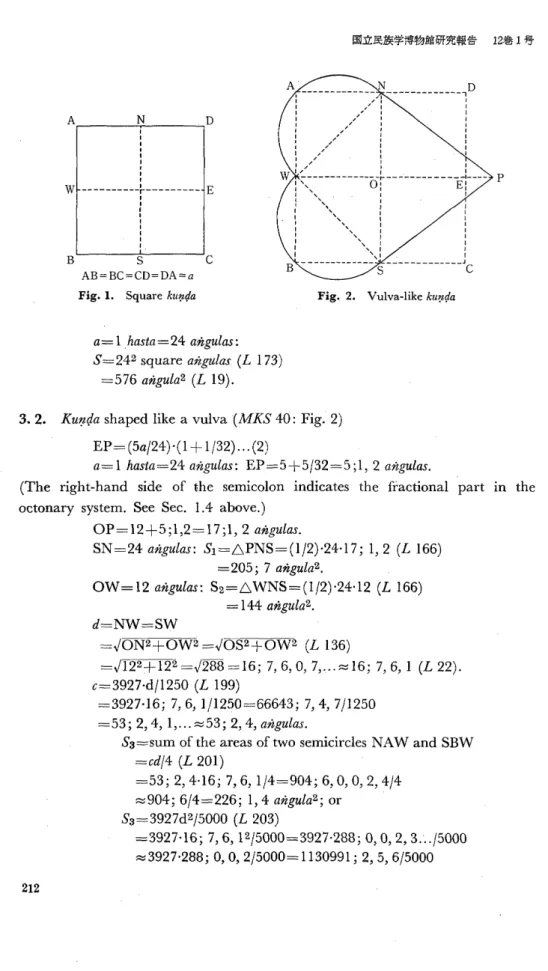
3. 1. Square kunda (MKS 39 : Fig. 1) S=a2... (1)
211
国立民族学博物館研究報 告 12巻 1号
Fig. 1. Square kumla Fig. 2. Vulva-like kuncla
a=1 hasta=24 arigulas:
8=242 square angulas (L 173)
=576 angula2 (L 19).
3. 2. Kw. la shaped like a vulva (MKS 40: Fig. 2) EP= (5a/24) • (1 + 1/32) ... (2)
a=1 hasta=24 angulas: EP=5+5/32=5;1, 2 angulas.
(The right-hand side of the semicolon indicates the fractional part in the octonary system. See Sec. 1.4 above.)
OP=12+5,1,2=17;1, 2 angulas.
SN=24 angulas: =APNS-= (1/2).24.17; 1, 2 (L 166)
=205; 7 angula2.
OW =12 angulas: S2=LWNS= (1/2).24.12 (L 166)
=144 angula2.
d=NW=SW
=\/ON2+0W2 ----VOS2+0W2 (L 136) -=,/122+122 =4288 =16; 7
, 6, 0, 7, 6, 1 (L 22).
c=3927•c1/1250 (L 199)
.--3927-16; 7, 6, 1/1250=66643; 7, 4, 7/1250
=53; 2, 4, 1,... 2, 4, angulas.
S3=sum of the areas of two semicircles NAW and SBW
=cd/4 (L 201)
=53; 2, 4.16; 7, 6, 1/4=904; 6, 0, 0, 2, 4/4 .,-.-.;904; 6/4=226; 1, 4 angula2; or
S3=3927d2/5000 (L 203)
=3927.16; 7, 6, 12/5000=3927.288; 0, 0, 2, 3.../5000
;-.--3927.288; 0, 0, 2/5000=1130991; 2, 5, 6/5000
212
HAYASHI Ritual Application of Mensuration Rules in India
=226; 1, 4, 5, 1,4 arigula2.
S=Si+S2H-S3=---576; 0,4 arigula2.
Remarks.
1) Having obtained EP=5;1,2 for a=1 hasta, Ganega remarks: ayam eva dvyadigunab san dvyadihaste bhavet/ evarn sarvatra/ "This (i.e. 5;1,2), when multiplied by two etc., would be <the value of EP> in the cases of <kw/as of> two square hastas etc. So is it everywhere (i.e. for kuncias of any shape)."
This statement is of course wrong because what are doubled, tripled, etc. in kundas of two square hastas etc. are not their lines but their areas.
2) The excess 0;0,4 in the area S is designated "likhyacatustaya (=liksa-)" by Ganega, but it should be "yakacatustaya". On the other hand, Vitthala- diksita, having obtained S=576;0,4,5 (83=226;1,4,5 according to him) in his own commentary, correctly remarks:
atra liksaparicakam yakacatustayarn cadhikam//
Here, the excess is five /iksas and four yalcds.
3) Vitthaladiksita in his commentary mentions a sort of proof intended for those who do not know mathematics, and prescribes how to multiply numbers in the octonary system:
yo ganitanabhijrias tena caturasram kundam tanduladina parayitva tan eva tandulan yonyadikunclesu dattva tatpurtau tostavyam iti/ atrangulayavaya- kaliksati krtva gomutrikadiritya gunayitvastabhir bhage grhite phala upary upari ca yojyamane phalany utpadyantem)//
One who does not know mathematics should be satisfied when kunclas beginning with the one shaped like a vulva are filled with exactly the same grains of unhusked rice and so on that a square kuncla <of the same size> has been filled with. Here, when one has multiplied <the numbers> arranged <in the places of> aligula, yaw, yfikei, and Kra <severally> in the manner of gomfitrika (lit. urine of a cow) etc., divided <each product> by eight, and added each quotient to the next higher place, the <true> results <for each place> are produced.
4) Requirement for the transformation. The transformation has to keep the area unchanged:
a2-=7r(N1 2 a14)2+a(a+EP)12, or EP=(1-44)a.
Comparing this with (2), we have 7r=201/64=3927/1250-39/40000.
5) The Saradatilaka, 3.53cd-55ab, prescribes:
EP=a/5.
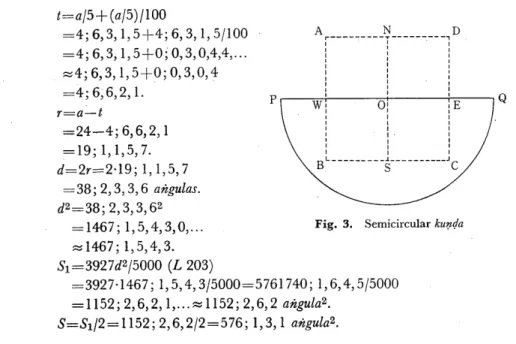
3. 3. Semicircular kuncla (MKS 41: Fig. 3) t=(a/5)(1+1/100)
r=OP=OQ=a—t
a=24 arigulas: a/5=24/5=4; 6, 3, 1, 4, 6, 3, 1, 5.
111) phalady utpadyate, in the text we have used (see Sec. 1.6 above).
213
国立民族学博物 館研 究報 省 12巻 1号
t=a/5+ (a/5)/100
=4; 6,3,1,5+4; 6,3,1,5/100
=4; 6,3,1,5+0; 0,3,0,4,4,...
cz,'4; 6,3,1,5+0; 0,3,0,4
=4; 6,6,2,1.
r=a—t
=24-4; 6,6,2,1
=19; 1,1,5,7.
d=2?.,---2.19; 1,1,5,7
=38; 2, 3, 3, 6 arigulas.
d2=38; 2,3,3,62
=1467; 1, 5,4, 3,0,...
---,-1467; 1,5,4,3.
Fig. 3. Semicircular kuncla
S1= (L 203)
=3927.1467; 1,5,4,3/5000=5761740; 1,6,4,5/5000
=1152; 2,6,2,1,...,,z1152; 2,6,2 arigula2.
S=S1/2=1152; 2,6,2/2=576; 1,3,1 arigula2.
Remarks.
1) Vitthaladiksita mistakenly obtains S1=1152;2,6,4 and hence S=576;1,3,2.
2) Requirement for the transformation:
a2=77.r2/2.
By assuming r---a—t, we have: t=(1—,,12/7t)a. A comparison of this with (3) will give v=500000/159201=3927/1250-182327/199001250. See Sec. 1. 5 above for 7r = 3927/1250.
3) Saradatilaka 3.55cd-57ab prescribes:
r=a—t, where
3. 4. Triangular kuncla (MKS 42ab:
Fig. 4)
t =AQ=BR a/4,1
u=EP=a/3....(4) PW=a+u
=24+24/3=32 arigulas.
QR=a+2t
=24+2•(24/4) =36 arigulas.
S-= QPQR
= (36/2).32 (L 166)
=576 arigula2.
Remarks.
1) The triangle prescribed by Vittha- Fig. 4. Triangular kuncja
214
HAYASHI Ritual Application of Mensuration Rules in India
ladiksita is not equilateral. If an equilateral triangle be required in this case, one has to satisfy the requirement,
a2=- (V 3 /4) (a+2t)2, where t=AQ=BR,
EP being consequently determined. This equation may be rewritten as:
t=(1/*/ 3 —1/2)a.
2) .-Saradatilaka 3.57cd-58 only gives t= a/4, being silent about the point P.
It is not certain whether this implies that the triangle in consideration was equi- lateral. See Raghavabhatta's commentary on Sciradatitaka lac. cit. for several interpretations.
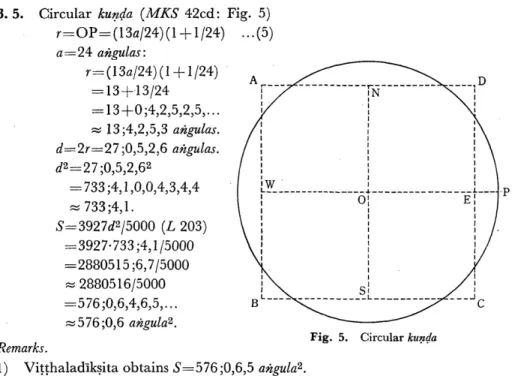
3. 5. Circular kunda (MKS 42cd: Fig. 5) r=0P=(13a/24)(1+1/24) ...(5) a=24 arigulas:
r=(13a/24)(1+1/24) A =13+13/24
=13+0;4,2,5,2,5,-.
13;4,2,5,3 angulas.
d=2r=27 ;0,5,2,6 angulas.
d2= 27 ;0,5,2,62
=733;4,1,0,0,4,3,4,4 733;4,1.
S=3927d2/5000 (L 203)
=3927.733;4,1/5000 =2880515 ;6,7/5000
2880516/5000
=576;0,6,4,6,5,...
576;0,6 angula2.
Remarks.
1) Vitthaladiksita obtains S=576;0,6,5 arigula2, 2) Requirement for the transformation:
a2=7rr2; hence r=a/iJ 7r ... (5a)
Fig. 5. Circular kunda
Or, by assuming r=a/2+t, we may rewrite the equation:
a2=7r(a12+02; hence t=-_-(1/Vir —1/2)a ...(5b)
By comparing (5a) with (5), we have ir=329776/105625=3927/1250-2569375/
132031250. The difference amounts to about 1/50. This is twenty times as large as those in the cases of the kundas shaped like a vulva and the semicircular kunda (see Sec. 3.2, Remark 4 and Sec. 3.3, Remark 2 above).
3) Saradatilaka 3.59 prescribes: t=a/18.
4) To transform a square into a circle is a traditional problem which can be traced back to the Sulbasiitras. Baudhayana (1.58), Apastamba (3.2), and Katyayana (3.13) prescribe [DATTA 1932: 140-143] : t=(,1 2 -a/2—a/2)/3=
215
国立民族学博物 館研究報 告 12巻 1号
(,/ 2 —1)a/6.
3. 6. 1. Irregular hexagonal kunea (MKS 43: Fig. 6. 1).
r=0P= (18a/24)(1+1/72) ... (6. 1) a=24 angulas:
r=18+18/72=18+0;2 =18;2 angulas.
d=-2r=36 ;4 angulas.
PR =RU=UP
=103923d/120000 (L 206-208)
=103923.36;4/120000 =3793189;4/120000 =31 ;4,7,0,2,...
31 ;4,7 angulas.
RH.= [RU+ (PR+PU) x (PR —PU)/RU]/2
(L 165) Fig. 6. 1. Irregular hexagonal kuncla
=RU/2=31;4,7/2=15;6,3,4 angulas.
RH2=15 ;6,3,42=249 249 ;6,2,3.
PR2-=31;4,72=999;1,1,6,1.
PH= (3/4)PT =,/PR2—RH2
=4999;1,1,6,1-249;6,2,3 =449;2,7,3,1 angulas.
Si= QPRU =PH-RH
=27;3,0.15 ;6,3,4=432 ;5,1,6,4:---1432 ;5 angula2.
TH-_---PT/4=d/4 =36 ;4/4=9 ;1 angulas.
FG-=--RU/3=31 ;4,7/3 =10 ;4,2,2,5,2,... =10;4,2,2 angulas.
S2 = PTFG (FG/2).TH=-- (10;4,2,2/2).9;1,0
=48 ;0,4,2,17-- 48 ;0,4,2 angula2.
S=S1+3S2= 432 ;5 + 3.48 ;0,4,2 =432 ;5+144 ;1,4,6=576;6,4,6 angula2.
Remarks.
1) Vitthaladiksita obtains Si =432;5,1,6 and hence S=576;6,6,4. He mentions that S can also be obtained from S=12•S2.
2) Gakiega says that the geometrical property, PH=PT —PT/4, "has been well established" (iti siddham). He also says that the property, RF=FG=GU, is
"observed by means of the direct perception" (pratyaksato drlyete). See also Section 3. 8. 1, Remark 2.
3) Requirement for the transformation:
a2=,/ 3 r2, or r=113 • 3 al3.
216
HAYASHI Ritual Application of Mensuration Rules in India
4) The S'aradatilaka only prescribes for the regular hexagonal kunda. See the next section.
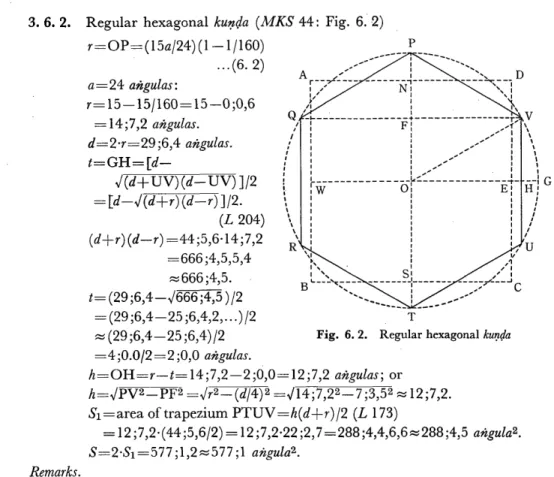
3. 6. 2. Regular hexagonal kuncla (MKS 44: Fig. 6. 2) r=013,----(15a/24)(1-1/160)
...(6. 2) a=24 angulas:
r=15-15/160=15-0;0,6 =14;7,2 angulas.
d=2•r=-29;6,4 angulas.
t=GH=V—
,1(d+UV)(d—UV)]/2
=[d—il(d+r)(d—r)]/2.
(L 204) (d+r)(d—r) =44;5,6.14;7,2
=666;4,5,5,4 t= (29;6,4—.1666;4,5 )/2
=(29;6,4-25;6,4,2,...)/2 (29;6,4-25;6,4)/2
=4;0.0/2=2;0,0 angulas.
Fig. 6. 2. Regular hexagonal kuNia
h=0H=r—t=14;7,2-2;0,0=12;7,2 angulas; or h=4PV2 —PF2 = — (dI4) 2 =114;7,22-7;3,52 Si =area of trapezium PTUV=h(d+r)/2 (L 173)
=12;7,2 (44;5,6/2) =12 ;7,2-22 ;2,7=288 ;4,4,6,6 288 ;4,5 angula2.
S=2•S, =577:1.2 angula2.
Remarks.
1) Vitthaladiksita obtains:
S1=12;7,2.22;2,7 288;3,1,5 (!); and S=2•S1=576;6,3,2 angula2.
This is not a misprint, because he remarks: "idarn liksadvayam yakatrayary yavasatkam adhikarp..." In computing h, he uses the second method of Gar.leia's.
2) Requirement for the transformation:
a2=3.\/ 3 r2/2, or r=,/ 2 ,/ 3 a/3.
3) The S'araddtilaka, 3.60-61, prescribes: PN=a/8.
3. 7. Kuncla shaped like a lotus (MKS 45: Fig.. 7) ri= (a18)-i, for i=1,2,3,4;
—(7) r5= (a/8)(5-1/38).
a=24 angulas: r4=12 angulas;
r5=15-3/38=15-0;0,5,0,...
15 —0 ;0,5=14;7,3 angulas.
217
国立民族学博物館研究報告 .12巻 1号
4=2•1'4=24 arigulas;
d5=2•r5=29;6,6 arigulas.
S4=---3927c14215000 (L 203)
=3927.242/5000 =2261952/5000 =452;3,0,7,7,...
arigula2.
S5=3927 d5215000 (L 203)
=3927.29;6,62/5000 =3927.890;5,1,4,4/5000 =3497580;1,7,7,4/5000
=699;4,1,0,...
;4,1 angula2.
S= S4 + (S5 — S4) /2
=452;3,1+123;4,4
=575;7,5 arigula2; or Fig. 7. Lotus-like kw*
S=S5— (S5—S4)/2=699 ;4,1 —123;4,4=575;7,5 arigula2.
Remarks.
1) Vitthaladiksita obtains 85=699;4,5,0 and hence S=575;7,7 angula2.
2) Requirement for the transformation:
a2= fir(a/2) 2 +7/752] /2, or r5=-,I217r — 1 /4 .a.
By comparing this with (7), we have ir=184832/58825=3927/1250+1369/
2941250.
3) The Sciradatilaka, 3.62-63, prescribes a circle with three inner circles, but without pedals. The size of the outermost circle is the same as that of the circular kunda.
1 8. 1. Irregular octagonal kuncla (MKS 46: Fig. 8. 1).
r=0Pi= (18a/24) (1+1/28) ... (8. 1) a=24 arigulas:
r=18+18/28
arigulas.
d-=2•r=37;2,2,2 arigulas.
P1P2=--P2P3, etc.
=45922d/120000 (L 207-208) =45922.37;2,2,2/120000
=1712208;7,4,4/120000 Fig. 8. 1. Irregular octagonal kuryja
218
=14;2,1,1,3,...=14;2,1,1 angulas.
P1Q2=P2Q2, etc. =,/PIP22/2 =414;2,1,12/2
=4203;4,4,0,5,2,1/2 =.1203;454/2
=x/101;6,2 =10 ;0.5,5,... =10 ;1 angulas.
P1P4 = P1Q2 Q2Q4 Q4P4 = P1P2 --1-2-P1Q2
=14;2,1,1+210;1=34;4,1,1 angulas.
Si=area of rectangle P1P4P5P8---P1P4•1)11)8 (L 173)
=34 ;4,1,1.14;2,1,1 =492 ;3,6,6,7,2,1=492 ;3,6,7 angula2.
P1R= [P 1138 ±(138Q1) (13 —P8Q1)/PiP8]/2 (L 165)
=-PiP8/2= 14;2,1,1/2 = 7 ;1,0,4,4 = 7;1,0,4 angulas.
P1R2=7;1,0,42=50;7,0,1,0,2,0=50;7,0,1.
P1Q12=10;12=102;4,1.
QiR = N/PiQi2—PiR2 =A/102 ;4,1 —50 ;7,0,1
=A/51;5,0,7 angulas (Gariega's value).
S2=---APiQiPs=PIR•QR (L 166)
=7;150,4-7,1,6,4=-51;4,2,7,3,2,0::---51;4,3 angula2.
(If we use a more accurate approximation Q1R.=7;1,3,7, we have S2 = 51 ;2,0,1,4,7,4.)
S3= area of P1P4Q5P5P8Q1=S1-2S2
=492 ;3,6,7-2.51 ;4,3=389 ;3,0,7 angula2.
S4 = area of P2P3Q4Q2= P2P3T2Q, 2 (L 173)
=14;251,1.10;1=144;3,5,3,1=144;3,5,3 angula2.
S5 = area of Q2P2Q3P3Q4=- S4 S2
=144 ;3,5,3-51 ;4,3 =92 ;7,2,3 angula2.
S--,---area of the kuncla-= S3 + 2.S5
=389;3,0,7+2.92;7,2,3=389;3,0,7+185;6,4,6=575;1,5,5 angula2.
Remarks.
1) Vitthaladiksita computes, instead of S2, 2 'S2 = P1Q12 =102 ;4,0 (which should be = 102 ;4,1). His value of S is 576;2,0 angula2.
2) Gaki6a, in computing P1Q2, uses the geometrical property thatPIV2Q2 is an isosceles right triangle, saying that the property P1Q2=P2Q2 "is observed by means of the direct perception" (pratyaksato drlyate). But he does not use the same property in the computation of S2. It seems that, to Garieia, the simpler was not always the better.
3) The word kona occurs three times in this section in the sense of trikona or a triangle.
4) Requirement for the transformation:
a2=4(,/ 2 —1)r2, or r==',1,1 2 +1.a/2.
5) The Saradati/aka does not prescribe for the kunda of this shape. See Remark 4 of the next section.
219
国立民族学博物 館研 究報告 12巻 1号
3. 8. 2. Regular octagonal kunda (MKS 47: Fig. 8. 2) r= OP]. = (14a/24) (1 +1/47)
...(8. 2) a=24 arigulas:
r=14+14/47 =14;2,3,0,4 ,...
14;2,3 arigulas.
d=2•r=28;4,6 arigulas.
P1P2=P2P3, etc.
=45922d/120000 (L 207-208)
=45922.28;4,6/120000 =1313082;1 ,4/120000
=10;7 ,4,2,3,...
arigulas.
P4P82=d2=--28;4,62
=817;4,6,4,4 arigulas;
but Ganda obtains:
P4P82=757;4,6 arigulas.
P1P82= 10 ;7,4,22=119 ;5,5,5,6,0,4 ::119;5,5,6.
P1P4=',./P4P82—P1P82 (L 136)
=4757;4 ,6-119;5,5,6 =4637;7,0,2
arigulas (Ganda s value).
Si=area of rectangle PiP4P5P8=--PiP4•PiP8 (L 173)
=25;2 ,1l0;7,4,2==276;3,4,2,0,2276;3,4 arigula2.
P 1Q= iP 4—P 2P 3) ± (P1P2 P3P4) (P1P2 P3P4) (P1P4 - P2P3)] /2
(L 184; 166)
---(P1P4—P2P3)/2=(25;2
,1-10;7,4,2)/2=7;1,2,3 arigulas.
P2Q=,1P1P22—P1Q2 =,/10;7,4,22-7;1,2,32 x/119;5,5,5,6,0,4-51;2,2,7,3,5,1
=x/68;3,2,6,2,3,3 =8;2,1,3,0,... X8;2,3,2 arigulas (Ganda).
S2 = area of trapezium P1P2P3P4=P2Q: (P1P4 P2P3) /2 (L 173)
=8;2,3,2.(25;2,1+10;7,4,2)/2=8;2,3,2.18;0,6,5 arigula2.
S=area of the kunda---Si+2.82=276;3,4+2.150;2,1,4
=276;3,4+300;4,3=576;7,7 arigula2; but the manuscript reads:
S =57 6 ;4,3 arigula2.
Remarks.
1) If we use the correct value of P4P82=817;4,6,4,4 instead of Ganda's erroneuos one, we have SP--577;6,1 arigula2. Probably, Gan.ega deliberately manipurated the first two digits in the correct value of P4P82 (=d2) in order to
220
HAYASHI Ritual Application of Mensuration Rules in India
get a better result.
2) Vitthaladiksita's method (cf. Fig. 8. 2). For the computation of P1P2, he cites a gloka from an unknown source:
candrartunandakrtibhir vyasardhe <ca> samahate/
khakhakhabhragnisambhakte//
PiP2 etc.-=22961r/30000:,-110;7,4,2,3 angular.
For the computation of Si and S2, he utilizes the versed sine:
t=UT-=[cl—,, (d+P2P3)(d—P2P3) ]/2 (L 204) arigulas.
P1P4=d-2•t=-26;3,3 arigulas.
arigula2.
P 2Q=r — (PiP 812 + t)
=7;6 arigulas.
S2 = P2Q: (P2P3 P1P4) /2 144;5 arigula2.
S=S1+2.52
=577;6,4 arigula2.
3) Requirement for the transforma- tion:
a2=2,/ 2 r2, or r=4 a/2.
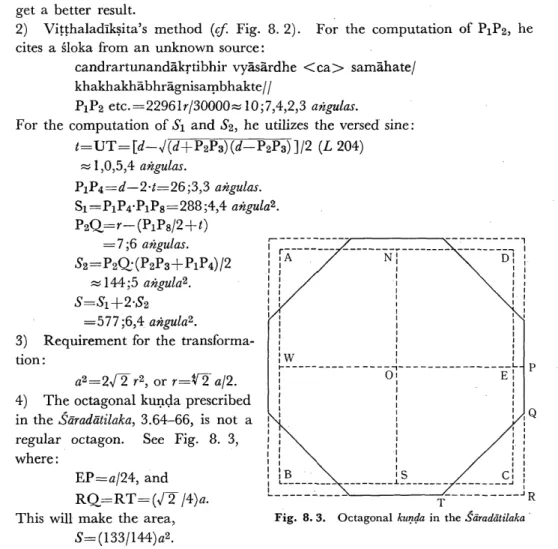
4) The octagonal kuncla prescribed in the :Sdraddtilaka, 3.64-66, is not a regular octagon. See Fig. 8. 3, where:
EP=---a/24, and RQ=-RT---(,/ 2 /4)a.
This will make the area, S=(133/144)a2.
Fig. 8. 3. Octagonal kunda in the jdradcitilaka
ACKNOWLEDGEMENTS
We are deeply grateful to Mr R. Baskaran, curator of the Govenment Oriental Manuscripts Library, Madras, for his kindly permitting us to photograph and publish the manusript (D 13403).
Many thanks are due to Mr T. A. K. Venkatachari and Mrs Rajalakshmi (Sanskrit Pandits) and other staffs of the Library for their kind help offered to us in researching the Sanskrit mathematical manuscripts of the Library. We are much indebted to the American Institute of Indian Studies, part of whose junior Fellowship for the period October 1982 to September 1983 enabled Hayashi to visit the Library.
P.S. The original draft of this article was first sent to Prof. Sri Rama Sinha of the Allahabad University, who was kind enough to propose to supervise my work in it and seek for a suitable means of its publication. His unfortunate death in April 1985, however, made the plan impossible.
It is thanks to Mr S. Einoo of the National Museum of Ethnology, Osaka, that this article has found its way into the present journal.
221
国立民族学博物館研究報 告 12巻 1号
4. Appendix
Mandapakundasiddhi 31-47 (on Kunda) pracyag catuskon.abhagendukhanclatrikonavrttangabhujambujani/
astasrigakregvarayos tu madhye vedasri va vrttam uganti kundam//31//
ageiakundair iha paiicakundi caikam yada pakimasomagaive/
vedyah sapadena karena yad va padantarenakhilakundasarnstha//32//
viprac chrutyasrarn ca vrttam ca vrttardham tryasri syad vedakonani vapi/
sarvany ahur vrttarilpani canye yonyakarany afigananarn tu tani//33//
siddhih putrah gubharn gatrunaiah gantir mrticchide/
vrstir arogyam uktarn hi phalarn pracyadikundake//34//
gatardhe 'ratnih syac chataparimite ratnivitatam sahasre hastam syad ayutahavane hastayugalam/
caturhastarn lakse prayutahavane satkaramitain kakubbhir va kotau nrpakaram api prahur apare//35//
laksaikavrddhya daialaksakantam karaikavrddhya daiahastakarn ca/
kotyardhadigvirniatilaksalaksadale munisvartukrianuhastam//36//
vedaksini yugagnayah iagiyugany astabdhayas trisavo '§tak§a vahnirasa rasarigakamita netrarsayo 'ksasvarah/
afigulyo 'tha yavah kham abhram isavah kham pafica at sagarah saptabhrarn munayas tv ami nigadita vedasrake bahavah//37//
kundatrayi daksinayonir aindryah saumyagraka syad itarani parka/
pakadbhaganindradigagrakani yonir na kon.e na ca yonikunde//38//
dvighnavyasarn turyacihnam sapagam siltrarn iankau pakime parvage 'pi/
dattva karset konayoh paiaturye syad evarn va vedakonarn samanam//39//
ksetre jinarnge puratah gararngan samvardhya ca sviyaradarngayuktan/
karnanghrimanena likhendukhande pratyak puro 'fikad gunato bhagabham//40//
svagatarngayutesubhagahinasvadharitrimitakarkatena madhyat/
krtavrttadale 'gratai ca jivarn vidadhatv indudalasya sadhusiddhyai//41//
vahnyarngam purato nidhaya ca punah gronyog caturtharngakarn cihnesu trisu sutradanata idarn syat tryasri kastojjhitam/
vigvamgaih svajinarngakena sahitaih ksetre jinarnSe krte
vyasardhena mitena mandalam idam syad vrttasarnjfiarn gubharn//42//
bhakte ksetre jinarniair dhrtimitalavakaih svaksigailarngayuktair vyasardhan mandale tanmitadhrtagunake karkate cendudiktah/
satcihnesu pradadyad rasamitagunakan ekam ekam tu hitva
n,ie sandhyartudosam api ca vrtikrter netraramyarn sadasram//43//
athava jinabhaktakun.damanat tithibhagaih svakhabhapabhagahinaih/
mitakarkatakodbhave tu vrtte vidhudiktah samasadbhujaib sadasram//44//
astamgac ca yatag ca vrttagarake tatradimam karnika yugme sodagakesarani carame svastatribhagonite/
222
H AY ASHI Ritual Application of Mensuration Rules in India
bhakte soclagadha Sarantaradhrte syuh karkate 'stau chadah
sarvam tam khana karnikarn tyaja nijayamoccakam syat kajam//45//
ksetre jinamSe gajacandrabhagaih svastaksibhagena yutais to vrtte/
vidigdiior antarato 'stasiltrais trtiyayuktair idam astakonam//46//
madhye gune vedayamair vibhakte iakrair nijarsyabdhilavena yuktaih/
vrtte krte digvidigo 'ntarale gajair bhujaih sydd athavastakonam//47//
(This text is based on the two editions we have consulted. See Sec. 1. 6 above.)
Bibliography BHASKARA
1937 Lildvati (1150). Ed. with the commentaries of Ganega and Mahidhara by V. G.
Apate. Anandgrama Sanskrit Series 107. Poona: Anandgrama Press.
1975 Lildvati (1150). Ed. with the commentaries of §ankara and Narayana by K. V. Sarma.
Hoshiarpur: Vishveshvaranand Vedic Research Institute.
BHOJA
1924/1925 Samardizganasidradhdra (ca. 1050). Ed. by T. Ganapatiiastri. Gaekwad's Oriental Series 25 & 32. Baroda: Oriental Institute.
1966 Samardnganasatradhdra (ca. 1050). Revised by V. S. Agrawala. Gaekwad's Oriental Series 25. Baroda: Oriental Institute.
DATTA, B. B.
1932 The Science of the Sulba: A Study in Early Hindu Geometry. Calcutta: University of Calcutta.
GUPTA , R. C.
1981 A Bibliography of Selected Sanskrit and Allied Works on Indian Mathematics and Mathematical Astronomy. Ganita Bhdrati 3 (3-4) : 86-102.
KIRFEL, W.
1920 Die Kosmographie der Inder. Bonn/Leipzig : Kurt Schroeder.
LAKSMA1VADEgIKENDRA
1981 :_c draddtilaka. Ed. with Raghavabhatta's commentary, Paddrthddarfa (1493), by grimukundajha Bakligi. Kagi Sanskrit Series 107. Varanasi: Chaukhambha
Sanskrit Sansthan.
MAH -AVIRA
1912 Ganitasdrasangraha (ca. 850). Ed. with an English translation by M. Rangacarya.
Madras: Government Press.
1963 Ganitasgrasahgraha (ca. 850). Ed with a Hindi translation by L. C. Jain. Jivaraja Jaina Granthamala 12. Sholapur: Jaina Samskrti Satnrakshaka Sarpgha.
MATSYAPURANA
1917 Matsyapurdna. Translated by a taluqdar of Oudh. The Sacred Books of the Hidus 17.
Allahabad.
PINGREE, D.
1971 Census of the Exact Sciences in Sanskrit, series A, vol. 2. Philadelphia: American Philo- sophical Society.
1981 Jyotih:sdstra: Astral and Mathematical Literature. Jan Gonda (ed.), A History of Indian Literature, vol. 6, fast. 4. Wiesbaden: Otto Harrassowitz.
RAGHAVAN, V.
1968 New Catalogus Catalogorum, vol. 4. Madras: University of Madras.
1969 New Catalogus Catalogorum, vol. 5. Madras: University of Madras.
223
国立 民族学 博物館研究報告 12巻 1号
VARAHAMIHIRA
1968 Brhatsarphitil (ca. 550). Ed. with the commentary of Bhattotpala by A. V. Tripathi.
Sarasvati Bhavana Granthamala 97. Varanasi: Varanaseya Sanskrit Vishvavidyalaya.
VA.YUPURANA
1905 Vayupurana. Ed. by the pandits of the Anandgrama. Anandairama Sanskrit Series 49. Poona: Anandagrama Press.
ガ ネ ー シ ャ 作 ク ン ダ 設 営 解 説
林 隆 夫