Introduction
Serum gamma-glutamyl transferase (GGT) was reported
to be positively associated with atherosclerosis [1-3] and diabetes incidence [4]. On the other hand, our previous study reported that categorizing diabetes based on TG-HDL ratio might be a beneficial tool for the estimation of atheroscle-
rotic risk as well as renal dysfunction risk, which is also strongly associated with atherosclerosis [5], with significant risk noted for high TG-HDL diabetes but not for intermedi- ate and low TG-HDL diabetes [6] [7], However, no studies have reported on the association between serum GGT levels and diabetes in terms of the TG-HDL ratio.
We therefore investigated the association in terms of TG-
MS#AMN 07205
Association of serum gamma-glutamyltransferase (GGT) and diabetes with triglycerides-to-HDL cholesterol ratio in Japanese subjects: The Nagasaki Study
Jun K
oyamatsu1, Yuji shimizu1,2, Koichiro Kadota1, Mako Nagayoshi1, Hirotomo yamaNashi3, Shimpei sato1,Hisashi g
oto4, Kunihiko murase5, Kiyoshi aoyagi6, Takahiro maeda1,31 Department of Community Medicine, Nagasaki University Graduate School of Biomedical Science, Nagasaki, Japan
2 Department of Cardiovascular Disease Prevention Osaka Center for Cancer and Cardiovascular Disease Prevention, Osaka, Japan
3 Department of Island and Community Medicine, Nagasaki University Graduate School of Biomedical Science, Nagasaki, Japan
4 Goto Health Care Office, Nagasaki, Japan
5 Nagasaki Goto Central Hospital, Nagasaki, Japan
6 Department of Public Health, Nagasaki University Graduate School of Biomedical Sciences, Nagasaki, Japan
Background: Although we reported in a previous study that diabetes with a high serum triglycerides to high-density lipoprotein cholesterol (TG-HDL) ratio constitutes a risk for atherosclerosis, associations in terms of TG-HDL ratio between diabetes and gamma-glutamyltransferase (GGT), which is also known as an independent risk factor for atherosclerosis, have not yet been clarified. The purpose of this study was to test the hypothesis that a positive association between GGT and diabetes may be confined to high TG-HDL.
Methods: This was a cross-sectional study of 2,302 Japanese subjects who were undergoing a general health check in 2014.
All subjects were divided into TG-HDL level tertiles and serum GGT and diabetes status were investigated.
Results: Of 207 diabetes patients identified in this study, 94 had high TG-HDL, 63 intermediate TG-HDL, and 50 low TG-HDL.
Independent of classical cardiovascular risk factors, serum GGT showed a positive association with diabetes in patients with high TG-HDL, but not in patients with intermediate and low TG-HDL diabetes. The multivariable adjusted odds ratios (OR) and 95%
coincidence intervals (95%CI) of diabetes for 1 standard deviation (SD) increment of GGT were 1.64 (95%CI: 1.16-2.31) for high TG-HDL, 1.46 (95%CI: 0.95-2.26) for intermediate TG-HDL, and 1.04 (95%CI: 0.60-1.79) for low TG-HDL diabetes.
Conclusion: Serum GGT is positively associated with diabetes in patients with high TG-HDL but not with intermediate or low TG-HDL diabetes. This finding may prove to be an efficient tool for estimating atherosclerotic risk in diabetes patients.
ACTA MEDICA NAGASAKIENSIA 61: 61−65, 2017 Key words: GGT, diabetes, triglycerides-HDL
Address correspondence: Yuji Shimizu, MD, PhD
Department of Community Medicine, Nagasaki University Graduate School of Biomedical Science, Nagasaki-shi, Sakamoto 1-12-4, Na- gasaki 1-12-4, Nagasaki, 852-8523, Japan
Tel: +81-95-819-7578, Fax: +81-95-819-8509, E-mail: [email protected] Received November 16, 2016; Accepted March 9, 2017
HDL level between serum GGT levels and diabetes among Japanese men and women who had participated in a survey on a cardiovascular risk in 2014.
Methods
Study populationThe survey population included 3,438 subjects aged 40 to
95 years, all of whom were residents of Goto City and Saza town. A total of 1,136 individuals with missing data (includ- ing 8 individual without smoking status, 1 individuals with- out BMI data and 1,127 individuals without serum data) were excluded, leaving 2,302 subjects (812 men and 1,490 women) enrolled in this study.
The mean age of the study population was 66.4 years
(±10.1 SD; range 40-95). Trained interviewers obtained in- formation on smoking status, drinking status, medical his- tory, use of agents for antihypertensive agents, lipid lower- ing agents and those for diabetes mellitus.
Anthropometric measurements
Body weight and height were measured with an automatic
body composition analyzer (BF-220; Tanita, Tokyo, Japan) at the time of drawing blood. Systolic and diastolic blood pressure was recorded at rest.
Biochemical measurements
Fasting blood samples were collected in a siliconized tube
and serum was isolated by centrifugation after blood coagu- lation. Serum triglycerides, serum HDL cholesterol, serum aspartate aminotransferase (AST), serum γ-glutamyltranspeptidase (GGT), HbA1C and serum creatinine were measured using standard laboratory procedures. Glomerular filtration rate (GFR) was estimated using an established method with three variations recently proposed by a working group of the Japanese Chronic Kidney Disease initiative [8]. According to this adaptation, GFR (mL/min/1.73 m2) = 194×(serum creatinine (enzyme method))-1.094×(age)-0.287 (×0.739 for women). Presence of diabetes was defined as HbA1c (NGSP) ≥ 6.5%, and/or initiation of glucose-lowering medication or insulin therapy [9].
We further defined subtypes of diabetes by calculating tertiles of TG-HDL for all participants, as in our previous study [5].
This study was approved by the Ethics Committee for
Human Use of Nagasaki University (project registration number: 14051404). All participants provided written, informed consent.
Statistical analysis
Sex-and age-adjusted clinical characteristics in this study
based on GGT levels were expressed. TG-HDL categories were established according to tertiles of TG-HDL values for all subjects. Logistic regression models were used to calculate odds ratios (ORs) and 95% confidence intervals (CIs) of diabetes with TG-HDL and Log GGT levels, since GGT had a skewed distribution; and logarithmic transportation was performed for the association between GGT and diabetes.
Two different approaches were used for making adjust-
ments for confounding factors. First, the data were adjusted only for sex and age. Second, we included other possible confounding factors, namely smoking status (never smoker, former smoker, current smoker), alcohol consumption [non- drinker, current light to moderate drinker (1-6 times/week), current heavy drinker (every day)], systolic blood pressure (mmHg), antihypertensive medication use (no, yes), history of cardiovascular disease (no, yes), AST (IU/L), lipid lowing- agents(medication) (no, yes), estimated GFR and menopausal status (pre-menopausal women, postmenopausal women).
All statistical analyses were performed with the SAS
system for Windows (version 9.4; SAS Inc., Cary, NC). All p-values for statistical tests were two-tailed, and values of
<0.05 were regarded as statistically significant.
Results
Of 2,302 subjects aged 40-95 years, 207 diabetes patients
were identified, with 94 patients having high TG-HDL (high TG-HDL diabetes), 63 patients having intermediate TG-HDL (intermediate TG-HDL diabetes), and 50 patients having low TG-HDL (low TG-HDL diabetes).
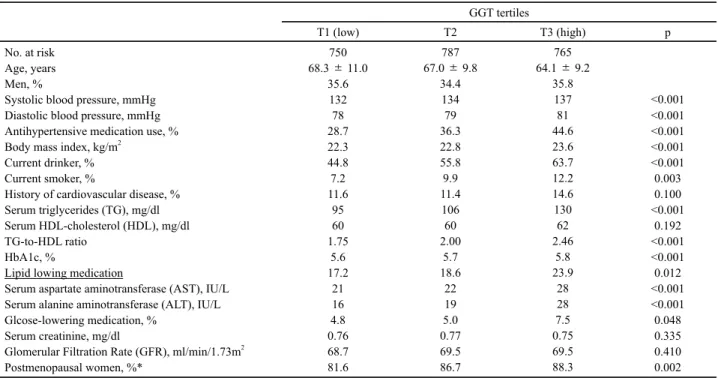
Clinical characteristics of the study population are sum-
marized in Table1. Systolic blood pressure, diastolic blood pressure, antihypertensive medication use, BMI, current drinker, current smoker, TG, TG-HDL ratio, AST, ALT, and glucose lowering medication were positively associated with GGT level.
Table 2 shows Odd ratios (OR) and 95% confidence inter-
vals (CI) of diabetes in relation to GGT level. Independent of classical cardiovascular risk factors, GGT level was found to be significantly associated with diabetes.
Analysis of the association between GGT levels and dia-
betes categorized by TG-HDL levels revealed a significant
positive association for high TG-HDL diabetes, whereas no
significant associations were observed for intermediate- and
low TG-HDL diabetes (Table 3).
Table 1. Sex-and age-adjusted distribution of characteristics by tertile of serum γ-glutamyltranspeptidase (GGT) level GGT tertiles
T1 (low) T2 T3 (high) p
No. at risk Age, years Men, %
Systolic blood pressure, mmHg Diastolic blood pressure, mmHg Antihypertensive medication use, % Body mass index, kg/m2
Current drinker, % Current smoker, %
History of cardiovascular disease, % Serum triglycerides (TG), mg/dl Serum HDL-cholesterol (HDL), mg/dl TG-to-HDL ratio
HbA1c, %
Lipid lowing medication
Serum aspartate aminotransferase (AST), IU/L Serum alanine aminotransferase (ALT), IU/L Glcose-lowering medication, %
Serum creatinine, mg/dl
Glomerular Filtration Rate (GFR), ml/min/1.73m2 Postmenopausal women, %*
68.3 ± 11.0750 35.6 132 78 28.7 22.3 44.8
7.2 11.6
95 60 1.75 17.2 5.6 21 16 0.76 4.8 68.7 81.6
67.0 ± 9.8787 34.4
134 79 36.3 22.8 55.8
9.9 11.4
106 60 2.00 18.6 5.7 22 5.0 19 0.77 69.5 86.7
64.1 ± 9.2765 35.8 137 44.6 81 23.6 63.7 12.2 14.6 130
62 2.46
5.8 23.9
28 7.5 28 0.75 69.5 88.3
<0.001
<0.001
<0.001
<0.001
<0.001 0.003 0.100
<0.001 0.192
<0.001
<0.001 0.012
<0.001
<0.001 0.048 0.335 0.410 0.002 Age: mean±standrd deviation. Serum γ-glutamyltranspeptidase (GGT) level tertiles were <24 IU/L, 24-41 IU/L, and >41 IU/L for men, and
<16IU/L, 16-23IU/L, and >23 IU/L for women.* Data was calculated only among women.
Table 2. Odds ratios (OR) and 95% confidence intervals (CI) for diabetes in relation to γ-glutamyltranspeptidase (GGT) levels
GGT tertiles 1SD increment of
Log GGT*
T1 (low) T2 T3 (high) P for trend
No. at risk
No. of cases (percentages) Sex- and age-adjusted OR Multivariable OR
750 50 (6.7)
1.00 1.00
787 63 (8.0) 1.27 (0.86-1.87) 1.12 (0.75-1.67)
765 94 (12.3) 2.13 (1.47-3.08)
1.58 (1.05-2.37) <0.001
0.023 1.69 (1.36-2.08) 1.45 (1.12-1.87) Multivariable OR: adjusted further for systolic blood pressure, antihypertensive medication use, history of cardiovascular disease, body mass index, smoking, alcohol intake, lipid lowing-agents(medication), serum aspartate aminotransferase (AST), glomerular filtration rate (GFR), and menopausal status. GGT level tertiles were <24 IU/L, 24-41 IU/L, and >41 IU/L for men, and <16IU/L , 16-23IU/L, and >23 IU/L for women.
*1 standard deviation for GGT was 57 IU/L for men and 27 IU/L for women.
Table 3. Odds ratios (OR) and 95% confidence intervals (CI) for diabetes subtypes in relation to γ-glutamyltranspeptidase (GGT) levels
GGT tertiles 1SD increment of
Log GGT*
T1 (low) T2 T3 (high) P for trend
No. at risk Low TG-HDL diabetes No. of cases (percentage) Sex-and age-adjusted OR Multivariable OR
Intermediate TG-HDL diabetes No. of cases (percentage) Sex- and age-adjusted OR Multivariable OR High TG-HDL diabetes No. of cases (percentage) Sex- and age-adjusted OR Multivariable OR
750 15 (2.0)
1.00 1.00 19 (2.5)
1.00 1.00 16 (2.1)
1.00 1.00
787 16 (2.0) 1.04 (0.51-2.12) 1.02 (0.49-2.14)
21 (2.7) 1.14 (0.61-2.15) 1.07(0.56-2.05)
26 (3.3) 1.60 (0.85-3.01) 1.33(0.70-2.54)
765 16 (2.1) 1.07 (0.52-2.22) 1.078(0.49-2.37)
27 (3.5) 1.65 (0.89-3.05)
1.48(0.75-2.92) 51 (6.7) 3.42 (1.91-6.11) 2.10 (1.13-3.92)
0.848 0.857
0.108 0.253
<0.001 0.014
0.99 (0.62-1.58) 1.034 (0.60-1.79)
1.48 (1.03-2.13) 1.46 (0.95-2.26)
2.13 (1.60-2.84) 1.64 (1.16-2.31) Multivariable OR: adjusted further for systolic blood pressure, antihypertensive medication use, history of cardiovascular disease, body mass index, smoking, alcohol intake, lipid lowing-agents(medication), serum aspartate aminotransferase (AST), glomerular filtration rate (GFR), and menopausal status. GGT level tertiles were <24 IU/L, 24-41 IU/L, and >41 IU/L for men, and <16IU/L , 16-23IU/L, and >23 IU/L for women.
*1 standard deviation for GGT was 57 IU/L for men and 27 IU/L for women.
Discussion
Serum GGT is positively associated with high TG-HDL
diabetes but not with intermediate TG-HDL and low TG-HDL diabetes. These findings suggest serum GGT as an efficient tool to estimate atherosclerotic risk in diabetes patients.
A previous study comprised of 1,441 men and women
followed up for 7 years reported elevated GGT as a significant predictor of either impaired glucose tolerance or diabetes (OR 1.62 (1.08–2.42) top quartile vs. lower quartiles, P <
0.02) after controlling for sex, age, adiposity/fat distribution, alcohol consumption, fasting plasma insulin, proinsulin levels, and 2 hours post-standardized 75g oral glucose load glucose level [10].
The present study also showed a positive association between
serum GGT and diabetes comparable with the previous study. The multivariable OR of the highest tertile vs. lowest tertile was 1.54 (1.02-2.32). We found further evidence that the positive association was confined to the high TG-HDL diabetes group.
A previous study of 3,412 Japanese men reported a relation
between GGT and increased levels of arterial stiffness as evaluated by brachial-ankle pulse wave velocity (PWV).
Conventional risk factor adjusted log GGT was significantly associated with PWV (β=0.060, p<0.001) [2]. Association between GGT level and diabetes might therefore be strongly influenced by the risk of atherosclerosis.
On the other hand, our previous study of 1,344 Japanese
men reported high TG-HDL diabetes (but not intermediate and low TG-HDL diabetes) as a risk factor for atherosclerosis (diagnosed as carotid intima-media thickness ≥1.1 mm) and increased arterial stiffness (diagnosed as cardio-ankle vascular index ≥8.0) [6]. Therefore, GGT was positively associated with high TG-HDL diabetes, which is risk factor for athero- sclerosis, while no significant association was observed for intermediate and low TG-HDL diabetes, which are much less significant atherosclerotic risk factors. Since renal function is well known to be associated with atherosclerosis [5], we also evaluated the GFR values for each of the diabetes cate- gories. In this study, we additionally measured GFR, which is related to arteriosclerosis. The high TG-HDL ratio group had a significantly lower GFR than the low TG-HDL group (high TG-HDL 68.4 ml/min/1.73m2, and low TG-HDL 76.0 ml/min/1.73m2(p<0.001)). These results also support the above mentioned associations.
Although the mechanisms for these associations were not
elucidated, higher TG-HDL was found to correlate with insulin resistance among the general population [11], among overweight individuals [12,13], and among type 2 diabetes
patients [14]. Therefore, diabetes classification according to tertile TG-HDL level (Shimizuʼs diabetes classification) is based on the assumption that high TG-HDL is mainly caused by insulin resistance with less compensatory β-cell function, while low TG-HDL is mainly caused by absolute β-cell dysfunction [6]. In addition to these mechanisms, GGT measurement can be a sensitive method for early diagnosis and a predictor of insulin resistance in the general population [15], and may also be a predictor of diabetes incidence [4].
The association between GGT and diabetes categorized by TG-HDL might therefore be affected by the state of insulin resistance.
We reported in previous study that our previous diabetes
classification is efficient tool to evaluate the risk of athero- sclerosis [5] and CKD [6]. And this diabetes classification might not only indicates insulin resistance [11] but also indicates the activity of low grade inflammation [16] and hematopoietic activity [17]. On the other hands, GTP is also known factor that is associated with inflammation and arterial stiffness [2]. Perspective of our present study is that, further investigation with longitudinal study became efficient tool to clarify the background mechanism of those factors.
Potential limitations of this study warrant consideration.
First, GGT levels are well known to be influenced by drinking status [18]; however, additional information on the drinking status of the subjects was unavailable, and a high and low prevalence of male and female drinkers, respectively, among the general Japanese population has been reported [19,20].
Gender differences may therefore influence the association between GGT level and diabetes categorized by TG-HDL level. However, the limited number of study subjects in this study prevents meaningful gender-specific conclusions to be drawn. Nonetheless, our additional analyses showed essentially the same correlations for both men and women with regard to the association between GGT level and diabetes categorized by TG-HDL. The age-adjusted ORs of 1SD increments of GGT for low and high TG-HDL diabetes were 0.75 (95%CI:
0.37-1.51) and 1.36 (95%CI: 1.12-1.65) for men, and 1.09 (95%CI: 0.85-1.40) and 1.18 (95%CI: 1.03-1.36) for women.
Second, since data on exercise were not available, we were
not able to make adjustments with regard to the influence of
exercise. Additionally, no data on family history of diabetes,
fasting glucose, and total cholesterol was available and
therefore could not be evaluated. Finally, since this study
was cross-sectional, causal relationships were not able to be
established.
Conclusion
The positive association between GGT and diabetes is
confined to high TG-HDL. This finding might be applied as efficient tool to estimate atherosclerotic risk in patients with diabetes.
Competing interests
The authors declare that they have no conflict of interest.
Human and animal rights and informed consent
All procedures performed in studies involving humanparticipants were in accordance with the ethical standards of the institution research committee and with the 1964 Helsinki declaration and its later amendments or comparable ethical standards. Ethics Committee for Human Use of Nagasaki University obtained ethical approval.
Acknowledgments
This work was supported by Grants-in-Aid for Scientific
Research from the Japan Society for the Promotion of Science (No.25291107, No.15K07243). We are grateful to the staff of Goto City Hall and Saza City Hall for their excellent support.
References
[ 1 ﹈ Park JS, Kang SA, Yoo JS, et al. Association between γ-glutamyltransferase, adiponectin and arterial stiffness. J Atheroscler Thromb 2012;19:90-7.
[ 2 ﹈ Saijo Y, Utsugi M, Yoshioka E, et al. The relationship of gamma- glutamyltransferase to C-reactive protein and arterial stiffness. Nutr Metab Cardiovasc Dis 2008;18:211-9.
[ 3 ﹈ Eroglu S, Sade LE, Polat E, et al. Association between serum gamma- glutamyltransferase activity and carotid intima-media thickness.
Angiology 2011;62:107-10.
[ 4 ﹈ Doi Y, Kubo M, Yonemoto K, et al. Liver enzymes as a predictor for incident diabetes in a Japanese population: the Hisayama study.
Obesity (Silver Spring) 2007;15:1841-50.
[ 5 ﹈ Shimizu Y, Sato S, Koyamatsu J, et al. Association of chronic kidney disease and diabetes with triglycerides-HDL choresterol ratio for a Japanese population: The Nagasaki Islands Study. Transl Med 2014;
4:125.
[ 6 ﹈ Shimizu Y, Nakazato M, Sekita T, et al. Association of arterial stiffness and diabetes with triglycerides-to-HDL cholesterol ratio for Japanese men: The Nagasaki Island Study. Atherosclerosis 2013;228:491-495.
[ 7 ﹈ Endemann DH, Schiffrin EL. Endothelial dysfunction. J Am Soc Nephrol 2004;15:1983-1992.
[ 8 ﹈ Imai E. Equation for estimating GFR from creatinine in Japan. Nippon Rinsho 2008; 66:1725-9.
[ 9 ﹈ American Diabetes Association. Diagnosis and classification of diabetes mellitus. Diabetes Care 2010;33:562-9.
[10﹈ Nannipieri M, Gonzales C, Baldi S, et al. Mexico City diabetes study.
Liver enzymes, the metabolic syndrome, and incident diabetes: the Mexico City diabetes study. Diabetes Care 2005;28:1757-62.
[11﹈ Antonio GC, Luis ESM, Sandra EA. Elevated triglycerides /HDL- cholesterol ratio associated with insulin resistnace. Cir Cir 2011;79:
115-9.
[12﹈ McLaughlin T, Abbasi F, Cheal K, et al. Use of metabolic marker to identify overweight individuals who are insulin resistant. Ann Intern Med 2003: 139; 802-9.
[13﹈ Karelis AD, Pasternyk SM, Messier L, et al. Rabasa-Lhoret R. Rela- tionship between insulin sensitivity and the triglyceride-HDL-c ratio in overweight and obese postmenopausal women: a MONET study.
Nurt Metab 2007;32: 1089-96.
[14﹈ Surapon T, Prapaporn P, Orathai T. Association of serum lipoprotein ratios with insulin resistance in type2 diabetes mellitus. Indian J Med Res 2010;131:641-8.
[15﹈ Yousefzadeh G, Shokoohi M, Yeganeh M, et al. Role of gamma- glutamyl transferase (GGT) in diagnosis of impaired glucose tolerance and metabolic syndrome: a prospective cohort research from the Ker- man Coronary Artery Disease Risk Study (KERCADRS). Diabetes Metab Syndr. 2012;6:190-4.
[16﹈ Shimizu Y, Nakazato M, Kadota K, et al. Association between white blood cell count and diabetes in relation to triglycerides-to-HDL cholesterol ratio in a Japanese population: The Nagasaki Islands study. Acta Medica Nagasakiensia Vol. 59 (2014) No. 3 p. 91-97 [17﹈ Shimizu Y, Nakazato M, Sekita T, et al. Association between hemo-
globin and diabetes in relation to the triglycerides-to-high-density lipoprotein cholesterol (TG-HDL) ratio in Japanese individuals: the Nagasaki Islands Study. Intern Med. 2014;53(8):837-43
[18﹈ Oikawa T. Alcohol intake and gamma-GTP observed from the view- point of an occupational physician. [Article in Japanese] Nihon Arukoru Yakubutsu Igakkai Zasshi. 2007;42:125-37.
[19﹈ Shimizu Y, Imano H, Ohira T, et al. Alkaline phosphatase and risk of stroke among Japanese: The Circulatory Risk in Communities Study (CIRCS). J Stroke Cerebrovasc Dis. 2013;22:1046-55.
[20﹈ Shimizu Y, Nakazato M, Sekita T, et al. Association between alkaline phosphatase and hypertension in a rural Japanese population: The Nagasaki Islands study. J Physiol Anthropol 2013;32:10.