後縁騒音モデルに基づく低速プロペラファンの 広帯域騒音の予測
佐々木壮一*・鳥瀬一貴**・村上寛明***・坂田涼***
Prediction on Broadband Noise of a Low Speed Propeller Fan Based on Amiet’s Trailing Edge Noise Model
by
Soichi SASAKI*, Ikki TORISE**, Hiroaki MURAKAMI*** and Ryo SAKATA***
Recent years, the trailing-edge noise model proposed by Prof. Michel Roger et al. in 2005 is utilized in the field of the aerodynamic noise prediction. In this report, the analytical theory is explained focusing on the mathematical description about the back-scattering model. Moreover, the prediction on the broadband noise spectra generated by a propeller fan with the semi-empirical models of the flow regime is discussed. The radiation integral of the disturbance pressure on the blade wall is given by the Amiet’s model which is the scattering equivalent sources as if the airfoil were infinite in the upstream direction; the Corcos’ model is employed for the span-wise correlation length.
Furthermore, the wall pressure spectrum of the Gliebe’s model on the blade is used. It was clarified that the aerodynamic noise sources formed by the back-scattering of the disturbance in the vicinity of the trailing edge produce the broadband noise in the high frequency domain.
Key words: Pressure Fluctuation, Turbomachinery, Aerodynamic Noise
1.はじめに
ブルドーザーなどに代表される建設機械は高速走 行することができないため,そのディーゼルエンジン はプロペラファンによって強制的に空冷される.この ため,建設機械から発生する騒音の中で,ファン騒音 の割合は大きくなる(1).また,米国,ドイツ,フラン ス,豪州など,それぞれの国毎に建設機械の騒音規制 の基準が異なるため,その機械を輸出するためには各 国の規制に対応する必要がある(2).このような背景か らも,エンジン冷却ファンの騒音を低減させることは 必須の課題となっている.
プロペラファンから発生する騒音の支配的因子は 空力騒音である.この騒音は広い周波数の帯域に分布 する広帯域騒音,および翼通過周波数に同期した離散
周波数騒音に分類される.第一執筆者は,低周波数の 帯域における広帯域騒音は後流渦の放出によって発生 すること(3),翼通過周波数の高調波次数の離散周波数 騒音が擬似的な動静翼干渉によって発生すること(4), リング状のシュラウドを有するプロペラ羽根車は空力 特性を改善できるだけでなく,その空力騒音の低減に も効果があること(5),などを明らかにしている.しか し,依然として高周波数の帯域に分布する広帯域騒音 の発生機構については不明な点も多く,国内ではその 発生機構について言及した研究事例は少ない.
この種の広帯域騒音の問題に関する初期の解析モ デ ル は Amiet(6)と Howe(7)な ど に よ っ て 継 承 さ れ た Ffowcs WilliamsとHall(8)の理論を用いて,1970年代に おいて開発されている.これらの理論では,翼の前縁
平成24年12月21日受理
* システム科学部門(Division of System Science)
** 大学院博士前期課程(Graduate School Student)
*** 工学部工学科(Faculty of Engineering)
を無視した半無限翼が取り扱われており,同研究の議 論はで翼後縁での散乱過程が翼弦長よりも十分に小さ い こ と が 仮 定 さ れ て い る . 一 方 , Michel Roger と Stepane Moreau(9)は,2005年にAmietの後縁騒音モデ ルを有限な翼弦長の問題に拡張した.同研究の目的は CFD の入力データからの広帯域騒音を予測する技術 へ発展させることであった.Roger理論をCFDへ応用 し た 研 究 成 果 は ,2012 年 に 開 催 さ れ た 国 際 会 議
ISROAC14で公表されており,遠心ファンと軸流ファ
ンの広帯域騒音が高精度に予測されている(10-11). 本報では,近年,欧州を中心に活発に利用されてい る後縁騒音モデルの解析理論を解説する.同理論で必 要となる流れの諸量を半経験則によって与え,予測さ れたプロペラファンの広帯域騒音の特徴を議論する.
2.後縁騒音モデルに基づく広帯域騒音の予測 2.1 後縁騒音モデルについて
図1は翼後縁近傍の流れの様子を示したものである.
速度U0の主流と固体壁面の間には,境界層δが形成さ れる.境界層δは後縁厚さよりは十分に大きく,翼弦 長Cよりも十分に小さい.このとき,境界層内部の乱 れは対流速度Ucで通過し,その乱れはUc’の対流速度 で後流中に放出される.このとき,翼の後縁が原点で
あると定義されると,翼の後縁近傍には後流中に放出 された擾乱によってP0の圧力変動が生成される.後縁 騒音はこの後縁に集中した圧力変動によって発生する 広帯域騒音である.
2.2 Schwarzschild の解(12)
二次元スカラー場における波動問題の解をΦとする と,その運動方程式は式(1)となる.
. 0 ,
0 ) 0 , (
, 0 ),
( ) 0 , (
,
2
0
2 2 2 2
x z x
x x f x
z x
(1)
x < 0のとき
0
( , , 0 ) ( )
) 1 0 ,
( x G x f d
(2)このとき
e . )
0 , , (
) ( i
x x x
G
x
(3)
ここで,Gが式(1)を満足するグリーン関数である.
2.3 二次元圧力突風の散乱
散乱項がSchwarzschildの解によって与えられたので,翼はX < 0の半無限上流へ拡張することができる.Pと
pの関係は式(4)の関係で定義される.
z
xx p z x
P ( , ) ( , ) e
-i(kM/ 2) (4)ここで,
0 2
2
0
, 1 , /
/ c M M U c
k
Kuttaの条件に従って圧力の擾乱は翼の後流で打ち消されなければならない.これは,X ≧ 0でP = P0 + P1となる
ような外乱圧力P1を与えることによって実現される.翼表面は剛体であることが想定されているので,P1の法線 導関数はX < 0で0でなければならない.
0 , e
, 0 ,
0 ) 0 , ( ,
0
1 1 -iK [ ( / )]1 2 2
1 2 2
1
2 2 2
X p
X Z X
p p Z
p X
p
X M(5)
δ U0 UC
UC’
U0 UC
y2*
y1* P0 0
-2
(a) boundary layer and perturbation on the blade (b) back-scattering model at the trailing edge
Fig. 1 Generic problem statement
このとき,p1はSchwarzschildの解より式(6)となる.
X d d X
X X X
p
M K M X
X K
0
] ) 1 ( [ -i i
0
)]
/ ( [ i ) - ( i 1
e e e
e ) 1
0 ,
(
2 2 (6)式(6)の右辺の積分は,数学的な手続きによって式(7)のように変形することができる.
0 0
-i 4
/ i i
-
-i
e e
1
e
Ae
AX AX tt dt X d
X
(7)複素数を解くと,式(8)のフレネル積分が得られる.
), ( i ) 2 (
) e (
*
2 20 -i
x S x C t dt x
E
xt
(8)
i 1 e
2
i /4 であるから,X < 0のとき1 ) ] ) 1 ( [
(
* i 1 e
) 0 ,
(
-i1
X E K M X
P
KX (9)これが,Amietによって導出された結果である(6).
2.4 放射積分
図2は平板翼の音源と観測点の関係を示したものである.波数K=(K1, K2)の壁面圧力変動に一致する遠方場圧 力は放射積分によって与えられる(13).
0 2
2 2
i 2
0 0
3
e
0x, 4
b L
L
c R
K
P dydx
S c
x
p i
t (10)ここで、x=(x1,x2,x3)は後縁中点の原点と観点の位置ベクトルを表している.また,翼面上の圧力変動ΔP = 2 ( P1 +
P2 ) = 2Pは前節までのSchwarzschildの解によって与えられる.このとき,圧力変動Pは式(11)のようになる.
Y K
X
Xf
P ( ) e
iK1 2 (11)ここで,f(X)は音源の複素振幅である.翼はスパン方向に-L/2からL/2へ拡張され,座標系が翼弦長の半分( c = 2b )
によって無次元化される.このとき,遠距離場音の放射積分は式(12)となる.
0 2
2 2
) ( i
Y) - K X K i(
- 2
0 0
3 0 1
2 2 0 1 2 2
1
e
e ) 4 (
x,
bL L
bX x M S b
Y x X S x k
K
f X dYdX
S c
x
p i
(12)このとき,スパン方向Yを含む積分は次のように単純化することができる.
x1 ,X
x2,Y
●
; far-field sound U : Uniform flow
L / 2
- L / 2
- c / 2
c / 2
x
rx3,Z
Fig.2 Source and observer coordinates
0 2 2 )
2 /(
) 2 /(
/ -i
sinc 2 e
2 2 0S k x b K
L L dY b
L bb L
Y S x k
K (13)
ここで,sinc ( x )はsin( x ) / xを表している.従って,
e ) ( 2 e
2 sinc
i
02
i - /
i - 0 2 2 2
0 0
3 2 0 1
dX X
S f k x b K
L S
c Lb
p
kx
k S Mx CX (14)ここで,放射積分Iは式(15)のように表される.
1 2 ) i 1 ( ) ( 2 e
i i 1
e e ) ( )
,
(
0 2i -2i * *2
iCX - 2 1
1
E B C E B
C B
B dX C
X f K
K
I
C C (15)このとき
S M K x
K C M
K B BX E X
f
0 1 1
2 2 2 2 2
* 1
1
( ) 1 i 1 , , ,
この結果はAmietの特殊なケースK2=0と同じである(6).
2.5 音響パワースペクトル密度
前述の放射積分には,相当周波数 ω で波数(K1、K2)を有す単位突風だけが含まれている.同じ周波数での遠 方場音のパワースペクトル密度はこの周波数に寄与する二次元波数を有す全ての突風に対して積分されなければ ならない.翼表面に渡る変動圧力分布Pは式(16)になる.
2 2
0
2
,
2, 1 ,
,
, K e dK
A U U K
x U g
z y x
P
iK yc c
c
(16)
式(16)のグリーン関数gはSchwarzschildの解である.翼表面の乱流による壁面圧力場には、定常なランダム状態 が仮定される.従って,Pを統計的に解析することができる.翼表面上での二つ点( x , y )と( x' , y' )でのクロスパ ワースペクトル密度は,式(17)として与えられる.
2 2 0
2
2
* ,' , ,
, 1 ,
, ,'
,
2K dK
e U U K
x g U K
x U g
x x S
c iK
c c
c
pp (17)
ここで、Π0は振幅 A0の入射する突風の波数スペクトル密度である.このとき,遠方場音に対応するパワースペ クトル密度は式(18)となる.
x 2
2 2 0
2 2 2
2 0
2 2 0 0
3
,
sinc 2 1 ,
, 2 K d K
I U S k x b K
K L U b
S c
Lb S x
c c
pp (18)
後縁の近くの擾乱した流れ場の代表長さが弦長と比較して十分に小さいとき,式(19)の近似式が満足される.
0 2 2 0
2 2
2
2
sinc 2
S k x L K
b S
k x b K
L
(19)従って,遠距離場での音響スペクトル密度は式(20)のようになる.
0 2 0
2
0 2 2
0 0
3
2 , ,
x, 2
S k x U S
k x I U S L
c b S x
c c
pp (20)
式(20)が長いスパンのファンに適用されるときには,翼はいくつかの要素に離散化されなければならない.
3.プロペラファンのファン騒音予測への応用 3.1 プロペラファンについて
図3は供試羽根車の外観図を示したものである.羽 根車の仕様は,直径Dは613mm,羽根枚数Bは14枚,
ハブ比νは0.424である.図4には,ファン性能の試
験装置の概略図が示されている.羽根車の取り付け基 準位置から 600mm 上流側の動圧がピトー管によって 測定され,送風機の流量はその動圧によって決定され ている.流量は測定胴の出口側に設けられたダンパー によって調整される.流量係数φと静圧係数Ψsは式 (21)によって定義される.
2 2
2
, 2 )
1 (
4
U P U
D
Q
sν s
π (21)
主軸の回転数は1200rpmとなるようにインバータで制 御されている.ファンの内部流動は熱線流速計と5孔 球形ピトー管により測定される.ファン騒音は羽根車 の回転軸上 1.0m 上流側の点で,精密騒音計(小野測 器;LA4350)に取り付けられた1/2インチマイクロホ ンによって測定されている.精密騒音計からの出力信 号はFFTアナライザ(小野測器;CF5210)へ入力され,
周波数分析された騒音スペクトルが得られる.
3.2 スパン方向相関長さ
式(20)を用いた空力騒音の予測では,スパン方向に 与えられた周波数 ω での入射壁面圧力変動のエネル ギーを表すΠ0を与える必要がある.ここで,Πが実験 または数値計算から与えられるならば,周波数ωでの エネルギーの総量は式(22)で説明される.
1 0
2 1 0
2
0
, , , dK
S k x S K
x
U
c (22)実際、Πを実験で計測することは困難である.このた め,文献(9)に代表される解析的なアプローチでは,
Corcosモデル(14)が使われる.このとき,スパン方向相
関長さlyは式(23)となる.
y c
U
l b
(23)ここでbcはCorcos 定数である.逆圧力勾配の翼に対
する一般的な定数bcは1.4程度である.最終的に,広 帯域の後縁騒音は式(24)で予測することができる.
1 , ,
0 2 0
2
0
S
k x S l
k x
U
c pp y (24)ここで,Φpp(ω)は翼面上の壁面圧力パワースペクトル 密度である.
3.3 壁面圧力スペクトル密度
Φppは壁面圧力スペクトル密度であり,それは式(25) のように無次元される.
3 1
2
W
pp
pp (25)
ここで,δ1は境界層排除厚さである.本研究では,負 圧面側の境界層排除厚さを翼弦長の2.5%として評価 し,静圧面側の境界層厚さは平均速度のLiebleinモデ ルを利用して平均速度の速度三角形から決定した.式
(26)のGliebeの式は高負荷状態の付着流れの境界層に
対して有効であると考えられている(15).
2 / 5 2 4
~ ) 5 . 0 1 (
10
(26) このとき
W
~
1ここで,Wは相対速度である.
Fig.3 Test impeller
1000
1000 300 700 1050 500
3990
400
300
Static Pressure Tube
Damper Torque
Meter Impeller
Motor Strut
5-hole Pitot Tube Pitot Tube
z x
y Hot-wire
1m
1m
4 m
Fig.4 Experimental apparatus
4.結果および考察
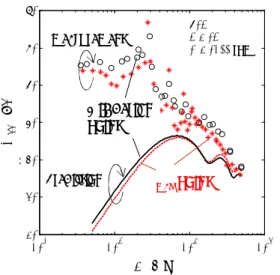
図5は実測値のファン騒音のスペクトルを予測値と 比較したものである.図中の凡例が実測値の騒音レベ ルであり,○が流量係数φ=0.25,凡例は,*がφ=0.35 である.また,実線はφ=0.25における式(20)による予 測値の空力音スペクトルであり,破線がφ=0.35のスペ クトルである.予測値のスペクトルは高周波数域(f >
1000 Hz)の実測値の傾向を表すことができた.従って,
後縁近傍の擾乱によって発生する空力騒音は高周波数 域の広帯域騒音を形成することがわかる.一方,後縁 騒音モデルには翼端渦音や後流渦音のような低周波の 挙動に関係する流れの機構が含まれていないため,低 周波数域の予測値の空力騒音は実測値よりも過少評価 されている.
5.おわりに
Michel Rogerによって提案された後縁騒音モデルお
よび広帯域騒音の予測式について解説した.この解析 理論に基づいてプロペラファンの広帯域騒音を予測す る上で必要となる流れの諸量が半経験理論によって与 えられた.後縁近傍での擾乱による後方散乱で生成さ れる空力音源は,高周波側の広帯域騒音を形成するこ とがわかった.
参考文献
(1) 坪田晴弘:リングファンの研究・開発,KOMATSU Technical Report, 第53巻 第159号, pp. 2 – 9, 2007.
(2) 難波義久:建設機械の規制・機械のグローバル化
と 安 全 性 の 向 上 , 建 設 の 施 工 機 械 , 第701巻 , pp.14-23, 2008.
(3) Soichi Sasaki, Masaharu Fukuda, Masao Tsujino, Haruhiro Tsubota,: Prediction of Aerodynamic Noise in a Ring Fan Based on Wake Characteristics, Journal of Thermal Science, Vol. 20 No.2, pp. 144-149, 2011.
(4) 佐々木壮一,坪田晴弘,辻野正雄:プロペラファ ンの擬似的な動静翼干渉によって発生する離散 周 波 数 騒 音 , タ ー ボ 機 械 , 第40巻 第10号 , pp.612-619, 2012.
(5) 佐々木壮一,福田雅治,坪田晴弘,辻野正雄:リ ングファンの空力特性に及ぼす内部流動の影響,
ターボ機械,第38巻 第12号,pp. 729-736, 2010.
(6) R.K. Amiet: Noise due to turbulent flow past a trailing edge, Journal of Sound and Vibration, Vol.
47 No.3, pp. 387–393, 1976.
(7) M.S. Howe: A review of the theory of trailing-edge noise, Journal of Sound and Vibration, Vol. 61 No.3, pp. 437–465, 1978
(8) J.E. Ffowcs Williams, L.H. Hall: Aerodynamic sound generation by turbulent flow in the vicinity of a scattering half-plane, Journal of Fluid Mechanics, Vol. 40, pp.657–670, 1970.
(9) M. Roger, S. Moreau: Back-scattering correction and further extensions of Amiet’s trailing edge noise model. Part I: theory, Journal of Sound and Vibration, Vol. 286 No.3, pp. 477–506, 2005.
(10) Sanjose, M., et al.: Unsteady Numerical Simulation of a Low-speed Radial Fan for Aeroacoustic predictions, Proc. of ISRMAC14, Honolulu, Paper No.
1117, 2012
(11) J. Christophe, et al.: Uncertainty Quantification of Low-speed Axial Fan Self-noise, Proc. of ISRMAC14, Honolulu, Honolulu, Paper No.1142, 2012
(12) M. Landahl: Unsteady Transonic Flow, Pergamon Press, New York, 1961.
(13) R.K. Amie: Acoustic radiation from an airfoil in a turbulent flow, Journal of Sound and Vibration Vol.
41 No. 4, pp.407–420, 1975.
(14) G.M. Corcos: The structure of turbulent pressure field in boundary-layer flows, Journal of Fluid Mechanics, Vol. 18, pp.353–378, 1964.
(15) Gliebe, P., Mani, R., Shin, H., Mitchell, B., Ashford, G., Salamah, S., and Conell, S: Aeroacoustic Prediciton Codes. NASA/CR – 2000-210244, 2000.
101 102 103 104
30 40 50 60 70 80 90
frequency (Hz) Spp ( dB, f = 25 Hz )
= 0.35 = 0.25
P14 Z = 14 N= 1200 rpm
Off-design point
ηmaxpoint
f, Hz S pp, dB
Prediction measurement
Fig. 5 Prediction of the trailing edge noise spectra based on the backscattering model