Instructions for use
Title Feeding and Ranging Behaviors of Proboscis Monkey Nasalis larvatus in Sabah, Malaysia
Author(s) Matsuda, Ikki
Citation 北海道大学. 博士(地球環境科学) 甲第8718号
Issue Date 2008-03-25
DOI 10.14943/doctoral.k8718
Doc URL http://hdl.handle.net/2115/34633
Type theses (doctoral)
File Information Matsuda.pdf
Feeding and Ranging Behaviors of Proboscis Monkey Nasalis larvatus in Sabah, Malaysia
A Ph.D. Dissertation Submitted to
Graduate School of Environmental Earth Science, Hokkaido University
By Ikki Matsuda
2008
CONTENTS
SUMMARY ………..…...…… i - iv INTRODUCTION ……….….. 1 - 5 STUDY AREA ………...………... 5 - 7 METHODS
1. Surveys of topography and vegetation ………..………..…….. 7 2. Behavioral observation of BE-Group …...………..…... 8 - 10 3. Boat census along the river ………...… 10 RESULTS
1. Number and composition of groups ……..………..……... 11 2. Selection of sleeping sites ………. 11 - 13 3. Activity budget ……….……….………. 13 - 15 4. Food habits
4. 1. Vegetation and food menu …..……… 16 - 17
4. 2. Spatiotemporal distribution of food sources ………....…... 17
4. 3. Food preference ………...……..………..… 18 - 19
4.4. High preference for fruits, especially seeds ……….………... 19 - 22
4. 5. Seasonal trend of food menu diversity ………...…………...… 22
4. 6. Consumption of tree barks, termite nests and water …...…………... 22 - 23 5. Ranging behavior
5. 1. Home range ……….…………....……. 24
5. 2. Travel distance ……….…. 24 - 25 5. 3. Behavioral core trees ………...….. 25 - 26 5. 4. Effects of water level on ranging ……….…………..……….… 26 - 27 DISCUSSION
Feeding Behavior………...……… 27 - 33 Ranging Behavior and Predation Pressure ……….... 33 - 40 Conservation Implications ……….... 40 - 42 ACKNOWLEDGMENTS ………...… 43 - 44 REFERENCES ………..…. 45 - 53 11 Tables, 37 Figures and 1 Appendix
SUMARRY
A one-male group (BE-Group) of proboscis monkey Nasalis larvatus consisting of the α-male Bejita, six adult females and some immatures was chosen and focal male and females in BE-Group were followed for a total of 1,968 and 1,539 hours, respectively, along the Menanggul River (which is a tributary of the Kinabatangan River), Sabah, Malaysia, focusing on feeding and ranging behaviors from May 2005 to May 2006. In order to determine the availability and seasonal changes of plant species consumed by the focal monkeys, vegetation surveys were carried out in 2.15 ha along 16 200-500 m trails set up in the forest. In addition, sleeping sites of all the groups in the area were surveyed in the evenings of 6-22 days per month using a boat along the river side. The main results were:
1) Sleeping sites of BE-Group were distributed in a wide range of overlap with those of other groups, suggesting no territoriality between different groups on the riverside trees. BE-Group seemed to select their sleeping sites on riverside trees at narrow river locations to reduce the predation chance of clouded leopard and/or to raise the probability of successful river crossing by females (often with infants) and juveniles to escape from predators.
2) As there was no difference in time budget between individuals excluding the category others (grooming + copulation) which contributed very little, the data of all focal monkeys were pooled, and its resting, feeding, moving and others accounted for 76.4%, 19.5%, 3.5% and 0.5%, respectively. In the feeding time, young leaves, fruits, flowers, mature leaves and other food sources constituted 65.9%, 25.9%, 7.7%, 0.03%
and 0.5%, respectively, indicating that the tendency of consuming young leaves was strong in terms of total food amount. However, monthly fruit production of plants positively correlated with monthly fruit-eating and feeding activity of proboscis monkeys, respectively, though young leaf production to young leaf-eating and flower production to flower-eating did not correlate with each other, respectively, and both young leaf and flower production did not correlate with feeding activity. These suggest that fruit production significantly affects the activity budget of proboscis monkeys.
3) In both the male and females, the ratio of feeding time was the highest at 15:00 - 17:00, i. e. shortly before sleeping. As proboscis monkeys require about 50 hours for processing leaves, they may feed on lots of foods in late afternoon to spend the night time not only for sleeping but also for digestion.
4) Total number of plant species consumed by focal monkeys was 188 (127 genera, 55 families). When the availability of each species was estimated from the vegetation survey in which 180 tree and vine species were described and monthly followed their phenology, the actual observed time for consuming them was significantly different from consumption time expected from availability in some species, suggesting that the proboscis monkey is the picky eater. For instance, Mallotus muticus, Ficus binnendijikii, Crudia reticulate, Lophopyxis maingayi and so on were positively preferred by proboscis monkeys.
5) The seven focal monkeys spent a total of 177.2 hours for fruit-eating, of which seed-eating constituted 97%, suggesting that the proboscis monkeys seemed to consume the fruits in favor of seeds. Whenever monkeys collected ripe fruits, they abandoned
flesh and consumed only seeds. They fed extensively on the seeds of Mallotus muticus trees and Lophopyxis maingayi vines which were the most abundant plant species in the study area, although some dominant and predominant species were not consumed or showed negative food preference. Because the proboscis monkeys almost completely grind and digest the seeds of these abundant plant species, in this study site, they may limit too much increase of the predominant species and permit minor plant species to survive in the community.
6) Nonetheless, some seeds of Antidesma thawaitesianum, Nouclea subdita and Ficus spp. remained undigested in the feces of proboscis monkeys. The undigested seeds were small and relatively hard and were found in intact shape. Especially seeds of Ficus spp. were often found in feces when the proboscis monkeys often fed on its fruits, and Ficus species have been thought to be one of the most important plant species for a lot of wildlife. There is a possibility that proboscis monkeys may play the role of seed dispersal for a few plant species.
7) During 1,968 hours, the BE-Group moved within the range of 138.3 ha. The ranging of proboscis monkey was affected by the location of river crossing points and the availability of foods, in particular fruits.
8) The daily path length of BE-Group ranged from 220 m to 1,734 m (mean: 799 m) which was negatively correlated with fruit availability. The proboscis monkeys were apt to stay within a small range in fruit-abundant seasons.
9) BE-Group sometimes stayed within a limited area to frequently visit a particular tree which produced their favorite foods. Out of positively preferred trees or vines, Crudia reticulate, Cynometra ramiflora and Carallia brachiata could be such
behavioral core trees.
10) Since the water level of the river had a statistically significant effect on the location of BE-Group’s sleeping site, when more than 3 m deep water covered the forest floor more than 1 km from both sides of the riverbank towards the inland in seasonal flood, the group slept inside the forest. It may be that the proboscis monkeys are not restricted to the riverbank, which has an uncluttered view for easily finding predators, because of reduced predation pressure by terrestrial animals during times when high water levels prevent predators from hunting.
Thus, the feeding behavior of proboscis monkeys shows a high degree of fruit-eating (or seed-eating) in some seasons, and their extremely wide dietary diversity was demonstrated. Therefore, the ranging behaviors of proboscis monkeys were influenced by availability of fruits. The fruit-eating and fruit availability were one of the key factors to control the feeding and ranging behaviors of proboscis monkeys. In addition to those factors, ranging behaviors, including the sleeping sites selection of proboscis monkeys may be affected by predation pressure. In any case, the riverine forest of at least 800 m from the both river banks is evidently needed for the surviving of proboscis monkeys.
INTRODUCTION
The proboscis monkey (Nasalis larvatus) belongs to the subfamily Colobinae, distributed in Asia and Africa that includes 44 species of 7 genera and 15 species of 3 genera, respectively (Groves, 2001; Fashing, 2007; Kirkpatrick, 2007). The monkeys in this subfamily are characterized by a reduced thumb and an enlarged and sacculated forestomach (Napier and Napier, 1967 and 1985; Napier, 1985). The forestomach with fermenting bacteria enables the digestion of cellulose and deactivates toxins in leaves (Bauchop and Martucci, 1968; Kay et al., 1976; Bauchop, 1978; Chivers and Hladik, 1980; Waterman, 1984). The endemic proboscis monkeys in Borneo Island inhabit mangrove, peat swamp and riverine forests. They exhibit sexual dimorphism; that is, the body size of adult males, which have a long and hanging nose, is the largest among colobine species and their weight reaches about 20-24 kg, whereas adult females have a much shorter nose than that of the males and their weight is about 10 kg (Allen and Coolidge, 1940; Schultz, 1942; Napier and Napier, 1985). Furthermore, proboscis monkeys are adept at swimming in rivers and walking on soft mangrove because their hind feet have webbed toes (Napier and Napier, 1967; Napier, 1985). Even though earlier research on proboscis monkeys reported stable or loosely organized multi-male groups (Kern, 1964; Kawabe and Mano, 1972; Jeffrey, 1979; Macdonald, 1982), recent studies have revealed that the monkeys are evidently organized into stable one-male groups consisting of one adult male, several females and their offspring and all-male groups consisting of young males (Benett and Sebastian, 1988; Yeager, 1989 and 1995;
Murai, 2004a, 2004b, 2006 and 2007).
Whereas substantial detailed research on Asian and African colobines has been conducted until now (Struhsaker, 1987; Fashing, 2007; Kirkpatrick, 2007), only a little information on proboscis monkeys has been reported because some of their favorite habitats are swampy and thus prevent the observation and tracking of the monkeys in inland forests. Nonetheless, since proboscis monkeys always come back to the riverbank for sleeping (Kern, 1964; Kawabe and Mano, 1972; Jeffrey, 1979; Bennett, 1986a; Bennett and Sebastion, 1988; Yeager, 1989) even though the reason why the riverbank is a preferred sleeping site has not yet been resolved, most earlier long and short-term research has been conducted by observing from a boat on the river while the monkeys are on the riverbank in the early morning and late afternoon.
In the previous boat-based studies on feeding behavior of proboscis monkeys, those conducted over shorter time periods conclude that food habits of proboscis monkeys show a high degree of folivory and low food diversity (Kern, 1964; Kawabe and Mano, 1972; Macdonald, 1982) whereas the importance of fruit-eating in their food habits and relatively higher food diversity is reported in longer term studies (Yeager, 1984 and 1989; Salter, et al. 1985; Benett and Sebastian, 1988). Since Yeager (1989) reports that the monkeys seasonally changed their food parts (fruit, flower and young leaf), the short-term studies might not cover a long enough period of time to observe their various feeding behaviors, including their fruit-eating. However, in observing proboscis monkeys only from the river by boat for a limited time, there is a limit in the ability to determine their feeding behaviors and whether they have a strong tendency for fruit or leaf-eating because the monkeys spend daytime mostly in the forest. Similarly, it is difficult to estimate the amount of their feeding time in a day when observing from
a boat on the river, although one report on proboscis monkeys by Salter et al. (1985), is conducted both by boat and occasional foot survey, represents the activity budgets and the daily rhythm of feeding amount in a day. According to this report, proboscis monkeys spend most of their time resting, feeding or moving as the amount of these activities differs between forest types and the daily feeding rhythm fluctuates with a peak at 13:00-15:00.
In addition to the feeding behavior of proboscis monkeys, their ranging behavior has not yet been studied in detail as terrain problems also make it difficult to follow the monkeys in the forest. Their ranging behavior is usually investigated from the location of their observed sleeping site by boat survey. The sleeping sites of proboscis monkey’s one-male groups overlapped each other (Benett and Sebastian, 1988; Yeager, 1989; Murai 2004a) and their home range sizes, which are estimated by the length of the riverbank used, differ between habitats in one male groups: 315 ha in mangrove forests (Boonratana, 1993); 900 ha in mixed mangrove and lowland forests (Benett and Sebastian, 1988); 137 ha in peat swamp forests (Yeager, 1989); 221 ha in riverine forests (Boonratana, 2000). Only Boonratana’s figure of 221 ha in riverine forests is calculated by tracking the monkeys in the forest.
One report suggests that the ranging behavior of proboscis monkeys may be affected by spatial and temporal distribution of food availability (Boonratana, 2000), as reported from other primates (Clutton-Brock, 1975; Raemaekers, 1980; Oates, 1987;
Bennett and Davies, 1994; Olupot et al., 1994; Koenig, 2000; Di Fiore, 2003;
Kirkpatrick, 2007; Lambert, 2007). It is also said that predation pressures are an important factor affecting ranging behaviors and social systems of primates, although
the estimation of predation rates is difficult as predation events on any type of primate are rarely observed (Cheney and Wrangham, 1987; Miller and Treves, 2007). In proboscis monkeys, three accidental observations of predations on adult males by false gavial (Tomistoma schlegeli) (Galdikas 1985) and by clouded leopard (Neofelis nebulosa) (Davis, 1962; Jackson & Nowell 1996) and one case of predation on an adolescent female by false gavial has been reported (Yeager 1991a). Of the four reports, Yeager (1991a) suggests that the ranging behavior and social system of proboscis monkeys is affected by predation pressure when they cross the river, as this behavior exposes monkeys to a high risk of predation by aquatic predators such as crocodiles.
Compared with the research on feeding and ranging behavior of proboscis monkeys, the research on their social system is the most focused theme in former studies since it is relatively easy to observe the relationship between the groups even by boat from the river. Recent long-term studies suggest that the proboscis monkey has a multi-level society in which one-male groups regularly associate with each other at least along the riverbank (Benett and Sebastian 1988; Yeager 1991b and 1992; Boonratana 2002; Murai 2004a). The degree of association between one-male groups at the riverbank may be influenced by the water level of the river and/or predation pressure (Yeager 1993; Murai 2004a). However, it is still unknown whether the association between the groups is maintained even in the forest.
Because of the limited habitat of proboscis monkeys along the river, the World Conservation Union (IUCN) reported in 1978 that the major threat to their population is habitat loss through logging. Their conservation status has been classified as
“endangered” since 2000 by IUCN, and this species is listed on Appendix I by the Convention of International Trade in Endangered Species (CITES). To conserve this endangered species, several studies for population estimation have been conducted: <
300, 1000, 5000 and 6000 individuals in Brunei Bay, Sarawak, protected reserves in Kalimantan and Sabah, respectively (Bennett, 1986b; Yeager and Blondal, 1992; Sha 2006), while the ecological data for the preservation of proboscis monkeys (especially feeding and ranging data in the forest), which should be useful information when establishing new forest reserves and replanting plant species at logged areas is hardly known.
Thus, as there is a total lack of behavioral data on proboscis monkeys inside the forest in past studies, to understand their ecology and preserve this endangered species, information about this monkey inside the forest is needed in every category. The present study, which is the first systematic research on a one-male group of proboscis monkeys observed not only at the riverbank but also inside the forest throughout a day, provides information focusing on their feeding and ranging behaviors.
STUDY AREA
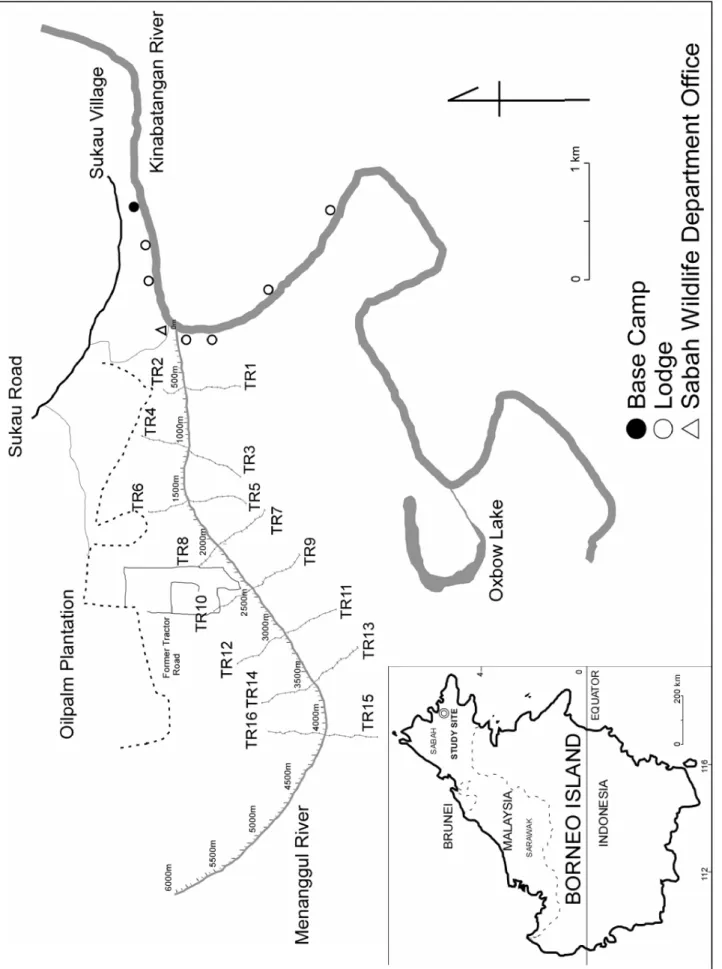
This study was made from January 2005 to May 2006 in riverine forests along the Menanggul River, a tributary of the Kinabatangan River, Sabah, Malaysia (Fig. 1).
Whereas the southern area of the Menanggul River was extensively covered by natural forest, the northern area had been deforested for oil palm plantations except for a legally
protected zone along the river. The riverine forest was inhabited by not only proboscis monkeys but also long-tailed macaques (Macaca fascicularis), pig-tailed macaques (Macaca nemestrina), silver langurs (Trachpithecus cristatus), hose’s langurs (Presbytis hosei), bornean gibbons (Hylobates muelleri) and orangutans (Pongo pygmaeus).
Although the main objective of this study was to investigate the behavior and food habits of proboscis monkeys, the food habits of other primates were also described facultatively. This area is one of tourism resources, and many boats and tourists visited the Menanggul River (especially in June-September), with the peak in September when an average of 12 boats and 70 tourists were counted per day (Fig. 2).
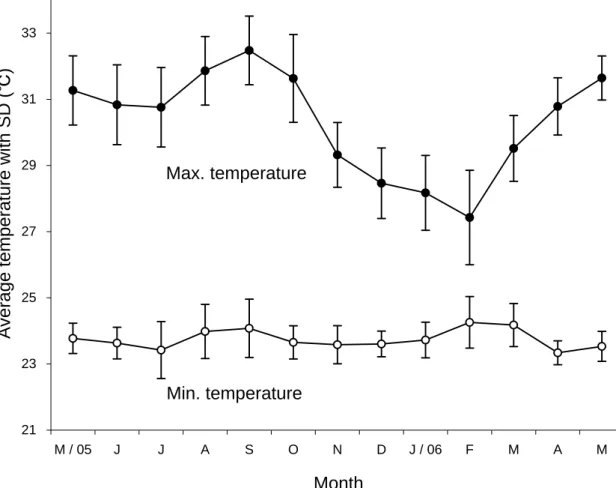
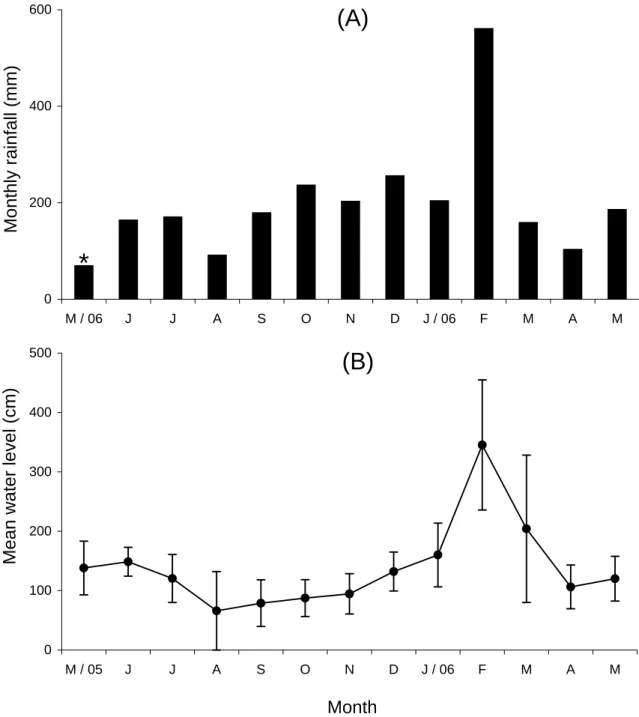
The rainfall was measured every morning at base camp, using a tipping bucket rain gauge. The air temperature was automatically recorded by a HOBO Water Temp Pro deposited at a lodge near the mouth of the Menanggul River. I firmly stuck a 5 m tall board of Borneo ironwood Eusideroxylon zwageri which was scaled at intervals of 10 cm, with 0 cm at the river bottom, onto the floor of river mouth to measure the water level. Whenever I entered the Menanggul River 20-26 days per month, the water level was checked at 18:30-19:00. Mean minimum temperature was nearly constant at about 24°C throughout a year but mean maximum temperature fluctuated between 27.4°C in February and 32.5°C in September (Fig. 3). Annual precipitation from June 2005 to May 2006 was 2,509 mm (Fig. 4A). Although monthly rainfall fluctuated from 90.9 mm in August to 560.6 mm in February, the dry season was not as clear as in the Samunsam Wildlife Sanctuary, western Sarawak, Malaysia (Basiuk, 1985; Bennett and Sebastian, 1988). In parallel with the fluctuation of monthly rainfall, the mean water level at the river mouth was highest in February (345 cm) and lowest in August
(66 cm) (Fig. 4B).
METHODS
1. Surveys of topography and vegetation
Prior to the beginning of regular surveys from May 2005, I made a topographic map of the study areas by using GPS. Along the Menanggul River, datum points were located at intervals of 50 m over an area stretching from the river mouth to a point 6 km upstream. At intervals of 500 m and over an area stretching from the river mouth to a point 4,000 m upstream, 200-500 m long and 1 m wide trails were set up (Fig. 1) by cutting off the floor layer of vegetation for the ready observation and following of proboscis monkeys. Along the trail, I labeled the trees of DBH ≥ 10 cm and vines of diameter ≥ 5 cm which were located on the trail or within 1 m from the edge of the trail, i. e. surveyed width = 3 m. All of the labeled trees and vines were measured DBH and taxonomically identified with the support of the Forest Research Center of Sabah State Forestry Department. Since trails were set up on both riversides, the total number of trails was 16: TR 2 = 200 m long, TR 4 = 400 m, TR 6 = 400 m, TR 8 = 250 m, TR 10 = 400 m and other trails = 500 m each. From May 2005, the trees and vines were visited at the end of each month to follow their phenology, that is, presence or absence of flowers (including floral buds), fruits (including ripe and unripe fruits) and young leaves (including leaf buds).
2. Behavioral observation of BE-Group
Prior to following a particular one-male group, I made a preliminary observation of some one-male groups to choose a group which seemed appropriate for the present study. In the study area, all of the one-male groups were relatively habituated to tourists on the river. However, once researchers attempted to land on a riverbank, the proboscis monkeys became excited and escaped into the forest, but not BE-Group whose α-male, Bejita, was unperturbed by the landing researchers and the other members of the group followed his attitude. Then, I carefully approached them almost everyday in the second half of April 2005 to habituate them to researchers. During this preliminary observation, I described some physical characteristics of BE-Group’s α -male and all adult-female members to identify them from proboscis monkeys of other one-male groups.
From the beginning of May 2005 to May 2006, the focal monkeys (which were all adults) in BE-Group were followed continuously from the time they were found until evening each day through a focal animal sampling method (Altman, 1974). At 06:00-06:30 a. m. of each sampling day, I and two research assistants arrived at the BE-Group’s sleeping site which had been determined the previous evening. The α -male Bejita was always focal and another focal monkey was chosen from the adult-female members by attempting to avoid the choice of the female followed on the last day. Of the three researchers, one followed the male, one followed the focal female and the other one supported the two followers. They followed the focal monkeys until the BE-Group set up their sleeping site and started sleeping at 18:30-19:00, though, if the focal female was lost from the researcher’s sight for more
than 30 minutes, one of the other females was chosen as a new target. The monkeys were followed 11-17 days per month, except in February 2006 when the study area was totally flooded and BE-Group was not discovered for almost one month due to their migration in the forest. In March, when the forest floor was flooded but BE-Group was fortunately found, the focal monkeys were followed by using boat even in the deep forest.
During observations, activities of the focal monkeys were recorded in seconds.
The researchers recorded the time the focal monkeys started and ended the following three activities, i. e. resting, moving and feeding, in seconds. Behaviors other than these three categories were treated as others. Resting includes all instances in which the subject was inactive, defecating or urinating. Moving includes any locomotor behaviors resulting in a change in spatial position. Feeding includes the acts of plucking, masticating, swallowing food or drinking water. Others include social and self grooming and copulation. When the focal monkeys were feeding, we recorded whether the food items consisted of young leaves (including leaf buds), flowers (including floral buds), fruits (ripe and unripe fruits), or others (including tree barks and termite nests). The food plants were taxonomically identified in situ and recorded, but if the food plant species was yet unidentified, leaves, flowers and/or fruits were collected from the plant for identification at the Forest Research Center. To certify that fruit-eating resulted in the seeds being defecated, some feces were examined in situ, though seeds of only a few plant species remained intact. While following Bejita, his geographical points were located by GPS at intervals of 10 minutes. The daily path length of Bejita from one sleeping site to the next sleeping site was considered as
BE-Group’s daily path length in this paper, because all group members traveled almost the same route and the focal females rarely moved more than 50 m away from Bejita.
3. Boat census along the river
Proboscis monkeys have been thought to set up their sleeping sites on the riverside trees (Kern, 1964; Kawabe and Mano, 1972; Jeffrey, 1979; Bennett, 1986a;
Bennett and Sebastion, 1988; Yeager, 1989) (Fig. 5). In order to observe the distribution of sleeping sites, membership of one-male groups, all-male groups and mixed groups and the number of these groups and solitary monkeys, a boat census was conducted starting from a point 6 km upstream of the river mouth in the evening of 6-13 days per month except in February 2006 when the boat census was carried out in the evening of 22 days partly in search of the lost BE-Group. At 16:00-16:30, we started the boat census from 6 km upstream, went down the river slowly to the river mouth, and finished before it got dark at 18:00-18:30. Whenever a group was found in each census, the member composition was recorded by categorizing the monkeys into five sex & growth stage groups (Table 1). In each boat census, because the survey was carried out traveling only one way on the river, the same groups were not counted double.
RESULTS
1. Number and composition of groups
In each boat census, 2-15 one-male groups were observed, except in February and March when the study area was entirely flooded and almost all of the groups traveled in the forest without returning to the riverbank for sleeping (Table 2). The size of the one-male groups was 2-29 individuals, with a mean number of about 5 females and 5-8 immatures (subadults, juveniles and infants). In addition to the one-male groups, there were a few mixed groups which referred to a loosely bonded predominantly male group with several females, all-male groups and solitary monkeys. The membership of mixed groups and all-male groups seemed unstable. The solitary monkeys were rarely observed and most of the monkeys found were males. Overall, 21-218 individuals of proboscis monkeys were observed in each census, i. e. with 3.5-29.8 individuals / km, suggesting that the number of proboscis monkeys which could be found in the study area at the riverbank fluctuates greatly from day to day due to the differing time each group would return to the riverbank.
2. Selection of sleeping sites
Figure 6 shows the temporal trends of the BE-Group’s sleeping sites along riverbanks based on the data obtained from the 13-month observation of this one-male group. They occasionally moved more than 1,000 m per day but usually stayed within a limited range for several weeks or months, frequently crossing the Menanggul River.
During the 13-month observation, 261 sleeping sites of BE-Group (confirmed by
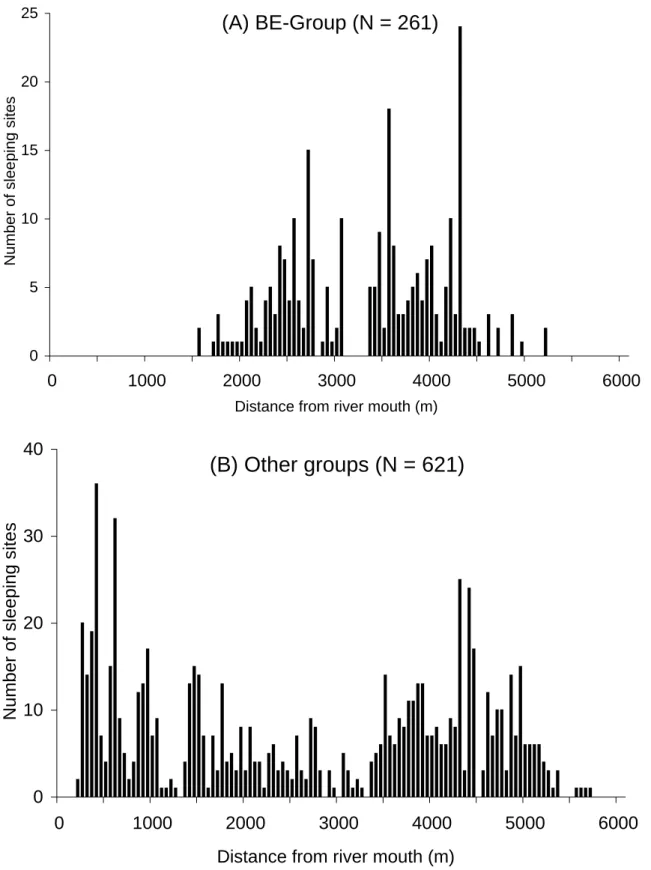
full-day observation and boat census) were distributed between 1,500 m and 5,180 m from the river mouth (Fig. 7A). As for other groups, 621 sleeping sites (confirmed by boat census) were distributed between 150 m and 5,650 m from the river mouth (Fig.
7B), with a wide range of overlap with the distribution of BE-Group’s sleeping sites, suggesting no territoriality between different groups at least on the riverside trees. The absence or inconspicuousness of between-group hostility is supported by Figure 8 representing that 100 sleeping sites of other one-male groups were located within 200 m from BE-Group’s sleeping site. Thirty-seven sleeping sites were located within 50 m, with occasional occurrences in which the same tree was shared. The nearest sleeping sites of other one-male groups were frequently situated on the same riverside with BE-Group’s sleeping site (Chi-square test: χ2 = 16.49 and p < 0.0001).
Over a total of 3,506 hours (Bejita: 1,968 hrs; females: 1,539 hrs), river crossings by Bejita and focal adult females were observed 90 times and 65, respectively. The frequency of pooled river crossings for Bejita and adult females was significantly higher at the parts of the river where the width was narrower, between 1,400 m and 5,250 m from the river mouth, which is the range of the riverbank used by BE-Group (Generalized linear models with Poisson error and log link: coefficient -0.053 ± 0.020 and p (G) < 0.01). As shown in Figures 6 and 7, BE-Group often (15 times or more) had sleeping sites at 2,650-2,700 m, 3,500-3,550 m and 4,200-4,250 m from the river mouth. At these locations, the Menanggul River was as narrow as 15-20 m in width (Fig. 9A) so that the α-male Bejita almost always successfully crossed the river from tree to tree (Fig. 9B). Whereas females often failed jumping between-trees and fell into the river, their success probability was higher at these locations than at others (Fig.
9B). The ratio of successful river crossings was 93% in the male, 53% in adult females with infants, 56% in adult females without infants and only 32% in juveniles (Fig. 10). Although I did not observe any deaths of the individuals which fell into the river, the Menanggul River is inhabited by estuarine crocodiles (Crocodylus porosus) which were thought to be one of the major predators for proboscis monkeys. In following BE-Group, I happened to observe an infant and a juvenile suddenly attacked and victimized by clouded leopard (Neofelis nebulosa) on 21 July 2005 and 8 April 2006, respectively (Fig. 11). BE-Group seemed to select their sleeping sites on riverside trees at narrow river locations to reduce the predation chance of clouded leopards and/or to raise the probability of successful river crossing by females (often with infants) and juveniles to escape from predators.
3. Activity budget
Six focal adults, Chi-J♀, Bul-J♀, Bul-I♂, Lun-J♀, Lun-I♀, Ara-J♀ and Big-J
♀ survived and stayed in BE-Group throughout the 13 months, whereas a subadult female, Ranfan, transferred to another one-male group in April 2006, Chi-I♂ disappeared for unknown reason in December 2005 and Ara-I♀ (Fig. 11A) was victimized by a clouded leopard on 21 July 2005 (Fig. 12). In addition to these members, new infants Big-I♂ and Ara-I♂ were born by Bigmama on 15 March 2006 and Arare on 27 January 2006, respectively, and a new female adult member Midori and her daughter Mi-J♀ transferred into BE-Group from another one-male group on 15 March 2006, though Mi-J♀ was victimized by a clouded leopard on 8 April 2006 (Fig.
11B). In the observation of this group, the new member Midori was also treated as one
of focal members. During the 13 months, the adult male Bejita was followed for a total of 1967.8 hours and adult females were followed for 48.2 hours (Midori) to 681.7 hours (ChiChi) (Table 3). An average of 12.5 ± 1.6 hours per day made for a total of 3,506 hours
As depicted in Table 4, the difference in time budget among seven focal monkeys, even including the new member Midori, was not significant for resting (One-way ANOVA: F = 1.03 and p = 0.40), feeding (F = 1.14 and p = 0.34) and moving (F = 1.35 and p = 0.23) consisting 73.9-79.6%, 16.4-21.0% and 3.0-3.6%, respectively, but significant in others (grooming + copulation) (Kruskal-Wallis-test: H = 45.5 and p <
0.01) constituting 0.1-2.4%. Thus, as there was no difference in time budget between individuals excluding the category others which contributed very little, the data of all focal monkeys were pooled, and its resting, feeding, moving and others accounted for 76.4%, 19.5%, 3.5% and 0.5%, respectively (Total in Table 4). Including about 12-hour stays at night at sleeping sites, proboscis monkeys spent about 21 hours / day for resting and sleeping and only about 3 hours / day for activities. Sexual difference in time budget was significant for feeding (t-test: t = 2.02 and p = 0.04), moving (U-test:
U = 10003.5 and p = 0.04) and others (U = 16140 and p < 0.0001) (Fig. 13). The male would spend more time on feeding than female to maintain his larger body. As the male frequently retraced the way he came to bring back the females separated from BE-Group, he would spend more time on moving than female. Females more frequently performed grooming to other females, infants and juveniles while the male more frequently performed copulation. Among activities, moving and others constituted only 2.3-4.3% and 0.05-1.3% per month, respectively, and therefore feeding
seemed a key factor which determined the activity budget of proboscis monkeys. To confirm the seasonal fluctuation of feeding activity, I examined the seasonal fluctuation of defecation frequency. The seasonal fluctuation of mean daily defecation frequency was significant in both the male (One-way ANOVA: F = 7.96 and p < 0.01) and females (Kruskal-Wallis-test: H = 41.43 and p < 0.01), with a high peak from June to August and another peak in November (Fig. 14A). As mentioned in the following section, monthly fruit production of plants positively correlated with monthly feeding activity (Pearson product-moment correlation coefficient: r2 = 0.37 and p = 0.04) and fruit-eating (r2 = 0.61 and p = 0.003) of proboscis monkeys, respectively, and fruit production and fruit-eating was the largest July to August. However, monthly young leaf and flower production of plants did not correlate with young leaf- and flower-eating, respectively (young leaf: r2 = 0.18 and p = 0.17; flower: r2 = 0.01 and p = 0.74) and feeding activity (young leaf: r2 = 0.08 and p = 0.38; flower: r2 = 0.02 and p = 0.70).
These suggest that fruit production significantly affects the activity budget of proboscis monkeys. Figure 14 additionally shows the seasonal fluctuation of urination frequency, also with a peak in June-July. The fluctuations in daily feeding rhythm were statistically significant in both the male (One-way ANOVA: F = 4.94 and p < 0.01) and females (F = 3.48 and p < 0.01) (Fig. 15), with a peak at 15:00-17:00, i. e. shortly before sleeping.
4. Food habits
4. 1. Vegetation and food menu
In the survey of vegetation along 16 trails, 1,645 trees and 497 vines of 180 species (124 genera, 46 families) were described (Table 5). Predominant species were Mallotus muticus, Excoecaria indica, Dillenia excelsa, Croton oblongus, Nauclea subdita, Xylosma sumatrana, Pternandra galeata, Vitex pinnata, Vatica rassak and Antidesma thwaitesianum in trees and Lophopyxis maingayi, Croton caudatus, Dalbergia parvifolia, Hydnocarpus sumatrana, Entada rheedei, Bridelia stipularis, Albizia corniculata, Artabotrys suaveolens, Bauhinia diptera and Millettia nieuwenhuisii in vines. Since DBH markedly varied among species and growth stages, total basal area of each species is also shown in Table 5. Whereas the surveyed area reached as large as 2.15 ha (3 m width × 7,150 m length), the cumulative number of plant species did not plateau (Fig. 16) due to extremely high species diversity in tropical riverine forests. Accordingly, the total number of plant species consumed by focal monkeys during a total of 3,506 hours was 188 (127 genera, 55 families, Fig. 17 and Table 6), exceeding the total number of plant species described in the survey of vegetation (180 species). The proboscis monkeys frequently ingested young leaves, fruits and flowers and occasionally mature leaves and others (barks of Eugenia sp. 2 and nests of termite Microcerotermes distans), and the difference of the composition of each plant part among seven focal monkeys was not significant in young leaves (One-way ANOVA: F = 0.78 and p = 0.58), fruits (F = 0.87 and p = 0.52), flowers (Kruskal-Wallis-test: H = 6.94 and p = 0.22) and others (H = 0.70 and p = 0.87) (Table 7). Thus, as there was no difference in the composition of the plant parts consumed
between individuals, the data for the focal monkeys were pooled, and young leaves, fruits, flowers, mature leaves and others constituted 65.9%, 25.9%, 7.7%, 0.03% and 0.5%, respectively (Total in Table 7). The numbers of plant species providing young leaves, fruits and flowers were 182, 49 and 28, respectively, with overlaps as shown in Figure 18.
4. 2. Spatiotemporal distribution of food sources
Every month, excepting February, 2006, when the study area was flooded with 3-4 m deep water and the tagged trees and vines could not be identified, phenology of the 2,142 plants along the 16 trails was surveyed by examining whether each plant had young leaves, fruits and/or flowers. Out of the 2,142 plants, 1,902 were of species consumed by focal monkeys: 1,899 plants for young leaves; 919 for fruits; 469 for flowers (Fig. 19). Figure 20 represents the spatiotemporal distribution of plants with fruits, flowers or young leaves. Young leaves were highly available in all seasons and all trails (Fig. 20A) and flowering trees and vines showed relatively even distribution across the trails and seasons (Fig. 20B). In contrast, the abundance of fruiting plants was distorted to particular seasons and trails (Fig. 20C). Spatially, the fruiting plants were more abundant on the southern side (trail of odd numbers), especially on TR 13, than the northern side (trails of even numbers). Seasonally, the availability of fruits was higher in July-August and November but lower in May than in other months.
4. 3. Food preference
In 48 of 180 species described in the vegetation survey along the 16 trails, the number of plants exceeded 12 which was the mean number of plants per species, i. e.
2,142 plants / 180 species. Out of the 48 dominant species, 16 species had many fruits and flowers but proboscis monkeys did not consume their fruits or flowers at all for unknown reasons, whereas orangutan or long-tailed macaque was facultatively observed consuming fruits of five of those species (Table 8). Out of the five species, Vitex pinnata, Microcos crassifolia and Dracontomelon dao had seeds which seemed too hard for proboscis monkeys to consume. Fruits of Entada rheedei appeared too large and hard for proboscis monkeys to take the seeds out of the fruits. Excoecaria indica was one of the predominant tree species in the study area and produced a lot of fruits throughout a year but neither proboscis monkeys, orangutans or long-tailed macaques consumed any fresh fruits and flowers on the trees, though a group of long-tailed macaques was once observed taking some old and dry E. indica fruits floating in the river. Even young leaves of this plant species were rarely consumed by proboscis monkeys. This species may have some chemicals which are toxic or repellent for the nonhuman primates. The proboscis monkeys did not consume any fruits and flowers of the predominant species Croton caudatus and C. oblongus, with very rare consumption of young leaves. Their fruits and young leaves exerted a specific smell, suggesting the presence of some toxic or repellent chemicals.
To test the proboscis monkeys’ preference for edible plant species, time spent for consuming each plant species was compared with time expected from its availability.
The availability of each part (flowers, fruits and young leaves) was calculated using the
following formula. Availability = Bk · ∑ (nki / Nk) / 12 where Nk is the total number of plants, nki is the number of tree or vine plants with flowers, fruits or young leaves in month i and Bk is total basal area per hectare in the species k. As shown in Table 9, the availability of each species was given by basal area, and G-test was conducted for trees and vines separately. Thus, the plant species were divided into six categories, i. e.
(vine and tree) × (fruits, flowers and young leaves), and observed data and expected values were compared by using G-test (Table 9) for each category. Accordingly, the difference between observed data and expected values was statistically significant in all of the six categories (G = 31307 and p < 0.0001 in tree fruits; G = 4686 and p < 0.0001 in vine fruits; G = 5860 and p < 0.0001 in tree flowers; G = 2405 and p < 0.0001 in vine flowers; G = 56541 and p < 0.0001 in tree young leaves; G = 11259 and p < 0.0001 in vine young leaves). In Table 9, the preferences of proboscis monkeys were categorized into positive (PO), negative (NG) and neutral (NU) preferences when the observed consumption was considerably larger, smaller than and nearly equal to the availability, respectively: observed or expected time is more than 180 minutes and the ratio of observed time to expected time is > 2.0 (PO), < 0.5 (NG) and 0.5 < 2.0 (NU).
4.4. High preference for fruits, especially seeds
As shown in Figure 13, the percentage of time spent for feeding exhibits remarkable seasonal fluctuation. To examine the contribution of fruit, flower and young leaf consumptions, the seasonal fluctuations of the three factors are separately represented in Figure 21A. Flower consumption was constantly low throughout a year.
Since the proboscis monkeys were primarily leaf eaters, young leaves almost constantly
contributed to their food habits at a high level. In contrast, fruit consumption was very low in some seasons but exceeded the percentage of young leaves in July and August, indicating the high contribution of fruits to the seasonal fluctuation of feeding activity.
For young leaves, fruits and flowers, the male-female difference of seasonal fluctuation was not statistically significant (U-test: U = 10059 and p = 0.28; U = 11641 and p = 0.28; U = 10277 and p = 0.43, respectively) (Fig. 21B-D).
The seven focal monkeys spent a total of 177.2 hours for fruit-eating, of which unripe fruits constituted 90.4% (Fig. 22A). A fruit was composed of seed, flesh and calyx, and the proboscis monkeys spent 32.9%, 2.1% and 0.9% of 177.2 hours for consuming only seeds, flesh and calyxes, respectively (Fig. 22B). When the seeds and the flesh of the fruit firmly stuck to each other and seemed difficult to be separated, proboscis monkeys concurrently consumed both the seeds and flesh in most cases (64.1% of the time). Accordingly, seeds made up 97% of 177.2 hours, suggesting that the proboscis monkeys seemed to consume the fruits in favor of seeds. Whenever monkeys collected ripe fruits, they abandoned flesh and consumed only seeds.
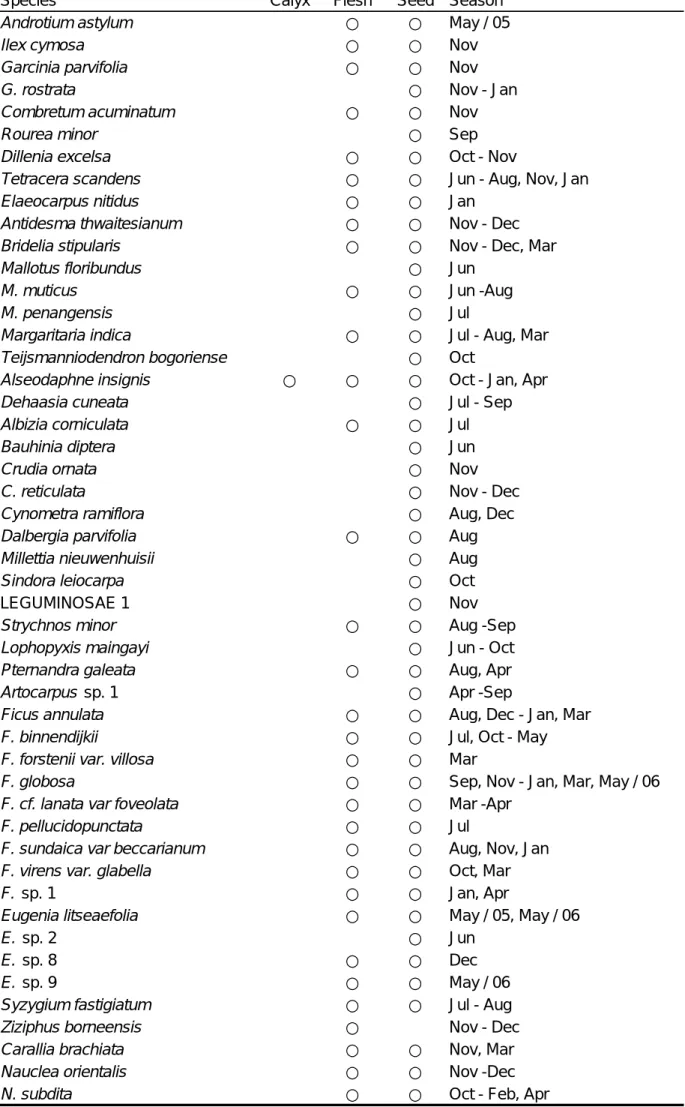
Fruit consumption by the focal members of the BE-Group was observed for a total of 49 plant species (Table 10), and seeds were consumed in 48 species, excepting Ziziphus borneensis which had extremely hard seeds. On the other hand, calyxes were consumed in only Alseodaphne insignis (Table 10). The growth of A. insignis fruits could be divided into four stages (Fig. 23). In unripe stage 1, the calyx was fresh and larger than the flesh, in which the seed was indistinct (Fig. 23A). In unripe stage 2, the calyx was still fresh and the flesh became large, with an immature seed (Fig. 23B). In unripe stage 3, the flesh grew up to full size with a still immature seed, and the calyx
was withered (Fig. 23C). In the ripe stage, the flesh was juicy with a mature seed (Fig.
23D). Proboscis monkeys consumed only calyxes in unripe stage 1, calyxes and flesh in unripe stage 2 and only seeds in unripe stage 3 and ripe stage. A. insignis was so rare in the study area that no trees of this species were described in the vegetation survey along 16 trails. Nonetheless, the focal members repeatedly visited three ca.
20-25 m tall trees of A. insignis near TR 13. Of the three, two trees (I and II) were located near the riverside and the other tree (III) was about 100 m away from the riverside. Whereas trees I and III produced fruits for at least four months from October to January, proboscis monkeys frequently visited in only December and January (Fig. 24) when the fruits had seeds, indicating that the main targets of the monkeys were not calyxes or flesh but seeds. The consumption of calyxes in April may suggest that the phenology of A. insignis is not well synchronized among trees.
In the observation of BE-Group, feces content was examined in 400 feces samples of focal members, ranging from 19 feces in September to 71 in November.
Seeds were contained in 23 of 71 feces in November, 15 of 38 feces in December and 5 of 21 feces in March. The indigested seeds were of Antidesma thawaitesianum, Nouclea subdita and Ficus spp. in November and December (Fig. 25A), which was consistent with the fact that focal members of the BE-Group consumed fruits of A.
thawaitesianum and N. subdita mostly in November and December (Fig. 25B).
Species of Ficus, F. binnendijikii and F. globosa were relatively abundant in the study area and their fruits were positively preferred by proboscis monkeys (Table 9).
Although F. binnendijikii had fruits throughout a year, the monkeys consumed only their young fruits containing immature seeds which seemed digestible in their forestomach.
F. globosa had fruits from September to May and the monkeys consumed not only young fruits but also pre-ripe or ripe fruits containing mature seeds. Most of the seeds contained in the feces were probably of F. globosa. The mature seeds of A.
thawaitesianum, N. subdita and F. globosa were probably too small and hard to be ground by teeth of proboscis monkeys.
4. 5. Seasonal trend of food menu diversity
The number of species consumed by the focal members of BE-Group seasonally fluctuated, ranging from 36 species in September to 82 species in December, excepting February when data was hardly obtained due to deep flooding (Fig. 26). The Shannon-Wiener index of Diversity (H’) (Pielou, 1966) was used to calculate for food menu diversity. Identified plant species were used in the analysis; unidentified plants were not included. Except in February, food menu diversity H’ ranged from 2.28 to 3.37, with a low in July, September and May 2006, whereas evenness (J’) was nearly constant at 0.6-0.8 (Fig. 26). The months with low diversity corresponded to the seasons when the fruit consumption peaked (Fig. 21A). Stepwise regression analysis detected a significantly negative correlation between the seasonal fluctuations of time spent feeding on fruits and food menu diversity (H’) (p = 0.043, see Table 11).
4. 6. Consumption of tree barks, termite nests and water
In addition to fruits, flowers and young leaves, tree barks and termite nests were consumed by proboscis monkeys (Fig. 27). In the study area, there were two species of papery bark trees, Eugenia sp. 2 and Pternandra galeata. Whereas P. galeata was
more dominant than E. sp. 2, proboscis monkeys consumed papery bark of E. sp. 2 but not of P. galeata. Since fruits and young leaves were negatively and flowers were never consumed in P. galeata (Table 9), the trees of P. galeata might have some chemicals repellent for proboscis monkeys. The bark of E. sp. 2 were consumed from September to March (Fig. 28A). Especially in females, the bark feeding season was restricted to three months from September to November. Although there were many species of termite nests in the study area, proboscis monkeys consumed nests of only arboreal species represented by Microcerotermes distans. Whereas the male Bejita consumed the nests almost throughout a year, females consumed them only from November to April (Fig. 28B).
In the study area, several 1-3 m wide streams were meandering through the forest and many temporary pools appeared on the forest floor after heavy rains. Because in leaf-eating monkeys, including proboscis monkeys, water is primarily supplied from leaves in the process of digesting cellulose in their stomach, they rarely drank water.
Nonetheless, the focal male and female monkeys were observed drinking water 11 and 15 times, respectively. In addition, juveniles of BE-Group were facultatively observed drinking water 14 times. When they drank water, the male always went down to the forest floor to use such water sources as the river and small streams but juveniles almost always hand-dipped from tree holes without descending to the forest floor (Fig. 29).
Females took water from the Menanggul River or small streams 12 times and from tree holes three times. At the river, small streams and temporary pools, the monkeys drank water for 21-80 seconds by putting their mouth into the water.
5. Ranging Behavior 5. 1. Home range
Over a total of 1,968 hours, BE-Group moved within a range of 138.3 ha, viz. 553 50 m × 50 m grids (Fig. 30). Because the group almost always had sleeping sites at riversides, the frequently used grids were distributed along the Menanggul River. The grids used 22 or more times were situated at 2,650-2,700 m, 3,500-3,550 m and 4,200-4,250 m where the Menanggul River was as narrow as 10-15 m in width and BE-Group often crossed the river (cf. also Fig. 9). The core ranging area was located around TR 13 where foods, in particular fruits, were most abundant from July to May (Fig. 20C). Thus, Figure 30 suggests that the ranging of proboscis monkey is affected by the location of river crossing points and the availability of foods, in particular fruits.
Whereas sleeping sites of one-male groups were often close to each other and they exhibited less or no hostility near the riverside, different groups rarely encountered each other in the deep forest and, if encountered, they showed aggressive behavior. During the 13-month observation, the encounters (in which another one-male group was in a radius of less than 50 m from BE-Group) were observed only three times, and in all of the encounters Bejita drove off the rival α-males.
5. 2. Travel distance
Excepting the missing period in February, BE-Group traveled a total of 128.8 km within the home range. The daily path length was from 220 m to 1,734 m, with a mean distance of 799 m (Fig. 31). Although the group traveled long distances when they moved along the Menanggul River, their daily path length rarely exceeded 1,000 m
when they traveled away from the river, evidently because they had to return to the riverside for sleeping before sunset.
Figure 32 demonstrates the seasonal fluctuation of mean daily path length and availability of fruits, flowers and young leaves. The daily path length significantly correlated with the availability of fruits (stepwise regression analysis: p = 0.0028 see Table 11) but not of flowers and young leaves. The negative correlation between the daily path length and fruit availability indicates that proboscis monkeys were apt to stay within a small range in fruit-abundant seasons. In addition, daily rainfall also seemed to reduce the daily path length, though the rainfall accounts for only 4.8% of the variation of daily path length (Spearman’s rank correlation tests: r2 = 0.048 and p <
0.01) (Fig. 33).
5. 3. Behavioral core trees
BE-Group sometimes stayed within limited areas to repeatedly visit particular trees which produced their favorite foods. Out of positively preferred trees or vines (Table 9), Crudia reticulate, Cynometra ramiflora and Carallia brachiata, which were repeatedly visited (five or more times on different days), could be such behavioral core trees. For instance, C. ramiflora had cigar like rolls of young leaves which seemed very attractive to the proboscis monkeys. From 16 to 21 July, BE-Group was frequently attracted to a large C. ramiflora tree near the riverside point which was about 300 m upstream from TR 16, and therefore the group traveled only 3,110 m during the five days (Fig. 34). Out of tree species which were not described in the vegetation survey but were observed to be consumed by proboscis monkeys, Artocarpus sp. 2 and
Garcinia rostrata could be behavioral core trees (cf. Table 6).
5. 4. Effects of water level on ranging
The ranging behavior of BE-Group dramatically changed when the study area was partly flooded in early to mid January and entirely flooded from early February to early March. The group came back to the riverside everyday until 10 January.
However, from 11 January when the water level reached 238 cm at the mouth of the Menanggul River and the forest floor around trail 10 was covered by about 1 m deep water, BE-Group started wandering in the forest without coming back to the riverside until 17 January (Fig. 35A). While wandering in the forest, BE-Group had sleeping sites at small open gaps or near former tractor roads (Fig. 36). From 18 January when the water level was 185 cm at the river mouth and the water depth at TR 10 decreased to about 40 cm, BE-Group began returning to the riverside again for sleeping (Fig. 35B).
Whereas BE-Group was lost in February, I happened to rediscover them on 3 March and resumed following them by boat. In the second flood, the water covered a wide range of forest including the southern area of the Menanggul River and the oil palm plantation (Fig. 35C). Nonetheless, their traveling range was limited to within about 800 m from the riverside as in the first flood, suggesting that proboscis monkeys can not be far away from the river even in the deep floods.
During the 13-month observation, 270 sleeping sites of BE-Group were located:
261 sites on the riverbank and 9 sites inside the forest. The water level at the river mouth ranged from 8 cm to 433 cm with a median 108 cm when the sleeping sites were located on the riverbank, and from 220 cm to 398 cm with a median 250 cm when the
sleeping sites were located inside the forest (Fig. 37). The water level had a statistically significant effect on the location of the sleeping site (logistic regulation analysis: coefficient = 0.027 ± 0.006; likelihood ratio G-test: p < 0.0001).
DISCUSSION
Feeding Behavior
Although former studies on the feeding ecology of proboscis monkeys indicate a high degree of leaf-eating and low food menu diversity (Kern, 1964; Kawabe and Mano, 1972; Macdonald, 1982), recent studies show a relatively high degree of fruit-eating and food menu diversity: young leaves, fruits and flowers constitute 38%, 50% and 3% in Samunsam, respectively (Benett and Sebastian, 1988) and 52%, 40% and 3% in Natai Lengkus, respectively (Yeager, 1989); 90 plant species of 39 families in Bako (Salter et al., 1985) and Samunsam and 47 plant species of 19 families in Natai Lengkus (Yeager, 1989) are reported for proboscis monkeys’ food habits. In this study, the feeding behavior of proboscis monkeys also showed a high degree of fruit-eating in some seasons although the tendency of consuming young leaves was strong in terms of total food amount, and their extremely wide dietary diversity was demonstrated.
There are two expected possibilities as to why the amount of proboscis monkeys’
fruit-eating in Samunsam and Natai Lengkus is higher than this study site. One is that the habitat types are different; Samunsam: mixed mangrove and lowland forests; Natai Lengkus: peat swamp forests. The different habitat types between study sites may
have different food availability and induce different food preferences in proboscis monkeys. However, it is difficult to fairly compare the food availability between study sites as the estimation method in Natai Lengkus is different from the method used in this study and there is no food availability data in Samunsam. Nonetheless, Yeager (1989) suggests that the food availability in Natai Lengkus is higher than in Samunsam due to the higher density of proboscis monkeys in Natai Lengkus (62.6 indeviduals / km2) than Samunsam (5.93). As following the density calculation by Yeager (1989), the density of proboscis monkeys in the present study site is 29.8 individuals / km2 (the highest density is used during the study period) which is higher than Samunsam and lower than Natai Lengkus. Thus, as the food availability expected by the density shows various values between study sites, the different amount of proboscis monkeys’
fruit-eating (which, as previously showed, is largely dependant on fruit availability) in each study site appears to result in their different food preference in each study site.
Another reason may be the methodological difference between researchers. In Samunsam, the percentages of each food part are based on only 34 feeding observations which are not taken systematically for 16 months, and in Natai Lengkus, the percentages are based on 1,700 observation hours of data which were collected through a scan sampling every 5 minutes for 12 months. Both studies were conducted mostly by boat from the river while the monkeys were at the riverbank. Thus, the methodological difference seems to be one of the reasons to explain the different amount of fruit consumption between the studies. The observation time in the present study, which was conducted not only by boat but also by following the group on foot in the forest, was much longer than the two other studies, and thus the data in this study
would show the most exact tendency of feeding behaviors of proboscis monkeys. The difference in food menu diversity between habitats may also be explained with the same reasons, i. e. the difference of data collection method, observation hours and/or observed place (only from the river by boat or on foot following the monkeys in the forest). Detailed studies of proboscis monkeys that observe the monkeys in the forest are awaited for performing a fair comparison.
The proboscis monkey was observed consuming termites and/or its nests and bark of a specific tree, although it was a small amount in the present study, and the bark and termite feeding seasons were more restricted in females than in the male. Red leaf monkeys (Presbytis rubicunda) in Sabah, Malaysia feed on termite nests (Macrotermes sp.) to supplement mineral intake, to buffer forestomach pH and to absorb toxins (Davies and Baillie, 1988; Davis, 1991). In the howler monkey (Alouatta belzebul discolor), which is a leaf eater similar to the proboscis monkey, geophagy occurs when consumption of leaves increases considerably and bark-eating occurs in times of lower and higher frugivory (De Souza et al., 2002; Pinto and Setz, 2004). Although the hanuman langur (Semnopithecus entellus) is observed consuming insects such as larvae when they are available (Newton, 1992), in Asian colobines, it is very rare to consume animal matter due to their specific stomach structure (Kirkpatrick, 2007), and thus it seems unlikely that proboscis monkeys consume termites as a protein source. In proboscis monkeys, these specific food habits appear to serve different functions at different times as reported on red leaf monkeys by Davies and Baillie (1988): to supplement mineral nutrients, to absorb toxins and/or to assist digestion. The reason why the feeding frequency of these specific food habits is higher in the male than the