“WITH LABYRINTHS REPLETE”:
PILGRIMAGE AND MEMORY IN MELVILLEʼS CLAREL
Dorsey Kleitz
Behold a man clothed with Rags, standing in a certain place, with his face from his own house, a Book in his hand, and a great Burden on his back.
John Bunyan, The Pilgrimʼs Progress These lines describing Christian near the start of John Bunyanʼs sev- enteenth-century allegory, The Pilgrimʼs Progress, might also describe Her- man Melville setting out in October 1856 on his pilgrimage to the Holy Land. Melvilleʼs journey, however, the inspiration for his long narrative poem Clarel, A Poem and Pilgrimage in the Holy Land (1876), was not the pilgrimage of a believer like Christian, but the pilgrimage of a questioner.
This essay looks at Melville and Clarel in the context of pilgrimage, espe- cially in the context of the relationship between pilgrimage and memory.
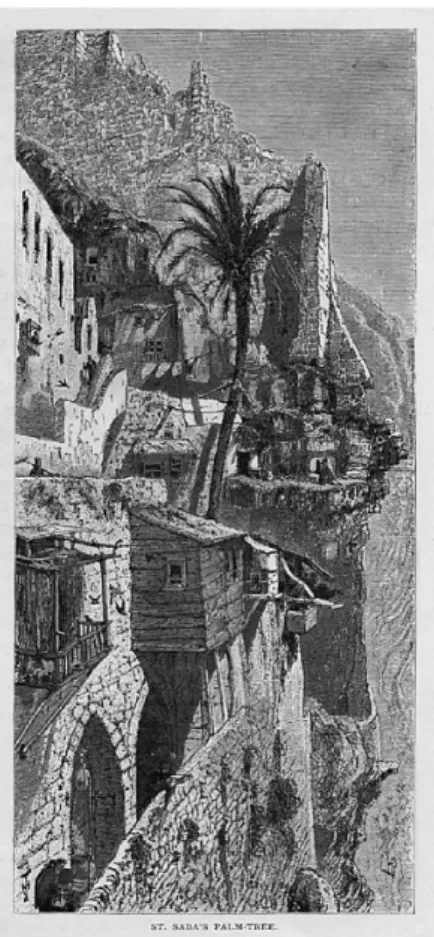
The discussion centers on two of the most striking fully developed visual images in Clarel: Canto 35 of the “Wilderness” section describing Giovanni Battista Piranesiʼs mysterious eighteenth-century Carceri (Prisons) etch- ings, and Cantos 25 through 30 of the “Mar Saba” section that take place at the ancient Mar Saba Monastery near the Dead Sea and form a constella- tion around the famous Mar Saba palm.
The background to the writing of Clarel is well known. After the ini- tial success of Typee (1846), a classic travel and adventure narrative, Mel- villeʼs writing career spiraled down. The failure of Moby-Dick (1851) to ig- nite readers, along with Melvilleʼs constant money problems and the exhaustion caused by overwork on Pierre (1852) and The Confidence Man
(1857), had brought him to the point of physical and mental collapse. At the urging of his family and with the financial help of his father-in-law, Judge Lemuel Shaw, Melville embarked on a five-month journey of recu- peration to Europe and the Middle East. His first stop was Liverpool where he visited Nathaniel Hawthorne who had been appointed the American consul by his college friend, President Franklin Pierce. Hawthorneʼs jour- nal entry for November 12, 1856 describes an afternoon he spent with Mel- ville in the Southport dunes:
We took a pretty long walk together, and sat down in a hollow among the sand hills (sheltering ourselves from the high, cool wind) and smoked a cigar. Melville, as he always does, began to reason of Provi- dence and futurity, and of everything that lies beyond human ken, and informed me that he had “pretty much made up his mind to be annihilated;” but still he does not seem to rest in that anticipation;
and, I think, will never rest until he gets hold of a definite belief. It is strange how he persists—and has persisted ever since I knew him, and probably long before—in wandering to and fro over these deserts, as dismal and monotonous as the sand hills amid we were sitting. He can neither believe, nor be comfortable in his unbelief; and he is too honest and courageous not to try to do one or the other. (Clarel 511) The journal entry shows Melvilleʼs bleak state of mind as he traveled to- ward Jerusalem and is an interesting premonition of things to come. Un- derlying the text are Hawthorneʼs memories of their past conversations and the observation that Melville hasnʼt changed and probably wonʼt. Their walk in the Southport dunes echoes their walks in the Berkshire hills in Massachusetts where they first became friends and also previews the Ju- dean desert of Clarel. Here, thousands of miles from the Holy Land, Mel- ville is already physically “among the sand hills,” mentally “wandering to and fro” over the deserts of “Providence and futurity.” Hawthorneʼs obser- vations on Melvilleʼs lack of belief but lack of comfort in his unbelief are significant. It is this spiritual restlessness that ultimately fueled Melvilleʼs pilgrimage to and in The Holy Land and the account of the pilgrimage
found in Clarel.
Though no single definition of pilgrimage can adequately identify all its characteristics, pilgrimage is pre-eminently a physical and metaphorical journey from the everyday world of home to a specific place or condition of holiness or healing. It obviously requires physical movement from one place to another and at the same time involves spiritual movement (Cole- man 239). The anthropologists Victor and Edith Turner have made what is probably the most influential modern analysis of Christian pilgrimage.
Drawing from sociological notions of rites of passage, the Turners identify three stages: separation from home, the journey itself, and the return. It is an overall structure Melville experienced first hand in his sea-going days and one found in various forms in much of his work.
Pilgrimage provides the physical and psychological movement in Clarel; itʼs the action that generates the narrative, driving it in all its com- plexity. The irregular rhymes and unstable iambic tetrameter of the poetry reflect the harsh physical, social, and spiritual landscape the pilgrims tra- verse from Jerusalem to the Jordan River, the Dead Sea, Mar Saba Monas- tery, Bethlehem, and back to Jerusalem. Melvilleʼs own pilgrimage along the same route was a similar rude awakening as he discovered the “heart sickening” (Clarel 517) contemporary reality of the Holy Land. Jerusalem, he wrote, “is grey & looks at you like a cold grey eye in a cold old man”
(517). Though Canto 1 opening the “Wilderness” section of Clarel links the poem to the Canterbury Tales, the grand allusion is all for contrast:
Adown the Dolorossa Lane The mounted pilgrims file in train Whose clatter jars each open space;
Then, muffled in, shares change apace As, striking sparks in vaulted street, Clink as in cave the horses feet,
Not from brave Chaucerʼs Tabard Inn They pictured wend; scarce shall they win Fair Kent, and Canterbury ken;
Nor franklin, squire, nor morris-dance
Of wit and story good as then:
Another age, and other men,
And life an unfulfilled romance. (133)
Starting their journey, Clarelʼs pilgrims are a motley band whose numbers rise and fall as the narrative progresses. Among them are Clarel, a pensive young theology student in love with Ruth whom he meets in Jerusalem;
Nehemiah, Clarelʼs guide; Vine, a quiet American modeled on Hawthorne;
Rolfe, an ex-mariner and skeptic; Derwent, a sunny Anglican minister;
Mortmain, a cynical Swedish Jew with a black skullcap; and Ungar, a Civil War veteran descended from native Americans. Itʼs the familiar collection of rootless isolatoes found in Melvilleʼs earlier novels, here united in their metaphysical obsession with faith, who stand in ironic contrast to Chaucerʼs cheerful pilgrim company. Itʼs the existential reality of the pres- ent set against the romantic past.
In the “Wilderness” section, placed near the center of Clarel with the pilgrims at the Dead Sea, Canto 35ʼs unexpected reference to Piranesiʼs Carceri interrupts and comments on the journey. Piranesi was eighteenth- century Italyʼs most accomplished architectural artist. His monumental etchings are poised between the extremes of archaeological veracity—
as seen in his Vedute di Roma (Views of Rome) series (1767) depicting contemporary Rome littered with ruins of the past, and invention—as seen in his Carceri dʼInvenzione (Imaginary Prisons) series (1749–50) (Figures 1–2). Both series have strong theatrical elements with sharply raked perspectives, intense contrast of lighting, and human figures cast in gesticulating stylized poses, all of which would have appealed to Melvilleʼs own sense of theater.
Canto 35 contains an example of one of Melvilleʼs favorite rhetorical tools: ekphrasis, the verbal description of artwork. Used well ekphrasis isnʼt simply a verbal reproduction of art, it is itself an act of creation, a way to—
in Ezra Poundʼs phrase taken from Confucius—“make it new.” Though Melvilleʼs text includes details of the title page of the Carceri series, which he could have seen in New York, in fact the plurals in the opening question and the lines following describe something less specific:
In Piranesiʼs rarer prints, Interiors measurelessly strange,
Where the distrustful thought may range Misgiving still—what mean the hints?
Stairs upon stairs which dim ascend In series from plunged Bastiles drear—
Pit under pit; long tier on tier Of shadowed galleries which impend Over cloisters, cloisters without end;
The hight, the depth—the far, the near;
Ring-bolts to pillars in vaulted lanes, And dragging Rhadamanthine chains;
These less of wizard influence lend Than some allusive chambers closed. (248)
Indeed, Melvilleʼs description summons up not just one of Piranesiʼs prints but the entire series of sixteen etchings plus their various states, which it- self suggests not a collection of separate prisons, but rather a world of pris- ons—linked galleries with an almost virus-like ability to reproduce with endless Escheresque variations.
The ekphrasis in Canto 35 resonates so powerfully in Clarel that the image can be compared to images and diagrams often used to symbolically map the process of pilgrimage. Perhaps the most famous example of these is the huge thirteenth-century pavement labyrinth in Chartres Cathedral symbolically representing the path the faithful must take to reach salvation (Figure 3). Walking this labyrinth, sometimes on their knees, pilgrims would pass through each of the four quadrants before reaching the rosette center. The four arms of the cross are readily visible reinforcing the Chris- tian symbolism. As a substitute for the actual pilgrimage to Jerusalem, the Chartres labyrinth came to be called the “Chemin de Jerusalem”—Jerusa- lem Road. In the same way the Chartres labyrinth is an emblem for Chris- tian pilgrimage, the Canto 35 ekphrasis is an emblem for the pilgrimage in Clarel, with the “stairs upon stairs” dimly ascending and the “shadowed galleries” forming the labyrinth of Clarelʼs pilgrim road. But where the
Chartres labyrinth is ordered around the cross and rosette suggesting the certainty of Christian faith and ultimate arrival for those who persevere, Melvilleʼs labyrinth, empty of such symbols, is an endless maze with no so- lution and no arrival.
Discussing Canto 35, Hennig Cohen notes Melvilleʼs ekphrasis “is close in language and spirit” to Samuel Taylor Coleridgeʼs description as re- corded in Thomas De Quincyʼs Confessions of an English Opium Eater (Po- ems 206):
Many years ago, when I was looking over Piranesiʼs Antiquities of Rome, Mr. Coleridge, who was standing by, described to me a set of plates by that artist, called his Dreams, and which record the scenery of his own visions during the delirium of a fever. Some of them (I de- scribe only from memory of Mr. Coleridgeʼs account) represented vast Gothic halls: on the floor of which stood all sorts of engines and machinery, wheels, cables, pulleys, levers, catapults, &c.&c. expressive of enormous power put forth and resistance overcome. Creeping his way upwards, was Piranesi himself: follow the stairs a little further, and you perceive it come to a sudden abrupt termination, without any balustrade, and allowing no step onwards to him who had reached the extremity, except into the depths below. Whatever is to become of poor Piranesi? You suppose, at least, that his labours must in some way terminate here. But raise your eyes, and behold a second flight of stairs still higher on which again Piranesi is perceived, by this time standing on the very brink of the abyss. Again elevate your eye, and a still more aerial flight of stairs is beheld and again is poor Piranesi busy on his aspiring labours, and so on, until the unfinished stairs and Piranesi both are lost in the upper gloom of the hall. (De Quincy 78) The passage is especially interesting because Coleridge—or De Quincy re- membering Coleridge—identifies the many characters peopling the prints as representations of Piranesi. It is the architect-artist imprisoned in his own imaginative labyrinth, or, in terms of Clarel, it is Melville, at the center of his text, imprisoned in a labyrinth of metaphysical speculation. Extend-
ing this reading further, the mysterious inhabitants in Piranesiʼs etchings, whether in agony or ragged silhouette posed on stairways and walkways, become aspects of Melvilleʼs imagination. They are Clarelʼs pilgrims with guide moving through the labyrinth, enacting their pilgrimage, stopping to point, gesticulate, argue, and converse. Oddly, however, Melvilleʼs ekphra- sis contains no mention of human figures. While Piranesiʼs prisons bristle with shadowy human activity, Melvilleʼs prison is, like the town on Keatsʼs ekphrastic urn, silent and desolate.
Beyond Melvilleʼs multivalent ekphrasis, whatʼs going on in Canto 35?
Halfway through the canto the language pivots from description to in- terpretation and Biblical allusion:
The thing implied is one with man, His penetralia of retreat—
The heart, with labyrinths replete:
In freaks of intimation see Paulʼs “mystery of iniquity:” (249)
Here Melville identifies his prison: it is the human heart whose shadowy depths reveal by half-concealing St. Paulʼs “mystery of iniquity,” and whose echoing corridors lead us back to the Garden of Eden, Original Sin, and the origin of Western faith. In Melvilleʼs hands, the labyrinth of the human heart is thus also the labyrinth of memory without which faith would be meaningless. Memory is a key element in pilgrimage and faith, both of which are anchored in the past. Canto 35 reminds us that pilgrimage is a ritual privileging memory and that while pilgrimage is the organizing prin- ciple in Clarel, the source of its power is the past.
Soon after Canto 35 of “The Wilderness” section, the pilgrims turn west to Mar Saba Monastery set in the stony gorge of the mostly dry Ke- dron Stream:
ʻTis Kedron, that profound ravine Whence Saba soars. And all between Zion and Saba one may stray,
Sunk from the sun, Through Kedronʼs way.
By road more menacingly dead
Than that which wins the conventʼs base No ghost to Tartarus is led. (295)
Much has been written about the important scene that takes place here, covering six cantos (Cantos 25–30) of the “Mar Saba” section where a solitary palm tree said to be planted by St. Saba more than a thousand years ago, growing from the cliff wall, becomes the focus of meditation for five of the main characters (Figure 4). Henry W. Wells calls these cantos
“the most sustained passage of metaphysical and symbolical expression” in Clarel (Clarel 815). Here Melville uses the dramatic landscape as an open- air stage where the pilgrim-actors observe the palm and each other from different vantage points in the gorge. The structural link between these cantos, creating its famous fugue-like effect, is St. Sabaʼs palm, but the the- matic link, the theme of the fugue, is memory.
Christianity has a long tradition of mnemonics based on memory im- ages. The idea that memory systems are useful to remember heaven and hell explains much of the structure and detail of Danteʼs Inferno. In the Re- naissance, memory theaters, and abbeys and monasteries as sites for mem- ory systems, were recommended to aid memory (Figure 5). In Clarel, the Mar Saba cantos, while not directly linked to traditional Christian memory systems, derive from a common need to organize, access, and make sense of the past. The monastery, a place of religious mediation largely focused on the past, is here a lieux de memoire for Clarelʼs pilgrims. Indeed, the whole scene with the narrow Kedron gorge punctuated by barren monkʼs cells on one side that are briefly inhabited by Mortmain, Vine, and Rolfe, and by the green palm and Clarel on the other is a Melvillian memory the- ater of people, events, and ideas from the past that are examined and ques- tioned.
In Cantos 25 and 27, Derwent and the Lesbian observe Mortmainʼs skull-cap stolen by a bird, that leads the Lesbian to recount a similar expe- rience he had at sea echoing “The Hat” chapter in Moby-Dick, which itself alludes to the legend that an eagle stole the hat of Tarquinius Priscus, an
early Roman king. It is a chain of memory and allusion receding into the past. In Canto 26 Vine, the character drawn from Hawthorne, who was himself obsessed with the Puritan past of America muses,
For my part, I but love the past—
The further back the better; yes, In the past is the true blessedness;
The futureʼs ever overcast— (361)
He then proceeds to invoke the palm “in a style sublime, /Yet sad” with al- lusions to Eden and Paradise lost. In Canto 28 Mortmain observes the palm and mourns the past: “The years outlived, with all their black” (371).
In Canto 29, the ex-mariner Rolfe faces the tree across the chasm:
Remindings swell;
Sweet troubles of emotion mount—
Sylvan reveries, and they well From memoryʼs Bandusia fount. (372)
His meditation is a collection of memories, welling up like spring water, of the South Pacific and the paradise depicted in Melvilleʼs Typee. And finally in Canto 30, Clarel, in the shadow of St Sabaʼs palm tree, thinks of his rela- tionship with Vine and Ruth and hungry for affection asks, “Can time teach?”:
his glance Rested on Vine, his reveries flow Recalling that repulsed advance He knew by Jordan in the wood, And the enigma unsubdued—
Possessing Ruth, nor less his heart Aye hungering still, in deeper part Unsatisfied. Can be a bond
(Thought he) as David sings in strain
That dirges beauteous Jonathan, Passing the love of woman fond?
And may experience but dull
The longing for it? Can time teach? (377)
Can time teach? Clarelʼs tortured answer is, “someday, maybe.” It is one of the characteristics of memory that while it can imprison and destroy it can also liberate, nourish, and map the future. Like pilgrimage—as a central el- ement of pilgrimage—memory can be transformative. In Clarel the trans- formation is presented as process. At the end of the poem, back in Jerusa- lem where Ruth has unexpectedly died, the bereft Clarel slips seamlessly from the poemʼs central pilgrimage ending in despair to the Pentecost pil- grimage of the crowd streaming down the Via Crucis with the renewed possibility of hope. It is a transition from one pilgrimage to another, from lost hope to new hope, from one set of memories to another, and, in the twilight of his career, is one of the only lessons Melville can offer us.
Figure 1. Giovanni Battista Piranesi, “View of the interior of the Villa di Mecenate”
from Vedute di Roma (1767)
Figure 2. Giovanni Battista Piranesi, “The Round Tower” from Le Carceri dʼInvenzione (1745)
Figure 3. Chartres Cathedral floor labyrinth (c. 1230)
Figure 4. St. Saba’s palm tree at Mar Saba Monastery
Works Consulted
Assman, Jan. Religion and Cultural Memory. Palo Alto: Stanford UP, 2005.
Bunyan, John. The Pilgrimʼs Progress. London: Penguin, 2008.
Coleman, Simon and John Elsner. Pilgrimage Past and Present in the Worldʼs Religions. Cam- bridge: Harvard UP, 1995.
De Quincy, Thomas. Confessions of an English Opium Eater. London: Penguin, 2003.
Finkelstein, Dorothee Metlitsky. Melvilleʼs Orienda. New Haven: Yale UP, 1961.
Halbwachs, Maurice. On Collective Memory. Chicago: U of Chicago P, 1992.
Melville, Herman. Clarel: A Poem and Pilgrimage in the Holy Land. Eds. Harrison Hayford, et al. Evanston: Northwestern-Newbury, 1991.
—. Selected Poems. Ed. Hennig Cohen. New York: Fordham UP, 1991.
Obenzinger, Hilton. American Palestine: Melville Twain and the Holy Mania. Princeton: Princ- eton UP, 1999.
Piranesei, Giovanni Battista. The Complete Etchings. Ed. Luigi Ficacci. New York: Taschen, 2011.
Spence, Jonathan D. The Memory Palace of Matteo Ricci. New York: Penguin, 1985.
Turner, Victor, and Edith Turner. Image and Pilgrimage in Christian Culture. New York:
Columbia UP, 1978.
Yates, Frances A. The Art of Memory. Chicago: U of Chicago P, 1974.
Figure 5. Abbey memory system with memory images from Johannes Romberch, Congestorium Artificiose Memorie (1533)