Hydraulic Properties for Unsaturated Water Flow in Aggregated Volcanic Ash Soils
Rudiyanto
A thesis submitted in fulfillment of the requirements for the degree of Doctor of Philosophy
Department of Sustainable Resource Sciences Graduate School of Bioresources
Mie University
December 2013
With water we have made all living things -The Quran, Al-Anbiyaa: 30
I dedicate this thesis to all soil physicists, in the past, present and future, for their wonderful ideas, persistent attempts and contribution
ACKNOWLEDGMENTS
Despite only my name is written in the cover of this a PhD thesis, this thesis is a result from the idea, inspiration, assistance, and guidance of many people especially my main supervisor, Prof. Dr. Nobuo Toride. Therefore, first of all, I would like to express my sincere gratitude to him who gave me the opportunity to do a PhD at Mie University, Japan. He introduced me to soil physics especially about dual porosity hydraulic properties, the evaporation method, hysteretic model as well as volcanic ash soils, Andisols. His scientific insight helped me to understand this study, to decide which direction should be taken, and to accomplish this study. His surprising knowledge, perfect guidance, great inspiration, brilliant ideas, thinking outside the box, and research philosophy such as focus on the objective and improvements, attention to the position of paper in the scientific stream, concern to the readers and conciseness in writing and audiences in presentation always impressed me. I also would like to thank for his financial support for me. I am really honored to be his PhD student.
I would like to thank to Prof. Dr. Atsushi Hashimoto and Prof. Dr. Hiroshi Ehara as the committee member for their constructive comments at preliminary evaluation. I am indebted to Dr. Kunio Watanabe as also the committee member for providing an important device: a dew point potentiameter, WP4 for my experiment and his valuable comments on the evaporation method paper. Dr. Masaru Sakai as the committee member is also owed my deep gratitude for verifying the derivation of the hysteretic model, helpful discussion, useful comments and suggestion and providing the setup of the evaporation experiment especially Basic source codes for data acquisition using the CR1000 data logger.
A great appreciation is given Prof. Dr. Jirka Šimůnek for finalization and responses on the reviewer comments for the hysteretic model paper. A special acknowledgement is given to Prof. Dr. ‘Rien’ van Genuchten for finalization and improving the quality of the evaporation method paper in short periods.
I would like to expresses sincere gratitude to the Ministry of Education, Culture, Sports, Science and Technology (MEXT) of the Government of Japan for the awards of
scholarship during this study. Many thanks are also extended to Prof. Dr. Budi Indra Setiawan for his generous support, kindness and visiting to Mie on 28 July 2013.
Further, I am thankful to Dr. Dimitar Antonov, and Chen Daiwin for their helpful hand, assistance and nice friendship. Many thanks are also given to all members of Environmental Soil Physics and Hydrology laboratory: Takafumi Hoshino who gave me his data for an evaporation method, Masato Oishi; from his miscible displacement data set, i.e., tensiometer and TDR reading pairs, I obtained an idea to develop a hysteretic model of hydraulic properties for dual porosity soils, Tomomi Wake, who introduced an experiment setup for the evaporation method, Tetsuya Kito, Shoko Oda, Kotake Ken, Tohru Nishida, Yudai Hisayuki etc. for their kind help and delightful friendship.
I am likewise grateful to my parents who always pray for me. I believe their prayer made me keep patience doing the relentless efforts and made everything possible. I owe you so much that I cannot return in any ways. My deepest thanks are also due to my beloved wife, Maulidiani, and my lovely daughter, ‘Mizuki’ Nur Amina who deserve a big hug for sharing all ups and downs while I am studying aboard with a great patience, understanding and care.
Finally, I thank everyone -might not have mentioned in this acknowledgements- who helped me during my study.
Rudiyanto Mie University
SUMMARY
Numerical analysis of soil water flow is frequently used to assess water management in agriculture. Hydraulic properties (i.e., water retention, θ(h) and unsaturated hydraulic conductivity, K(h) or K(θ)) are required for that analysis. Among soil physical properties, the unsaturated hydraulic conductivity is the most difficult to measure. This thesis mainly describes determination of a wide range of unsaturated hydraulic conductivity of Andisols based on the evaporation method. Subsequently, a hysteretic model for hydraulic properties of Andisols was proposed. Furthermore, roles of aggregate structure of Andisols were also numerically evaluated for water management in the root zone layer.
Chapter 2 reviews the uniqueness of Andisols because of a well-developed and stable aggregate structure made up of noncrystaline minerals (e.g., allophane, imogolite, ferrihydrite). Several hydraulic functions for aggregated soils were also presented. This chapter also provides the procedure of the inverse method mainly focusing on the evaporation method for determining hydraulic properties. A hysteretic model based on Kool and Parker (1987) derived from the scaling methods was also reviewed.
In Chapter 3, parameters of the bimodal van Genuchten (VG) hydraulic functions for two aggregated Andisols were inversely determined using the evaporation method.
Initial estimates of the water retention parameters were determined from separate retention measurements, which facilitated rapid convergence of the parameter optimization process regardless of the number of optimized parameters. When the bimodal water retention parameters were fixed according to the independently measured retention data from near saturation to very low pressure heads down to -105 cm, it was possible to estimate the unsaturated conductivity, K(h), by optimizing only two conductivity parameters (Ks, ℓ). Since the flat region of the bimodal retention curve at intermediate pressures is difficult to measure precisely, however, we still recommend optimizing all bimodal VG parameters to yield the best overall results. Including water retention data at very low pressure heads in the dry range extended the applicable range of the model predictions, at least down to pressure heads of approximately -104 cm. This confirms that collecting water retention data over a wide range of pressure heads will
give very useful prior information to the parameter estimation process for not only Andisols but also other soils.
Chapter 4 proposes a hysteretic model of hydraulic properties for dual porosity soils based on the bimodal van Genuchten (VG) model and the Kool and Parker (K&P) hysteresis model. Hysteresis is considered only in the first pore domain, affecting mainly higher water contents, while a nonhysteretic behaviour is assumed in the second pore domain, affecting mainly lower water contents. The main drying and wetting curves are described with the same set of parameters, except for the α1 parameter, which is different for the drying curve, α1d, and for the wetting curve, α1w. The scanning hysteresis loops in the first subregion are also described using the K&P model. The hysteretic water retention model agrees reasonably well with drying and wetting retention curves and scanning loops observed for Andisols. Although the corresponding unsaturated hydraulic conductivity, evaluated using the Mualem pore-size distribution model, as a function of the water content, K(θ), is nonhysteretic for higher water contents, unrealistic hysteresis occurs in K(θ) for lower water contents. In order to obtain an ‘almost’ nonhysteretic K(θ) function for the entire range of water contents, an additional constraint on the value of the α1 parameter for K(θ) is imposed, and a single value α1k is used for both drying and wetting curves.
Chapter 5 reports roles of aggregate structure for Andisols in the root zone layer through numerical water flow evaluation. Similar to sandy loam soil, Kumamoto Andisol exhibits large infiltration and drainage rate from root zone because of large Ks
which is resulted in from interaggregate pores. Kumamoto Andisol shows greater water and air storage, the potential and actual plant available water (PAW) than those in sandy loam and clay soils. For water storage and the potential and actual PAW, Kumamoto Andisol is similar to clay soil; however, for air storage, Kumamoto Andisol has similarity to sandy loam soil. Intraaggregate pores are responsible on water storage and the potential and actual PAW. Contrary, interaggregate pores are responsible on soil aeration. Aggregated structure that developed in Kumamoto Andisol accounts combination of sandy loam and clay soils properties.
TABLE OF CONTENTS
ACKNOWLEDGEMENTS SUMMARY
TABLE OF CONTENTS
1 GENERAL INTRODUCTION 1.1 PROBLEM DEFINITION 1.2 OBJECTIVES
1.3 OUTLINE OF THESIS 2 LITERATURE REVIEW
2.1 UNIQUENESS OF PHYSICAL PROPERTIES OF ANDISOLS 2.2 UNSATURATED WATER FLOW
2.3 DUAL POROSITY HYDRAULIC FUNCTIONS 2.4 WATER RETENTION CURVE MEASUREMENT 2.5 ESTIMATION OF SOIL UNSATURATED HYDRAULIC
CONDUCTIVITY BASED ON THE EVAPORATION METHOD 2.5.1 Inverse method for unsaturated hydraulic conductivity 2.5.2 Estimation of the bimodal VG using inverse method 2.5.3 Soil evaporation experiment
2.6 HYSTERETIC MODEL OF HYDRAULIC PROPERTIES 2.6.1 Hysteretic model for water retention
2.6.2 Unsaturated hydraulic conductivity 2.7 CONCLUSIONS
2.8 REFERENCES
3 ESTIMATING THE UNSATURATED HYDRAULIC CONDUCTIVITY OF ANDISOLS USING THE EVAPORATION METHOD
3.1 INTRODUCTION
3.2 MATERIALS AND METHODS 3.2.1 Evaporation experiment 3.2.2 Bimodal van Genuchten model 3.2.3 Parameter optimization
3.3 RESULTS AND DISCUSSION 3.3.1 Parameter estimation
3.3.2 Water retention data at low pressure head 3.3.3 Pressure head measurement range
3.4 CONCLUSIONS 3.5 REFERENCES
4 A HYSTERETIC MODEL OF HYDRAULIC PROPERTIES FOR DUAL POROSITY SOILS
4.1 INTRODUCTION
4.2 MATERIALS AND METHODS
4.2.1 Observed hysteretic water retention 4.2.2 Hysteretic model
4.3 RESULTS AND DISCUSSION
4.3.1 Main wetting and drying branches 4.3.2 Scanning retention curves
4.3.3 Unsaturated hydraulic conductivity 4.4 CONCLUSIONS
4.5 REFERENCES
5 ROLES OF AGGREGATE STRUCTURE OF ANDISOLS IN WATER FLOW IN THE ROOT ZONE
5.1 INTRODUCTION
5.2 THEORETICAL CONSIDERATION 5.2.1 Governing equation of water flow 5.2.2 Soil hydraulic functions
5.3 MATERIALS AND METHODS 5.3.1 Materials
5.3.2 Numerical analysis of water flow 5.4 RESULTS AND DISCUSSION
5.4.1 Soil water infiltration and surface runoff 5.4.2 Redistribution of water in soil
5.4.3 Drainage from the root zone
5.4.4 Water and air storage and the potential and actual plant available water (PAW)
5.4.5 Roles of inter and intra aggregate pores 5.5 CONCLUSIONS
5.6 REFERENCES
6 CONCLUDING REMARKS AND PERSPECTIVES 6.1 CONCLUSIONS
6.2 FUTURE PERSPECTIVES 6.3 REFERENCES
LIST OF SYMBOLS AND ABBREVIATIONS
CHAPTER 1
GENERAL INTRODUCTION
1.1 PROBLEM DEFINITION
Andisols in US soil taxonomy (Soil Survey Staff, 1999) or Andosols in the World Reference Base for Soil Resources (WRB Classification) (FAO, et al., 1988) or
“Kurobokudo (黒ボク土)” in Japanese (The Third Division of Soils, 1973) meaning the black-fluffy soils are commonly used to refer to volcanic ash soils. Henceforth, Andisols are used to refer the volcanic ash soils for simplification. Andisols cover more than 124 million ha or approximately 0.84 % of the earth’s surface (Takahashi and Shoji, 2002). Despite the areas of Andisols are relatively small extent of the world surface, Andisols are very important resources owing to huge populations living in these regions (Shoji et al., 1993).
Figure 1.1 shows distribution of Andisols in the world. Major locations of Andisols are found around the Pacific ring: on the west coast of South America, in Central America, the Rocky Mountains, Alaska, Japan, the Philippine Archipelago, Indonesia, Papua New Guinea and New Zealand. Andisols are also prominent on many islands in the Pacific: Fiji, Vanuatu, New Hebrides, New Caledonia, Samoa and Hawaii.
In Africa, Andisols can be found along the Rift Valley, in Kenya, Rwanda and Ethiopia and on Madagascar. In Europe, Andisols were obtained in Italy, France, Germany and Iceland (FAO, et al., 1988; Soil Survey Staff, 1997 and Takahashi and Shoji, 2002).
In Japan, Andisols are widely distributed about 6.8 million hectares or 18% of the territory, especially at Hokkaido, Tohoku, Kanto and Kyushu districts as shown Fig. 1.2 (Takahashi and Shoji, 2002). The area of Andisols are used for cultivation about 1.35 million hectares of Andisols, comprising 24% of total area of agriculture in Japan.
orldwide distribution of volcanic ash soils (Andisols) (World Soil Resources Staff, 1997).
i !
l i n i l s j
j
︒ ‑
︒
σ包め
o ‑ ‑ m
伺包
0 5
発
J
‑ ‑ ‑ ‑
章一塁一0
・
・
・
・ ・
hP
3 A
US一o
aw
岡山山山山︾aa
Z6 W
日 川 um
孟豊 騎
・
・
・ ・
0
崎色 宮支昔
‑ ‑ ‑ ‑
z
量so g
‑‑
‑‑
ぎの @
叉 前三
一ω
‑E
EZ忌﹁
ao
‑ "
・
・
・
・ ・
円 支
ab s w
・
・
・
・ ・
ω旬
︒
a︒"og
‑ ‑ ‑
量一g a
...
︿・
5.
︒‑e
・
・
・
・ ・
36 0R
︑v愉w﹁a a rl lL
ω亘書
‑aE
30 5
nH HU
隻6F O
宮包
零
、
,J
1 ; ;
可
J I A
一 九
" 、
Fig. 1.2. Distribution of allophanic and nonallophanic volcanic ash soils in Japan (Takahashi and Shoji, 2002).
Andisols play an important role for resources of agriculture, particularly upland crop production. From a physical point of view, Andisols are known as the most productive soil in the earth owing to high water retention, high drainage rate and high plant water and nutrient availability (Shoji et al., 1993). Those valuable properties are as a result of the strong natural aggregation of particles in Andisols (Nanzyo et al., 1993;
Shoji et al., 1993; Shoji and Takahashi, 2002; Nanzyo, 2002; and Dahlgren et al., 2004).
The aggregated structure of Andisols is developed well and made by noncrystalline materials (e.g., allophane, imogolite) for allophanic Andisols and Aluminum-humus complexes for nonallophanic Andisols (Mizota and van Reeuwijk, 1989). Figure 1.2 shows distribution allophanic Andisols that occupy 69.9% of land area of total Andisols in Japan and nonallophanic Andisols (30.1%) (Takahashi and Shoji, 2002; Saigusa and Matsuyama, 1989). As the aggregated soils, Andisols often characterized as dual porosity soil where interaggregate pores and intraaggregate pores are created surrounding the aggregates and within the aggregates, respectively (Miyamoto et al., 2003; Hamamoto et al., 2009b; Chamindu Deepagoda et al., 2012).
This aggregation will strongly influence the water flow, solute transport and many processes in Andisols.
Knowledge of soil hydraulic properties is required to analyze water flow and solute transport in the unsaturated zone. The Richards equation, as the standard model to describe water flow in the vadose zone, relies on soil hydraulic properties defined as the constitutive relationships between the volumetric water content, θ, the pressure head, h, and the soil hydraulic conductivity, K, i.e., the soil water retention, θ(h) and the unsaturated hydraulic conductivity, K(h) or K(θ) functions (Durner and Flühler, 2005;
and Šimůnek, 2005).
Many investigations on θ(h) of Andisols showed unique shape (Miyamoto et al., 2003; Hamamoto et al., 2009a; Hamamoto et al., 2009b; Kato et al., 2011; and Chamindu Deepagoda et al., 2012). They obtained that θ(h) of Andisols exhibits stepwise or two subcurves with high water content in a wide range of pressure head (Fig.
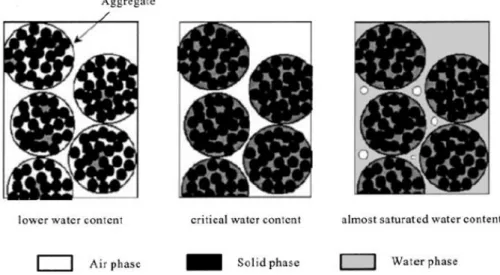
1.3a). Based on pore size distribution which consists of two peaks (Fig. 1.3b), Miyamoto et al. (2003) characterized that the first peak at larger pore size represents the existence of interaggregate pores, while the second peak at smaller pore size represents the existence of intraaggregate pores. Figure 1.4 shows schematic diagram representing
water distribution in aggregate soil depending on saturation degree (Miyamoto et al., 2003).
Miyamoto et al. (2003) showed that larger aggregate size of Andisols leads to steeper slope in the first subcurve and smaller air entry region of θ(h) (Fig. 1.3a) which is similar to θ(h) of sandy soils. Because of capillary hysteresis in interaggregate pores, a hysteretic θ(h) might be exist at the first subcurve which also similar in sandy soils.
To date, quite limited study was carried out to investigate hysteretic water retention of Andisols.
Although the second subcurve of hydraulic properties of Andisols cover in lower pressure head, high water content still remains in this region (Fig. 1.3a). Thus the measurement of hydraulic properties of Andisols until low pressure head is still necessary. However, measurements of K(h) of Andisols were conducted only limited in high pressure head (Ritter et al., 2004; Fontes et al., 2004). Moreover, because the estimation of K(h) especially at low pressure head is known the most difficult among soil physical properties, only few effort was conducted to estimate a wide range of K(h).
One of the most popular methods for estimating K(h) is parameter estimation based on the evaporation method (Šimůnek et al., 1998, Hopmans et al., 2002). This method is suitable for intermediate range of pressure heads, h > about -700 cm. To extend the estimate range of K(h), Sakai and Toride (2007) included the water retention data from saturation down to low pressure head in the objective function. This technique might be able to yield reliable estimates for K(h) until low pressure head and or beyond the measurement range of tensiometers in the evaporation experiment.
Fig. 1.3. (a) Water retention and (b) pore size density, dθ(h)/d log10 h for Andisols with different aggregate size (Miyamoto et al., 2003).
Fig. 1.4. Schematic diagram representing water distribution in aggregate soil depending on saturation degree (Miyamoto et al., 2003).
1.2 AIMS OF THE THESIS
(1) To estimate a wide range of the unsaturated hydraulic conductivity of Andisols based on the evaporation method.
(2) To observe hysteretic water retention of Andisols and propose a hysteretic model of hydraulic properties for Andisols.
(3) To numerically evaluate roles of aggregate structure of Andisols in water flow in the root zone layer.
1.3 THESIS OUTLINE
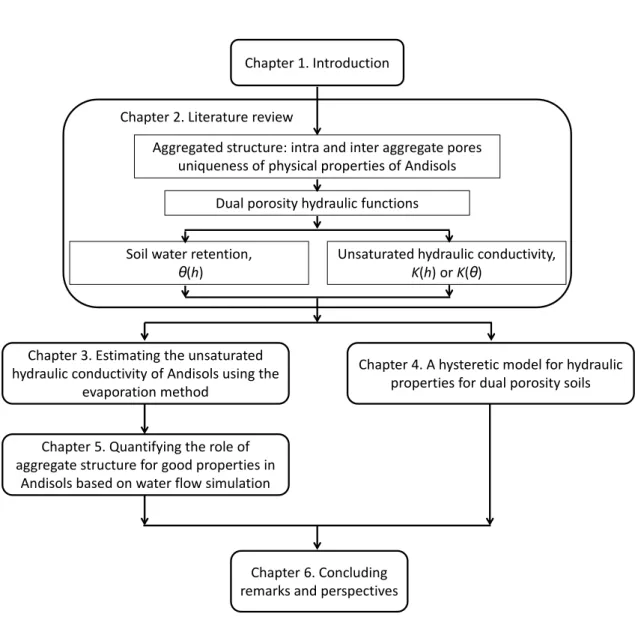
Figure 1.5 shows the structure of this thesis and how to read. Chapter 2 reviews the unique physical properties of Andisols, hydraulic functions for aggregated soils, experimental design and parameter estimation for estimating hydraulic properties especially based on the evaporation method. How to derive the hysteretic model based on Kool and Parker (1987) for the main loop as well as scanning loops was also depicted.
Chapter 3 describes the determination of a wide range of hydraulic properties of Adisols was conducted inversely using the evaporation method. Different optimized parameter sets and range of pressure head measurements were compared. Moreover, inclusion of a wide range of water retention in the objective function was addressed to extend the applicability of the estimated hydraulic properties until low pressure head was discussed and the results were validated.
Chapter 4 presents measurement of hysteretic water retention and development of hysteretic water retention model for Andisols. Moreover, the used of hysteretic water retention parameters for predicting non hysteretic unsaturated hydraulic conductivity in term of water content was also discussed.
In Chapter 5, the estimated hydraulic properties in Chapter 3 was used for evaluating the roles of interaggregate and intraaggregate pores of Andisols in the root zone layer based on numerical evaluation of water flow. Infiltration followed by redistribution were conducted and compared in Andisol, sandy loam and clay soils.
Finally Chapter 6 summarizes the conclusion and the future perspective of the results from this thesis.
Fig. 1.5. The schematic of thesis outline.
Aggregated structure: intra and inter aggregate pores uniqueness of physical properties of Andisols
Dual porosity hydraulic functions
Chapter 4. A hysteretic model for hydraulic properties for dual porosity soils Chapter 3. Estimating the unsaturated
hydraulic conductivity of Andisols using the evaporation method
Chapter 5. Quantifying the role of aggregate structure for good properties in
Andisols based on water flow simulation Chapter 2. Literature review
Chapter 6. Concluding remarks and perspectives
Chapter 1. Introduction
Soil water retention, θ(h)
Unsaturated hydraulic conductivity, K(h) or K(θ)
1.4 REFERENCES
Chamindu Deepagoda, T.K.K., P. Moldrup, M.P. Jensen, S.B. Jones, L.W. de Jonge, P.
Schjønning, K. Scow, J.W. Hopmans, D.E. Rolston, K. Kawamoto, and T.
Komatsu. 2012. Diffusion Aspects of Designing Porous Growth Media for Earth and Space. Soil Sci. Soc. Am. J. 76: 1564-1578. doi: 10.2136/sssaj2011.0438 Dahlgren, R.A., M. Saigusa, and F.C. Ugolini. 2004. The nature, properties and
management of volcanic soils. Adv. Agron. 82:113-182. doi:10.1016/S0065- 2113(03)82003-5
Durner, W. 1994. Hydraulic conductivity estimation for soils with heterogeneous pore structure. Water Resour. Res. 30:211-223. doi:10.1029/93WR02676
Durner, W., and H. Flühler. 2005. Soil hydraulic properties. Encyclopedia of Hydrological Sciences, John Wiley & Sons, Ltd. doi:10.1002/0470848944
FAO. 1988. Soil Map of the World. Revised Legend. Reprinted with corrections. World Soil Resources Report 60. FAO, Rome.
Fontes, J.C., M.C. Gonçalves, and P.S. Pereira. 2004. Andosols of Terceira, Azores:
measurement and significance of soil hydraulic properties. Catena. 56:145–154.
Special issue (Volcanic soil resources: occurrence, development and properties, Arnalds O, Stahr K, eds). doi:10.1016/j.catena.2003.10.008
Hopmans, J.W., J. Šimůnek, N. Romano, and W. Durner. 2002. Simultaneous determination of water transmission and retention properties: Inverse methods. p.
963–1008. In J.H. Dane and G.C. Topp (ed.) Methods of soil analysis. Part 4.
SSSA Book Ser. 5. SSSA, Madison, WI.
Hamamoto, S., K. Seki, and T. Miyazaki. 2009a. Effect of aggregate structure on VOC gas adsorption onto volcanic ash soil. J Hazard Mater. 166:207-212.
doi:10.1016/j.jhazmat.2008.11.008
Hamamoto, S., M.S.A.Perera, A.C.Resurreccion, K.Kawamoto, S.Hasegawa, T.Komatsu, and P.Moldrup. 2009b. The solute diffusion coefficient in variably compacted, unsaturated volcanic ash soils. Vadose Zone J. 8:942-952.
doi:10.2136/vzj2008.0184
Kato, C., T. Nishimura, H. Imoto, and T. Miyazaki. 2011. Predicting soil moisture and temperature of andisols under a monsoon climate in Japan. Vadose Zone J.
10:541-551. doi:10.2136/vzj2010.0054
Miyamoto, T., T. Annaka, and J. Chikusi. 2003. Soil aggregate structure effects on dielectric permittivity of an andisol measured by time domain reflectometry.
Vadose Zone J. 2:90-97. doi:10.2136/vzj2003.9000
Mizota, C., and L. P. van Reeuwijk. 1989. Clay mineralogy and chemistry of soils formed in volcanic material in diverse climatic region. Soil Monograph 2. ISRIC.
Wageningen. 185 p.
Nanzyo, M., S. Shoji, and R. Dahlgren. 1993. Physical characteristics of volcanic ash soils. In: Shoji, S., M. Nanzyo, R.A. Dahlgren. Volcanic ash soils: Genesis, properties, and utilization. Elsevier Amsterdam, the Netherlands. p:89-207.
doi:10.1016/S0166-2481(08)70268-X
Nanzyo, M. 2002. Unique properties of volcanic ash soils. Glob. Environ. Res. 6: 99- 112.
Ritter, A., R. C.M. Muñoz-Carpena, M. Regalado, Vanclooster and S. Lambot. 2004.
Analysis of alternative measurement strategies for the inverse optimization of the hydraulic properties of a volcanic soil. J. Hydrol. 295:124-139.
doi:10.1016/j.jhydrol.2004.03.005
Saigusa, M., and N. Matsuyama. 1998. Distribution of allophanic Andisols and Non- allophanic Andisols in Japan. Tohoku J. Agr. Res. 48:75-83
Šimůnek, J. 2005. Chapter 78: Models of Water Flow and Solute Transport in the Unsaturated Zone, In: M. G. Anderson and J. J. McDonnell (Editors), Encyclopedia of Hydrological Sciences, John Wiley & Sons, Ltd., Chichester, England, 1171-1180.
Shoji, S., M. Nanzyo, and R. Dahlgren. 1993. Productivity and utilization of volcanic ash soils. In: Shoji, S., M. Nanzyo, R.A. Dahlgren. Volcanic ash soils: Genesis, properties, and utilization. Elsevier Amsterdam, the Netherlands. p:209-251.
doi:10.1016/S0166-2481(08)70269-1
Shoji, S., and T. Takahashi. 2002. Environmental and agricultural significance of volcanic ash soils. Glob. Environ. Res. 6:113-135.
Soil Survey Staff. 1997. National Soil Survey Handbook. Title 430-VI. U.S.
Government Printing Office, 732 N. Capitol Street, NW, Washington, DC 20401.
Soil Survey Staff. 1999. Soil Taxonomy 2nd edition. Agricultural Handbook 436;
Natural Resources Conservation Service, USDA, Washington DC, USA, pp. 869.
Takahashi, T., and S. Shoji. 2002. Distribution and classification of volcanic ash soils.
Glob. Environ. Res. 6:83-97.
The Third Division of Soils. 1973. Criteria for making soil series and a list of soil series.
The first approximation. Nat. Inst. Agr. Res., Japan (in Japanese).
CHAPTER 2
LITERATURE REVIEW
2.1 UNIQUE PHYSICAL PROPERTIES OF ANDISOLS
Andisols show many unique properties from other mineral soils. One of the uniqueness of Andisols can be seen from physical properties (Nanzyo et al., 1993). The bulk density of Andisols is extremely low ranging from 0.4 to 0.8 g cm-3 while the general values for mineral soils ranges from 1.2 to 1.8 g cm-3. Hence the total porosity of Andisols generally ranges between 0.6 and 0.85 cm3 cm-3 which is higher than those in other mineral soils (0.3 to 0.6 cm3 cm-3). In allophanic Andisols, the low bulk density is due to high porosity caused by well-developed high aggregate structures (Fig. 2.1) made of noncrystalline minerals (e.g., allophane, imogolite, ferrihydrite), while for non- allophanic Andisols, accumulation of a large amount of humus lead to highly porous aggregation. The bulk density of Andisols decreases with increasing concentrations of active Al and Fe for allophanic Andisols and humus content for non-allophanic Andisols (Dahlgren et al., 2002; and Nanzyo, 2002). Low bulk density of Andisols provides easy tillage and less energy for root growth (Nanzyo et al., 1993; and Shoji et al., 1993).
Because of well-developed highly aggregated structures made up of noncrystaline minerals, Andisols can retain a lot of amount of water in wide range of pressure head (Nanzyo et al., 1993; Shoji et al., 1993; Nanzyo, 2002) and are often characterized as dual porosity soils (Miyamoto et al., 2003). Water retention of Andisols is consisted of two subcurves which indicate that interaggregate and intraaggregate pores are existed.
Allophane greatly contributes to the retention at low pressure because its fine particle- size and hollow spherical structure can accommodate water molecules in both intra- and inter-spherical pores (Nanzyo et al., 1993). These characteristics lead to large plant available water (PAW) (Shoji et al., 1993) which is defined as the difference between 33 kPa water content (or the field capacity) and 1500 kPa water content (or the permanent wilting point). Low bulk density of Andisol yields excellent water storage for root growth which can produce high yields of upland crops.
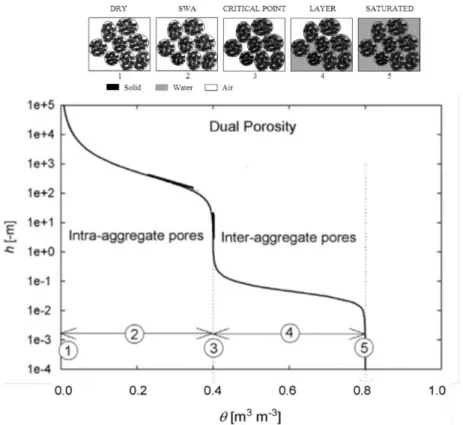
Blonquist et al. (2006) conceptualized dual porosity system resulted by aggregate structure in dual porosity soils. They outlined five important physical conditions, or stages, of the porous medium as shown in Fig. 2.2: (1) The soil is completely dry. (2) The intra-aggregate pores are partially saturated but the inter-aggregate pores are air filled. (3) At the critical water content, θhc where intraaggregate pores are water saturated and all interaggregate pores are air filled. (4) The intraaggregate pores are water saturated and the interaggregate pores fill with water under gravity, creating a layered system that has water-saturated interaggregate pores at the base and air filled inter-aggregate pores at the top. (5) Both intra and interaggregate pores are water saturated and there is no air in the soil.
High pores structure in Andisols that developed by noncrystalline minerals also yielded increasing both saturated and unsaturated hydraulic conductivity (Nanzyo et al., 1993). Motomura (1979) in Shoji et al. (1993) reported that the saturated hydraulic conductivity of Andisols in wetland rice varies from 10-3 to 10-4 cm s-1 and is 10-100 times greater than Gray lowland soils or other paddy soils. For the unsaturated hydraulic conductivity, Hasegawa, (1986); Iwata (1966); and Iwata et al. (1988) in Shoji et al.
(1993) showed that Andisols also have higher hydraulic conductivity than other mineral soils such as clayey alluvial soils and red/yellow soils, respectively. High conductivity leads to large drainage rate and good aeration (Shoji et al., 1993) and it will provide favorable condition for optimum growth of upland crop. Conversely, it gives negative impact on paddy field because of percolation of irrigation water and leaching of plant nutrient (Nanzyo et al., 1993).
Soil texture of Andisols which content high allophonic is difficult to analysis because of difficulties in dispersing allophonic soil during particle distribution analysis.
Noncrystalline Al and Fe content in Andisols inhibit dispersion of mineral particles (Nanzyo et al., 1993; Fontes et al., 2004). Soil texture may not show a valid meaning for Andisols (Warkentin and Maeda, 1974), for instance: the saturated hydraulic conductivity of Andisols which contain high clay shows higher than 10-4 m s-1, whereas the hydraulic conductivity of general soils which also contain high clay is lower than 10-
6 m s-1 (Iwata et al., 1995).
Fig. 2.1. Andisol from Mie, Japan (Leij et al., 2012).
Fig. 2.2. Schematic describing aggregate structure and illustrating the five described physical conditions (stages) of soil water retention (Blonquist et al., 2006).
In environmental issue, the high water storage and high hydraulic conductivity of Andisols also are important to reduce flood during rainy season (Shoji and Takahashi, 2002). High rainfall will be infiltrated rapidly and then some of water stored in its pore and some of water drained quickly. Because of rapid infiltration reduced runoff, stable aggregate and strong resistance of dispersion, Andisols also have a strong resistance on soil erosion (Shoji and Takahashi, 2002). Therefore, almost physical properties of Andisols are excellent for crop production as well as environment protection (Dahlgren, et al., 2004). Those properties strongly contribute to maintaining high productivity of Andisols (Shoji et al., 1993).
2.2 UNSATURATED WATER FLOW
When soil is partially saturated, an air phase is existing, and then pressure head in unsaturated soil is negative because of traction to solid surfaces and the surface tension of the air. Consequently the water flow channels are significantly different from those in saturated soil (Jury and Horton, 2004). In head units, the Buckingham-Darcy flux law may be expressed for vertical water flow in unsaturated soils as (Jury and Horton, 2004):
w
H h z h
J K h K h K h K h
z z z
[2.1]
where H = h +z is the hydraulic head in unsaturated soil [L], K(h) is the unsaturated hydraulic conductivity [L T-1] and the water flux, Jw [L T-1] is the water flow per unit cross-sectional area per unit time. The first term in the right side, -K(h)∂h/∂z the is the capillary flux, that is water flux due to the capillarity, while the second one, -K(h) is the gravity flux, that is water flux due to the gravity.
Generally, wetting or drying of the soil will occur as water flows, and the matric potential and water content will be functions of time as well as of space. To describe that transient water flow, the water conservation equation, also called the mass balance or continuity equation is used and given by.
0
w w
J r
z t
[2.2]
where θ is the volumetric water content [L3 L-3] and rw is the sink term (i.e., water uptake of plant roots).
Inserting the Buckingham-Darcy flux law, Eq. [2.1] into the continuity equation Eq. [2.2], and assuming vertical water flow and no plant roots (rw = 0) results in the Richard equation:
K h
h 1t z z
[2.3]
where is the volumetric water content [L3L-3], h is the soil water pressure head [L], K(h) is the hydraulic conductivity [L T-1], t is time [T]; z is the vertical coordinate [L].
Eq. [2.3] may not be solved in the form it is in, because it contains two unknown θ and h in only one equation. Eq. [2.3] can be solved since two boundary conditions and initial condition are specified and θ(h) and K(h) are known.
2.3 DUAL POROSITY HYDRAULIC FUNCTIONS
Water retention of aggregated soil such as Andisols exhibits stepwise shape which indicated existing dual porosity system namely inter and intra aggregate pores. The first and second subcurves represent contributions of cumulative water in interaggregate and intraaggregate pores, respectively. The unimodal VG model (van Genuchten, 1980) were reported could not describe soil water retention of aggregated soil properly (Durner, 1994). To overcome limitation of the unimodal VG model, some dual porosity retention functions were proposed which aggregated soils are viewed as consisting of two pore systems, each with its own retention function and interacted instantaneously (i.e., instantaneous equilibrium). Two pore systems are assumed can be described by a linear superposition of each pore size system (Durner, 1992, 1994; Ross and Smettem, 1993; Seki, 2007, Romano et al., 2011).
Durner (1992, 1994) proposed dual porosity retention function, which was built by a linear superposition of two the van Genuchten type (van Genuchten, 1980):
1 1 2 2
r
s r
S h w S w S
[2.4]
and Si is given by
1 ni mi
i i
S h [2.5]
where i represent pore system-i (= 1 or 2), wi is the weighing factor subject to 0 < wi < 1 and ∑wi = 1. Parameter shapes are αi, ni and mi = 1 – 1/ni subject to the conditions αi > 0 and ni >1. If wi = 0, Eq. (1) is equal to be the unimodal VG model. In addition, S is the effective saturation, h and θ is the pressure head [L] and the volumetric water content [L3 L-3], respectively; θs and θr are the saturated and the residual volumetric water content, respectively.
For the unsaturated hydraulic conductivity, the analytical expression of the closed- form between dual porosity retention function (Durner, 1992, 1994) and the Mualem model (1976) is given by (Priesack and Durner, 2006):
1 2
1 2
2
1/ 1/
1 1 1 2 2 2
1 1 2 2 2
1 1 2 2
1 1 m m 1 1 m m
s
w S w S
K S K w S w S
w w
[2.6]
where Ks and ℓ are the saturated hydraulic conductivity [L T-1] and the pore connectivity and tortuosity factor [-], respectively. Figure 2.3 shows an example of the bimodal VG (Priesack and Durner, 2006) to describe soil water retention and unsaturated hydraulic conductivity of an aggregated loam soil from Smettem and Kirkby (1990). It can be seen that the characteristic of the unsaturated hydraulic conductivity, Eq. [2.3] is also a superposition of conductivities of two the van Genuchten model that is the same with its soil water retention.
The hydraulic characteristics defined by Eqs. [2.4 – 2.6] contain 9 unknown parameters: θr, θs, α1, n1, α2, n2, w2, (7 retention parameters) ℓ, and Ks (2 conductivity parameters). Of these, θr, θs, and Ks have a physical meaning, whereas α1, n1, α2, n2, w2, and ℓ are essentially empirical parameters determining the shape of the retention and hydraulic conductivity functions. Afterwards, the bimodal VG model is used to refer the bimodal hydraulic functions in Eqs. [2.4 – 2.6]. Other forms of the bimodal functions can be found in (Ross and Smettem, 1993; Seki, 2007, Romano et al., 2011).
Although the bimodal VG model is widely used for describing water retention of Andisols and showed excellent results for an entire range of pressure heads as reported in many studies (Miyamoto et al., 2003; Hamamoto et al., 2009; Kato et al., 2011; and Chamindu Deepagoda et al., 2012), the application of the bimodal VG model for unsaturated hydraulic conductivity of Andisols is still limited.
Fig. 2.3. Illustrations of the bimodal VG model for soil water retention and unsaturated hydraulic conductivity. Solid lines represent the total retention and conductivity curve, while the dash lines refer to the subcurves (Priesack and Durner, 2006).
2.4 WATER RETENTION CURVE MEASUREMENT
Water retention curve shows the relationship between water content and pressure head. Water content can be measured directly using the gravimetric method by placing the sample in a convection oven at 105oC for 24 h (Jury and Horton, 2004). For pressure heads from water saturated soil to very dry soil, several methods can be used depend on range of pressure heads.
A hanging water column is for range about -200 cm < h < 0. Since contact between the samples and the porous ceramic is good and water content of the samples is still high, equilibrium will be reached rapidly (i.e., 24 hours) (Jury and Horton, 2004).
Then, a pressure plate is generally for range about -15000 cm < h < about -200 cm.
Since, this porous plate has a very high flow resistance due to a fine-pored porous plate;
it might take time to equilibrate. Thus, the time of equilibrium is difficult to estimate (Jury and Horton, 2004). The loss of hydraulic contact between the samples and the plate is major source of error in the pressure plate method (Cresswell et al., 2008;
Bittelli and Flury, 2009). For h < -15000 cm, equilibration over saturated salt solutions
can be used (Jury and Horton, 2004). However, lack of equilibrium will result in errors in water potential measurements (Scanlon et al., 2002; Jury and Horton, 2004).
Recently, the Dew Point Potentiameter (WP4) (Decagon Devices, Inc., Pullman, WA) was widely used for -3106 cm < h < -1104 cm. The WP4 measures the vapor pressure, p of the air using a chilled mirror, and computes the saturation vapor pressure, po, of the sample from its temperature. Subsequently, the sample water potential (ψ, Pa) is calculated using (Scanlon et al., 2002):
ln
o
RT p
M p
[2.7]
where p is the vapor pressure of the air, po is the saturation vapor pressure at sample temperature, R is the gas constant (8.314 J mol-1 K-1), T is the Kelvin temperature of the sample, and M is the molecular mass of water (1.8 x 10⁻⁵ m3 mol-1). The ratio between p and po is the equilibrium relative humidity, that is, the relative humidity of the air space in equilibrium with soil under isothermal conditions in a sealed container.
The WP4 measures water potential in very short time (i.e., 5 to 10 minutes). The accuracy is 1% from -3103 cm to -3106 cm. Therefore, the WP4 is known as a very robust instrument that is fast, accurate and easy laboratory measurements of water potential (Scanlon et al., 2002). Maček et al. (2013) could extend range of the WP4 to the higher pressure heads up to approximately -3103 cm with considerable care.
2.5 ESTIMATION OF UNSATURATED HYDRAULIC CONDUCTIVITY BASED ON THE PARAMETER ESTIMATION
2.5.1 Inverse method for unsaturated hydraulic conductivity
The parameters of soil hydraulic functions can be determined by either fitting the observed soil hydraulic data from the direct method or fitting the processes of water flow such as cumulative flux, pressure head change or water content change through the inverse method. Generally, measurement of soil hydraulic data using the direct method is more difficult than measurement of processes in transient flow experiment of the inverse method where it can be conducted much more flexibility in experimental boundary condition (Hopmans et al., 2002). The transient water flow experiments that commonly used in the inverse method are the multistep and the evaporation method for
high pressure and intermediate range of pressure head, respectively (Hopmans et al., 2002; Schelle et al., 2010). Moreover, the inverse method can estimate simultaneously water retention and hydraulic conductivity (Hopmans et al., 2002). Therefore, the inverse method becomes more popular than the direct method.
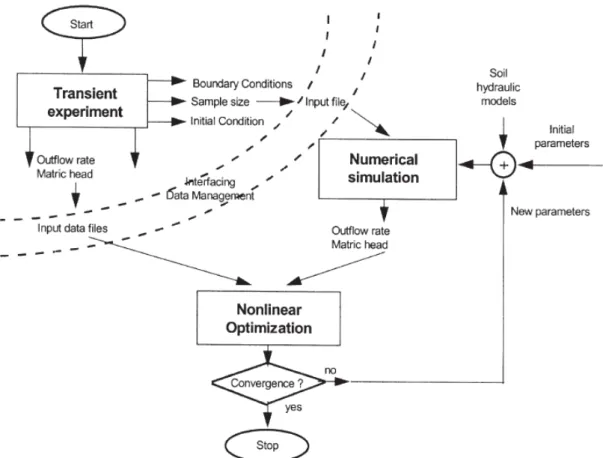
Basically, four components are required in the inverse method in order to estimate soil hydraulic functions (Hopmans et al., 2002; Minasny and Field, 2005): (1) the governing equation to simulate water flow, (2) parameters of hydraulic functions to describe θ(h) and K(h) curves, (3) the objective function to account deviation between output of water flow model and the measured the processes of water flow (e.g., pressure head, water content or cumulative flow as a function of time); and (4) the optimization procedure to optimize parameters of hydraulic functions by minimization of the objective function. Figure 2.4 shows the schematic of the measurement, modeling and optimization for the inverse method.
Figure 2.4. Flow chart of the inverse method illustrating the integration of measurement, modeling, and optimization (Hopmans et. al, 2002).
Hopmans et al. (2002) pointed out that the success of the inverse method depends on suitability and quality of three factors: (1) the experimental design, that is, the choice of boundary condition, the location and time resolution of the measurement sensor and the degree of accuracy of the experimental data; (2) the suitability of the transient flow model and hydraulic functions; and (3) the robustness of the optimization algorithm. If any of these three components is unsatisfactory, the inverse method may diverge.
One dimensional vertical variably saturated water flow in soil is usually described using the Richard equation, Eq. [2.3]. The Richard equation had been frequently used in the inverse modeling and showed successfully (Šimůnek et al., 1998; Zurmühl and Durner, 1998; Romano and Santini, 1999; Minasny and Field, 2005). Hydrus 1D as a software of the inverse method implements the Richard equation as governing equation of water flow (Šimůnek et al., 2008).
To solve the Richard equation, soil hydraulic functions are required. A proper soil hydraulic function is very important in the inverse method. Unsuitable soil hydraulic functions will lead to inaccurate parameters or even divergence. Most hydraulic functions assume that the predictive K(h) is coupled water retentions with the Mualem model (Hopmans et al, 2002). They also pointed out that number and correlation of hydraulic parameters will affect on selection of optimized parameters as well as success of the inverse method.
The objective function that describes discrepancy between the observed and fitted the processes flow is minimized by the optimization procedure. Šimůnek and Hopmans (2002) discussed more detail several formulations for the objective function. The weighted least square problem commonly is used for formulation of the objective function (Šimůnek and Hopmans, 2002; Hopmans et al, 2002) given by:
,
21 1
, , , ,
y j
j m i n
j i j j i j i
j i
y v w y z t y z t
[2.8]where the right-hand side represents the residuals between the measured (yj*) and model predicted (yj) space–time variables using the soil hydraulic parameters of the optimized parameter vector, β. The first summation describes sums the residual for all measurement of type of flow parameter my, whereas the variable nj in the second summation denotes the number of measurements for a certain measurement type j. The
weight vj is used for normalization of the type of flow parameter. It is usually set to be a variance those type flow parameter. Another weigh wi,j is used for the individual measured data.
Generally, not only flow processes of pressure head measurements but also water volume should be included in the objective function. Only one value of the water volume is needed in the objective function in order to position the retention curve along the θ axis. Without this information, neither θs or θr can be estimated because of their mutual correlation (Šimůnek et al., 1998). Hydrus 1D provides almost all types of the water flow processes can be included in the objective function (e.g., pressure head and water content as a function of time, cumulative flux, independent measurement data of soil hydraulic properties, etc.) (Šimůnek et al., 2008).
The optimization procedure is used to optimize the hydraulic parameters by minimizing the objective function. Several methods were proposed as the optimize procedure and work iteratively (Šimůnek and Hopmans, 2002). The Marquardt–
Levenberg method (Marquardt, 1963) is known a very effective method, which has become a standard in nonlinear least square fitting among soil scientists and hydrologists (van Genuchten, 1981; Kool et al., 1985, 1987). This method gives a confidence interval of the parameter solution. However, this method requires good starting estimation to obtain a convergence (Minasny and Field, 2005). Hydrus 1D implemented this method as the optimization procedure (Šimůnek et al., 2008).
The general problem about θr in the inverse method was reported. Šimůnek et al.
(1998) obtained that the optimized θr is high uncertainty due to intermediate range of pressure head measurements in the inverse method. van Dam et al. (1994) recommended that θr should not optimized, since the maximum pressure that applied in outflow experiment is about -1000 cm, because θr refers to lower pressure head. van Dam et al. (1994), Šimůnek et al. (1998) and Schelle et al. (2010) recommended to include water content at low pressure head or directly residual water content in the objective function.
Extrapolation beyond the range of measurement from tensiometer reading does not guarantee accurate estimates because of a high level uncertainty (Šimůnek et al., 1998; Minasny and Field, 2005). Inclusion of independently measured information
beyond the measurement range, i.e., water contents at some high suction, or directly the residual water content, could greatly decrease this uncertainty.
Detail review on the inverse method for estimaing soil hydraulic properties can be found in (Kool et al., 1987). Recently, Hopmans et al. (2002) also discussed more detail on guidance for not only how to perform the inverse method but also some transient water flow experiments.
2.5.2 Estimation of the bimodal VG model using the inverse method
Although the bimodal VG model was introduced in 1994, the first investigation of estimation of the bimodal VG parameters using the inverse method was performed in 1998 by Zurmühl and Durner. They conducted the multistep method as transient water flow experiment and analyzed whether θ(h) and K(h) parameters of the bimodal VG model can be identified by the inverse method or not, because the bimodal VG model has large number of parameters. They concluded that the parameters can be identified if the bimodality of the pore system is well developed due to uncorrelated parameters. It means that the increased number of parameters does not impose problems in the inverse method. Moreover, from the experimental data, they also showed it is possible to determine the bimodal VG model parameters from the multistep outflow experiment, inversely.
Subsequently, Spohrer et al. (2006) determined θ(h) and K(h) for the bimodal VG parameters for a tropical Acrisol using the inverse method of the transient flow experiment (TFE) from four layer soils in the field. They involved five variables, (1) water content change (θ vs t), (2) pressure head change (h vs t), (3) soil water retention (h vs θ), (4) K(h) at h=-2cm and (5) θ at pF=4.2 from the pedotransfer function in the objective function. The initial values of estimation for θ(h) were from fitted measured θ(h). The initial estimation for Ks and ℓ were obtained from matching K at h = -2cm and trial error values, respectively. As a result, they succeed to estimate 25 parameters of the bimodal VG simultaneously. They obtained that the bimodal VG model can describe well the measured θ(h). The optimized K(h) matched well with K(h) from the instantaneous profile method. A good simulation result of TFE was also achieved. The optimized Ks of the bimodal vG model showed realistic result.