Introduction
The family Pamphiliidae consists of primitive sawflies generally known as the leaf-rolling or webspinning sawflies. The family is divided into two subfamilies, the Cephalciinae and the Pam- philiinae. Larvae of the Cephalciinae feed on conifers, whereas those of the Pamphiliinae are associated with broad-leaved trees. There are over 260 species distributed in the Holarctic re- gion, of which about 75 species of six genera have been recorded from Japan (Abe & Togashi, 1989; Shinohara, 1994, 1997b, 2001b, 2004, 2005).
Aomori Prefecture is situated at the northern end of Honshu and has an area of 9,606.52 km2, nearly 70% of which is covered with forests. The highest peak is Mt. Iwakisan (1625 m alt.), an in- dependent volcano in the western part of the pre- fecture, while several peaks in Hakkoda Moun- tains in central part of the prefecture exceed 1500 m. The pamphiliid sawfly fauna of Aomori Prefecture has been little explored. The first ref- erence to this family of sawflies in Aomori Pre- fecture is Torikata (1912), who reported on the injury of leaves of cherry trees by “Lyda nigri-
cans Mats.” (Neurotoma iridescens (André, 1882)) in Tsugaru area, western part of the pre- fecture. Takeuchi (1923, 1930) recorded Neuro- toma iridescens from Aomori Prefecture based on Torikata’s paper. Takeuchi (1930) also de- scribed a new species, Cephalcia variegata, on the basis of 17 specimens, one of them, a paratype, from Mt. Hakkoda in Aomori Prefec- ture. Shinohara (1980, 1985a, 1986a, b, 1997b, 1998, 2000, 2001a, b, 2005), in a series of taxo- nomic works on various groups of the family, and Ichita (1994) recorded a total of 15 species from Aomori Prefecture. These are all the references ever published on the pamphiliid fauna of the prefecture.
The present work is an attempt to put together all the available information, published or unpub- lished, on the pamphiliid fauna of Aomori Pre- fecture mainly based on the study of a collection made by M. Yamada in the last two decades. Be- sides this collection, very few specimens from Aomori Prefecture were available for study. Un- less otherwise stated, the material used in this paper was collected by M. Yamada and is kept in his collection. Abbreviations for depositories are:
—NSMT: National Science Museum, Tokyo;
Pamphiliid Sawflies (Hymenoptera) from Aomori Prefecture, Northern Honshu, Japan
Akihiko Shinohara1and Masateru Yamada2
1Department of Zoology, National Science Museum, 3–23–1 Hyakunin-cho, Shinjuku-ku, Tokyo, 169–0073 Japan
e-mail: [email protected]
2Joto-kita 1–3–6, Hirosaki, Aomori, 036–8092 Japan
Abstract Collection records are given for 27 species of the sawfly family Pamphiliidae from Ao- mori Prefecture, northern Honshu. They are four species of Acantholyda, two species of Cephalcia, one species of Neurotoma, five species of Onycholyda, and 15 species of Pamphilius.
Of these, one species of Cephalciaremains unidentified and nine species of Onycholydaand Pam- philiusare newly recorded from Aomori Prefecture. The pamphiliid fauna of Aomori Prefecture is compared with the pamphiliid faunae of other four well-investigated areas in Honshu and general species composition of the local pamphiliid faunae in Honshu is discussed.
Key words: Hymenoptera, Pamphiliidae, fauna, Aomori Prefecture, Honshu, Japan.
UOP: Faculty of Agriculture, University of Osaka Prefecture, Sakai; KYU: Faculty of Agri- culture, Kyushu University, Fukuoka.
We wish to thank K. Goukon (Tohoku Gakuin University, Sendai), T. Hirowatari (UOP), T. Ichi- ta (Aomori), T. Oku (Morioka), O. Tadauchi (KYU), T. Tanabe (Gifu), I. Togashi (Tsurugi), and H. Yoshitomi (Sapporo) for making the ma- terial available for study. The present work was supported in part by a Grant-in-aid for Scientific Research No. 15570093 from the Ministry of Ed- ucation, Culture, Sports, Science and Technolo- gy, Japan.
Results and Discussion
We have recognized 27 species of five genera of Pamphiliidae occurring in Aomori Prefecture (see Table 1 and the enumeration below). They are four species of Acantholyda, two species of Cephalcia, one species of Neurotoma, five species of Onycholyda, and 15 species of Pam- philius. Of these, 17 species have already been recorded from Aomori Prefecture, while nine species are new to the fauna of Aomori Prefec- ture. One remaining species, a Cephalcia, has not been identified.
General comments on the pamphiliid fauna of Honshu
The local faunae of pamphiliid sawflies have not been well documented in Japan (Shinohara, 2002b). Table 1 shows the Pamphiliidae known to occur in four prefectures and Kamiange area in western Tokyo (unidentified species are not in- cluded). The four prefectures are perhaps the best investigated prefectures in Honshu for the pam- philiid fauna, though further studies will certain- ly reveal occurrence of additional species. Other references to the comparatively well-known pam- philiid faunae at the prefecture level include Fukui Prefecture (18 species of three genera;
Haneda et al., 1998), Kanagawa Prefecture (16 species of five genera; Nagase, 2004), and Saita- ma Prefecture (13 species of four genera;
Nambu, 1998). Kamiange is shown here as an
example of the best-known pamphiliid fauna in a small area in lower mountains of central Honshu (Shinohara, 2002b).
The subfamily Pamphiliinae is rather well studied taxonomically in Japan but we are much less informed about the subfamily Cephalciinae, which includes the genera Acantholyda and Cephalcia. The Japanese species of Acantholyda were recently revised (Shinohara, 2001b) but the material available for that work was rather limit- ed and the distributional range of each species is not well known. The Japanese species of the genus Cephalcia are badly in need of revision and identification of the species is impossible in many cases. That is why some specimens of Cephalcia were left unidentified in Nakamura (2003) and in the present work. It is thus prema- ture to make any meaningful comparisons among the local faunae of the cephalciine species in Japan.
Table 1 shows that a total of ten species of Neurotoma, Onycholyda and Pamphilius (darkly shadowed in Table 1) are known to occur in all the five regions treated and additional seven species of Onycholyda and Pamphilius (lightly shadowed in Table 1) have been found in four of the five regions. We regard these 17 species, all belonging to the subfamily Pamphiliinae, as con- stituting a “basic group” in the pamphiliid fauna of Honshu. The species of the “basic group” are expected to occur in most, if not all, areas in Honshu. The composition of the “basic group”
will change (increase in the number of species) as our knowledge on the pamphiliid fauna of Honshu grows.
Most of the members of the “basic group” be- long to the subgenus Neurotoma of the genus Neurotoma, the amplecta group of the genus Onycholyda, and the alternans, sulphureipes, and sylvaticus groups of the genus Pamphilius(Shi- nohara, 2002a). These are comparatively south- ern species mainly associated with the Rosaceae and Aceraceae. On the other hand, the “basic group” includes no species of the Cephalciinae, the subgenus Gongylocorsiaof the genus Neuro- toma, the genus Chrysolyda, the luteicornis
Table1.Pamphiliidae recorded in five areas in Honshu (undetermined species not included) Hyogo Pref. Ishikawa Pref. Kamiange Tochigi Pref. Aomori Pref. [0–1510m alt.][0–2702m alt.][ca. 400m alt.][12–2578m alt.][0–1625m alt.] Subfamily CEPHALCIINAE Genus ACANTHOLYDA Subgenus AcantholydaA. nipponica11 SubgenusItycorsiaA. albomaculata A. alpina A. iwatai 1313 A. kojimai14 A. mizunoi A. posticalis posticalis A. sasakii1313 A. tsuyukii Genus CEPHALCIA C. lariciphila japonica1 C. variegata15 Subfamily PAMPHILIINAE Genus NEUROTOMA Subgenus NeurotomaN. iridescens16, 17 Subgenus GongylocorsiaN. atrata N. harai25 Genus CHRYSOLYDA C. leucocephala Genus ONYCHOLYDA O. amplectagroup O. decorata O. esakii18, 19 O. lucida20 O. minomalis5 O. moriutii O. similis O. tenuis O. viriditibialis18 O. luteicornisgroup O. kumamotonis Genus PAMPHILIUS P. basilarisgroup P. basilaris P. alternansgroup P. komonensis6, 7 P. takeuchii6, 7 P. sulphureipesgroup P. ishikawai19 P. zhelochovtsevi nipponicus
Table1.(Continued). Hyogo Pref. Ishikawa Pref. Kamiange Tochigi Pref. Aomori Pref. [0–1510m alt.][0–2702m alt.][ca. 400m alt.][0–2578m alt.][0–1625m alt.] P. histriogroup P. brevicornis ibukii P. vafergroup P. confusus388 P. flavipectus8 8 P. nakagawai8 P. lobatus P. venustus9 P. kamikochensis21 P. archiducalis P. hortorum P. itoi7, 10 P. varius11 P. togashii P. sylvaticusgroup P. alnicola P. benesi4 P. daisenus4 P. japonicus4, 19 P. volatilis22 P. inanitusgroup P. hilaris12 Total number of species2431193526 B/T ratio (see text for explanation)0.710.520.840.430.54 N/B ratio (see text for explanation)0.180.56010.63 Main referencesNaito et al. (2004) Togashi (1998)Shinohara (2002b)Nakamura (2003)present work Additional references for respective species
1Shinohara (1997b); 2Shinohara (1997a); 3Shinohara (2005); 4Shinohara (2001a); 5Katayama (2004a); 6Shinohara (2002b); 7Katayama (2004b); 8Shinohara (2005); 9Shinohara & Morita (2003); 10Shinohara (1985c); 11new record, 1 female, Chuzenji, Nikko, 4. VI. 1977, N. Matsuba leg. [NSMT]; 12Nakamura (2004); 13 Shinohara (2001b); 14 Shinohara (2000); 15 Takeuchi (1930); 16 Torikata (1912); 17 Shinohara (1980); 18Shinohara (1986a); 19Ichita (1994); 20Shinohara (1986b); 21Shinohara (1998); 22Shinohara (1985a).
group of the genus Onycholyda, and the basilaris, histrio, and inanitus groups of the genus Pamphilius, and it includes only a few species of the vafer group of the genus Pam- philius. Particularly the absence or poor repre- sentation of the Cephalciinae and Pamphilius vafergroup in the “basic group” is important, be- cause these two groups contain considerable number of species, most of them northern in dis- tribution.
In general, a local pamphiliid fauna in Honshu may be represented by three, very roughly deter- mined categories of species:
1) the “basic group” as discussed above;
2) the mainly “northern group” of species of the Cephalciinae and Pamphilius vafergroup (ex- cluding the three species included in the “basic group”; and
3) other, mostly rare or very localized species or species with only scanty information, such as the species of Neurotoma (Gongylocor- sia) and Chrysolyda.
In more southern regions (e.g., Hyogo Prefec- ture) or in the lower altitude (e.g., Kamiange), the “basic group” is predominant, with few species of the “northern group”, whereas in the region with higher mountains in central and northern Honshu (e.g., Ishikawa, Tochigi, and Aomori Prefectures), the “northern group” is richly represented in addition to the “basic group”.
For making comparisons of local pamphiliid faunae in Honshu easier, two indices are pro- posed here, the “B/T ratio” and the “N/B ratio”, both ratios in the number of the species. The B/T ratio (the ratio of the species number of the
“basic group” to the total number of species oc- curring in the area) shows the portion of the
“basic group” sharing in the total pamphiliid fauna of the area. The higher this ratio becomes, the more “basic” becomes the fauna; in other words, the fauna is less diversified, with fewer el- ements of the “northern” or “other” categories.
On the other hand, a pamphiliid fauna with a rich representation of the “northern group” and/or the species in the category 3 will have a low B/T
ratio. To understand the share of the “northern group” in a particular local pamphiliid fauna, the N/B ratio may be useful. It is a ratio of the num- ber of species of the “northern group” to that of the “basic group” found in the area.
The B/T and N/B ratios are given for each area in Table 1. Among the five regions, Kamiange is peculiar in having the B/T ratio as high as 0.84 and the N/B ratio 0 (“northern group” not found). The research field in Kamiange is a small area about 400 meters high in southwestern part of Tokyo in central Honshu (Shinohara, 2002 b).
This is probably a typical pamphiliid fauna in the lowlands to lower mountains in Honshu. The pamphiliid fauna of Hyogo Prefecture (B/T ratio 0.71; N/B ratio 0.18) has much in common with that of Kamiange but has some elements of the
“northern group”. This is well explained by its southwestern location in Honshu and the pres- ence of high but not very high mountains (slight- ly over 1500 meters in altitude) in the prefecture.
Each of the other three prefectures, Ishikawa Pre- fecture (B/T ratio 0.52; N/B ratio 0.56), Tochigi Prefecture (B/T ratio 0.43; N/B ratio 1), and Ao- mori Prefecture (B/T ratio 0.54; N/B ratio 0.63), covers a large area from lowlands to high moun- tains and has a pamphiliid fauna of mixed ele- ments of the three categories (B/T ratio 0.43–0.54; N/B ratio 0.56–1). This is a general composition of the pamphiliid fauna expected to be found in most of the prefectures in central to northern Honshu insofar as the prefecture has higher places over 1500–2000 meters. The very high value of N/B ratio in Tochigi Prefecture (1) probably reflects the presence of good collection of sawflies from higher mountains (particularly from Nikko area), where the “northern group” is richly represented.
Characteristics of the pamphiliid fauna of Ao- mori Prefecture
Of the 26 pamphiliid species now known to occur in Aomori Prefecture, 14 species belong to the “basic group” and ten species belong the
“northern group”. A low value of B/T ratio (0.54) and a high value of N/B ratio (0.63) show
that the pamphiliid fauna of Aomori Prefecture is typical of the pamphiliid fauna of a prefecture with a wide range of altitudes in central and northern Honshu.
No species endemic to Aomori Prefecture has been found. Pamphilius zhelochovtsevi nipponi- cus, P. daisenus, and P. japonicus are rarely col- lected species but they are rather widely distrib- uted (Shinohara, 2001a, 2002b).
Considering that 31 species of Pamphiliidae have been recorded from Ishikawa Prefecture and 35 species from Tochigi Prefecture (Table 1), we assume that the pamphiliid fauna of Aomori Pre- fecture, with 26 recorded species, has not been fully explored. Of the 17 species recognized as members of the “basic group” of the Honshu pamphiliid fauna (see discussion above), three species (Onycholyda decorata, O. similis, and Pamphilius togashii) have not been discovered in Aomori Prefecture. The northernmost localities recorded for the three species are Sendai, Miyagi Prefecture for O. decorata (Shinohara, 1985b, known also from southwestern Hokkaido), Mt.
Gassan, Yamagata Prefecture for O. similis(Shi- nohara, 1987; recorded erroneously as Akita Pre- fecture), and Hachimantai, Iwate Prefecture for P.
togashii(Shinohara, 2002b). These three species are very likely to be found in Aomori Prefecture.
Other species expected to be discovered are a birch-feeding species, P. varius, alder-feeding species, P. archiducalis and P. alnicola, and P.
hortorum (host unrecorded in Japan), because they are known to occur rather widely in moun- tainous regions of Honshu and Hokkaido.
List of Pamphiliidae from Aomori Prefecture
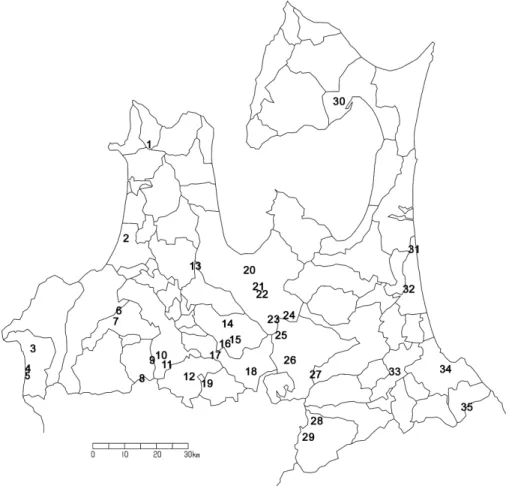
(The numerals in brackets after the locality names in the collection data refer to the numerals in the map, Fig. 1)
Acantholyda nipponicaYano & Sato, 1928
[Japanese name: Nihon-akazu-hiratahabachi]
Material examined. 1?, Mt. Hakkoda [23], 21. VII. 1985.
Distribution. Japan (Hokkaido, Honshu).
Host plants. Larix leptolepis(Sieb. & Zucc.) Gord., Pinus strobus L., Pinus pumila (Pallas) Regel (Shinohara, 2001b).
Remarks. This species has been recorded from Hokkaido, Aomori, Miyagi, Saitama, Tokyo, Yamanashi, Nagano, and Ishikawa Prefec- tures (Shinohara, 2001b). In Hokkaido, this is a pest on planted larch trees (Shinohara, 1997b), but it is usually rare in Honshu.
Acantholyda iwataiTakeuchi, 1938
[Japanese name: Iwata-hiratahabachi]
Material examined. 1?, Hakkoda (Aomori) [23], 17. VII. 1997 (recorded by Shinohara, 2001b).
Distribution. Japan (Honshu, Shikoku, Kyushu).
Host plants. Unknown.
Remarks. This species was first recorded from Aomori Prefecture by Shinohara (2001b). It is known to occur in Honshu (Aomori, Tochigi, Yamanashi, Nagano, Aichi Prefectures), Shikoku (Tokushima Prefecture), and Kyushu (Kagoshima Prefecture).
Acantholyda kojimaiShinohara, 2000
[Japanese name: Kita-atoguro-hiratahabachi]
Material examined (all paratypes). 1?, Mt.
Iwaki [6], 16. VI. 1991; 3?, Mt. Iwaki (Iwaki) [6], 17. VI. 1997; 1?, Hakkoda (Aomori) [23], 17. VII. 1997; 1?, Mt. Hakkoda [23], 24. VI.
1984; 1?, Mt. Hakkoda [23], 8. VII. 1989; 1?, Mt. Hakkoda [23], 3. VIII. 1986.
Distribution. Japan (Honshu).
Host plants. Pinus parvifloraSieb. & Zucc., Pinus pumila(Pallas) Regel (Shinohara, 2000).
Remarks. This species is known to occur in Aomori, Miyagi, Niigata, Fukushima, Tochigi, Gumma, and Nagano Prefectures (Shinohara, 2000). The Aomori specimens listed above are paratypes.
Acantholyda sasakii(Yano, 1916)
[New Japanese name: Haraaka-matsu-hiratahabachi]
Material examined. 1?, Hakkoda (Aomori) [23], 22. VII. 1997 (recorded by Shinohara, 2001b); 1?, Hakkoda (Aomori) [23], 23. VI.
1997 (recorded by Shinohara, 2001b).
Distribution. Japan (Honshu).
Host plants. Pinus densifloraSieb. & Zucc., Pinus parviflora var. pentaphylla (Mayr) Henry, Pinus koraiensis Sieb. & Zucc. (Shinohara, 2001b).
Remarks. Shinohara (2001b) recorded this species from Aomori, Yamagata, Miyagi, Fukushima, Tochigi, Gumma, Ibaraki, Saitama, Tokyo, Kanagawa, Yamanashi, Nagano, Ishi- kawa, and Tottori Prefectures.
Cephalcia variegataTakeuchi, 1930
[Japanese name: Takane-hiratahabachi]
Material examined. 5/5?, Mt. Hakkoda [23], 21. VII. 1985; 4/14?, Hakkoda (Aomori) [23], 22. VII. 1997.
Distribution. Japan (Hokkaido, Honshu);
Sakhalin.
Host plants. Pinus pumila (Pallas) Regel (Togashi & Yoshida, 1988).
Remarks. This species occurs in the alpine Pinus pumilazone in Hokkaido and northern and central Honshu (recorded from Aomori, Nagano, and Ishikawa Prefectures) (Takeuchi, 1930; To- gashi, 1961). One of the paratypes was obtained from Mt. Hakkoda (Takeuchi, 1930).
Fig. 1. Map of Aomori Prefecture. The numerals show the approximate locations of the sites; see numerals given in brackets in the collection data.
Cephalciasp.
Material examined. 1?, Mt. Iwaki [6], 8.
VII. 1990.
Remarks. This male specimen has not been determined. The Japanese species of Cephalcia need a taxonomic revision and are not identifi- able for now, except for a few very characteristic species.
Neurotoma iridescens(André, 1882)
[Japanese name: Sakura-hiratahabachi]
Material examined. 1/, Mt. Kuromori (Kuroishi) [14], 6. VI. 1985.
Distribution. Japan (Hokkaido, Honshu, Shikoku, Kyushu), Korea, Siberia, and Europe.
Host plants. Prunus spp., Sorbus spp., Crataegus chlorosarca (Shinohara & Hara, 1999).
Remarks. Torikata (1912) reported on the damage of leaves of cherry trees by the present species (under the name of “Lyda nigricans Mats.”) in Tsugaru area. This is a widely distrib- uted species and the gregarious larvae are quite noticeable; however, the adults are not commonly collected.
Onycholyda esakii(Takeuchi, 1938)
[Japanese name: Esaki-hiratahabachi]
Material examined. 1/, Juniko (Iwasaki) [3], 16. VI. 1985; 1?, Zato-Ishi (Hirosaki) [11], 14. VI. 1984; 1/, Ikarigaseki [19], 14. VIII.
1982 (recorded by Shinohara, 1986a); 1?, Na- gasaka (Kuroishi), 2. VII. 1988; 1/, Yokouchi- Yaegiku [20], Aomori-shi, 7. VIII. 1993, T. Ichita (NSMT; recorded by Ichita, 1994); 1/, Tsuta (Towadako) [25], 17. VIII. 1986; 1?, Tsuta (Towadako), 24. VIII. 1986.
Distribution. Japan (Honshu, Shikoku, Kyu- shu).
Host plant. Unknown.
Remarks. This rather uncommon species was already recorded from Aomori Prefecture by Shi- nohara (1986a) and Ichita (1994).
Onycholyda lucida(Rohwer, 1910)
[Japanese name: Tsuya-hiratahabachi]
Material examined. 2/, Kudojiyama (Hi- rosaki) [9], 27. V. 1989; 1/1?, Hayaseno (Owani) [13], 18. V. 1985 (recorded by Shino- hara, 1986b); 2?, Shiroiwa (Onoe), 11. V. 1985;
1?, Mt. Tashiro (Kuroishi) [15], 20. V. 1990; 1/, Mt. Tashiro (Kuroishi), 26. V. 1990; 1/, Mt.
Tomioka (Kuroishi) [16], 3. VI. 1989; 1/, Okawara (Kuroishi), 29. V. 1984; 9?, Mt. Yasute (Hiraka) [17], 22. V. 1989; 1?, Kayanochaya (Aomori) [22], 30. V. 1986; 1?, Tsuta (Towadako) [25], 28. V. 1997; 3/, Tsuta (Towadako), 31. V. 1987; 2/, Yasumiya (Towadako), 1. VI. 1987; 1/ Mt. Herai (Shingo) [27], 19. V. 1986; 1/, Nagashita (Gonohe) [33], 14. V. 1987; 1/, Mt. Hashikami (Hashikami) [35], 8. VI. 1986.
Distribution. Japan (Honshu, Shikoku, Kyushu).
Host plants. Rubus spp. (Okutani & Fujita, 1955).
Remarks. This is probably the commonest species of Pamphiliidae in Honshu. It was first recorded from Aomori Prefecture by Shinohara (1986b).
Onycholyda minomalis(Takeuchi, 1930)
[Japanese name: Komon-hiratahabachi]
Material examined. 2?, Amagamori (Mi- sawa) [31], 6. VI. 1988; 1/, Sabishiroi (Misawa) [32], 6. VI. 1988.
Distribution. Japan (Hokkaido, Honshu, Shikoku, Kyushu).
Host plant. Rubus parviflora L. (Okutani, 1967).
Remarks. This is the first record of O. mino- malis from Aomori Prefecture. It is not uncom- mon in central Honshu, but rarely found in north- ern Honshu, with only one previous record from Miyagi Prefecture (Shinohara, 1987).
Onycholyda viriditibialis(Takeuchi, 1930)
[Japanese name: Aosune-hiratahabachi]
Material examined. 1/, Mt. Tomioka (Ku- roishi) [16], 18. VI. 1988; 1?, Shigabou (Hira- ka), 6. VI. 1999; 1/, Ikarigaseki [19], 14. VIII.
1982 (recorded by Shinohara, 1986a); 1?, Okuromori (Takko) [28], 2. VIII. 1986.
Distribution. Japan (Hokkaido, Honshu, Shikoku, Kyushu), Korea, Russia (Primorskij kraj).
Host plant. Rubus crataegifolius Bunge (Okutani & Fujita, 1956).
Remarks. This is a widespread species al- ready recorded from Aomori Prefecture by Shi- nohara (1986a).
Onycholyda kumamotonis(Matsumura, 1912)
[Japanese name: Onishimotsuke-hiratahabachi]
Material examined. 1?, Chokeimori (Soma) [8], 10. VI. 1989; 1/, Kudojiyama (Hirosaki) [9], 27. V. 1989; 1/, Hayaseno (Owani) [13], 18.
V. 1985; 2?, Nurukawa (Hiraka) [18], 10. VI.
1999; 1/4?, Tsuta (Towadako) [25], 31. V.
1987; 2/, Yasumiya (Towadako), 1. VI. 1987;
1/, Natsusaka (Takko) [29], 6. VI. 1987.
Distribution. Japan (Hokkaido, Honshu), Sakhalin, southern Kuriles.
Host plant. Filipendula kamtschatica (Pal- las.) Maxim. (Shinohara & Okutani, 1983).
Remarks. Onycholyda kumamotonis was known from Iwate, Tochigi, Nagano, Gifu, and Ishikawa Prefectures in Honshu (Shinohara, 1985d), and this is the first record from Aomori Prefecture.
Pamphilius komonensisTakeuchi, 1930
[Japanese name: Kaede-hiratahabachi]
Material examined. 1?, Omagoshi (Iwasaki) [5], 2. VI. 1999; 5?, Tozando (Dake-Iwaki) [7], 29. V. 1994; 1/, Chokeimori (Soma) [8], 10. VI.
1989; 1?, Chokeimori (Soma), 7. VI. 1998; 2?, Mt. Kuromori (Kuroishi) [14], 6. VI. 1985;
1/6?, Mt. Tashiro (Kuroishi) [15], 11. VI. 1994.
Distribution. Japan (Honshu, Shikoku,
Kyushu).
Host plant. Acer mono Maxim. (Shinohara
& Okutani, 1983).
Remarks. This species is commonly found in central Honshu (Shinohara, 2002b) but has not been recorded from the Tohoku district. In addi- tion to the Aomori specimens listed above, I have examined the following specimens from the To- hoku district. Akita Prefecture: 2?, Kuroyu, 16.
VI. 1951, K. Takeuchi (UOP). Iwate Prefecture:
1?, Tsunagi-onsen, 3. VI. 1981, T. Tanabe (NSMT); 1?, Tsunagi-onsen, 3. VI. 1981, T.
Oku (NSMT); 10?, Tsunagi-onsen, 29. V. 1982, A. Shinohara (NSMT); 1?, near Hachimantai (ca. 1000–1300m), Ashiro-cho, 10–13. VII.
1995, H. Yoshitomi (NSMT). Fukushima Prefec- ture: 15?, Shitokigawa-keikoku, Iwaki, 6. V.
1982, A. Shinohara (NSMT).
One female from Mt. Tashiro is aberrant in that its head color pattern is very different from that of an ordinary female but resembles that of an ordinary male of the same species.
Pamphilius takeuchiiBeneˇs, 1972
[Japanese name: Usumon-hiratahabachi]
Material examined. 1/, Juniko (Iwasaki) [3], 16. VI. 1985; 1/, Juniko (Iwasaki), 23. VII.
1988; 1/, Omagoshi (Iwasaki) [5], 2. VI. 1999;
1?, Sukayu (Aomori) [23], 22. VI. 1995; 1?, Mt. Hakkoda (Aomori) [23], 29. VI. 1995; 1?, Mt. Kamafuse (Mutsu) [30], 12. VI. 1997.
Distribution. Japan (Hokkaido, Honshu, Shikoku, Kyushu).
Host plant. Acer mono Maxim. (Okutani, 1959).
Remarks. This widespread species has not been recorded from the Tohoku district. I have examined the following specimens from the To- hoku district, besides the specimens from Ao- mori Prefecture listed above. Iwate Prefecture:
11?, Tsunagi-onsen, 29. V. 1982, A. Shinohara (NSMT). Miyagi Prefecture: 1?, Mt. Maeyama, Zao, 23. VI. 1974, K. Shirahata (NSMT). Yama- gata Prefecture: 1/, Mt. Gassan, 19. VI. 1960, K.
Shirahata (NSMT). Fukushima Prefecture: 1/,
Mt. Azumayama, 19. VII. 1959, K. Sato (NSMT).
Pamphilius ishikawaiShinohara, 1979
[Japanese name: Tsuya-kuro-hiratahabachi]
Material examined. 1/, Kudojiyama (Hi- rosaki) [9], 27. V. 1989; 1?, Zatoishi (Hirosaki), 6. VI. 1984; 1/, Itadome, Kuroishi [15], 18. VI.
1983.
Distribution. Japan (Honshu).
Host plant. Unknown.
Remarks. This is the first record of P.
ishikawai from Aomori Prefecture. It is wide- spread in Honshu, though it has been recorded only from Akita and Fukushima Prefectures in the Tohoku district (Shinohara, 2002b).
Pamphilius zhelochovtsevi nipponicus Shinohara, 1993
[Japanese name: Mon-tsuya-kuro-hiratahabachi]
Material examined. 1/, Moyasawa, Aomori- shi [21], 6-13. VI. 1992, yellow sticky trap, T.
Ichita (NSMT; recorded by Ichita, 1994); 1/, Nagashita (Gonohe) [33], 23. V. 1986.
Distribution. Japan (Honshu).
Host plant. Unknown.
Remarks. Ichita (1994) was the first to record this species from Aomori Prefecture. Otherwise, this rare species is known to occur in Iwate, Tokyo, Nagano, Gifu, Ishikawa, Hyogo, and Tot- tori Prefectures (Shinohara, 2002b).
Pamphilius confususShinohara, 2005
[Japanese name: Hannoki-hiratahabachi]
Material examined (holotype and paratypes).
51/ (incl. holotype) 115?, Mt Iwaki (Iwaki) [6], 6. VI-27. VII., 1981–1997 (partly in NSMT, see Shinohara, 2005, for more details); 1?, Dakeon- sen (Iwaki) [7], 27. V. 1989; 1/3?, Kudojiyama (Hirosaki) [9], 27. V. 1989; 1/, Hayaseno (Owani) [13], 18. V. 1985; 1/, “Aomori” “Pam- philius (Anoplolyda) ?pallipes Zetter., det. K.
Sato, 1957” (NSMT); 1/, Mt. Hakkoda, 10. VII.
1932, K. Takeuchi (UOP); 1/, Mt. Hakkoda [23], 26. VI. 1983; 1/2?, Mt. Hakkoda, 24. VI.
1984; 4?, Mt. Hakkoda [23], 29. VI. 1988;
1/1?, Mt. Hakkoda (Aomori) [23], 23. VI.
1997.
Distribution. Japan (Hokkaido, Honshu, Shikoku).
Host plant. Alnus maximowiczii Call. (Shi- nohara, 2005)
Remarks. This species was long known under the name of Pamphilius pallipes(Zetterst- edt) in Japanese literature (e.g., Takeuchi, 1938;
Togashi, 1961; Okutani, 1967; Shinohara & Oku- tani, 1983), but Shinohara (2005) described it as a new species. All the Aomori specimens listed above belong to the type series, including the holotype from Mt. Iwakisan.
Pamphilius flavipectusShinohara, 2005
[Japanese name: Kimune-hiratahabachi]
Material examined (paratypes). 1/, Mt.
Bonju, Namioka [12], 29. V. 1983; 1/, Oirasegawa (Towadako) [26], 12. V. 1997.
Distribution. Japan (Honshu, Shikoku, Kyushu).
Host plant. Alnus hirsutaTurcz. (Shinohara, 2005).
Remarks. This species was very recently de- scribed on the basis of 125 specimens including the two paratypes from Aomori Prefecture (Shi- nohara, 2005).
Pamphilius nakagawaiTakeuchi, 1930
[Japanese name: Nakagawa-hiratahabachi]
Material examined(all recorded by Shinohara, 2005). 1/, Shiroiwa (Hiraka), 6. V. 1989; 1/, Tsuta (Towadako) [25], 30. V. 1999.
Distribution. Japan (Honshu, Shikoku, Kyushu).
Host plants. Alnus hirsutaTurcz. and its va- riety, var. sibirica (Fischer) C. K. Sch., Alnus matsumuraeCall. (Shinohara, 2005).
Remarks. This species is sometimes com- monly found in central Honshu, but seems to be
scarce in Aomori Prefecture.
Pamphilius lobatusMaa, 1950
[Japanese name: O-haraaka-hiratahabachi]
Material examined. 1/, Ichinowatari (Hi- rosaki) [10], 23. VI. 1985; 1/, Mt. Tashiro (Kuroishi) [15], 12. VI. 1993; 1?, Mt. Hakkoda [24], 11. VI. 1989.
Distribution. Japan (Hokkaido [new distribu- tion record], Honshu), Korea, China (Jilin) (Shi- nohara & Xiao, 2005).
Host plant. Unknown.
Remarks. This is the first distribution record of P. lobatusfrom Aomori Prefecture and the To- hoku district. I have also examined the following specimens from Akita and Miyagi Prefectures.
Akita Prefecture: 1/, Kuroyu, 14. VI. 1951, K.
Takeuchi (UOP). Miyagi Prefecture: 1?, Ippit- suyama, Hanayama-mura, 5. VI. 1990, K.
Goukon (NSMT). In Japan, this species has been recorded from Honshu only (Shinohara, 1988).
The following specimens represent the first dis- tribution record of P. lobatus from Hokkaido:
1?, Yamada-onsen, Tokachi, 21. VI. 1990, A. Shinohara (NSMT); 1?, Horoshika-toge, 1100 m, Tokachi, 7. VII. 1994, A. Shinohara (NSMT); 2?, same locality, 21–23. VI. 2000, A.
Shinohara (NSMT); 2/, Asahidake-onsen, Daisetsuzan Mountains, Kamikawa, 29–30. VI.
2000, A. Shinohara (NSMT); 1/, same locality, 25–28. VI. 2002, A. Shinohara (NSMT); 1?, Akadake-Ginsendai, Daisetsuzan Mountains, Kamikawa, 12–14. VII. 2001, A. Shinohara (NSMT).
Pamphilius venustus(Smith, 1874)
[Japanese name: Haraaka-hiratahabachi]
Material examined. 1/, Mt. Masukawa (Mimmaya) [1], 22. V. 1988; 1?, Chokeimori (Soma) [8], 10. VI. 1989; 1/, Chokeimori (Soma), 25. VI. 1989; 1?, Kudojiyama (Hirosa- ki) [9], 27. V. 1989; 1/, Zatoishi (Hirosaki) [11], 19. V. 1983; 1/, Zatoishi (Hirosaki), 7. VI. 1983;
1/2?, Nurukawa (Hiraka) [18], 10. VI. 1999;
1/, Tsuta (Towadako) [25], 31. V. 1987; 2/, Tsuta (Towadako), 30. V. 1999; 11/4?, Ya- sumiya (Towadako), 1. VI. 1987.
Distribution. Japan (Hokkaido, Honshu, Shikoku) (Shinohara & Morita, 2003).
Host plant. Filipendula kamtschatica (Pall.) Maxim. (Shinohara & Okutani, 1983).
Remarks. In Honshu, this species is known to occur in Aomori, Iwate, Tochigi, Niigata, Ya- manashi, Nagano, Gifu, Ishikawa, and Shiga Pre- fectures (Shinohara & Morita, 2003), but the col- lection data in Aomori Prefecture have not been published.
Pamphilius kamikochensisTakeuchi, 1930
[Japanese name: Ko-haraaka-hiratahabachi]
Material examined. 1/, Mt. Masukawa (Mimmaya) [1], 22. V. 1988; 1/, Tsubaigawa (Iwasaki) [4], 2. VI. 1999; 1?, Kudojiyama (Hi- rosaki) [9], 27. V. 1989; 1?, Mt. Bonju (Namio- ka) [12], 15. V. 1983; 1?, Mt. Bonju (Namioka), 29. V. 1983 (recorded by Shinohara, 1998);
1/4?, Hayaseno (Owani) [13], 18. V. 1985;
1/1?, Hayaseno (Owani), 18. V. 1985 (recorded by Shinohara, 1998); 1/10?, Towadasan (Owani), 19. V. 1991; 2/2?, Mt. Tashiro (Kuroishi) [15], 2. VI. 1994; 2?, Mt. Tashiro (Kuroishi), 20. V. 1990; 1/, Mt. Tashiro (Kuroishi), 24. V. 1993; 1/18?, Mt. Tashiro (Kuroishi), 26. V. 1990; 1?, Mt. Tashiro (Kuroishi), 28. V. 1994; 1/, Takinosawa (Hira- ka), 10. VI. 1999; 1/, Tsuta (Towadako) [25], 30. V. 1999; 1/, Yasumiya (Towadako), 1. VI.
1987.
Distribution. Japan (Hokkaido, Honshu).
Host plant. Prunus ssioriF. Schmidt (Shino- hara & Okutani, 1983; Shinohara, 1998)
Remarks. This species is usually uncommon but sometimes occurs in great numbers near the trees of Prunus ssiori (Shinohara & Okutani, 1983). Shinohara (1998) recorded this species from Aomori Prefecture, and it was the only available distribution record of P. kamikochensis from the Tohoku district.
Pamphilius itoiShinohara, 1985
[Japanese name: Hanno-haraaka-hiratahabachi]
Material examined. 1?, Mt. Bonju (Namio- ka) [12], 27. V. 1995.
Distribution. Japan (Hokkaido, Honshu), Kunashiri Is.
Host plant. Alnus hirsuta Turcz. (Shinohara
& Hara, 1995)
Remarks. In the Tohoku district, this species was known only from Iwate Prefecture (Shino- hara, 1985c). This is the first distribution record from Aomori Prefecture.
Pamphilius benesiShinohara, 1985
[Japanese name: Hashibami-hiratahabachi]
Material examined. 1/, Mt. Hakkoda [24], 11. VI. 1989.
Distribution. Japan (Hokkaido, Honshu, Shikoku, Kyushu), Korea.
Host plant. Corylus sieboldianaBlume (Shi- nohara & Hara, 1997).
Remarks. This is an uncommon though widely distributed species. In the Tohoku district, P. benesi was known only from Iwate Prefecture (Shinohara, 1985a, 2001a), and this is the first distribution record from Aomori Prefecture.
Pamphilius daisenusTakeuchi, 1938
[Japanese name: Daisen-kuro-hiratahabachi]
Material examined. 1?, Mt. Kamafuse (Mutsu) [30], 12. VI. 1997 (recorded by Shino- hara, 2001a).
Distribution. Japan (Honshu), Korea.
Host plant. Unknown.
Remarks. This is a rare species known only by several specimens from Aomori, Miyagi, Tochigi, Saitama, Nagano, Hyogo, and Tottori Prefectures and Korea (Shinohara, 2001a).
Pamphilius japonicusShinohara, 1985
[Japanese name: O-kuro-hiratahabachi]
Material examined. 1/, Moyatoge, Aomori- shi [21], 13–27. VI. 1992, yellow sticky trap, T.
Ichita (NSMT; recorded by Ichita, 1994, and Shi- nohara, 2001a); 1?, Sabishiroi (Misawa) [32], 6.
VI. 1986 (recorded by Shinohara, 2001a).
Distribution. Japan (Honshu, Kyushu).
Host plant. Unknown.
Remarks. This uncommon species was recorded from Aomori Prefecture by Ichita (1994) and Shinohara (2001a). Besides, it is known to occur in Iwate, Tokyo, Aichi, Ishikawa, Fukui, Hyogo, and Tottori Prefectures in Honshu, and in Fukuoka and Oita Prefectures in Kyushu (Shinohara, 2001a).
Pamphilius volatilis(Smith, 1874)
[Japanese name: Shima-hiratahabachi]
Material examined. 11?, Hiratakinuma (Kizukuri) [2], 22. V. 1991; 3/, Hiratakinuma (Kizukuri), 27. V. 1990; 1?, Mt. Iwaki (Iwaki) [6], 17. VI. 1997; 1?, Tozando (Dake-Iwaki) [7], 29. V. 1994; 24?, Kudojiyama (Hirosaki) [9], 27. V. 1989; 1/, Zatoishi flow [11], 19. V. 1984;
1?, Towadasan (Owani), 19. V. 1991; 1?, Mt.
Hakkoda [23], 1. VII. 1984; 1?, Mt. Hakkoda [23], 8. VII. 1989; 2/, Sabishiroi (Misawa) [32], 6. VI. 1988; 1?, Hachinoe [34], 17. V. 1960, A.
Fukuda (KYU; recorded by Shinohara, 1985a).
Distribution. Japan (Hokkaido, Honshu, Kyushu), Korea, and Russia (Primorskij Kraj).
Host plants. Prunus spp., Crataegus chlorosarca(Shinohara & Hara, 1999).
Remarks. This is a common species already recorded from Aomori Prefecture by Shinohara (1985a).
References
Abe, M. & I. Togashi, 1989. Symphyta. In: Hirashima, Y.
(ed. supervisor), A Check List of Japanese Insects, pp.
541–560. Entomological Laboratory, Faculty of Agri- culture, Kyushu University, Fukuoka. (In Japanese.) Haneda, Y., T. Tano, H. Okuno, C. Nozaka, T. Murota, H.
Kurokawa & S. Inoue, 1998. Hymenoptera. In: Fukui- ken Shizen-kankyo Hozenchosa Kenkyu-kai Konchu Bukai (ed.), [Catalogue of Insects of Fukui Prefecture, 2nd Ed.], pp. 314–404. Fukui-ken, Kemminseikatsu-bu, Fukui. (In Japanese.)
Ichita, T., 1994. [Other insects.] In: Aomori-shi (ed.),
[The Nature of Moya and its Surroundings, Aomori City], pp. 167–264. Aomori-shi, Aomori. (In Japanese.) Katayama, E., 2004a. [Hymenoptera of Otawara City VI.
Additional records of the Symphyta.] Insekuto, Utsu- nomiya, 55: 47–56. (In Japanese.)
Katayama, E., 2004b. [Additional records of the Hy- menoptera of Kuroiso City I. Symphyta.] Insekuto, Utsu- nomiya, 55: 87–100. (In Japanese.)
Nagase, H., 2004. Hymenoptera (excl. Formicidae). In:
Insect Fauna of Kanagawa, pp. 1241–1326. Kanagawa Konchu Danwakai, Odawara. (In Japanese.)
Naito, T., H. Yoshida, H. Nakamine, T. Morita, T. Ikeda, H. Suzuki & A. Nakanishi, 2004. Species diversity of sawflies in Hyogo Prefecture, central Japan. Mus. Nat.
hum. Act., Hyogo, Mon. nat. Hist. env. Sci., (1):
[1–2][pl. 1–10]1–85. (In Japanese.)
Nakamura, K., 2003. [Hymenoptera (excl. Formicidae).]
In: Tochigi-ken Shizen-kankyo Chosa Kenkyu-kai Konchu Bukai (ed.), [Insects of Tochigi I, Basic Survey of Natural Environment in Tochigi Prefecture], pp.
249–336. Tochigi-ken, Rimmu-bu, Utsunomiya. (In Japanese.)
Nakamura, K., 2004. [Additional records of Hymenoptera to the “Insects of Tochigi” I.] Insekuto, Utsunomiya, 55: 101–102. (In Japanese.)
Nambu, T., 1998. [Hymenoptera of Saitama Prefecture.]
Saitama-ken Konchu-shi, (3): 9–92. (In Japanese.) Okutani, T., 1959. [Life of sawflies.] In: Iwata, K. et al.
(eds.), [Nippon-konchu-ki III], pp. 139–190. Kodansha, Tokyo. (In Japanese.)
Okutani, T., 1967. Food plants of Japanese Symphyta (I).
Jpn. J. appl. Ent. Zool., 11: 43–49. (In Japanese with English abstract.)
Okutani, T. & E. Fujita, 1955. Studies on Symphyta (II).
On the life-history of a Japanese Pamphilid[sic]-Sawfly, Pamphilius lucidus Rohwer. Sci. Rep. Hyogo Univ.
Agric., 2(1): 80–88.
Okutani, T. & E. Fujita, 1956. Outline of the life-history of a sawfly Pamphilius viriditibialisTakeuchi. (Studies on Symphyta V). Sci. Rep. Hyogo Univ. Agric., 2 (2):
3–10.
Shinohara, A., 1980. East Asian species of the genus Neu- rotoma (Hymenoptera, Pamphiliidae). Trans. Shikoku ent. Soc., 15: 87–117.
Shinohara, A., 1985a. Web-spinning sawflies of the syl- vaticusgroup of Pamphilius(Hymenoptera, Pamphili- idae). Syst. Ent., London, 10: 323–351.
Shinohara, A., 1985b. The sawfly genus Onycholyda(Hy- menoptera, Pamphiliidae) of Japan I. Kontyû, Tokyo, 53: 346–359.
Shinohara, A., 1985c. Pamphilius itoi n. sp. from Japan and the southern Kuriles, with notes on Pamphilius balteatus (Fallén) (Hymenoptera, Pamphiliidae).
Kontyû, Tokyo, 53: 452–460.
Shinohara, A., 1985d. The sawfly genus Onycholyda(Hy- menoptera, Pamphiliidae) of Japan II. Kontyû, Tokyo, 53: 711–720.
Shinohara, A., 1986a. The sawfly genus Onycholyda(Hy- menoptera, Pamphiliidae) of Japan III. Kontyû, Tokyo, 54: 271–281.
Shinohara, A., 1986b. The sawfly genus Onycholyda(Hy- menoptera, Pamphiliidae) of Japan IV. Kontyû, Tokyo, 54: 611–617.
Shinohara, A., 1987. The sawfly genus Onycholyda(Hy- menoptera, Pamphiliidae) of Japan V. Kontyû, Tokyo, 55: 486–501.
Shinohara, A., 1988. Pamphilius stramineipes (Hy- menoptera, Pamphiliidae) and its close relatives. Bull.
natn. Sci. Mus., Tokyo,Ser. A, 14: 179–197.
Shinohara, A., 1994. Cephalcia antennatasp. nov. (Hy- menoptera, Pamphiliidae) from central Honshu, Japan.
Bull. natn. Sci. Mus., Tokyo,Ser. A, 20: 173–177.
Shinohara, A., 1997a. New or noteworthy distribution records of six Palearctic species of pamphiliid sawflies (Hymenoptera). Bull. natn. Sci. Mus., Tokyo,Ser. A, 23:
69–72.
Shinohara, A., 1997b. Web-spinning sawflies (Hy- menoptera, Pamphiliidae) feeding on larch. Bull. natn.
Sci. Mus., Tokyo,Ser. A, 23: 191–212.
Shinohara, A., 1998. Pamphilius albopictus (Hy- menoptera, Pamphiliidae) and its close relatives. Bull.
natn. Sci. Mus., Tokyo,Ser. A, 24: 225–252.
Shinohara, A., 2000. Pine-feeding webspinning sawflies of the Acantholyda posticalis group (Hymenoptera, Pamphiliidae). Bull. natn. Sci. Mus., Tokyo,Ser. A, 26:
57–98.
Shinohara, A., 2001a. The group of Pamphilius sylvaticus (Hymenoptera, Pamphiliidae): Two new species, new collection records, and a key to Palearctic species. Jpn.
J. syst. Ent., 7: 99–116.
Shinohara, A., 2001b. Conifer-feeding webspinning sawflies of the genus Acantholyda(Hymenoptera, Pam- philiidae) of Japan. Species Diversity, 6: 23–63.
Shinohara, A., 2002a. Systematics of the leaf-rolling or webspinning sawfly subfamily Pamphiliinae: a prelimi- nary overview. In: Viitasaari, M. (ed.), Sawflies 1 (Hy- menoptera, Symphyta), pp. 359–438. Tremex Press, Helsinki.
Shinohara, A., 2002b. Pamphiliid sawflies (Hymenoptera, Symphyta) from Kamiange at the foot of Mt. Jimbaya- ma, southwestern Tokyo. Mem. natn. Sci. Mus., Tokyo, 38: 179–194.
Shinohara, A., 2004. Leaf-rolling sawflies of the subfami- ly Pamphiliinae (Hymenoptera, Pamphiliidae) in east- ern Asia: A preliminary review. Natn. Sci. Mus. Mon., (24): 255–272.
Shinohara, A., 2005. Leaf-rolling sawflies of the Pam- philius vafer complex (Hymenoptera, Pamphiliidae).
Natn. Sci. Mus. Mon., (27): 1–116.
Shinohara, A. & H. Hara, 1995. A new host record for Pamphilius itoi (Hymenoptera, Pamphiliidae). Jpn. J.
Ent., 63: 572.
Shinohara, A. & H. Hara, 1997. Occurrence of Pam- philius benesi(Hymenoptera, Pamphiliidae) in Hokkai- do, Japan, and notes on its gregarious leaf-rolling lar- vae on Corylus sieboldiana. Jpn. J. Ent., 65: 851–852.
Shinohara, A. & H. Hara, 1999. Host-plant records for six pamphiliine sawflies (Hymenoptera, Pamphiliidae) in Hokkaido, Japan. Bull. natn. Sci. Mus., Ser. A, 25:
123–128.
Shinohara, A. & T. Morita, 2003. A leaf-rolling sawfly, Pamphilius venustus (Hymenoptera, Pamphiliidae) found in Shikoku, Japan. Jpn. J. syst. Ent., 9: 29.
Shinohara, A. & T. Okutani, 1983. Host-plant of Japanese Pamphiliinae (Hymenoptera, Pamphiliidae). Kontyû, Tokyo, 51: 276–281
Shinohara, A. & G.-r. Xiao, 2005. Some leaf-rolling sawflies (Hymenoptera, Pamphiliidae, Pamphiliinae) from China in the collection of the Research Institute of Forest Protection, Chinese Academy of Forestry, Beijing. In: Blank, S. M., Schmidt & A. Taeger (eds.), Recent Sawfly Research: Synthesis and Prospects.
Goecke & Evers, Keltern. (In press).
Takeuchi, K., 1923. A list of Pamphiliidae of Japan. Ins.
World, Gifu, 27: 362–366. (In Japanese.)
Takeuchi, K., 1930. A revisional list of the Japanese Pam- philiidae, with descriptions of nine new species. Trans.
Kansai ent. Soc., 1: 3–16.
Takeuchi, K., 1938. A systematic study on the Suborder Symphyta of the Japanese Empire (I). Tenthredo, Kyoto, 2: 173–229.
Togashi, I., 1961. Sawflies of Mt. Hakusan. Life Study, Fukui, 5: 27–42. (In Japanese with English résumé.) Togashi, I., 1998. Hymenoptera, Hachi-moku. In:
Ishikawa Mushi-no-kai & Hyakuman-goku Cho-dan- kai (eds.), [Insects of Ishikawa Prefecture], pp.
252–304. Ishikawa-ken Kankyo-anzen-bu, Kanazawa.
(In Japanese.)
Togashi, I. & N. Yoshida, 1988. Injury to Pinus pumila Regel by the larvae of Cephalcia variegataTakeuchi, and Gilpinia daisetusanaTakeuchi in Japan, with a de- scription of the larvae and life history of Cephalcia variegata (Hymenoptera: Diprionidae, Pamphiliidae).
Can. Ent., 120: 185–188.
Torikata, T., 1912. [On the Cherry-webspinning-sawfly (Lyda nigricansMats.).] Ins. World, Gifu, 16: 433–436.
(In Japanese.)