Studies On Different Solution Pattern Of Linear And Quadratic Algebraic Equation: A Variant Of Newton’s Method
*Dr. Rajeev Kumar and **Geeta Arora
*Assistant Professor, Department of Mathematics, OPJS University, Churu, Rajasthan (India)
**Research Scholar, Department of Mathematics, OPJS University, Churu, Rajasthan (India) Email: [email protected]; Contact No. +91-9518073997
Abstract: It is found that not only the model (equation (1.5)) and its derivative agree with the function f ( x )
and its derivative f ' ( x ),
respectively, but the second derivative of the model and the second derivative of the function are also agreeing at the current iterate x x
n(Fernando and Weerakoon [1997]). Even though the model for Newton’s method matches with the values of the slope f ' ( x
n)
of the function, it does not match with its curvature in terms of
) ( '' x
nf . It was found that the computational order of convergence is more than three in some cases in variant of Newton’s method, which is higher than the classical Newton’s method. The number of function evaluations was found to be less for variant of Newton’s method as compared to classical Newton’s method. Another important characteristic of this method is that it does not require second or higher derivatives of the function to carry out iterations.
[Kumar, R. and Arora, G. Studies On Different Solution Pattern Of Linear And Quadratic Algebraic Equation:
A Variant Of Newton’s Method. Academ Arena 2020;12(2):9-13]. ISSN 1553-992X (print); ISSN 2158-771X (online). http://www.sciencepub.net/academia. 2. doi:10.7537/marsaaj120220.02.
Keywords: Solution, Linear, Quadratic, Newton Method
1.1 Introduction
In this study, authors have suggested an improvement over the Newton’s method at the expense of one additional first derivative evaluation. Derivation of Newton’s method involves an indefinite integral of the derivative of the function, and the relevant area is approximated by a rectangle. Here authors have approximated this indefinite integral by a trapezoid instead of a rectangle, and the resulted method has third-order convergence, i.e., the method approximately triples the number of significant digits after some iterations. Computed results overwhelmingly support this theory, and
computational order of convergence was even more then three for certain functions. It is important to understand how Newton’s method is constructed. At each iterative step construct a local model of the function f (x )
at the point x
nand solve for the root x
n1of the local model. In Newton’s method, shown in figure 1.1, the local linear model is the tangent drawn to the function f ( x )
at the contact point x
nas:
).
( ) ( ' ) ( )
(
n n nn
x f x f x x x
M …(1.1)
Dennis [1983] interpreted local linear model in another way. From Newton’s theorem,
x
n x
n
d f x
f x
f ( ) ( ) ' ( ) .
…(1.2)
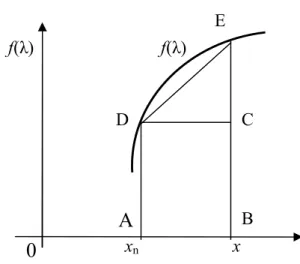
Dennis [1983] replaced the indefinite integral by the rectangle ABCD as shown in figure 1.2, i.e.,
), (
) ( ' )
(
'
nx
x
f d f x
nx x
n
…(1.3)
which results in the model given in equation (1.1). In this the area DCE is ignored.
1.2 A Variant of Newton’s Method
In this paper the authors have approximated the indefinite integral involved in equation (1.2) by the trapezium ABED as shown in figure 1.3, i.e.,
' ( ) ' ( ) . )
2 ( ) 1
(
' d x x f x f x
f
n nx
xn
…(1.4) Thus, the local modal is given by
Figure 1.1: Newton’s iterative step.
Figure 1.2: Approximating the area by the rectangle ABCD.
( ) )
(
nn
x f x
M
' ( ) ' ( ) . )
2 (
1 x x
nf x
n f x
…(1.5)
It is found that not only the model (equation (1.5)) and its derivative agree with the function f ( x )
and its derivative f ' ( x ),
respectively, but the second derivative of the model and the second derivative of the function are also agreeing at the current iterate
x
nx
(Fernando and Weerakoon [1997]). Even though the model for Newton’s method matches with the values of the slope f ' ( x
n)
of the function, it does not match with its curvature in terms of f '' ( x
n)
.
Figure 1.3: Approximating the area by the trapezoid ABCD.
The next iterative point as the root of the local model (equation (1.5)) is
, 0 ) (
n1
n
x
M
' ( ) ' ( ) 0 )
1 ( )
(
x x f x f x
x f
f(λ) f(λ)
A B
C D
E
x x
n0
f(λ) f(λ)
A B
C D
E
x x
n0
) . ( ' ) ( '
) ( 2
1 1
n n
n n
n
f x f x
x x f
x
…(1.6) This is an implicit scheme, which means
derivative of the function at the
n 1 )
th(
iterative step is used to calculate the
n 1 )
th(
iterate. This difficulty is overcome by using Newton’s method to
compute the
n 1 )
th(
iterate on the right-hand side.
Therefore, the resulting scheme is
' ( ) ' ( ) , 0 , 1 , 2 ,...
) ( 2
* 1
1
n
x f x f
x x f
x
n n
n n
n
…(1.7)
where
) . ( '
)
*
(
1
n n n
n
f x
x x f
x
…(1.8)
1.3 Convergence of Method
Let be a simple root of f ( x )
, i.e., f ( ) 0
and f ' ( ) 0
. Let approximate value of the root is given by x
n e
n, where e
nis the error. Using Taylor expansion f ( x
n)
can be written as:
) (
)
( x
nf e
nf
) ( )
! ( 3 ) 1
! ( 2 ) 1 ( )
( f
(1)e
nf
(2)e
n2f
(3)e
n3O e
n4f
( )
) (
) (
! 3
1 ) (
) (
! 2 ) 1
(
(1) 43 ) 3 (
) 1 (
2 ) 2 ( )
1 (
n n
n
n
O e
f
e f
f
e e f
f
( ) ,
)
(
2 2 3 3 4) 1 (
n n
n
n
C e C e O e
e
f
…(1.9)
where C
j ( 1 / j ! ) f
(j)( ) / f
(1)( ).
Similarly, using Taylor expansion,
) (
) (
(1)) 1 (
n
n
f e
x
f
1 2 3 ( ) .
)
(
2 3 2 3) 1 (
n n
n
C e O e
e C
f
…(1.10)
Dividing equation (1.9) by equation (1.10) and after some simplifications, one gets,
) (
) (
) 1 (
n n
x f
x f
), ( )
2 2
(
22 3 3 42
2 n n n
n
C e C C e O e
e
…(1.11)
Substituting the results from equation (1.11) in equation (1.8), one gets,
* 1
x n C
2e
n2 ( 2 C
3 2 C
22) e
3n O ( e
n4).
…(1.12)
This value of
* 1
x n
is used for the Taylor’s series expansion of * 1
) 1 (
x n
f as,
] ) ( ) ( ) ( )
2 2
( [
) ( )
(
*1 (1) 2 2 3 22 3 4 (2) 4) 1 (
n n
n n
n
f C e C C e O e f O e
x
f
1 2 4 ( ) ( ) .
)
(
22 2 2 3 22 3 4) 1 (
n n
n
C C C e O e
e C
f
…(1.13)
Adding equation (1.10) and equation (1.13),
( )
2 1 3
) ( 2 ) ( )
(
(1) * 1 (1) 2 22 3 2 3) 1 (
n n
n n
n
f x f C e C C e O e
x
f
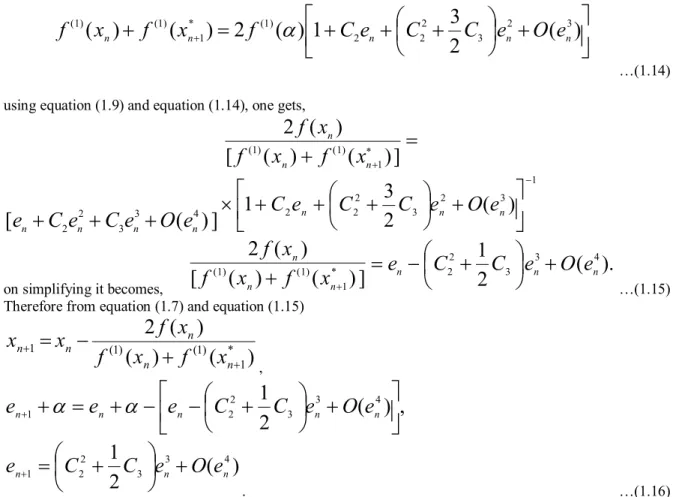
…(1.14) using equation (1.9) and equation (1.14), one gets,
(
) ] )
( [
) ( 2
1 ) 1 ( )
1 (
n n
n
x f x f
x f
] ) ( [ e
n C
2e
n2 C
3e
n3 O e
n41 3 2
3 2
2
2
( )
2 1 3
C e
nC C e
nO e
non simplifying it becomes, [ ( ) ( ) ] )
( 2
* 1 ) 1 ( )
1 (
n nn
x f x f
x
f ( ).
2
1
3 43 2
2 n n
n
C C e O e
e
…(1.15) Therefore from equation (1.7) and equation (1.15)
) ( )
(
) ( 2
* 1 ) 1 ( )
1 1 (
n n
n n
n
f x f x
x x f
x
,
, ) 2 (
1
3 43 2
2
1
n n n nn
e e C C e O e
e
) 2 (
1
3 43 2
2
1 n n
n
C C e O e
e