1. Introduction
In the past, sodium azide had been used as the main com- ponent of gas generating mixtures for automobile airbag inflators, but because it is highly toxic and harmful to dispose, fuel component has shifted from sodium azide to non-azide chemical compounds, and at present, mixtures of 5-amino-1H-tetrazole, CH
3N
5(5-ATZ) and oxidiz- ers have been commercialized. The authors have been searching for new tetrazole compounds that are superior to 5-ATZ
1). In this study, aminoguanidium 5,5’-azobis- tetrazolate, C
4H
14N
18(AGAT) which contains two tetrazole rings in one molecule and is expected to produce large amount of gas per unit mole, was selected as a fuel; and selecting copper(II) oxide, CuO as an oxidizer, the com- bustion characteristics of the mixtures were studied. CuO was selected as the oxidizer because its mixture is not legally an explosive in Japan unlike other oxidizers, such as perchlorates and nitrates
2).
In addition, the volume of generated gases per unit vol- ume is estimated to be 77.5 % of 5-ATZ / Sr(NO
3)
2mix- ture, and the residue is Cu.
Furthermore, AGAT has a self-decomposition property which may help combustion of the mixture. In this study, linear burning rate test, 4-liter closed vessel test, 60-liter tank test, and qualitative and quantitative analysis of com- bustion products were examined to study on the burning characteristics of the mixture. Comparing such character- istics of AGAT / CuO mixture with those of the already- commercialized 5-ATZ / Sr(NO
3)
2mixture and black powder (BP), the possibility of AGAT / CuO mixture as a potential gas generating mixture was examined.
2. Experimental 2.1 Samples
As a fuel component of the non-azide gas generat- ing mixture, AGAT which is commercially available as
“ABAG” (Toyo Kasei Kogyo Co., Ltd.) was used. This compound has drawn attention as a substitute for sodium azide which had been used as a nitrogen gas source for air- bag inflators. CuO (Kanto Chemical Co., Inc., Kanto extra pure grade reagent) was used as an oxidizer. The particle diameter of AGAT was controlled under 45 µm by using
Burning characteristics of the consolidated mixtures of aminoguanidium 5,5’-azobis-
tetrazolate and copper(II) oxide
Yasuyoshi Miyata, Kenji Morita, Kazuo Iwakuma, Masahiro Abe, Shingo Date, and Kazuo Hasue
†Department of Applied Chemistry, National Defense Academy, 1-10-20 Hashirimizu, Yokosuka, Kanagawa 239-8686, JAPAN
†
Corresponding address: [email protected]
Received : August 1, 2007 Accepted : November 27, 2007
Abstract
Experimental work was carried out in search for the potential of aminoguanidium 5,5’-azobis-tetrazolate (AGAT) / copper(II) oxide (CuO) mixtures as a gas generating mixture. Altering the fuel/oxidizer ratio, linear burning rate test, 4-liter closed vessel test, and 60-liter tank test were carried out to study on the burning characteristics of the mixtures. The quantitative and qualitative analysis of the combustion gases of a 4-liter closed vessel and a 60-liter tank were carried out, and the results were compared with those of 5-amino-1H-tetrazole (5-ATZ) / Sr(NO
3)
2mixture. The linear burning rate of AGAT / CuO mixtures reached its maximum when the mixture was AGAT rich. Internal pressure of the 4-liter closed vessel also reached its maximum when the mixture was fuel rich, but the combustion temperature reached its maximum at a stoichiometric ratio. In the 60-liter tank test, the maximum pressure of AGAT / CuO mixture was one third of the maximum pressure of 5-ATZ / Sr(NO
3)
2mixture. In the 4-liter closed vessel test, the hazardous gases such as CO, NO, NO
2, NH
3, HCN, and N
2O were found in combustion gases of AGAT / CuO mixture but the concentration of all measured hazardous gases were less than those of 5-ATZ / Sr(NO
3)
2, except for NH
3and NO
2. The results suggest the possibility of AGAT / CuO mixture as a novel gas generating mixture for automobile airbags and other uses.
Keywords : AGAT, CuO, Combustion, Gas generating mixture.
Research
paper
standard sieves. The mixtures were mixed at a designated mixing ratio for 30 minutes at 80 r.p.m. through a rotary mixer (Tsutsui Scientific Instruments Co., Ltd., S-3) and coated with 0.2 wt% polyvinyl alcohol (PVAc) (Kanto Chemical Co., Inc.). The mixtures were then dried through a vacuum dryer (Kuramochi Kagaku Co., Ltd., RG-501) at 333 K and 10 Pa for 24 hours. The 4 grams of mixture was then compressed at approximately 0.6 GPa for 5 min- utes to produce a rectangular strand (5 x 5 x 70 mm). The weight percentages of AGAT (x) were 20.85 (stoichiomet- ric ratio), 30.0, and 40.0 wt%.
2.2 Measurement of linear burning rate
All parts of the surface of a strand except for the top surface were applied with epoxy resin (Cemedine Co., Ltd., 1500), and with the use of a chimney-type strand burner with observation windows (Kyowa Giken Co., Ltd., SCTA-50), combustion test was performed under 1 - 4 MPa nitrogen atmosphere at 298 K. The igni- tion of the strand was carried out through a heated nichrome wire (diameter 0.6 mm). Pressure (p) was measured through a strain-gauge pressure transducer (Kyowa Electronic Instruments Co., Ltd., PG-100KU) and after amplification (Kyowa Electronic Instruments Co., Ltd., CDV-230C), it was recorded on a recorder (Keyence Co., Ltd., GR-3000). The testing apparatus is described elsewhere
3). The linear burning rate (r) was calculated from the duration of burning time by observing the pressure change inside the burner. The pressure started rising when the strand started burn- ing and the pressure rise stopped at the end of burning.
2.3 4-liter closed vessel test
The chimney-type strand burner had its orifice closed to act as a 4-liter closed vessel has been examined as a screening test before 60-liter tank test
4),5), and the pres- sure-time change was measured at the initial operational pressure of 2 MPa helium gas and at the initial tem- perature of 298 K. The procedures of the ignition of the strand and measurement of net pressure increase within the chamber (Dp
v) were the same as those of r measure- ment. The gas temperature in the vessel was obtained with K-type thermocouple (diameter 1 mm). The output of the thermocouples was recorded on a recorder (Keyence Co., Ltd., GR-3000).
2.4 60-liter tank test
Fifteen of 1 g cylindrical pellets, each pressed at approxi- mately 10 MPa for 1 minute, were installed in a simu- lated inflator which was mounted inside a 60-liter tank
4),6)
. After purging the atmosphere inside the tank with nitrogen gas, the pellets were ignited by using a primer (Nippon Kayaku Co., Ltd.) and 1 g of B / KNO
3igniter mixture (Nippon Koki Co., Ltd.). The initial tank tem- perature was 296 K. The internal pressure of the tank (p
T) was measured by a strain gauge pressure transducer (Kyowa Electronic Instruments Co., Ltd., PGM-10KC).
The temperature inside the tank (T
T) was measured by using a 50 µm K-type thermocouple. After amplification
(Kyowa Electronic Instruments Co., Ltd., CDV-230C), the data were recorded on a recorder (Keyence Co., Ltd., NR-2000).
2.5 Qualitative and quantitative analysis of combustion products
Solid residues that resulted from the burning of the strand were analyzed by using a wide angle X-ray diffractometer (XRD) (Mac Science Co., Ltd., M21-SRA) and the spec- trum was compared with those of standard samples for identification. Gaseous products (those of 4-liter closed vessel test and 60-liter tank test) were analyzed by a gas chromatography (GC) (Shimadzu Corp., GC-8A) and FT-IR gas analyzer (Temet Co., Ltd., DX-4000). In GC analysis, WG-100 (GL Science Co., Ltd.) was used as the column packing to analyze N
2, CO
2, and O
2gases. Using helium as the carrier gas at a flow rate of 40 ml min
-1, the column temperature and the injection temperature were 323 K. In the FT-IR analysis, helium was used as the carri- er gas and CO
2, CO, NO
2, NO, NH
3, CH
4, N
2O, and HCN were analyzed.
2.6 Chemical equilibrium calculation
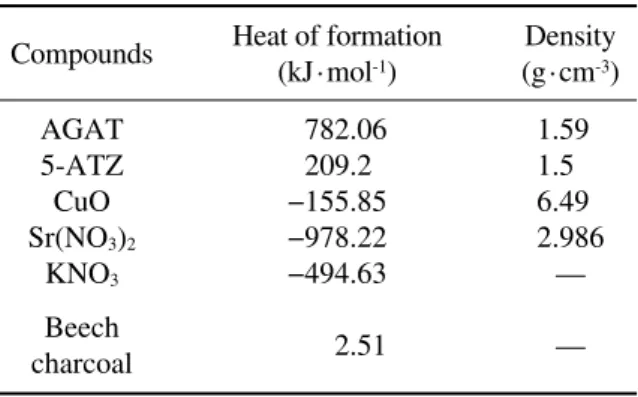
Table 1 shows the heat of formation of compounds that were used in the chemical equilibrium calculation
7)and density. The composition of BP was KNO
3/ C / S = 75 / 15 / 10
8)and beech charcoal was used as charcoal. The density of BP used for the calculation of the volume of generated gases per unit mass and the volume of generated gases per unit volume was assumed to be 1 g . cm
-3 9). 3. Results and discussions
3.1 Linear burning rate
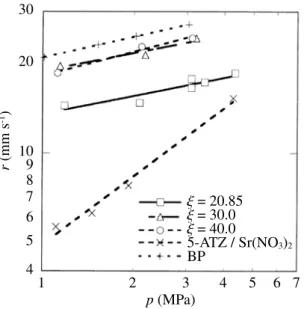
Observed r at various x is given in Fig. 1. r followed Vielle’s formula r = a . p
n, where a is a constant and n is the pressure exponent of r, showing an increase with an increase in p. The pressure exponent (n) was within the range of 0.20 ~ 0.27 and it was 0.21 for the stoichiometric mixture. In comparison with 5-ATZ / Sr(NO
3)
2mixture whose n varied within the range of 0.2 ~ 0.8
3), it was found that the variation of n was smaller and r was less affected by the change in p. Under 4 MPa, r of AGAT / CuO were larger than that of 5-ATZ / Sr(NO
3)
2.
It was found that r at x = 30.0 wt% and 40.0 wt% were slightly smaller than that of BP
10). BP is employed as one
Table 1 Compounds and their heat of formation and density.
Compounds AGAT 5-ATZ CuO Sr(NO
3)
2KNO
3Beech charcoal
Heat of formation (kJ.mol
-1)
782.06 209.2
−155.85
−978.22
−494.63 2.51
Density (g.cm
-3)
1.59 1.5 6.49 2.986
—
—
of the gas generating mixtures for a power cartridge
11). r were larger at AGAT rich composition (x = 30.0 wt%
and 40.0 wt%) as compared to the stoichiometric ratio (x = 20.85 wt%). This demonstrates that the combustion reactions do not proceed ideally. For the stoichiometric mixture, excess amount of oxygen was found as shown in Table 4, it is suggested that the decomposed products of AGAT escape from the reaction phase and the gas phase near the burning surface will be fuel-lean so that the stoi- chiometric reaction cannot take place and the amount of heat transfer from the gas phase to the solid phase was less than expected.
3.2 Amount of generated gases
Gas generating mixtures for automobile airbags need to release large amount of gas with small volume of sample in order to downsize the inflator.
Table 2 shows the calculated values of the amount of generated gases per unit mass and the amount of generated gases per unit volume by means of chemical equilibrium calculation
7). Here, H
2O is assumed to be in a liquid state and is not included in the calculation of the generated gases. If the amount of generated gases per unit mass is
large, it is possible to reduce the mass of an inflator. On the other hand, if the amount of generated gases per unit volume is large, it is possible to reduce the volume of the gas generating mixture and downsize the inflator.
As for the mixtures examined in this experiment, the amount of generated gases per unit mass of AGAT / CuO mixture was 57.5 % of the amount of gases generated per unit mass of 5-ATZ / Sr(NO
3)
2mixture, but the amount of generated gases per unit volume for AGAT / CuO mixture was 77.5 % of the amount of gases generated per unit vol- ume of 5-ATZ / Sr(NO
3)
2mixture.
Even though the volume of generated gases per unit mass for chemical stoichiometric ratio AGAT / CuO mixture was inferior to that of BP, the volume of generated gases per volume was approximately three times that of BP. In addition, the mixture has the advantage of not being cat- egorized as an explosive.
According to the chemical equilibrium calculation as shown in Fig. 2, the amount of combustion gases per unit mass of the mixture increases with an increase in x.
Although x was changed up to 40.0 wt% in this study, because it was found from preliminary experiments that AGAT could undergo self-combustion, a further increase Table 2 Theoretical amount of generated gases.
Samples
AGAT / CuO = 20.85 / 79.15 AGAT / CuO = 30.0 / 70.0 AGAT / CuO = 40.0 / 60.0 5ATZ / Sr(NO
3)
2= 36.5 / 63.5 KNO
3/ C / S = 75 / 15 / 10
Oxygen balance
(%)
0 8.83
18.48 0
16.74
Generated gases per mass
(mol.g
-1) 8.625×10
-315.30 ×10
-322.51 ×10
-315.01 ×10
-312.0 ×10
-3 12)*12.73 ×10
-3Generated gases per volume
(mol.cm
-3) 34.1×10
-351.6×10
-365.4×10
-344.0×10
-312.7×10
-3Generated
gases per mass (cm
3.g
-1)
211.0 374.3 550.8 367.2 311.5
*experimental result
Fig. 1 Linear burning rates of AGAT / CuO mixtures.
4 5 6 7 8 9 10 20 30
1
x = 20.85 x = 30.0 x = 40.0
5-ATZ / Sr(NO
3)
2BP
2 3 4 5 6 7
r (mm s
-1)
p (MPa)
Fig. 2 Relation between the amount of generated gases per mass and the weight content of AGAT for AGAT / CuO mixture.
1,200 1,000
x (wt%) 800
600 400 200
0 0 20 40 60 80 100
Amount of generated gases (c m
3g
-1)
in the amount of generated gases with an increase in x would be possible. Figure 3 shows the estimated quanti- ties of generated gases and liquid per 1 kg mixture. CO
2, N
2, CO, H
2, and liquid H
2O are main products. Liquid H
2O is included in the graph because H
2O may become vapor inside airbags in actual condition. It was found that an increase in the amount of generated gases is due to an increase in the total amount of N
2, H
2, and CH
4that are produced during the decomposition of AGAT.
3.3 4-liter closed vessel test
Figure 4 gives the schematic diagram for the result of closed vessel test. Dp
v- time (t) relation inside the closed vessel is shown in Fig. 5. The mixtures with AGAT rich content (x = 30.0 and 40.0 wt%) had the higher rate of pressure increase (Dp
vmax/ Dt
v, where Dt
vis the time dif- ference between ignition and the time when Dp
vmaxwas
observed and maximum pressure (Dp
vmax)) as compared to the stoichiometric mixture. Dp
vmax/ Dt
vincreases for high fuel content because of an increase in the volume of the generated gases (Table 2) and r (Fig. 1).
The net temperature rise inside the closed vessel (DT
v) is shown in Fig. 6. It was found that the maximum tempera- ture rise (DT
vmax) was the highest for the stoichiometric mixture.
Table 3 shows Dp
vmax, Dt
v, Dp
vmax/ Dt
v, and DT
vmax. For the stoichiometric mixture, Dp
vmaxand Dp
vmax/ Dt
vof AGAT / CuO were 0.20 MPa and 36 kPa . s
-1and those of 5-ATZ / Sr(NO
3)
2were 0.55 MPa and 60 kPa . s
-1, respec- tively. It was found that Dp
vmax/ Dt
vof AGAT / CuO was 60.0 % of 5-ATZ / Sr(NO
3)
2. On the other hand, DT
vmaxof 5-ATZ / Sr(NO
3)
2was 69 K and that of AGAT / CuO was 20 K. Dp
vmaxand DT
vof AGAT / CuO are about one third of 5-ATZ / Sr(NO
3)
2. However, the calculated volume of Fig. 3 Estimated quantities of generated gases and liquid
derived through chemical equilibrium calculation.
30 25
x (wt%) 20
15 10 5 0 0
CO
2H
2O (L) N
2CO H
2CH
420 40 60 80 100
Comb ustion products (mol kg
-1)
Fig. 4 Schematic diagram for the result of 4-liter closed vessel test.
Time (s) Dp
vmaxDt
vPressure (MP a)
Fig. 5 Comparison of pressure-time history of AGAT / CuO and 5-ATZ / Sr(NO
3)
2mixtures for 4-liter closed vessel test.
Time (s)
0 5 10 15 20
1.0 0.8 0.6 0.4 0.2 0.0 D p
v(MP a)
x = 40.0 x = 30.0
x = 20.85
x = 20.85 without rest.
5-ATZ / Sr(NO
3)
2Fig. 6 Comparison of temperature-time history of AGAT / CuO and 5-ATZ / Sr(NO
3)
2mixtures for 4-liter closed vessel test.
80 70
Time (s) 5-ATZ / Sr(NO
3)
2x = 20.85 without rest.
x = 20.85
x = 40.0 x = 30.0 60
50 40 30 20 10
0 0 5 10 15 20
D T
v(K)
generated gases per unit volume is 77.5 % of the volume of generated gases per unit volume of 5-ATZ / Sr(NO
3)
2, so the possibility of practical use for passenger side air bag which has less restrictions than a driver’s side cannot be excluded. It was found that the effect of restrictor on Dp
vmax/ Dt
v, Dp
vmax, and DT
vmaxwere negligible. In this study, the effect of restrictor is not considered on the basis on these results, unless otherwise mentioned.
According to the results of Table 3, the pressure gener- ated by AGAT / CuO mixture during the closed vessel test was 36.4 % of the pressure generated by 5-ATZ / Sr(NO
3)
2mixture. The observed result (36.4 %) was much smaller than 57.5 % obtained through the chemical equilibrium cal- culation. Since oxygen gas was detected as shown in Table 4, incomplete reaction took place, making the gas volume smaller and the gas temperature lower than expected.
3.4 60-liter tank test
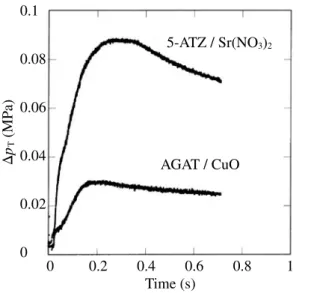
An example of typical pressure-time profiles within the 60-liter tank for AGAT / CuO / PVAc and 5-ATZ / Sr(NO
3)
2at stoichiometric ratio are shown in Fig. 7.
For AGAT / CuO / PVAc mixture, the maximum pres- sure inside the 60-liter tank (Dp
Tmax) was about 0.03 MPa at 0.15 s after ignition. As for 5-ATZ / Sr(NO
3)
2mixture, Dp
Tmaxwas 0.09 MPa at 0.22 s after ignition and the value
is approximately three times of AGAT / CuO.
Since gas generating mixture that contain CuO generates relatively small amount of gas per unit mass, it is neces- sary to use approximately three times the mass of 5-ATZ / Sr(NO
3)
2mixture to acquire equivalent amount of gas.
Figure 8 shows the temperature-time curves for 5-ATZ / Sr(NO
3)
2and AGAT / CuO / PVAc. The net maximum temperature (DT
Tmax) for 5-ATZ / Sr(NO
3)
2and AGAT / CuO / PVAc were 44 K and 10 K, respectively.
Since the mass / volume ratio of 60-liter tank is one forth of that of 4-liter closed vessel, it is suggested that the gas temperature inside 60-liter tank did not reach as high a value as that of 4-liter closed vessel, so that there was not much of an expansion of gas.
3.5 Combustion products
Tables 4 gives the results of combustion gases analysis through GC. It was found that although the combustion gases are largely nitrogen, sizable amount of oxygen remains unreacted. Since AGAT decomposes at 509 K
1)and CuO melts at 1299 K followed by the decomposition
13), there is a large temperature difference, causing the defi- ciency of AGAT because of its decomposition at relatively low temperature, so that oxygen gas generated through CuO may have been released unreacted out of the system.
Fig. 7 Pressure-time history of AGAT / CuO and 5-ATZ / Sr(NO
3)
2mixtures on the 60-liter tank test.
0.1 0.08
Time (s) 0.06
0.04 0.02
0 0
5-ATZ / Sr(NO
3)
2AGAT / CuO
0.2 0.4 0.6 0.8 1
D p
T(MP a)
Fig. 8 Temperature-time history of AGAT / CuO and 5-ATZ / Sr(NO
3)
2mixtures on the 60-liter tank test.
50 40
Time (s) 30
20 10 0 0
5-ATZ / Sr(NO
3)
2AGAT / CuO
0.2 0.4 0.6 0.8 1
D T
T(K)
Table 3 Results of 4-liter closed vessel test for each sample.
Samples
AGAT / CuO / PVAc = 20.85 / 79.15 / 0.2
+AGAT / CuO / PVAc = 20.85 / 79.15 / 0.2 AGAT / CuO / PVAc = 30.0 / 70.0 / 0.2
+AGAT / CuO / PVAc = 40.0 / 60.0 / 0.2
+5-ATZ / Sr(NO
3)
2= 36.5 / 63.5
+Dp
vmax(MPa) 0.20 0.19 0.27 0.29 0.55
Dp
vmax/Dt
v(MPa.s
-1) 0.036 0.036 0.100 0.104 0.060
DT
vmax(K) 20 19 25 20 69 Dt
v(s) 5.62 5.36 2.71 2.78 9.1
PVAc was added in excess of the chemical stoichiometric ratio AGAT mixture.
+
with restrictor.
For the stoichiometric mixture, it is suggested that the decomposed products of AGAT may have escaped from the reaction phase and the gas phase near the burning sur- face would be fuel-lean so that the stoichiometric reaction could not take place.
Table 5 gives the observed combustion gases by 4-liter closed vessel test at 298 K. Harmful gases such as CO, NO, NO
2, NH
3, HCN, and N
2O were found.
With regard to harmful gases in combustion gases, the mixtures would be considered to be fit for practical use if the measured values for these harmful gases are lower than those of 5-ATZ / Sr(NO
3)
2mixtures. The values have been measured after being diluted at 2 MPa helium in 4-liter closed vessel test.
Comparing the quantitative analysis results of harm- ful gases for stoichiometric ratio mixtures, mixtures that contain AGAT produces more NO
2, NH
3, and CH
4as com- pared to mixtures that contain 5-ATZ, but produces less CO, NO, HCN, and N
2O. The influence of whether or not the restrictor was applied to the strand was not obvious. It is believed that because dried epoxy resin remained with- out being burnt, there would be less influence on gas com- position.
The concentration of NH
3, HCN increased with the increase of AGAT content.
After the combustion test, a stoichiometric mixture strand
kept its original shape and no powder residue was found and the black color of CuO altered to copper color. An X-ray analysis of the solid combustion products shows that the main solid product was identified as Cu. It can be con- cluded that the elimination of the residue is not difficult.
Table 6 gives the observed combustion gases by 60-liter tank test for stoichiometric ratio of AGAT / CuO / PVAc and 5-ATZ / Sr(NO
3)
2mixture. Harmful HCN, NO, and N
2O were found for both mixtures. The numbers of harm- ful gases on 60-liter tank test were less than those of 4-liter closed vessel test. Probably because the igniter mixture was used to ignite the smaller pellets in 60-liter tank test, the ideal combustion was achieved in earlier stage. The concentration of HCN and N
2O for AGAT / CuO / PVAc mixture was higher than those of 5-ATZ / Sr(NO
3)
2mix- ture. In addition, since the mass / volume ratio of 60-liter tank is one forth of that of 4-liter closed vessel, the con- centration inside 60-liter tank becomes smaller.
4. Conclusions
In this study, gas generation behavior of AGAT / CuO mixtures was examined, and by comparing the behavior with that of 5-ATZ / Sr(NO
3)
2mixture that has been put into practical use, the possibility of AGAT / CuO mixtures as practical gas generating mixtures was examined. The conclusions are summarized as follows:
Table 4 Quantitative analysis results of combustion gases analyzed through GC during 4-liter closed vessel test.
Samples
AGAT / CuO / PVAc = 20.85 / 79.15 / 0.2
+AGAT / CuO / PVAc = 30.0 / 70.0 / 0.2
+AGAT / CuO / PVAc = 40.0 / 60.0 / 0.2
+N
275.4 75.0 76.0
O
223.2 23.6 22.7 CO
21.4 1.6 1.3
+
with restrictor.
(vol %)
Table 5 Quantitative analysis results of combustion gases analyzed through FT-IR method during 4-liter closed vessel test. The values were measured after being diluted at 2 MPa helium in 4-liter closed vessel.
Samples
Combustion gases
AGAT / CuO / PVAc = 20.85 / 79.15 AGAT / CuO / PVAc = 20.85 / 79.15 / 0.2
+AGAT / CuO / PVAc = 20.85 / 79.15 / 0.2 AGAT / CuO / PVAc = 30.0 / 70.0 / 0.2
+AGAT / CuO / PVAc = 40.0 / 60.0 / 0.2
+5-ATZ / Sr(NO
3)
2= 36.5 / 63.5
+NO (ppm)
0.0*
29 4.0 9.8 7.1 140
NO
2(ppm) 0.0282*
1.2 2.7 4.9 6.3 0.0 CO
(vol%) 0.015*
0.010 0.010 0.020 0.030 0.020
CH
4(ppm) 0.0*
150 97 410 200 7.5
N
2O (ppm)
0.1386*
0.0 1.3 0.0 0.070 4.7 HCN
(ppm) 0.0*
5.4 3.9 110 310 11 0.6046*
130 160 580 760 7.1
NH
3(ppm)
*The results of chemical equilibrium calculation.
+
with restrictor.
Table 6 Concentration of poisonous gases in combustion gases on 60-liter tank test of AGAT / CuO and 5-ATZ / Sr(NO
3)
2mixtures. The values were measured after being diluted in N
2.
Samples
Combustion gases
AGAT / CuO / PVAc = 20.85 / 79.15 / 0.2 5-ATZ / Sr(NO
3)
2= 36.5 / 63.5
NO (ppm)
11 90
NO
2(ppm) 0.0 0.0 CO
(vol%) 0.0 0.0
0.0 144
CH
4(ppm)
9.8 7.9 N
2O (ppm) HCN
(ppm) 58 32 0.0
0.0 NH
3(ppm)
(1) Linear burning rates followed Vieille’s law and they have maximum value at fuel-rich condition(30.0 and 40.0 wt% of AGAT).
(2) During 4-liter closed vessel test, stoichiometric ratio mix- ture achieved maximum burning temperature, but maxi- mum pressure was achieved in a fuel-rich condition.
(3) AGAT / CuO mixture showed 36.4 % in maximum pressure and 60 % in rate of pressure increase as com- pared to those of 5-ATZ / Sr(NO
3)
2mixture in 4-liter closed vessel test.
(4) In 4-liter closed vessel test, the main combustion gases of AGAT / CuO mixture were N
2, CO
2, and O
2, and although there were small concentration of harmful CO, NO
2, NO, N
2O, NH
3, and HCN. The concentrations of harmful gases were less than those of 5-ATZ / Sr(NO
3)
2mixture except NO
2and NH
3. In addition, Cu was iden- tified as the combustion residue.
(5) During 60-liter tank test, the maximum tank pressure achieved by AGAT / CuO mixture was approximately one third of 5-ATZ / Sr(NO
3)
2mixture.
(6) According to the chemical equilibrium calculation, it is possible to increase the amount of combustion gases by increasing the weight content of AGAT.
References
1) K. Iwakuma, Y. Miyata, S. Date, and K. Hasue, Sci. Tech.
Energetic Materials, 68, 95(2007).
2) Editorial Department of the Japanese Explosives Industry, Ippan-Kayakugaku (General Explosives Engineering), p. 8 (2007).
3) K. Hasue, P. Boonyarat, Y. Miyata, and J. Takagi, Kayaku Gakkaishi (Sci.Tech.Energetic Materials), 62, 168(2001).
4) S. Date, P. Boonyarat, T. Kazumi, and K. Hasue, ibid., 63, 209 (2002).
5) Y. Miyata, K. Baba, S. Date, and K. Hasue, Sci. Tech.
Energetic Materials, 65, 167(2004)
6) D. Ding, T. Kazumi, and K. Matsuda, ibid., 67, 28 (2006) 7) F. Volk and H. Bathelt,“User’s manual for the ICT-
Thermodynamic Code” (1998) Fraunhofer-Institut für Chemische Technologie, Pfinztal.
8) J. A. Conkling, “Chemistry of Pyrotechnics Basic Principles and Theory”, p. 2 (1985), Marcel Dekker, Inc. New York and Basel.
9) Editorial Department of the Japanese Explosives Industry, Ippan-Kayakugaku (General Explosives Engineering), p. 27 (2007).
10) J. A. Conkling, “Chemistry of Pyrotechnics Basic Principles and Theory”, pp. 114-115(1985), Marcel Dekker, Inc. New York and Basel.
11) Editorial Department of the Japanese Explosives Industry, Ippan-Kayakugaku (General Explosives Engineering), p. 116 (2007).
12) J. A. Conkling, “Chemistry of Pyrotechnics Basic Principles and Theory”, p. 33(1985), Marcel Dekker, Inc. New York and Basel.
13) B. T. Fedoroff and O. E. Sheffield, “Encyclopedia of Explosives and Related Items”, Vol. 3, p. c522(1966) Picatinny Arsenal.
アミノグアニジウム5,5 -アゾビステトラゾレイト/
酸化銅(II)混合物の燃焼特性
宮田泰好,森田健司,岩隈一生,阿部雅浩,伊達新吾,蓮江和夫†
法規上火薬類に属さないアミノグアニジウム5,5 -アゾビステトラゾレイト(AGAT)と酸化銅(II)混合物につ いてガス発生能力を調べた。本研究ではAGATと酸化銅(II)混合物について,組成比を変化させて,線燃焼速 度測定,4リットル密閉容器試験,燃焼生成物分析を行い,量論混合試料については,60リットルタンク試験,
燃焼生成物分析を行い5-アミノ-1H-テトラゾール(5-ATZ)と硝酸ストロンチウム混合物の結果と比較した。
AGATと酸化銅(II)混合物は燃料過剰で最大燃焼速度を示した。密閉容器試験では燃料過剰で最大圧力となっ たが,燃焼温度は量論混合物で最大となった。化学平衡計算によれば燃料量を増すことでガス量が増加するこ とがわかった。60リットルタンク試験ではAGAT混合物の燃焼圧力は5-ATZ混合物の約1/3であった。また,
密閉容器試験の燃焼生成気体は,有害な CO,NO,NO2,NH3,HCN,N2Oが同定されたが,NO2とNH3以外の濃 度は5-ATZ混合物より小さかった。
防衛大学校応用科学群応用化学科 〒239-8686 神奈川県横須賀市走水 1-10-20
†Corresponding address: [email protected]