
• 検索結果がありません。

Let k be a field, and let G be a group. We recall that the group ring k[G] is defined to be the free k-module with basis (g) g

N/A
N/A
Protected

Academic year: 2021

シェア "Let k be a field, and let G be a group. We recall that the group ring k[G] is defined to be the free k-module with basis (g) g"

Copied!
5
0
0

読み込み中.... (全文を見る)

全文

(1)

Let k be a field, and let G be a group. We recall that the group ring k[G] is defined to be the free k-module with basis (g) g

G and with multiplication given by the convolution product

( X

g

G

a g g) ∗ ( X

g

G

b g g) = X

g

G

( X

hk=g

a h b k )g.

A left k[G]-module V is also said to be a k-linear representation of G. It determines and is determined by the ring homomorphism

ρ: k[G] → End k (V ) defined by

ρ( X

g

G

a g g)(v) = ( X

g

G

a g g) · v.

In particular, this map assigns to every element g ∈ G the k-linear endomorphism ρ(g) : V → V of the k-vector space V , so, in this way, the elements of the (abstract) group G become represented by (concrete) endomorphisms of the vector space V , whence the name. In fact, the k-linear endomorphism ρ(g) : V → V is a k-linear automorphism with inverse ρ(g

1 ) : V → V .

We have proved Maschke’s theorem, which states that if the group G is finite and if its order is invertible in k, then the group ring k[G] is a semi-simple ring.

This implies that every finitely generated left k[G]-module is semi-simple.

Example 4.1. Let C n be a cyclic group of order n. Maschke’s theorem shows that the group ring C [C n ] is semi-simple, and we now determine its structure. We choose a generator g ∈ C n and a primitive nth root of unity ζ n ∈ C . For 0 6 k < n, we define the left C [C n ]-module C (ζ n k ) to be the sub- C -vector space of C generated by the family (ζ n jk ) 0

6

j<n with the left C [C n ]-module structure given by

(

n−1

X

j=0

a j g j ) · z =

n−1

X

j=0

a j ζ n jk z.

The left C [C n ]-module C (ζ n k ) is simple. For as a C -vector space, C (ζ n k ) = C , and therefore has no non-trivial proper submodules. Suppose that f : C (ζ n k ) → C (ζ n l ) is a C [C n ]-linear isomorphism. Then we have

ζ n k f (1) = f (ζ n k ) = f (g · 1) = g · f (1) = ζ n l f (1),

where the first and third equalities follows from C [C n ]-linearity. Since f (1) 6 = 0, we conclude that k = l. So the n simple left C [C n ]-modules C (ζ n k ), 0 6 k < n, are pairwise non-isomorphic, and therefore, Theorem 3.5 shows that the map

f :

n−1

M

k=0

C (ζ n k ) → C [C n ] that to w = (w k ) 0

6

k<n assigns z = f (w) = P

0

6

k<n w k e k , where e k =

n−1

X

j=0

ζ n

jk g j ∈ C [C n ],

is an isomorphism of left C [C n ]-modules. The ring End

C[Cn

] ( C (ζ n k )) is isomorphic to the field C for all 0 6 k < n.

16

(2)

Remark 4.2. The identification in Example 4.1 of the complex group ring C [C n ] is called the discrete Fourier transform and is of great practical importance.

Indeed, it is the foundation for the digital representation of various signals, including audio and video signals. Let us define a signal to be a function σ: R → C . We call σ(t) ∈ C the signal at time t ∈ R . 1 To digitally represent the signal in the time interval [0, 1), we choose some (large) sampling rate n and record the signal at the times t = j / n with 0 6 j < n. That is, we record the vector

z =

n−1

X

j=0

σ( j / n )g j ∈ C [C n ]

and think of this as an approximation of the signal in the time interval [0, 1). We wish to determine the unique vector

w = (w k ) 06k<n

n−1

M

k=0

C (ζ n k )

such that f ( w ) = z . We interpret the component w k as the contribution to the signal with frequency k / n . We think of w as a better representation of the signal than z; if we compress the signal before e.g. transmitting it or storing it, then we loose less essential information by compressing w instead of z. We let

e

0

k

n

1

M

l=0

C (ζ n l )

be the unique vector such that f (e

0

k ) = e k . So e

0

k has lth component δ kl ∈ C (ζ n l ), where we use Kronecker’s symbol. Now, the matrix P n ∈ M n ( C ) that represents

f :

n

1

M

k=0

C (ζ n k ) → C [C n ]

with respect to the basis ( e

0

k ) 0

6

k<n of the domain and the basis (g j ) 0

6

j<n of the codomain is given by

P n = (ζ n

jk ) 0

6

j,k<n ∈ M n ( C ).

So the coordinates x = (w k ) 06k<n of w with respect to the basis (e

0

k ) 06k<n and the coordinates y = (σ( j / n )) 0

6

j<n of z with respect to the basis (g j ) 0

6

j<n satisfy

y = P n x.

It is easy to give a formula for the inverse matrix of P n . Indeed, recall that if ζ d is a primitive dth root of unity, then

d

1

X

i=0

ζ d i =

( 1 if d = 1, 0 if d > 1.

Hence, the (i, k)th entry in the matrix P n

P n is

n

1

X

j=0

n

ij )

ζ n

jk =

n

1

X

j=0

ζ n ij ζ n

jk =

n

1

X

j=0

n i

k ) j =

( n if i = k, 0 if i 6 = k,

1 Traditionally, one calls the modulus |σ(t)| ∈ [0, ∞) and the argument arg(σ(t)) ∈ [0, 2π) for

the amplitude and the phase of the signal at time t, respectively.

(3)

since ζ n k−i is a primitive dth root of unity for some divisor d in n. So P n

P n = nI n , and since also P n P n

= nI n , we find that

P n

1 = 1

n P n

= 1

n (ζ n jk ) 06j,k<n .

A priori we need to calculate the n 2 complex numbers ζ n jk with 0 6 j, k < n to determine the matrix P n and its inverse. However, if n = 2 m is a power of 2, then P n can be calculated much more effectively. So let n = 2r, let T n be the permutation matrix, whose first r columns are the odd columns of I n , and whose last r columns are the even columns of I n , and let D r be the diagonal matrix

D r = diag(1, ζ n

−1

, ζ n

−2

, . . . , ζ n

−(r−1)

).

Then, as first noted by Gauss in 1805 and, independently, by Cooley and Tukey in 1965, one has the matrix identity

P n =

I r D r

I r − D r

P r O O P r

T n ,

which greatly reduces the amount of calculation necessary to determine P n . The algorithm for calculating P n for n = 2 m based on this matrix identity is called the fast Fourier transform 2 and is one of the most important algorithms in terms of its myriad applications. So starting from P 1 = 1

, we find e.g.

P 2 =

1 1 1 − 1

1 0 0 1

1 0 0 1

=

1 1 1 − 1

P 4 =

1 0 1 0

0 1 0 − i

1 0 − 1 0

0 1 0 i

1 1 0 0

1 − 1 0 0

0 0 1 1

0 0 1 − 1

1 0 0 0

0 0 1 0

0 1 0 0

0 0 0 1

=

1 1 1 1

1 − i − 1 i 1 − 1 1 − 1 1 i − 1 − i

 .

We leave it as an exercise to the reader to verify the matrix identity in general.

Example 4.3. Let us also determine the real group ring R [C n ], where C n is a cyclic group of order n. We again fix a generator g ∈ C n and a primitive nth root of unity ζ n ∈ C . For 0 6 k < n, we define the left R [C n ]-module R (ζ n k ) to be the sub- R -vector space R (ζ n k ) ⊂ C generated by the family of complex numbers (ζ n jk ) 0

6

j<n and with the left R [C n ]-module structure given by

(

n

1

X

j=0

a j g j ) · z =

n

1

X

j=0

a j ζ n jk z.

The left R [C n ]-module R (ζ n k ) is simple. Indeed, if z, z

0

∈ R (ζ n k ) are two non-zero elements, then there exists ω ∈ R [C n ] with ω · z = z

0

. The dimension of R (ζ n k ) as

2 The time required to compute P

n

by means of FFT is O(n log n).

(4)

an R -vector space is

dim

R

( R (ζ n k )) =

( 1 if ζ n k ∈ R , 2 if ζ n k ∈ / R ,

and the left R [C n ]-modules R (ζ n k ) and R (ζ n l ) are isomorphic if and only if the complex numbers ζ n k and ζ n l are conjugate. Hence, by counting dimensions, we conclude from Theorem 3.5 that, as a left R [C n ]-module,

R [C n ] =

bn/2c
M

k=0

R (ζ n k ),

where b x c is the largest integer less than or equal to x. For example, R [C 3 ] = R (ζ 3 0 ) ⊕ R (ζ 3 1 ),

R [C 4 ] = R (ζ 4 0 ) ⊕ R (ζ 4 1 ) ⊕ R (ζ 4 2 ).

In general, for n = 2r even, the 1-dimensional representation R (ζ n r ) = R ( − 1) is called the sign representation, since the left R [C n ]-module structure is given by

(

n

1

X

j=0

a j g j ) · x =

n

1

X

j=0

a j ( − 1) j x.

Finally, the endomorphism ring End

R[Cn

] ( R (ζ n k )) is isomorphic to R , if k = 0 or if n = 2r and k = r, and is isomorphic to C , otherwise.

Remark 4.4. Representations of groups are also important in chemistry and physics. To wit, if a molecule has finite symmetry group G, then its wave function must be a representation of G on the Hilbert space h = N

a h a , where the tensor product ranges over the atoms in the molecule, where the wave function of atom a is a vector in h a , and where G acts on the tensor product by permuting the tensor factors. In this way, the representation theory of finite groups determines the relative likelihood of the outcome of chemical reactions.

In the standard model of elementary particle physics, the elementary particles in the three generations (up-down, strange-charmed, top-bottom) of elementary particles correpond to simple representations of the group

G = U (1) × SU (2) × SU (3).

This group is not finite, but it has a natural topology with respect to which it is compact. In fact, the topological space G has the structure of a compact smooth manifold, and the maps µ: G × G → G and ι : G → G given by multiplication and inversion in the group G, respectively, are smooth maps. We say that G is a Lie group. If V is a finite dimensional C -vector space, then Aut

C

(V ) also has a canonical Lie group structure, and by a representation of G on V we mean a map

ρ: G → Aut

C

(V )

that is both smooth and a group homomorphism. We let SU (5) ⊂ M 5 ( C ) act on C 5 = M 5,1 ( C ) by matrix multiplication. This defines a simple representation of SU (5) that we call the standard representation. By functoriality, we obtain an induced action by the group SU (5) on the exterior algebra

Λ

C

( C 5 ) = M

0

6

j

6

5

Λ j

C

( C 5 ),

(5)

20

and this again is a representation of SU (5). In fact, each exterior power Λ j

C

( C 5 ) is simple as an SU (5)-representation. We now consider the map

f : G = U (1) × SU (2) × SU (3) → SU(5) given by

f (α, A, B) =

α 3 A 0 0 α

2 B

,

which is both smooth and a group homomorphism. 3 Therefore, we can let G act on Λ

C

( C 5 ) by defining g · ω to be f (g) · ω. As a G-representation, the exterior powers Λ j

C

( C 5 ) with 0 < j < 5 are no longer simple, but decompose as direct sums of simple representations. It turns out that the simple G-representations that appear in this decomposition of the G-representation Λ

C

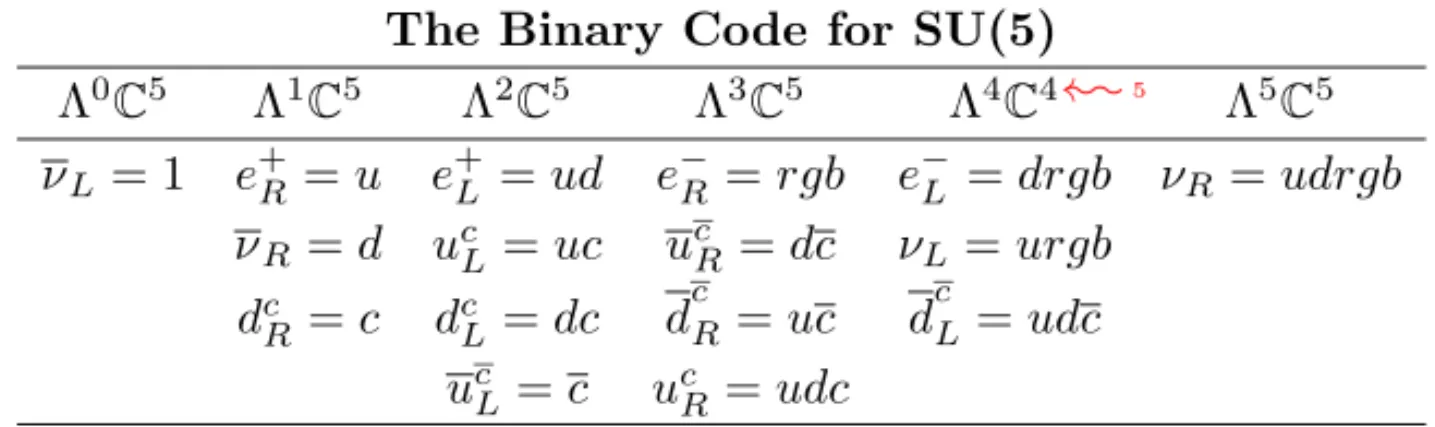
( C 5 ) precisely enumerate the elementary fermions observed in nature; see the figure below, which is taken from [1]. This is a purely phenomenological fact; nobody understands the reason why this is so! In the figure, the basis of C 5 is (u, d, r, g, b), which stands for up, down, red, green, and blue. For example, rgb, which corresponds to the right-handed electron e

R , is an abbreviations for r ∧ g ∧ b. The 1-dimensional subspace of Λ 3

C

( C 5 ) generated by (r ∧ g ∧ b) is a simple G-representation. Similarly, the 3-dimensional subspace of Λ 2

C

( C 5 ) generated by (d ∧ r, d ∧ g, d ∧ b) is a simple G-representation, which corresponds to the left-handed down-quark d c L . The left-handed electron e

L and the left-handed neutrino ν L form the basis (d ∧ r ∧ g ∧ b, u ∧ r ∧ g ∧ b) of a simple 2-dimensional representation of Λ 4

C

( C 5 ). Accordingly, these two particles are rather two states of a single particle. Finally, the left-handed anti-neutrino ¯ ν L and the right-handed neutrino ν R correspond to the simple 1-dimensional G-representations Λ 0

C

( C 5 ) and Λ 5

C

( C 5 ), respectively. Both of these representations are trivial, which, in physics, means that ¯ ν L and ν R do not interact through any of the three forces (electro-magnetic, weak, strong) described by the standard model. In fact, it is not known whether or not ¯ ν L and ν R exist.

isospin and one color. We must have u c L = u ∧ c and d c L = d ∧ c, where again c runs over all the colors r, g, b. Now for the tricky part: the u L quarks live in the Λ 2 C 3 representation of SU(3), but this is isomorphic to the fundamental representation of SU(3) on C 3 , which is spanned by antired, antired and antiblue:

r = g ∧ b, g = b ∧ r, b = r ∧ g.

These vectors form the basis of Λ 2 C 3 that is dual to r, g, and b under Hodge duality in Λ C 3 . So we must have

u c L = c,

where c can be any anticolor. Take heed of the fact that c is grade 2, even though it may look like grade 1.

To work out the other grades, note that Hodge duality corresponds to switching 0’s and 1’s in our binary code. For instance, the dual of 01101 is 10010: or written in terms of basis vectors, the dual of d ∧ r ∧ b is u ∧ g. Thus given the binary codes for the first few exterior powers:

Λ 0 C 5 Λ 1 C 5 Λ 2 C 5 ν L = 1 e + R = u e + L = u ∧ d

ν R = d u c L = u ∧ c d c R = c d c L = d ∧ c

u c L = c taking Hodge duals gives the binary codes for the rest:

Λ 3 C 5 Λ 4 C 4 Λ 5 C 5

e R = r ∧ g ∧ b e L = d ∧ r ∧ g ∧ b ν R = u ∧ d ∧ r ∧ g ∧ b u c R = d ∧ c ν L = u ∧ r ∧ g ∧ b

d c R = u ∧ c d c L = u ∧ d ∧ c u c R = u ∧ d ∧ c

Putting these together, we get the binary code for every particle and antiparticle in the first generation of fermions. To save space, let us omit the wedge product symbols:

Table 4. Binary code for first-generation fermions, where c = r, g, b and c = gb, br, rg

The Binary Code for SU(5)

Λ 0 C 5 Λ 1 C 5 Λ 2 C 5 Λ 3 C 5 Λ 4 C 4 Λ 5 C 5 ν L = 1 e + R = u e + L = ud e R = rgb e L = drgb ν R = udrgb

ν R = d u c L = uc u c R = dc ν L = urgb d c R = c d c L = dc d c R = uc d c L = udc

u c L = c u c R = udc

Now we can see a good, though not decisive, reason to choose Λ 0 C 5 ∼ = ν L . With this choice, and not the other, we get left-handed particles in the even grades, and

oo

5

References

[1] J. Baez and J. Huerta, The algebra of grand unified theories, Bull. Amer. Math. Soc. 47 (2010), 483–552.

3 The map f : G → SU(5) is not quite injective; its kernel is a cyclic group of order 6.

Table 4. Binary code for first-generation fermions, where c = r, g, b and c = gb, br, rg

参照

関連したドキュメント

As with M¨ obius groups, we define the limit set L(G) of the convergence group G to be the set of all limit points of those sequences { f n } converging in the sense of (ii)..

Thus as a corollary, we get that if D is a finite dimensional division algebra over an algebraic number field K and G = SL 1,D , then the normal subgroup structure of G(K) is given

We shall always assume that the commutative algebra A is finitely generated over the ring k, with rational action of a Chevalley group scheme G. Further, M will be a noetherian

Let X be an admissible Riemannian complex and G be a finitely generated group with with polynomial volume growth such that X/G = Y is a finite polytopal complex satisfying

In this paper the classes of groups we will be interested in are the following three: groups of the form F k o α Z for F k a free group of finite rank k and α an automorphism of F k

In analogy with Aubin’s theorem for manifolds with quasi-positive Ricci curvature one can use the Ricci flow to show that any manifold with quasi-positive scalar curvature or

Similarly, for any affine algebraic group scheme G over a field, with representation category G-Rep, the exterior power operations endow the representation ring K(G-Rep) with

We study the theory of representations of a 2-group G in Baez-Crans 2- vector spaces over a field k of arbitrary characteristic, and the corresponding 2-vector spaces of