
Introduction to
Nuclear Engineering
Kenichi Ishikawa (
石川顕一)
http://ishiken.free.fr/english/lecture.html
[email protected]
Course material downloadable from:
http://ishiken.free.fr/english/lecture.html References
•
Basdevant, Rich, and Spiro, “Fundamentals in Nuclear Physics” (Springer, 2005)•
Krane, “Introductory Nuclear Physics” (Wiley, 1987)•
八木浩輔「原子核物理学」(朝倉書店, 1971)•
石川顕一、高橋浩之「工学教程『原子核工学II』」(丸善、準備中)Nuclear Physics
• basic properties of nuclei
• nuclear reactions
• nuclear decays
Basic properties of
nuclei
A nucleus is made up of protons and neutrons
charge mass (kg) mass energy
(MeV)
proton (p)
+ e
1.67493 10-27 938.272neutron (n)
0
1.67262 10-27 939.565electron (e-)
- e
9.109 10-31 0.511×1840
×1.0014
e = 1.6022 ⇥ 10
19C
E = mc
2MeV = 10
6eV eV = 1.6022 ⇥ 10
19J
nucleon: proton, neutron
by atomic number and mass number
Z : atomic number = number of protons
A Z X N : number of neutrons A = Z + N : mass number
example
235 92 U or simply 235 U “uranium-235”
N = 235 - 92 = 143
nuclear binding energy and mass defect
mass defect
proton
mass neutron
mass nuclear mass
M = Zm
p+ N m
nm
N> 0
binding energy B = M c
2= (Zm
p+ N m
nm
N)c
2~ 8 MeV
8 6 4 2 0
B/A (MeV)
250 200
150 100
50 0
stable unstable
max 8.7945 MeV @
62Ni
binding energy
per nucleon
Nuclear reactions
Nuclear reactions
free particle (photon, electron, positron, neutron, proton, …)
scattering
nuclear reactions
α +
14N →
17O + p (Rutherford, 1919)
p +
7Li →
4He + α (Cockcroft and Walton, 1930)
projectile
target
a + X → Y + b X(a,b)Y
projectile target
example
Energetics
エネルギー論m
Xc
2+ T
X+ m
ac
2+ T
a= m
Yc
2+ T
Y+ m
bc
2+ T
ba + X → Y + b
rest mass kinetic energy
reaction Q value Q = (m
initialm
final)c
2= (m
X+ m
am
Ym
b)c
2= T
Y+ T
bT
XT
aexcess kinetic energy
Q > 0 : exothermic
発熱反応Q < 0 : endothermic
吸熱反応235
U + n ! X + Y + (2 ⇠ 3) n
example
235U + n !
144Ba +
89Kr + 3n + 177 MeV
Important nuclear reactions for thermal energy generation
Fission
(核分裂)Fusion
(核融合)D + T !
4He (3.5 MeV) + n (14.1 MeV) D + D ! T (1.01 MeV) + p (3.02 MeV)
!
3He (0.82 MeV) + n (2.45 MeV) D +
3He !
4He (3.6 MeV) + p (14.7 MeV)
> 10 6 times more efficient than chemical reactions!
Nuclei for fission reactors
• 233 U, 235 U, 239 Pu (fissile materials)
→ fission by thermal neutron capture
• Fission of 235 U produces ~2.5 neutrons
• 238 U, 232 Th (fertile materials) change to
239 Pu, 232 Th by neutron capture
→ fast breeder reactor
3.1 Cross-sections 109
L
dz
.
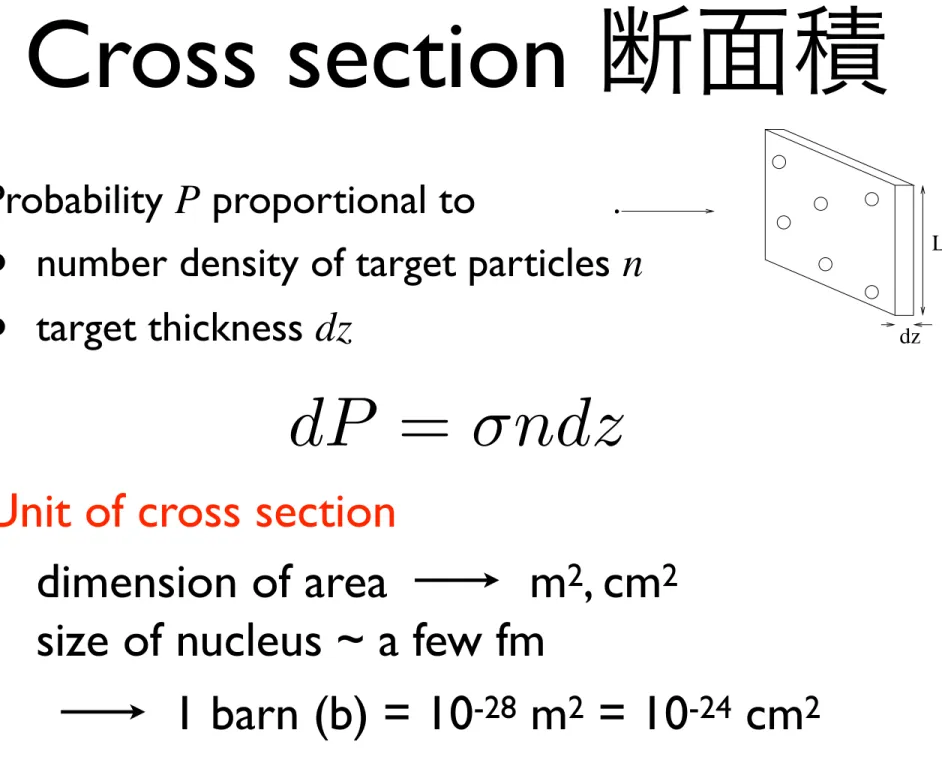
Fig. 3.1.A small particle incident on a slice of matter containingN= 6 target spheres of radiusR. If the point of impact on the slice is random, the probability dP of it hitting a target particle is dP=NπR2/L2=σndzwhere the number density of scatterers isn=N/(L2dz) and the cross section per sphere isσ=πR2. a probability dPof hitting one of the spheres that is equal to the fraction of the surface area covered by a sphere
dP = NπR2
L2 = σndz σ = πR2. (3.4)
In the second form, we have multiplied and divided by the slice thickness dz and introduced the number density of spheresn=N/(L2dz). The “cross- section” for touching a sphere,σ=πR2, has dimensions of “area/sphere.”
While the cross-section was introduced here as a classical area, it can be used to define a probability dPrfor any type of reaction, r, as long as the probability is proportional to the number density of target particles and to the target thickness:
dPr = σrndz . (3.5)
The constant of proportionalityσrclearly has the dimension of area/particle and is called the cross-section for the reaction r.
If the material contains different types of objectsiof number density and cross-sectionniandσi, then the probability to interact is just the sum of the probabilities on each type:
dP = !
i
niσi (3.6)
Probability P proportional to
• number density of target particles n
• target thickness dz
Unit of cross section
dimension of area m 2 , cm 2 size of nucleus ~ a few fm
1 barn (b) = 10 -28 m 2 = 10 -24 cm 2
dP = ndz
Cross section 断面積
Differential cross section
angular dependence (
角度依存性を考える)
targetdetector d Probability that the incident particle is scattered to a solid angle d
differential cross section (微分断面積)
= d d
d =
20
d
0
d
d ( , ) sin d dP
,= d
d ndzd
for isotropic scattering (等方散乱)
d
d = 4
total cross section
Mean free path and reaction rate
平均自由行程3.1 Cross-sections 109L
dz
.
Fig. 3.1.A small particle incident on a slice of matter containingN= 6 target spheres of radiusR. If the point of impact on the slice is random, the probability dP of it hitting a target particle is dP =NπR2/L2 =σndzwhere the number density of scatterers isn=N/(L2dz) and the cross section per sphere isσ=πR2. a probability dP of hitting one of the spheres that is equal to the fraction of the surface area covered by a sphere
dP = NπR2
L2 = σndz σ = πR2. (3.4)
In the second form, we have multiplied and divided by the slice thickness dz and introduced the number density of spheresn=N/(L2dz). The “cross- section” for touching a sphere,σ=πR2, has dimensions of “area/sphere.”
While the cross-section was introduced here as a classical area, it can be used to define a probability dPrfor any type of reaction, r, as long as the probability is proportional to the number density of target particles and to the target thickness:
dPr = σrndz . (3.5)
The constant of proportionalityσrclearly has the dimension of area/particle and is called the cross-section for the reaction r.
If the material contains different types of objectsiof number density and cross-sectionniandσi, then the probability to interact is just the sum of the probabilities on each type:
dP = !
i
niσi (3.6)
flux F
dF = F ndzdF
dz = F n
F(z) = F(0)e nz = F(0)e z
macroscopic cross section (マクロ断面積) = n [1/length]
1.0
0.8
0.6
0.4
0.2
0.0
F(z)/F(0)
z
1/e = 0.368
1/ n
mean free path also distribution
of free path if there are different types of
target objects (nuclei)
l = 1/ n
l = 1/
i
i
n
ireaction rate
反応速度
v
l = n v
General characteristics of cross-sections
Elastic scattering
弾性散乱The internal states of the projectile and target (scatterer) do not change before and after the scattering.
• Rutherford scattering, (n,n), (p,p), etc.
Inelastic scattering
非弾性散乱• (n,γ), (p,γ), (n,α), (n,p), (n,d), (n,t), etc.
• fission, fusion
Elastic neutron scattering
• relevant to (neutron) moderator in nuclear reactors
• due to the short-range strong interaction
中性子減速材
10-1 100 101 102 103 104
Cross section (barn)
10-5 10-3 10-1 101 103 105 107
Energy (eV) 1H(n,n) 2H(n,n) 6Li(n,n)
JENDL flat region
el 20 b (2fm)2 0.1 b range of the strong
interaction
(p2/2mn > 200 MeV) p > h/r
resonance
10-1 100 101 102 103 104
Cross section (barn)
10-5 10-3 10-1 101 103 105 107
Energy (eV) 1H(n,n) 2H(n,n) 6Li(n,n)
JENDL
resonance
共鳴The energy levels of 7Li and two dissociated states n-6Li and 3H-4He (t-α)
n + 6 Li → 7 Li * → n + 6 Li
10 9 8 7 6 5 4 3 2 1 0
Energy (MeV)
10 8
6 4
2 0
0.478 7.47 6.54
4.63 9.6
2.466 7.253
0
3H +4He
7Li n + 6Li
Nuclear data libraries
• ENDF (Evaluated Nuclear Data File, USA)
• JENDL (Japanese Evaluated Nuclear Data Library, Japan)
• JEFF (Joint Evaluated Fission and Fusion file, Europe)
•
CENDL (Chinese Evaluated Nuclear Data Library, China)•
ROSFOND (Russia)•
BROND (Russia)http://www-nds.iaea.org/exfor/endf.htm
Neutron capture
• Radiative capture
• emits a gamma ray
•
113Cd(n,γ)
114Cd ← neutron shield
• Other neutron capture reactions
•
10B(n,α)
7Li,
3He(n,p)
3H,
6Li(n,t)
4He
• Applications: neutron detector, shield, neutron neutron binding energy = ca. 8 MeV
exothermic reaction in most cases
発熱反応放射捕獲(放射性捕獲)
Highly excited states formed, which subsequently decay.
A
X(n,γ)
A+1X
activation
放射化neutron radiative capture
放射捕獲(放射性捕獲)10-6 10-5 10-4 10-3 10-2 10-1 100 101
Cross section (barn)
10-5 10-3 10-1 101 103 105 107
Energy (eV) 1H(n,gamma)
2H(n,gamma) 6Li(n,gamma)
JENDL
JENDL ENDF
discrepancy between JENDL and ENDF
E
1/21/v
1/v law Energy-independent reaction rate v
No threshold ← exothermic, no Coulomb barrier
with large cross section
• 113 Cd(n,γ) 114 Cd : shield
• 157 Gd(n,γ) 158 Gd : neutron absorber in nuclear fuel, cancer therapy
• 10 B(n,α) 7 Li : detector, cancer therapy
• 3 He(n,p) 3 H : detector
• 6 Li(n,t) 4 He : shield, filter, detector
Applications
• BF
3proportional counter
• Boron neutron capture therapy (BNCT) for cancer
10-1 100 101 102 103 104 105
Cross section (barn)
10-5 10-3 10-1 101 103 105 107
Energy (eV) 10B(n,alpha)7Li
JENDL
1/v law
10 B(n,α) 7 Li
3
He(n,p)
3H
• Helium-3 proportional counter
• Excitation and break-up (dissociation) through photo-absorption
•
Analog of the photoelectric effectthreshold (2.22 MeV) = binding energy of 2H
2.5x10⁻³
2.0
1.5
1.0
0.5
0.0
Cross section (barn)
30 25
20 15
10 5
0
Energy (MeV)
2H(gamma,n)1H
0.7
0.6
0.5
0.4
0.3
0.2
0.1
0.0
Cross section (barn)
30 25
20 15
10 5
0
Energy (MeV)
208Pb(gamma,n)207Pb
2 H 208 Pb
giant resonance 巨大共鳴
Resonance
共鳴6 Li
10-4 10-3 10-2 10-1 100 101 102 103 104
Cross section (barn)
10-5 10-3 10-1 101 103 105 107
Energy (eV)
(n,gamma) (n,n)
(n,t)
(n,p)
JENDL
resonance共鳴
1/v law 162 3. Nuclear reactions
10 elastic
elastic (x10)
(n 4) (n,γ)(/100)
(n,fission) (/10
10
2 3
E (eV)
,γ) (/10 10−2
1 102
235U
238U
1 10 10 10
−4
−2
−4 5)
10
cross−section (barn)
1
2
10
Fig. 3.26.The elastic and inelastic neutron cross-sections on235U (top) and238U (bottom). The peaks correspond to excited states of236U and239U. The excited states can contribute to the elastic cross-sections by decaying through neutron
Many excited states for heavy nuclei complicated resonance structure
重い核には多くの励起状態
複雑なエネルギー依存性
Excited states of 239U
10 9 8 7 6 5 4 3 2 1 0
Energy (MeV)
10 8
6 4
2 0
0.478 7.47 6.54
4.63 9.6
2.466 7.253
0
3H +4He
7Li n + 6Li
24
(E) A
(E E
0)
2+ ( /2)
2-3 -2 -1 1 2 3
0.5 1.0 1.5 2.0
Lorentzian ローレンツ関数 E
full width at half maximum (FWHM)
半値全幅
long tail
Resonance
natural width homogeneous width
: 自然幅 Life time = /
Decay rate 1 = /
ドップラー幅 inhomogeneous width
-3 -2 -1 1 2 3
0.2 0.4 0.6 0.8 1.0
Doppler effect
ドップラー効果
Nuclear decays
Introduction to Nuclear Engineering (Kenichi ISHIKAWA) for internal use only (Univ. of Tokyo)
Decay rate, natural width
probability to decay in an interval dt
dP = dt
= dt
mean life time
平均寿命decay rate 壊変(崩壊)速度
N (t) = N (t = 0)e
t/An unstable particle has an energy uncertainty or “natural width”
number of unstable nuclei
6.58 10
22MeV sec
自然幅 壊変(崩壊)速度
The mean survival time is τ, justifying its name.
The inverse of the mean lifetime is the “decay rate”
λ = 1
τ . (4.4)
We saw in Sect. 3.5 that an unstable particle (or more precisely an un- stable quantum state) has a rest energy uncertainty or “width” of
Γ = ¯hλ = ¯h
τ = 6.58 × 10⁻²² MeV sec
τ . (4.5)
Since nuclear states are typically separated by energies in the MeV range, the width is small compared to state separations if the lifetime is greater than ∼ 10−22 sec. This is generally the case for states decaying through the weak or electromagnetic interactions. For decays involving the dissociation of a nucleus, the width can be quite large. Examples are the excited states of 7Li (Fig. 3.5) that decay via neutron emission or dissociation into 3H4He.
From the cross-section shown in Fig. 3.4, we see that the fourth excited state (7.459 MeV) has a decay width of Γ ∼ 100 keV.
It is often the case that an unstable state has more than one “decay channel,” each channel k having its own “branching ratio” Bk. For example the fourth excited state of 7Li has
Bn6Li = 0.72 B3H4He = 0.28 Bγ7Li ∼ 0.0 , (4.6) where the third mode is the unlikely radiative decay to the ground state. In general we have
!
k
Bk = 1 , (4.7)
the sum of the “partial decay rates,” λk = Bkλ
!
k
λk = λ , (4.8)
and the sum of the “partial widths,” Γk = BkΓ
!
k
Γk = Γ . (4.9)
4.1.2 Measurement of decay rates
Lifetimes of observed nuclear transitions range from ∼ 10−22 sec
7Li (7.459 MeV) → n6Li, 3H4He τ = 6× 10⁻²¹ sec (4.10) to 102176yrGe 76Se 2e 2¯e t1/2 = 1.78 1021 yr
half life
半減期t
1/2= (ln 2) = 0.693
> 1011 × (age of universe) !
Decay diagram
壊変図half life
半減期
branching ratio
分岐比
alpha decay
A Z X ! A Z 4 2 Y + ↵
=
42He
238
U !
234Th + ↵ (4.2 MeV)
example
half life = 4.468×10
9years
beta decay
decay
+
decay
dating
年代測定half life = 5730 years
AZ
N
AZ+1N + e + ¯
eAZ
N
AZ 1N + e
++
eIntroduction to Nuclear Engineering (Kenichi ISHIKAWA) for internal use only (Univ. of Tokyo)
Emitted electron (positron) energy has a broad distribution
binations of initial Ji and final Jf spins are possible. The Fermi term will vanishes if the angular dependences of the initial and final wavefunctions are orthogonal so we require
Fermi : Ji = Jf . (4.90)
The Gamow–Teller term can change the spin but vanishes if the initial and final angular momenta are zero:
GT : Ji = Jf, Jf ± 1 Ji = Jf = 0 forbidden . (4.91) Additionally, in both cases, the parity of the initial and final nuclei must be the same. Transitions that respect the selection rules are called “Allowed”
decays. “Forbidden” decays are possible only if one takes into account the spatial dependence of the lepton wavefunctions, i.e. using (4.83) instead of (4.84) The examples of forbidden decays in Fig. 4.12 illustrate the much longer lifetimes for such transitions.
β _ β +
p (MeV/c) p (MeV/c)
0.2 0.6 1.0 1.4 1.8 0.2 0.6 1.0 1.4 1.8
Fig. 4.14. The β− and β+ spectra of 64Cu [44]. The suppression the of the β+ spectrum and enhancement of the β− at low energy due to the Coulomb effect is seen.
64 Cu
64 Cu
31
beta decay
The existence of the neutrino was predicted by Wolfgang Pauli in 1930 to explain how beta decay could conserve energy, momentum, and angular momentum.
decay
+
decay
dating
年代測定half life = 5730 years
AZ
N
AZ+1N + e + ¯
eAZ
N
AZ 1N + e
++
ePauli
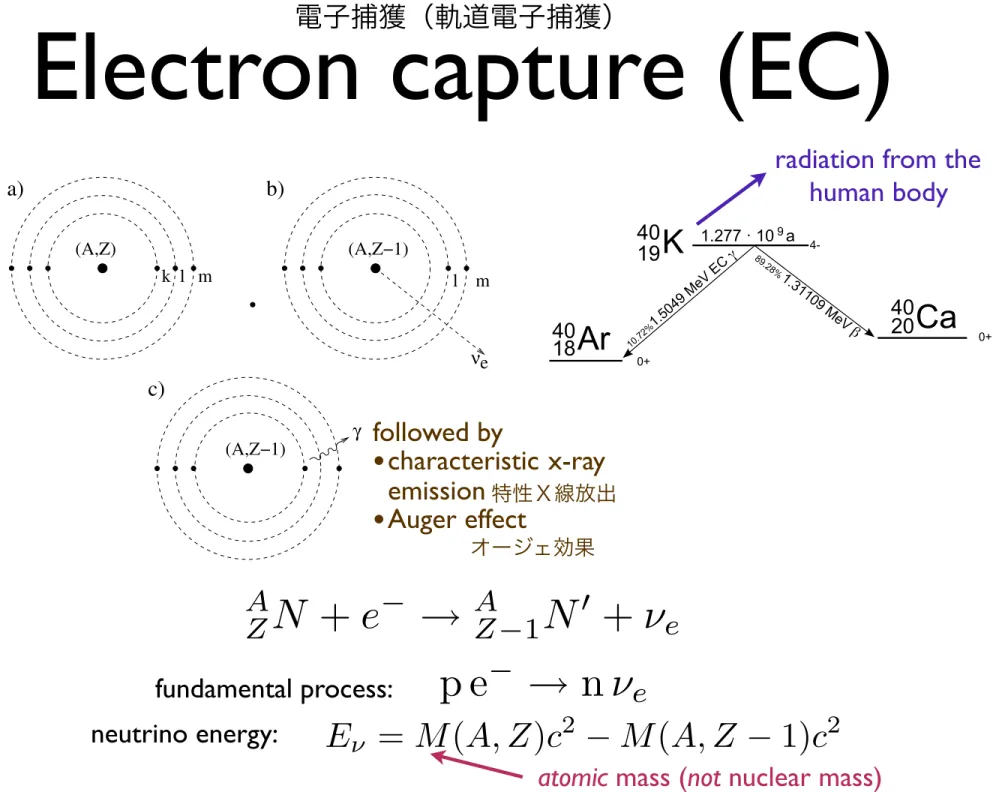
Electron capture (EC)
電子捕獲(軌道電子捕獲)208 4. Nuclear decays and fundamental interactions
m l m l k (A,Z)
νe
(A,Z−1)
(A,Z−1)
a) b)
c)
γ
Fig. 4.15. Electron capture. After the nuclear transformation, the atom is left with an unfilled orbital, which is subsequently filled by another electron with the emission of photons (X-rays). As in the case of nuclear radiative decay, the X-ray can transfer its energy to another atomic electron which is then ejected from the atom. Such an electron is called an Auger electron.
The decay rate is then λ = c
π(¯hc)4
(2.4GF)2Z3
a30 |M|2Q2ec. (4.98)
Compared with nuclearβ-decay, theQ dependence is weak,Q2ecrather than Q5β. This means that for smallQβ, electron-capture dominates overβ+decay, as can be seen in Fig. 2.13. The strongZ dependence coming from the de- creasing electron orbital radius with increasingZmeans that electron-capture becomes more and more important with increasingZ.
Finally, we note that nuclear decay by electron capture leaves the atom with an unfilled atomic orbital. This orbital is filled by other atomic electrons falling into it and radiating photons. The photons are in the keV (X-ray) range since the binding energy of the inner most electron of an atom of atomic numberZ is
E ∼ 0.5Z2α2mec2= 0.01Z2keV. (4.99)
followed by
•
characteristic x-ray emission•
Auger effect特性X線放出オージェ効果
10.72%
1.5049 Me
V ECγ 89.28%
1.3110 9 MeV
β 0+
0+
40
K
4-19
40
Ar
18
20
Ca
40
1.277 · 109a
radiation from the human body
AZ
N + e
AZ 1N +
efundamental process:
p e n
eneutrino energy:
atomic mass (not nuclear mass)
E = M (A, Z )c
2M (A, Z 1)c
234
gamma decay A A +
unstable high-energy state (stable) low-energy state
gamma ray ガンマ線
mA > mA mA mA mA
momentum conservation p = E c energy conservation
運動量保存 エネルギー保存
spontaneous emission 自然放出
E + p2
2mA = (mA mA)c2
recoil energy (energy loss)
反跳エネルギー(エネルギー損失)
ER = E2
2mAc2 mAc
2 A 931.5 MeV
E E E (m m )c2 but E > in general
Internal conversion
内部転換4 3 2 1
00 1 2 3 4 5
1s
0.5 0.4 0.3 0.2 0.1
0.00 1 2 3 4 5
2s
0.020 0.015 0.010 0.005 0.000
5 4
3 2
1 0
2p
0.12 0.08 0.04
0.000 1 2 3 4 5
3s
probability density
interaction
An excited nucleus can interact with an electron in one of the lower atomic orbitals, causing the electron to be emitted (ejected) from the atom.
s-electrons have finite probability density at the nuclear position.
for a hydrogen atom
水素原子の例
s軌道の電子は、原子核の位置で存在確率が有限
The electron may couple to the excited state of the nucleus and take the energy of the nuclear transition directly, without an intermediate gamma ray.
Energy of the conversion electron
Ece (mA mA)c2 Eb E Eb
binding energy of the electron
followed by
•
characteristic x-ray emission•
Auger effect特性X線放出オージェ効果
Mössbauer effect
Inverse transition (resonant re-absorption) possible when
• nuclear recoil is suppressed in a crystal (“very very large m
A”)
• the excited nucleus decays in flight with the Doppler effect compensating the nuclear recoil
recoil energy (energy loss)
反跳エネルギー(エネルギー損失)
Emitted gamma rays are not resonantly re-absorbed by other nuclei in gases.
E
R= E
22m
Ac
2but ...
← Mössbauer effect (discovered in 1957)
Mössbauer spectroscopy
182 4. Nuclear decays and fundamental interactions
E (µeV)
∆
0.0417 0.129 191Os
% absorption
−4 0 4 v(cm/sec)8 12
−20 0 20 40
1.0 0.8 0.6
0.4 0.2
γ γ
191Ir
v
absorber
191Ir γ−
detector sourceOs
191
Fig. 4.4. Measurement of the width of the first excited state of 191Ir through M¨ossbauer spectroscopy [39]. The excited state is produced by theβ-decay of191Os.
De-excitation photons can be absorbed by the inverse transition in a191Ir absorber.
This resonant absorption can be prevented by moving the absorber with respect to the source with velocityvso that the photons are Doppler shifted out of the reso- nance. Scanning in energy then amounts to scanning in velocity with∆Eγ/Eγ=v/c.
It should be noted that photons from the decay of free 191Ir have insufficient en- ergy to excite191Ir because nuclear recoil takes some of the energy (4.42). Resonant absorption is possible with v = 0 only if the 191Ir nuclei is “locked” at a crystal lattice site so the crystal as a whole recoils. The nuclear kinetic energyp2/2mA in (4.42) is modified by replacing the mass of the nucleus with the mass of the crystal.
The photon then takes all the energy and has sufficient energy to excite the original state. This “M¨ossbauer effect” is not present for photons withE >200 keV because nuclear recoil is sufficient to excite phonon modes in the crystal which take some of the energy and momentum.
メスバウアー分光による寿命測定
v
(a)
38
Test of Albert Einstein's theory of general relativity
Jefferson laboratory (Harvard University) by Pound and Rebka, 1959
gamma ray
(14.4 keV) 57
Fe
H = 22.5 m


![Fig. 4.14. The β − and β + spectra of 64 Cu [44]. The suppression the of the β + spectrum and enhancement of the β − at low energy due to the Coulomb effect is seen.](https://thumb-ap.123doks.com/thumbv2/123deta/7073556.2311879/31.1263.232.1062.83.810/fig-spectra-suppression-spectrum-enhancement-energy-coulomb-effect.webp)
![Fig. 4.4. Measurement of the width of the first excited state of 191 Ir through M¨ossbauer spectroscopy [39]](https://thumb-ap.123doks.com/thumbv2/123deta/7073556.2311879/38.1263.376.889.243.785/fig-measurement-width-excited-state-ir-ossbauer-spectroscopy.webp)
