Economic Effects of Free Trade Agreements in Northeast Asia: CGE Analysis with the GTAP 9.0a Data Base
ENKHBAYAR Shagdar*
NAKAJIMA Tomoyoshi**
Abstract
Despite growing trade and economic relations among the countries in the Northeast Asian (NEA) region, there are only two bilateral free trade agreements in effect currently. The China–
ROK Free Trade Agreement entered into force on 20 December 2015 and the Japan–Mongolia Economic Partnership Agreement (EPA) became effective on 7 June 2016. However, several EPAs and free trade agreements (FTAs) are under negotiation or have prospects to emerge among not only the countries in the region, but also surrounding regions and countries.
An analysis of the economic effects of the ongoing FTA (China–Japan–Korea Trilateral Free Trade Agreement (CJK FTA)), and several other prospective FTAs—Northeast Asia Preferential Free Trade Agreement (NEA FTA); Northeast Asia plus the Eurasian Economic Union (EAEU) Preferential Free Trade Area (NEA+EAEU FTA); and Northeast Asia plus the Regional Comprehensive Economic Partnership (RCEP) plus the EAEU Preferential Free Trade Area (NEA+RCEP+EAEU FTA)—using the standard CGE Model and GTAP Data Base 9.0a revealed that all parties of the agreements will benefit from the formation of these free trade agreements, having welfare gains and real GDP expansions regardless of international capital mobility status—i.e. whether the capital is internationally mobile or not. Moreover, the results indicated that for the NEA region as a whole, the NEA FTA is preferable to the CJK FTA alone, and it would be even better off with the formation of wider free trade areas, such as with the other RCEP and EAEU members.
Keywords: Free trade, CGE analysis JEL classification codes: F150, C680
1. The Model
In analyzing the expected economic effects of FTAs in Northeast Asia, we employed the Global Trade Analysis Project (GTAP) Data Base (Version 9.0a) and the standard GTAP Model (The Model). The GTAP Model is a multi-region and multi-sector Computable General Equilibrium (CGE) model1 with perfect competition and constant returns to scale. Bilateral trade is handled via the Armington assumption. It combines detailed bilateral trade, transport and protection data characterizing the economic linkages among regions, together with individual country input–output databases, which account for inter-sectoral linkages.
The GTAP Data Base 9.0a has triple reference years (2004, 2007 and 2011) and this analysis used 2011 as the reference year. Thus the values indicated in this analysis are expressed in constant 2011 US$ terms. The data are for 140 regions and 57 commodities, and in the consideration of the target countries the regions were aggregated into 12 from the original 140 regions in the model, while the original 57 sectors in the model were not aggregated. The aggregated regions are: China, Japan, the ROK, Mongolia, Russia, the EAEU4, ASEAN9, ANZI, the Rest of Asia, the United States, the EU_28, and Rest of World. Due to lack of data, the DPRK was not included in the Northeast Asia region, but the country is included implicitly in the Rest of Asia region as a part of the Rest of East Asia. Thus, the NEA region in this analysis refers to
five countries in the region, excluding the DPRK (Appendix Tables I and II).
The original eight factors in the Model were aggregated into four factors: land, labor, capital and natural resources, where land and natural resources are immobile and labor and capital are mobile factors (Appendix Table III).
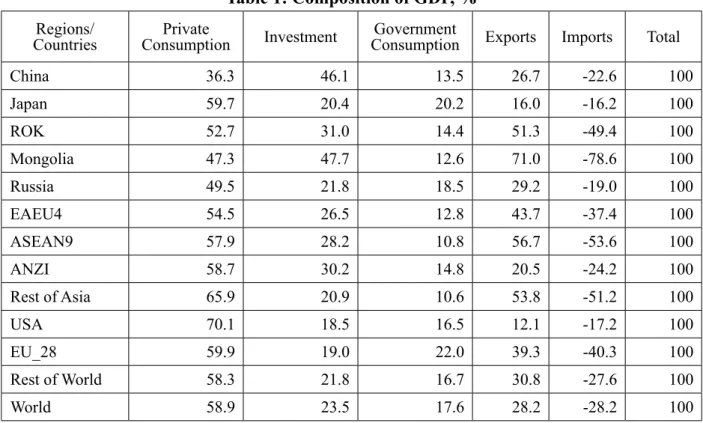
The composition of GDP of the countries in question is provided in Table 1. GDP shares of foreign trade activities were the highest for Mongolia among the selected countries with exports and imports each exceeding 70% of the country’s GDP.
Table 1: Composition of GDP, % Regions/
Countries Private
Consumption Investment Government
Consumption Exports Imports Total
China 36.3 46.1 13.5 26.7 -22.6 100
Japan 59.7 20.4 20.2 16.0 -16.2 100
ROK 52.7 31.0 14.4 51.3 -49.4 100
Mongolia 47.3 47.7 12.6 71.0 -78.6 100
Russia 49.5 21.8 18.5 29.2 -19.0 100
EAEU4 54.5 26.5 12.8 43.7 -37.4 100
ASEAN9 57.9 28.2 10.8 56.7 -53.6 100
ANZI 58.7 30.2 14.8 20.5 -24.2 100
Rest of Asia 65.9 20.9 10.6 53.8 -51.2 100
USA 70.1 18.5 16.5 12.1 -17.2 100
EU_28 59.9 19.0 22.0 39.3 -40.3 100
Rest of World 58.3 21.8 16.7 30.8 -27.6 100
World 58.9 23.5 17.6 28.2 -28.2 100
Source: GTAP 9.0a Data Base
2. The Experiments
Four FTA scenarios in the NEA region were considered in the simulations where the ad valorem import tariffs and tariff equivalents of bilateral nontariff barriers (NTBs) between the countries in question were removed on a preferential basis. The scenarios were:
i) China–Japan–Korea Trilateral Free Trade Agreement (CJK FTA). The members are: China, Japan and the ROK (CJK);
ii) Northeast Asia Preferential Free Trade Agreement (NEA FTA). The members are the CJK members plus Mongolia and Russia (NEA);
iii) Northeast Asia plus the Eurasian Economic Union (EAEU) Free Trade Area (NEA+EAEU FTA). The members are CJK, Mongolia, Russia and the other four members of the EAEU (EAEU4). The EAEU4 members are described in the Appendix Table I;
iv) Northeast Asia plus RCEP plus the EAEU Preferential Free Trade Area (NEA+RCEP+EAEU FTA). The members are NEA plus the EAEU4, ASEAN9 and ANZI members. The ASEAN9 and ANZI members are described in the Appendix Table I.
Source-specific change in tax on imports of commodity “i” from country “r” into country
“s” is expressed by a variable “tms (i,r,s)” in the Model and shocks were applied for a target rate of zero for this variable. Both values of the parameter “RORDELTA”, which is the investment allocation binary coefficient in the Model, were applied in each scenario to observe the impacts of investment allocation decisions in the assumed FTAs. The default value of the parameter RORDELTA in the Model equals 1, where investment is allocated across regions to equate the change in the expected rates of return, rore (r) which implies international capital mobility.
When RORDELTA equals 0, investments are allocated across regions to maintain the existing composition of capital stock (no international capital mobility) and it effectively fixes the trade balance for each country/region. Description of the experiments is provided in Box 1. The solution method was Gragg, or a multiple step extrapolation method.
In order to simplify the application of shocks to the Model, three additional subsets of the regions were created by modifying the CMFSTART file of the GTAP Model. These are: CJK, NEA4 (China, Japan, the ROK, and Mongolia) and RCEP (China, Japan, the ROK, ASEAN9 and ANZI) and the modified CMFSTART file is illustrated in Box 2, where rows numbered from 7 to 15 were added into the default version of the CMFSTART file. The CMFSTART file contains some additional instructions, which are sent to GEMPACK prior to solving the model.
Box 1: Description of the Experiments
Experiments:
Complete removal of ad valorem import tariffs and tariff equivalents of
bilateral nontariff barriers (NTBs)
(tms = 0%) Export interventions
were not altered.
a. China–Japan–Korea Trilateral Free Trade Agreement (CJK FTA)
Shock
tms(TRAD_COMM,CJK,CJK)
= target % 0 from file tms.shk;
Experiment 1:
Default (RORDELTA = 1)
Experiment 2:
(RORDELTA = 0)
b. Northeast Asia Preferential Free Trade
Area (NEA FTA) (Shocks list is in Box 3)
Experiment 3:
Default (RORDELTA = 1)
Experiment 4:
(RORDELTA = 0) c. Northeast Asia plus
Eurasian Economic Union Free Trade Area (NEA+EAEU FTA) (Shocks list is in Box 4)
Experiment 5:
Default (RORDELTA = 1)
Experiment 6:
(RORDELTA = 0) d. Northeast Asia plus
RCEP plus Euroasian Economic Union Preferential Free Trade
Area
(NEA+RCEP+EAEU FTA) (Shocks list is in Box 5)
Experiment 7:
Default (RORDELTA = 1)
Experiment 8:
(RORDELTA = 0)
Box 2: The Modified CMFSTART file 1. ! If a version has no CMFSTART file of its own
2. ! RunGTAP creates one by copying the supplied file CMFSTART.DEF 3. CPU = yes; ! log show simulation times
4. NDS = yes; ! no displays
5. Extrapolation accuracy file = NO ; ! No XAC file 6. !servants = 1; ! use 2 processors at once, if possible 7. XSET NEA4 #NEA4 regions#
8. (China, Japan, ROK, Mongolia);
9. XSUBSET NEA4 is subset of REG;
10. XSET CJK #ChinaJapanKorea#
11. (China, Japan, ROK);
12. XSUBSET CJK is subset of NEA4;
13. XSET RCEP #RCEP regions#
14. (China, Japan, ROK, ASEAN9, ANZI);
15. XSUBSET RCEP is subset of REG;
Source: GTAP Model
Box 3: Shock Statements in NEA FTA Scenario Shock tms(TRAD_COMM,NEA4,NEA4) = target % 0 from file tms.shk;
Shock tms(TRAD_COMM,NEA4,”Russia”) = target % 0 from file tms.shk;
Shock tms(TRAD_COMM,”Russia”,NEA4) = target % 0 from file tms.shk;
Source: GTAP Model
Box 4: Shock Statements in NEA+EAEU FTA Scenario Shock tms(TRAD_COMM,NEA4,NEA4) = target % 0 from file tms.shk;
Shock tms(TRAD_COMM,NEA4,”Russia”) = target % 0 from file tms.shk;
Shock tms(TRAD_COMM,”Russia”,NEA4) = target % 0 from file tms.shk;
Shock tms(TRAD_COMM,”Russia”,”EAEU”) = target % 0 from file tms.shk;
Shock tms(TRAD_COMM,”EAEU”,”Russia”) = target % 0 from file tms.shk;
Shock tms(TRAD_COMM,”EAEU”,NEA4) = target % 0 from file tms.shk;
Shock tms(TRAD_COMM,NEA4,”EAEU”) = target % 0 from file tms.shk;
Source: GTAP Model
Box 5: Shock Statements in NEA+RCEP+EAEU FTA Scenario Shock tms(TRAD_COMM,RCEP,RCEP) = target % 0 from file tms.shk;
Shock tms(TRAD_COMM,RCEP,”EAEU”) = target % 0 from file tms.shk;
Shock tms(TRAD_COMM,”EAEU”,RCEP) = target % 0 from file tms.shk;
Shock tms(TRAD_COMM,”EAEU”,”EAEU”) = target % 0 from file tms.shk;
Shock tms(TRAD_COMM,RCEP,”Mongolia”) = target % 0 from file tms.shk;
Shock tms(TRAD_COMM,RCEP,”Russia”) = target % 0 from file tms.shk;
Shock tms(TRAD_COMM,”Mongolia”,RCEP) = target % 0 from file tms.shk;
Shock tms(TRAD_COMM,”Russia”,RCEP) = target % 0 from file tms.shk;
Shock tms(TRAD_COMM,”Russia”,”EAEU”) = target % 0 from file tms.shk;
Shock tms(TRAD_COMM,”Mongolia”,”EAEU”) = target % 0 from file tms.shk;
Shock tms(TRAD_COMM,”Mongolia”,”Russia”) = target % 0 from file tms.shk;
Shock tms(TRAD_COMM,”Russia”,”Mongolia”) = target % 0 from file tms.shk;
Shock tms(TRAD_COMM,”EAEU”,”Russia”) = target % 0 from file tms.shk;
Shock tms(TRAD_COMM,”EAEU”,”Mongolia”) = target % 0 from file tms.shk;
Source: GTAP Model
3. The Results
a) China–Japan–Korea Trilateral Free Trade Agreement (CJK FTA)
In terms of the equivalent variation (EV), which is an indicator for measuring the effect on public welfare, the simulation results demonstrated that all three countries, China, Japan and the ROK, would benefit from the CJK FTA regardless of the investment allocation decisions, while other countries and regions, including those in the NEA region, would experience welfare losses and real GDP contractions.
In Experiment 1, with international capital mobility, Japan would have the largest welfare gain of US$21.4 billion, while those for the ROK and China equaled US$11.2 billion and US$1.9 billion, respectively. Most of Japan’s welfare gain was associated with gains in terms of trade in goods and services equaling US$15.2 billion, while the ROK had relatively equal gains in terms of allocative efficiency (US$5.6 billion) and terms of trade in goods and services (US$5.8 billion). However, the ROK may experience a slight loss in its terms of trade in investment and savings equaling US$237 million. At the same time, China’s allocative efficiency and terms of trade in investment and savings were improved by US$4.46 billion and US$475 million, respectively, while the country’s terms of trade in goods and services would worsen by US$3.05 billion. However, the net effect was positive, equaling US$1.88 billion, as the allocative efficiency and terms of trade in investment and savings gains were larger than the terms of trade losses in goods and services. Although Russia was not a part of the CJK FTA, the country may benefit by having a welfare gain of US$43 million, when the capital is not mobile across regions (Table 2).
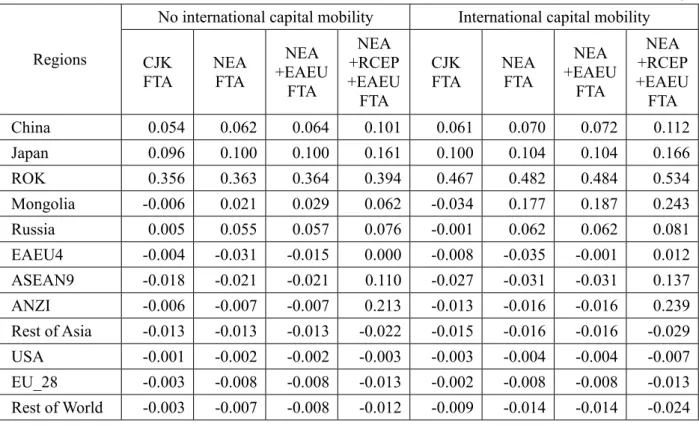
In addition, the simulation results indicated that the CJK FTA would result in positive changes in all the three countries’ real GDP (expressed in the GDP quantity index) regardless of the investment allocation decisions. The ROK’s real GDP change was the highest, equaling 0.467% and 0.356% depending on the investment allocation decisions, while those for Japan were 0.1% and 0.096%, and for China 0.061% and 0.054%. Higher values were observed when
capital is internationally mobile (Table 3).
b) Northeast Asia Preferential Free Trade Area (NEA FTA)
As expected, all members of the NEA region had welfare gains in the case of the NEA FTA, regardless of investment allocation decisions, while other regions would experience welfare losses and real GDP contractions. Welfare gains for Japan were the highest among the FTA members, equaling US$23.5 billion, followed by the ROK’s US$12.4 billion and China’s US$5.1 billion, when capital is internationally mobile. The other members of this FTA, Russia and Mongolia, had welfare gains of US$1.97 billion and US$58 million, respectively. These values were lower when capital is internationally immobile (Table 2).
When capital is internationally mobile (Experiment 3), most of the welfare gains were associated with allocative efficiency gains as well as improvements in terms of trade in goods and services for all NEA countries, except Russia. Russia would have a loss of US$785 million in its terms of trade in goods and services, but due to its gains of US$1.5 billion in its terms of trade in investment and savings and US$1.2 billion gains in allocative efficiency, the country’s total welfare gain from this FTA was positive, equaling US$1.92 billion (Appendix Table V).
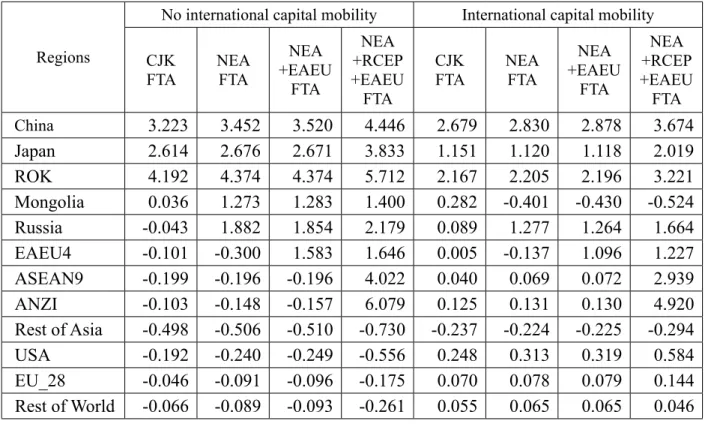
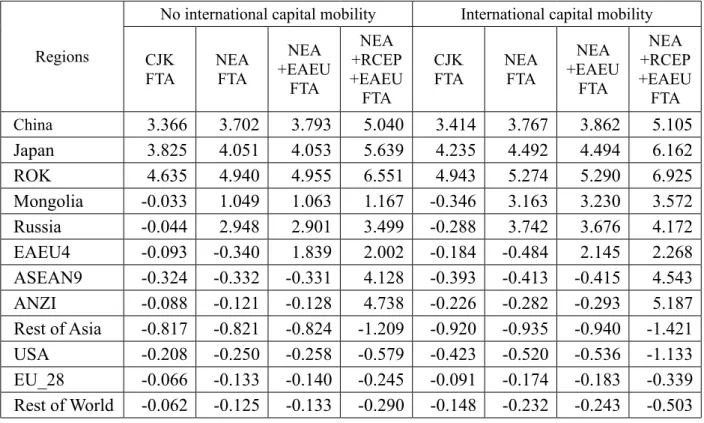
Moreover, all members of the NEA FTA would expect positive changes in their real GDP regardless of investment allocation decisions. The gains were higher when capital is internationally mobile. The ROK would benefit most from the formation of the NEA FTA, with its real GDP increasing by 0.482% when capital is internationally mobile and 0.363% when capital is internationally immobile. In addition, the foreign trade activities of all NEA countries would increase as a result of this agreement and the increase for merchandize exports ranged between 1.12% (the lowest) for Japan and 4.374% (the highest) for the ROK, depending on international capital mobility, while the increase for merchandize imports would range between 1.049% (the lowest) for Mongolia and 5.274% (the highest) for the ROK. However, Mongolia’s merchandise exports would decline by 0.401% when international capital is mobile (Tables 3, 5 and 6).
In terms of nominal GDP (expressed in the value of GDP), Russia may be affected negatively in both the cases of international capital mobility due to drops in its aggregate prices. Russia’s GDP price index dropped respectively by 0.883% and 1.145%, when capital is internationally mobile and immobile. In addition, the prices of Russia’s merchandise exports declined in both cases and the price index of its merchandise exports were 0.264% and 0.347%
lower, respectively, when capital is internationally mobile and immobile. Mongolia would also experience a drop in its nominal GDP of 0.313% without international capital mobility, due to the 0.334% reduction in its aggregate prices (Table 4 and Appendix Tables VII and VIII).
c) Northeast Asia plus the Eurasian Economic Union (EAEU) Preferential Free Trade Area (NEA+EAEU FTA)
All countries in the NEA region would benefit from the formation of this FTA regardless of investment allocation decisions, while other countries and regions would experience welfare losses and real GDP contractions. The magnitude of these benefits were larger for all the NEA countries, except Russia, in the NEA+EAEU FTA scenario compared to the previous two FTA scenarios. The welfare gains ranged between US$61 million for Mongolia and US$23.5 billion for Japan, while Russia’s welfare gain became slightly lower than the NEA FTA scenario, equaling US$1.958 billion when capital is internationally mobile. At the same time, real GDP
expansion ranged between 0.062% (the lowest) for Russia and 0.484% (the highest) for the ROK when capital is internationally mobile. The gains were lower without international capital mobility and welfare gains ranged between US$21 million (the lowest) for Mongolia and US$20.4 billion (the highest) for Japan, while real GDP changes were 0.029% (the lowest) for Mongolia and 0.364% (the highest) for the ROK. Changes in nominal GDP had a similar pattern with the NEA FTA (Tables 3 and 4).
However, despite being a part of this FTA, the other four members of the EAEU (EAEU4) may experience welfare losses as a result of the formation of this FTA, along with contractions of their real and nominal GDP due to losses in their allocation efficiency and worsening of the terms of trade in goods and services. EAEU4‘s terms of trade in goods and services worsened by US$194 when capital is internationally mobile. Russia’s nominal GDP may also contract by 0.85% and 1.12% depending on international investment allocation decisions. This was associated with price drops of their merchandize exports. Price decline of merchandize exports in the EAEU area would range between 0.282% and 0.421% depending on international capital mobility (Table 3 and Appendix Table VIII).
d) Northeast Asia plus RCEP plus the EAEU Preferential Free Trade Area (NEA+RCEP+EAEU FTA)
All countries in the NEA, RCEP and EAEU areas, except the EAEU4, would benefit from formation of this FTA by having welfare gains and real GDP expansions regardless of investment allocation decisions, while other countries and regions would experience welfare losses and real GDP contractions. The magnitude of these gains were larger for all the NEA countries in this scenario than in the previous three FTA scenarios. Welfare gains ranged between US$70 million for Mongolia and US$31.8 billion for Japan and real GDP expansions were between 0.012% (the lowest) for the EAEU4 and 0.534% (the highest) for the ROK, when capital is internationally mobile. Without international capital mobility, the gains were lower and the welfare gains ranged between US$19 million for Mongolia and US$28 billion for Japan, while the ROK’s real GDP expansion was also the highest, equaling 0.394%. Similar to the previous FTA scenario, although being a part of this FTA, the EAEU4 members would experience welfare losses regardless of investment allocation decisions and may see no impacts on their real GDP when capital is not internationally mobile (Tables 2 and 3).
Impacts on nominal GDP had a similar pattern as in the NEA+EAEU FTA scenario.
Mongolia’s aggregate level of prices became 1.083% lower when capital is not internationally mobile. Also, Russia, the EAEU4 and the ANZI members may experience reductions in their nominal GDP in both the cases of international capital mobility decisions due to drops of their aggregate price indices. At the same time, prices of merchandise exports of these countries would decline in a range of 0.098% to 0.439% (Table 4 and Appendix Tables VII, VIII).
Table 2: Equivalent Variations (EVs) via the FTAs
(2011 US$ million)
Regions
No international capital mobility International capital mobility CJKFTA NEA
FTA
+EAEUNEA FTA
+RCEPNEA +EAEU FTA
CJKFTA NEA FTA
+EAEUNEA FTA
+RCEPNEA +EAEU FTA
China 93 2,831 3,456 7,845 1,883 5,130 5,841 10,623
Japan 18,421 20,309 20,376 27,977 21,446 23,485 23,544 31,801 ROK 7,758 8,701 8,821 11,150 11,194 12,384 12,521 14,040
Mongolia -13 19 21 19 -26 58 61 70
Russia 43 1,824 1,817 2,492 -314 1,969 1,958 2,518
EAEU4 -15 -141 -185 -68 -78 -205 -111 -18
ASEAN9 -3,051 -3,458 -3,482 3,781 -3,800 -4,255 -4,290 6,207 ANZI -1,014 -1,178 -1,210 5,142 -1,765 -2,053 -2,109 7,904 Rest of Asia -2,753 -2,788 -2,796 -4,321 -3,048 -3,131 -3,145 -4,995 USA -2,753 -3,178 -3,266 -7,445 -5,139 -6,307 -6,495 -13,924 EU_28 -3,098 -6,066 -6,339 -10,724 -3,670 -7,364 -7,724 -13,753 Rest of World -1,687 -4,838 -5,142 -6,554 -4,272 -7,090 -7,385 -10,840
Source: GTAP Model, simulation results
Table 3: Real GDP Changes via the FTAs (qgdp = GDP quantity index)
(% change)
Regions
No international capital mobility International capital mobility CJKFTA NEA
FTA
+EAEUNEA FTA
+RCEPNEA +EAEU FTA
CJKFTA NEA FTA
+EAEUNEA FTA
+RCEPNEA +EAEU FTA China 0.054 0.062 0.064 0.101 0.061 0.070 0.072 0.112 Japan 0.096 0.100 0.100 0.161 0.100 0.104 0.104 0.166
ROK 0.356 0.363 0.364 0.394 0.467 0.482 0.484 0.534
Mongolia -0.006 0.021 0.029 0.062 -0.034 0.177 0.187 0.243 Russia 0.005 0.055 0.057 0.076 -0.001 0.062 0.062 0.081 EAEU4 -0.004 -0.031 -0.015 0.000 -0.008 -0.035 -0.001 0.012 ASEAN9 -0.018 -0.021 -0.021 0.110 -0.027 -0.031 -0.031 0.137 ANZI -0.006 -0.007 -0.007 0.213 -0.013 -0.016 -0.016 0.239 Rest of Asia -0.013 -0.013 -0.013 -0.022 -0.015 -0.016 -0.016 -0.029 USA -0.001 -0.002 -0.002 -0.003 -0.003 -0.004 -0.004 -0.007 EU_28 -0.003 -0.008 -0.008 -0.013 -0.002 -0.008 -0.008 -0.013 Rest of World -0.003 -0.007 -0.008 -0.012 -0.009 -0.014 -0.014 -0.024
Source: GTAP Model, simulation results
Table 4: Changes in Nominal GDP (vgdp = change in value of GDP)
(% change)
Regions
No international capital mobility International capital mobility CJKFTA NEA
FTA
+EAEUNEA FTA
+RCEPNEA +EAEU FTA
CJKFTA NEA FTA
+EAEUNEA FTA
+RCEPNEA +EAEU FTA China -0.214 0.002 0.041 0.234 -0.086 0.147 0.191 0.429 Japan 1.502 1.726 1.735 2.179 1.875 2.122 2.131 2.682
ROK 1.047 1.372 1.407 1.346 1.818 2.199 2.239 2.316
Mongolia -0.416 -0.313 -0.301 -1.021 -0.685 0.914 0.957 0.541 Russia -0.157 -1.091 -1.118 -1.261 -0.273 -0.820 -0.850 -1.052 EAEU4 -0.184 -0.401 -1.161 -1.192 -0.282 -0.512 -0.932 -1.007 ASEAN9 -0.441 -0.458 -0.459 0.076 -0.504 -0.532 -0.534 0.485 ANZI -0.263 -0.281 -0.287 -0.558 -0.366 -0.406 -0.415 -0.179 Rest of Asia -0.654 -0.639 -0.639 -0.976 -0.695 -0.690 -0.691 -1.054 USA -0.222 -0.243 -0.248 -0.510 -0.321 -0.372 -0.380 -0.772 EU_28 -0.227 -0.323 -0.334 -0.560 -0.268 -0.384 -0.397 -0.681 Rest of World -0.201 -0.278 -0.289 -0.498 -0.276 -0.362 -0.374 -0.655
Source: GTAP Model, simulation results
Table 5: Changes in Real Exports (qxwreg = change in volume of merchandise exports)
(% change)
Regions
No international capital mobility International capital mobility CJKFTA NEA
FTA
+EAEUNEA FTA
+RCEPNEA +EAEU FTA
CJKFTA NEA FTA
+EAEUNEA FTA
+RCEPNEA +EAEU FTA
China 3.223 3.452 3.520 4.446 2.679 2.830 2.878 3.674
Japan 2.614 2.676 2.671 3.833 1.151 1.120 1.118 2.019
ROK 4.192 4.374 4.374 5.712 2.167 2.205 2.196 3.221
Mongolia 0.036 1.273 1.283 1.400 0.282 -0.401 -0.430 -0.524
Russia -0.043 1.882 1.854 2.179 0.089 1.277 1.264 1.664
EAEU4 -0.101 -0.300 1.583 1.646 0.005 -0.137 1.096 1.227
ASEAN9 -0.199 -0.196 -0.196 4.022 0.040 0.069 0.072 2.939
ANZI -0.103 -0.148 -0.157 6.079 0.125 0.131 0.130 4.920
Rest of Asia -0.498 -0.506 -0.510 -0.730 -0.237 -0.224 -0.225 -0.294
USA -0.192 -0.240 -0.249 -0.556 0.248 0.313 0.319 0.584
EU_28 -0.046 -0.091 -0.096 -0.175 0.070 0.078 0.079 0.144
Rest of World -0.066 -0.089 -0.093 -0.261 0.055 0.065 0.065 0.046
Source: GTAP Model, simulation results
Table 6: Changes in Real Imports (qiwreg = change in volume of merchandise imports)
(% change)
Regions
No international capital mobility International capital mobility CJKFTA NEA
FTA
+EAEUNEA FTA
+RCEPNEA +EAEU FTA
CJKFTA NEA FTA
+EAEUNEA FTA
+RCEPNEA +EAEU FTA
China 3.366 3.702 3.793 5.040 3.414 3.767 3.862 5.105
Japan 3.825 4.051 4.053 5.639 4.235 4.492 4.494 6.162
ROK 4.635 4.940 4.955 6.551 4.943 5.274 5.290 6.925
Mongolia -0.033 1.049 1.063 1.167 -0.346 3.163 3.230 3.572
Russia -0.044 2.948 2.901 3.499 -0.288 3.742 3.676 4.172
EAEU4 -0.093 -0.340 1.839 2.002 -0.184 -0.484 2.145 2.268
ASEAN9 -0.324 -0.332 -0.331 4.128 -0.393 -0.413 -0.415 4.543 ANZI -0.088 -0.121 -0.128 4.738 -0.226 -0.282 -0.293 5.187 Rest of Asia -0.817 -0.821 -0.824 -1.209 -0.920 -0.935 -0.940 -1.421 USA -0.208 -0.250 -0.258 -0.579 -0.423 -0.520 -0.536 -1.133 EU_28 -0.066 -0.133 -0.140 -0.245 -0.091 -0.174 -0.183 -0.339 Rest of World -0.062 -0.125 -0.133 -0.290 -0.148 -0.232 -0.243 -0.503
Source: GTAP Model, simulation results
4. Conclusions
CGE analysis of the economic impacts of the four prospective free trade agreements covering the NEA region using GTAP Model and Data Base 9.0a have demonstrated that removing tariff barriers will benefit all parties of a free trade agreement, due to increased trade and economic activities. Specifically, in the cases of:
a) CJK Trilateral Free Trade Agreement: All three countries, China, Japan and the ROK, will benefit as a result of this agreement having positive EV values and real GDP expansions regardless of whether capital is internationally mobile or not. The ROK would benefit most in terms of real GDP change. All other regions would experience welfare losses, including those in the NEA region, except Russia when capital is not internationally mobile.
b) NEA Preferential Free Trade Area: All five countries in the NEA region would benefit from formation of an NEA FTA, having welfare gains and increases of real GDP regardless of the investment allocation decisions. The ROK was the largest winner in terms of its real GDP expansion. The other countries and regions in the model experienced welfare losses and contractions of their real GDP as well.
c) NEA+EAEU Preferential Free Trade Area: All countries in the NEA region would benefit from formation of this FTA regardless of investment allocation decisions, while other countries and regions would experience welfare losses and real GDP contractions. The magnitude of these benefits were larger for all the NEA countries, except Russia, in this scenario compared to the previous two FTA cases. Japan was the largest winner in terms of welfare gains, while the ROK would be the top beneficiary in terms of real GDP expansion.
However, despite being a part of this FTA, the EAEU4 members may experience welfare losses along with drops in their real and nominal GDP due to their allocative efficiency losses and worsening of terms of trade in goods and services.
d) NEA+RCEP+EAEU Preferential Free Trade Area: Similar to the previous scenario, all countries in the NEA region would benefit from this agreement by having welfare gains and expansions of real GDP regardless of international capital mobility decisions. All countries in the NEA region were better off under this scenario than the previous three FTA cases, whereas Japan was the largest winner in terms of welfare gains and nominal GDP expansion, while the ROK would benefit most in terms of its real GDP expansion. The other members of the RCEP region would also benefit from this FTA by experiencing welfare gains and real GDP expansions. However, in both cases of international capital mobility, Russia, the EAEU4 and ANZI would experience reductions in terms of nominal GDP due to drops in their aggregate price indices.
Accordingly, for the NEA region as a whole, the NEA+ FTA is preferable to CJK FTA only, and would be even better off in formation of a wider coverage of free trade agreement partners, such as RCEP and the EAEU, where all the countries in the region would benefit from larger welfare gains and real GDP expansions regardless of the investment allocation decisions.
*Senior Research Fellow, Research Division, ERINA
**Senior Research Fellow, Research Division, ERINA
1 For more details on the GTAP model and database, refer to Hertel, T. (ed.), 1997.
References
ADAMS Philip D. (2003). Interpretation of Macroeconomic Results from a CGE Model such as GTAP, Centre of Policy Studies, Monash University. Available online.
BEGG M., Ch. BURMAA, et al (2012). “GTAP 8 Data Base Documentation - Chapter 7.C: Mongolia” by BEGG Michael, BURMAA Chadraaval, RAGCHAARSUREN Galindev, ESMEDEKH Lkhanaajav, and ERDENESAN Eldev-Ochir. Retrieved from: https://www.gtap.agecon.purdue.edu
ENKHBAYAR Shagdar and Tomoyoshi NAKAJIMA (2013). Impacts of Mongolian FTAs with the Countries in Northeast Asia: CGE Analysis with the GTAP 8 Data Base. The Northeast Asian Economic Review, Vol. 1, No.
2, December 2013, pp. 43–67.
ENKHBAYAR Shagdar and Nyamdaa OTGONSAIKHAN (2017). Impacts of Import Tariff Reforms on Mongolia’s Economy: CGE Analysis with the GTAP 8.1 Data Base, The Northeast Asian Economic Review, Vol. 5, No. 1, March 2017, pp. 1–25
HERTEL T. (ed.) (1997). Global Trade Analysis: Modeling and Applications. Cambridge University Press
NAKAJIMA Tomoyoshi (2012). “The ROK’s FTA Policy: Developments under the Lee Myung-bak Administration”, The Journal of Econometric Study of Northeast Asia, Vol. 8, No. 2, 2012
NARAYANAN G. Badri, Angel AGUIAR, and Robert McDOUGALL (eds.) (2012). Global Trade, Assistance, and Production: The GTAP 8 Data Base, Center for Global Trade Analysis, Purdue University
Appendix Table I: Classification of Regions in the Model The Model
(12 regions) GTAP 9.0a (140 regions)
China China
Japan Japan
ROK Republic of Korea
Mongolia Mongolia
Russia Russian Federation
EAEU4 Kazakhstan, Kyrgyzstan, Armenia, Belarus
ASEAN9 ASEAN9 members, except Myanmar: Brunei Darussalam, Cambodia, Indonesia, Lao People's Democratic Republic, Malaysia, Philippines, Singapore, Thailand, Vietnam
ANZI Australia, New Zealand, India
Rest of Asia Hong Kong, Taiwan, Rest of East Asia, Rest of Southeast Asia, Bangladesh, Nepal, Pakistan, Sri Lanka, Rest of South Asia
USA United States of America
EU_28
Austria, Belgium, Cyprus, Czech Republic, Denmark, Estonia, Finland, France, Germany, Greece, Hungary, Ireland, Italy, Latvia, Lithuania, Luxembourg, Malta, Netherlands, Poland, Portugal, Slovakia, Slovenia, Spain, Sweden, United Kingdom, Bulgaria, Romania, Croatia
Rest of World
Rest of Oceania, Canada, Mexico, Rest of North America, Argentina, Bolivia, Brazil, Chile, Colombia, Ecuador, Paraguay, Peru, Uruguay, Venezuela, Rest of South America, Costa Rica, Guatemala, Honduras, Nicaragua, Panama, El Salvador, Rest of Central America, Dominican Republic, Jamaica, Puerto Rico, Trinidad and Tobago, Caribbean, Switzerland, Norway, Rest of EFTA, Albania, Ukraine, Rest of Eastern Europe, Rest of Europe, Rest of Former Soviet Union, Azerbaijan, Georgia, Bahrain, Islamic Republic of Iran, Israel, Jordan, Kuwait, Oman, Qatar, Saudi Arabia, Turkey, United Arab Emirates, Rest of Western Asia, Egypt, Morocco, Tunisia, Rest of North Africa, Benin, Burkina Faso, Cameroon, Côte d’Ivoire, Ghana, Guinea, Nigeria, Senegal, Togo, Rest of Western Africa, Central Africa, South Central Africa, Ethiopia, Kenya, Madagascar, Malawi, Mauritius, Mozambique, Rwanda, Tanzania, Uganda, Zambia, Zimbabwe, Rest of Eastern Africa, Botswana, Namibia, South Africa, Rest of South African Customs, Rest of the World
Source: GTAP 9.0a Data Base
Appendix Table II: Classification of Sectors in the Model
No. Code Description
1 pdr Paddy rice
2 wht Wheat
3 gro Cereal grains nec.
4 v_f Vegetables, fruit, nuts
5 osd Oil seeds
6 c_b Sugar cane, sugar beet
7 pfb Plant-based fibers
8 ocr Crops nec.
9 ctl Cattle, sheep, goats, horses 10 oap Animal products nec.
11 rmk Raw milk
12 wol Wool, silk-worm cocoons
13 frs Forestry
14 fsh Fishing
15 coa Coal
16 oil Oil
17 gas Gas
18 omn Minerals nec.
19 cmt Meat: cattle, sheep, goats, horse
20 omt Meat products nec.
21 vol Vegetable oils and fats
22 mil Dairy products
23 pcr Processed rice
24 sgr Sugar
25 ofd Food products nec.
26 b_t Beverages and tobacco products
27 tex Textiles
28 wap Wearing apparel
29 lea Leather products
30 lum Wood products
31 ppp Paper products, publishing 32 p_c Petroleum, coal products
33 crp Chemical, rubber, plastic products 34 nmm Mineral products nec.
35 i_s Ferrous metals
36 nfm Metals nec.
37 fmp Metal products
38 mvh Motor vehicles and parts 39 otn Transport equipment nec.
Appendix Table II: Classification of Sectors in the Model (continued)
No. Code Description
40 ele Electronic equipment
41 ome Machinery and equipment nec.
42 omf Manufactures nec.
43 ely Electricity
44 gdt Gas manufacture, distribution
45 wtr Water
46 cns Construction
47 trd Trade
48 otp Transport nec.
49 wtp Sea transport
50 atp Air transport
51 cmn Communication
52 ofi Financial services nec.
53 isr Insurance
54 obs Business services nec.
55 ros Recreation and other services
56 osg Public administration, Defense, Health, Education
57 dwe Dwellings
Source: GTAP 9.0a Data Base
Appendix Table III: Classification of Production Factors in the Model
Old factor New factor
No. Code Description No. Code Description
1 Land Land 1 Land -1
2 tech_aspros Technicians/Associates, Professional 2 Labor mobile
3 clerks Clerks 2 Labor mobile
4 service_shop Service/Shop workers 2 Labor mobile
5 off_mgr_pros Officials and Managers 2 Labor mobile 6 ag_othlowsk Agricultural and Unskilled 2 Labor mobile
7 Capital Capital 3 Capital mobile
8 NatlRes Natural Resources 4 NatRes -0.001
Source: GTAP 9.0a Data Base
Appendix Table IV: CJK FTA Welfare Effects: EV Decomposition Summary (Experiment 1: International Capital Mobility)
(2011 US$ million)
Regions Allocative
Efficiency
Terms of Trade in Goods and
Services
Terms of Trade in Investment
and Savings Total Welfare
China 4,459 -3,051 475 1,883
Japan 5,894 15,160 337 21,391
ROK 5,611 5,819 -237 11,194
Mongolia -3 -22 -1 -26
Russia -14 -495 195 -314
EAEU4 -21 -77 19 -78
ASEAN9 -583 -3,262 46 -3,799
ANZI -451 -1,150 -165 -1,765
Rest of Asia -187 -2,915 54 -3,048
USA -413 -3,769 -957 -5,139
EU_28 -413 -3,128 -166 -3,707
Rest of World -1,312 -3,357 396 -4,272
Total 12,568 -246 -4 12,319
Source: GTAP Model, simulation results
Appendix Table V: NEA FTA Welfare Effects: EV Decomposition Summary (Experiment 3: International capital mobility)
(2011 US$ million)
Regions Allocative
Efficiency
Terms of Trade in Goods and
Services
Terms of Trade in Investment
and Savings Total Welfare
China 5,121 364 -374 5,111
Japan 6,161 16,914 356 23,431
ROK 5,800 6,888 -304 12,384
Mongolia 16 46 -3 58
Russia 1,174 -785 1,529 1,918
EAEU4 -93 -154 42 -205
ASEAN9 -660 -3,578 -16 -4,254
ANZI -547 -1,290 -216 -2,053
Rest of Asia -199 -2,954 22 -3,131
USA -588 -4,674 -1,045 -6,307
EU_28 -1,391 -5,651 -356 -7,398
Rest of World -2,029 -5,429 367 -7,090
Total 12,765 -303 2 12,464
Source: GTAP Model, simulation results
Appendix Table VI: NEA+EAEU FTA Welfare Effects: EV Decomposition Summary
(Experiment 5: International capital mobility)
(2011 US$ million)
Regions Allocative
Efficiency
Terms of Trade in Goods and
Services
Terms of Trade in Investment
and Savings Total Welfare
China 5,291 999 -467 5,823
Japan 6,164 16,966 359 23,490
ROK 5,821 7,007 -308 12,521
Mongolia 16 47 -3 61
Russia 1,190 -859 1,577 1,908
EAEU4 -2 -194 85 -111
ASEAN9 -667 -3,605 -18 -4,289
ANZI -565 -1,326 -217 -2,109
Rest of Asia -202 -2,963 21 -3,145
USA -617 -4,817 -1,060 -6,495
EU_28 -1,484 -5,912 -363 -7,758
Rest of World -2,129 -5,652 396 -7,385
Total 12,816 -309 2 12,509
Source: GTAP Model, simulation results
Appendix Table VII: Aggregate Price Changes by Region: GDP Price Index (pgdp (REG))
(% change) Regions No international capital mobility International capital mobility
NEA FTA NEA+EAEU+
RCEP FTA NEA FTA NEA+EAEU+R
CEP FTA
China -0.06 0.133 0.077 0.319
Japan 1.624 2.015 2.016 2.512
ROK 1.005 0.949 1.709 1.781
Mongolia -0.334 -1.083 0.736 0.297
Russia -1.145 -1.336 -0.883 -1.133
EAEU4 -0.37 -1.193 -0.477 -1.020
ASEAN9 -0.437 -0.034 -0.501 0.348
ANZI -0.274 -0.770 -0.391 -0.417
Rest of Asia -0.624 -0.954 -0.674 -1.025
USA -0.242 -0.507 -0.368 -0.765
EU_28 -0.315 -0.547 -0.375 -0.668
Rest of World -0.271 -0.487 -0.349 -0.631
Source: GTAP Model, simulation results
Appendix Table VIII: Price Index of Merchandise Exports by Region (pxwreg (REG)) (% change)
Regions
No international capital mobility International capital mobility CJKFTA NEA
FTA
+EAEUNEA FTA
+RCEPNEA +EAEU FTA
CJKFTA NEA FTA
+EAEUNEA FTA
+RCEPNEA +EAEU FTA
China -0.237 -0.081 -0.055 0.023 -0.141 0.03 0.06 0.185
Japan 1.153 1.313 1.32 1.674 1.434 1.615 1.622 2.062
ROK 0.56 0.709 0.726 0.821 0.916 1.096 1.115 1.282
Mongolia -0.347 0.241 0.253 0.173 -0.457 0.683 0.709 0.784
Russia -0.141 -0.347 -0.366 -0.439 -0.218 -0.264 -0.282 -0.391
EAEU4 -0.146 -0.27 -0.421 -0.47 -0.218 -0.327 -0.349 -0.43
ASEAN9 -0.274 -0.291 -0.292 0.061 -0.302 -0.32 -0.321 0.311 ANZI -0.226 -0.257 -0.263 -0.308 -0.308 -0.348 -0.354 -0.098 Rest of Asia -0.409 -0.396 -0.396 -0.601 -0.42 -0.409 -0.409 -0.614 USA -0.205 -0.233 -0.238 -0.462 -0.286 -0.333 -0.34 -0.664 EU_28 -0.203 -0.284 -0.294 -0.485 -0.245 -0.335 -0.346 -0.585 Rest of World -0.164 -0.248 -0.258 -0.408 -0.228 -0.305 -0.314 -0.514
Source: GTAP Model, simulation results