Coupled Chaotic Circuits with Nonlinear Mutual Inductors
Yuta KOMATSU Yoko UWATE Yoshifumi NISHIO (Tokushima University)
1. Introduction
Many nonlinear dynamical systems in various fields have been confirmed to exhibit chaotic oscillations. Re- cently applications of chaos to engineering systems are expected such as chaos noise generators, control of chaos, synchronization of chaos, and so on [1][2].
In this research, synchronization phenomena observed from simple chaotic circuits with asymmetric coupling by nonlinear mutual inductors are investigated.
2. Circuit Model
Figure 1 shows the circuit model. In the circuit, three identical chaotic circuits are coupled asymmetrically by nonlinear mutual inductors.
Figure 1: Circuit model.
First, we approximate the i−v characteristics of the nonlinear resistor by the following function.
vd(ik) =√9
rdik. (1) Further, theφ−icharacteristics of the nonlinear inductor is described as following function.
Ik= φk
L2 +
³ 1 L1 − 1
L2
´|φ
k+ Φ| − |φk−Φ|
2 . (2)
By changing the variables and the parameters,
t=√
L1C τ , a= 8 s
rd
rC L1
, “·” = d dτ, φk=a√
L1C xk, ik=a rC
L1yk, vk=a zk, α= L1
L0, β=r rC
L1, γ= L2
L0, δ= Φ a√
L1C. (3)
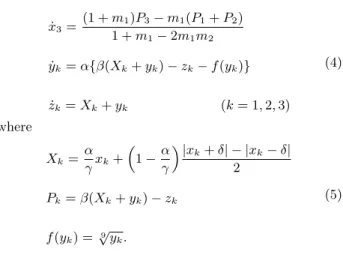
the circuit equations are normalized and described as
˙ x1=
1−m1m2
1−m1 P1−m11−m(1−m2)
1 P2−m2P3
1 +m1−2m1m2
˙ x2=
1−m1m2
1−m1 P2−m11−m(1−m2)
1 P1−m2P3
1 +m1−2m1m2
˙
x3= (1 +m1)P3−m1(P1+P2) 1 +m1−2m1m2
˙
yk=α{β(Xk+yk)−zk−f(yk)}
˙
zk=Xk+yk (k= 1,2,3)
(4)
where
Xk= α γxk+
³ 1−α
γ
´|x
k+δ| − |xk−δ|
2 Pk=β(Xk+yk)−zk
f(yk) =√9 yk.
(5)
3. Computer Calculated Results
Figure 2 shows computer calculated result. From Fig.2, we can confirm that two chaos observed from subcircuit 1 and 2 are synchronized at in-phase. Moreover we can confirm that subcircuit 3 becomes asynchronous state.
(a) (b) (c) (d)
Figure 2: In-phase synchronization of chaos. α= 20.0. β
= 0.26. γ = 10.0. δ= 1.5. m1 = 0.2. m2 = 0.19. (1)x1
vs.z1. (2)x3 vs. z3. (3)x1 vs. x2. (4)x1 vs. x3.
4. Conclusions
In this research, we investigated quasi-synchronization phenomena observed from chaotic circuits with asymmet- ric coupling by nonlinear mutual inductors. By carrying out the computer calculations, we confirmed that various quasi-synchronization phenomena of chaos were observed.
In the future, we investigate phenomena observed from the case which four or more subcircuits are coupled asym- metrically by nonlinear mutual inductors.
References
[1] M. Wada, Y. Nishio and A. Ushida, “Analysis of Bi- furcation Phenomena in Two Chaotic Circuits Coupled by an Inductor,” IEICE Transactions on Fundamentals, vol.
E80-A, no. 5, pp. 869-875, May 1997.
[2] G.O. Zhong, C.W. Wu and L.O. Chua, “Torus- Doubling Bifurcations in Four Mutually Coupled Chua’s Circuits,” IEEE Transactions on Circuits and Systems I, vol. 45, no. 2, pp. 186-193. 1998.
平成18年度電気関係学会四国支部連合大会 320
17 - 24