Master’s and Doctoral Programs in International and Advanced Japanese Studies
Graduate School of Humanities and Social Sciences, University of Tsukuba
Article
Expanding Education through Local and International Borders:
Tajikistani Students in Japan
Nazira SODATSAYROVA
University of Tsukuba, Graduate School of Humanities and Social Sciences, Ph.D. Student
This article explores local education and its connection to the international mobility of students regarding culture and education in terms of preparation ʻback home’ and their experience in their host country. It examines the importance of the presence of institutions that enable students to take further steps to continue their education internationally, in particular, focusing on the motivations of Tajikistani students in going to Japan. This paper approaches the topic through the concept of culture and social structures, and explores how cultural concepts and social structures could shape and re-shape student’s actions, as well as student responses to the new changes. The conceptualization of culture explores how students find cultural values help them in their new situation, for example kase shudan or
“becoming master of oneself,” which becomes extended in the context of living and studying in a different environment.
Using qualitative methodology, the research focused on ʻhow’ mobility is experienced and ʻwhat’ motivates student mobility. The findings demonstrate that, contrary to expectations of the collapse of the education system during the civil war, Tajikistan’s educational system has not totally collapsed. Although this appears to be true from an overall standpoint, when examined carefully, the situation is found to be more complicated. Students seek out high-quality institutions within the local settings of Tajikistan that help them move beyond their local area and across international borders. These institutions include schools such as the Russian-Tajik Lyceum of Hotam and P.V.,1 and other public and private lyceums in different regions. There are also other non-formal pathways to education through non-governmental organizations (NGO) internship and volunteering that develop young people`s critical thinking, analytical and creative thinking skills, which in turn prepare students to apply and to succeed in their goals related to studying abroad.
Keywords: Post-Soviet Tajikistan, Japan, Motivation, Educational Mobility, Local Institutions, Agency, Culture Introduction
This article draws on empirical research from interviews and secondary sources to show the motivation of Tajikistan students to come to Japan from an insider’s perspective2 and contributes to the limited academic study on Tajikistani students’ educational mobility in higher education (HE) in the context of Japan (see sections 4.2 and 4.3). Furthermore, this article explores why students have turned to the East to acquire
1 Hotam is the head of Hotam and P.V. school in Tajikistan and he includes name of his Russian friend Pavel Vasil’evich who helped him to establish Russian-Tajik Lyceum in Tajikistan.
2 Scholarly debates argue on the importance of conducting research and contributing to “peripheral regions” (Takayama et al., 2015, p.5) and indigenous intellectual voices (Chankseliani, 2017, p.1).
further education abroad. Since achieving independence and later after signing a peace treaty,3 the mobility of international students slowly increased from Tajikistan towards new established social, political and historical borders4 such as post-Soviet countries, western and eastern Asian countries. Within the academic studies of Asian students in Western countries or Asia, research on the mobility of Tajikistani students remains limited.
This study draws attention to the conditions and motivation of students, as well as their preparation in their home country, exploring the how and what of student motivations and experiences to make decisions about continuing their education. International students are an important group of a skilled population, but they remain an unrecognized group5 in the context of Tajikistan, and therefore are understudied.
This region of Central Asia and the countries within this area are multicultural and complex (MacKay, 2013).
The clash of multiple agendas by different groups led to a civil war in Tajikistan after the collapse of the Soviet Union (1991) and it resulted in the collapse of the central education system, educational institutions6 and, led to prolonged civil war in Tajikistan (1992-1997). The fall of the Soviet Union has also changed the educational mobility of people within the country and beyond. While Tajikistani students were seeking asylum, (having left their university studies and moving to rural areas or neighboring countries such as Afghanistan), other central Asian students were already mobile within their countries and beyond, studying in both domestic and international institutions. The consequences of the civil war led to the creation of new borders which resulted in people becoming immigrants without moving from the locations where they lived. The notion of belonging and exclusion became more prominent than inclusion within different regions. Tajikistan’s situation is unique among other Central Asian countries in terms of its geographical locations, economic and social stability.
The civil war had an impact on the deterioration of the education system, the effects of which remain apparent today.7 However, after 25 years of independence in Tajikistan, while the education system is apparently in decline, the number of students abroad is growing through different pathways that have been created and affected by local and international institutions. This article shows that contrary to expectations, Tajikistan’s system has not totally collapsed, as even within the current system, new institutions8 and programs9 exist that can support the young generation of Tajikistan by improving their competency and giving them knowledge and skills with which to compete globally, despite existing challenges and issues.
1. Expanding Education through Mobility: Insights from the Literature
Student mobility is on the rise and the statistics clearly show an increase in student mobility worldwide from 2.1 million in 2000 to 4.5 million in 2012 (OECD, 2015). In OECD countries, the number increased from 1.6 million in 2000 to 3.4 million in 2012 (OECD, 2015). Educational mobility and moving to another country is a complex, life-changing process that is affected by economic, social, political and cultural motives (Chirkov, Vansteenkiste, Tao & Lynch, 2006). Research studies approach the phenomenon of student mobility from
3 Conciliation Resources: Working Together for Peace, Key Elements of the Tajikistan Peace Agreement, 1997 General Agreement of the Establishment of Peace and National Accord and its Related Protocols (1995-97). Accessed June 2, 2016. url: http://www.c-r.org/accord-article/key-elements-tajikistan-peace-agreement.
4 In some cases, it is the borders that have moved rather than people.
5 There are an increased number of scholarly debates focusing on Tajikistan people migration, particularly towards Russia.
6 One-fifth of the public schools were damaged or destroyed during the civil war and the gross domestic product decreased from 9.2% in 1991 to 2.1% in 1995 (ADB, 2015, p.2).
7 The average salary in 2010 in the education sector was USD 60.38 per month, much lower than industry and government workers who earned USD 119 per month and finance at around USD 298 and even transportation sector who earned USD 188 per month (ADB, 2015, p.3)
8 NGOs, public/private lyceum/lyceum boarding schools such as Hotam and P.V., presidential lyceums, and the Aga Khan Lycee.
9 The Aga Khan Humanities Project and also the School of Professional and Continuing Education (SPCE).
different perspectives. Economists study this situation based on demand of labor migration, brain drain and brain gain (see neoclassical economic of migration). Sociologists focus on structural, political and social factors (Singh et al., 2014; Chirkov et al., 2007; Mazzarol & Soutar, 2002) and some research studies focus only either on the educational perspective of students or on acculturation and the emotional impact of international education. Other research focuses on the destination countries or the different programs such as Erasmus, Bologna program (Gonzalez, Mesanza, & Mariel, 2011; O’Hara, 2013) which also becomes a motivating factor for mobility of students.
The new emerging trend on the study of higher education focuses on the ranking system that was developed in 2003 by the Shanghai Jiao Tong University and draws attention to geographical centers of knowledge or knowledge “hubs.” Various groups and interrelated scholarly debates on internationalization and educational mobility seem to suggest that universities say “I want to be a world class leader” and students say “I want to be a world class expert.”
Within these studies there are paradoxes that could be difficult to explain without knowing where ideas and concepts are sourced, such as the complex idea of brain drain. Studies show that developing countries want to send their students abroad (sometimes without any clear agenda) and developed countries are more concerned about brain drain than developing countries. However, if looking from the country’s perspective, one loses the importance of individuals and their families and, as recent articles emphasize, the financial interest by universities and those who can supply it, particularly parents (Findlay, 2010) that form a transnational capitalist class (Sklair, 2001). The notion of push and pull factors also becomes very prominent in the study of migration and educational mobility that will be discussed below.
(1) Educational Mobility, Push-Pull and Supply-side Motivations
The mobility of students was studied in relation to push and pull, or home and host, countries and determinants of mobility of students in home and host countries. Push factors are attributed to decisions made in a student’s home country and pull factors are related to the attractiveness of universities in host countries.
Although push- pull factors sound like two different notions, when analyzing scholarly articles, the two notions sometimes seem to be discrete, sometimes overlap, and sometimes there are larger factors which cannot be explained. At the same time, push- pull factors do not reflect the big picture including individual, family, country, policies, and geopolitical diplomacy.
What comes out from the studies is that most scholars divide the phenomenon of educational mobility into only push-pull factors, but Findlay (2010) suggests that not only the decisions or motivation of students and the role of their parents (see section 2) are significant, but also the role of the supply side needs to be researched and emphasized.
Some scholars argue that parents’ level of education is significant as a motivating factor for their children to continue higher education (Gonzales et al., 2011, p.413), however Findlay et al., (2006) underline that it is rather parent’s social capital and also institutional agendas that could become motivating factors for students, as well as the parents’ occupations (Findlay et al., 2006). Limited access to education in the case of students from Africa and poor quality of tertiary education in their home countries also has resulted in those students’ migration overseas (Mazzarol & Soutar, 2002). Limited access to education and at the same time the reputation of the host country for quality education were key drivers of mobility.
Studying student migration reveals that students from other countries are similarly motivated and also that commonality of language, cost of living, social networks and recommendations from friends could become factors which motivate students to move across international borders (Gonzales, et al., 2011;
Mazzarol & Souter, 2002). The awareness space,10 which indicates from where potential mobile students get information, is also significant in educational mobility and identifies the role of contacts, networks and friends (Gonzales et al., 2011). This research also finds awareness space and networks significant motivating factors for students.
Students’ movement was also studied as a form of migration in response to the question of the consequences of the movement and was linked to the debate on the brain drain that would weaken the national economy (Skeldon, 1997, p.108) in which skilled workers who are mobile or migrate are thought of as being lost resources (Portes, 2016). However, some oppose this idea and suggest that instead mobility connects different economies and opens up new markets (De Hass, 2010). What was not emphasized was that brain drain could also happen if people do not move.
There are some important pull factors that were also underlined by scholars in regard to the role of host countries. Studies have found that country size, geographical proximity, social costs such as crime and safety, cost of living, part-time jobs, university quality, linguistic commonality as well as science and technology, can become key pull factors for international students (Gonzales et al., 2011; Mazzarol & Soutar, 2002). What comes out from examining the push-pull factors is that they are framed by local and international economic, political, social and cultural aspects, and, at the same time, it becomes evident that decisions are connected to larger local and global life and ideas. Therefore, it is important to go beyond the macro-level to understand the impact of cultural beliefs that can “frame, reframe, and finally form responses and outcomes that allow people to make sense of what is going around them” (Cohen & Sirkeci, 2011).
But there are barriers to push-pull factors such as rising costs and as well as the language of the country.
However, compiling the list of push-pull factors as a theory of migration does not provide the reader with the significance of the culture and the structure that leads to mobility. It is important to understand and explore the impact of the structural factors and the culture that leads to the mobility of individuals.
(2) Cultural Lens in Education and Mobility
There is a strong relationship between culture and education as culture plays a great role in the framing, delivery (Stephens, 2007) and shaping of education. The importance of looking from a cultural perspective is to bring the context of the person into discussion, as context is the main part of culture that can shape and re-shape education and mobility of students. The purpose of looking through a cultural lens is not to frame individuals’ decisions only from a cultural perspective, but to see the role of culture as something dynamic and transformative that can become a motivating factor for individuals in making decisions about relocation.
There is research that focuses more on cultural aspects that impact migrants and lead to stress (Bhugra
& Becker, 2005) but there are very few studies that look at culture as the motivating, or pull-and-push factor of mobility. Culture is part of the system of values of a society that is passed on generation by generation and at the same time it is a distinguishing marker (Bhugra & Becker, 2005). Chirkov et al. (2006) investigate self-determined motivation to study abroad and self-determined motivation is closely linked to culture that focuses on “what is” and “what is acted upon” (Stephens, 2007). Educational mobility is influenced by various factors before, during and after mobility, and culture becomes an important factor in the process of mobility.
Cultural beliefs can sometimes become motivating factors for mobility or at the same time can limit it.
Although there is discussion about the importance of culture and structure, the literature does not give an emphasis on these two aspects related to how culture and structure could be main factors that prepare the young generation for mobility. There is great discussion regarding cultural capital, but there is not an emphasis
10 The “awareness space” is also explained as an available opportunity or a network for new individuals to become mobile students (Gonzales, et al., 2011, p. 422).
on cultural aspects that have an impact on the actions of individuals.
(3) Experience of Students
Most studies show that the aim of higher education and particularly international education is intellectual and professional development that leads to personal growth and intercultural understanding (Carlson &
Widaman, 1988). The main principle of education is consistent but there are some new ideas surrounding the debate of international experience of students according to time, space and individual interest. Time spent overseas was researched, and it was argued that spending extended periods of time internationally leads to enhanced international understanding (Carlson & Widaman, 1988, p. 3). Thieme (2011) indicates that degrees from prestigious universities are always seen as a ladder for better career prospects in the context of Central Asia, specifically in Kyrgyzstan, and the same applies to the context of Tajikistan.
International education is about individual and institution and how one can impact the other. Different types of institutes, such as universities, can affect students’ experiences and at the same time social classes can be
“modified, reinforced or transformed through the experience of going to university, particularly in relation to how students develop their learner identities” (Reay et al., 2010). According to Robertson (2011), the process of international education leads to “student switching” depending on the policies of the host countries. The phenomenon of student switchers indicates the close connection of personal and political realms (Reay et al., 2010). The experience and its impact are always multidimensional; it is not only educational but there are personal, economic and cultural aspects that are relevant and connected to the experience.
2. Conceptual Framework
Based on the analysis of the literature, conceptual frameworks from migration, culture and sociology have been brought together to understand the phenomenon of the mobility of students. The concepts were developed to understand student mobility and motivation from the cultural perspective, as culture is “what is” and “what is acted upon” (Stephens, 2007, p. 50), and the existing social structures (institutions) that could be produced and reproduced through individual actions (Giddens, 1984). Understanding the role of social structures in the context of Tajikistan also helps to understand human actions but, as Giddens suggests, structures can influence actions but do not determine them. Exploring the role of social structures allows the reader to see how actions could be shaped and re-shaped by such structures.
Looking from a cultural perspective allows us to look at both the motivation of students and their experiences, as the experiences are also personal and reflect individuals’ desire to improve their own lives and lives of their families. One of the important concepts that comes out of these findings is kase shudan or “to become master of oneself,” a concept which will be discussed in more detail in the findings and analysis.
3. Data Collection Methods: How the Data was Collected
This research used a qualitative approach to collect data from current and former students who have studied in Japan for more than a year. A biographical research method was used to understand “both social reality and the subjects, worlds of knowledge and experience” and how these experiences are constantly transformed (Apitzsch
& Siouti, 2007, p. 5). In this study, the life story method was used to understand the notion of the international education phenomenon (Apitzsch & Siouti, 2007). The approach allowed current and former students to think of their experiences before and during the period of international mobility (for those who have finished, sharing
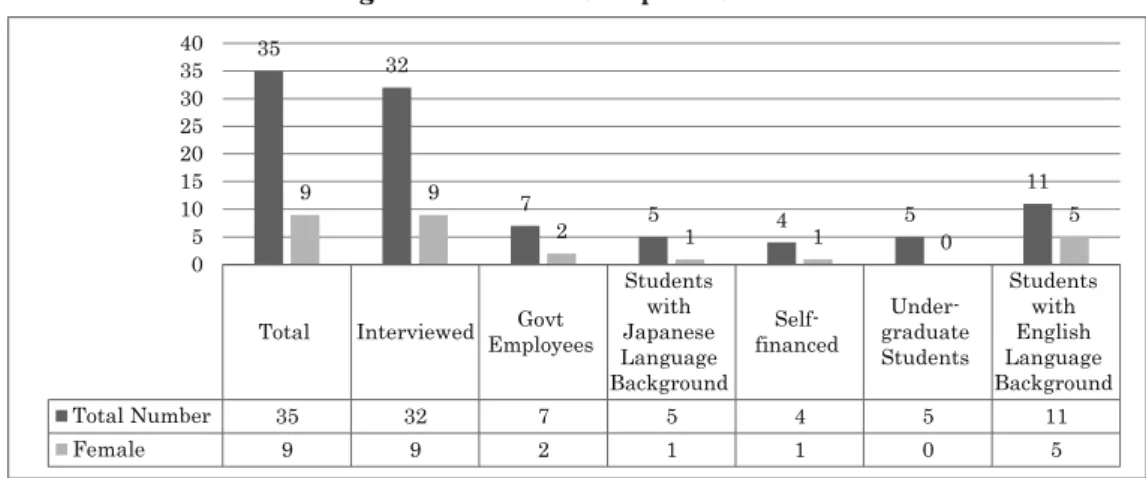
their experience after international education). In this study, 35 students from different parts11 of Tajikistan who studied and are studying at different universities in Japan were interviewed (Table 1).
Table 1. Sample Description Sex Number of
Participants Age of Participants Number of Participants According to Age Groups
Male 26 Minimum Range 20 to 25 5
Female 9 Maximum Range 25 to 40 30
Firstly, students were contacted and the purpose of the study was explained to them, after which the date of the interview was decided according to the time and availability of each student. Then biographical interviews were conducted with the students in order to understand their educational history and how they progressed with their understanding and ideas about education. The question of “tell me about yourself” was used at the beginning of each discussion to assess how students are motivated to continue their education locally and internationally. This question led to discussions of how their families valued education, the role of their teachers, the role of their situation and their own interest to continue their education.
The interviews were conducted with former students who have already finished any level of university in Japan and who are currently working either in Tajikistan or Japan. Interviews were also conducted with current students in their second year of education in Japan. The fieldwork (interviews) started from July 2016 and ended December 2017. Some participants were interviewed in Tajikistan and the rest were contacted and interviewed in Japan.
The semi-structured interview questions were translated into the Tajik language, however, two students preferred to speak in English rather than in Tajik. Out of 35 students, 10 of them were already in their home country either in search of work or were working in a particular institution. Ages ranged from 20 years to 44 years. The age differences are significant to the students’ mobility decisions. Most of the older students already have children (very few are not married yet) and most of the younger students are not married yet (only a few are married). At the same time, the age difference reveals their educational background; the older ones studied in the Soviet period and the younger ones studied during Tajikistan’s independence period.
In terms of scholarship, majority of students received MEXT12 ( Ministry of Education, Culture, Sports, Science and Technology Japan) or JDS13 (Project of Human Resource Development by Japanese Grant Aid) scholarships. There were different groups of students who were in undergraduate studies, language-learning programs, first-year Master of Arts, second-year Master of Arts and three-year doctoral programs. The diverse group of students (Figure 1) came from different perspectives, as those masters and doctoral students were from Tajikistan’s pre-independence generation, and the undergraduate and some language students were post- independence students.
11 The different parts of Tajikistan place different emphasis on and have different perspectives of the importance of education. The different parts also have different cultural values, language and geographical condition.
12 Ministry of Education, Culture, Sports, Science and Technology Japan (文 部 科 学 省 Monbu kagaku shō) offers scholarships to international students.
13 JDS, or the Project of Human Resource Development by Japanese Grant Aid, was established in Tajikistan by the Government of Japan in 2008. It is funded through official development assistance (ODA) supported by Japanese taxpayers. The program targets young government officials and provides two-year Master’s courses in Japan and from 2017, it also provides one scholarship for doctoral students.
Figure 1. Different Groups of Students
The ethical issues of consent, oral, written form, confidentiality and anonymity are central aspects of this paper, therefore before the interviews, the researcher obtained informed consent from all research participants.
In order to maintain the anonymity of the participants, the researcher refers to them as participant SO, NP and so on, according to the letters used in their surnames.
4. Brief Context of Higher Education in Tajikistan: Change and Continuity
Tajikistan youth comprise 35% of the population (ADB, 2015) and people aged 14 to 30 comprised 2.851 million out of 8.351 million people in 2014 (Statistical Yearbook, 2015). The majority of youth live in rural areas and strive to get out of the complexities and difficulties that are created by geographical locations. It should be emphasized that the rural minds are different from previous years as they are connected and influenced by new physical (tourists, organizations, visitors) and virtual/technological information channels. Virtual and physical connectivity have influenced the world view, thinking and mobility of people in regard to future opportunities and notions of quality of life.
Immediately following the fall of the Soviet Union in 1991, the centralized education system collapsed in the former Soviet republics and state funding was reduced for higher education, particularly in Tajikistan. The higher education system in Tajikistan is still shaped by its Soviet heritage. Universities follow the same patterns as the most universities in other post-Soviet countries. One simple example could be “students cannot take classes outside their departments and are destined to graduate in a pre-determined field of study” (Froumin
& Malinovsky, 2015, p.12). Although the education system today does not closely follow the former Soviet centralized system, the traces of that ideology remain.
Schooling generally starts from age 7, however some private school preparatory groups start from age 6, and compulsory education continues until grade 9. Those who wish to continue their education in higher education should finish secondary education (Grades 10 and 11), a system which has continued since the Soviet period.
Statistics show that in 1990-91, around 80% of students progressed to secondary education, but in 2011- 12, around 52% advanced to secondary education, which also indicates the decline of qualified people in the workforce, although job creation remains a major issue in Tajikistan (ADB, 2015).
Recent online news also indicated that from one small region of Tajikistan, as many as 4,700 students studied abroad and now the government administration emphasizes that they do not have a problem with the availability of qualified workers, noting that “some of our qualified students are working internationally
Total Interviewed Govt Employees
Students Japanesewith Language Background
Self- financed
Under- graduate Students
Students Englishwith Language Background
Total Number 35 32 7 5 4 5 11
Female 9 9 2 1 1 0 5
35 32
7 5 4 5
9 9 11
2 1 1 0 5
0 5 10 15 2025 30 35 40
which is the indicator of the quality of education in the region.”14 There is a paradox surrounding how the international community places emphasis on brain drain, but locals look at it as an achievement and result of the good quality of education that their students can work internationally.
Tajikistan primary school, secondary school and universities follow Russian structures that were inherited from the Soviet period. It has been emphasize that some countries gained political power but still remain academic colonies (Teichler, 1999, p.100). Although, Tajikistan remains dependent on the policies and relationships of Russia (Silova, 2011), at the same time it seeks to expand beyond its borders. Nevertheless, higher education reforms in the newly independent countries affected their geopolitical configurations (Silova, 2011). Looking through an educational lens, Tajikistan is trying to maintain the Russian-derived structure of its educational system and at the same time include additional aspects based upon Western educational systems.
Local universities in Tajikistan do not have autonomy to address their problems and do not offer or prepare capable researchers to do quality research domestically. The increased number of universities from 13 in 1991 to 38 in 2015-16 in Tajikistan are not indicative of the quality of education (Tajikistan Statistics Agency, 2016), but is simply indicative of the increased number of buildings, which have tripled since 1991. What is significant regarding the increase of universities is that it has led to an increase of new academic disciplines in the country.
However, the question remains as to whether new disciplines and faculties have qualified personnel, a topic which is beyond the scope of this current research.
Table 2. Yearly Statistics of Higher Education Institutions and Students in Tajikistan
Item/Year 1991-92 1997-98 2003-04 2009-10 2015-16
Number of institutions 13 25 35 36 38
Number of students 69,300 76,700 107,600 157,800 176,500
Population increase - - - 7,622,000 8,352,000
Source: Tajikistan Statistics Agency, Education in the Republic of Tajikistan: 25 Years of Independence (2016, pp.90-98).
The increase in the number of universities also has led to an increase in the number of the students, but at the same time, the increase in the population should not be forgotten as well. It could be said that more people are attending higher education, simply because of the increase in the population.
Importantly, the allocation of budget to higher education increased to 16.0 percent in 2015, compared to 6.4.
percent in 2007 (Tajikistan Statistics Agency, 2016, p. 9.). Compared to other Central Asian countries, the budget remains low, although within the country comparatively the amount is increasing.
(1) An Institutional Effect on Students Motivation
Why and how Tajikistan students move beyond local boundaries is also dependent on particular institutional structures, behaviors of authority and diplomatic relations15 between Tajikistan and other countries. There is a clear connection or bridge between individual action and institutional structures,16 as “individual actions take place in, and are created by social structures, and social structures are created by individual and collective actions” (Kupfer, 2015, p.30). In the absence of quality education in public schools, some individuals decided to establish their own private schools which provide relatively better education by hiring better qualified teachers
14 Radioi Ozodi (Radio Free Tajikistan), Interview given by Eraj Djonmirzoev, Chief Educational Officer (CEO) in GBAO, Tajikistan.
15 Globalization and internationalization does not mean that everyone is open to apply wherever they wish but there are always check-points. One of those checkpoints is nationality and diplomatic relations. The applications clearly state that “applicants must hold the citizenship of a country that has diplomatic relations with Japan.”
16 Institutional structure creates a space for students to exercise their mobility choices.
in the context of Tajikistan. This has occurred in response to the collapse of overarching structural factors, such as political and economic of the former Soviet Union, as well as national and regional institutions. The schools were not only targeted to help communities, but also the school owners themselves. Significantly, the private schools have achieved far better results than public schools. Such private schools exist in very special areas such as population and city centers which attract students from far and near. A few such schools are the Russian-Tajik Lyceum-Boarding School of Hotam and P.V. in Dushanbe, Azizov College in Isfara, Abdurahmoni Jomi a Lytceum-Boarding School in Kuibeshev, the Aga Khan Lycee in Khorog, Turkish Lyceums and International School. These schools are salient to this article17 in that they are becoming significant facilitators of student mobility through their quality education and qualified teachers.
The aforementioned schools have been successful in developing highly skilled individuals (grade 9 to 11) who take part in national and international educational Olympiads, where almost every year, students receive distinctive positions. In 2017, in competition with students from 10 other countries, four Tajikistani students received gold medals, of which three students were from Hotam and P.V. in the field of natural science (mathematics, physics, biology and chemistry).18 These experiences also have become significant events and motivating factors in the mobility decision of the students, as it was indicated by one interviewee that:
“I took part in one international Olympiad and I realized that I am equal to other students. Why not? I can study in the best prestigious universities the same as other international students” (MD, 2016).
What this shows is that the institutions provide the parameter of possibilities and the educational institutions and individuals can shape and re-shape each other (Reay et al., 2010).
However, it should be emphasized that the educational expansion of Tajikistan remains unclear. Government of Tajikistan provides certain amount of scholarship for students (Wilmoth, 2011) to study internationally and at the same time signed the contract with some countries such as Japan to encourage Tajikistani students to study abroad. It is uncertain why Tajikistan encourages students to study abroad, as it does not encourage students to return, or those who return are not adequately supported or motivated to work in different sectors.
Even if the government encourages students to come back, there is no clear support system that provides job opportunities for educated young scholars. Although, Tajikistan wants to expand its connections and boundaries, it still keeps hold of its national language and is very slowly moving to incorporate other languages such as English or Japanese in its educational system. The next paragraph will discuss the aims of building new relations and expanding educational borders.
(2) Expanding Opportunities Globally: Looking at Tajikistan and Japan’s Relations
After the collapse of the Soviet Union, the major power of the West and the East such as the United States, Britain, China and Japan were interested in (re)-defining their relationships with newly intendent countries in central Asia (Dadabaev, 2014; Rakhimov, 2014; DeDanieli, 2013; Linn, 2012). At the same time, Central Asian countries also were interested to expand their borders (Linn, 2012).
Tajikistan was a country that faced civil war and was ready to expand diplomatic relations with almost any developed country. Japan was important for several reasons because of its technological advancement and preservation of its cultural values (Dadabaev, 2013). Its emphasis on contributing to general and human
17 A great number of Presidential Schools are emerging in different regions of the country which provide students with comparatively better education and places to stay. Aga Khan Lycee, Turkish Lyceums and International school are considered to be the best schools that prepare competitive students locally and globally.
18 ASIA-Plus, Tajikistan Students Received Gold Medal in International Olympiad in India (Tadjikskie Shkolniki Poluchili Zolotie Medali Mejdunarodnoi Olimpiadi v Indii). Accessed May 30, 2017. url: https://news.tj/ru/news/
tajikistan/society/20170530/tadzhikskie-shkolniki-poluchili-zolotie-medali-mezhdunarodnoi-olimpiadi-v-indii.
resource development was also significant. In signing bilateral agreements and acknowledging the sovereignty of Tajikistan, in December 1991, Japan International Cooperation Agency (JICA) started its mandate as a capacity-building cooperative agency. The organization provides assistance in peace building, rebuilding collapsed economies and structures and contributing to development of human resources (JICA Tsukuba profile, 2015). In 1993, JICA has offered 21 opportunities for Tajikistani citizens to study in Japan. Since 1993 to 2015 around 1500 individuals received trainings in Japan (ASIA-Plus, 2017). Through these new approaches to human development and other projects, Japan has extended its links with Central Asian countries.
Although Central Asian countries and Japan have signed bilateral agreements, Japan still has a “lack of clearly defined goals for regional engagement”(Dadabaev, 2013, p.511). The statistics also does not show clear explanation of why there are big difference in the number of Central Asian students (on an individual-country level) who study in Japan. For example, the number of Tajikistani participants remains lower than those from Kazakhstan, Kirgizstan or Uzbekistan).19
For some Tajikistani students, Japan’s education system is seen to be as advanced as the West but concurrently unique in inculcating Asian cultural values. But the attraction of international students is not as much about Western or Eastern education systems as it is about opportunities and recruitment policies. The international dimension of higher education is becoming the main priority of many countries such as Japan to attract international students20 and to open up the country to the global knowledge society and economy (Ninomiya et al., 2009). Bilateral cooperation in area of education is part of the building capacity of youth and government officials, and simultaneously expanding its soft power through internationalization of education.
Through greater internationalization of education, Japan wants to become a gateway between Asian countries and the rest of the world (Ninomiya et al., 2009).
Students do not look at major and minor powers, they look for opportunities. Structural factors also influence students’ choices, as mentioned previously, 35 percent of the Tajikistani population is composed of young people. At the same time, the aging population in Japan has also created a need for workers from overseas.
The policies of Japan in terms of part-time labor migration seem to suggest that human recourse development is part of attracting highly skilled labor migrants (Liu-Farrer, 2011). Student mobility is also a way to attract highly skilled labor migrants (Liu-Farrer, 2011). Japan remains in the list of the top 10 countries that have high levels of international student enrolment (OECD, 2011).
Japan’s goal is the internationalization of its education system and becoming a hub among the Asian countries, in order to maintain its global competitiveness, political and economic power (Yonezawa & Shimmi, 2015). This is also important to recognize when considering the diplomatic relations between Japan and Tajikistan (Yonezawa & Shimmi, 2015; Yonezawa, 2009). There is a paradox within the educational mobility of students in Tajikistan as well as Japan. In most host countries, especially those which are non-English speaking countries, students struggle in two arenas “between national system… and international” visibility (Teichler, 1999, p.105). To provide more detail about the complexity of interests, the next section focuses on international programs and institutions that also have an impact on both mobility decisions and experiences of students in particular situations.
(3) International Structures as a Motivating Factor
The support and encouragement of some international organizations play key roles in international education. This research will mainly focus on institutions and programs that have direct ties to Japan and Tajikistan. Institutions such as JICA and JDS (both are Japanese projects) play great roles in encouraging and spreading Japanese soft power in most developed countries, including Tajikistan, albeit to a very limited group
19 http://www.immi-moj.go.jp/toukei/index.html. Access date: January 15, 2018.
20 Japan Prime Minister in 2007 announced to attract 300,000 students by 2020.
of people.21 Although the capital of Tajikistan is the country’s major economic center, as previously discussed (see section 1), almost 72% of the population lives in rural areas scattered throughout the country. The limited group of people who have access to JICA and JDS projects use the opportunity to either work as employees or take Japanese language training.
In addition to JDS and JICA, there are different programs that provide courses in developing English language proficiency. One such program mentioned by a research participant is the AKHP (Aga Khan Humanities Project)22 not only focuses on developing English language skills but on philosophy and humanity that develop critical thinking skills and change individual perceptions (FH, 2016). The AKHP program possibly could be the only project that develops students’ academic critical writing skills in the context of Tajikistan.
The JDS project, which focuses on the “Project for Human Resource Development Scholarship,” also has operated in Tajikistan since 2008. In July 26, 2016 the ambassador of Japan to Tajikistan and the Ministry of Foreign Affairs of Japan exchanged notes on increasing the quota for Tajikistani students in Japan from 2017 onwards (Asia-Plus, 2016), however compared to other Central Asian countries,23 the number of young Tajikistani nationals studying in Japan remains very low. Above sections (see section 1, 2, and 3) show that the structures prepare and motivate students back home toward taking new steps to move beyond local and national boundaries.
5. Findings: The Role of Culture, Institutions and Individuals
Two key themes can be derived from this study: The first is cultural factors, and the second is structural factors. These themes appear to be the main motivating factors for students which encourage them to study and continue their stay in a different country. Both exist within local borders and these factors prepare individuals to take further steps towards international arenas. This section will discuss the notion of cultural factors and the new concept of kase shudan or “to become master of oneself” which is becoming a motivating factor for students in local areas (Sodatsayrova and Waljee, 2017). The following section will discuss these structures by referring to the experiences of students.
Educational mobility is not an immediate irrational decision but is connected to economic, social, religious and cultural aspects of life. The economic part has already been highlighted in this paper (see section 1), but here the focus is to see how culture can impact the decisions of the students. In addition to economic factors, a further emphasis can be found in the cultural aspects that have an impact on individual decisions in specific local contexts. When it comes to educational mobility, the notion of mobility expands beyond economic situations. Student mobility is not only about the availability of scholarships, as there are always students who move in search for connections within new places and culture. Students coming to Japan have indicated that they find the Japanese culture to be respectful of people, wherein respect for older people and humbleness is similar to the Tajikistani culture. What is significant is that a majority of students mentioned in the interviews that “Japanese people are not Muslim but they act according to the Islamic values that are required from Muslims.” For example:
21 The programs are located in the capital city of Tajikistan and as it was mentioned almost 72% of the population lives in the rural areas. Therefore, the program remains limited to some group of people in the specific area.
22 The University of Central Asia’s Aga Khan Humanities Project (AKHP) “cultivates and develops critical thinking and academic writing skills through providing multidisciplinary courses and program.” Accessed March 10, 2017.
url: http://www.ucentralasia.org/Schools/HumanitiesProject.
23 Immigration bureau of Japan statistics, 2016 shows there are 158 individuals from Tajikistan, 1,986 Uzbekistan, 461 Kazakhstan, 445 Kyrgyzstan and Turkmenistan 55.
“The only thing is that they [Japanese people] do not pray but they [Japanese people] act according Islamic tenet that is required from Muslims [highlighted idea of honesty, punctuality, kindness]” (MD,2016).
Another mentioned that:
“My experience in Japan shaped me and it helps one to reflect not only on their personal development, it helps one to reflect on their role as a human being [again emphases is on values as human being]” (MF, 2017).
These responses suggest that the cultural values of Japanese people are becoming pull factors for encouraging international students to choose Japan as an educational destination. In addition, one student mentioned that:
“Europe changed me; I became too much open and confident, but Japan made me think before I take any action. It makes you humbler and more respective towards other human beings and nature” (SO 2017).
As noted earlier, student mobility is not only about push-pull factors or economic and political crises. The fieldwork data obtained by exploring the subject more deeply in this research suggests that individual decisions and motivations are influenced by culture, wherein kase shudan is a concept that is reflected and analyzed in the new circumstances. The new geographical space creates new personal space that allows for reflection and understanding of their own cultural concepts. The concept embodies both motivation and experience of the individuals that will be discussed below in more detail.
(1) Kase Shudan or Becoming Master of Self: Cultural and Self Motivating Factors
One understudied notion of cultural values in the local context of Tajikistan is the idea of becoming one’s own master (kase shudan or sohibi khud shudan). The phrase sohibi khud shudan, meaning to shape one’s own destiny, is considered to be a cultural value of personal obligation. At the same time, it is an internal process.
There are four features which constitute the notion of becoming a master of oneself. The elements below are not discrete; rather, they share the same and sometime overlapping ideas.
First of all, there are certain factors that define the notion of either empowering or discouraging to continue their inner search and obligation. The idea of a search and self-fulfillment appear to be embedded in the notion of kase shudan. The notion is that this is an obligation passed from generation to generation; a thinking and internal search which leads to self-fulfillment. Searching deeply to understand the root and foundation of the notion, the notion is not only cultural it takes source from people’s religious teaching, from Islamic24 values which is now embedded in their cultural life. It is a process, not a product, as dynamic and changes according to the time. Also, in terms of individuals it is a process that leads to becoming master of oneself. The search could be done differently by different people; through education and travel. The study also shows that the place is becoming important to reinforce the notion.
In some specific areas geographical conditions also play a big role in shaping the concept of kase shudan.
Students move out in order to become master of self. It is the new environment or location that can also impact the element of self. The environment could be school, home, specific programs or a new geographical location that becomes a springboard for the student on which to move towards self-realization.
24 There is very famous saying (hadith) of Prophet Muhammad “Search for knowledge even if it takes you as far as China” or “Seek for knowledge from the cradle to the grave” is very famous among people of the region that suggests person to be in constant search for knowledge no matter where it is.
Economic condition is also significant because the end result of becoming somebody is to find economic fulfilment. The notion becomes more recognizable and noticeable after the collapse of the Soviet Union, and the civil war of Tajikistan as it impacted the cultural, social, political and economic change in the country. This could be noticeable when the gap between poor and reach grew, or quality of life between qualified teacher and unqualified migrant become visible that pushed toward the recognition and the utilization of this concept. The notion of becoming somebody guides one toward independence of moral and material life.
However, going beyond what students have suggested, crises or critical moments can impact the fulfillment of the notion:
“When I was a student and received help from my family I did not understand what kase shudan means.
My parents always encouraged me to study hard in order to become somebody. I enjoyed my life when I was a student but after finishing I could not find a proper job and realized that I lost so much and I need to work hard to become somebody” (TK, 2016).
The notion strengthens when the person moves, steps out from family and geographical dependency towards new localities and cultures. Students see the process of “becoming somebody” as developing and honoring independence of thought and action.
(2) Kase Shudan and the Role of Parents
What is important is that the selection of host country is connected to the student’s education background and confidence regarding where he or she wants to continue his or her education. The impact of relatives and family is there but the main role is played by the student; whether he or she is happy with the suggested decision or not. In most cases parents would encourage students to continue education but they do not influence destination areas as they do not have the same amount of knowledge and information that their child has.
“My parents live in the village. They sent me to Dushanbe to apply to any faculty to continue my education. I was not a successful candidate to study at an English language faculty. After failing I decided to apply to a Japanese language faculty as I liked Japanese culture such as karate since early childhood. … When I applied to Japan my parents did not know about my decision. Even if I told them they would not know about Japan and they would tell me this is your choice and you know better what to do” (SI, 2016).
The situation of NY (2016) was different. Almost all of his family members live in Moscow. They promised to send him money to buy a car for himself but he found information about one company that sends students to improve their language skills in Japan. The cost for the course was around five to six thousand dollars which is 10 years’ salary of an ordinary teacher in the context of Tajikistan. He informed his parents that he would not buy a car, but rather he would go to Japan. When they heard that the process would be conducted through a company they discouraged him to go there, but he convinced his parents that Japanese companies are different from other companies that sometime trick people. What comes out from stories of students that they are autonomous and willing to continue and change their life even without their family’s decision and sometimes without their support. Moreover, the image of Japan is honest and ethical among Tajikistani community becomes a motivating factor for students to continue their education.
The situation in Tajikistan differs compared to developed countries. A majority of parents do not know about the application process, and do not influence the decisions of their children when choosing a country
or subject because the parents themselves went through a different system.25 However, the important part is that they encourage their children that they should work hard to become successful, or sohibi khud shavand.
NY emphasizes the importance of education to his siblings who live in Moscow, telling them that only through
“education and learning you can understand the meaning of life.”
The important point here is that students act as their own agents and they are autonomous in making decisions about the countries in which they study. The data corroborates previous research on the importance of parent’s education (Gonzales et al., 2011) and in most cases, it remains significant in encouraging their children to continue their education. Parents of some students did not reach HE level of education but they were the ones who encouraged their children to continue their education regardless of their educational background.
In the case of one girl’s mother, even though she had neglected to continue her education when she was younger, she became the main supporter for her daughters to do so.
Interviews revealed that student’s motivation starts from early ages; around grade 6 to7 depending on their family situation and interests, without concern for the economic capital of their parents. Siblings and immediate relatives also play a great role in supporting individuals to become the people whom they wish to be.
“To me, my aunt (my father’s sister) is the one who made me who am I today. Both my parents do not work and my aunt paid for my education from early childhood until now. She now encourages me to support my brothers and sisters and also my aunts and uncle’s brothers and sister, so mostly my responsibility falls on teaching the English language to all of them… (laugh)” (SO, 2017).
It is not only support from immediate family but also that of relatives who encourage students to continue their education which is significant in the context of Tajikistan. Those who are migrants generally support their relatives in continuing their education.
(3) Variety of Motivation Factors: Existing Institutional Structures
The data reveals that students in Japan have elected to go there for a variety of reasons and there are many motivating factors that are linked to particular institutions. Scholarship or economic support remains significant in selecting and studying in Japan, however this is not the only main factor. Students decisions are also based in history and have multiple determining factors. For some self-financed students who do not receive scholarships, the new policy which allows students to work 28 hours per week is significant. They do not see their part-time job detached from their education, rather they find it significant to their understanding of their situation, and it is a means by which they are able to gain knowledge and immerse themselves in the culture of the country where they are studying. Students emphasized that during their part time jobs they learn communication skills, work skills and honorific words which are a main part of Japanese culture. For them it is a way to expand their study beyond academic education.
“If you do not work part time you would not understand people. Working in Japan helps you to understand people and culture of Japan and understand who you are” (BR, 2017).
They see education as something broader, which is gained more through interacting with culture in different ways, not only by being placed inside the classroom. There are many students who supported this view of part- time work. There are some students who also support their families but they did not mention whether or not part-time work could disturb their educational life.
25 Previous studies also show that in many situations parents do not have a role in the decision on destination countries for their children such as in the case of Indonesian parents (Mazzarol & Soutar, 2002, p.86).
The data shows that in developing countries there are few key institutions that keep the education system moving such as NGO programs, private institutions or schools and very few public schools or lyceums.
Students’ interviews revealed that before making international choices they search domestically to find better schools that they can enter without paying extra money, in which to continue their education and to prepare for local universities.
The concept of kase shudan encourages students to further their education go beyond the actual classroom.
In some areas of Tajikistan where there is a poor quality of education, students who seek knowledge and experience often take further steps to find education outside the classroom. Some students participated in the volunteer activities such as working in camps, working with youth, teaching specific subjects and participating in educational events which added to their knowledge and expanded their backgrounds.
The AKHP program and volunteering programs mentioned by few students are also significant for students’
international mobility as FR (2016) mentions that:
“I heard that the AKHP program was a good way to study English. However, when I applied to the program it opened up a new world for me. I am really thankful for the opportunity to participate in this program, otherwise with only our university education I would not gain anything.”
The same idea was emphasized by three more students who also studied English, whose university education would not have been able to take them far. However, some argue that it depends on individuals, “If you work hard you can reach your goal and gain whatever you wish” (MZ, 2016).
According to SI (2016), “If I did not participate in the volunteering activities I would not have become the person who am I today.” FR (2016) emphasized “If I did not take part in the AKHP programs I could not become the best student at my university.” There is a number of students that supported the idea of volunteerism and cited taking part in extracurricular activities as a significant part of their local education that prepares them for studying internationally.
Another significant point was the way students feel regarding Soviet teachers. The notion of private school as well as the Soviet teachers was emphasized by some students who moved to study at private schools. For them private schools equipped with quality teachers are significant in shaping students’ perspectives on educational mobility. The system itself becomes a motivating factor for mobility for students and their parents.
They are aware that they had Soviet teachers at their previous schools, and they seek new schools which offer the best qualified teachers from the region. Here the data suggests that the new structures build bridges with old ones such as the idea of qualified teachers originating from the Soviet period, to prepare youth for future.
Another motivating factor that was emphasized by students is brain waste or mental stagnation which is also becoming a significant point among those who gained comparatively better-quality education. They understand that particular situations can impact their knowledge and some situations such as developing countries become a space of wasting their knowledge if they remain there. Therefore, some students suggest that in order to prevent brain waste it is important to move to new places to keep up with the global society.
(4) Ways of Thinking during Soviet and Independence Periods
The data demonstrates that early years in around 2000 to 2005 students who came to Japan did not know too much about the country’s social situation or living conditions. They were less prepared to come to Japan compared to the group of students who came later in 2010 to 2015. The early group of students were more likely to have had Soviet education compared to new group of students. The new group of students prepared locally before coming to Japan, and studied in specific schools purposefully in order to apply to come to Japan.
An example of the first group students from Hotam and P.V. school would not even dream that they could have continued their education in Japan but after successfully finishing their school with the advice and direction
of their teachers, a few applied to do so. The first group did not know that they would be successful and could continue their education in Japan. According to one of those students:
“Our school was very special. The school offers a hostel for students and we stay there, eat, play and study.
But when student stay in the learning environment the notion of search, learning and exploring increases and differs from staying at home and going to school every morning. One will become a mature person, independent with big dreams” (MD, 2016).
The second and third group of students already knew about existing opportunities in Japan and at the same time received enough information from their friends who were studying there. The findings show the same pattern as Gonzales et al. (2011) suggested about importance of awareness space as networking among groups of people. The awareness space allowed new students to be more focused, directed and prepared to apply and study in Japan and the word spread among relatives, friends and neighbors.
“Recently one parent contacted me. I did not know him before but he is from our region and I was wondering how he got my contact information. He asked me how I came to Japan. I told him about our school [Hotam and P.V.] and later he contacted and asked me about school contacts. His son also wants to study in Japan and that is why he wants to apply to study in our school in Hotam and P.V.” (DD, 2017).
It shows how institutions become a ladder and a motivating factor for social and educational mobility. Most of the interviewees also underlined that particular schools do not only prepare students for studying in Japan but students from above mentioned school study in many different countries all around the world such as America, Japan, China, or Russia, depending on the language and subject they choose.
For nearly half of the respondents, the decision to study a specific subject and program was random. Only for those who studied advanced natural science subjects such as math, physics and technology were the decision about their subject almost predetermined as their secondary education directed them to choose subjects that they were confident with.
What is important is that, immediately after the collapse of the Soviet Union, education became more competitive. Students were selected through interviews and only the most talented students could get access to the above-mentioned schools or programs. One student expressed that “only one score could change the course of my life” (BR, 2017). It is the structural parameters that exist in the local context which prepare students to compete globally and from early years they realize the role of education in their own lives.
(5) Technology and Its Impact on Decisions
As was determined by previous scholarly research in Western countries, many factors contribute to the motivation and decisions of students. One of these factors which was highlighted is the advancement of technology. Students choose Japan because they view its technological and economic advancement as being equal to the West.
Students with Soviet background:
“I heard a lot about technological advancement of Japan when I was a child and it was interesting for me to know how the country developed. I thought they [Japanese people] must be extraordinary people but when I went to Japan I found them to be very simple and humble. However, I did not see anything extraordinary in Japan in terms of its technology” (BN, 2016).
and
“You know during the Soviet times those who had anything Japanese or we call Yaponskii they were very famous. The quality of Japanese technology goes back to the Soviet time, not only today” (VT, 2016).
Independence period students:
“I knew about the progress and technological advancement of Japan and I wanted to learn about these new technologies so I could work in their companies” (DD, 2017).
and
“I learned about Japan through animation. I watched animation in Tajikistan with my friends and after that I decided to go and to see the real Japan, not just the animated one” (FU, 2016).
What comes out from these voices is that technological advancement also becomes another key motivating factor for students. The notion of technology itself develops the curiosity of students. Both BN and VT indicate that the fame of Japan goes back to the Soviet time but at the same time they also mention the social values and humbleness of Japanese society.
In local places students find that knowledge and technical skills are in high demand and therefore they make decisions according to the needs of the global society, which can bring them to move towards more technologically advanced countries. The students who grew up in the independent period tend to pursue skills that are in demand globally rather than locally. On the other hand, students of the pre-independent period or those who received their education during the Soviet period would rather search for subjects, themes and topics that are in demand in their home country. New independent students are already thinking globally and searching for global skills.
(6) Experiences are Shaped by Individuals and Shape Individuals
The process of motivation and experience of students is not as simple at it first se ems to be.
Student’s experiences are not only about culture and education, but also about transforming and shaping individual ideas and confidence. Students believe that experience in the new context shapes their ideas and ultimately the directions of their lives and careers.
“Before coming to Japan, I thought of studying some courses on technology but when I came here now I think of the importance of an MA degree in my life. In the future I would like to do business and open my own restaurant. An MA degree would provide me with opportunities and new options” (NI, 2016).
BR also emphasized that “international education and an MA degree provides individuals with two options: A and B. Through this they can have some options to choose from.
Another student, SO (2017) underlined that:
“When I think about my future, I think of today. If I gain knowledge and develop my knowledge here, then I can become somebody in future. When I studied in Tajikistan one of my hopes was to work in the Ministry of Foreign Affairs. However, I did not believe that I can work there. After studying here, I am confident to work anywhere I wish” (SO, 2017).
What is significant in the above discussions is that notion of confidence, new ideas and hope for the future comes out when students are placed in a new environment. Higher education overseas is seen as a life-changing experience. It provides students with new choices and new options that are not generally available locally.
6. Analysis of the Findings
The pull of culture, students’ sense of becoming somebody and opportunities that are provided by established systems come to forefront of the findings. The personal value of kase shudan exists in the context but it expands and deepens when the person is challenged and placed in a new environment. This equates to moving out of their comfort zone in order to become somebody.
The motives of students are not only materialistic,26 they are also partially connected to culture. It should be noted that culture is also defined by its material expression and social parts but this paper focused more on the social definition of culture which is connected to ideas that are passed, continued and changed through generations and interactions. The cultural part was connected to “describe and evaluate…action” (Stephens, 2007, p.29) and thoughts. In this article it was discussed how culture is dynamic and it evolves over time according to the needs of people and at the same time culture and structures are not separate they come together within thoughts and actions of individuals.
The above data shows that, in a sense, culture can keep structures from collapsing. The notion of education and valuing it maintains structures and causes them to continue, and can even enact positive changes upon them. As Giddens emphasized, structures interact with individuals. They do not force decisions but in this case structures shape the thinking of individuals and structures can bridge past with present, as in the case of qualified soviet teachers who are hired to teach at private schools and prepare young people for becoming functioning members of society. The comparative study of students in Japan exposed a great link between post-Soviet context, post-Soviet education and the independent period. There is always a process of lending and borrowing between past and present and at the same time between individuals and society. Although it is not visible, international education and the cultural values of family and individuals are shaping the local and international structures. Today students travel longer distances in order to gain better quality education under qualified teachers. The notion of qualified person remains significant for schools, students and their families.
Mobility motivations are connected to structures and individuals. Here the role of kased shudan becomes a personal motivation to change their life. The first step of changing their life is seen through getting better education and later they may come upon the idea of a better, globally connected career. A majority of the students are ready to go back and to serve their country but when it comes to job opportunities, they find the policies unhelpful. There are paradoxical policies of education in Tajikistan between encouraging students to study abroad and encouraging them to find jobs locally.
The data also indicates that the young generation has gained more autonomy, not because of family value but because of economic, political and social changes. Parents are not quick to change and therefore they cannot control the situation. The young generation are exercising their own autonomy in the current situation.
They have more to contribute to, rather than to learn from, their parents. However, it is important for parents to continue to pass core values that help their children to make rational decisions.
The data also demonstrates the difference in the thinking pattern of pre and post-Soviet students. Those who were born in the Soviet time aimed to study and go back to serve their country but the new ones choose their topic and subject for the purpose of being globally competitive, and before going abroad they think of how to settle down in their destination country.
26 The author recognizes the importance of material need and material search; however, suggests that it is important to recognize the importance of cultural values that become push factor on mobility motivations.