Experimental Studies of Edge Turbulence, Convective Transport and SOL Flow in the Spherical Tokamak QUEST
サンタヌ, バナジー
https://doi.org/10.15017/1398411
出版情報:九州大学, 2013, 博士(学術), 課程博士 バージョン:
権利関係:全文ファイル公表済
Convective Transport and SOL Flow in the Spherical Tokamak QUEST
Doctoral Thesis July, 2013
By
Santanu Banerjee
(Professor Hideki Zushi, Supervisor)
Advanced Energy Engineering Science
Interdisciplinary Graduate School of Engineering Sciences
Kyushu University
Slowly setting into the final lap of my doctoral studies, it is a ‘dream come true’ moment for me.
I would like to express deep gratitude to my supervisor, Professor Hideki Zushi on this occasion.
He has been a constant source of motivation and guidance ushering my apparently incoherent thoughts towards a well knit study with definitive objectives. I enjoyed his thorough understanding of plasma physics and especially tokamak plasma. His constant encouragements motivated me to take on the problems by their horns. These three years of his affectionate patronage will remain as an everlasting memory in my life.
ありがとうございました 先生。I sincerely acknowledge Professor Nobuhiro Nishino and Professor Tomohiro Morisaki for the collaborative research and their deep interest in my work. I sincerely thank Professors Hiroshi Idei, Kazuaki Hanada and Kazuo Nakamura for their constructive criticism of my work from time to time. I also thank Professors Akihide Fujisawa, Makoto Hasegawa and Yoshihiko Nagashima for many useful discussions in due course of my study. I also thank Professor Keisuke Matsuoka for his able support during my experiments and glitch free operation of the QUEST device.
I sincerely thank Professor P.K. Kaw, Dr. P. Vasu, Dr. J. Ghosh and the members of the academic committee of the Institute for Plasma Research (IPR) for their motivations and providing me this opportunity to pursue my doctoral studies at Kyushu University, Japan.
I would like to thank Mrs. A. Higashijima, Mr. S. Kawasaki and Mr. H. Nakashima for their technical support. I also wish to acknowledge the QUEST office ladies for their kind support and help. Special thanks to Ms. R. Isayama, Ms. K. Nakamura, Ms. J. Miyachi, Ms. K. Kono, and Ms Y. Tominaga. I really enjoyed the events either hosted or initiated by the office ladies.
I am really fortunate to share a comfortable research space with my colleagues in the Zushi-Idei
laboratory. I would like to thank specially Dr. S. Tashima for her constant support and immense
help during my stay in Japan. I would like to thank Mr. T. Ryokai, Mr. K. Nagata, Mr. T. Inoue,
on plasma physics as well as society and customs of different countries.
At this point, I feel the urge to acknowledge a host of friends and close relatives in India who have wished me well and helped me all along my stay over here. My father Mr. Sarashi Kumar Banerjee and my mother Mrs. Tripti Banerjee have provided me the platform from where I can launch myself towards the field of active research and pursue my studies towards this long cherished goal. Special thanks to my in laws, Mr. Prasanta Kumar Chatterjee and Mrs. Manashi Chatterjee for their constant support and blessings. I would like to thank my friends from IPR technical training program batch of 2002 and the Spectroscopy Diagnostics Division. I would also like to thank my family members, especially my uncle and aunt and my elder brother for their patronage. I am also thankful to a lot many of my other friends from Durgapur and Ahmedabad and relatives whose contributions are really worth mentioning in my life.
Last but not the least I must acknowledge my beloved wife Dr. Kasturi Banerjee for her great patience, warm encouragements and support. Without her heartiest desires and motivations I would have not achieved this success. I owe a lot of this achievement to her.
Santanu Banerjee
Kyushu University, Japan
2013
Issues related to edge turbulence and transport in tokamaks are quite indispensible, as they dictate the dynamical plasma behavior both in the plasma core and the edge. Edge turbulence may have a dramatic impact on the fusion reactor operation by causing rapid release of energy and particles which may produce significant local damages on the first wall. On the other hand, when controlled effectively, edge turbulence could also play a beneficial role in removing exhaust particles that, if accumulated, would lead to fuel dilution, quenching the fusion reactivity. Another important phenomenon is the plasma flow along the magnetic field lines in the scrape off layer (SOL). It is believed to play a vital role in the regulation of instabilities, turbulent transport and L-H transition. Plasma flow can attain velocities approaching a significant fraction of the local sound speed. A number of mechanisms are known to generate parallel flows in the SOL: ionization imbalances, Pfirsch–Schlüter flows, poloidal transport asymmetries (e.g. ballooning-like transport), and toroidal rotation. However, experimental evidence of RF-induced poloidal flow is less readily available.
A two-fold objective is set for this thesis. First, the characteristics of the edge and SOL turbulence and convective transport are studied in both slab annular plasma featuring open field lines and Ohmic plasma with well defined last closed flux surface. Statistical features of the edge fluctuations and physical mechanisms controlling the generation and propagation of blobs are considered imperative for the core confinement efficiency and heat and particle transport to the material wall. Fluctuations and blob trajectories can be traced comprehensively in 2D with tangential fast imaging across a wide region in the SOL. Hence it can provide significant improvements over the single point probe measurements. The second aspect is the characterization of the SOL flow. This is aimed at gaining knowledge of the flow pattern in the SOL and its impact on the turbulent transport. Tangential fast imaging diagnostic along with the conventional Langmuir and Mach probes in the SOL can provide a wealth of information regarding the poloidal flow components. This thesis is therefore organized as follows:
In Chapter 2, brief descriptions of the spherical tokamak QUEST and diagnostics are outlined.
In the first part, statistical aspects of the convective transport with respect to the variation in magnetic field pitch are studied. Amplitude and waiting time of the blobs attains a maximum for highest B
z/B
t. 2D statistical analysis of the images enables us to identify blob formation location precisely. Accelerated radial propagation was observed for large blobs.
In the second part, effect of mirror ratio on turbulence is studied with the change in poloidal field curvature. Fluctuation characteristics are quite different for the poloidal field coil pairs PF17, 26 and 35 with high, moderate and low magnetic shears respectively. Coherent peak appears for deep PF well (PF35) beyond B
z~ 13 mT.
In chapter 4, plasma turbulence characteristics in the edge and SOL of Ohmic plasma are summarized. Intermittency, dominated by blobs, is observed in the SOL. A simple parabolic relation exists between skewness and kurtosis, and the probability density function (PDF) significantly deviates from Gaussian beyond the density gradient region. A model has been proposed to characterize the PDFs in the density gradient and far SOL regions.
In chapter 5, observation of ECW induced SOL flow is reported. Definite flow structures with long range radial and poloidal correlation and a distinct mode at 781 Hz are observed. Cross correlation of intensity shows poloidal spin-up and radial out-flow. Also, a novel technique based on particle image velocimetry is developed to further analyze the flow velocity of the coherent mode. Increase in H and ion saturation current suggests strong cross-field transport.
This may be driving the SOL parallel flow under the unique scenario of ECW induced inboard poloidal null configuration in QUEST.
In conclusion, this study has provided deeper insights in the generation mechanisms and
propagation dynamics of the coherent convective structures (blobs). The effect of field pitch and
curvature may provide better controls on the intermittent transport at the edge. Further,
characterization of the SOL flow induced by ECW, which is one of the most common auxiliary
heating and current drive systems in fusion devices, may provide better regulation of instabilities
and help in achieving improved confinement.
ACA – auto conditional average CAD – Computer aided design CCA – cross conditional average
CMOS – Complementary metal oxide semiconductor ECRH – Electron cyclotron resonance heating ELM – Edge localized mode
FOV – Field of view FPS – Frames per second
FWHM – Full width at half maxima HFS – High field side
IPN – Inboard poloidal null
ITER – International Thermonuclear Experimental Reactor LCFS – Last closed flux surface
LFS – Low field side LOS – Line of sight
MHD – Magneto-hydrodynamic PDF – Probability density function PF – Poloidal field
QE – Quantum efficiency SN – Single null
SOL – Scrape off layer TF – Toroidal field
TITR – Tangential image tomographic reconstruction
UHR – Upper hybrid resonance
Acknowledgements ii Abstract iv
List of abbreviations vi
1 1
Introduction 11.1 Foreword 2
1.2 Edge turbulence and transport 3 1.3 Scrape off layer (SOL) flow 5
1.4 Motivation: study of convective intermittent transport and SOL flow 6 1.5 Objective 8
1.6 Organization of this thesis 8 References 10
2 2
Device description 122.1 Q – shu University Expt. with Steady State Spherical Tokamak (QUEST) 13 2.2 Wide angle visible imaging system 14
2.3 Tangential fast visible imaging system 14 2.4 Reciprocating probe 17
References 18
3 3
Edge turbulence in the slab plasma 19A. Statistical features of coherent structures at increasing magnetic field pitch 3.1 Introduction 20
3.2 Experimental conditions 22
3.3 Variation of the source plasma with field pitch 25 3.4 Statistical properties of the fluctuations 27
3.4.1 Blob generation location 29
3.4.2 Quadratic relation between s and k 30
3.5.2 Conditional averages 33 3.5.3 Time between two bursts 36 3.5.4 Blob propagation 37
3.6 Discussions 38 3.7 Conclusions I 40
B. Variations in edge turbulence induced by poloidal magnetic field curvatures for 8.2 GHz slab plasma
3.8 Introduction II 42
3.9 Experimental condition 42 3.10 Statistical analysis 45 3.11 Correlation analysis 46
3.11.1 Correlation coefficient 46 3.11.2 Power spectral density 47 3.12 Conclusions II 49
References 50
4 4
Edge turbulence in inboard limited plasma 534.1 Introduction 54
4.2 Experimental setup and fast camera imaging 56 4.3 Characteristics of the Ohmic plasma SOL 60 4.4 Statistics of the intensity fluctuations 61 4.5 Discussions 65
4.6 Conclusion 67 References 69
5 5
ECW induced scrape off layer (SOL) flow 715.1 Introduction 72
5.2 Experimental details 73
5.5 Particle image velocimetry through orthogonal dynamic programming (ODP) 79 5.6 Strong outward particle flux serves as source 82
5.7 Conclusions 84 References 85
6 6
Conclusions and future scope 886.1 Conclusions 89
6.2 Future scope 91
7 7
List of publications and presentations 93Peer reviewed journals:
1.
Santanu Banerjee, Hideki Zushi, Nobuhiro Nishino, Yoshihiko Nagashima, KazuakiHanada, Saya Tashima, Tsubasa Inoue, Kazuo Nakamura, Hiroshi Idei, Makoto Hasegawa, Akihide Fujisawa and Keisuke Matsuoka, “Turbulence velocimetry of tangential fast
imaging data on QUEST”, accepted in Plasma Fusion Res. 20132.
Santanu Banerjee, H. Zushi, N. Nishino, K. Hanada, S.K. Sharma, H. Honma, S. Tashima,T. Inoue, K. Nakamura, H. Idei, M. Hasegawa and A. Fujisawa, “Statistical features of
coherent structures at increasing magnetic field pitch investigated using fast imaging in QUEST”, Nucl. Fusion, 52, 123016, 20123.
Santanu Banerjee, H. Zushi, N. Nishino, Y. Nagashima, K. Hanada, M. Ishiguro, T.Ryoukai, S. Tashima, T. Inoue, K. Nakamura, H. Idei, M. Hasegawa, A. Fujisawa, and K.
Matsuoka, “Fast visible imaging and edge turbulence analysis in QUEST”, Rev. Sci. Instum., 83(10), 10E524, 2012
4.
Santanu Banerjee, H. Zushi, N. Nishino, K. Hanada, S. K. Sharma, T. Inoue, H. Q. Liu, M.Ishiguro, T. Ryoukai, S. Tashima, K. Nakamura, H. Idei, M. Hasegawa, A. Fujisawa and K.
Matsuoka, “Statistical Analysis of the Convective Intermittent Transport at the Edge Region
of QUEST”, IEEJ Transactions on Fundamentals and Materials, 132(7), 545-554, 20125.
Santanu Banerjee, H. Zushi, N. Nishino, K. Hanada, H. Q. Liu, M. Ishiguro, T. Ryoukai, S.Tashima, K. Nakamura, H. Idei, M. Hasegawa, and A. Fujisawa, and the QUEST group,
“Statistical interpretation of the density fluctuations from the high-speed visible images of
edge turbulence on QUEST”, IEEE Transactions on Plasma Science, 39(11), 3006, 2011Conference presentations:
1.
Santanu Banerjee, H. Zushi, N. Nishino, Y. Mahira, K. Nagaoka, K. Mishra, K. Hanada, S.Tashima, Y. Nagashima, K. Nakamura, H. Idei, M. Hasegawa, A. Fujisawa and K. Matsuoka,
“Scrape off layer flow characteristics investigated using fast visible imaging in QUEST”, 12
thAsia Pacific Physics Conference (APPC12), July 14 – 19, 2013, Makuhari Messe, Chiba, Japan
2. Kishore Mishra, H. Idei, H. Zushi, S. Tashima, S. Banerjee, M. Hasegawa, K. Hanada, K.
Nakamura, A. Fujisawa, K. Matsuoka, Y. Nagashima, S. Kawasaki, A. Higashijima, H.
Nakashima and QUEST Group, “Characteristics of high poloidal beta (
p) plasma formed by
electron cyclotron waves in spherical tokamak QUEST”, 12
thAsia Pacific Physics
Conference (APPC12), July 14 – 19, 2013, Makuhari Messe, Chiba, Japan
Matsuoka, “Experimental investigation of electron cyclotron wave induced plasma flow in
the scrape off layer of QUEST”, 3rdAsian-Pacific Transport Working Group (APTWG2013) Meeting , May 21 – 24, 2013, Jeju Island, Korea
4.
Santanu Banerjee, H. Zushi, N. Nishino, Y. Nagashima, K. Hanada, S. Tashima, T. Inoue,K. Nakamura, H. Idei, M. Hasegawa, A. Fujisawa and K. Matsuoka, “Edge turbulence
characteristics of the Ohmic-ECRH driven plasma current phase investigated with fast visible imaging in QUEST”, 22ndInternational Toki Conference (ITC22), November 19 – 22, 2012, Ceratopia Toki, Toki-city, Gifu, Japan
5. H. Zushi, S. Tashima, M. Ishiguro, M. Hasegawa,
S. Banerjee, N. Nishino, M. Isobe, K.Hanada, H. Idei, K. Nakamura, A. Fujisawa, Y. Nagashima, K. Matsuoka, S.K. Sharma, H.
Liu, K. Toi, T. Maekawa, A. Ejiri, T. Yamaguchi, J. Hiratsuka, Y. Takase, M. Kikuchi, A.
Fukuyama, Y. Ueda, O. Mitarai, S. Okamura, “Non-inductive current start- up and plasma
equilibrium with an inboard poloidal field null by means of electron cyclotron waves in QUEST”, 24thIAEA Fusion Energy Conference, October 8 – 13, 2012, San Diego, USA 6.
Santanu Banerjee, H. Zushi, N. Nishino, K. Hanada, M. Ishiguro, S. Tashima, T. Inoue, K.Nakamura, H. Idei, M. Hasegawa, A. Fujisawa, K. Matsuoka and Y. Nagashima, “Edge
turbulence study with fast visible imaging in QUEST”, 2ndEast Asian Workshop on Laboratory, Space, Astrophysical Plasmas, June 26 – 29, 2012, Jeju Island, Korea
7.
Santanu Banerjee, H. Zushi, N. Nishino, Y. Nagashima, K. Hanada, M. Ishiguro, T.Ryoukai, S. Tashima, T. Inoue, K. Nakamura, H. Idei, M. Hasegawa, A. Fujisawa, K.
Matsuoka and the QUEST group, “Variations in edge turbulence induced by poloidal
magnetic field curvatures for 8.2 GHz slab plasma in QUEST”, 19th Topical Conference;High-Temperature Plasma Diagnostics (HTPD19), May 6 – 10, 2012, Monterey, CA, USA 8.
Santanu Banerjee, H. Zushi, N. Nishino, K. Hanada, S.K. Sharma, T. Inoue, H.Q. Liu, M.Ishiguro, T. Ryoukai, S. Tashima, K. Nakamura, H. Idei, M. Hasegawa, A. Fujisawa and the QUEST group, “Statistical analysis of the convective intermittent transport at the edge
region of QUEST”, 16th International Workshop on Spherical Torus (ISTW2011);September 27 – 30, 2011, National Institute for Fusion Science, Japan
9. N. Nishino, H. Zushi,
S. Banerjee, K. Hanada, S.K. Sharma, H.Q. Liu, M. Ishiguro, S.Tashima, K. Nakamura, H. Idei, M. Hasegawa, A. Higashijima, A. Fujisawa and the QUEST group, “Two-dimensional HeII Doppler shift image measurement in QUEST”, 16th International Workshop on Spherical Torus (ISTW2011); September 27 – 30, 2011, National Institute for Fusion Science, Japan
10.
Santanu Banerjee, H. Zushi, N. Nishino, K. Hanada, H. Honma, H.Q. Liu, M. Ishiguro, T.Ryoukai, S. Tashima, K. Nakamura, H. Idei, M. Hasegawa, A. Fujisawa and the QUEST
group, “Origin and evolution of coherent convective structures investigated using fast
Besides, there are a number of presentations in the Physical Society of Japan (JPS) spring and fall meetings and the Japan Society of Plasma Science and Nuclear Fusion Research (JSPF) meetings.
- -
Introduction
1.1 Foreword
1.2 Edge turbulence and transport 1.3 Scrape off layer (SOL) flow
1.4 Motivation: study of convective intermittent transport and SOL flow 1.5 Objective:
1.6 Organization of this thesis
References
1.1 Foreword
Nuclear fusion powers the Sun and stars as hydrogen atoms fuse together to form helium, and matter is converted into energy. The fuel gas hydrogen, heated to very high temperatures changes from gas to plasma in which the negatively charged electrons are separated from the positively charged atomic nuclei (ions). Normally, fusion is not possible because the strongly repulsive Coulomb forces between the positively charged nuclei preventing them from getting close enough together for fusion to occur. However, if the conditions are such that the nuclei can overcome the electrostatic forces to the extent that they can come within a very close range of each other, then the attractive nuclear force (which binds protons and neutrons together in atomic nuclei) between the nuclei will overwhelm the repulsive (electrostatic) force, allowing the nuclei to fuse together. Such conditions can occur when the temperature increases, causing the ions to gain energy and eventually reach speeds high enough to bring the ions close enough together.
The nuclei can then fuse, releasing an enormous amount of energy.
The most favorable fusion reaction is between the nuclei of the two heavy isotopes of hydrogen – deuterium (D) and tritium (T). Each D-T fusion event releases 17.6 MeV (2.8 x 10
-12J, compared with 200 MeV for an U-235 fission). Deuterium occurs naturally in seawater (30 g m
-3), which makes it very abundant relative to other energy resources. Tritium does not occur naturally and is radioactive, with a half-life of around 12 years. It can be made in a conventional nuclear reactor, or in the present context, bred in a fusion system from lithium. Lithium is found in large quantities (30 ppm) in the Earth's crust and in weaker concentrations in the sea. Thus, despite the challenging task of plasma confinement at high temperature, the option of nuclear fusion stands out as the most viable energy source to serve the ever increasing energy demand while addressing effectively the carbon free energy issue for clean environment.
In the Sun, increase in ion energy to a level where fusion can occur, without the plasma being
disrupted is possible due to the perfect plasma confinement with massive gravitational forces. On
the contrary, such conditions are rather challenging to achieve on the Earth. Fusion fuel –
different isotopes of hydrogen – must be heated to extreme temperatures of the order of 100
million degrees Celsius, and must be kept dense enough, and confined for long enough, to allow
the nuclei to fuse. The aim of the controlled fusion research program is to achieve 'ignition',
which occurs when enough fusion reactions take place for the process to become self-sustaining, with fresh fuel then being added to continue it. The answer to this problem is magnetic confinement fusion. In magnetic confinement, hundreds of cubic meters of plasma at a density of less than a milligram per cubic meter are confined by a magnetic field at a few atmospheres pressure and heated to fusion temperature by Ohmic heating, auxiliary heating like with microwaves and finally fusion alpha particle self-sustained heating. The most promising device to confine plasma is a TOKAMAK (a Russian acronym of
" i.e. toroidal'naya kamera s magnitnymi katushkami) where plasma is confined by a combination of toroidal and poloidal field coils such that the plasma particles traverses a distance million times the device dimension before getting lost on the vessel wall [Wesson]. As a first step towards a fusion reactor, an International Thermonuclear Experimental
Reactor (ITER) is under construction at Cadarache in southern France under the auspices ofseven partners like China, European Union, India, Japan, Korea, Russian Federation and the USA. ITER has been designed to deliver 500 MW of fusion power, ten times the input power and sustained for up to 1000 s. The plasma volume is 8.4 times the largest operating tokamaks like Europe’s JET and Japan’s JT-60U.
Confinement of the plasma at fusion temperatures is nevertheless not trivial as the plasma is highly susceptible to various type instabilities leading to eventual disruption. There is a growing consensus that the turbulent process at the edge affects the overall particle and energy confinement of the core plasma. The edge plasma is particularly important as it bridges the hot core and the material wall. Consistent efforts are on worldwide to identify the causes of density, potential and temperature fluctuations in the edge plasma and to estimate the particle and energy transports induced by fluctuations.
1.2 Edge turbulence and transport
Issues related to turbulence and transport in tokamaks are quite indispensible, as they dictate the
dynamical plasma behavior both in the plasma core and the edge. Edge turbulence may have a
dramatic impact on the reactor operation by causing rapid release of energy and particles of the
plasma which may produce significant local damages on the first wall [1]. Edge turbulence on
the other hand, when controlled effectively, could also play a beneficial role in removing exhaust
particles that, if accumulated, would lead to fuel dilution, quenching the fusion reactivity [2].
Edge turbulence is typically characterized by very high relative fluctuation levels, leading to strong nonlinear effects and to the formation of macroscopic field-aligned structure, often referred to as ‘blobs’ (or blob-like structures, filaments).
The edge plasma contains both closed (inside the separatrix) and open (outside the separatrix) magnetic field lines, which terminates on the material surfaces. Both heat and particle fluxes are transported through the separatrix into the SOL by anomalous processes. In low-confinement mode (L-mode) cross-field anomalous transport is relatively large while in high-confinement mode (H-mode) it is significantly weaker. However, in H-mode, the edge plasma is subject to violent events associated with destabilization of magneto-hydrodynamic (MHD) modes, so called edge-localized modes (ELMs), which are not observed in the L-mode plasma.
Figure 1.1: Schematic of a plasma blob showing
B and curvature driven charge polarizationmechanism responsible for the radial transport.
Early experimental studies of edge plasmas in tokamaks had already revealed rather large- amplitude turbulence in the edge region (e.g. plasma density fluctuations of the order of the averaged plasma density,
n/n ~ 1) and an intermittent character of the turbulence. Moreover, thevery first applications of fast cameras for diagnostics of edge plasma phenomena identified the existence of coherent structures [3]. Later, such structures were also found with two-dimensional (2D) probe arrays [4] and with imaging diagnostics, such as the gas-puff imaging (GPI) systems [5] on NSTX and Alcator C-Mod. A near comprehensive physical picture of the radial
E
B VE
Wall
+
- F Plasma Blob
convection of coherent plasma structures called blob-filaments or simply ‘blobs’ has been portrayed by a rapidly growing volume of theoretical, computational and experimental work. It also became clear that the dynamics of plasma filaments generated by ELMs is very similar to blob dynamics [6], which suggests some similarities in the physics of ELM filaments and blobs.
Theory and simulations predict that blobs and ELM [7,8] filaments are born as a result of the nonlinear saturation of underlying edge turbulence or coherent magneto-hydrodynamic (MHD) instabilities, respectively. Experimental observations show that these coherent objects are spatially localized in the two-dimensional (2D) plane perpendicular to B, resembling “blobs” of enhanced density against a lower-density background. They are spatially extended along the direction of the magnetic field, appearing as field-aligned “filaments” in a three-dimensional (3D) view of the SOL. Theoretically, it has been predicted that blobs in tokamaks move towards first walls in the low field side due to E×B drift caused by the charge separation in blobs driven by the gradient and curvature of the magnetic field [9-12]. A propagation model of blobs was proposed in [10], based on an assumption that a filament with large plasma density at the outer side of the torus is peeled off the bulk plasma, as sketched in Fig. 1.1 [10,13]. Then, plasma polarization (i.e. charge separation) caused by effective drifts at low field side of a torus (curvature and grad-B drifts in tokamaks), results in a radial E×B convection of blobs toward walls. The magnitude of the electric field and, therefore, the convection speed are determined from a balance of polarization and parallel currents. In Refs. [10], the blob was assumed to be in the far SOL and the parallel current to be limited by sheath “resistivity”. In this case, it was shown that indeed the blobs can propagate as a coherent structure with a speed of the order of a few hundred meters per second, which was roughly in agreement with then-available experimental data.
1.3 Scrape off layer (SOL) flow
Plasma flow along the magnetic field lines in the scrape-off layer (SOL) is believed to play a
vital role in the regulation of instabilities, turbulent transport and L-H transition since it can alter
the
E B shear profile [1,14-16]. The regulation mechanism [14] is quite simple. When a fluideddy is placed in a stable laminar background flow whose speed varies transverse to the flow
direction, the eddy is stretched and distorted as different fluid parcels in the eddy are advected
(carried along) at different speeds. If the eddy is isolated, it can be stretched to many times its original scale length. When the eddy is constituent of a turbulent flow, however, it loses coherence when stretched to the eddy coherence length along the direction of the background flow. The eddy coherence length is the distance over which the eddy flow remains correlated and can be thought of as roughly the distance between two adjacent eddies of comparable scale, a distance on the order of the eddy diameter in fully developed turbulence.
Plasma flow along magnetic field lines has been measured in the scrape-off-layer (SOL) of many tokamaks [17–28], with velocities approaching a significant fraction of the local sound speed. A number of mechanisms are known to generate parallel flows in the SOL: ionization imbalances, Pfirsch–Schl¨uter flows, poloidal transport asymmetries (e.g. ballooning-like transport), and toroidal rotation. However, experimental evidence on RF-induced poloidal flow is less readily available. Analytical models and numerical simulations have been proposed to reconstruct the observed flows and their impact on impurity distributions. The success rate of such models is still very low owing to the complexity of the flow pattern.
1.4 Motivation: study of convective intermittent transport and SOL flow
According to one of the first model of radial propagation velocities [29], blobs basically propagated to the low field side riding on
E×Bdrift, where
Eand
Bshow electric field to poloidal direction and toroidal magnetic field, respectively. The electric field can be originally formed by self-induced charge separation due to grad-B and curvature drifts and keeps a certain value via current paths through sheathes at attached region of metallic walls. However, the idea of the formation of induced electric field is still ambiguous and the possibilities that other mechanisms may play the crucial role such as ion polarization current [30] and ion-neutral friction force [31]. Moreover, the radial propagation models of the structures are quite debatable and experimental verifications are far from adequate, resulting a number of unresolved physics issues and an ‘yet to be’ recognized mechanism is one of the key areas of magnetic fusion research.
In high performance fusion devices, these investigations are hindered by their complex interplay
with atomic effects and by the intrinsic difficulty in diagnosing fusion grade plasmas with
adequate temporal and spatial resolution, even in the plasma boundary. As a consequence, a conclusive comparison with theoretical models is hampered by limited accessibility for diagnostics in large magnetic confinement devices. These difficulties motivate the development of basic plasma physics experiments dedicated to fluctuations, turbulence and transport studies, which offer better diagnostic access and more flexibility in the use of control parameters.
Provided suitable observables for comparisons are defined, observations from these relatively cold and low density plasmas can be used as reference cases for fusion grade plasmas.
Some aspects of the physics of waves related to turbulence and cross-field transport can be addressed in linear devices [32], but toroidal geometry is important in order to have the ingredients that drive turbulence in fusion experiments; namely, magnetic field line curvature in combination with plasma gradients. A line of research has been motivated by these limitations, namely the study of basic physics aspects of the edge turbulence in plasma environments that are qualitatively similar to, yet much simpler than those of the edge of burning plasmas. Some detailed measurements using simulated experiments, greatly contribute to the clarification of the physical mechanism of blobs. Recently, similar experiments are reported were performed on TORPEX. Blobs in the SOL region of tokamaks are simulated in plasmas created using electron cyclotron resonance heating (ECRH) at 2.45 GHz [33]. However blobs’ characteristics are not yet well understood because of complexity involved and the difficulty of measurements. These motivate the further development of diagnostics of blob and dedicated physics study in toroidal slab annular plasmas owing to the unique feature of wide SOL-like region. Blob generation and their propagation can be studied in comprehensive details in such geometry.
Regulation of instabilities and characterization of impurity transport and particle balance is
clearly a necessary task for the efficient steady state operation of magnetic fusion reactors, such
as ITER [1]. Plasma flow in the SOL plays the quintessential role in both these aspects. The
flow is expected to expel helium ashes and to retain impurities in the divertor region. Plasma
flow parallel to the magnetic field lines may consist of a combination of Pfirsch–Schlüter ion
currents,
u//PS, toroidal plasma rotation,
u//rot, and a parallel component driven by cross-field
transport, u
//trans, arising to satisfy particle balance [16]. Information on the poloidal component
of the flows is essential to reconstruct the total flow pattern in the SOL. For the impurity
retention, it is required that the friction force by the SOL flow towards the divertor plate exceeds the thermal force in the vicinity of the divertor throat. It has been experimentally observed, however, that the flow direction is sometimes opposite; from the outer plate side to the SOL middle side in the outer SOL region (low field- side) of tokamaks [16,34]. This backward flow is seen when the single null point is located in the ion
∇B drift direction, while it vanishes for thereversed null point location. The physics mechanisms of this backward flow have not yet been fully known [35]. Tangential fast imaging diagnostic along with the conventional Langmuir and Mach probes in the SOL can provide a wealth of information regarding the poloidal flow components. Velocimetry techniques adapted from fluid mechanics for the fast visible images can provide further insight on the flowing structures or specific modes. Thus the dominant mechanisms behind SOL flow, especially the RF induced flow, can be analyzed in greater detail.
1.5 Objective
A two-fold objective is set for the thesis. First, the characteristics of the edge and SOL turbulence and transport are studied in both slab annular plasma featuring open field lines and Ohmic plasma with well defined last closed flux surface (LCFS). Statistical features of the edge fluctuations and generic mechanisms controlling the generation and propagation of coherent convective structures are considered imperative for the core confinement efficiency and heat and particle transport to the material wall. These issues are quite compelling and envisaged crucial for the future fusion devices like ITER and beyond.
The second aspect addressed in this thesis is the characterization of the SOL flow and the associated mechanisms. This is aimed at gaining knowledge of the flow pattern in the SOL and its impact on the turbulent transport. Further, flow generation mechanisms and the physical parameters that can control the flow are important as they can provide the necessary knob to regulate the particle exhaust and turbulence driven transport at the edge.
1.6 Organization of this thesis
This thesis is organized as follows:
In Chapter 2, brief description of the spherical tokamak QUEST is outlined along with the diagnostic tools that have been used during the experimental studies of turbulence and transport.
Detailed description of the experimental conditions and plasma parameters are given in the respective chapters wherever deemed necessary.
Chapter 3 deals in the edge turbulence and convective intermittent transport in slab plasma. Two types of slab plasma with different ECR heating (2.45 GHz and 8.2 GHz) are studied. On the first part, statistical aspects of the convective transport with respect to the variation in magnetic field pitch are dwelled upon, while in the second part the effect of mirror ratio on turbulence is studied with the change in poloidal field curvature.
In chapter 4, plasma turbulence characteristics in the edge and scrape off layer of Ohmic plasma are summarized. Statistics of the intensity fluctuations are discussed and a model has been proposed to characterize the probability density function (PDFs) in the density gradient and far scrape off layer regions.
In chapter 5, observation of ECW induced scrape off layer flow is reported. Cross-correlation analysis is performed to evaluate the flow velocity. Also, a novel technique based on particle image velocimetry using orthogonal dynamic programming is developed to further analyze the flow velocity of the coherent mode flowing in the SOL. Probable flow mechanisms are summarized.
Finally, in chapter 6, the summary and future plans are discussed.
References
[1] Loarte A et al 2007 Nucl. Fusion
47 S203.[2] Wesson J 2004 Tokamaks (International Series of Monographs on Physics Vol. 118) (Oxford: Oxford University Press).
[3] Goodall, D H J 1982 J. Nucl. Mater.
111–112 11.[4] Zweben S J 1985 Phys. Fluids
28 974.[5] Terry J L et al 2003 Phys. Plasmas
10 1739.[6] Rudakov D L et al 2002 Plasma Phys. Control. Fusion
44 717[7] Zohm H 1996 Plasma Phys. Controlled Fusion
38 105[8] D’Ippolito D A, Myra J R and Zweben S J 2011 Phys. Plasmas 18 060501 [9] D’Ippolito D A et al 2002 Phys. Plasmas
9 222.[10] Krasheninnikov S I et al 2001 Phys. Lett. A
283 368.[11] Aydemir A Y 2005 Phys. Plasmas
12 062503.[12] Garcia O E et al 2004 Phys. Rev. Lett.
92 165003.[13] Myra J R, et al 2005 Phys. Plasmas 12 092511.
[14] Biglari H, Diamond P H and Terry P W 1990 Phys. Fluids B
2 1[15] Terry P W 2000 Rev. Mod. Phys.
72 109[16] LaBombard B et al 2004 Nucl. Fusion
44 1047[17] Wan A S, LaBombard B, Lipschultz B and Yang T F 1987 J. Nucl. Mater. 145–147 191 [18] Vershkov V A, Grashin S A and Chankin A V 1987 J. Nucl.Mater. 145 611
[19] Vershkov V A 1989 J. Nucl. Mater. 162 195
[20] Pitts R A, Vayakis G, Matthews G F and Vershkov V A 1990 J. Nucl. Mater. 176 893 [21] Boucher C, MacLatchy C S, Le Clair G, Lachambre J L and St-Onge M 1990 J. Nucl.
Mater. 176 1050
[22] MacLatchy C S et al 1992 J. Nucl. Mater. 196–198 248 [23] LaBombard B et al 1997 J. Nucl. Mater. 241–243 149 [24] Asakura N et al 1999 Nucl. Fusion 39 1983
[25] Erents S K, Chankin A V, Matthews G F and Stangeby P C 2000 Plasma Phys. Control.
Fusion 42 905
[26] Asakura N et al 2003 J. Nucl. Mater. 313–316 820
[27] LaBombard B, Gangadhara S, Lipschultz B and Pitcher C S 2003 J. Nucl. Mater. 313–316 995
[28] Pitts R 2004 private communication on flow measurements in TCV [29] Krasheninnikov S I et al 2008 J. Plasma Physics 74 679.
[30] Garcia O E et al 2005 Phys. Plasmas
12 90701.[31] Noam Katz et al 2008 Phys. Rev. Lett.
101 15003.[32] Carter T A 2006 Phys. Plasmas 13 010701.
[33] Fasoli A et al 2009 “Wave particle interactions in plasmas: Alfven waves, turbulence and blobs”19th International Toki Conference.
[34] Asakura N and ITPA SOL and Divertor Topical Group 2007 J. Nucl. Mater. 363–365 41 [35] Takizuka T, Shimizu K, Hayashi N, Hosokawa M and Yagi M 2009
Nucl. Fusion 49075038
Device description
2.1 Q – shu University Experiment with Steady State Spherical Tokamak (QUEST) 2.2 Wide angle visible imaging system
2.3 Tangential fast visible imaging system:
2.4 Reciprocating probe
References
2.1 Q – shu University Experiment with Steady State Spherical Tokamak (QUEST)
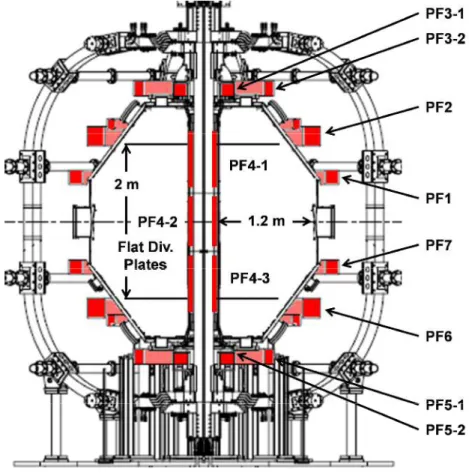
QUEST is a medium sized spherical tokamak [30] with major and minor radii of 0.68 and 0.4 m, respectively. The diameters of the center stack and the outer wall are 0.2 and 1.4 m respectively with flat divertor plates at b (= ±1 m) from the mid-plane. Eight toroidal field coils (TF coil) can produce typical toroidal magnetic field,
Bt= 0.29 T at R = 0.6 m. The poloidal magnetic field coils (PF coils) and QUEST size is schematically shown in figure 2.1. The poloidal magnetic field, B
z, is produced by PF coils of PF1/PF7, PF2/PF6, PF3 – 1/ PF5 – 1 and PF3 – 2/ PF5 – 2.
The center solenoid coils are PF4 – 1, PF4 – 2 and PF4 – 3, which are providing the flux for the plasma via Ohmic heating and capability to supply the magnetic flux of 200 mVs
-1. The chamber aspect ratio
Ac(= R
c/a
c~ 1.4) is derived as the ratio given by (R
out- Rin) / (R
in+
Rout), where the chamber major radius R
c= (R
in+ R
out) / 2 ~ 0.78 m, and the chamber minor radius a
c= (R
out- R
in) / 2 ~ 0.55 m. The chamber elongation factor
cis given by Z
0/a
c~ 1.8.
Figure 2.1: QUEST device showing various PF coils and the flat divertor plates.
Two RF systems with frequencies 2.45 GHz (< 50 kW) and 8.2 GHz (< 200 kW) are used for heating and current drive. For 2.45 GHz, waves are launched from the low field side in the O – mode, and for 8.2 GHz both O – mode and X – mode can be injected. They are injected on the mid plane. For 2.45 GHz and 8.2 GHz, typical fundamental resonance position, R
res1, are 0.37 m (2.45 GHz) and 0.33 m (8.2 GHz), respectively.
2.2 Wide angle visible imaging system:
The Memrecam fx K5 fast camera (NAC Image Technology) is used for this experiment from a radial port with a field of view (FOV) of 60 . NAC’s Memrecam fx K5 provides 2D light sensitivity with ultra high speed and mega pixel resolution. The K5 records brilliant color images or crisp monochrome images with resolutions up to 1280 X 1024 pixels at 1000 FPS (frames per second). Using an advanced CMOS sensor, the K5 captures images at frame rates up to 168,000 FPS with ISO10000 monochrome (~576 Lux @ 1000 FPS F4) in light sensitivity. The electronic shutter opens to 3 micro seconds, and the signals are digitized to 10 bits. The camera is used at 20 kHz and each frame is made up of 288 × 240 pixels. The camera with the wide angle lens is shown in figure 2.2.
Figure 2.2: Memrecam fx K5 fast camera with wide angle lens
2.3 Tangential visible imaging system:
A Photron Fastcam SA5 complementary metal oxide semiconductor (CMOS) camera with frame
rate of 7000 frames/s (fps) at full resolution (1024 × 1024) is used for tangential imaging on the
mid-plane of QUEST. Spatial resolution on the tangency plane is 3.7 mm. The camera is
operated from the tokamak control room via Gigabit Ethernet, and image acquisition is initiated by an external trigger synchronised with the tokamak operational sequence. Image is transferred away from the view port by a 4.5 m long imaging fiber bundle manufactured by Schott. At the back end the camera is connected with the fiber bundle through an image intensifier (IMI). Each frame is made up of 242 × 242 pixels/526 × 240 pixels, and framing rate is 20 kHz/50 kHz. The SA5 camera with the IMI and filter wheel is shown in figure 2.3.
The camera can achieve a maximum speed of 775 kfps with an image size of 128 24. In this experiment we used 704 520 pixels with maximum achievable speed of 20 kfps. However, the actual image is much smaller and higher speeds can be selected with smaller image size. In this case, the photon flux is the limiting factor for achieving higher speed. Quantum efficiency (QE) is 35% at 500 nm. The camera is affected by B
tand the stray field of B
z. Hence, a safe distance of 4 m is maintained from the TF coil with the fiber bundle and associated optics.
The Hamamatsu make C10880-03C IMI is equipped with a single stage multi channel plate and a 16 mm diameter phosphor screen. The relative intensity of the phosphor screen decays to 1%
within 1 s. Luminous gain available is 10
5(lm/m
2)/lx. The multialkali phtocathode gives a wide spectral response with ~15% QE over the visible range. Gain, gate width and delay time is controlled and set from a PC through the RS-232C interface. The front end is attached to a 50 mm C-mount lens (YMV5095, Yakumo) and the back end is connected with the camera through a 1:1 relay lens. The IMI is affected by axial magnetic field and hence it is mounted radially w.r.t.
the TF coils.
The IG-154 fiber bundle is made up of 10 micron elements with an active area of 4 mm 4 mm.
The numerical aperture is 0.63 with a resolution of ~50 LP/mm at a QE of 28% at 500 nm. A 6.5
mm objective lens at the front end and a 16~160 mm zoom lens (VZCH16160 Seikou Opltical
Ltd.) at the back end are used. Up to ~200 keV hard X-rays are produced in QUEST by the RF
generated fast electrons and this environment can significantly reduce the transmission of the
fiber after certain time. Hence, the fiber is shielded from the hard X-rays with 1 cm thick lead
tube.
Figure 2.3: Tangential fast visible imaging with Photron SA5 camera with auxiliary components like image intensifier, filter wheel, zoom lens and relay lens.
Comparison with images using a H filter indicates that the observed visible image is mainly due to the H emission. In order to analyze temporal and spatial evolution of images it is assumed that the neutrals
n0are distributed uniformly in the chamber and images are due to the local evolution of plasma or propagating plasmoid whose electrons can excite the neutrals immediately [1,2]. The intensity I(
ul) of a spectral line of wavelength
uldue to a transition from the upper level u to the lower level l is given (in photons m
-2s
-1sr
-1) by:
2
1 2
1
4 , 1 4
1
xx
g e e e exct x
x ul u
ul n A dx PEC n T n n dx
I
(1)
Here
Aulis the spontaneous transition probability from upper to lower level and
nuis the population number density of the upper level
u (= 3) of the emitting ion [3]. In the collisionalradiative approximation, ignoring recombination, the emissivity can be attributed to the excitation of ground state atoms (n
g) by electrons and the consequent photon emission. PEC
exctis the ‘effective’ photon emission coefficient for the excitation of ground state atoms by the electrons and is a function of
neand T
e. The integration denotes the tangential line of sight for each pixel that traverses through the plasma from x
1to x
2. It has been shown that, at similar n
eand T
ein TORPEX, the mean value of the light emission signal recorded with a tangential fast
camera depends linearly on n
eat varying neutral hydrogen density and ECRH power [4]. Hence, in our case too, it is reasonable to interpret the intensity fluctuations as density fluctuations, although, more precisely it resembles plasma pressure fluctuations. Contextual references to these considerations are again deliberated in chapters 3 and 4.
2.4 Reciprocating probe
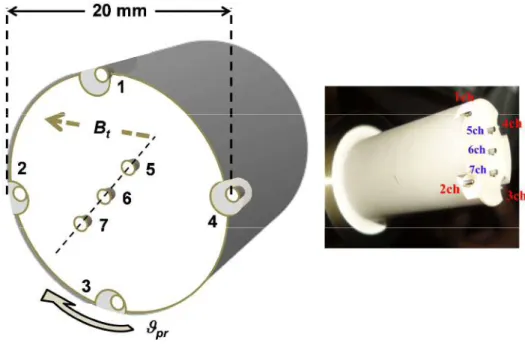
A reciprocating ceramic probe head (diameter 20 mm) consisting of seven tungsten probe tips of diameter 1 mm and length 2 mm each, is inserted radially below mid-plane. The probe head can be rotated about its axis to align the central probes toroidally or poloidally. Schematic of the probe head is shown in figure 2.4. In order to avoid damage due to hot electrons in the ECW phase, probes can be inserted only up to 20 cm from the vessel wall. Hence, only the far-SOL (FSOL) can be scanned in a shot by shot basis in reproducible discharges to measure floating potential (
f) and ion saturation current (
IsatFSOL) at 50 kHz.
Figure 2.4: Left: Schematic of the probe head with 7 tips; Right: Assembled probe head
References
[1] Jha R, Kaw P K, Mattoo S K, Rao C V S, Saxena Y C and ADITYA Team 1992 Phys.
Rev. Lett.69 1375
[2] Ono M et al 2003 Plasma Phys. Control. Fusion
45 A335[3] Prakash R, Jain J, Kumar V, Manchanda R, Agarwal B, Chowdhari M B, Banerjee S and Vasu P 2010 J. Phys. B: At. Mol. Opt. Phys.
43 144012[4] Iraji D, Diallo A, Fasoli A, Furno I and Shibaev S 2008 Rev. Sci. Instrum.
79 10F508Edge turbulence in the slab plasma
A. Statistical features of coherent structures at increasing magnetic field pitch for 2.45 GHz slab plasma
3.1 Introduction I
3.2 Experimental conditions
3.3 Variation of the source plasma with field pitch 3.4
Statistical properties of the fluctuations3.5
Generation and propagation of coherent structures (blobs)3.6
Discussions3.7 Conclusions I
B. Variations in edge turbulence induced by poloidal magnetic field curvatures for 8.2 GHz slab plasma
3.8 Introduction II
3.9 Experimental conditions
3.10 Statistical analysis
3.11 Correlation analysis
3.12 Conclusions II
A. Statistical features of coherent structures at increasing magnetic field pitch for 2.45 GHz slab plasma
3.1 Introduction I
Edge turbulence in plasma confinement devices continues to remain as one of the most important research topics as it plays vital role in the performance of the plasma core and core to edge transports of heat and particle fluxes. This is deemed crucial for future fusion devices like ITER [1] and beyond as the confinement of plasma is determined largely by turbulent plasma processes [2] at the edge. Anomalous convection in the edge plasma transport has been reported experimentally for a wide range of plasma devices [3-9]. Experimental evidences show that mesoscale plasma structures, that extend along the magnetic field lines, often called as ‘blobs’
are convected from the region of last closed flux surface (LCFS) well beyond the scrape-off layer (SOL) [2]. Blobs being omnipresent at the edge region of both tokamaks and stellarators [9]
and with the confirmation of their role in enormous particle and energy fluxes in the far SOL, these convective intermittent structures gained serious importance in the edge plasma community.
These coherent structures are localized in the two-dimensional (2D) plane and appear as ‘blobs’
of higher density in contrast with the lower density ambience. They are spatially extended along the magnetic field lines and appear as filaments in three-dimensional (3D) view of the SOL.
Origin of the blobs has been attributed to the nonlinear saturation of the underlying edge turbulence or coherent magneto-hydrodynamic (MHD) instabilities [2,10]. Qualitative theory of blob dynamics suggests that due to some turbulent processes in the vicinity of the LCFS, a filament with large plasma density at the low field side (LFS) of the torus is peeled off from the bulk plasma [2]. The models assume plasma polarization caused by the curvature and
B drifts atthe LFS of tokamaks leading to the E B convection of the blob towards the main chamber wall.
However, the models propose different damping mechanisms and the predictions on the radial
propagation velocity of blob filaments diverge accordingly. The first model cites sheath
dissipation at the target as the damping mechanism [2,11,12]. The second model includes
damping through a diamagnetic current in the filament [13,14]. Finally a third modified model is
proposed to include both the above models as limiting cases. Here the electron diamagnetic
current acts as the drive for the blob motion and the current loop is closed by the ion
polarization current, sheath currents, and the ion current caused by a neutral friction force [15].
In the limit where sheath losses and the ion-neutral collisions are negligible, the blob velocity (v
b) is proportional to (2a)
1/2, a being the blob size. If sheath losses become dominant,
vbscales as 1/a
2and when ion-neutral friction dominates,
vbis inversely proportional to the ion-neutral collision frequency (
in) independent of
a. Both the sheath dissipation model and the modifiedmodel predict velocity damping for larger filaments and are confirmed through experiments [15- 18]. Nevertheless, the main constraint that prevents rigorous validation of these models through extended traces of blob motion is that the SOL and edge are typically thin in the conventional tokamak discharges. Hence, the velocity damping concept for larger filaments may not be ubiquitous and thereby seems inconclusive.
The other imperative aspect of blob dynamics is the source plasma itself that drives the edge and SOL turbulence and subsequently the blob generation. Statistical features of turbulence can provide essential information about both the source plasma and the propagation dynamics of the intermittent blobs. Probability density functions (PDFs) of density fluctuations at the edge from various machines suggested a large deviation from the Gaussian statistics with strongly skewed curves, reflecting intermittence. Comparison of edge turbulence data taken from machines with different configurations [19-23] was done [24]. Dealing with the complete PDF often proves to be cumbersome and higher order moments like skewness (s) and kurtosis (k) may provide the necessary details. However, only very few detailed reports are available till date on the statistical properties of the blob-generation and propagation regions.
This paper deals in our efforts to achieve better understanding of the source plasma, criteria for
blob generation and also the propagation dynamics in toroidal devices. In the spherical tokamak
QUEST blob generation and propagation is studied by two dimensional fast imaging technique
in slab plasma with a simple magnetic configuration characterized by open field lines [25]. Slab
annular plasma is formed by electron cyclotron resonance heating (ECRH) near the resonance
region and instabilities are excited depending on the ratio of the vertical (B
z) and toroidal fields
(B
t) [26,27]. The
Bz/B
t(field pitch) is varied in an attempt to regulate the source plasma
fluctuations and the blob characteristics. Relative fluctuation level ( I/
~I ) near the ECR layer was
found earlier to be ~ 5% at B = 0 and increased ~ 25% with increasing B [25]. Although the line
tying stabilization effect was expected with increasing
Bzand decreasing connection length between the upper and lower flat divertor plates, the fluctuations and their nonlinear evolution was large and significant at higher B
z. Slab plasma in QUEST also presents a unique feature of the propagation of blobs across a long distance in the R-Z plane (2D). Such blob motions can be traced comprehensively with tangential fast imaging. The region beyond the steep density gradient of the slab towards the LFS resembles the SOL of normal tokamak discharges.
Relatively weak fluctuation at the ECR region and intermittent strong fluctuations dominated by blobs in the outer SOL are observed. Hence, in this work, we attempt to address the following two aspects of blob dynamics with the core idea of varying
Bz/B
t. Fluctuations of the source plasma are characterized. Statistical features of the initial perturbations and trigger mechanisms of blobs are analyzed by steepening the density gradient. Finally, the size, frequency and acceleration of the blobs [28,29] along the excursion are investigated.
Outline of part A is as follows: the experimental setup is discussed next. Change in the source plasma with increasing B
z/B
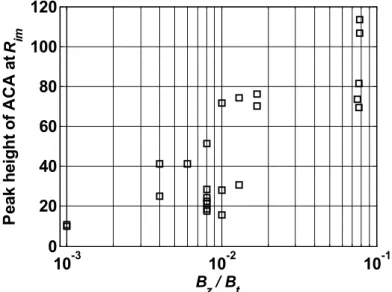
tis characterized in section 3.3. Section 3.4 provides an account of the statistical analysis of the image data. Blob amplitude, waiting time and velocity are determined as a function of B
z/B
twith the conditional averaging technique in section 3.5. Results are discussed in section 3.6 and finally, some conclusions are drawn in section 3.7.
3.2 Experimental conditions
Open magnetic field configuration is realized with both
Btand
Bzfield components without plasma current (< 1 kA). Slab-annular plasmas, intersecting the divertor plates, are initiated with hydrogen and ECRH at 2.45 GHz. Plasmas extend vertically near the resonance layer R
res(~ 0.37 m) corresponding to the resonant field of B
res= 87.5 mT, and diffuse outward depending on RF power and
Bz/B
t.
Bzis varied in the range of -1.5 ~ 6.7 mT. When
Bz/B
tis varied, the pitch distance
z2 R B
zB
t, pitch angle tan
1 Bz Btand the connection length
z t
c
b B B
L 2 of field lines between the flat divertor plates are changed. Typical electron
density and temperature at the edge are n
e~ 5 10
16m
3and T
e~ 1–12 eV. The ion acoustic
speed c
sis ~10-34 km/s and effective ion gyro-radius
sis ~ 3-9 mm. Plasma beta is quite low at
~ 10
-4. Three radial locations are defined; the plasma source region (0.35 <
Rs< 0.6 m),
bounded by a relatively sharp boundary, the intermediate (0.4 < R
im< 0.8 m) and the source-free (0.7 <
Rsf< 0.9 m) regions respectively (figure 3.1).
Rimis characterized by a steep intensity gradient near the plasma boundary and
Rsfby very weak intensity or essentially vacuum, depending on
Bz/B
t. Fairly good agreement of the helix angle with
zand vertical wavelength (
z) of initial helix-sinusoidal perturbations with was observed earlier [25]. Both drift and interchange modes being intrinsic to this plasma [25], experiments are conducted to investigate the helical perturbations near the outer plasma edge, where
B p > 0.Figure 3.1: (a) cross sectional view of the QUEST vessel showing the arbitrary positions of the three regions R
s, R
imand R
sf. Flux contours are shown for the PF26 coil. Dotted rectangle shows the extent of the images; Solid horizontal lines represents the divertor plates (b) top view of QUEST showing the field of view (FOV = 60 ) of the fast camera.
The Memrecam K5 fast camera is used for this experiment from a radial port with a field of view (FOV) of 60 (figure 3.1b). Each frame is made up of 288 × 240 pixels, and framing rate is 20 kHz. The intensity fluctuations can be interpreted reasonably as plasma density fluctuations as discussed in chapter 2.
0.5 1 1.5
-1 -0.5 0 0.5 1
PF2
PF6
Rim Rsf
Rs
(a)