光円錐ハミルトニアンにおけるくりこみ群の方法
杉原, 崇憲
九州大学理学研究科物理学専攻
https://doi.org/10.11501/3122894
出版情報:Kyushu University, 1996, 博士(理学), 課程博士 バージョン:
Department of Physics, Kyushu University, Fukuoka 812, Japan (
December26, 1996)
Abstract
A perturbative renormalization group
(RG)
scheme for the light-front Hamiltonian is formulated on the basis of the Bloch-Horowitz effective Hamiltonian, and applied to the simplest
q}
model with spontaneous symmetry breaking of Z2 symmetry.RG
equations are derived at one-loop order for both symmetric and broken phases. The equations are consistent with those calculated in the covariant perturbation theory. For the symmetric phase, an initial cut
off Hamiltonian in the
RG
procedure is defined by excluding the zero-mode from the canonical Hamiltonian with an appropriate regularization. An initial cutoff Hamiltonian for the broken phase is constructed by shifting a field
¢(
x)
by¢(
x)
='P(
x)
+ v in the initial Hamiltonian for the symmetric phase.The vacuum expectation value v is determined as a function of the original running parameters so that the relation does not depend on the unphysical cutoff parameter. On the basis of the perturbative considerations, the three
dimensional real scalar model is renormalized in a nonperturbative manner on a truncated Fock space. A critical line is calculated by diagonalizing the Hamiltonian regularized with basis functions. The marginal
( ¢6)
coupling dependence of the critical line is weak. The vacuum expectation value v is determined as a function of running mass and coupling so that the mass of the ground state vanishes.the quantum chromodynamics
(
QCD)
nonperturbatively to investigate low-en rgy hadronic physics. The most reasonable nonperturbative method for u h a problem is th latti e gauge theory. In the method, it is easy to calculate the lightest particle state, but not to evaluate the excited and scattering states. Although there exist many nonperturbative prescriptions in the Hamiltonian formalism, the formalism has been abandoned so far sin Lorentz invariance and the renormalizability are not obvious.The light-front
(
LF)
Tamm-Dancoff field theory[1]
is known as a m thod bas d on the Hamiltonian formalism. The Hamiltonian is constructed by quantizing fields on the light-front and truncating the Fock space. The truncation is called the Tamm-Dancoff approximation
[2].
The completeness of the Fock space is approximated as���p In) (nl
rv1,
where NTD ----t oo corresponds to the full theory. It is possible to calculate mass spectra nonperturbatively by diagonalizing the Hamiltonian in the space. The resulting mass spec
trum seems to be accurate for low-lying states, since the pair creation and annihilation are suppressed in the LF field theory, especially the pair creation of particles from the LF vac
uum is kinematically prohibited. The prohibition warrants the truncation to be reliable.
This is really true in two-dimensional gauge theories
[3-5],
since the physical vacuum is trivial in the light-front field theory[6-9]
and as the natural result the states have simple structures. This is an advantage of this method, but, at the same time, it causes a problem.No pair creation means that the vacuum is trivial
HIO)
=0,
i.e., the vacuum is always symmetric and can not posses information of the symmetry in the LF field theory. This is a serious problem, because various phenomena are explained as results of spontaneoussymmetry breaking
(SSB)
in the relativistic field theory. How can the LF field theory describe
SSB?
It has been said that the zero-mode operator leads the LF field theory toSSB
[6,10].
We have a constraint equation for the zero-mode, if the system is quantized in a boxworks
[7-9]
for the two-dimensional real scalar model, in which the zero-mod con traint equation is solved under reasonable approximations to describe SSB of the Z2 symm try. At least for the two-dimensional case, the light-front formulation seems to be consist nt with the equal-time one, if the zero-mode contributions are treated properly. Thi approa h to SSB has never been applied to higher dimensional models having ultraviolet div rg nc .The main purpose of this paper is to propose practical perturbative and nonp rturbative RG schemes and describe SSB by using the schemes. The light-front field th ory raises complicated renormalization issues, when it is applied to realistic higher dimensional field theories, because of the non-covariant Hamiltonian formulation. As a powerful method for solving such renormalization issues in light-front field theory, we consider Wilson's renor
malization group
(
RG)
approach[13],
in which renormalization is achieved automatically by finding a fixed point and a renormalization trajectory. Perry[12]
applies the Minkowskispace version of Wilson's RG approach
[14]
for the light-front Hamiltonian. Glazek and Wilson formulate a new perturbative RG scheme for the Hamiltonian by using a sp cially designed similarity transformation[15].
The two RG schemes are based on perturbation and reliable for an analysis of RG flows near a Gaussian fixed point. In this paper, BlochHorowitz effective Hamiltonian
[16]
is used here in order to achieve renormalization. This scheme is applied to the simplest¢4
model in four dimensions. Our RG scheme is simple compared with the other two, since it contains no nonlinear equation. This scheme is, furthermore, free from the "vanishing energy denominator" problem, as shown in Sec. II.
This scheme was originally introduced by Perry in the context of light-front field theory, but not accepted because of the energy dependence of the effective Hamiltonian
[12].
Thedependence means that the effective Hamiltonian is not Hermitian, but it does not cause problems in practice, as shown in Sec. II. The resultant RG equations are energy indepen-
the correct vacuum expectation value
(VEV)
to restore positivity of the spectrum. As a result, we have an asymmetric Hamiltonian HA, in which the RG parameter spa i larger than that for the symmetric Hamiltonian Hs. This is equivalent to assuming that th asymmetric Hamiltonian originally includes symmetry breaking interactions. There hould exist a relation amongVEV
and running parameters which does not depend on an unphy ical cutoff parameter. TheVEV
is determined from the relation as a function of th original parameters. The broken phase is an RG invariant surface containing the critical line in the parameter space of the asymmetric theory. The symmetry breaking interactions were originally introduced by Perry and Wilson in the coupling coherence study[19,12],
but theinstability of the canonical Hamiltonian was not mentioned.
The considerations mentioned above strongly depend on perturbation. In order to inves
tigate the instability of the canonical Hamiltonian Hs in the broken phase, we renormalize the real scalar model in three dimensions with a nonperturbative RG prescription based on the Tamm-Dancoff truncation. The theory is regularized by expanding wavefunctions in terms of basis functions in a truncated momentum space. The mass spectrum is then obtained by diagonalizing the Hamiltonian within a space spanned by the basis functions.
In actual calculations we take the Fock space up to three-body states. The truncation is justified by examining the wave functions. The marginal coupling dependence of the critical line is also analyzed. A proper Hamiltonian for the broken phase is construct d by shifting the field as
¢(x)
=<p(x)
+ v. A relation of v to the original parameters are nonperturbatively determined by searching the critical surface which gives a vanishing mass for the ground state.
The paper is organized as follows. Section II presents our RG scheme. In Sec. III, the scheme is applied to
¢4
model in 3 +1
dimensions with spontaneous symmetry breakingon basis functions is introduced. In Sec IV C, numerical RG is carried out by u ing the nonperturbative regularization mentioned above. Section V is devoted to summary and discussions.
Notational conventions are summarized as x± =
(x0
± xd-1)/.J2
, time x+, space(
x-, x..L)
, momentumk
=(
k+,k..L),
metric g+-= g+- = -gii = -gii = l(
i = 1, ... , d- 2)
and others= 0, and LF energy k-=E(k)
=(ki
+ r)/
2k+, where r is a mass parameter.II. PERTURBATIVE RG SCHEME
The basic RG procedure for the Hamiltonian is the following.
(
l)
A bare Hamiltonian is regularized by truncating Fock space at a large cutoff energyA0.
The regularized Hamiltonian
HAo
is regarded as the initial Hamiltonian in RG procedure.(
2)
The truncated space is separated into the lower- and higher-energy sectors. An effective HamiltonianHA
for the lower-energy sector is constructed in a manner that it preserves physics of the lower-energy sector, while the higher-energy sector is eliminated. The cutoff is thus lowered toA.
In the actual derivation ofHA,
the finite transformation(Ao
----+A)
isexpressed with successive small transformations
(Ao
----+A1
----+···A),
and the nth effective HamiltonianHAn
is derived with perturbation from the(
n- l)
th oneHAn_1•
(
3)
The cutoffA0
by changing the energy scale, and field variable are also rescaled so that a fixed point may exist. In consequence,HA
is transformed into a new HamiltonianH�0
withthe initial cutoff
A0.
The second and third steps progress from ultraviolet to infrared.The main purpose of this paper is to propose a practical perturbative RG scheme. Our RG scheme differs from those of Perry and of Glazek and Wilson in the second step. Perry uses the Bloch effective Hamiltonian
[
20)
which contains an operator R obeying a nonlinearby assuming that all matrix elements of Rare small, the solution has infinitely large matrix elements, since the matrix elements contain vanishing energy differences in denominators.
To circumvent the problem, he adopts the invariant mass regularization
[12,21],
but it causes a new problem that the running mass and coupling have spectator dependenc . The RG scheme of Glazek and Wilson also contains a nonlinear equation, but the "vanishing energy denominator" problem does not appear, since it is designed so that energy differences in denominators can be replaced by energy sums. Our RG scheme is based on the Bloch- Horowitz effective Hamiltonian[16],
(2.2)
where
HAo
is composed of the free and interaction parts,H0
and V. The effective Hamil- tonian has been derived from the Schrodinger equationHAol'lli) = Eil'lli)·
Eigenvalues and eigenstates,E�
andjwi),
ofHA
satisfyE� = Ei
andl'llD = Pj'lli)·
The Bloch-Horowitz effective Hamiltonian thus preserves physics of theP
sector. The present RG scheme is simple compared with the other two, since it contains no nonlinear equation. This scheme is, furthermore, free from the "vanishing energy denominator" problem, as shown in Sec. II.This scheme was originally introduced by Perry in context of light-front field theory, but not accepted because of the
Ei
dependence of the effective Hamiltonian[12].
The dependence means that the effective Hamiltonian is not Hermitian, but it does not cause a big problem in practice, as shown in Sec. III. This is one of the main claims in the present paper. This scheme is applied to the simplest¢4
model with spontaneous breaking of the discrete z2 symmetry¢ -+ -¢.
As step
(1),
the light-front bare Hamiltonian is regularized with a boost-invariant reg- ularization. As a feature, the bare Hamiltonian has no coupling between center of massIn light-front kinematics, an invariant mass
M
of ann-body Fock state is defined as(2.3)
for total momentum
n
p
= (P+,Pl_) = Lki. (2.4)
i=l
The invariant mass regularization excludes all Fock states with
M
larger than an initial cutoffA0.
The massM
does not diverges because the mode withk+ =
0 is removed here.The initial Hamiltonian is denoted by
HAo·
As step
(2),
the truncated Fock space is cut atM = A
smaller than A0 by a finite amount, and separated into the lower and higherM
sectors, i.e., the P and Q sectors. We use the Bloch-Horowitz effective Hamiltonian(2.2),
where the ith eigenmassMi
is determined fromEi
with the dispersion relationEi =(Pi+ Ml)/2P+.
In principle, the finite transformed Hamiltonian
HA
is derivable with(2.2)
fromHAo·
Inpractice, however, the finite transformation is described with successive small transforma- tions. The nth Hamiltonian
HAn
is derived with n times transformations. This discretization has a merit, which will be explained in Sec. III B. The nth effective HamiltonianHAn
in-eludes the Q-space Green function
(2.5)
where the Q space is
An+l
<M
<An
and the P space isM
<An+l·
The Green functionG
is related to the free oneG0
=1/(Ei-
QH0Q)
asG =Go+ G0QVQG, (2.6)
where
A-1 - B-1
=B-1(B- A)A-1
is used. The full Green function G is obtained by solving(2.6)
perturbatively.The RG procedure is completed by the scale transformation of step
(3).
Th effective HamiltonianHA
is transformed into a new HamiltonianH�0
with a cutoffA0
by scaling transverse momentak
..l as(2.7)
since the
P
space(M
<A)
is expanded to theP
+ Q space(M
<A0);
precis ly speaking, a total energy of an n-body Fock state belonging to theP
space is varied in the r gionn
k� + r p2 + A2 0
< """' t..l < _..l __ _� 2kt 2
P+
'and the rescaling expands to the region to
n
k'. 2 +(A /A)2r P'2 + A2
0
< """' t..l0
< _.=::...l __� 2k7- 2
P+
't=1 t
(2.
8)
(2.9)
In addition to the transverse momenta, the field variables
¢;( k) (
the creation and annihilation operatorsa(k)
andat(k))
and the HamiltonianHA
are also rescaled to[12]
cf;(k+, k..i)
=acf;'(k+, k�)
HA(cj;(k+,k..i))
=/3-1H�0(cj;'(k+,k�)) (2.10)
The constants
a
andf3
are determined so that fixed points can exist. There exists a Gaussian fixed point in the four-dimensional¢;4
model. At the fixed point,HAo
is reduced to the free partH0(A0; cj;(k+, k..i)).
Then, transformed HamiltonianHA
and the rescaled oneH�0
areeasily derived as
HA
=P Ho(Ao; cf;(k+, k..i))P
andH�0
=f3P Ho(A0; acf;'(k+, k..l))P.
Theconstants
a
andf3
are determined from the condition thatH�0
=HAo.
The constants thus obtained are[12]
(2.11)
Adopting the Bloch-Horowitz effective Hamiltonian in step
(2)
makes the present RG procedure practical, because we can easily solve Eq.(2.6)
in perturbation theory. Thepresent RG scheme is free from the "vanishing energy denominator" problem, because an energy gap between
Ei
andE
does not vanish for eigenmassesMi
rv Aphys of low-lying states(2.12)
where
M
belongs to the Q space.The effective Hamiltonian is not Hermitian, since it depends on
Mi.
However, it does not make any trouble. The only difference from the ordinary RG is that th running massr and the running coupling A depend on not only A but also
Mi.
TheMi
d pend nc orthe state dependence becomes negligible for A >>
Mi,
since on the right-hand side of(2.6) Ei- E
=(Ml - M2)/(2P+)
rv-M2 /(2P+)
as a result ofMi
<< A <M
< A0. We are interested in low-energy physics, soMi
is considered to be of order Aphys· The parameters r and A thus have noMi
dependence for A >> Aphys·III. APPLICATION TO FOUR-DIMENSIONAL REAL SCALAR MODEL
A. The first step of RG procedure
The Lagrangian density of the ¢} model in four dimensions is
(3.1)
for a real scalar field ¢. The field is quantized as
(
d =4)
(3.2)
if the zero-mode is neglected. The factor
1/4
on the right-hand side of Eq.(3.2)
is from the Poisson bracket(3.3)
where <I>(x) = n(x)- 8_¢(x) is a primary constraint and 1r is conjugate to¢. The field is expanded in terms of oscillators at x+ = 0,
(3.4)
where
(3.5)
Inserting this form into
(3.2)
yields the relation(3.6)
between the coefficients of expansion for positive k+ and k'+. Obviously,
a(k)
andat(k)
with positive k+ are annihilation and creation operators for the Fock vacuum. As an important feature of light-front field theory, furthermore, they are annihilation and creation operators also for the true vacuumjO),
since it is proven thata(k)jO)
=0
for positive k+[6].
This indicates that the true vacuum is trivial in light-front field theory, at least as far as the zero-mode is neglected; it is still true even after the zero-mode is included explicitly with an appropriate way[7-9].
The Fock space is then constructed by acting the creation operator on the true vacuum:jk1, k2, ... , kn)
=Il�1 at(ki)jO).
The Hamiltonian derived from the energy-momentum tensor is
(3.7)
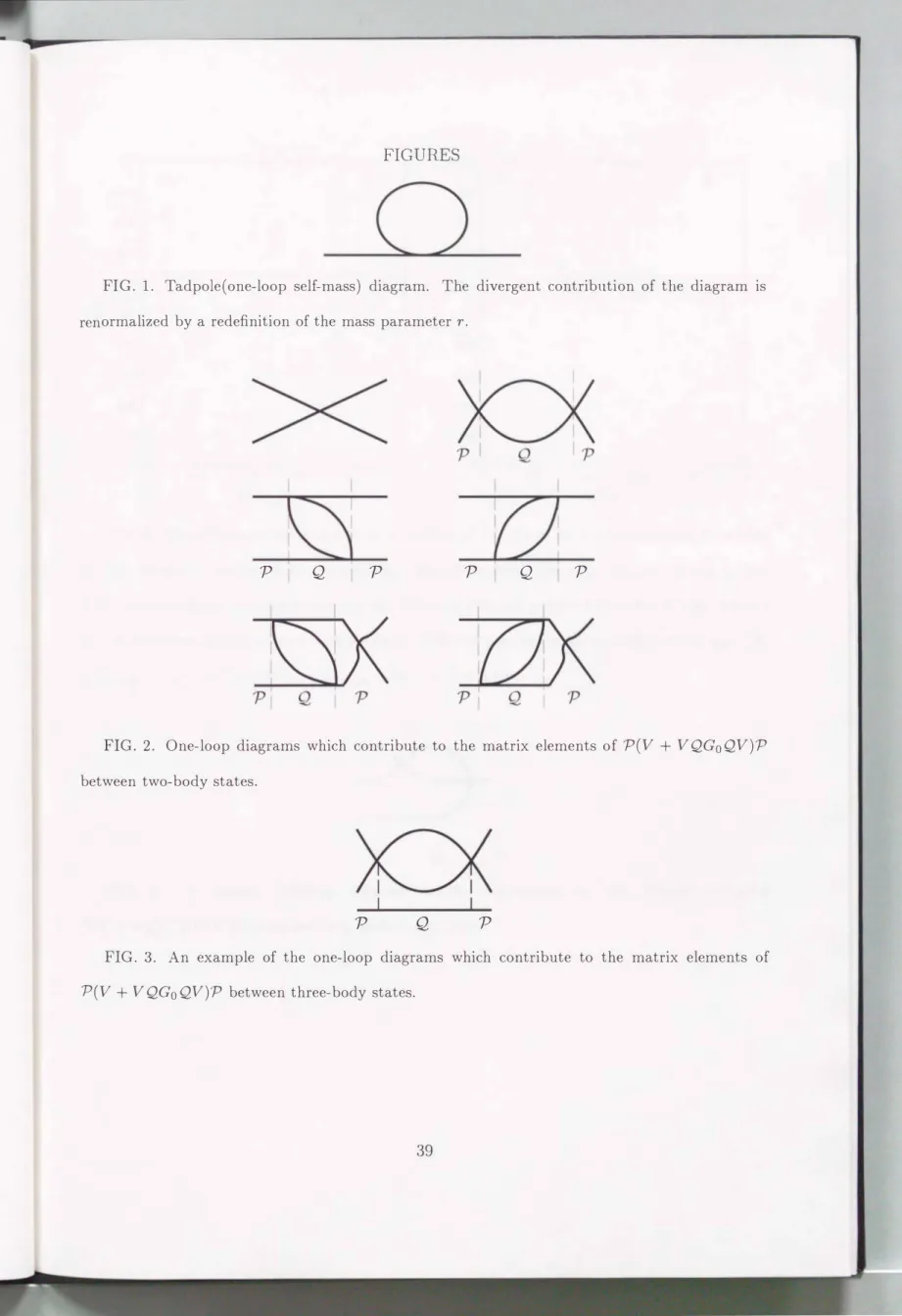
where the tadpole diagram
(
F ig.1)
is removed by normal ordering the interaction term.The Hamiltonian is rewritten as
H(Ao)
=Ho
+ V,00 00
V =
L
Vn,n +L (
Vn,n+2 + Vn+2,n)
,n=2 n=l
(3.8)
(3.9)
(3.10)
where
A
J 4 dd-1k· n
Vn,n
=16(21f )d-In! [ g Jkt'] [ g dd-!Pi ]
x()
(
EA0 -�
E( k; )
-�
E( p
;) )
()(
EA0-�
E( k
;) - �
E( P
i) )
X
!k1, k2,P1,
· · ·,pn)(k3, k4,p1,
· · ·,Pn!,
A
J 4 dd-1k· n-1
Vn,n+2
=24(21f)d-l(n- 1)! [ g Jkt'] [ g dd-!Pi ]
x()
(
EA0 -E(kJ) - � E(p;) )
()(
EA0 -�
E( k; ) - �
E( p
;) )
X
!k1,p1,
· · ·,Pn-1)(k2, k3, k4,p1,
· · ·,Pn-11
where EA0 =
(Pi
+A6)/2P+.
The total energy and momentum of an n-body state!k1, k2, ... , kn)
satisfy the dispersion relation E =(Pi
+M2)/(2P+),
so the invariant massM
of the state is represented by the Jacobi variables,xi
andsi(i
= 1,... , n),
aswhere
n 2
+M2
=Lsi r >nr - 2
'i=1 Xi (3.12)
(3.13)
One of the Jacobi variables is a dependent variable, since
2:.:�1 Xi
=1
andL.:i=1 si
= 0in consequence of
P
=2:.:�1 ki.
Thexi
can vary from 0 to1
and two components of the vectorsi
=(
s}
, si)
from -oo to oo. The invariant mass M2 becomes minimumn2r
whensi
= 0 andXi
=1/n
for alli,
and it diverges at s{
= oo or atXi
= 0. The ultraviolet and infrared divergences are simultaneously excluded by the invariant mass regularizationM
<A0.
The Hamiltonian(3.8)
has already been regularized with this, i.e., with thestep function () appearing in the momentum integrations. Here, it should be noted that the Hamiltonian does not include the zero-mode at all. The Fock vacuum is obviously an eigenstate of the Hamiltonian, indicating that the physical vacuum is trivial. A center of
mass motion is decoupled from internal motion in the Hamiltonian, ince it do s not contain any interaction between the two motions. This property is not broken by th invariant mass regularization.
The light-front quantization mentioned does not treat the zero-mode properly
[6,22].
As shown in Sec. III B, it is needless for the sy mmetric phase, but not for the brok n one. In principle, the zero-mode is treatable by quantizing the theory in a spatial box-
L < x- � L under the periodic boundary condition, but in practice the procedure does not seem feasible, as mentioned in Sec. III C. The Ohio group suggests adding counter terms to the regularized Hamiltonian which does not contain the zero-mode[12,19,23].
An aim of th present paper is to support the suggestion.B. The second and third step of RG procedure
The second step of out RG procedure starts with dividing the finite transformation
(A
0 ---+A)
into successive small transformation(Ao
---+A1
---+···A).
For the nth smalltransformation, G is obtained by solving G = G0 + G0 QV QG perturbatively, where the projectors
P
and Q are defined asPlk1, k2, ... , kn)
=B(EA0- c)lkl, k2, ... , kn) Qlkl, k2, ... , kn)
:=B(E- EA0)1kl, k2, ... , kn)
(3.14) (3.15)
for any state having the total energy
E.
As shown in(3.12), An
should be larger thanJr,
so the one-body Fock state(
withM2
= r)
can not be in the Q space. Any diagram including the one-body state then does not contribute to the Q-space Green function G.In this paper we make one-loop approximation and neglect all irrelevant operators pro
duced by the RG procedure as a reasonable approximation. A perturbative expansion of the Bloch-Horowitz Hamiltonian is then calculated up to second order in A, that is,
(3.16)
The second order correction
PV QG0 QVP
gen rates two-, four- and six-point vertices, but the six-point one is neglected, because it is an irrelevant op rator. Th correction i obtain d by calculating the matrix elements(3.17)
separately.
Matrix elements of
P(V
+V QG0 QV)P
between two-body Fock states are composed of four-point vertices displayed in Fig.2.
In our all diagram, time flows toward the right. The longitudinal and transverse momenta are conserved at each vertex, and all particl s arc on shell. A net contribution of the diagrams becomes(3.18)
The effective interaction has the same form as
V,
but with a new coupling constant(3.19)
where
(
=1/167r2
and A is a loop integral defined asA=
J[�d:;i]83(P-�ki)F(k1,k2),
=
IA(An, r(An), Mi)- JA(An+l, r(An+l), Mi), (3.20)
for
(3.21)
The loop integral A is obtained with an analytic function
IA
defined in Appendix A. The function depends on the cutoff,Tn
andMi,
but not onP.
Hereafter, it is assumed thatAo
>>Aphys
andMi
andr n
are of orderAphys·
ForAn+l
>>Aphys,
A= 47rln
An+l.
An (3.22)
Matrix elements of
P(V
+VQG0QV)P
between three-body states are also calculated in a similar way. All diagrams contributing to the elements are also in Fig.2,
but with aspectator added. An example is shown in Fig.
3.
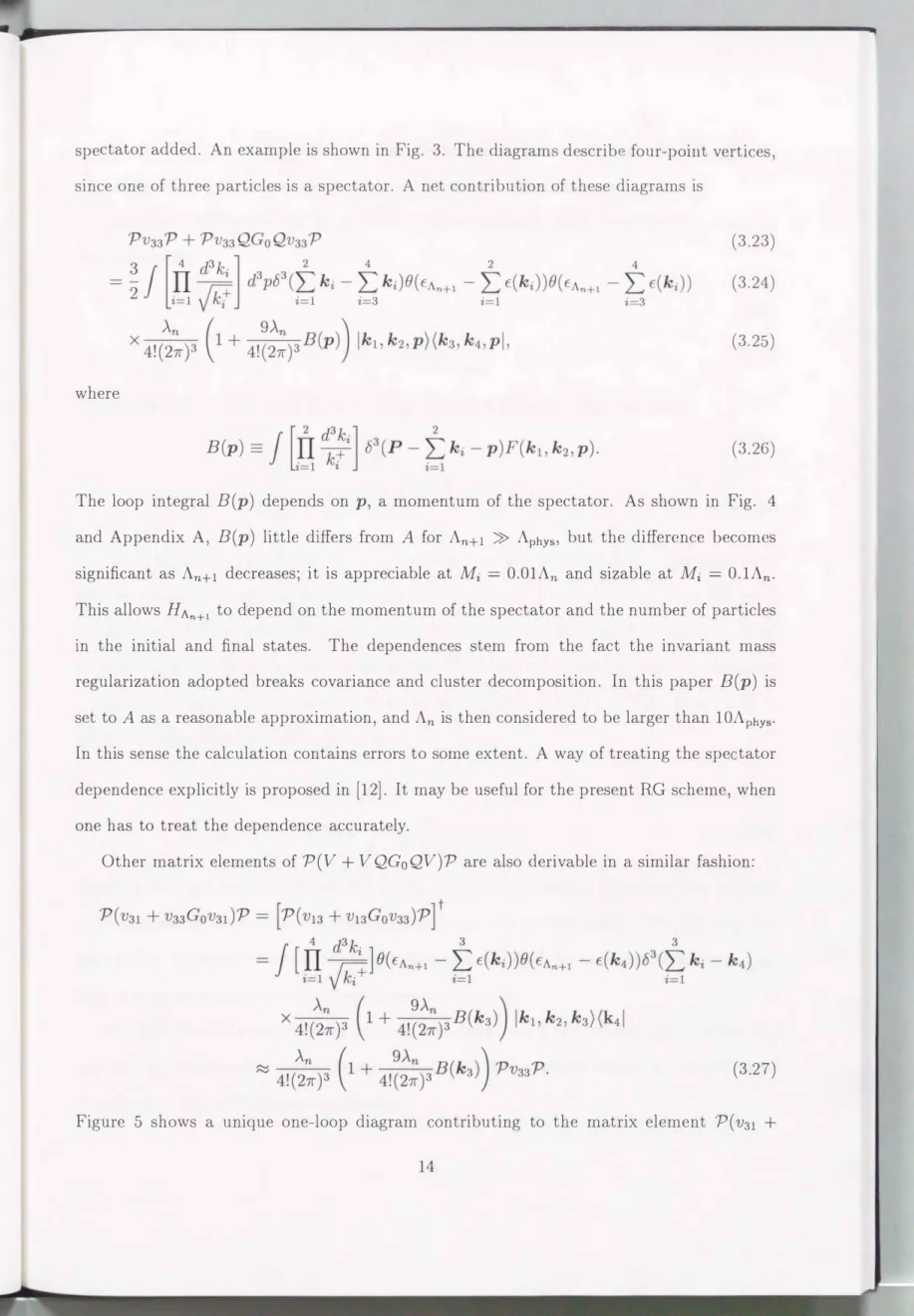
The diagram d scrib four-point vertices, since one of three particles is a spectator. A net contribution of these diagrams iswhere
(3.23) (3.24)
(3.25)
(3.26)
The loop integral B
(
p)
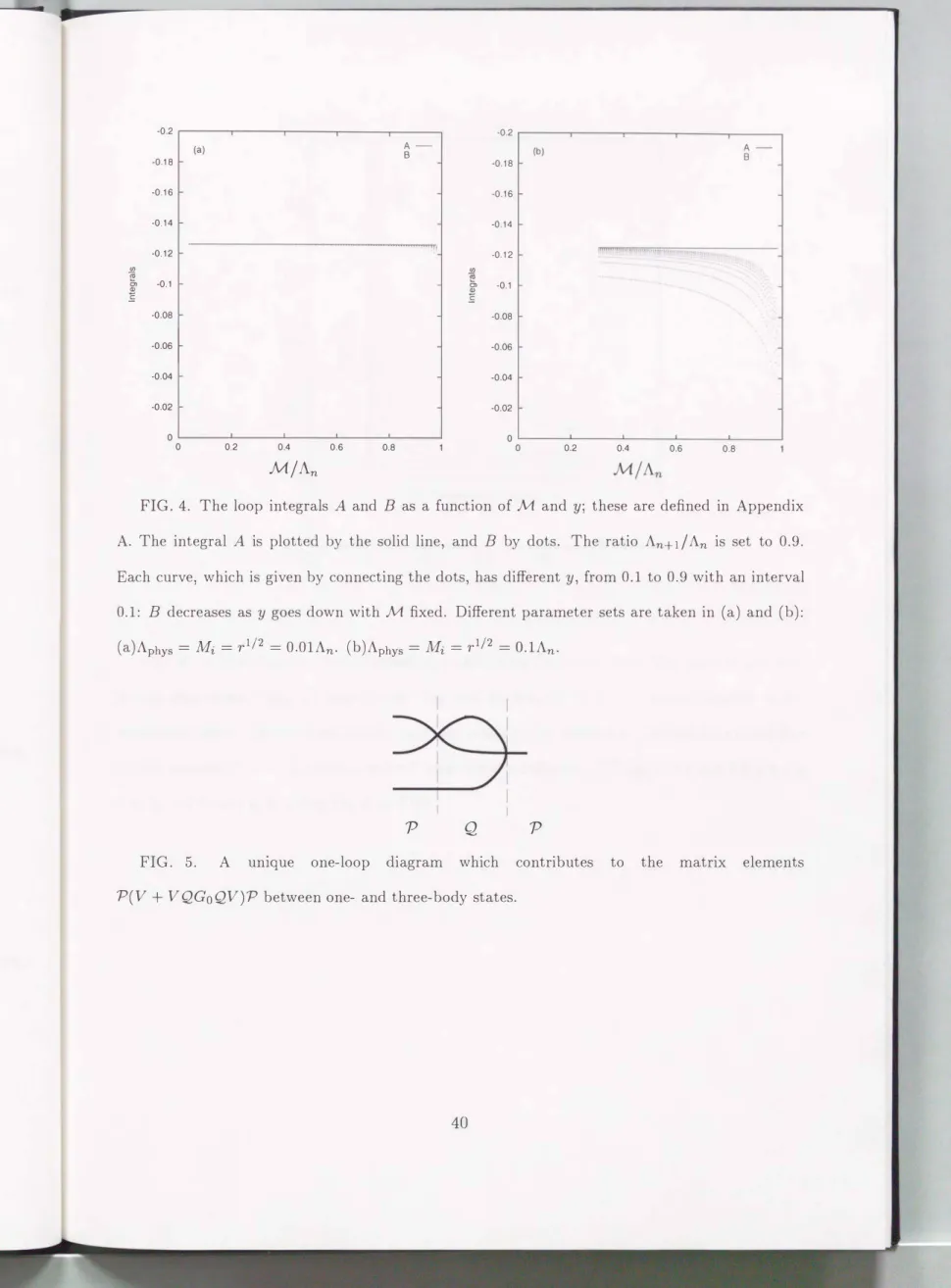
depends on p, a momentum of the spectator. As shown in Fig.4
and Appendix A, B
(
p)
little differs from A forAn+l
>>Aphys,
but the difference becomes significant asAn+l
decreases; it is appreciable at Mi =0.01An
and sizable at Mi =0.1An.
This allows HAn+l to depend on the momentum of the spectator and the number of particles in the initial and final states. The dependences stem from the fact the invariant mass regularization adopted breaks covariance and cluster decomposition. In this paper B
(
p)
isset to A as a reasonable approximation, and
An
is then considered to be larger than10Aphys·
In this sense the calculation contains errors to some extent. A way of treating the spe tator dependence explicitly is proposed in
[12].
It may be useful for the present RG scheme, when one has to treat the dependence accurately.Other matrix elements of
P(V
+V QG0 QV)P
are also derivable in a similar fashion:(3.27)
Figure
5
shows a unique one-loop diagram contributing to the matrix elementP(
v31 +v33QGoQv3I)P.
No one-loop diagram contributes to the matrix lementPv13QG0Qv31P,
indicating that the element vanishes within the present approximation.
The effective Hamiltonian
HAn+I
thus obtained holds th same form asHAn,
but withnew parameters
Tn+l = Tn,
\ \ '21
An+l An+l =An+ 3(An
n-- An
.Taking the infinitesimal limit
8A
----+0, (An+l = An+ 8A)
leads to RG equations(3.28) (3.29)
( 3
.3 0 )
For
A
>>Aphys,
the right hand side of the second equation tends to3( A
2• The right handside originally included a partial derivative
8IA (A, T(A)) I 8A
withT(A)
fixed, but it has been replaced bydiAl dA.
The replacement is correct in this case, because ofdT IdA = 0.
Evenif
dT IdA -=/= 0
just as in the case of subsection III C, one can make the same replacementto derive RG equations at one-loop level, since
diAidA = 8IAI8A + O(n)
as a result ofdTidA = O(n).
The solution to(3 . 3 0 )
isT(A) =To,
A(A)- Ao
- 1- 3(AAol(47r)'
(3.31)
(3.32)
where
To= T(Ao), Ao = A(Ao)
andA= IA(Ao, T(Ao))- IA(A, T(A)).
Expanding the solutionA(A)
in power of A, one can find that it contains not only contributions of the one-loop diagrams
(
Fig.2)
but also those of the ladder diagrams, although for each small transformation only the one-loop diagrams have been taken into account.The RG procedure ends up with the scale transformation
T
of(2.9)
and(2.10),
where it is assumed that there exists only a Gaussian fixed point in the present model. The transformed HamiltonianH�0
=T[HA]
has parametersA
'(A)
=A(A), r'(A)
=( ;,. )
2r(A), (3.33)
The running coupling X
(A)
depends not only onA,
but al o on th eig nvaluMi
ofHAo
through A. In the limit
A----*
oo, however, the coupling tends to-\(A)=
Ao1-
3(-\0ln(A/A0)/(4n)' (3.34)
indicating no
Mi
dependence. The mass parameterr(A)
present inHA
has noA
dependence and then equal to the lowest massM1,
so that the corresponding param terr'(A)
in the transformed HamiltonianT[HA]
behaves asM1A0/ A.
We then draw a flow diagram for the lowest state by settingMi
=M1
=Mphys
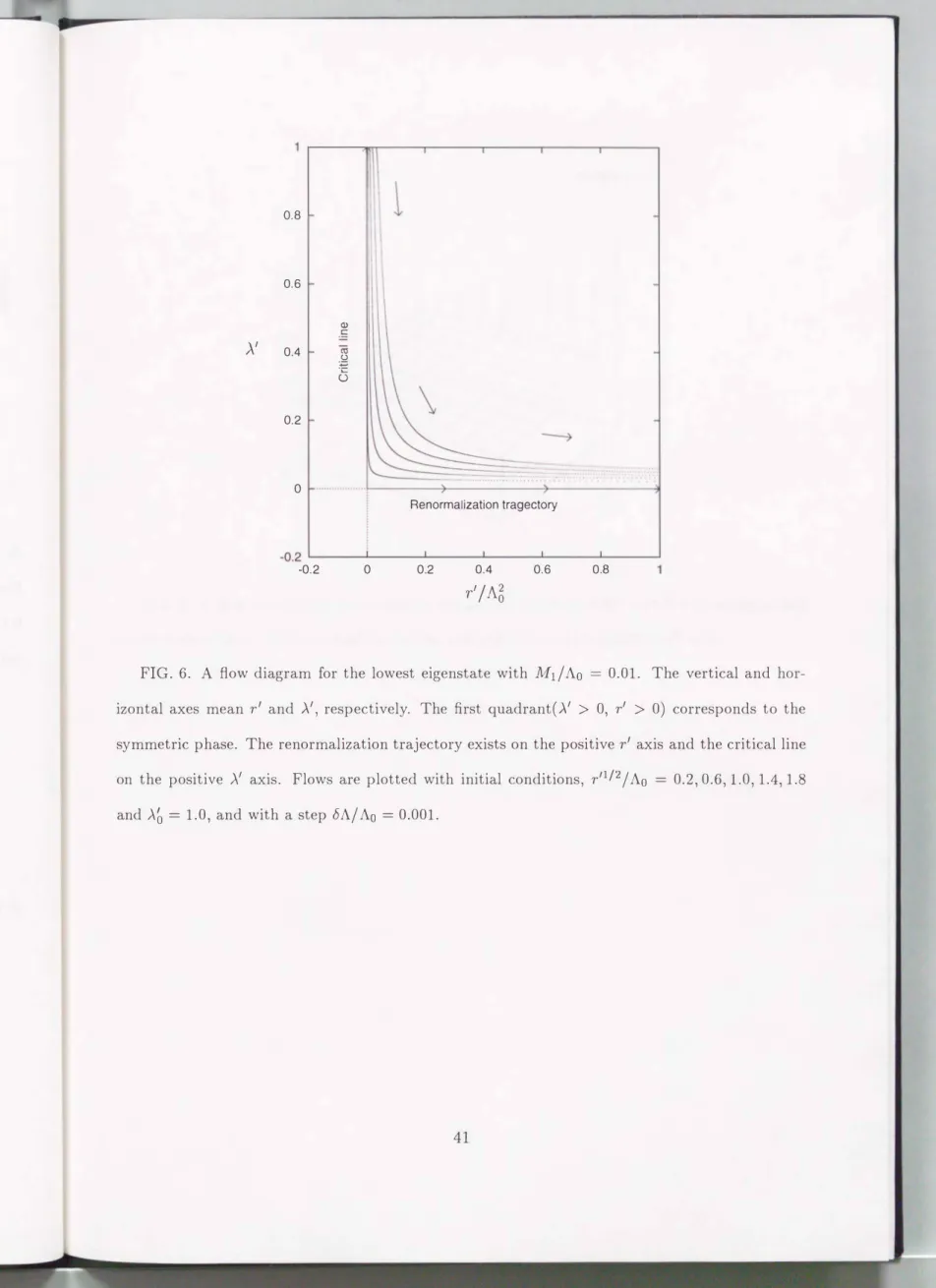
in A as a renormalization condition. The diagram presented in Fig. 6 shows, as expected, that there exists a renormalization trajectory on th positive r ' axis. On the axis X is always zero, indicating that the present model is trivial.Once the trajectory is found for the lowest state, renormalization trajectories for other states are obtainable from the one for the lowest state by replacing
M1
by invariant masses of the excited states, if they are known. In the present case, such a state depend nee does not appear as a reflection of the triviality, that is, all the trajectories exist on the positive r'aXlS.
There appear two phases in Fig. 6; a critical line between the two is on the positive X axis. A phase present in the first quadrant
(-\'
2:: 0 and r' 2:: 0)
is symmetric for thereflection
¢
----*-¢,
since the effective Hamiltonian holds the symmetry. Another phase appearing in the second quadrant is then considered to be a broken one. The present cutoff HamiltonianHA0,
however, is not applicable for the phase, since Fock states with negativer are not physical in the sense that tachyons come out. In general, light-front Hamiltonians are different between the phases, while their vacua are always equal to the Fock vacuum.
This is explicitly shown in two-dimensional
¢4
model[7-9];
for the symmetric phase the Hamiltonian contains oscillatory modes only, while for the broken phase it includes both zero and oscillatory ones. The Hamiltonian for the broken phase has a new mass term produced by the zero-mode in addition to the original one r, so one can define Fock stateswith the sum, even if
r
is negative. Further discu sion on th brok n phase is mad in Sec.III C.
C. The RG equations for the broken phase
The RG equation
(3.30)
is valid for the symmetric phase, but not for the broken one, because the canonical Hamiltonian is tachyonic in the broken phase, as shown in S c. III B.The failure stems from the fact that the present HAo does not contain the zero
(k+
=0)
mode. It is known that there are two kinds of zero-mode, a constant and a onstrained zero-mode. The zero-mode is responsible for the spontaneous symmetry breaking, because the order parameter cannot become nonzero without the zero mode. Hence the present HAo is valid only for the symmetric phase which has a vanishing order parameter.
There are two ways of finding a Hamiltonian valid for the broken phase. One way is to treat the zero-mode explicitly
[6-9).
For this purpose¢4
theory is usually quantized in aspatial box
-
L <x-
< L under the periodic boundary condition, so that the z ro-mode is separated from the oscillator ones. The resulting bare Hamiltonian is different from the present Hamiltonian in the sense that the bare Hamiltonian contains not only the oscillator modes but also the zero-mode. The zero-mode is an operator-valued function of the oscillator modes, since the zero-mode satisfies a constraint[6)
j_
-L Ldx- { (r-ai)¢(x)+ �¢3(x) 3. } =0. (3.35)
This has been obtained by integrating the equation of motion over
x-.
In general, it is not easy to solve the operator valued nonlinear equation for the zero-mode without perturbation in order to treat spontaneous symmetry breaking. A trial is reported for¢4
model in two dimensions. In[7-9),
the equation is symmetrically ordered and approximately solved under the Tamm-Dancoff truncation. However, it is not clear how we should order the equation, since the zero-mode is not a dynamical operator.Another way is to add counterterms to the canonical Hamiltonian which has no zero- mode
[12,19,23].
Only the zero-mode can make the order parameter(Oj¢j0)
nonzero. Thismeans that the system has to sit in the bottom of the effective potential, a oon as the zero-mode is discarded from
¢.
So we introduce a constant zero-modev,
and hift¢(x)
as¢( x) = <p( x) + v,
and determine a value ofv
as a function of original running parametersr
and
A.
In terms of the shifted field<p
the Lagrangian density b comeswhere
u
= vr + 1v3, A
3.
m=r+- AV2
2 ' g =VA,
(3.36)
(3.37)
and a constant term has been discarded, because it is irrelevant to physics. The light-front Hamiltonian is then
(3.38)
where normal ordering is assumed. A linear term in
<p
does not appear, since the constrained zero-mode is removed by a small longitudinal cutoff, i.e., invariant mass regularization.Following the RG procedure shown in the previous subsections, one has RG equations for
m, g,
andA.
RG equations for new parameters areBy taking infinitesimal limit An+l = An
+
8A, 8A ---+0,
we havedm 2
AdA=
(g'
d
g
AdA
= 3(Ag,
Ad
A = (A2
dA
3 '
where
A
is replaced with41f
ln(
A/
A0)
. The solutions to(3.42)
are obtained as(3.39) (3.40) (3.41)
(3.42)
m(A) - m - �A v2 � Aov5
- 0 3
°0
+3 1
+3( Ao ln(A0/ A)'
(A)- go
g - 1
+3(A0 ln(A0/ A)' A(A)
=Ao
1
+3(A0 ln(A0/ A)"
Cutoff dependence of the original parameters is
v(A)
=vo,
r(A) - r �A v2 - � Aov5
- 0
+6
°0 6 1
+3( Ao ln(A0/ A)'
A(A)- Ao
- 1
+3(A0 ln(A0/ A)'
(3.43) (3.44) (3.45)
(3.46) (3.47) (3.48)
where all parameters at
A
=A0
are characterized by a subscript"0".
Th corresponding parameters,v', r',
andA',
present inT[HA]
are then obtained byv'(A)
=( �) v(A), r'(A)
=( �) 2 r(A), A'(A)
=A(A). (3.49)
The parameter space of the broken phase is larger than that of symmetric phas . The degrees of freedom of independent parameters should be same in both phases. It is natural to suppose that there exist a relation, which is independent of renormalization, among the parameters in the broken phase. By using these solutions
(3.46)-(3.48),
we observe that the sum6r
+Av2
does not depend on the cutoffA
(3.50)
indicating that a quantity c =
6r
+Av2
is RG invariant. Thus,v
is obtained as a dependent variable. This is a natural result of the fact that the original theory includes onlyr
andA
as physical parameters. The relation betweenv
and the physical parameters should be unique.In fact, c is determined as follows. The relation becomes
6r'
+A'v'2
=cA2
for parametersv', r',
andA1
which include rescaling effect, and it forms a group of surfaces, each with different c, in the parameter space. Only a surface with c =0
contains th critical line(
the positiveA
axis)
between the broken and symmetric phases. The line is a border of the surface, sincer' = ->..'v'2 /6
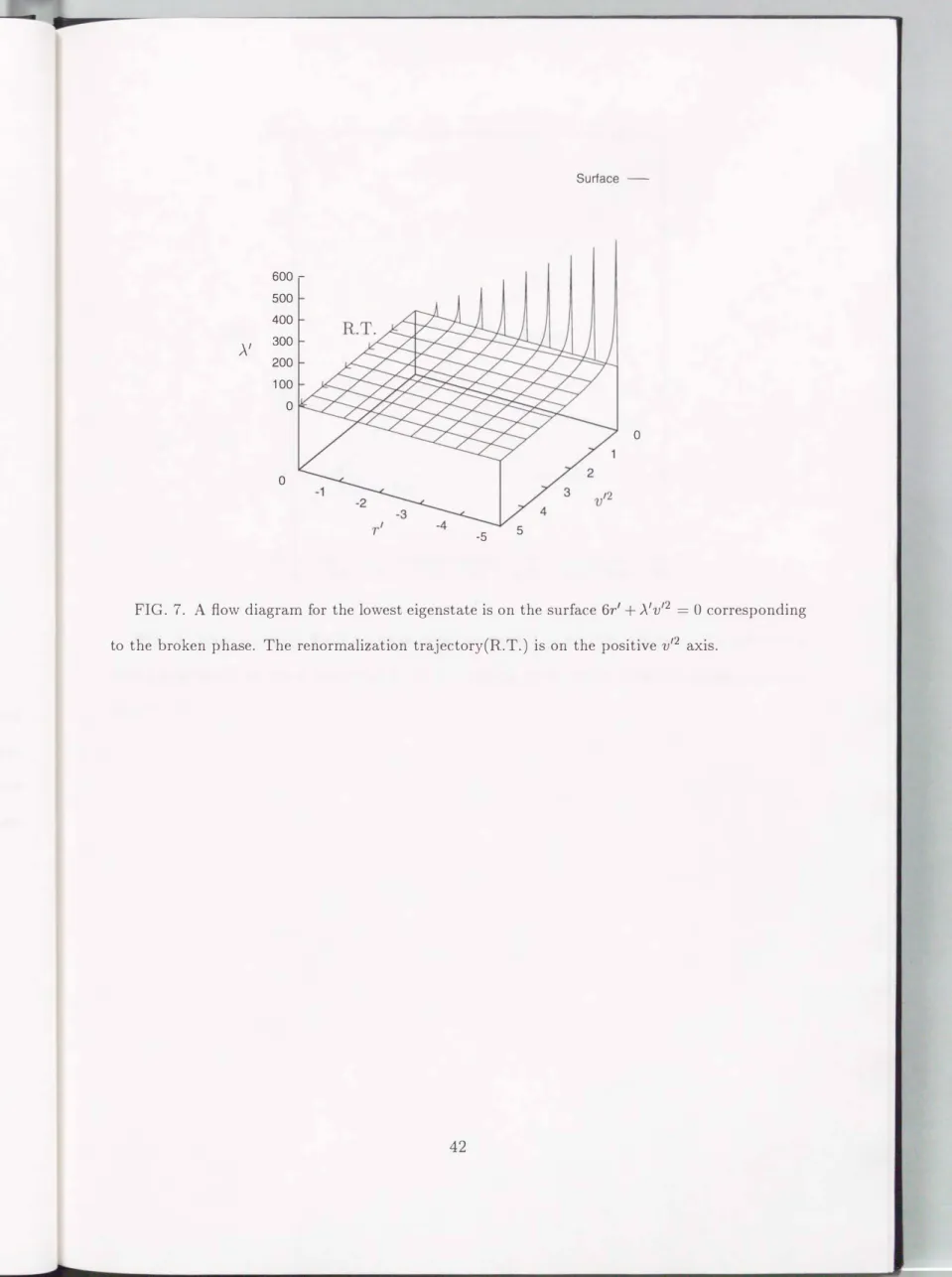
< 0 for positive A'. The surface can be regarded as the broken phase, since it can be connected to the symmetric one on the critical line. The surfac is depict d in Fig. 7. The asymmetric Hamiltonian for the broken phase is defined on the RG invariant surface 6r +>..v2 =
0. The effective potential should become minimum on the surface, and it is really confirmed in Sec. III D. The renormalization trajectory is on the surfac , as expected. Perry and Wilson also found the same relation without calculating the effective potential. Their derivation is essentially equivalent to ours, although c is set to z ro a priori in their derivations.D. Covariant perturbation theory and effective potential
The RG equations (3.42) based on the present light-front Hamiltonian formalism are compared with those on the covariant (equal-time) perturbation theory. For this purpose, we use a cutoff on the Euclidean momentum,
k2
<A 2,
and make the same approximation, that is, the one-loop approximation and dropping irrelevant operators. The resultant RG equations areA-du =
__(g_A _ 2 dA
1 +TJ'
A dm = (g2 - _(>.. _ A_2 dA
( 1 +TJ) 2
1 +TJ ' A dg = 3(>..g
dA
(1 +TJ)2' A-d>..= 3(_A2
dA
(1 +TJ)2'
(3.51)where
TJ
=m/ A 2.
Inserting relation (3.37) into (3.51) yields RG equations for the original parameters,AdA= dv
0,A-dr = ((>..v)2
__(>.._A _ 2 dA
2 ( 1 +TJ) 2
1 +TJ' A-d.A = 3(.A2
dA
(1 +TJ)2•
(3.52)In the derivation of
(3.52)
from(3.51),
the number of quations i reduced from4
to3.
One of four equation in
(3.51)
is thus not indep ndent under th condition(3.37).
ForA
much larger than m and Mi,(3.52)
agre with(3.42),
except(3.52)
n wly have a t rm-(.XA2/(1 + TJ)
in its second equation. The term comes from the tadpole (Fig.1),
but in the present formulation the self-mass has already been included in th rna s parameterT
by taking the normal ordered Hamiltonian. Hence, the RG equations obtained in th light
front Hamiltonian formalism are essentially equal to Eqs.
(3.52)
cal ulated in the covariant perturbation theory. Of course, the two RG equations are not identical except the largeA
limit, because regularization schemes are different between the two formulations. The light-front perturbation theory is formally equivalent to th covariant on[24],
if the same regularization scheme is taken. In fact, as soon as the k- integration is made in the covariant formalism, one finds a direct connection between diagrams obtained in the covariant th ory and time-ordered ones in the present formalism.The equality guarantees that within the framework of the light-front Hamiltonian formal- ism we can calculate the effective potential through the following ordinary procedure. In the covariant perturbation theory, the effective potential
V[¢cJ]
is obtained asTR¢�1/2 + .\R¢�1/4!
within the present approximations, where
TR
andAR
stand for renormalized quantities and<Pc1
for the classical field, that is, the vacuum expectation value of ¢. The renormalized quantities are solutionsT(A)
and.\(A)
at the smallA
limit to RG equations(3.52)
under the condition v = 0, becauseTR(.XR)
are just the sum of one-particle irreducible diagramsproduced by an interaction
.\¢4
with2( 4)
external lines. In fact, the solutions are3 2 { A5 + To A5 } 2
.X(A)IA=o
=Ao- -(.\0
ln- A2 + O(n )
,2 To 0 +To
1 { 2 A2 +To } 2
T(A) IA=O =To - -( Ao A0 -To
ln+ O(n )
,2 To
(3.53) (3.54)
at the one-loop level, and they agree with
TR
andAR
directly calculated with the covariant perturbation theory. Also in the light-front Hamiltonian formalism,TR
andAR
are obtained from the solutions(3.46)(3.47)(3.48)
by settingA
to the smallA
limit and v to zero. TheAR
thus obtained contains not only contributions of the one-loop diagrams (Fig.2)
but alsowhere
a= 3(
lnA (A
rv0). (
i)
Conversely,(3.56)
The condition
dV[<Pc�]/ d<Pc1
=0
on which the effective potential is minimum leads to(
ii) 6rR
=-.AR<P�1•
RG equations(3.52)
are now solved under the initial conditions(
i)
and(
ii)
;of course
<Pc1
is identified withv.
As mentioned in Sec. III C, c =6r(A) + .A(A)v2(A)
is RG invariant. For anyA
it becomesav2,A2
C = _
0 R
1 + aAR' (3.57)
because of relations
(
i)
and(
ii)
. In the largeA0
limit, the quantitya
diverges, so that c tends to-v5 AR
forAR
=.A0/ (1
-a.A0)
----70.
Hence, c is zero in the limit, as far asv0
isfinite. This is a reflection of the fact that
AR
is forced to vanish in the limit, that is, the present model is trivial. The condition for the system to be in the bottom of the effective potential is then c =0.
It agrees with the result shown in Sec. III C.IV. NONPERTURBATIVE RG SCHEME
The first principle of RG is to find a flow which g1ves the same physics. It is not easy to calculate the effective interaction part of the Bloch-Horowitz Hamiltonian directly for our practical purpose of nonperturbative renormalization and we have to avoid energy dependences of renormalization, then we consider another approach. In our framework, we can draw RG flows by calculating spectra. We regularize the LF Hamiltonian with the basis function regularization and try to calculate the critical surface.
A. Three-dimensional real scalar model
First, We derive perturbative RG equation for mass parameter in the thr -dim nsional real scalar model. We assume that the canonical Hamiltonian is given by
Hs =
J
d 2 x( -(81_¢ 2 1 )
2 +2
r 2-¢
+-¢ 4!
A 4 + -w6! ¢ 6)
.( 4.1)
The normal ordering is taken here. This is equivalent to renormalization of tadpole diagrams by redefining parameters. We have to include various kinds of marginal and irrelevant inter- actions to renormalize all new interactions produced by RG transformations. Our Hamilto- nian is assumed to have three interactions in Eq.
( 4.1).
Let us consider mass r normalization perturbatively in order to guess where the critical line exists. The mass renormalization is most important, because r is most relevant to mass spectra. It is the free part which mainly contributes to mass spectra especially in the perturbative region. The RG equation for mass r is given in perturbation theory as( 4.2)
where
(4.3)
It is understood implicitly that the loop integral is made in the Q space. The factor L is produced by rescaling the new cutoff An+l to the original cutoff An. By changing variables to Jacobi coordinates,
0 < Xi <
1,
- OO < Si < 00,where all intermediate states have a common total momentum K, the integral B becomes
( 4.4)
where
M
is an external mass(
an eigenvalue of Hamiltonian)
andMint
a mass in the inter- mediate Fock state,(4.5)
It is assumed that the external mass
M
is small compared to the cutoff scale. The int rmedi- ate massMint
is large because it sits in the higher mass spac Q. Then,M2
is much smaller thanMi;t.
This assumption is reasonable for the purpose to calculate critical lin and draw a phase diagram. We can observe from C being negative that limn-+oor
n = oo if the initial valuero
is sufficiently large and limn-+oor
n = -oo if the initial valuer0
is small. That is, there exist a critical liner
=rc(.A)
in the first quadrant of the two dimensional parameter space(r, ..\),
and r >rc(.A)
andr
<rc(.A)
correspond to symmetric and asymm tric phases respectively. In the asymmetric phase, the canonical Hamiltonian( 4.1)
is tachyonic, i.e., square of eigenmass is not bounded from below although Hamiltonian should be positive definite. Positivity of the spectrum is restored by expanding the field¢
around th correct VEV v. Substituting¢(x)
=<p(x) +v
into Eq.(4.1),
we havewhere the new mass parameter is
and the new coupling constants are
93 =
(.A + -)v,
wv26
94
=.A+--,
wv22
95 = wv, 96 = w.( 4.6) (4.7) ( 4.8)
(4.9)
(4.10)
The v is just a free parameter at this stage. We have three parameters in the symmetric Hamiltonian Hs and four in the asymmetric one HA. The RG parameter space for HA is larger than that for Hs. The v should be a function of the original three parameters belonging
to Hs, that is, there should exist an RG invariant relation among the four parameters.
Actually, following our previous work
[17]
for the real scalar model in four dimensions, we can find out the same RG invariant relation 6r +.Xv2
= 0 also for the thre -dimcn ional case, with perturbative renormalization at one-loop order, if the¢6
interaction is n gl ted.The neglect of the marginal operator will be justified by numerical analyses hown later.
The RG invariant relation forms a surface in the parameter space for HA· All asymmetric Hamiltonians on the surface describe physics for the brok n phase. All running param ters on the surface go to zero in the limit A ----* 0 which corresponds to infinite iterations of RG transformation, satisfying the RG invariant relation 6r +
.Xv2
= 0. The Hamiltonian HA thus gives massless spectrum in the limit. All Hamiltonians on the surface converg to the same massless Hamiltonian in the limit, indicating that HA gives massless sp ctrum at any point on the surface. We will continue our analysis assuming that the broken phase would be found nonperturbatively by searching massless eigenvalues.B. Basis function regularization
In general, we can express an arbitrary state in the Fock space such as
( 4.11)
where
P
is the total momentum of the state and the wavefunction 1/Jn is symmetric under exchanges of arbitrary two momenta. The limitNTD
----* oo corresponds to the full theory and the state is normalized as(w(P)Iw(Q))
=82(P- Q). ( 4.12)
We will set a certain small number to
NTD,
which is called the Tamm-Dancoff approximation.In this paper, the Fock space is truncated up to three body states
(NTD
=3).
According to the variational principle, the mass spectrum in the truncated Fock space is given by solving(
diagonalizing)
the Einstein-Schrodinger(
ES)
equation(4.13)
We introduce a cutoff
A
and show the pre ent regularization sch me later. All quantities belonging to the model are measured in units of theA
and attached tild . In unit of the cutoff, eigenmass and running parameters arethen
!Jn
=9n/ A (6-n)/2.
(4.14)
( 4.15)
The ¢6 interaction is marginal as shown in Eq.
( 4.15).
We will check the marginal coupling dependence of the critical line in the next section. The momentum is also redefined as(4.16)
where 0 < xi <
1
sincekt
> 0. In this rescaled notation, the normalization condition Eq.(4.12)
of the wavefunction becomes( 4.17)
where
(4.18)
and the rescaled wavefunctions are
n-1
,(/;n(xl,x2,···,xn)
=(P+A)-2 'I/Jn(kl,k2,···,kn)· (4.19)
The ES equation in the rescaled notation is given in appendix B. It can be seen that the ES equation does not depend on the longitudinal momentum
p+
and the cutoffA.
Regularization of transverse momenta and discretization of Fock space are closely related to each other. The regularization of the Hamiltonian is realized as a boundary condition of the wavefunctions. That is, we solve this eigenvalue problem, keeping the constraint that
the transverse component of
{/;3
is zero at edg s(Xi
=-1, 1).
Th ES equation i regularized with the naive transverse cutoff,-A <
kij_
< A� -1
<Xi
<1, ( 4.20)
since the ultraviolet divergence is caused by the transverse loop integral. The Fock space is discretized by expanding the wavefunction in terms of basis fun tions in th morn ntum space
( -1
<Xi
<1, 0
<Xi
<1),
where
n n
L: x i = 1, I: xi= Pj_,
i=l i=l
(4.21)
( 4.22)
and S1,2,
... ,n
is a symmetrizer. The NL(
n)
and NT(
n)
are taken sufficiently large so that the eigenvalue of the ground state can converge. Longitudinal basis functions arefk(x)
=x{3(n)+k, 0
<x
<1,
for
0
<{3(
n)
<1
and transverse basis functions are( 4.23)
( 4.24)
The variational parameter /3( n
)
is tuned so that the ground state takes minimum igenvalue.The behavior of the three-body wavefunction near the edges
(
x= 0, 1)
is important because of the kinetic term proper to LF[25,26].
The coefficientsaL�)
are determined by diagonalizing the Hamiltonian in the momentum space spanned by the basis functions. Mathematically, Eq.( 4.13)
has exact eigenvalues only in the case the functional space is expanded in terms of the complete set of basis functions. We can get only upper bounds of eigenvalues, since the wavefunction is expanded in terms of incomplete basis functions in this calculation.However, we expect that the spectrum is described accurately for low-lying states, since shapes of the wavefunctions are simple; for example, the calculated wavefunction of the ground state has no node.
In this paper, a phase diagram which includes rescaling effect is evaluated, in accor
dance with Wilson's RG prescription [13]. It is not need d to vary the cutoff because th transformed cutoff is rescaled to the original one in this RG. Param ter s ts whi h give the same eigenvalue are calculated for a fixed cutoff.
The wavefunction renormalization is neglected in this calculation, i.e., Zcp = 1. Th phase diagram is dominated by the Gaussian fixed point, since the field is reseal d according to the canonical dimension. In order to find a non-trivial fixed point, w have to consider th wavefunction renormalization. These two phase diagrams, which have trivial and non-trivial fixed points, describe different theories. Our result makes sense as the theory dominat d by the Gaussian fixed point.
In this calculation, the total transverse momentum of the eigenstate is set to zero,
F1_
= 0, andN1,T(n)
= 3 in Eq. (4.21), which is sufficiently large so as to give a convergent spectrum.C. Numerical results
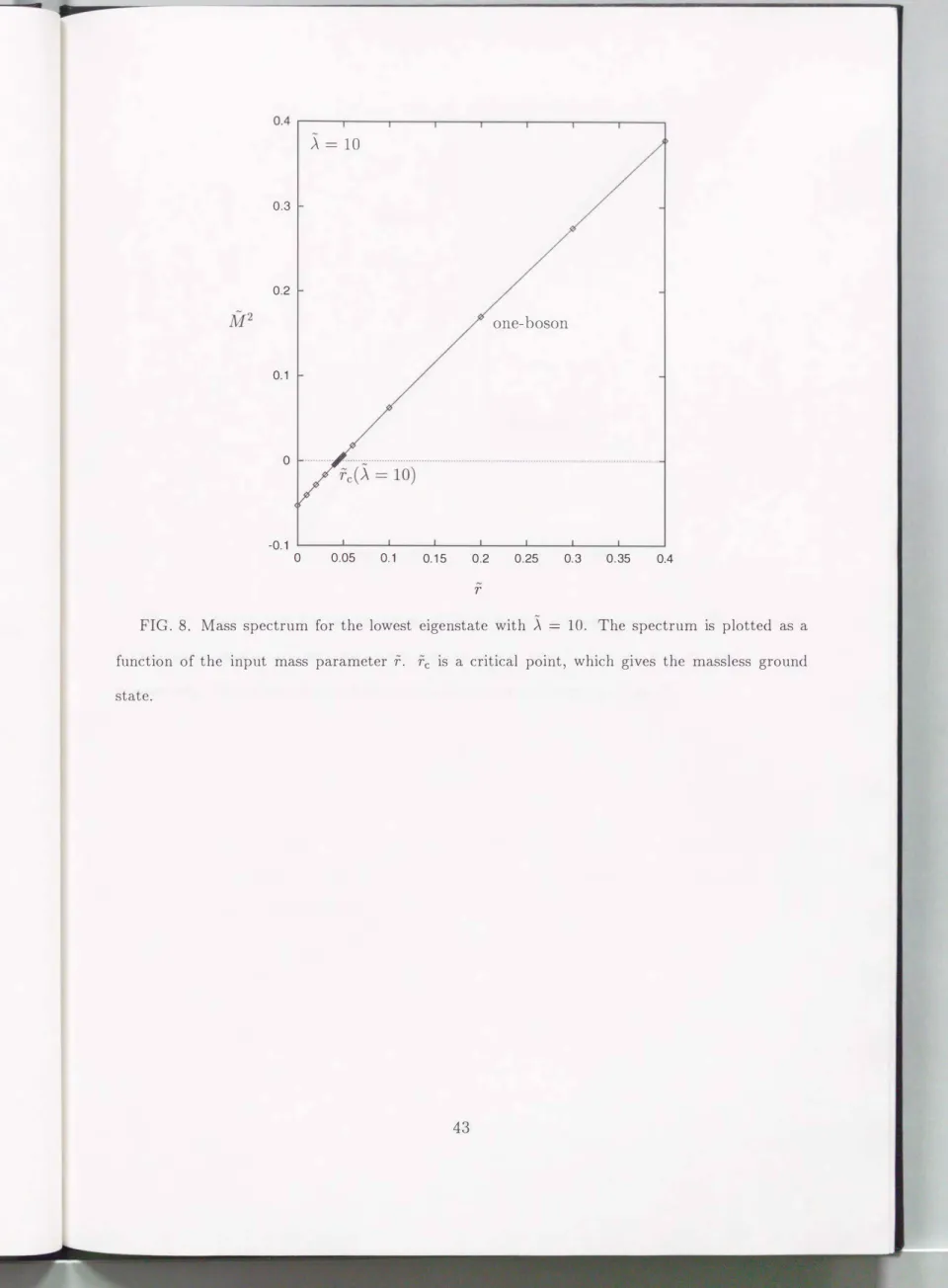
Mass spectrum is plotted in Fig. 8 for the case A = 10 and w = 0 without introducing v.
No multi-bosonic bound state is found in this calculation. We can observe a massless point
rc(�
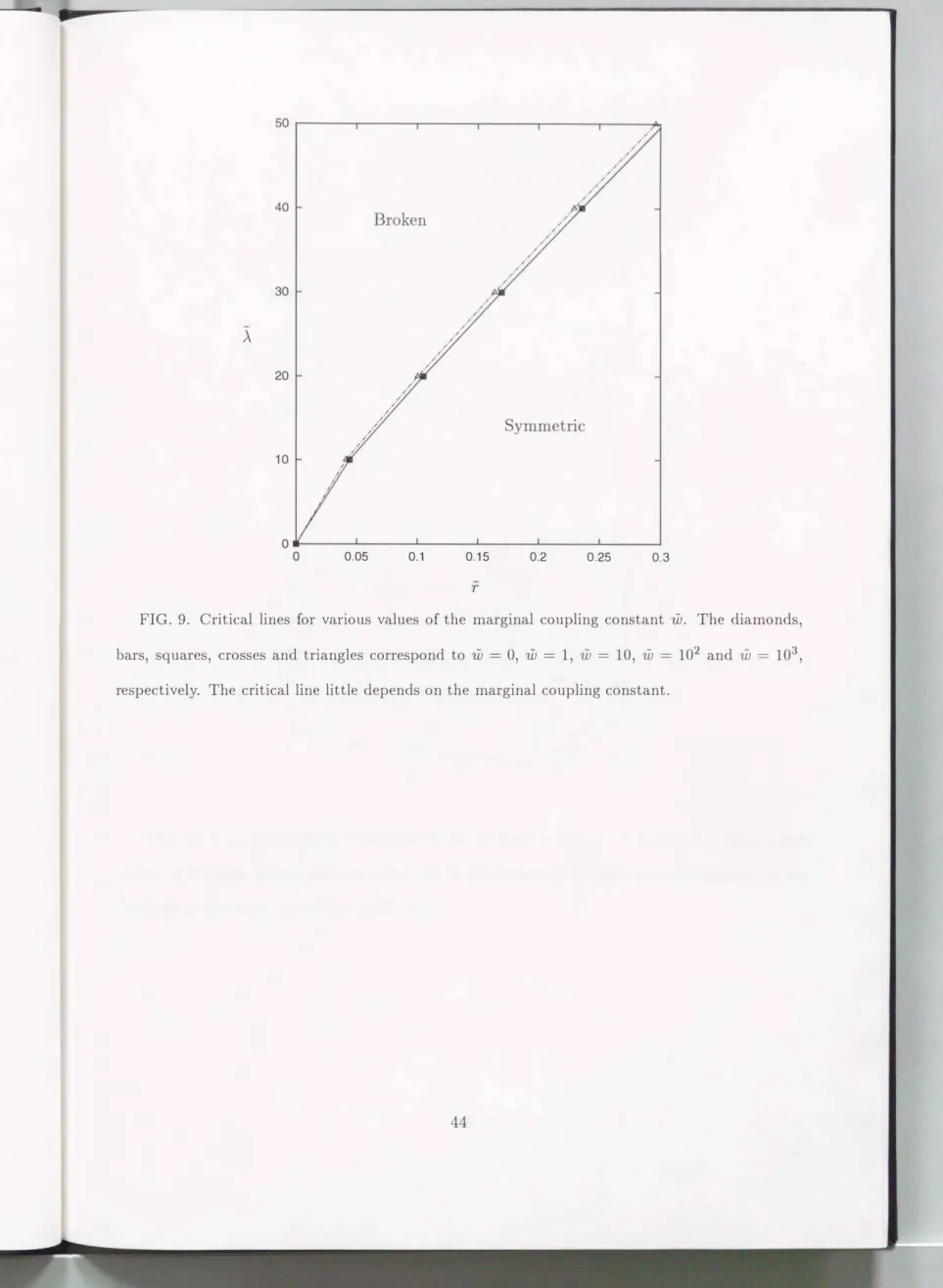
= 10). The point is called the critical point. We can draw the critical line by connectingthe critical points which are calculated for various A. The critical line is plotted in Fig. 9 for five values of marginal coupling constants, w = 0, 1, 10, 102, 103. Values of two parameters
r
and
�
which form the critical lines are tabulated in table I for each w. The depend nee of the line on w is weak. This is consistent with our intuition based on perturbative analysis, i.e., the dependence of the line on higher power operators in cp may be week. After this, we will switch off the marginal coupling w = 0, and draw the phase diagram of three running parameters, v,r
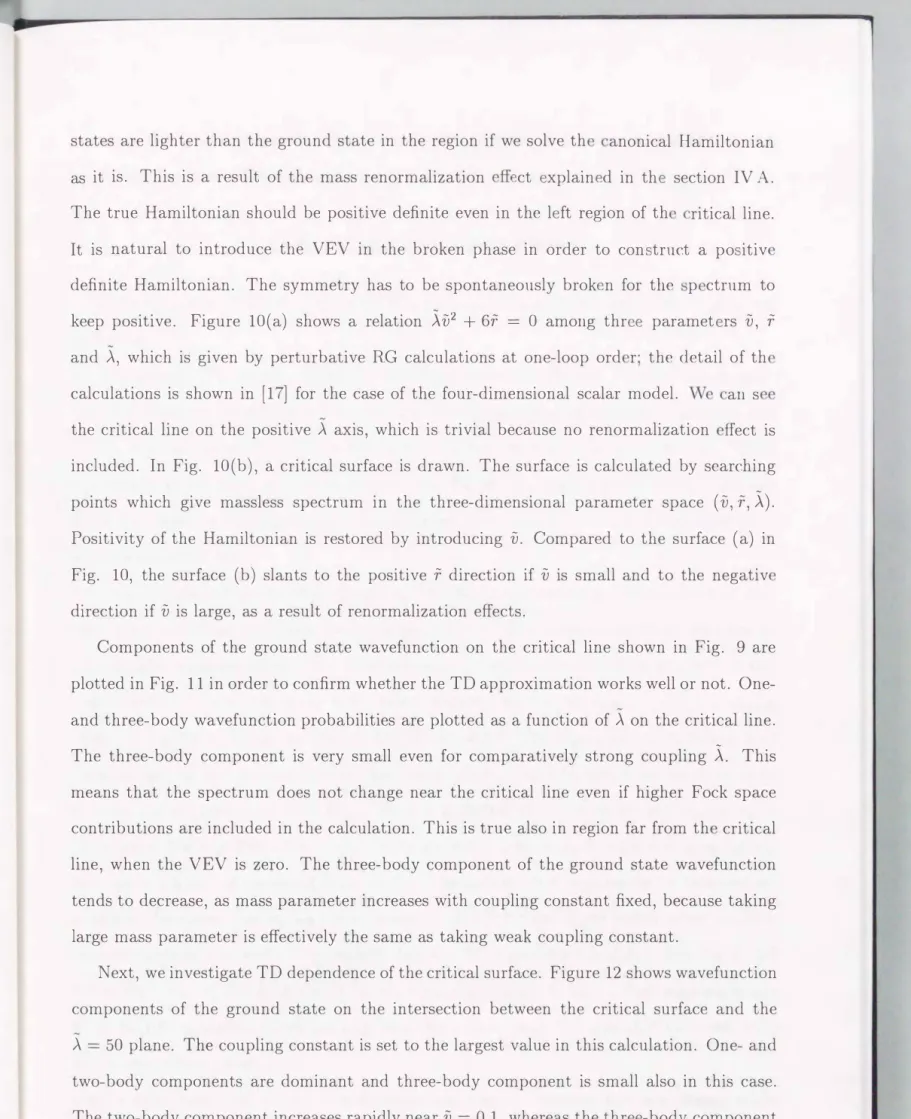
and A near the v = 0 plane.The lowest eigenmass is zero on the line, corresponding to an infinite correlation 1 ngth in the statistical theoretical language. The spectrum of the canonical Hamiltonian is not bounded from below in the left region of the critical line. We then conclude that excited
states are lighter than the ground state in the region if we solve th anonical Hamiltonian as it is. This is a result of the mass renormalization eff ct xplain d in th section IV A.
The true Hamiltonian should be positive definite even in the l ft region of th ritical line.
It is natural to introduce the VEV in the broken phase in order to con truct a po itiv definite Hamiltonian. The symmetry has to be spontaneously brok n for the p ctrum to keep positive. Figure 10
(
a)
shows a relation�v2
+ 6r = 0 among thr paramet rsv,
rand A, which is given by perturbative RG calculations at one-loop ord r· the detail of th calculations is shown in
[
17]
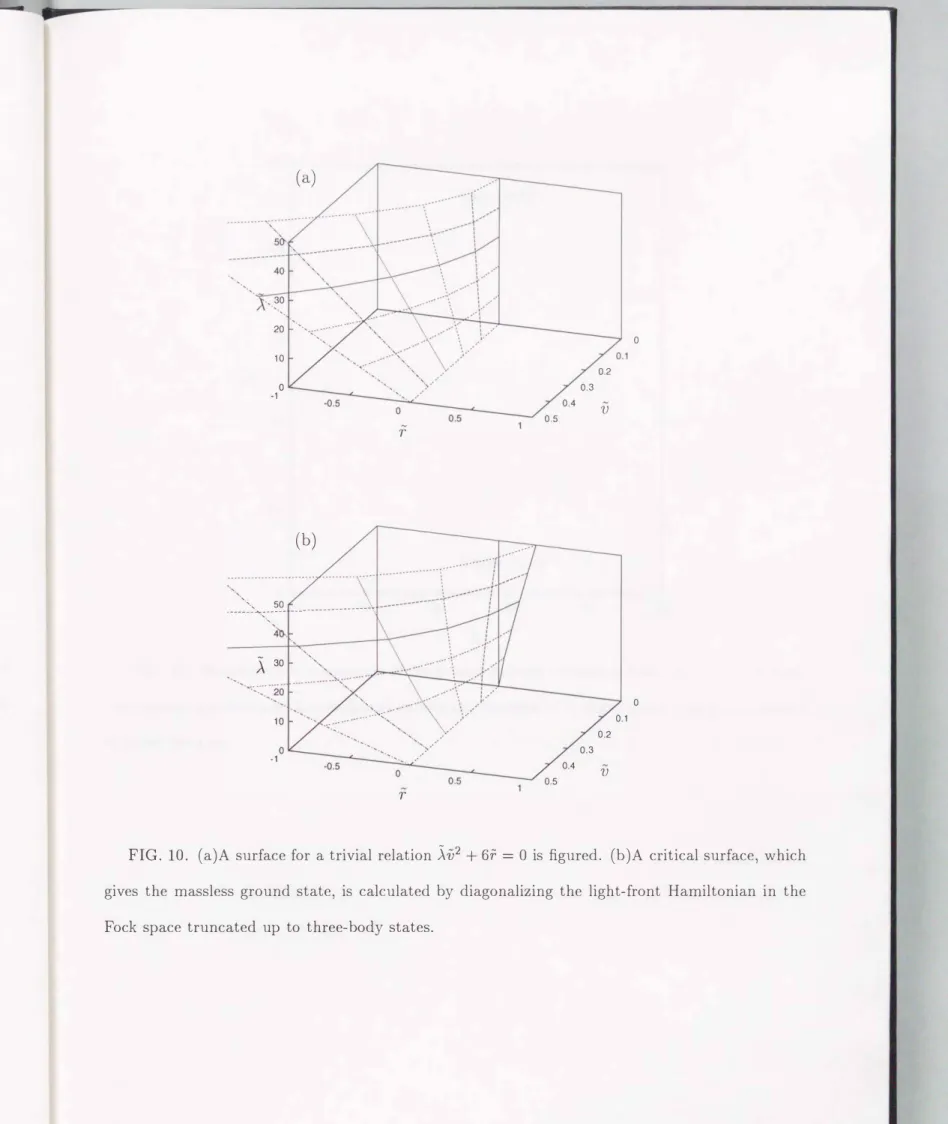
for the case of the four-dimensional scalar model. W an s the critical line on the positive A axis, which is trivial because no renormalization ffect is included. In Fig. 10(
b)
, a critical surface is drawn. The surface is calculat d by searching points which give massless spectrum in the three-dimensional parameter space(v,
r,�).
Positivity of the Hamiltonian is restored by introducing
v.
Compared to the surface(
a)
inFig. 10, the surface
(
b)
slants to the positive r direction ifv
is small and to the negativ direction ifv
is large, as a result of renormalization effects.Components of the ground state wavefunction on the critical line shown in Fig. 9 are plotted in Fig. 11 in order to confirm whether the TD approximation works well or not. One
and three-body wavefunction probabilities are plotted as a function of A on the critical line.
The three-body component is very small even for comparatively strong coupling
�.
Thismeans that the spectrum does not change near the critical line even if higher Fock space contributions are included in the calculation. This is true also in region far from th critical line, when the VEV is zero. The three-body component of the ground state wavefunction tends to decrease, as mass parameter increases with coupling constant fixed, because taking large mass parameter is effectively the same as taking weak coupling constant.
Next, we investigate TD dependence of the critical surface. Figure 12 shows wavefunction components of the ground state on the intersection between the critical surface and the A = 50 plane. The coupling constant is set to the largest value in this calculation. One- and two-body components are dominant and three-body component is small also in this case.
The two-body component increases rapidly near
v
= 0.1, whereas the three-body componentincreases slowly and keeps the value around a few percent. It is exp cted near th
v =0 plane that the Tamm-Dancoff approximation is good.
V. SUMMARY AND DISCUSSIONS
Our results of perturbative RG in the four dimensional real scalar mod l ar ummarized as follows.
(i) The present RG scheme based on the Bloch-Horowitz effective Hamiltonian is quite practical, because the scheme is free from the "vanishing energy d nominator" problem and the
Eidependence of the effective Hamiltonian causes no big problem in practic . Whil RG equations are easily derived in perturbation theory, RG flows d pend on eig n nergics
Ei