{前注}カナダ・バンクーバー市の British Columbia University において
2007 年 8 月 22 − 25 日の間 Urban Justice & Sustainability なる表題のもとで大きな国際会議 が開かれた。以下はその Culprit & Sustainability 分科会における柴田徳衛「発展途上大都市 の自動車混雑とそのマイナス要因」の報告文である。 その報告のポイントは―― 西欧先進国で「20 世紀の恋人」と呼ばれた自動車は,同世紀を通じ市民交通の「救済者」 として広く活用されてきた。しかしその世紀末頃になると,発展途上国の急速な経済発展・ 大都市急膨張につれて,従来主役だった自転車・荷車に代り,公共交通手段の電車や地下鉄 網の立ち遅れとあいまち,自動車(ないしモーター・バイク)が猛烈な勢いで普及し始めて きた。だがその氾濫の結果,交通の麻痺や事故,騒音・振動や,排ガスによる大気汚染悪化 と呼吸器病患者急増などのマイナス現象 Social Cost が急増し,市民生活全体にとり自動車は 市民生活の救済者からそれを脅かす「犯罪者」となってきた。 こうした実情をジャカルタ,ホーチミン,メキシコ市,カトマンズなどに求めた後,東京 の 1950 年代以前の鉄道〔電車〕中心から以後道路〔自動車〕中心に移り各種自動車公害を起 こす姿と,その間に郊外鉄道や地下鉄の発展する経緯やその建設財源を調べる。 こうして,急速な発展と自動車の洪水に直面する新興大都市の交通問題にいかに対処する かを,当面バス優先の交通に求める形から公共高速交通手段に求める道,さらに都市計画に おける土地利用の改善を通じ職住接近を求める道,さらに根本的に地方農村や小都市を振興 し大都市の一極集中の機能分散を図る道などの検討課題を提起する。
Preface : Rapid Growth in the Popularity of Automobiles
Automobiles rapidly became a symbol of modern, convenient civilization. The Ford Model T made its debut in 1908, and Ford’s mass production system made cars affordable to the general public in the developed countries in the West.
Paved roads were already in place in major Western cities before the rise of the automo-bile. These paved roads were straight and wide enough for the horse-drawn carriages, and
Social Costs of Traffic Congestion in
Developing Metropolises
later for the automobiles that were to replace them. The substitution of automobiles for horse-drawn carriages proceeded smoothly in these advanced metropolises; there was no need to radically change or develop roads and urban infrastructure. Most horse-drawn car-riages for hire in London were replaced by gas-powered taxicabs by the outbreak of the First World War in 1914. Even before the Second World War, automobile ownership per 1,000 people in 1939 was 227 in the US, 54 in the UK, 51 in France and 25 in Germany (MacGregor Knox, Hitler’s Italian Allies, Cambridge University Press, 2000, p.30, http://www.friesian.com/stats-2.htm). In these countries, the automobile became the“sav-ior”of the common people, offering them convenience and flexibility in their daily travel.
Today, at the beginning of the 21st century, automobiles are causing entirely different problems in newly developing metropolises and countries that have different road and urban infrastructure from Western cities due to their different rates of growth and states of development.
Firstly, the population growth in developing countries and their cities has been much more rapid than in the West. Table 1 shows 2005 data from selected Asian and Latin
Table 1 Population of Selected Metropolises and Countries(2005)
Source : The World Almanac 2007(World Almanac, New York City).
*The population of Tokyo is the total of 23 special administrative wards or“ku”(= 8,437,000) plus municipalities within the Tokyo Metropolitan Government. The total population of the Tokyo Metropolitan Region, the largest metropolis in the world, is about 35 million. It is roughly within the radius of 50 km or 30 miles covering Tokyo and three adjacent prefectures.
American countries.
Secondly, the registered number of automobiles is drastically increasing together with high levels of economic growth in these countries. Table 2 shows the changes in automo-bile ownership in both developed and developing countries and the rate of increase between 1985 and 2004.
In rapidly urbanizing developing countries, both people and economic functions concen-trate in major metropolises. Over time, more people use automobiles and motorcycles instead of bicycles for commuting(hereafter in this article, the term“automobile”may include both four-wheeled vehicles and motorcycles unless otherwise stated). Rapid urban-ization brings with it the expansion of the metropolitan area into the surrounding suburbs, and longer commuting distances and travel times for suburban residents. The office may now be too far and away for commuting by bicycle. The speed of urbanization is so fast that improvement in public transport cannot catch up. Thus, once suburban residents can earn enough income to afford an automobile, they rush to buy one.
For example, in Beijing, the registered number of automobiles per 1,000 residents increased from 23 in 1998 to 126 in 2004, and in Bangkok from 175 in 2000 to 225 in 2004. Automobile ownership in rural areas is also increasing, but generally speaking, the rate of increase is much higher for metropolitan residents.
Table 2 The number of registered automobiles by country
Chapter 1 Traffic Congestion in Developing Metropolises
Until recently, only high-ranking government officials or the rich and privileged classes could own and ride in automobiles in developing countries. The vast majority of ordinary people either walked or rode bicycles.
Only in the last decade have developing metropolises begun to flood with automobiles. They now have their own transport problems, as illustrated below, based on the on-site observation by the author within the past 15 years or so and on recent statistics.
Jakarta
As shown in Table 1, more than 13 million people live in Jakarta. The number of automo-biles and drivers has increased rapidly, and the city government has made the main roads “one-way”to control traffic flow.
The author once stayed at a hotel in Jakarta and went to visit the Japanese embassy located several blocks away on the opposite side of a very congested road. The hotel called a taxi, but because of this one-way system, the taxi had to drive quite a long distance to be able to make a turn. It took half an hour to get to the embassy.
A recent media report on Jakarta goes as follows :“As Indonesia’s main city and gate-way to the world, Jakarta should be a thriving hub. Instead, it is a choking bottleneck in the nation’s troubled real economy... At night, a truck can travel by toll-way from an indus-trial estate in Bekasi or Tangerang to Priok in less than an hour. In daytime it may take two or three hours. By the peak shipment days of Friday or Saturday, trucks have to wait three to four hours in a queue to enter the port and offload their containers. As a result, a truck can make only one trip per shift and there are two to three times as many trucks on the road as should be needed... Traffic is the most urgent problem. Half the cars in Indonesia are on the streets of Jakarta and their number is growing. There will never be enough road space to accommodate this trend...(“Time for Jakarta’s bottleneck to be opened up,”The Asahi Shimbun(English edition), June 8, 2007)
The average Indonesian monthly income is around 10,000 Japanese yen(80 US dollars) so motorcycles(cost an average 100,000 yen)are the major means of commuting and travel for ordinary people. The total number of motorcycles sold between January and April 2007 was 1.372 million. Most were made by Japanese companies(44% Honda, 41% Yamaha and 13% Suzuki). This figure was 195 thousand more than the same four-month
period of 2006(Kabusiki Shimbun, June 5, 2007).
Hanoi and Ho Chi Minh City
The capital of Vietnam is Hanoi in northern Vietnam. The largest and most populous city is Ho Chi Minh City in the south. Three decades have passed since the end of the Vietnam War and both metropolises are now vibrant and fast growing. With the rise in ordinary annual incomes, motorcycles have replaced bicycles and three-wheeled pedal taxis, flooding the streets of both cities before roads have been properly developed or traffic signals or signage put in place.
As a recent edition of the Asahi Shimbun(English version)reported :“Hanoi - A decade ago, bicycles rode quietly down the streets of Vietnam’s capital. Today, 1.8 million motorcycles and scooters buzz through Hanoi in a confused and unrelieved cacophony... Hoping to avoid the“grow first, clean up later”pattern most Asian countries have fol-lowed, Vietnam decided several years ago to tighten its lax vehicle emissions laws(July 07,2007).”
Tougher policies on paper may sound excellent, but it will probably take a long time to put these into practice. The air in both Hanoi and Ho Chi Minh has become polluted with hydrocarbons, sulfur dioxide and floating particles. Tokyo’s experience tells us that as the air becomes polluted, the number of patients with respiratory diseases such as asthma increases. We are deeply concerned about this trend.
Indeed, the same Asahi article reports that“Fatal accidents have increased almost five-fold in 11 years from 1990. To put Vietnam’s road toll in perspective, the number of fatali-ties is twice as high as the average road fatalifatali-ties in Japan, whose population is 30 percent larger.”
A recent survey has revealed that only 1.4 % of the country’s motorcycle drivers wear a helmet. To increase helmet use and to decrease the number of traffic accidents, the gov-ernment will introduce a strict regulation“every motorcycle driver should wear a helmet” from Dec.15, 2007. Violators’motorcycles will be confiscated from 60 to 90 days and it is hoped that the measure will improve the current situation.
Mexico City
The author has visited Mexico three times. On his last visit about ten years ago he smelt gasoline a few minutes before landing at Mexico City Airport and realized that automobile gas emission from the city had reached thousands of feet above ground in the air.
This metropolis had a sophisticated, French-style subway - but the line served only the central business district. The rest of the metropolis expanded before public railway lines were developed.
Suburban residents, many of them migrating to the city from the other parts of the country, must commute to the city center by car. Every morning, during the rush hour, large numbers of automobiles flow into the expressway system, causing terrible traffic jams. Drivers are forced to move at a crawl or just wait in vain. Mexican people used to ridicule their expressway by saying“it is the longest parking lot in the world.”The city and its suburbs now have a network of 11 subway lines, so both the traffic congestion and air pollution have improved.
Kathmandu
Nepal is a mountainous country. Its capital city, Kathmandu, is located in a high basin. The rapid increase in the number of automobiles in the city is causing severe air pollution. For example, the strong sunshine at the high altitude creates photochemical smog. The smog combined with other pollutants damages historical monuments(especially bronze castings in Hindu temples)and old palaces. It is difficult to assess this kind of irreversible cultural damages in monetary terms. The number of asthma patients is increasing too.
Taipei
Like Hanoi and Ho Chi Minh City, Taipei has experienced a flood of motorcycles in recent years. Often one motorcycle will carry three or four family members - the husband drives the motorcycle carrying a child on his back and the wife with a baby strapped on her back in the back seat.
When the author visited Taipei twelve years ago, the construction of a new subway line was underway, and the streets were blocked in many places. The construction work appeared to have paralyzed the city’s entire transportation system. The citizens seemed to have supported the idea of the subway - or any other transportation facilities - but in reality the road blockages everywhere was causing resentment.
The Taipei MRT subway/railway network started operation in 1996. As of 2007 eight lines are in operation and seven lines are under construction. Another two lines have been planned. The MRT has greatly improved the traffic situation in Taipei.
Singapore : A model city?
Singapore, with a population of 4,492 thousand and an area of 693 km2(a little larger than
Tokyo’s ward area), is a highly urbanized country. The Singaporeans have developed a system of controlling traffic congestion by regulating the total number of automobiles reg-istered plates and by improving road and mass transit, including subways(MRT and LRT) and public bus systems. In addition to this, the city government adopts the road pricing system to alleviate traffic congestion during rush hours.
The city strictly controls parking. In developing metropolises, often we can see many cars parked on both sides of four-lane streets. Moving cars are forced to use the remaining central two lanes, and the traffic flow is restricted.
Singapore is trying to become the hub of world commodity flow by providing an excel-lent airport with five runways and an efficient port with a magnificent container yard. The public transportation system inside the city is also a“model”for other metropolises even though it may be difficult for them to follow Singapore’s example.
Chapter 2 The Social Cost of Automobiles : Case Studies of Bangkok and Tokyo
In this chapter the author examines cases in Bangkok and Tokyo. The section on Bangkok is mainly based on“Motor Vehicle Pollution in Bangkok,”a joint research study by T. Shibata(T. Shibata, S. Nagai and Y. Mizutani“The State of the Environment in Asia 1999-2000,”edited by the Japan Environmental Council, published by Springer). The Tokyo case study is based on the experience of the author who served as the director of the TMG’s Institute of Environmental Protection from 1974 to 1980.
A. Case Study of Bangkok
Bangkok is a beautiful and historical metropolis with many Buddhist temples. Unfortunately(from the viewpoint of economic development we must say“fortunately”), the recent rise in the number of motor vehicles in Bangkok has been particularly rapid, and accounts for about a quarter of all motor vehicles registered in Thailand. Bangkok’s streets are jammed all day long. The automobiles’terrible noise invades temples to disturb the quiet atmosphere.
It is noteworthy that a significant portion of Bangkok’s vehicles are motorcycles and at least 90% of them have two-stroke engines with high exhaust emission levels. This means
that the city’s traffic jams and vehicle exhaust fumes generate appalling air pollution. Serious pollutants include airborne particulates, hydrocarbons(HC)and lead.
The World Bank and other institutions have tried to estimate the social cost of traffic congestion and pollution in Bangkok. The results have shown that if pollution by airborne particulates and leaded gasoline were to be reduced by 20%, the annual benefit due to a lower death rate and reduced costs of medical treatment, would be equivalent to anywhere between $US300 million and $1.6 billion.
In 1995, Thailand Farmers Bank released the following calculated estimates on the social cost of motor vehicle use. Each day 1.5 million motor vehicles enter central Bangkok, with an average driving speed of 15-20 km/hour(10-12 miles/hour). If the average traffic speed when flowing smoothly is assumed to be 25 km/h(16 miles/hour), the resulting loss in fuel cost is 12.36 billion Baht($US360 million). Additionally, an average commuter living within 30 km(19 miles)from central Bangkok wastes 86 minutes each day commuting because of traffic congestion. If 50%(or 20%)of this time were to be used more produc-tively, the value obtained would be anywhere between 14.9 and 37.26 billion Baht($US 465 million-1.16 billion).
Statistics by the Ministry of Health show there are about 1.9 million people with respira-tory problems in Bangkok - which is one out of four people. Interviews with physicians show that 80% to 90% of these people are likely to be victims of air pollution - and most of the air pollutants are from motor vehicles. If these 1.9 million people visit the hospital 10 times a year and pay 500 Baht(US$15.62)on each visit, that would come to about 9.5 bil-lion Baht($US 300 milbil-lion)in medical expenses. Total social costs of motor vehicle oil con-sumption, time loss, and health damage total 59.13 billion Baht($US 1,847 million)annual-ly, or 28.44 Baht($US 0.89)per person per day.
Because canals have been reclaimed and converted to roads and because of the city’s land ownership system, where a small number of landowners own large parcels of land, the city is full of one-way or dead-end alleys. As the author has experienced, drivers must take roundabout routes to their destinations, further increasing traffic congestion.
Construction of roads and development of public transportation in Thailand have relied on foreign aid or private funds for build-operate-transfer〔BOT〕schemes, so plans do not always proceed smoothly.
At present Bangkok has, in addition to public bus network, taxis and boats, the Sky-train BTS and subway that opened in August 2004. These are expected to improve the traffic situation.
B. Case Study of Tokyo : Automobile-related social cost factors other than traffic congestion and air pollution
1)Noise and vibration resulting from Tokyo’s land use patterns
In many cities, frustrated drivers stuck in heavy traffic blow their horns. In such a situa-tion, the sound of car horns no longer serves its original purpose to warn others, but sim-ply becomes a source of noise pollution. Although car horn noise is not so much of an issue in Tokyo, the capital has its own traffic problem: heavy truck noise and vibration. At night, heavy trucks thunder along the narrow residential Tokyo streets at speed, causing exces-sive noise and vibration and disturbing sleeping patterns. This problem may be due to the land use/ownership system and road patterns unique to Tokyo and other Japanese cities.
While the central business districts(CBDs)of Tokyo have developed vertically, with many new skyscrapers, the wider areas on the outskirts have developed horizontally (sprawled)with highly congested low-rise two-and-three-storied wooden houses - the “rabbit hutches”ridiculed by foreign media.
After World War II, the Japanese national government promoted its“My Home”policy and encouraged citizens to build their houses on their own residential lots. A nice idea -provided that you have a residential lot to build upon. The process through which most Japanese acquire this land takes many years and many steps. Generally speaking, citizens first live in rented accommodation and work hard to save money. After they save the money for a deposit, they buy a housing lot with a mortgage. Tokyo has no regulations to control land subdivision. As the Tokyo economy developed, residential land prices increased. Accordingly, the size of individually owned house lots became smaller and small-er. In the built-up Tokyo ward area in 2005, there were 1,042,367 individuals owning a total of 210.7 km2of land, and 82,853 corporations owning 80.5 km2of land. Table 3 shows
individ-uals’land ownership classified by the size of their housing lot(Note : 1 km2 = 247 acres,
50 m2= 538 ft2, 100 m2= 1/40 acre, 500 m2= 1/8 acre, 5,000 m2= 1.23 acre)
In the Tokyo ward area, 67.4%, or more than two-thirds of residents, live on lots smaller than 150 m2(1,600 ft2 or 1/27 acre). Thus, the heavy trucks speeding by small houses all
crammed together disturbs the neighborhood.
Though it is difficult to make appraisal in monetary terms,“noise and vibration”are important components of social cost caused by automobiles in Tokyo.
2)Limited space
As Table 3 shows, as the residential areas developed around Tokyo, the average size of housing lots became smaller and smaller, and the price of building land became more expensive. A lot in a conveniently located places(e.g., within ten minutes’walk from a railway station or from a shopping center)may easily cost 0.5-0.6 million yen per square meter($US 400-450 per 1 ft2).
There were 4,608 thousand automobiles registered in Tokyo(2005). If one automobile occupies an average 8 m2(90 ft2)parking space, cars as a whole would require 36,864
thousand m2of scarce space in Tokyo.
To secure a parking space, small Tokyo houses have to do without open space to plant greenery and flowers. Small side streets in residential areas are no longer safe place for children to play because so many cars pass through them to avoid congestion on the main road.
Though the subdivision of land and narrow streets may be major sources of automobile-related social cost in Tokyo, the situation may be similar in the other metropolises men-tioned earlier.
Table 3 Residential land ownership in the Tokyo ward(ku)area(2005)
3)Automobiles decimating public transport services
Outside Tokyo, the growing popularity of automobiles is affecting the use of public trans-port services including buses and trains. If there were no bus or train, even low-income workers would have to use automobiles to commute. In the United States, the lack of sav-ings or a poor credit record often forces poor people to buy unreliable used cars with high-interest loans. Cheaper but older, more unreliable and less fuel efficient cars force people to spend more on car repairs and fuel.
A lack of buses and trains would make it difficult for vulnerable people to travel, for example, senior citizens to go to hospital or young children to commute to school. The growing number of, and reliance on automobiles increases the total social cost, both direct-ly and indirectdirect-ly.
Chapter 3 Tokyo’s Experience in Traffic Improvement : Positive and Negative Lessons to be Learned
A. The Prewar Period(1872 - mid-1950s)
The first modern transport facility developed in Japan was a railway line between Tokyo and Yokohama that began operation in 1872. The rail network gradually expanded nation-wide. Its trunk lines were nationalized in 1907. Taking advantage of abundant rainfall, one of few natural resources that Japan is blessed with, many hydro-dams were constructed in mountainous areas to generate electric power. Prior to World War I, electric locomotives and electric railcars were introduced to replace the steam locomotives. Electric railcars are suitable and efficient for short-distance commuter travel.
During World War I, the Japanese economy enjoyed a high rate of growth, and in cen-tral business district CBD(around Marunouchi)many modern office buildings were built. Tokyo Central Station opened in 1914, not only as the symbol of the Tokyo CBD, but also as the center of whole national railway network(the station is still the main intercity rail terminal). With the rapid increase in the population of office workers as well as city resi-dents, the National Railways built the loop line(the Yamanote Line)in 1925 connecting Tokyo Central Station with sub-central stations such as Ueno, Ikebukuro, Shinjuku, Shibuya and Shinagawa. The loop line covered most of the built-up area of Tokyo City. However after the Great Kanto Earthquake in 1923, many Tokyo office workers lost their homes and moved away from the area within the loop line to the suburbs.
railway services in the suburbs. Although these companies’stated business was passenger transportation and their names ended in“... Railway Company Ltd”their core business was real estate development. As might be expected, during the course of their railway development they would buy up large tracts of inexpensive farming or forest along the proposed railway route, and later develop this into residential land. To make the newly developed land attractive, the railway companies built shopping centers, terminal depart-ment stores, baseball fields or tennis courts, museums and more importantly, universities and other higher educational institutions to enhance the prestigious image along the rail-way line. By selling residential land lots at a handsome profit and by securing more passen-gers from the new residents, the railway companies made adequate profits and expanded their territories.
In the meantime, the Tokyo City Government(until 1943 when it was replaced by the Tokyo Metropolitan Government)managed administrative works within the Tokyo built-up area, and both streetcars and public bus services were under City management. In those days, Tokyo was heavily dependent on“rail”and only a few automobiles ran along the streets. The automobile industry in Japan before WWII was minor and Tokyo had little traffic congestion.
B. The Postwar Period(from the mid-1950s)
1)Rapid development of the automobile industry and trends in the means of transport During the last stage of WWII, Tokyo was completely devastated by the B29 bombing raids. During the immediate postwar occupation period, there were virtually no automo-biles on Tokyo streets except US Army jeeps and a few Ford passenger cars. In was not until the Korean War from 1950 that the Japanese economy began to recover. By the mid-1950s its fundamental energy source switched from hydro to thermal power.
Large-scale industrial complexes called kombinat were constructed along the seaside (e.g. Yokkaichi, Osaka, Yokohama, Mizushima and Chiba)and powered by nearby thermal power stations. Crude oil imported from the Middle East by gigantic oil tankers was taken to large-scale oil refineries that produced gasoline, diesel and kerosene. Within the kombi-nat, thermal power stations, petrochemical and steel plants began production. At the same time, the government started to invest heavily in both the developing automobile industry and improving the country’s road networks. In 1958 a special law was promulgated to encourage the automobile industry and road(especially expressway)construction. Automobile taxes were imposed on gasoline and diesel and on automobile acquisition tax
revenue from these was earmarked for road improvement. Thanks to this national policy, Japan’s automobile industry made remarkable progress. Table 4 shows how the number of automobile registrations increased in Tokyo.
As the number of automobiles increased, people saw streetcars as a hindrance to traffic. By the late 1960s all the streetcar lines were removed except one line(the Arakawa Line which mainly operates on its own tracks and only partially runs on ordinary streets). Buses took over the role of the streetcars. As the number of commuters to central Tokyo increased, a subway public corporation was established in 1961 and was named the Teito Kousokudo Kotsu Eidan(meaning“Imperial City Rapid Transit Public Corporation”). This company was reorganized and renamed“Tokyo Metro Company”in 2004. At pres-ent the company operates 10 lines over a total of 183 km(114 miles)of track, carrying 5.66 million passengers daily. For the comparative study with New York City subway, refer to Clifton Hood“722 Miles”(Simon & Schuster, NYC 1993).
In addition the Tokyo Metropolitan Government(TMG)abolished streetcar lines and built four subway lines. TMG at presently manages 109 km(68 miles)of track and is expanding public bus services. Table 5 shows the breakdown of the means of transport in Tokyo.
Tokyo now has many railway stations and bus stops, and most commuters have easy access to the train station or bus network.(Commuters living far from the train station often go to the station by bicycle, creating a bicycle parking problem.)One in three citi-zens, or 33.9% of total passengers, use personal cars for travel - mainly for business or shopping and other personal purposes, but not much for commuting.
Table 4 Number of automobiles in Tokyo
2)Motorization, traffic accidents and respiratory problems
The Korean War revitalized the Japanese economy. By the mid-1950s there were many industrial plants in Tokyo burning coal as their energy source. Some 20 thousand chimneys discharged black smoke, turning the Tokyo sky a dirty gray.
In 1959, the Bluebird and Publica car models for the mass market made their debut in Tokyo and ushered in the age of motorization in Japan. In the early 1960s the mixture of sooty industrial black smoke and automobile emissions made the Tokyo atmosphere even worse. It was then called“Tokyo Smog.”TMG launched a strong campaign to control industrial smoke. Some plants cooperated with this control and others moved out from Tokyo to make the situation better.
In the 1960s a new problem emerged : traffic accidents caused by automobiles. In 1960 the number of persons killed by automobiles in Tokyo surpassed 1,000 to reach 1,179. The national government in those days was more concerned with constructing new roads than protecting citizens from traffic accidents.
It was not until 1966 that the national government enacted an emergency law to facili-tate installment of traffic safety devices. Though the decline was gradual, these safety devices, such as traffic signals and better signage, helped lower the number of traffic acci-dents, from 1,179 in 1960 to 420 in 1990, and 244 in 2005.
Though the number of accidents decreased, less visible and more chronic problems have not been solved. Automobile gas emissions, especially nitrogen oxide, are harmful to the lungs. It is estimated that the number of asthma patients in Tokyo now is roughly 160,000
Table 5 Means of transport in the Tokyo Metropolitan Region by mode
Notes :(NR=National Railways, PR=Private Railways, SC=Street Car, PC=Private Car, TP=total number of passengers, RP=Regional population)
Note : * = negligible
resulting in substantial medical expenses and social costs.
3)Citizens movement requesting stronger automobile gas emission control(mid-1970s) and development of fuel-saving compact cars
In the morning of July 18 1970, the residents of Tokyo people enjoyed a beautiful blue sum-mer sky. No smog could be seen in the air. In the western residential area of Suginami-ku, about 40 junior high school girl students were running in their school field surrounded dur-ing PE class. Suddenly they experienced difficulty breathdur-ing and felt pain in their eyes and throat. Some had to be hospitalized. Everyone in the school panicked, as they did not know what had caused the problem. Parents with school-age children in Tokyo were terrified.
Research officers of TMG’s Institute of Environmental Protection who had just returned from Los Angeles rushed to the school to identify whether a Los Angeles type of smog was at work in Tokyo. This smog, called“photochemical”smog, occurs when nitrogen oxide and hydrogen chloride(mainly from automobile emissions)are exposed to the ultra-violet rays of strong sunlight. A reaction ensures that creates some nasty chemicals. Until this time, people in Tokyo had believed that soot-like materials generated in congested areas were responsible for air pollution. They had never dreamed that invisible smog under a clear, blue sky would attack young, healthy children in the nicer residential areas. At once, local offices began a photochemical smog warning system on clear and sunny summer days to warn younger people playing or doing sports outdoors. The warning was issued 45 times(days)in 1973, 41 times in 1975 and 35 times in 1984.
In 1971 the US Clean Air Act(the“Muskie Act”)set a goal to control automobile gas emissions by 1975. The goal set out to reduce emissions of nitrogen oxide to 0.4 gram per 1 kilometer of travel. When this act was enacted, Japanese automakers accepted the chal-lenge of meeting this emission requirement. But even in 1974, the Japanese car companies paid no attention to this goal, stating that it was technically impossible, too expensive to achieve, would take more than 10 years to accomplish - among a myriad of other excuses.
Worrying about worsening pollution, leading officials of seven metropolises(the Governor of Tokyo and the Mayors of Osaka, Kyoto, Yokohama, Kobe, Nagoya and Kawasaki)formed the“League of Automobile Gas Emission Control.”They adopted a resolution on September 24, 1974 and appealed to the Japanese automakers to achieve the targets of the US Clear Air Act immediately. Consumers, especially mothers with school-age children held a national conference and supported this resolution, saying that any car failing to achieve the goal shall not enter our neighborhoods. The citizens’movement
gained momentum because of this national conference.
After heated discussion between citizens and automakers, new type of engines meeting the US Act were introduced to the market in late 1974, for example, the Honda CVCC, the Mazda rotary engine, and various engines with catalytic converters. The Big Two(Toyota and Nissan)who has said it would take“ten years”brought their new US Clean Air Act-compliant car to the market without delay.
A top executive at a Japanese car company commented,“Citizens’movements to achieve cleaner engines enabled us to develop fuel-saving engines with lower emissions. Now the price of oil is going up. Surely people in developing metropolises will welcome our new environmentally conscious car. On the other hand US carmakers, taking advantage of a cheap and abundant supply of gasoline, continued to make big sedans that consume more gasoline. We call these cars‘gas guzzlers’.”Today, after three decades, these“guzzlers” are losing out in the market. Toyota on the other hand, with its more eco-friendly cars, has become the No. 1 auto supplier.
Chapter 4 Solutions to Traffic Congestion in Developing Metropolises
A. Immediate remedial measures : A priority on public bus services
It takes time and considerable investment for the development of a mass rapid-transit net-work in developing metropolises. The investment, often through loans and technical assis-tance from developed countries, can overburden the national economy. Rather than con-structing new lines, the way to maximize the use of current transport facilities should be sought. Some successful examples in developed countries are as follows :
Denver, Colorado(population : 590 thousand in 2005)
Denver has a magnificent airport attracting visitors from all over the world for golf, skiing and shopping. In the city, the highest priority is given to buses for transport. Private pas-senger cars are prohibited from using the bus-only lanes. In addition to this, the buses are operated free of charge.
How to finance such a bus service? The surcharge on real estate tax is imposed on shops locating along the bus routes. The theoretical reason of this is that making bus rides free would bring more visitors to these shops and give extra profits to the shop owners. Therefore, it should be reasonable to impose extra taxes on these shop owners.
they do not have to pay attention to collecting fares.
Seattle, Washington(population : 580 thousand in 2005)
There is a tunnel, exclusively used by buses, in downtown Seattle, leading to a shopping center in the suburbs. When passengers arrive at the shopping center they get off at the underground bus stop, then take the elevator to the ground level and go shopping. There is a free bus service within the shopping area.
How to cover the necessary expenses for the free bus in case of this city? In Seattle, the city imposes a value-added tax. Some of this tax revenue is used as financial aid to the bus company. Theoretically speaking, thanks to the free bus, a larger number of customers visit the shopping center to increase its sales, and this automatically increases the tax rev-enue and therefore it is reasonable to give some of this tax revrev-enue for the bus free serv-ice.
Fukuoka, Japan(population : 1.38 million in 2005)
Fukuoka city is a major gateway between East Asia and Japan. It is developing rapidly and more people from the suburbs are commuting to the city offices and shopping centers by car. Many of them park illegally, worsening the traffic congestion. As the number of these suburban car commuters increased, the number of bus passengers decreased. Faced with this critical condition, one bus company“Nishitetsu”made a daring decision: reduce the bus fare from 190 yen to 100 yen, so that a ride costs a single 100-yen coin.
While the average number of daily passengers between July 1998 and June 1999(bus fare : 190 yen)was 29,948, the number between April 2000 and February 2001(bus fare : 100 yen)increased to 56,990(data by West Japan Railway Co.「Nishitetsu」Bus Section). As a result of bus fare cut from 190 yen to 100 yen, the number of passengers increased by 1.9 times.
Thanks to this bold decision, many car-driving commuters switched to buses. The num-ber of car in the city and the illegal parking decreased. The“one coin”bus succeeded without decreasing total bus fare revenue.
B Longer-term solutions : Building up the mass rapid transit network
If it is possible to follow Singapore’s example - to allow only certain people(such as senior citizens, the handicapped, doctors, etc.)to use automobiles, and force the rest to use other means of transport - then the mass rapid transit network will be well developed in
metrop-olises and there will be no stressful congestion.
However, in newly developing metropolises, the use of automobiles spread so rapidly that city transport facilities could not offer a viable alternative. It has become very difficult to solve traffic congestion in these metropolises. Mass rapid transit networks should be put in place as soon as possible, but how can they procure suitable funding to realize this goal?
It takes several years from the start of construction of a new subway(or any railway) line until any income is generated. A metropolis must marshal the investment money beforehand, and the money should be paid back over twenty to thirty years. Usually the national government cannot afford to procure money and it is impossible for commercial banks to commit themselves to such long-term loans.
They should seek other source of money and in doing so, they can learn from the experi-ence of Tokyo explained below.
1)Financing the construction of subways in Tokyo : The secret of postal savings
Before World War II, the Tokyo Subway Co.(officially named the“Imperial Tokyo Rapid Transit Authority”)operated only one line(the Ginza Line between Shibuya and Asakusa with 19 stations). In 1959 the company began constructing new lines and now operates ten lines. Almost every year, as subway construction proceeded, new stations opened. At pres-ent there are 187. New York City Subway has 468 subway/train stations, but only two new ones have been opened since the end of the War.
Japan took a unique way of financing such large-scale infrastructure that included high-ways, railways(including subhigh-ways, streetcars, LRTs and monorails)dams and ports.
As an isolated island nation in the Pacific, Japan experienced negligible invasion from outside, but repeated natural disasters(including typhoons, floods, volcanic eruptions, earthquakes, fire and tsunami). As a result, the Japanese have traditionally been great savers of surplus food or money to prepare for emergencies. Historically speaking, the Japanese“propensity for saving”has always been very high.
Japan’s modernization started in the mid 19th century when the new government intro-duced the European post system. The government built post offices all over Japan and introduced a postal saving system in 1875. Any villages, even on small, isolated islands, had a post office(the total number reached 24,631 in 2006). Easy access to the post office and the credibility of the government made people willing to deposit so much of their money in postal savings and in life insurance reserves. This accumulated money, plus welfare and national pensions(total 171.5 trillion yen), forms the so-called“second national budget”
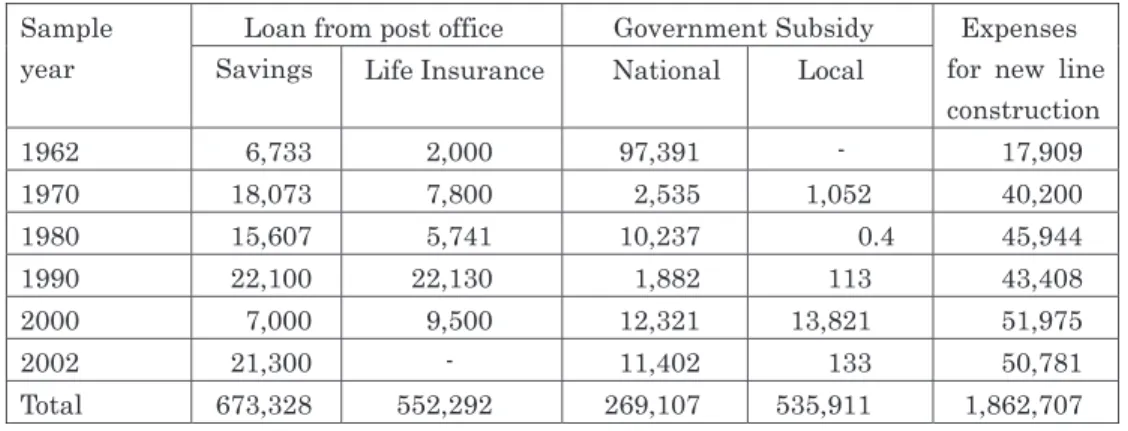
(officially called the“Fiscal Investment and Loan Program.”)This Program invests in national infrastructure including metropolitan subways. Table 6 shows how postal savings and post life insurance reserves helped finance the construction of the Tokyo subway. As Table 6 shows, the total amount spent on new subway line construction was 1,862,707 million yen, with subsidies from government to the order of 805,018 million yen(33% by the national government and 67% by local governments), in another words: 43.2% of the total new line construction expenses were covered by government subsidy. The remaining construction cost was covered mainly by post office-related loans that can be redeemed over the longer term. Similarly, subways operated by the TMG were constructed with about 40% of government subsidy(half by the national government and half by TMG). And the remaining expenses were mainly covered by loan from“Japan Finance Corporation For Municipal Enterprises”.
Post office savings and life insurance reserves collected from ordinary people working hard and saving like ants in Aesop’s fable“The Ant and the Grasshopper”played an important role in developing Japan’s public transportation system. This may not be well understood abroad, but is worthy of further study by public transportation experts in developing metropolises.
Table 6 Fiscal support for the construction of Tokyo subways(Unit : million yen)
Note : 1)The subway company was renamed twice : to Teito Rapid Transit Authority in 1941 and Tokyo Subway Co. in 2004.
2)Loans from post offices includes loans from welfare and national pension funds. 3)Total means gross total of 1962 ∼ 2002
Conclusion, or Perspective
New dimensions to 20thcentury problems
At the end of the 19th century, the world’s first car race was held between Paris and
Bordeaux. The speed was only 24 kmph(15 mph)but the spectators along the route were wildly excited by the splendid racing machines. Since then, the automobile has contin-ued to be a symbol of civilization in developed metropolises in the West all through the 20th
century. However at the end of the 20thcentury, many developing countries(including the
BRICs of Brazil, Russia, India and China)have made rapid economic progress accompanied by urbanization and the creation of megalopolises where huge numbers of automobiles are causing serious problems far larger in scale than in developed countries. Now in the 21st
century, different ways of thinking are required to address the“flood”of automobiles, pre-vent the wasteful use of fuel, and make cities more sustainable in developing countries. In addition to the solutions to traffic congestion mentioned in Chapter 4, here are some more general solutions to these problems.
Technical innovation
We must encourage the technological innovation(e.g., the fuel-saving Honda CVCC engine and the Mazda rotary engine mentioned in Chapter 3)to make automobiles more fuel effi-cient and less of an environmental hazard. At present electric cars and hydrogen vehicles are being developed.
New sources of fuel
Brazil and other countries are promoting biogasoline that is a mixture of ethanol and gaso-line. Ethanol is made of corn or sugar cane for example. There are, however, two major concerns related to biogasoline. First is its effect on the global food supply, especially for Japan whose food self-sufficiency rate is 39%. After the introduction of biogasoline, the international price of corn and sugar rose. Second is its effect on the environment. The Amazon rainforest may be destroyed if farmers find it more profitable growing corn than preserving the rainforest.
Urban land use readjustment
was to establish garden cities in the suburb of metropolises, have factory workers live in a healthy city and commute to the factories located on the outskirt of the city. This way the working classes would not have to commute long distances while suffering traffic conges-tion.
When I met the mayor of Moscow during the Soviet regime, I was told that the capital city’s function was divided among eight sub-cities within Moscow. Each resident commut-ed to an office or factory locatcommut-ed within the sub-city. No worker was forccommut-ed to make long-distance commutes. In addition to this, many high-rise and mixed-use buildings were sched-uled to be built - in these buildings the lower floors are used for offices or shops and the higher floors for residents working on the lower floors of the building. The plan was to con-vert commuting from horizontal to con-vertical, making the elevator the key means of resi-dents’daily commutes. It was an interesting idea - maybe only possible under the socialist planned economy.
Tokyo now has large-scale mixed-use developments including Roppongi Hills and Tokyo Midtown in the downtown area, but only rich people can afford to live there. Many ordi-nary workers are still putting up with long commutes from the suburbs.
Regional development
During the period of high economic development, the tendency was for metropolises to enjoy rapid growth at the sacrifice of rural agricultural villages. Japan is a typical example. More than a half of the land in Japan is now covered by depopulated villages where only old people remain.
Similar trends can be seen in China and other developing countries : the mass migration to cities of young people from rural villages causes serious overpopulation and traffic con-gestion.
To stop this trend, urbanization should be controlled by city planning, regional planning and other measures. Income-generating opportunities in rural areas should be identified (e.g. utilizing new information and communication technologies)so that villagers do not
have to go to the city to find work.
In this article the author focused on metropolitan transportation problems from the view-point of people setting aside the transportation of goods(commodity flow)- trucks carry-ing commodities and industrial products.
References
In English
T. Shibata et. al,“Motor Vehicle Pollution in Bangkok”in The State of the Environment in Asia 1999-2000, Japan Environmental Council(ed.), Springer 1999.
T. Shibata(ed.), Japan’s Public Sector”(revised edition of Public Finance in Japan), University of Tokyo Press, 1987.
T. Shibata,“Globalization of Local Public Finance in Japan”in Globalization and Cities, Center for Urban Studies, Tokyo Metropolitan University, 1999.
T.Shibata,“Land, waste and pollution : Challenging history in creating a sustainable Tokyo Metropolis”in Sustainable Cities, H.Tamagawa(ed.), United Nations University Press, 2006.
In Japanese
T. Shibata,“On the issue of automobile gas emission control”in Nihon no Toshi Seisaku(Urban Policy in Japan), Yuhikaku, Tokyo, 1981.
T. Shibata & H. Nakanishi, Douro to Kuruma no Keizaigaku(Economics of Road and Automobile), Otsuki Shoten, 2000. {後注}以上の世界諸大都市を例に挙げつつ述べたのに対し,幾つかの質問なり意見が寄せら れた。例えば―― *1974 年に東京都をはじめ七大都市連合が 2 千万市民の声を代表し,日本の自動車メーカー に窒素酸化物などの排出ガスの改善を強く要求し,国会での論議にまで及び,遂に燃料消 費を節約し排出ガスを改善した高能率自動車を開発製造させた経緯。 *戦後東京に地下鉄網が驚くべき発展をみせ,その建設資金が大きく郵便貯金や同簡易保険 (正式には財政投融資資金)に依存したが,その意義をどう考えるのか,また郵政民営化に より同制度は今後どうなるか? *戦後僅かの間に,日本の自動車産業は百年以上の伝統を持つ自動車王国アメリカを凌ぎ, トヨタ・ホンダからダイハツ・スズキなどと小型で燃費も性能もよい車を世界に輸出し, 特に発展途上の海外大都市に歓迎されている。かつて世界の先端に立ったフォードはその 利益の社会的還元や労務者政策で当時なりに模範を示したが,年間 2 兆円以上〔200 億ド ル〕もの巨大な利益をあげるトヨタは,現在いかなる政策を社会的責任として出している か?またトヨタがなぜ世界最高の自動車会社といわれるようになれたか,その要因は? *日本経済のミクロの観点では,その自動車産業が世界特に発展途上の大都市に多数販売さ れるのはめでたい。しかしこのままでは,ごく近い将来中国やインドだけをとっても国民 10 人に 1 台の自動車は保有しよう。(1989 年末あたりで乗用車 1 台あたりの人口は,フラ ンスとイタリア 2.4,英国 2.5,米国 1.6 にたいし,中国 1055.0,インド 455.0 だった。)す ると中国の保有台数は軽く 1.3 億台,インドは 1.0 億台を超えよう。2003 年末世界の自動車
保有台数は 8 億 3681 万台と推定されるが,こうした発展大都市における趨勢を中南米やア フリカまで含め考えると,その世界保有台数は近くでも 2 倍 3 倍と急増することは不可避 だ。そうとすると前記大都市における社会的費用の急増のみならず,地球の温暖化はさら に加速され,石油資源枯渇の時期も早まらざるをえまい。こうした時代の到来に備え,各 国の社会からさらに地球規模での Sustainability への道を緊急に考えていかねばなるまい。 交通手段としての自動車の将来像をいかに考えるか。