Vo!. 34, No. 2, June J 991
ON A PARAMETRIC DIVISOR METHOD FOR THE APPORTIONMENT PROBLEM
Tat.suo Oyallla Sai/a7lla C/I '1'( ""lly
(Received March 19, 1090; Rp,is"d Sept.cllJiwr le!, 1990)
Abstract Apportiollment problem has Iwen focused UPOll for mort' tltiln LOO years by many applied matlt-emat.icians and operations researchers. Billinski and )"onng haY<' done quite t'xtt'w;ivl' works for t.his prohlem.
In t.his paper we propose a parilmetric divisor lIlt':hod for whiu!'. an apportionl1lent. problem. Our method is showll to ·'·.:over" IIIOSt. tradit.ional apportiolllllellt l1letho(b. First \\'e introduce the idea of stable
regions for t.he allocation of seat.s to ,~ach political cOIL:itit uenc~, thell sho\\' the explicit rl'iiltioll b·,tween apportionment methods and corresponding stable regiolls. Then lVe look at t.hese apportionment methods from t.he viewpoints of constrained opt.imization probl"IlI, alld we shOl\' t.he cOl'l'esponciing optimIzation problem for our parametric divisor met.hod
Finally using Jaran's lIollse of Represent.ative data, l\'t' shol\' the Illllllerical results for the applIcation of variolls apportionment methods. 'vVe conclude our p,' }cr by Sltsgcstins Clppropriat.e parcll11E'ter values for Ollr parametric appor :.ionmen t method.
1. Introduction
In Japan the issue of "weight of olle vote" has bC('1l COllt 1'01'ersial sincE' people began to recognize the gap between political constituencies with respect to the weight given to the number of seats per voter. In 198G our Suprellle Court gal'e a decisioll responding to the appeal that a gap of more than 2.0 mal' be lltlCOllstitutiollal. Siuce tlleu. sE'vera.! similar decisions have been given in various judicia.! courts. Om ruling Libera'! Democratic Party in the Diet has also recognized the importa.nct' of t his problem. It is considering reform of the election system, which has not been changed sinc(' the UJ.'iO's. Their plan includes reducing the total number of seats from the presellt 512. which was established in 1925. to 471 and accepting middle size electoral districtlllg syst em (the llumlwr of seats assigned to each constituency should be between :3 and 5).
Various types of "equity" problellls arise iu distri butiug Cl I·a.ila ble personllel or resources
in "integral parts" to differen t su bdi visions. T,I :)ical exalll pies are the a.llocation of a set of available teachers to classE's in order to make timetablE'S. Ilw assignment of a set of individuals to certain jobs, which is the so-called classica.! as,ignment problem for operations researchers. and the distribution of seats in a legislature among different politica.! constituencies, Several
solution methods have been proposed and establi,hed for some problems (e.g., the assignment
problem), Others have not yet been "efficiently" solved (t.g .. the timetabling problem). The apportionment problem a.ims at allocating seats "fairly" alllong political const;tuen-cies when the total number of seats and the di,tributioll of each cOllstituency's population are given. Mathelllatically, tlw apportiollllwnt. problem call 1)(' forlllltiated as follows : (~ivell the set of N political cOllstit.twllcies as .').
=
{l. 2 ... Y}. tll(' populillioll of political con-stituency i E ::.:; as ]Ii. the t.otal pOPlIlatiull clSe.
alld the totitlllllllJiwr of seats as h.'. t.he "ideal" number of seats allocat.ed t.o the cOllstituellcy i. i.r .. tile "exact quot.a" </" is given188 by where Hence we have T. Oyamu. i E S P=LPi ;ES Lq;=X IES (1.1) (1.2) (1.3 ) Then the apportionment problem is to partition a giYf'n positin' int.eger /\' into nonnegative integral parts {cl;
liE
S} such thatL
d;=
J\';ES
d;
2:
u.
integer. i E S'(1.4 )
(1.5 ) and such that these parts c.re '"as near as possible" proportional. respectively. to a set of nonnegative integers {PI, P2, , , . , PN }.i .e., {ql. (12 ... Cf,\, }. If the exact quotas {qj I I E S} were to be integers for a.ll i E.',", then the apportionment would 1)(' obtailwd by setting dj
=
q,for each i E S. But this is an extremely rare case, so uSllall,\' exact quotas
{q,
li
E:: S'} all have fractional parts. Therefore, the problem becomes how to rOlllld the fractions {Chli
E S} to their "nearby" integral valUo's keeping their sum equa.] to a gin'll \'a.]lle h ..The apportionment problem may seem to he an easily soh'ed '"approximation" problem. However, this is not the caSE as hist.ory shows. The Congress of the U nit.ed States, for exam-ple, has used four different :>ehemes to apportion the seats in the House of Representatives among the various states oV(~r the past 2UO years. and they have. on many occasions (begin-ning in 1790), held lengthy debates on this issue. General descriptions of the apportionment problem and its history are given in e.g .. [8. 11].
Difficulties of the apportionnwn t problem occur Cl t s(-~\'''ra I points. Firstly. how should we express the measure of "Inequit.y·' to be l1linimized'? The}'e 111<1\' IWlIlall,\' definitions
rep-resenting both global and local "inequities" bet.ween various ('()]}sl it lWllcies. These include minimizing the sum of differences betweeJl given apportioJllll(,llts a11(1 tlte exact quota of ead! constituency or minimizing "Iocally" relative differences of til(, 11llllIiwr of seat.s allocated per voter. Secondly, the difficulty of the apportionment problf'l11 is rf'la.tecl to the property which we want our apportionment. method to satisfy. For example. we want the apportionment method to ha.ve the property that the number of seats given to each constituency is either rounded-up or rounded-dowll by an exact quota or we ma~' wallt that a constituency should not be given less representation if the total number of seals illcreases and the distribution of the population of each constituency remains the same. There are various "natural" re-quirements for acceptable apportionment methods. Some of tlwse "requirement.s". however, are inconsistent. As yet, no method ha.s been found to sat.isfy them simultaneously in the general case. This means that no matter which apportiolllllent. method is accepted, it will possess certain "defects". Namely, we may have to decide in advance which properties must be satisfied, and which "defects" are acceptable before we employ our own apportionment method.
Ba.linski and Young ha\'e clone extensive work in the area of apportionment problems (see e.g.,
[1,
2, 3, 4, .5. 6, 7]). EveJl though they have proposed Cl ut'w complicated scheme called quota method (see[1,
2]) satisfying certa.in properties Silllultil.lleously. they ha.ve been promoting a classical \Vebster method (see [8]) for its illljlarl.ialll(,ss alld silllpllcity. In this paper we propose Cl lIt'\\' sil1lple apportiOllllH:'Ilt. IIWt.llOci. whi('h \\'(' ('id 1 a jlaI'ilIlIf't.ric divisormethod. We show that our method is general enough to "cover" most traditional apportion-ment methods so far employed in several countries. vVe theu propose a range of appropriate parameter values for our apportionment method in order to maintain our method's impar-tialness and fairness with respect to the population size of each constituency.
In Section 2 we review several representativE' apportionrnent methods and introduce the idea of a stable region related to certain locally optimal assignments. In Section 3 we look at those apportiolllnent methods from the viewpoints of cOllstrailwd optimization problems, then consider what kind of objective function these apportiollnlf'llt lllethods are trying to minimize. In Section 4 we expl"in our parCl\1lC'tric divisor method with its re\"tion to other methods. InScctioJl .5 we give' the results of our llunwrical cxperi Il1cnt.s lIsing .Japan's House of Representative data, and compare these results with the apportionment methods described therein. In the last Section, we conclude our pa.per by giving certain evaluations obtiLined from our ana.lysis and numerica1 experiments.
2. Apportionment methods and the stable regIOn 2.1 Traditional apportionment methods
We expla.in several vel',)" common apportionment methods .. SOlIle of which aTe employed or have been employed in some European and Americall couutries. First, we will gi.ve a common scheme called the largest fractioll method. This scheme is based upon remainders. Next, we will show five divisor methods. These were baseciupoll divisors and go by the name of Huntington methods.
The largest fraction method, which we sha.!1 denote by LFM, was first suggested by A. Hamilton at the United States Congress in 1791, and was used by the Congress from 1851 until 1910. The LFlU first assigns each cOllstituellcy i E S' its lower quota
lq;j,
wherelqJ
denotes the largest integer less than or equa.! to q. Then we define the fraction of eachconstituency t, as follows.
i E ..,. (2.1 )
Sorting the set {ti liE ,)'} from the largest. arbitrarily for tll<' equell elemellts, we define the set of suffices of the first J\' - LiES
l
q;J cOllstituellcies in tlw ordering by T. Then the LF M allocates an additional seat to the constituencies belongillg to tlw set T: namely, the whole allocation {di liE:n
by the LFM is given as follows,i E T
i
tt
T (2.2)Let us define the general divisor method. First, we giv(> a divisor ,\ in orcler to compute the quotient of each constituency i E S' with the population Jil as q/('\) =
zx..
Then, we round the quotients according to values of the number of seats to each constituency. Let us denote the integer ,'alue obtained from the quotient q,(.\)=
~ by [q, (,\ll,
=
[zx.]r.
Then, in order that these quotient.s can be all apportiollllwnt the followillg Illust hold.I:,[q;('\)]r
=
I:,ll~\;],
=
J-:
tE.'> lES
(2.3)
Now we genera1ize the rounding process by defilling the di"isol' function v(d) a.s follows. Let v( cl) be a monotone increasing function defined for all integers d :::: U and also satisfy
cl:::;
v(d) :::; cl+
l. Thell, for allY positive real number .1'. there COITf'SPOllds cl unique integerd such that v(d - l:
<
.f :::; u(d). \Vc define the above rounding process hyPi
[-], =
rli190 T. Oyama
where
]J
')(d; - 1)
< ; ::::;
V(di) lE,S (2 . .5 )The apportionment method described above is called t.he di\'isor method based upon the divisor function v( d). The divisor method can be defined equi \'aklltly as follows, From (2.4) and
(2 .
.5), the parameter). has t.o satisfyThis means that
]J' Pi
- ' - < ). <
for all i E S' v(d;) -- v(di-l) mm c/,>II Pi t,(d, - L) (2.6) (2.7)where we permit dividing by 0 and assume that
*
>
4f
if Pi>
}JJ' Defining the rank functionr{Pi' di) for i E S as
Pi r(pi,dj ) =
-u(cZil then we can write the above relation (2.7) as follows.
(2.8)
(2.9) We denote t.he avportiOllllWnt method ba.sed UpOll (he d i I'ism fUllction 1'( cl) by A( p,I{),
which expresses a functioll giving N integral compollents cL1 . ... ,dN as all ima,ge of a given
population distribution vector p
=
(]l1,' .. ,]IN) and a total llllllliw]' of seats !{. The functionA{p, J() can be writ.ten as follows.
(2.10)
where d denotes the allocation I'ector given by d
=
(cl], ... ,ds),There exists an alternative way of expressing the general a pportionment methods based upon the rank function v{p;, d;) recursively. Let.
df
be the llumiwr of seats allocated to the political constituency i E S gl veil the total nUlllber of seats /,' E {O. 1. ... , !\'}. Then an iterative algorithm for the gen(,ral divisor method can 1)(' II'ritten as follows.Algorithm (general divisor metlill.d.l
~
df
= o.
j,. E {O,1,. .. , X}. i E .':l'. j,.=
O. Step 2f
d~'+1=
d~;+
I'l
dk,'+ 1=
(lk,' I T . .../. t, lE,':>' . Step 3 k = /,~
+
1. If k=
K. then stop. Otherwise. go to step 2.(2.11 )
(2.12 )
As shown in the above algorithm, for j,. = 0, tIlt' allocation m1lst be zero for every constituency. Given that an allocation dk
=
(dt, ... , d\) has been determined for a total number of seats k, an allocation for a size k+
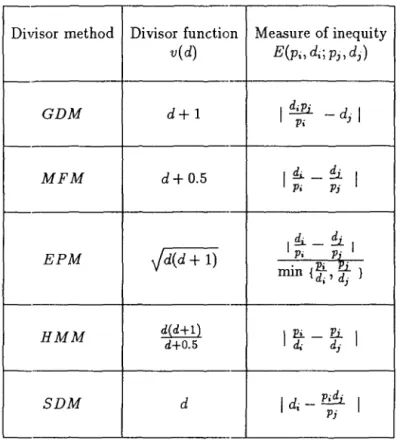
1 is found by gi\'ing one more seat to the constituency i for which t.he rank function l'(p;. cl;) is a lllaximulll.Based upon different divi~;or fUllct.ions we can define all infinit.e number of different. divisor methods (see (:.g., [1,:2 :3,4 .. S, 6.7, L.5]). There are fin' traditiollal divisor methods
shown in Table 1. The method of greatest divisors, which \Ye denote by GDM, was also called the Jefferson method in Balinski and Young's papers. The method of major fradions, which we denote by I'll FM. was called the Webster method in their papers. Balinski and Young called the equal proportion method (EPl"), the harmonic lllethod (HM M), and the smallest divisor meT-hod (SDM) after the nanws of their ad"ocatcs, i.f., the Hill method, the Dean method, and the Adams method, respe,:ti\'ely.
From the computational aspects, three apport.iOllll1ellt lllethods, G D .~1, !vI F M and
SDM can be separately described. First, apportionment by the GDJ1 can be obtained as follows.
(i) Find the maximum A
=
ACD such that(2.13)
(ii) If (2.13) holds as equality for ,\
=
'\CD, thenJw aliocClt ion cl is given byP,
el,
=
l
'\CDJ (2.14)If (2.13) holds as a ,trid inequality, then let
E
=
{ . II'
l E , ) , - - : , J J , . ll1tegn },\(; j)
(2.1.5 )
Since there exist. more t.han olle i such that )\~';D is illtegn \"duecl. E
f:.
9. Suppose(2.16 )
then we must decide that 1{' - X cOllstituencies lose' Cl seal. Hellce let D be a subset of E with
1
D
1=
X'-X
(we can apply an ad-hoc rule to determille' this), thell the apportionment can be given a.sd;
= {
/]:;D
- " - - 1 '\GD
i
tf-
D. i E E i E DIn the case of 1\} F 111 the maximum A = '\.1/ F can be obtailled as satisfying
(2.17)
(~:.18 )
The remaining part:3 in the abo\'f? procedure (ii) 'Ht-' similarl:-' obtained by changing ~; to
~ A M F '
+
0 . .5. Similarb', for the case of SDM the 1)<lra11)('t('r ,\,'D is obtaineci as the maximum '. A such thatL
l~
+
1J
2::
1\'.lE.') '\SD
(:2'.19) The remaining parts in the above procedure (ii) MP also silllilarh' obtaincd by changing ~ to
!;-;;
+
1.141ere are severa.l properties for each a pportiolllllt'lIt 11 wt lwd to sa t isfy. If the allocation
{dj 1 i E S} given b~' the method J1 satisfies
192 T. Oyama
then we say that apportionment method Al satisfies the lower quota. Suppose the allocation
{di liE S} satisfies
i E 8 (2.21 )
where
r
qi1
indicates the smallest integer larger than or equal to qithen method !vI is said to satisfy the upper quota. If method 1'1 satisfies both the lower and the upper quota properties, we say that method 1H satisfies the quota. Neither divisor method described above satisfies the quota property, while the LFM does satisfy it.
An apportionment method Ai is said to satisfy the hOllse 1ll0llo(one property if no
po-litical constituency i E 8 decreases its allocation when the house size increase:3 from k to k
+
1. The violation of this property is often referred to as the "Alabama paradox". The word "Alabama paradox" originates from the fact that when (Ill' ll.S. Congress was using the LFlv! in 1881, the state of Alabama was allocated 8 rcpres('ntatiycs. while (lte.y received 7 when the total went to :300 from 290. Therefore. the L F.\J does not satisfy this property. All other divisor methods satisfy it.2.2 Local measures of inequity
Now we focus upon the local measures of inequit\· Iwt\\'eeu pairs of cOllstituencies. Let the population in the constituency i E S' be Pi alld tIlt' nllllllwr of seats assigned be d,. We say that constituencyi is fayorecl over j whell the nUllllwr of s('ats per illcliviclua.l in the constituency i is greater tha1 or equal to that ill j; namel.\·. !lJ. :::: <!:.J... (i.t., l!!.," ::;
u
j
' ).
Hunt-P, Pi ( I ( )
ington considered making ratios such as !h p, or l!.!.. d, as equal as possible over all cOllstituencies. That these ratios are nearly equal means that, ideally. relat.ive or the absolutE' differences concerning 5b. PI or l!.!.. el become zero. Generallv. we denote tbe measure of inequitv between
t '" .J
two constituencies i and j a, E(p,. cl,; PJ. clJ). Then Huntington \ rule says that we should
transfer a seat from a more favorecl constituency i to a less fa\'ored constituency j when it brings a smaller measure of inec[uitv. Namelv, when • ,1 . , !lJ. p, -
>
iL
J!) ilnd(2.22)
we should transfer a scat ft·,ml i t.o j. The oi>jectiH' of llulltingtoll's I'lde is~o mlllll1lize the measure of inequit.y between pairs of constittwllcies. So tlJ(' "desirable apport.iollment" is obtained when no switchilg of seats betweell constituellcies call illlpro\'(' (he measure of inequity between any such p,iir of constituencies. The attailllll(,llt of this state i:; referred to a stable assignment of seats.
Huntington's rule was applied to several forms of the measure of inequity E( Pi, di;}JJ' dJ) as shown in Table l. For each measure of illequity in Table 1 \\'(' can obtain a stable assign-ment of seats. Moreover, the resulting stable apportiollnwllt. obtained from ead function of EGD, E/I1 F, EEP, E HM • and £SD indicatillg the measure of ille<jui(.\·. correspollds to the so-lution for the apportionment. nwthocls GDM, M FM. EP.IJ.II.II ,I} ami ::U)Jl,·espectively. For example, the correspondence bet ween function EEP(P,. rI,: PI' ri,) and E P!1i is shown in the following theorem, which can be proved in a similar way to [So plUl]. [11, p378]. Theorelll 2.1 For the pair of constituenciesi and j with populatiolls p, and p)' appor-tionments di and dj, respectively, the following holds.
EEP(Pi,di;lij,dJ )::; EEf'(p"d, -l:PJ,d,
+
J) i.j E ," (2.23)if and only if
jli
<
]I)Vd,(d,+l) Vd,(ill-J)
Table 1. Divisor method, divisor function and measure of inequity
Divisor method Divisor function Measure of inequity v(d) E(p;, d;i Pj, dj ) GDM d+1
I
d;pj Pi - djI
MFM d+O.S 14i._~I
Pi pj d t!L EPM Jd(d+
1) I~- p' I min {12h }
di'dj HMM d(d+l) d+O.5 112_Ei. di dI
j SDM d Id. _ • Pidj PjI
Using thE' ahow' thE'OrPllL suppose that t.hE' rE'latioll (2.2:~) holds for all i E ,':>' and j E S'.
ThE'n thE' assignll1E'1l t. corn'sponds to t hE' optimal cOl1\·E'rgenl i1 pport.ioll mcn t. HE'Jlc(',
compar-ing (2.23) or (2.241 with (2.7) or (2.D), WP can conclude tllat tlI(' aboVt' casE' in Theorem 2.1 is equivalent to the case that the divisor functic'n is gi veil as u( rI,) = d, (di
+
1). In other words, the pairwise transfering procedure givell by the criteriOll in T leorem 2.1 gives the same apportionment solution as EPAl. Similarly, we can prow' that the measure of inequityfunctions EGD,E.~fF,EEP,EHM. and ESD are equi,·alent to G1JJ{,MFM,EPM,HA1M,
and SDM, respectively.
From the computational points of view, pairl"ise comparisons are very illefficient since We probably have to consider each of the N(;\-l) combinations seyeral tirnes. The above (:'quiv-alent relations between measures of ineql;ity fULctions and rail!.: functions indicate that We can apply divisor methods to compute the appOl tionnwnt method based upon Huntington's criteria.
Huntington examined 64 different measures of inequity including :32 relative and 32 ab-solute differences (see
[10]).
All of tlw relative differences alld two of the absolute differences lead to EP M. For example, if we c\enlw allotlH'· relati,·e diffcu'llces with respect to J~ and 1!.J..d' J instead of <b. and P,
<iL
p) in EEP, \Vc agaill obtaill the samE' re.~lllt as Theorem 2.1. Vmiousabsolute differcnce, brought. other four method:; G LJ .11 . .11 F .11. jj .H .\1 alld S D J1. There a.re also some absolute differences for which the ll1t'a"urc of ill('qui(,· fUlIctioll does not \\'ork. In
[10]
an example of the lllf'(1S11rf' of inequity flll:ctioll E(jJj. ilj: /1,. iI,)=
1-"-'.,' -hi
for \,'hich< . ( ' ) jJ)
194 T.Oyama
Theorem 2.2 Let the measures of inequity be as follows. max{ l!..!..
U}
E( " " .,.)_ I P'.(·I,]I}.c) - .{n.
d,d} J} } . mlll c. U d, d) (2.2.5) max{!!"".:!.L } E (. . l.. . d ) - p, 1')2 PI, (I, ]I), ) - . I d
mll1{!..:t. --"-} p, p) (2.26) Then the apportionment by the EP1\1 gives a stable solutioll when the Huntington's rule is
applied to the above measures of inequity El and £2.
Proof By subtracting 1 from each of the functions El and L'J. we obtain the e:'1'or functions
EEP(Pi, di; Pi, dj ) in Table l. From the equivalent correspondence between the ['unction E EP
and the method EP!vI, we can conclude tha.t apportionment b~i the EP Iv! gives a stable
solution to the measure of ll1equity in (2.25) and (2.2G). 0 Similarly, we can obta.in the following corollary.
Corollary 2.3 Let the measures of inequity be as follo\\·s.
(2.27)
(2.28) Then the apportionment b~' E P!lf gives a stable solu tioll WilCll H untington's rule is applied to the above measures of inequity £3 and £4'
2.3 The ARPT rule
We consider a new rule, which we call the average ratio pairwise transfer (ARPT) rule, for transferring a seat from one constituency to another. Our new rule provides deep insights to traditional apportionment methods and it is also ver~' useful for investigating our new apportionment method proposed later. Our ARPT rule is based upon the measure of inequity
E(Pi, dl;pj, dj). Let T be the average number of seats j)f'r individual i.t.. "
=
If,,
thenthe ARPT rule says that, for any two constituencies i and J' such tha.tiz.
<
r<
&. we" p) -- - PI
should make a transfer of one seat from the more fa vared cOllsti t uency i to the less favored constituency j if it reduces tile measure of inequity. i .t .. if E(ji;. d;: p). rI,) > £(Pi, di
-1; Pi, elj
+
1). Our transfer rule is different from Huntingt.oll's Olle ill tltat IVP add a restriction ~ :::; r :::; ~, which possibly implies that our stable region is "IM!!,er tha.ll" HUlItillgt.on's one. Applying ARPT rule to sew'ral types of measures of inequity. \H' can obtain the followillg theorems. In the following we always assume constituency i is faxo['ed o,,{'\' constituency j. i.e. , p, -4..>
~ PJTheorenl 2.4 Let the mea.surt" of inequity be
Then applying the AR PT rule to the ahove measure ES(Pi. cli: I'). d;). a stable assignment can be obtained a, sa tisfying
I I , I ) i
+
P, r /> T - . _ - - ' . } - . , :2 I I P - jJsgn(pi - p}) . ·/'k 2:> sgn(p; - Ji)) . (I"
+
T)
(:2.30 )
(2.31 ) h ' -!!i , - ~ I - 1 '. - 1 I I, -- .. 'f' I
>
I . - " f I I d (t) 1werexl - p. .,.1:)- ,pi--,p)--,anch--l1 p,-p,.-JI Pi <p);a.n sgn. =
j)l p. Pl .
if
t
>
0;=
-1 ift ::;
O.Proof Since constituency i is favored over j', we have ~ < I" < !!i. So we need to consider
j)l - - p.
the following three cases (i)-(iii). In each case we sho\\' the condition that the measure of inequity a.fter a transfer of one seat from i to j is larger than or equaJ to that before the transfer. (i) d,-1
<
I' dJ+1>
r PI - , Pl -(ii) d, -1>
r :!.L±..~> /'
p, ' P J -(iii) d.-l<
r ~.!<
r PI - , }JJ el, cl7 rl; - 1 cl,+
1 - - I"+
I" - --'-<
1" - . - -+ -'
-- - ,.
Pi p) - Pi P, d; - ~ il]+
~- - -
<._--Pi JI.I I I Pi+
P, .r}·>
.r, - . _ - - ' - :2 cli d) di - 1 d,+
1---<---1'+-.---,.
Pi p} - Pi p) f I Pi - P .r· } ->
r + - - - ) :2 cl; d, cli - 1 _ cl}+
1- - --'- <
I" - - - -+
f' ]i, 1') - 1', Ji)pi -
Ji'
.f,<
1"+
- - - . I - :2 From (:2.3:2)-(2.34) we obtain (:2.30) (2.:n). D (2.32) (2.33) (:2.:34 )Illustrating a stable region given by (:2.30: and (:2.:31) 01] the ,fi - .rj plane, shaded areas are obta.ined as in Fig. 1. Namely the [Joint. (,ri. ,c,) .
=
(!!..c. iL) I), }Jj in the shaded area indicates that the corresponding apport.ionment does llot decrease the measure of inequity by transferring a ;;eat from a more favored constituency i to a less fa\'ored cons tit ue:1CY j, Let us define the dlocation of seats {di liE S} is stable if the assignlllent {cl;. cl)} is in thestable region for any pair i and j in .,' \yhen ARPl' rule is applied. Then, from the above Theorem 2.4 we can obtain the following corolla,ry.
196 Xj r ~ ______ ~~~~~ ______ ___
,
r-Pj T. Oyama rr+~/-p
Xjr-~/+p/)
r-~/+p/)
----~~---~~--~----~~Xi ----~~---"---"---. . Xir+p/
o
rFig.l Stable region for the case ES(P"clj;PJ,dj )
Corollary 2.5 The alloca.tion of seats obtaillf'd from M F.11 is stahle for t\l(' application of ARPT rule.
Proof The allocation of seats {cl; liE S} obta.ined frolll M F1\J satisfies
Pi Pj
max - - 1
:S
mm-cli
+
'2 j d) - ~Therefore the relation (2.32) can be satisfied for any pajr of i and j in S. Hence the
allocation given by the M F M is stable for the application of the ARPT rule. 0 Applying the ARPT rule to the measure of inequity fumtioll defim'd by maximizing the absolute biases from the average ratios, we obtaiu the followillg results. whos\'· proofs a.re given in the Appendix.
Theorenl 2.6 Let the measure of inequity be
(2.35)
Then applying the ARPT rule to the measure EM(]J,.dj:p,.dJ). a stable allocation can be obtained as satisfying
.. > .
.{
l ' }.i) _ .l, - max Pi']).! (2.36)
if Sgll(p; - Pj)' (:1:;
+
,Cj):s:
sgn(p; - pJi )· 21'( ' ') ( ' ') 1 { ' '}
sgn Pi - PJ . XI.;:S sgn Pi - p) .,.
+ 2
111ax Pi'P) (2.37):1'.1
2:
:fj - min{p;,p',}if sgn(p~ - Pj)' Cri
+
.1'))2:
sgn(p: -1/,)' (2,.+
p; - pi,) andeit her pj
:S
P~:S
2pj or 2Ji~2:
JI',
>
jJ:
where suffix k and function sgn(p) are defined as in Theorem 2.4.
(2.38)
Illustrating a ,table region given by (2.36 )-( 2.:38) on tl1f' .1'; - .1'.1 plane, shaded areas are
obtained as in Fig. 2. while other cases pi
>
2p', a.nd 2Pi<
pi, can be reduced to degenerateones. X' J 2r+p/-p/ 2r , r Xj 2r 2r+ p/-p/ Pi r---~~~~~--- r+--p
2
,
r t---~~~~~~--- Pir--2 -r-p/ 2 r-Pi
,
---t~___::-_:_'_--"___T----... --,-~ Xi-pI
-p/
r -+
p/
2 ( a) 2pj
2:
pi
2:
pj
-Pi,
-pI
r+pi--, p/
2Corollary 2.7 Suppose that both of the two avportiolllllell t lllethods Cl D j)1 and S'D lVI give an identical a;;signment of seats. '1'11('n it is a sta ble allocation for the application of the
ARPT rule to the measure of inequity EM. Theorem 2.8 Let the measure of inequity 1)('
(2.39)
Then applying the ARPT rule to tlte measure Ep(p;. d;: p). cl)). a stable allocation can be obtained as satisfying
2XiXj + Xi - X.J - 1
2:
0 for Xi>
1. -I:S
X):S
0 and 0:S
Xi. -l > X,where Xi = cl; - Cji, X) = clj - qj. qi
=
rpi and 11,=
I'p).(2.40)
198 T. Oyama
The shaded areas in Fig. :3 sen'e to illustrate Cl s\dbk It'gioll g)\TIl I)\" ("2.~IJ) dnd (2.41)
on the X; - X.I plane.
---~~~~~~~~~~~~~~~~~~Xi
- ... ~~~~~~~ 2XjXj +Xj -Xj -1 =0
2XjXj +Xj -Xj -1 = 0
Fig.3 Stable region for the case EA1(Pi.di:PJ,dJ)
Corollary 2.9 Suppose'\
=
~ be a parameter satisfying li)(' .\1['-"1 conditioll (2.6) forv(dil = d;
+
*.
Then the SOllltioll of tlw .\1 F:\1 is a ~(,ahle as.~igll!llent for the application of the ARPT r~lc.3. Global optimization aspects of apportionment methods
In this section we look at apportionment methods from the viewpoint of constrained optimization problems. In this respect, as far as we kllO\l", \"('ry few inyestigations have been done so far except that some preliminary results have been obtained and seen in [8, 11]. The various kinds of constrained optimization problems with respect. to the unknovvn variables {di liE S} have tIlt' same c<)nstraints as follows.
L
cl,=
I": lE.'"di
2:
0, illteger, i E'; (:3.2)So from now OIl we abhrc\'iate the above constraillts. shO\\"illg ollly the objective func-tion for each constrained optimizafunc-tion problem. First. t he following tlworem shows the constrained optimization problems for w hicb all optima.! soil! lioll is gi yen by the L F 1\11. Theorem 3.1 The L FM givcs all optimal solution for t.ht' following constrained
optimiza-tion problems.
PI : mm cl
iES
P2 : min max
Id; -
(/iI
cl ,ES P3 : minL
(di - qj)" cl iES (3.3) ( 3.4) (3 .. 5)The above theorem can be easily proved, so it is omitted here. Incidentally, the LPIv! gives an optimal solution to all constrained optimizat ion problems with objective functions with the form of lp-norlll of
Id - ql
(see[DJ).
Regarding the GDM and the M FAI, we have the follo\\'iug results.
Theorem 3.2 The G D M gIves an optimal ~;ollltioll for Ill(' following constrained opti-mization problems.
cl;
P4 : luill llIax
cl IES jI,
P.5 : Illax II1Ill I); d I E S di
(3.6)
(3.7)
Proof If an assignment {cli liE
.'n
is uptil1la. t heu for alJ el" ell with iI:
j and cli > 0, atransfer from i to j cannot improve the objecti\(:, criterion. That is, let
cl;
(3.8)
me . .:\:
iE " jl,
then we have to have the following
cl)
+
1 cl I. d;- - - > -
> -
all." i E.". SOllW j E S (:3.9)Pj
P,
Hence the following relation has to 1)1' satisfied.
I E S. j E.'" (3.10)
The ahove inequality is equivalent to tlw following relatioll.
P i " PI
lllax - - '-. llUll
I d,
+
1 --- I cl}d,;:O:O dJ >11
(:3.11 )
which is the max-min inequality that characterizes the G [) .\1.
Conversely, if {d, liE S'} is all a.ssignnwnt solutioll vbtilillecl from the CDil1, then it satisfies the relatioll (:Lll). Suppose {cl;
I
I E S} is allot Iter assignment differem from{di liE S}, then we define sets of suffices as follows.
Let
i E S+ j E')'~
(3.12)
200 T.Oyama
then positive parameters {Oi}, {/3j } satisfy
Then we need to show
L
°i=
L
Il)=
I iES+ jES-_ 11) max ) ri,Hence there are two cases we need to consider.
{
Case 1 : k
tJ.
s+
u .''';-.
I E ,)'+Case 2 : k E S-, l
tJ.
s+
uS'-Case 1 Since k
tJ.
s+
U S- and I E .S+, we ha.vePI PI Pi - - :c= - - -
> -
any ItJ.
s+
U 'i-d; dl+
Ltl - el, Hence we obtain Pk PI<
-cik -
dl+
etl which is equivalent to (:3.1.5).Case 2 Since k E S- and l
tJ.
s'+
U .';-. we hav~'Hence we obtain ~
<
JIk<
PI elk -(h
-)k - ell ( 3.14) (3.1.5 ) (3.16 ) (3.17) (3.18)which is equivalent to (:3.1.5) again. Th liS the criterion p.~ is sllOII"JI to be sat isfied by the CDJ';f. The case P.5 is equivalent to P4. 0
Similarly we can obtaill the following results whose proofs are given in the Appendix.
Theorem 3.3 The 111 Fkl gives an optimal solution for tIlE' following constrained opti-mization problems.
.
~Idi
I
PG : mill L.. - - T {d} iES Pi (3.20) ~ di ) Pi : min L.. Pi( - -- rJ-{d} iES Pi (3.21 )Theoren13.4 The E P.M gives all optimal solution for the folloll"ing constrained optimiza-tion problem.
) . ~ p, .)
P;-; : 111111 L.. !li( - --
.-)-{d} iES el, (:3.22 )
Theorem 3.5 The H A1 A1 gives an optimal solution for the following constrained opti-mization problem.
P PI) : min
L
I-I' -si
id} iES (,
(3.23)
Interestingly enough, Theorem 3.;~ shows that, when the measure of inequity is given as
the bias of the numher of seats per individual from its l1lca.u. both their absolute surn and
weighted squared Sllm are minimized by the AI FM. However. whcn the measure of inequity
is expressed as the differencc of the number of individuals per seat from its mean, their
weighted squaTed sum is minimized by the E P lU, while the H M Jj minimizes their a.bsolute
sum. We believe that the A1 FlU is more sensitive to the faimcss of seat per individual ['atio,
i.e. seat per individual oriented, rather than tJe EPJ1 and the H AI M, which are more individual per seat oriented.
4. Parametric divisor method
Using a parameter t such that 0 ::; t ::; L the divisor functioll of the paTametric d;visor method, which we denote by P D.'1, can he written as follows.
vPD(d,t)=d+t (4.1 )
Comparing the above function u p( d, t) with thaee ill Tabl" 1. we filld that t
=
0, 1/2, and 1correspond to those functions of the 3DJ!, 1H FM alld G DJ!. re~pectively.
Now the apportionment method based upon the P f) M can be described as follow~ .. Let the parameter for PDA1 be ,\ = '\1'D, then '\1"D can be cletenllined as the maximum A
satisfying
L
lP,
+
1 - tJ
2:
A'IES ,\
If (4.2) holds as an equality for ,\ = ,\p D, then tile allocation {el, liE .'l} is giyen by
Pi
cli =
l-
+
1 - fJ
A i E :-/
(4.2)
(4.3)
The case that (4.2) holds as an inequality is dealt with similarly as descrilwd in (2.1.5)-(2.17)
for the GDA1. Also parameter '\PD satisfies
p,
< \
< __
1_)1 _ _ d;+
t - . P D d, - 1+
t ( 4.4) Hence we have Pi Pj max ::; min I di+
t j ( j - 1+
t ( 4 . .5) In order to look at the paramet.ric method ['rom the ,·iewpoillt of applying the ARPTrule, we define the mea.sure of inequity function ESF(PI,d':P.I,d,: c) using a parametel' v a.s follows.
U <
l'::;
(4.6)Then we obtain the following theorem.
Theoren14.1 Applying the ARPT rule to the measure of illc(juit.y F.)\". a sta.blc region can be obtained a.~ follows. If
pi
2':
pi" then we 1 aYeupi
+
]J~x)
2:
.1'; ----"-1
+
v ifr - } / ::; .!')
:s;
I"202 T. Oyama (1-['):1') ::::: -(1
+
v)x,+
21'+1'11; - p',
,
ifmax{O.r - Pi - (1+
'!!..)p'}
<.r < r -p'
2 2.1 - ./ .I llj --vp' .r , -<
r + - - - ) 2 if 0::; .r)::; max{O.r- / :2' - (1+
2)11~} t' (4.8) (4.9) where Xi,Xj,pi andpj
are ai, defined in Theorem 2.4. If pi < p~. thell the following has to hold. vpi+
pj
:1:)2:
Xi - if l' ::::: ·I'i ::::: ,.+
pi
1+
l' (4.10) (1+
v):rJ2:
(1 - V)Xi+
2vl'+
upi -1/, ·t· ,<
(1 l ) , p')I
r+
Pi<
Xi _ r+
+
~ _I Pi+
~ _ (4.11) J , p - vp· x )>}'
+
-.-:-.--.1 - :2v . . 1 , p' , I1 (1+ -:-)
,)Pi+ -:-)./
< .1", ami Pi :::::t'j/
_1 ~ ./ (4.1:2 )If
pi> vpj.
then only (4.10) and (4.11) have to hold.Proof Let the constitucncv
i
be fa.vored over J., thcn we hill'<' ~<
1"<
~. So we need to. P; - - jJ}
consider the following cases (i)- (iii). In each case we sho\\" the conditioll t.bat the measure of inequity after a transfer 01" one seat frolll i to j does llot cle("l"eC)se.
(i) d,-l
<
l' d)+l> ,.
p, - , jJj -d, d d .+
1 el, - 1- - ,. +
v(,. - --L) ::::: _J _ _ - ,.+1'( /. - - - )
M ~ ~ 0 rI; - 1+"" d·+
_1-_ _1-_ -"-!.-'- < . I 1 + " Pi ])./,'pi
+
l)~ .r j2:
.r, - ---"-1+
l' (ii) d,-l Pi>
r ' P J -d,+l>
rIf dj-l
<
d)+I. then we need to have p, - l'J .cl; d) dJ
+
1 el, - j- - l'
+
V( l' - - ) ::::: - - - ,.+1'( - - -
r)Pi ]Jj p) jJi
(1
+1' );/'./
~::: (1-1').l'i + "LPI' +
rpi - p',
O 1 t lerwise, i.e., " "-1-!. - I
>
.1,+1,
t 1 f' 11' 1(' 0 owmg lleec s to I I W satls wc. . f· IPI }Jj
(4.13)
(4.14 )
(4.15 )
(iii) \~I
<
T,If dj-I
<
dJ+I then we need to havePt - Pl '
cli cl] d;
+
1 (/, - 1- - - l'
+
V(I' - - ) ::; T - - " - -+
['(I' - - - )Pi Pl pj Pi
(1 - V):l'j ::; -(1
+
v):r,+
21'+
up: -
fl'J ( 4.17)Otherwise, i.e., ~~
>
d,+I, the following needs to 1)(' satisfied.1', ]1)
cl; cl, ri, - 1 d,
+
1- - - l'
+
vi
l' - -'-) ::; l' - - - -+
d /' - -'--)
~ ~ ~ ~
0·18)
Summarizing the above results. we obtain the relations gin'll by (4.7)--(4.12).
o
The shaded areas in Fig. 4 illustrate stable regions given by (4.7 )-( 4.12) on the r,-x 1
plane. Note that Theorem 4.1 is a gelleralization of Theorelll 2.1 ill the sense that u
=
1 in (4.6) corresponds tu Es in (2.29). v p {+p.' X ,--J --x . _ I J l+v j == X i -(P {
+p }) r ~ ________ ~~~~ ___ ~~ __ __ r-p/. .¥
(1-v) x j == -(1 +v) x i + 2r +v Pi' - Pj'
·
·
·
--'--~r---~~~~---~~Xi (a)pi
2:
pj
204
X' J
T. Oyama
r + p /
+fv{
p / +v p(b) p~
<
vpjFig. 4 Stable region for the case E5\'
From Theorem 4.1, the following corollary can be easily ohta.ined.
Xi
Corollary 4.2 The assignment obtained from the P D Jj giH's a stable solution for the application of the ARPT nlle to the measure of inequity E')'I"
Proof The assignment {d, liE S'} given by the PDJi satisfies (1.:'5). Hellce let t
=
l~v' then we obtainPi
< .
Pjmax 1 - 111m 1 /'
d;
+
I+V J (J - -r:tr(4.19) which implies (4.13) for all pairs of i and j in S as given in Theorem 4.1. Thus the solution given by the P DJl1 is a stable allocation of seats for the applicatioll of the ARPT rule based upon the measure function (4.6). 0
Regarding the measure of inequity with the form
Pi P
ESS(Pi' cl,; Pj, cl))
=
1- -
si
+
I----L -
si
cli d, (4.20)
we obtain a stable region for the application of the ARPT rule including the state (pi, d;; PJ' dj) satisfying
Pi(di
+
~) pj(clj - ~)~----~"-
<
"
di(di
+
1) - dj(dj - 1)The above condition is obtained by the H MM since its allocatioll satisfies the following relation.
(4.21 ) Therefore, by defining Cl pa.rametric divisor function similarly ctS the measure of inequity with the form (4.6)
we obtain a. stable region satisfying
Pi(di
+
y:fu) <
pJ(d1 -Tiw)
ddd,+l) dj(dJ -1)
Suppose for a given parameter w such that 0 <I,)
S
I. we have 11((/ , , +~) I+w<
.
I } ) )·(d - _1_) 1+(('max llllll
i di(di+1) - .I dJ(d,-I) (4.23)
Then we determine that a convergent assignment is obtained. Let us call this apportionment method a parametric harmonic mean method (P H Jl "1). Following similar procedure as in Theorem 4.1 and Corollary 4.2, we can obtain tlte following theorem.
Theorem 4.3 The alloca.tion of seats by the P HM M gives a stable assignment for the application of the ARPT rule to the measure of llleq1\ity EST!'.
From t.he viewpoint of global optimization. regardillg the avportionmellt method PD.M,
we can obta.in the following t.hcorelll.
Theorenl 4.4 Tie P 1):\1 gi\'cs an opti IlIa.1 soln LiotJ for t 1)(' l'ollO\\·i nl!, constrained optimiza-tion problem.
. ' " d,
+
t -~
) PlO: nlln L P i ( - - - -1)-id} iES Pi
(4.24) Proof Criterion cf the problem PlO can be wri Hell as follows.
. { ' " (d;
+
t.-
H!
mm L -id} iES p, - 21' (cl;+t--t)" . I ) = min {I:
- - - - = - - - L\' 1'(1 - -) - P1'-} id} iES Pi 2 (4.25)Hence mlmmlzmg the criterion (1.24) of PlO IS equi\'alellt to minimizing the first term '\'. (d.+t_~)2. (4 ')5)
L...ES Pi m . _ .
If an assignment {cli liE S} is optimal, then for a.! I d,.dJ with i
i:-
j and cl;>
0, a transfer of a seat from all}' constituency i to j (,<lllllOt illlprOH-' the objective criterion, thatIS, (di--4+tj" (dJ+~+t)2 (r/,+t_~)2
-
+
-
>
-Jli ]1.1 - P, 1 .)(d,+t-,,)-+ . .
-p) (4.26)Hence the following relation has to be satisfied for am' i. j E')·.
ji, Pi
' <
-cl)+
t -
di .-. I+
tTherefore, the above inequa.lity is eqlliva.lent to the follo\\'ing relation. ma.x ~
<
t1lin Ji,dJ ~o dj
+
t - d, >11 d, - 1+
I(4.27)
206 T.Oyama
Conversely, if {cli liE
S}
is a solution obtained from the C;D M,
then it satisfiesthe relation given by (4.27). Suppose {di liE S} be another assignment. different from
{cli liE S}, then we define sets of suffices S+ and :S- as ill (:3.1:2) ami denote {di liE S}
as in (3.13). Then we need to show the following relation.
(4.28) Namely, we have Pi o i (cli
+
t -t
+
(~')
---'---=--~>
(4.29) Pi From (4.26) we have cl;+
t+
¥
>
di+
t - 1>
d)+
t - I>
ri,+
t -¥
i E ,)+. j E S'-P, ~ ~ ~Therefore, the inequa.lity (4.29) can be obtained jllst b\ adding ; ineqllaJities with the following form.
cl
+
t+
0,.:-1 d·+
t _ 11)+1, 2
> )
.
2 i E ''''+. j ES-p,
Thus the theorem is proved.
o
(4.:30 )
In the next section we investigate a PDN! df'scribecl ill (4.:3) using Japar\ HOR data,
then compare this with other traditional apportionment met hod~.
5. NUluerical experiluents
Japan's House of Representative (HOR) has 1:.~U political constitucncies, each (CNST.)
of which has a population (P PL.) and a current allocatioll (CHT)
or
l"f'presf'lltati\'es as showllin Table 2. Applying six apportionlllcnt methods (GDJ! . .\I F.I/. HP,I/. HJI M, SDM and
LF AI) to Japan':; HO R dat.a based upon the 1 ~)8.s Census. ,,'(' ohtaill the I"f'sults given ill Table 2. First we recognize that J apa.n 's current allocation of 1-10 I{ seats t.o each constituency does not reflect the "proportionality to the population" and Illoreoyer smaller constituencies, which are mostly in rural a.reas, are favored over larger constituellcies, which are mainly in urban areas. The results in Table 2 show tha,t t.he apportiolllllent methods GDM, M Fl\l!, EP M, H M AI and S D At are, in this order, relatively more faxora ble t.o these constituencies with larger popula.tion, and Japan's current alloca.tion of H OR sea.ts is rather close to that
of the SD~f. The apportionment method IFAI always satisfips the quota property sincf'
the allocation by the LF Al is either rounded up or rounded dOWIl of the exact quota.. i.e., stays within the quota. W'2 believe that the IF!\{ is the 1l10::.t unhiased method although it violates the hOllse property unfortunately. The result in Table "2 also shows tha.t the method
LF M gives similar a.pportiollment to .H FM or E PM. III \ lie 191U's aIld 1920\ in the United States there had bf~en very severe controversy over tlw bia~ betweell the Ai F!H and the EPAI regarding which method shonld Iw more unbiased (see. c.g., [8], ch.6). From our numerical results and historical argumpnts done so far, we can say that "impartiaJ (unbiased
to both larger or smaller constituencies) and appropriate" apportionment methods should be either M F11vf or EP M, or between or around these methods.
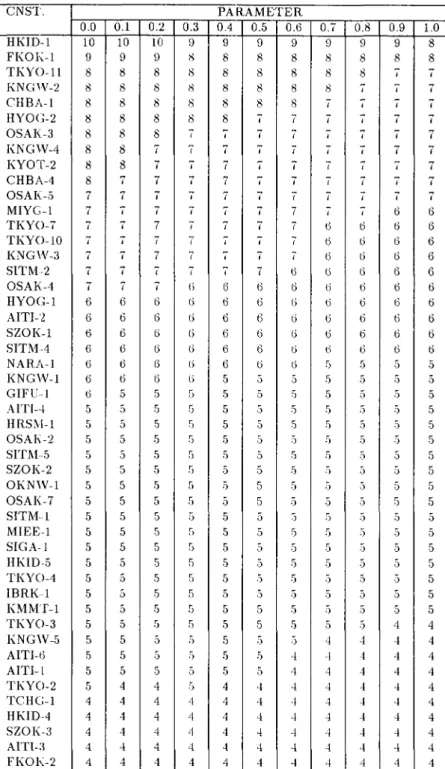
Applying the PDM given in section 4 to our HOR data we obtain the apportionment
results as given in Table 3 using the values ot a new parameter 8, which equals 1-t in
(4.3). The results in Table 3 indicate that the P D JJ with a smaller parameter value s is more favorable to larger constituencies while tha.t with a larger parameter value s is more favorable to smalle~' constituencies.
Comparing the results of Table 3 with the aJlocatioll by the LF AJ in Table 2, we can easily recognize that if the parameter value s satisfies 8
<
U.5, larger constituencies get moreseats and smaller ones have less, while if s
>
0."1, smaller constituencies obtain more seatsand larger ones lesE. Thus we can conclude that the P D.M should be taken into account for
the parameter s such that 0 .. 5 :S 8 :S U.7 since a)aramcter .s less than 0.5 makes the PDM
too favorable to larger constituencies and 8 larger tha.n U./ makes the method too favorable
to smaller constituencies.
Let us look at the relation between apponionment. results and the parameter s for 0.5 :S "" :S 0.7 into more detail. Firstly, we denote t.he apport.ionlllent results obtained from the P D AI wi th parameter .' by the row \·('Ctor A (-') cOllsisting of nine elements such that A(8)
=
(i9, itl •... ,id
where i" indicates that i,,-th largest cOllstituency is thesmall-est one such that k seats are assigned. Based upon this notation. we obtain A(0 .. 5)
=
(1,5,16,22,42, 70, DD, 127,130), A(0.6)
=
(1, 5, 1~), 22,10. 70,101. 128, 130), A(0.7)=
(1, 4c, 12,21,39,70,106,129,130). Also defining the apportionment results by the methods MFM,
EPM and LFM by A(MFM),A(EPM) and A(LFM), respectively, we obtain A(MFM)
=
(1,5,16,22,42, 70, DD, 127,130), A( EP 111)
= (
l ,e •• 15,22, 4U, 7U. 101,127,130), and A( LF M)=
(1,5,15,22,41,71).101,127,130), respectively.From the definition of the vector notatioll of .-l(.s) alld .-l( m) where 0.5 :S 5 ~; 0.7
and mE {1'vIF1I1, EP1H, LFA!}, we call define the difference between two apportionment
methods A(x) and A(y) where :/;,y E {.'> I 0 .. 5 :S .s
:s
U.7} U {MFM. EPM, LFM} as follows.A(x) - A(y)
=
(i~. i~, ...,in -
(i0·
i~ ...if)
=
(i~ - i0,i~-
i~ ... .,il -
inand the distance between these two methods by
9
1.'1(·1') - A(1/)1
=
L
lit: -
if
I
(,=1Obviously, the distance function is symllletric ~ !lee IA(.I") - .1(.11)1
=
1.4(.1/) - ,-l(.r)1 amI it gives an even number sinceLL=l
(iJ; -if)
=
o.
From the results of Tables 2 alld :3 we h<l\(' 1.-t(JJ F.\1) - .-l(l:'P,ll)I
=
6, IA(LFM)-A(EPM)I=
2, and IA(LFlvI) - A(M FM)I=
L vVe kno\\' from the definition of distance that ~ IA( x) - A(y) I indicates the number of constituencies such that two apportionment meth~ds A( x) and A( y) give different assignments. Therefore. there exist 6 differenta.>,sign-ments between AIFM and EPM, 4 different assignments bet\\"een MFJJ and LFM, and
only 2 between LF M and EP M.
Let us look at the apportionment results A( i;) by the P J).\J into more detail. We know
that A(0.5)
=
A(MFM). Our numerical experimellts show that A(EPM)=
A(5) for therange of 5,0.543:S 8:S 0.6, i.e., the apportionment method EP1H corresponds to the PDM
for the approximate parameter value .~ such that
o.:")n
:s ., :s
0.6. Also A( H 1\1 "~1)=
A( 5)for the range of 8,0.64
:s ,'; :s
U.645. i.t .. the apportiullllwllt lllethod H M M corresponds ,to the PDM for approximately 0.64:s ' :s
O.G45. while .-l(LFJ1)=
A(.,) for the range208 T.Oyama
Table 2. Political constituency and final appOl'tiolllllents CNST. PPL. GDM lIfFM EPM HMM "Dill LFM CRT
HI(lD-1 2169716 10 9 9 ,) K 9 () FKOK-l 1939788 9 8 8 8
"
1\ ,. .) TKYO-11 187.5744 8 8 8 8 I 8 .) ,. KNGW-2 1828593 8 8 8 8 I 8 .) ,. CHBA-1 1790189 8 8 8 7,
8 .) " HYOG-2 1755079 8 7 7 7 7 7 .) " OSAK-3 1720428 8 7 7 7 7 7 .) " KNGW-4 171104.5 8 7 7 7 I 7 4 KYOT-2 17071.52 8 7 7 I I I " .) CHBA-4 168312.5 8 I I 7 7 7 .[ OSAK-5 1637539 7 7 7 7 7 I"
MIYG-1 1599740 7 7 7 7 () 7 " .) TKYO-7 1.565417 7 7 7 I (; I"
TKYO-lO 1.5.56469 7 7 7 7 () I ,) ,. KNGW-3 154205.5 7 7 7 () () 7 <I SITM-2 1526.507 7 7 () 6 I; () <I OSAK-4 1496106 7 () (j (; I; I; <I HYOG-l 1410S3·1 6 6 (j I; 15 15 ,. .) AITI-2 1381:30.5 (j 6 (j (j I; (j <I SZOK-l l:370~2:3 6 6 (j I; (; (j !) SITI\1-4 1:3(9).57 (j 0 13 I; I; (j .[ NARA-l 1:.104~(j(; (j (j (j G ;) (; ;") KNGW-l 1281~81 (j .5 ') .5 .) ;) ·1 GIFU-1 1263,:39 6 ,5 G G .) G ;, AITI-4 1230)59 5 G G :) .) G 'I HRSM-l 12031136 .5 5 .5 5 G 5 :1 OSAK-2 1201348 5 5 .5 .5 :) S fi SITM-5 1190 l06 .5 5 .5 ') ;) .5 :1 SZOK-2 1183·1.57 ') 5 :) ~) ') S ~. OKNW-I 11791)97 5 5 .5 .5 ') .5 ~. OSAK-7 1177-173 .5 .5 .5 .5 .) G 0.1 SITM-1 1177:247 .5 .5 .5 ') !) .5..
l\lIEE-1 1172·17:3 .5 .5 5 ;) :) !) ~I SIGA-1 1155:~44 5 .5 :) :) .) !) ~I HKID-5 1131~)04 !) 5 .5 ::; :) ::; ~I TKYO-4 1118:220 5 ::; ::; S .) ;) , ., IBRK-1 11071;26 5 5 .5 ::; S G.
KMI\1T-1 1097780 .5 5 .5 G .~ S ~I TKYO-3 1080·[70 5 5 5 ;') -l 5 KNGW-.5 1068·100 5 5 5 :j 4 G c' AITI-6 10581,80 5 5 4 -I 4 .5 j AITI-l 10.5'!;01 5 .5 4 4 .[ ·1 y TKYO-2 1054 1:3:3 5 4 4 4.,
·1 TCHG-l 10:361i 12 4 4 4 4 I 'I " HKID-4 10341,61 4.,
4 -I -l .[ ;:. SZOK-3 1020712 4 4 4 4 I 4 j AITI-3 1010H:34 ·1 4"
-I I -I :l FKOK-2 991556;3 -I -I -l Y I .[ 5 AOMR-l 987405 4 4 4 4 I Y 4 OKYM-2 976010"
4 4 -I I <1 :.J IBRK-3 967446 4 4 <1 4,
.j .5 NGSK-1 9647.59 4 4 4 4 ·1 4 5CNST. PPL. GDM MFM EPM [[MM SDiU LF;)[ CRT OKYl'vl1 940896 4 t 4 4 4 4 .5 HYOG-3 931342 4 J 4 4 -1 4 3 HRSJ\1-3 907690 -1 I 4 -l -l -1 5 FKOK-1 900537 -1 I 4 4 -1 4 4 FKOK-3 882371 4 1 4 4 -1 4 5 SAGA-l 880013 4 ·1 4 -1 -1 4 5 KYOT-l 879422 4 4 4 -1 4 4 5 CHBA-:l 876419 4 4 4 4 4 4 5 TKYO-iJ 873135 -1 ,I 4 4 -1 4 3 TKYO-) 866342 -1 4 4 4 4 4 3 KGSJ\1-1 851854 4 ,I -1 -1 4 4 4 HYOG-l 851743 4 4 -1 4 4 4 4 YMGC-2 848828 4 -1 1 -l 4 4 .5 IWTE-l 846892 4 4 1 -1 4 4 4 KOTI-l 839784 3 4 I I 4 4 5 TKSM- 834889 3 -1 I ·1 cl ,j 5 YMNS-J 832832 3 4 I 1 4 4 .5 TCHG-:~ 8294.54 3 4 j -1 -l 4 5 FUKI-l 811633 3 :1 .l 3 3 3 4 OITA-1 816464 3 3 :3 :3 :3 3 4 TKYO-() 808974 :3 3 :3 :3 :3 :3 4 CHBA-L 798,130 :3 :3 :\ :1 :3 :3 4 SIJ\1N-1 794(j29 :3 :3 :1 :1 :3 :3 :) ISKW-1 789142 :3 :3 :\ :3 :3 3 3 FKSl\I-1 771072 :3 3 :3 :3 :3 3 4 NIGT-3 768503 :3 3 :3 :3 :3 3 5 HKID-2 767974 3 .3 :3 :) ;) :3 4 GIFU-2 764797 :3 :3
..
:3 :3 :3 4 YMGC-l 752799 :3 :3..
:3 :3 3 4 FKSM-2 747622 3 :l..
:3 :1 3 5 AKTA-1 746675 :3 :3 '.' :3 :3 :3 4 c' MYZK-l 745710 :3 :3 .', :3 :1 :3 3 NIGT-l 743154 :) :3 : ~, :3 :3 :3 3 KMMT-:2 739907 3 :3 :3 :3 3 :3 .5 GNMA-:: 725265 :l ;) :3 :3 :3 3 4 OSAK-1 724129 :3 :l :3 :3 :3 :3 :3 YMGT-1 11.5822 3 :3 :l :3 :3 :l 4 OSAK-6 710772 3 ;) :\ :3 :3 :3 :3 AITI-5 709.593 3 3 :3 :3 :3 :3 3 HRSI'I'l-2 708344 3 3 :3 :3 :3 :l -l GNMA-l 659408 3 :l :3 :3 :3 :3 :l IBRK-2 649933 3 :3 :3 :3 :3 :3 3 WI\Yl\I-l 6:397.~6 :3 :3 :3 :3 :3 :3 :3 NGSK-:2 6:2fJ209 2 :3 :1 :3 :3 :3 .j TOYM-1 62722(j '2 3 :1 :3 :\ :3 :1 TOTR-l 61G024 2 3 :1 :3 :3 :3 4 SITM-3 600761 2 :3 :1 :3 :3 :3 3 IWTE-2 .586719 :2 '2 :1 :1 :1 :3 -l NGNO-l 585569 2 2 :; :1 :3 :3 :3 TKYO-l 577806 2 '2 L :3 :l '2 :3 MIYG-2 .576.5.55 2 :2 L :3 :3 '2 -l HKID-3 574984 '2 '2 '2 '2 :1 :2 3 MIEE-2 .5748:38 '2 :2 '2 '2 :3 '2 -l210 T. Oyama CNST. PPL. GDM MFM EPM HMM SDM LFM CRT NGNO-3 571726 2 2 2 2 :~ '2 4 FKSM-3 561610 2 2 2 '2 :~ 2 3 NIGT-2 .560065 2 2 2 2 3 '2 3 KAGW-l 557122 2 2 2 2 3 '2 3 EHIM-2 555415 2 '2 2 2 :) '2 3 YMGT-2 545840 2 2 2 2 :1 '2 3 AOMR-2 537043 2 2 2 '2 '2 :2 3 GNMA-2 536586 :2 2 2 :2 :2 '2 3 EHIM-l 517401 2 2 2 :2 '2 2 3 AKTA-2 507357 2 2 2 '2 '2 2 3 NGNO-4 505719 2 2 2 2 '2 :2 3 TOYM-2 491143 2 2 2 2 2 2 3 NGNO-2 473913 2 2 2 '2 '2 :2 3 KGSl'1'1-2 468450 2 2 2 2 '2 '2 3 KAGW-2 465447 2 2 2 2 '2 2 3 EHIM-3 457167 :2 2 2 2 '2 :2 3 TKYO-8 4526.53 :2 2 2 2 '2 :2 :3 WKYIVI-2 447450 :2 '2 :2 :2 '2 '2 :j OITA-2 -B37.50 2 2 2 :2 '2 '2 :j MYZK-2 429833 2 :2 :2 :2 '2 :2 :3 NIGT-4 406748 I 2 2 :! '2 :2 :! ISKW-2 363183 1 2 2 '2 '2 :2 2 KGSM-3 345904 1 I '2 2 2 I 2 HYOG-5 329052 1 1 1 2 '2 I :2 KGSM-4 153062 0 I 1 1 J 1 I Tot.al .512 512 512 512 5J2 .512 512
Table 3. Final apportionments by parametriC' divisor method CNST. PARAMETER 0.0 0.1 0.2 0.3 0.4 0.5 0.6 0.7 0.8 0.9 1.0 HIGD-l la la 10 9 9 9 9 9 9 9 8 FKOI~-l 9 9 9 S 8 8 8 8 8 8 8 TKYO-ll 8 8 8 8 8 8 8 8 8 7 7 KNGW-2 8 8 8 8 8 8 8 8 7 7 7 CHBA-l 8 8 8 8 8 8 8 "i I 7 7 HYOG-2 8 8 8 8 8 7 7 7 I 7 7 OSAK-3 8 8 8 7 I 7 7 'j' 7 7 7 KNGW-4 8 8 7 7 7 I 7 7 7 7 7 KYOT-2 8 8 7 7 7 I 7 I 7 I 7 CHBA-4 8 7 7 7 7 7 7 7 7 7 7 OSAK-.5 7 7 7 7 7 7 'j' 7 7 7 7 MIYG-l 7 7 7 7 7 7 'j' 'j' 7 6 6 TKYO-7 7 7 7 i 7 7 7 () 6 (j 6 TKYO-lO 7 7 7 7 'j' 7 7 I:i 6 6 6 KNGW-3 i 7 7 i i 7 7 6 () () () SITM-2 7 7 7 7 7 7 (j (j 6 6 6 OSAK-4 7 7 i (i 6 () () () 6 () 6 HYOG-1 6 6 () (j 6 (j li (j () () 6 AITI-'2 6 6 6 (j 6 G (j (j () G 6 SZOK-1 6 6 () G 6 6 () Ij 6 6 G SITM-4 6 6 G I; () 6 () 6 6 6 6 NARA-1 () 6 6 li 6 () () 5 5 5 5 KNGW-l 6 (j 6 (i .5 5 :) 5 5 5 5 GIFUl () .5 5 :, 5 5 5 5 :~ 5 5 AITI-·* 5 .5 .5
"
5 5 -'i 5 5 .5 5 IIRSI\I-l 5 .5 5"
5 .5 -5 5 5 -5 5 OSAh-2 5 5 .5 .5 5 .5 :) :) .5 5 5 SI1'1\15 5 5 .5"
:) .5 5 :) 5 5 5 SZOK-2 5 5 5 ;) .5 5 :) -) 5 5 5 OKNW-1 5 5 5 5 .5 5 5 S 5 :) 5 OSAI\-7 5 5 5 [) .5 5 :) 5 .) S 5 SITM-1 5 5 5 S .5 5 ::; S ::; 5 5 1I1IEE-l 5 5 5 ;) .5 .5 5 5 ') 5 :) SIGA-l .5 .5 5 S .5 .5 .) .) S .5 S HKID-5 5 5 5 f) S .) .) .) .) .) 5 TKYO-4 5 5 .5 ;) 5 .5 5:s
.5 :) 5 ISRK1 5 5 .5 5 5 5:s
5 .5 5 5 KMMT-1 5 5 5 ;) 5 5 5 5 5 5 5 TKYO-3 5 5 5 5 .5 5 5 5 5 4 4 KNGW-5 5 5 .5 ;) 5 5 .)'*
·1'*
4 AITI-G 5 5 .) ;) .5 :) -1 -I I 4 4 AITI-l 5 5 5 [) .5 .5 -1'*
-'I 4 4 TKYO-2 5 4 4 S 4 4..
.j .j'*
4 TCHC-1 4 4 4 4 4 4 ·1 :j .j .* 4 HKID--1 4 -1 -1 4 4 4'*
.j --l 4 4 SZOK-3 4 4 4 4 4'*
--l -I -'I --l 4 AITI-:I..
'*
4 4 4..
..
·1 --1 --1 --1212 T.Oyama CNST. PARAMETER 0.0 0.1 0.2 0.3 0.4 0.5 O.fl 0.7 0.8 0.9 1.0 AOMR-l 4 4 4 4 4 4 4 4 4 4 4 OKYM-2 4 4 4 4 4 4 4 4 4 4 4 IBRK-3 4 4 4 4 4 4 4 4 4 4 4 NGSK-l 4 4 4 4 4 4 4 ·1 4 4 4 OKYM-l 4 4 4 4 4 4 4 4 ·4 4 4 HYOG-3 4 4 4 4 4 4 4 4 4 4 4 HRSM-3 4 4 4 4 4 4 4 I 4 4 4 FKOK-4 4 4 4 4 4 4 4 4 4 4 4 FKOK-3 4 4 4 4 4 4 4 4 4 4 4 SAGA-l 4 4 4 4 4 4 4 4 4 4 4 KYOT-l 4 4 4 4 4 4 4 4 4 4 4 CHBA-3 4 4 4 4 4 4 4 4 4 4 4 TKYO-9 4 4 4 4 4 4 4 '1 4 4 4 TKYO-5 4 4 4 4 4 4 4 cl 4 I 4 KGSM-l 4 4 4 4 4 4 4 ,1 1 4 -4 HYOG-4 4 4 4 4 4 -4 -4 ) '1 -4 4 YMGC-2 4 4 4 4 4 4 4 -I