NUE Journal of International Educational Cooperation, Volume 13, 31-38, 2019
Study Note
1. Introduction and Background
Nepal has been committed to the education of all its children and to improve the quality of education during the last six and a half decades. Almost all national education commission reports and educational plans of Nepal have stressed the need for comprehensive and regular assessment of students’ learning. The first and most comprehensive report, “Education in Nepal 2011 B.S.” stated that evaluation must cover all aspects of students’ learning and it should be regular. Likewise, the National Education
Plan (1971-76) developed a comprehensive and continuous evaluation scheme for primary school students by use of a variety of evaluation tools. Furthermore, the National Education Commission report (1992) stressed the need to introduce a comprehensive and regular evaluation scheme for proper judgment of students’ learning and quality improvement in education, but it did not materialize. Six years later, the High-Level National Education Commission Report (1998) blamed the existing examination system for creating serious educational wastage at the primary level due to its defectiveness
Current Situation and Issues of Continuous Assessment System in
Mathematics Education of Nepal
Ram Chandra DHAKAL
Naruto University of Education Abstract
Continuous Assessment System (CAS) is a formative type of student assessment carried out during teaching-learning activities in the classroom. The prime concern of this study is to identify the current situation and issues of CAS in the mathematics classroom, and if there are any issues, to indicate some remedies for them. Seventy-nine primary mathematics teachers and Seventy-nine instructors were selected as samples. The questionnaires, interviews, observations, and focus-group discussions were used as data collection tools.
According to the data analysis, most of the respondents mentioned that in teacher training, there is no time for discussion and practical sessions on how to make a plan and use practically CAS tools in students’ evaluation, in other words, how to use students’ evaluation information to improve their learning. It was also clarified that most teachers do not use CAS evaluation criteria (tools) and give ticks (score) to their students without any real assessment. Thus, they are possibly not able to use the students’ evaluation information to improve their learning.
For improving the implementation of CAS in the mathematics classroom, teacher training should be practice-based and focused on how to make a plan of CAS and use its tools for students’ assessment and how to use assessment information to improve their learning. The government should encourage all teachers to implement CAS in classroom instruction and provide a favorable environment for teachers to share good practices of CAS.
Keywords: Continuous Assessment System, Assessment for Learning, Project work, Creative work, Behavior change.
and recommended implementing the liberal promotion from grades 1 to 3 through regular evaluations (HLNEC, 1998). According to the report of the National Achievement Level of Grade 3 Students; the average score in Mathematics was 43.8, Nepali 45.6 and Social Studies 50.37 (BPEP, 1997). It was also the context of CAS implementation all over the country. It was expected that the implementation of CAS will improve the students’ participation and their learning at the primary level.
The CAS is a practice by which teachers manage their classes, adopt student-centered techniques in teaching and assess students individually. The assessment of the individual student is based on his or her regularity, participation, performance and so on, by using a variety of formal and non-formal evaluation tools. Teachers evaluate students’ learning along with their teaching. They use the assessment information for improving their teaching as well (CDC, 2002). The main objective of the CAS is to find out students’ learning achievement along with the teaching and to help weak students and conduct remedial teaching and encourage them to learn (CDC, 2008). Therefore, the CAS is merely a tool that helps teachers to use the information to vary their teaching and also cater to the needs of their individual students. It is not a system in which the teachers are busy giving tests to the students frequently. However, they need to know how well their students have understood the ideas being taught.
The criteria of CAS in primary education grades (1-5) are shown below with tick marks in each lesson (CDC, 2008 p63).
The definition of all the five criteria is explained in the continuous students evaluation tools (CDC, 2013) as follows:
1)Classroom participation: The involvement of students in classroom instruction is called classroom participation.
2)Attendance: Attendance means the regularity of students in school.
3)Project work: It is a method, based on a specific time, resource, and work process, where students integrate their theoretical learning in practice to gain the purpose of the lesson.
4)Creative work: The act of creating a new interesting idea, composition or outline of a material is called creative work. It promotes students’ imagination. 5)Behavior change: It is a process where students
could change their behavior based on their perceptions of what is being learned permanently, as expected.
However, with respect to project work, creative work, and behavior change, their definition is not so much clear to develop activities in each unit content or lesson. Besides, to achieve the objectives in mathematics education, these criteria are also defined in the primary curriculum. However, it is not so precise that the relationship between these three criteria and objectives is considered in each unit’s content or lesson. Therefore, the author, by himself developed and rewrote here the comprehensive definition of the three criteria, taking into account the primary curriculum’s intention and objectives for each unit content and lesson. As internationally discussed about 21st Century Skills (Care, 2018) and
exampled by the Programme for International Student Assessment (PISA) (OECD, 2006), knowledge and skill, their application and reasoning are most frequently indicated as core components of competency with respect to mathematics learning. In the primary curriculum, it is also mentioned that knowledge and skill, their application and reasoning (CDC, 2008). Therefore, the definition developed by the author is also aligned with these core components as follows:
i)Project work: Project work is an individual or group work for students, designed by the teacher based on learning outcomes. Its main purpose is to find out the students’ learning level (knowledge and understanding) through experiments or practical Table1: Assessment criteria for primary level (grade 1-5)
Sn Criteria Best* Better** General*** 1 Class work (classroom Participation) √√√ √√ √ 2 Project Work √√√ √√ √ 3 Behavior Change √√√ √√ √ 4 Creative Work √√√ √√ √ 5 Attendance √√√ √√ √
*Best: The tasks given by the teacher can be done by the student him/herself without any help from others.
**Better: The tasks given by the teacher can be done by the student him/herself with the help of others (teacher or colleague). ***General: The tasks given by the teacher which cannot be done by the student him/herself even with the help of others (teacher or colleague).
Source: made by the author according to the explanation in CDC (2008).
work.
ii)Creative work: Creating a new interesting idea, composition, or imagination of the content is called creative work. It is mainly designed by the teacher and sometimes students themselves. It is used to find out the students’ learning level (creativity and application) through their creativity. The approaches to creative work in Mathematics are brainstorming, puzzles, drawing, making models, problem-solving, and poem writing and so on.
iii)Behavior change: Students using their knowledge and skills in daily life which they learned in the classroom to change their behavior as needed is called behavioral change. The teacher finds out the students learning level (application and reasoning) through behavioral change
The provision of CAS in the present school curriculum, 100% marks in grades (1-3), 50% of total marks in grades 4 and 5 (CDC, 2008 ) and 40% of total marks in grades 6 and 7 are evaluated (CDC, 2012). The Ministry of Education of Nepal has introduced CAS since the ninth plan (1997-2002) and it has been continued till now. During the last two decades, the government of Nepal has spent much of the budget for teachers' training for the implementation of CAS in the classroom but the result is different from expected. According to the National Assessment of Student Achievement (NASA) Report 2015, the average scores in Mathematics of grade 3 and grade 5 were 60 and 53 in 2012, similarly 44.6 and 48.3 in 2015 respectively (ERO, 2016). This shows that the trend of students’ achievement in mathematics is getting lower.
On the other hand, the primary curriculum defined five criteria to do formative assessment, but, as discussed above, there is no model/example of
project work, creative work and behavior change activities in the curriculum, teacher guide and other national documents. Also, teachers cater to the student based on his/her performance: the tasks given by the teacher can be done by his/herself without any help from others is best (√√√), with the help of others (teacher or colleague) is better (√√) and can’t do him/herself with the help of others in general (√). But the task is not clearly defined in the curriculum and the teacher guide. Therefore, these circumstances are supposed to affect teachers’ management of CAS. This is the main concern of this study.
2. Conceptual framework
Assessment of Learning, Assessment for Learning and Assessment as Learning are the three perspectives of assessment purpose. The purpose of the assessment of learning is usually summative and is mostly done at the end of a task or unit of work (MECY, 2006). Assessment for Learning occurs throughout the learning process. The emphasis shifts from summative to formative assessment in Assessment for Learning (MECY, 2006). Assessment as Learning focusses on students and emphasizes assessment as a process of metacognition (knowledge of one’s thought processes) for students. The ultimate goal in the assessment as learning is for students to acquire the skills and the habits of mind to be metacognitively aware of increasing independence (MECY, 2006).
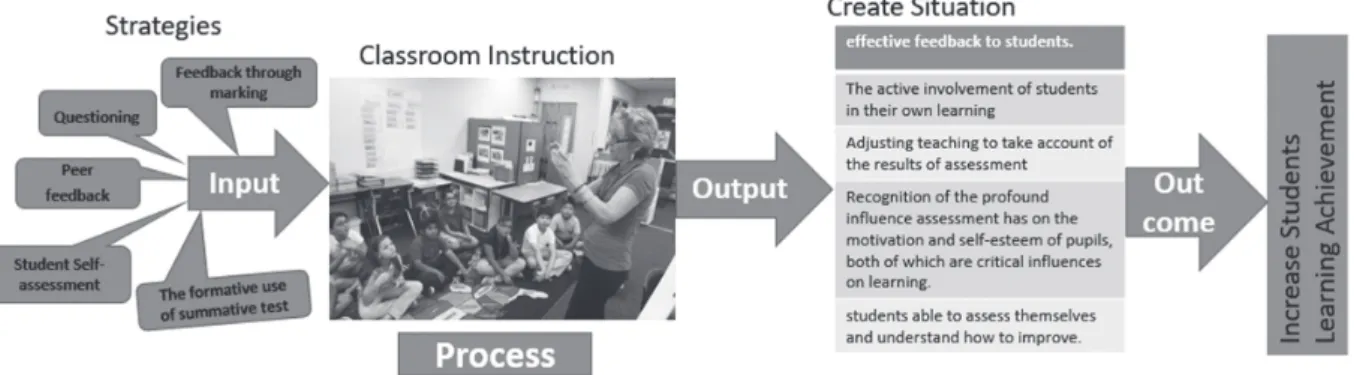
The main objectives of CAS are to find out the students’ learning achievement along with the teaching and to help left-behind students and conduct remedial teaching and encourage them to learn. CAS is also a formative type of student assessment system, therefore, this study is based on the “Assessment for Learning (AfL)” theory which was invented by the
Assessment Reform Group UK (1999). AfL is the process of seeking and interpreting evidence for use by learners and their teachers to decide where the learners are in their learning, where they need to go and how best to get there (ARG, 2002). There are five main strategies in this theory. If a teacher uses these strategies properly in classroom instruction, the favorable learning environment will be created and the student learning achievement level will increase. Questioning, feedback through marking, peer feedback, student self-assessment and formative use of summative assessment are the main strategies of AfL (Education service Australia, 2018). Teachers are the key element of quality education, what teachers do in classroom teaching is very important for quality. CAS criteria; project work, creative work, and behavior change activities are designed to be applied by the teacher for finding students’ learning levels and difficulties in the classroom. Therefore, the researcher examines teachers’ role and responsibility in the classroom assessment first. The teacher can find student’s learning difficulties through questioning and can help them with providing feedback based on their performance, therefore, in this study, the researcher focused on questioning and feedback through marking strategies. Based on the definition of the Assessment Reform Group UK (1999), the author rearranged the definition of questioning, feedback through marking for this study as follows:
a. Questioning: Questioning is used not only as a pedagogical tool but also as a deliberate way for the teacher to find out what students understand important mathematical concepts and achieve key knowledge and skills, how they constructed the knowledge and concepts and what they can do based on what they know. In Nepalese context, during the teaching learning activities in classroom, the teacher can use project work, creative work and behavior change tools/activities and find out the students’ learning difficulties and levels, and categorize them as best, better and general. b. Feedback through marking: Feedback through
marking focuses on established success criteria (e.g., lesson objectives), marking students’ performance (to what extent they achieve) through appropriate questioning and confirms with the students what they have achieved, and, if necessary, guide them to reach the established goal, helping
them to reflect on what they have done. Importantly, the feedback provides specific suggestions about how the goal can be achieved. The teacher finds the students’ learning levels and categorizes through the using of CAS criteria and gives feedback to the students based on their performance showing what they learned and where they need to improve.
3. Purpose and methodology of the study
3.1. Purpose of study
Continuous assessment provides day-to-day feedback about the learning and teaching process. Assessment can reinforce the efficacy of teaching and learning. It also encourages the understanding of teaching as a formative process that evolves with feedback and input from students (Matthew Lynch, 2016). But according to NASA Report 2015, the trend of students’ achievement in mathematics is getting lower. Therefore, the sole purpose of this study is to identify the situation and issues on CAS in mathematics classroom instruction and suggest the possible way to improve the situation.
3.2. Methodology
A total of 79 primary level mathematics teachers (37 female and 42 male) and nine instructors selected by random sampling method, participated in this study. Questionnaire, observation, interview and focus-group discussion tools were used for data collection. The first three tools for finding the current situation and the last two of them for finding the issues and possible ways to improve CAS in mathematics classroom. In addition, as questioning and feedback through marking are main activities for identifying student’s difficulties and providing feedback to them during the classroom teaching, so the author emphasize, to find what teachers do and what kind of problem appears during the implementation of CAS in classroom teaching, and what are the possible ways for improvement through these tools.
4. Result and analysis
4.1 Classroom teaching:
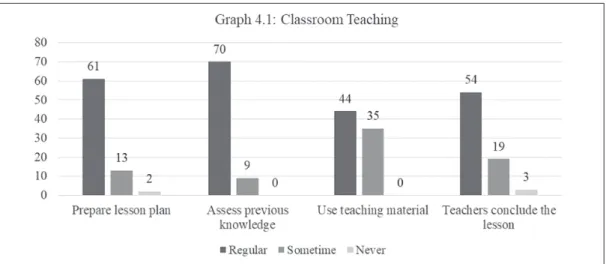
Based on teachers’ responses on the questionnaire, as displayed in Graph 4.1, 61 out of 79 teachers
prepared lesson plans. But based on interview and observation, only two teachers could show lesson plan, but which was incomplete one, in their teacher notebook. Fifty-four teachers gave the conclusion of the lesson regularly, which means teachers simply
transfer mathematical knowledge to their students. Only three teachers provided a favorable environment in the classroom for students to reach their own conclusions.
4.2 Assessment criteria used to assess the studentʼs learning outcomes
Based on the teachers’ responses on the questionnaire (could choose more than one option), as shown in Graph 4.2, 26 out of 79 teachers followed all criteria (attendance, participation, project work,
creative work and behavior change) and evaluated students’ learning outcomes. But according to the observation and interview results, all of teachers evaluated students’ learning outcomes through homework except one teacher who followed all the mentioned criteria.
4.3 Teachersʼ understanding of CAS
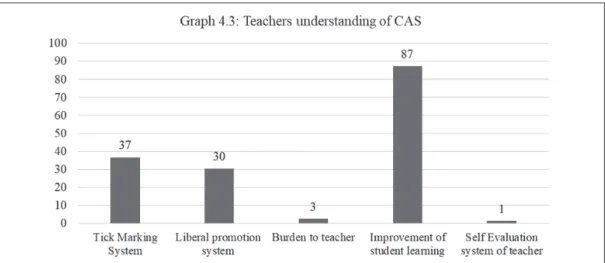
Based on questionnaire analysis as illustrated in Graph 4.3, 87% of teachers think CAS as a student-learning improvement system and 37% of teachers think CAS as a tick marking system. But based on
another questionnaire’s responses, 56% of teachers used CAS to give marks for students’ learning performance. It implies that they do not use CAS in classroom properly.
Figure 4.1 Classroom Teaching. Source: summarized by the author based on the collected data
Figure 4.2 Assessment tools using to assess the student’s learning outcomes. Source: summarized by the author based on the collected data
4.4 Teacher training related to CAS
CAS training is conducted separately and sometimes the contents of CAS are included in a different type of training such as Teacher Professional Development (TPD) Training, Head Teacher Leadership Training, and so on. According to the results from the questionnaire as shown in Graph 4.4, 22 teachers selected all content such as: introduction and objectives of CAS, process of CAS, method
of mark sheet and identification of difficulties and providing feedback are included in teacher’s training; 40 teachers selected to identify difficulties of students and provide feedback included in training content as the main objectives of CAS. Also, 6% of teachers discuss CAS regularly, 15% monthly, 44% once in three months, 25% yearly and 9% never discuss in school. Among the respondent teachers, 73% of them have attended the CAS at least one time.
4.5 Studentsʼ portfolio
A student portfolio is the most important component of CAS. Based on the teachers’ questionnaire, 73% of teachers kept students’ performance records in his/ her portfolio while during observation and interview only two teachers could show a portfolio. There are many pages to write about each student’s progress, but the teacher wrote the student’s name only.
4.6 Issues of CAS
In Nepal, there is no subject teacher at the primary level, which means a teacher teach all subjects. However, the reality is different from what is expected. According to the result of the interview and focus group discussion; all subject teachers (mixed group) usually participate in the same training group at the same time. The training sessions are divided Figure 4.3 Teachers understanding of CAS. Source: summarized by the author based on the
collected data
Figure 4.4 Contents including in CAS Training. Source: summarized by the author based on the collected data
for all subjects such as four sessions for mathematics, five for language, two for social studies and four for other subjects so that there was not enough time for subject-wise practice-based training. The trainer emphasized objectives of CAS, the marking (tick) system and how to calculate a score from the tick marks and skipped the subject-wise practice-based training such as how to make a plan of project work, creative work and behavior change and evaluate students’ learning achievement and difficulties in mathematics classroom. Moreover, how to improve the students’ learning level after the evaluation. Also, as mentioned earlier 54 out of 79 teachers conclude the lesson themselves, which shows that most of the teachers have no idea, how to find student difficulties and learning level to give them feedback for their improvement, so questioning and feedback through marking is weak. In addition, the trainer did not discuss the other two criteria, attendance and classroom participation, or how to connect the improvement of a student’s learning level. During the focus group discussion, it was reconfirmed that there is no model/example of project work, creative work and behavior change activities in the teacher guide and other national documents which is another important issue of CAS in mathematics teaching.
5. Conclusion
Based on the research results, it is found that more than 50% of teachers use CAS only to give marks for a student’s learning performance. Most of the teachers did not use CAS evaluation criteria (tools) and give ticks (score) to their students without evaluation. Most of the schools did not keep students’ individual portfolios. CAS training is focused on the theoretical aspect and the time duration is very short. In that short period, the facilitator focused on what is CAS, what are the criteria (tools) of CAS and how to manage student performance record. It also focused on how to calculate scores and grades. Thus, they are not able to use the students’ evaluation information for future improvement of students. In this case, teachers could not use CAS in classroom instruction without a clear understanding of CAS tools.
For improving the implementation of CAS in mathematics classroom instruction, more time should be allocated to the content of CAS’s in TPD training.
Training should be practice-based and should focus on how to make a plan of CAS and use CAS tools for students’ assessment and how to use assessment information for improving their learning. The government should encourage all the teachers to implement CAS in classroom instruction and make a favorable environment for teachers to share good practices of CAS with each other.
References
Assessment Reform Group (2002) Assessment for learning: 10 principles, London: Assessment Reform Group.
Care, E. (2018) Twenty-First Centuary Skills: From Theory to Action. In M. W. Esther Care, Assessment and Teaching of 21st Century Skills, pp. 3-17. Cham, Switzerland.
Center, C. D. (1999) Continuous Assessment System Teacher Training Manual, Bhaktapur, Nepal: Curriculum Development Center.
Center, C. D. (2002) Introductory Manual on Continuous Assessment System, Bhaktapur, Nepal: Curriculum Development Center.
Center, C. D. (2006) Primary Education Curriculum grade 1-3, Bhaktapur, Nepal: Curriculum Development Center.
Center, C. D. (2008) Primary Education Curriculum grade 4-5, Bhaktapur, Nepal: Curriculum Development Center.
Center, C. D. (2012) Basic Education Curriculum grade 6-8, Bhaktapur, Nepal: Curriculum Development Center.
Center, C. D. (2013) Continuous students evaluation tools, Bhaktapur, Nepal: Curriculum Development Center.
Commission, HLNE. (1998) High Level National Education Commission Report 1998, Kathmandu, Nepal: Ministry of Education.
Commission, N. E. (1992) National Education Planning Commission Report 1992, Kathmandu, Nepal: National Education Planning Commission.
Commission, N. N. (1956) Education of Nepal, Kathmandu, Nepal: Bureau of Publications, College of Education. Education service Australia. (2018) professional learning.
Retrieved November 18, 2019, from Assessment for learning: https://www.assessmentforlearning.edu. au/professional_learning/intro_to_afl/introduction_
key_questions.html
Matthew Lynch. (2016) The real purpose of assessmentsin education. Retrieved September 18, 2019, from The Edvocate: https://www.theedadvocate.org/real-purpose-assessments-education/
MoE, (1971) National Education System Plan, 1971-1976, Kathmandu, Nepal: Ministry of Education. MECY, (2006) Rethinking Classroom Assessment with
Purpose in Mind, Winnipeg, Canada: Manitoba Education, Citizenship and Youth.
Office, ER. (2016) National Assessment of Student Achievement 2015 (Grade 3 and 5), Bhaktapur, Nepal: Education Review office.
Program, B. E. (1999) Report of National Achievement Level of Grade Three Students 1997, Bhaktapur: Basic Primary Education Project.