高軸力を受ける二重CFT柱に関する実験的研究
著者
李 文聰
著者別名
Wencong Li
雑誌名
工業技術
巻
41
ページ
83-87
発行年
2019-02
URL
http://id.nii.ac.jp/1060/00010951/
Creative Commons : 表示 - 非営利 - 改変禁止 http://creativecommons.org/licenses/by-nc-nd/3.0/deed.ja高軸力を受ける二重
CFT 柱に関する実験的研究
Experimental Investigation of Concrete-Filled Double-Layer Steel Tubular Column
under High Axial Force
Wencong Li* 1.Introduction
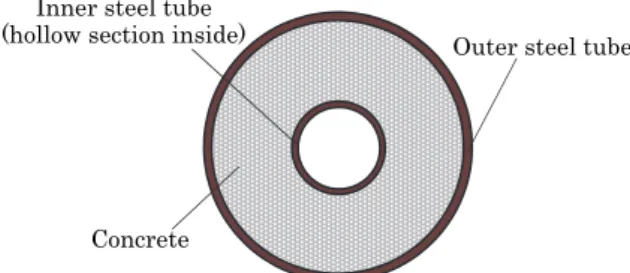
In the past two decades, a special cross-section of column with the concrete-filled double-skin steel tubes shown in Fig. 1 was proposed by several researchers due to some advantages in respect of concrete filled steel tube column, which include reducing total dead load of structure, lowering concrete consumption, increase in section modulus and improving cyclic performance. Researches on the concrete-filled double-skin steel tubular (abbreviated
as CFDST hereinafter) column were carried out1)-5),
and it was also clarified that CFDST column has excellent structural performances, such as damping characteristics and fire resistance. Hence, it is expected that CFDST columns have a potential of being used in building structures. However, in building structures, especially in high-rise building,
the hollow part of cross-section can lead to
significant axial compressive strain under high axial force.
Fig. 1 Cross-Section of column with concrete-filled double-skin steel tubes
In this study, a different cross-section of column with concrete-filled double-layer steel tubes shown in Fig.
2 is selected to decrease the axial compressive strain. The concrete-filled double-layer steel tubular (abbreviated as CFDLT hereinafter) column is transformed from the CFDST column by filling the hollow part of cross-section with concrete. Quasi-static cyclic tests of the CFDLT and CFDST column specimens were carried out under constant axial force ratio of 0.5 to investigate the effect of solid cross-section and hollow cross-section on the seismic performance of column.
Fig. 2 Cross-Section of column with concrete-filled double-layer steel tubes
2.Specimens
In this study, two steel-concrete composite column specimens were prepared. Either specimen has two concentric circular steel tubes. The mechanical properties of steel tubes and concrete used in these two specimens are listed in Table 1. The details of specimens are illustrated in Fig. 3. The experimental parameters of the both test specimens are summarized in Table 2. In column region of either specimen, diameter is 190.7 mm, clear height is 800 mm, and shear span to depth ratio is about 2.1. 15-
Inner steel tube
(hollow section inside) Outer steel tube
Concrete
Inner steel tube
(solid section inside) Outer steel tube
高軸力を受ける二重 CFT 柱に関する実験的研究
Experimental Investigation of Concrete-Filled Double-Layer Steel Tubular Column under High Axial Force Wencong Li
All dimensions in mm.
c) Section A-A’ d) Section B-B’
190.7x6 a) 15-CFDLT b) 15-CFDST 89.1x3.2 190.7 190.7x6 89.1x3.2 800 460 460 A’ A 800 460 B’ B 460 190.7 Concrete Hollow section Solid section
Table 1 Mechanical properties of materials
a) Steel tubes
Categorie fy (MPa) y (%) Es (GPa) u (MPa) %EL
190.7×6 389 0.17 223 457 41.1
89.1×3.2 394 0.19 199 450 34.1 Note: fy = yield strength of steel, y = yield strain of steel, Es
= modulus of elasticity, u = ultimate strength, %EL =
percentage elongation
b) Concrete
B (MPa) c (%) Ec (GPa)
59.4 0.230 40.4 Note: B = compressive strength of concrete cylinder, c =
strain corresponding to compressive strength, Ec =
initial tangent stiffness
Fig. 3 Details of specimens
CFDLT is a concrete-filled double-layer steel tubular column specimen with circular solid section. 15-CFDST is a conventional concrete-filled double-skin steel tubular column specimen with circular hollow section. Cross-sections of outer steel
tube and inner steel tube for both specimens were
selected as 190.7 x 6 (outside diameter of 190.7 mm
and thickness of 6 mm) and 89.1 x 3.2, respectively.
Axial force ratio of either specimen was set at 0.5. The test setup is illustrated in Fig. 4.
Table 2 Column specimens
Specimens 0 = 0.5 Outer tube Inner tube ps
15-CFDLT N/(Aso.fyo+Asi.
fyi +Ac.B) 190.7×6 89.1×3.2
15.2
15-CFDLT 18.7 Note: 0 = axial force ratio, N = axial load on column, Aso =
area of outer steel tube, Asi = area of inner steel tube,
fyo = yield strength of outer steel tube, fyi = yield
strength of inner steel tube, Ac = area of concrete in
cross-section, B = compressive strength of concrete
cylinder, ps = steel ratio
Fig. 4 Test setup 3.Experimental Results
The relationship between experimental lateral force,
Q, and drift ratio, R, of either test specimen is shown
in Fig. 5. In the Q -R curves, the dotted line
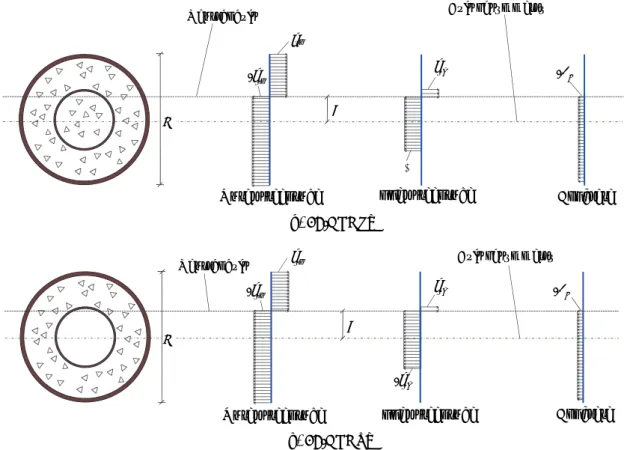
represents the calculated flexural strength of the column based on the corresponding assumption of rectangular stress block as shown in Fig. 6 with yield strength of steel and compressive strength of concrete cylinder, and the calculation procedure for
the flexural strengthis as follows:
(1) Determine the neutral axis of cross section in
I I I I I I
term of the equilibrium condition of axial force on column.
(2) Calculate the ultimate moment of the cross section depending on the determined neutral axis.
(3) Figure out the flexural strength based on the calculated ultimate moment.
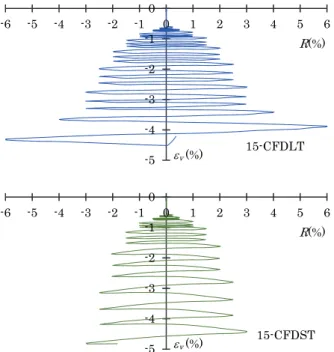
The relationships between measured average axial
strain, v, and R of these two specimens are shown in
Fig. 7. However, v was measured until 5.0% due to
capacity of displacement transducer. Failure pattern at bottom end of column after test for either specimen is shown in Fig. 8.
The main similarities between these two specimens are as follows:
(1) At an early stage, the measured lateral force increased with the increase of drift ratio and the hysteresis loops were almost overlapping
Fig. 5 Measured Q -R relationships
-300 -200 -100 0 100 200 300 -6 -5 -4 -3 -2 -1 0 1 2 3 4 5 6 Q(kN) R(%) 15-CFDLT Flexural strength -300 -200 -100 0 100 200 300 -6 -5 -4 -3 -2 -1 0 1 2 3 4 5 6 Q(kN) R(%) 15-CFDST Flexural strength
where, D is the diameter of outer steel tube (or the diameter of column), Y is the distance between neutral axis and axis of symmetry, fyo is the yield strength of outer steel tube, fyi is the yield strength of inner steel tube, B is the
compressive strength of concrete cylinder.
Fig. 6 Assumption of stress blocks for ultimate moment Outer steel tube
a) 15-CFDLT
Axis of symmetry
Inner steel tube Concrete
fyo -fyo fyi ‐fyi -B Y Neutral axis
Outer steel tube Inner steel tube
-fyo -B Neutral axis b) 15-CFDST Concrete Axis of symmetry -fyi fyi fyo Y D D
―
]
高軸力を受ける二重 CFT 柱に関する実験的研究
Experimental Investigation of Concrete-Filled Double-Layer Steel Tubular Column under High Axial Force Wencong Li
together.
(2) The experimental lateral load capacity exceeded the corresponding calculated flexural strength.
Fig. 7 Measured v -R relationships
Fig. 8 Bottom ends of columns after test
In the specimen 15-CFDLT, when the drift ratio shifted from 2.0% to 2.5%, the experimental lateral force reached the experimental lateral capacity. After the drift ratio of 2.5%, local buckling of the outer steel tube at the top and bottom regions of the
column began to occur. As a result, lateral force decreased gradually. However, the hysteretic curve showed excellent ductility and remained stable until the final drift ratio of 6%.
On the other hand, in the specimen 15-CFDST, when the drift ratio was near 1.5%, the experimental lateral force reached the experimental lateral capacity. After the drift ratio of 1.9%, local buckling of the outer steel tube at the top and bottom regions of the column could be observed and lateral force declined gradually.
For the specimen 15-CFDST, due to hollow section of inner steel tube, local buckling at the top and bottom regions of the column occurred earlier than that of 15-CFDLT; the flexural compressive failure at both ends of column became more remarkable than those of 15-CFDLT; the progress of axial compressive strain was obviously faster than that of 15-CFDLT (see Fig. 7); the experimental lateral capacity was about 0.9 times of that of 15-CFDLT. For the specimen 15-CFDLT, because of the contribution of solid section of inner steel tube (infilled with the concrete), the buckling deformation at bottom end of column became smaller than that of 15-CFDST (see Fig. 8); the lateral force decreased more slowly than that of 15-CFDST (see Fig. 5); the seismic performance under high axial force was more
excellent than that of 15-CFDST. It is expected that
the CFDLT column has a potential of being used in building structures in the future, especially in high-rise building.
4.Conclusions
The experimental results of the circular CFDLT column and the conventional circular CFDST column specimen under the reversed cyclic lateral force and constant axial force ratio at 0.5 lead to the following conclusions: -5 -4 -3 -2 -1 0 -6 -5 -4 -3 -2 -1 0 1 2 3 4 5 6 v(%) R(%) 15-CFDLT -5 -4 -3 -2 -1 0 -6 -5 -4 -3 -2 -1 0 1 2 3 4 5 6 v(%) R(%) 15-CFDST a) 15-CFDLT b) 15-CFDST
(1) The progress of axial compressive strain of the circular CFDLT column is remarkably slower than that of the conventional circular CFDST column.
(2) The lateral force of the circular CFDLT column decreases more slowly than that of the conventional circular CFDST column.
(3) It is expected that the CFDLT column has a potential of being used in building structures in the future, especially in high-rise building.
References
1) Wei S., Mau S.T., Vipulanandan C., and Mantrala S.K., “Performance of New Sandwich Tube under Axial Loading: Experiment,” ASCE Journal of Structural Engineering, vol. 121, issue 12, pp. 1806-1814, 1995, USA.
2) Zhong Tao, Lin-Hai Han and Xiao-Ling Zhao, “Behaviour of Concrete-Filled Double Skin (CHS Inner and CHS Outer) Steel Tubular Stub Columns and Beam-Columns,” Journal of Constructional Steel Research, vol. 60, issue 8, pp. 1129-1158, 2004, Netherlands.
3) Lin-Hai Han, Hong Huang, Zhong Tao and Xiao-Ling Zhao, “Concrete-Filled Double Skin Steel Tubular (CFDST) Beam-Columns Subjected to Cyclic Bending,” Engineering Structures, vol. 28, issue 12, pp. 1698-1714, 2006, Netherlands.
4) Kojiro Uenaka, Hiroaki Kitoh and Keiichiro Sonoda, “Experimental Study on Short Concrete Filled Double Steel Tubular Columns under Compression,” JSSC Steel Construction Engineering, vol. 14, issue 53, pp. 67-75, 2007, Japan (in Japanese).
5) Yasushi Hayashido, Kunitomo Sugiura, Hirotaka Kawano, Yoshinobu Oshima and Yuici Demukai, “Experimental Study on Bending Behavior of Concrete Filled Double Skin Tubular Members,” Journal of Structural Engineering A, Japan Society of Civil Engineers, vol. 54A, pp. 807-814, 2008, Japan (in Japanese).