of contemporary developments in Peace
Education theory and the drive for its
application across the educational sphere
著者名(英)
Daniel.Short James
journal or
publication title
Toyohogaku
volume
54
number
3
page range
390-357
year
2011-03-29
URL
http://id.nii.ac.jp/1060/00000815/
Creative Commons : 表示 - 非営利 - 改変禁止《 論 説 》
Educating for a Culture of Peace
― a synthesis of
contemporary developments in Peace Education
the-ory and the drive for its application across the
educa-tional sphere
James Daniel Short
This article presents a synthesis of the developments in Peace Education theory and curriculum development which have underscored the expansion of the subject in class-rooms in many parts of the world. It also identifies areas of recommendable curriculum content which have emanated from locations that experienced devastation during the Second World War.
Introduction: A subject on the rise
In the November 2010 bulletin of the Global Campaign for Peace Education, the New York-based organisation that is coordinating an international drive to have the subject of Peace Education introduced into school and university classrooms around the world, the peace scholar, educator and women's rights advocate Barbara Wien de-clared “Peace Education is reaching critical mass”. Aside from the somewhat unfortu-nate use of an analogy that likens the expansion of a subject that, as one of its major goals, seeks the abolition of nuclear weapons to an imminent nuclear explosion, this statement asserts that Peace Education is expanding on a number of levels around the world and that this trend is likely to continue. Wien lists a series of recent develop-ments which have seen Peace Education courses or modules introduced into a wide va-riety of contexts in several countries: these include courses for former gang members, prisoners and combatants; for humanitarian workers, refugee officials and staff of
emergency aid agencies; within ministries of education for senior education officials; within the media for radio producers and movie makers; within religious congregations and environmental NGOs; and for leading figures in society such as doctors, econo-mists and scientists. Her contention is that Peace Education is demonstrably a subject on the rise:
Peace Education is spreading rapidly and scaling-up throughout the world. From Pakistan to South Central Los Angeles, from Iraq to the Philippines, from Afghanistan to Kenya, we are finding more and more Peace Education pro-grammes in after-school propro-grammes, summer camps, schools, refugee settings, community centres, houses of worship, college campuses and thousands of oth-er venues. A rich storehouse of knowledge is building, infusing and integrating peace scholarship into public spaces, communications, curricula, and research... Formal and non-formal peace educators are mobilising their professional socie-ties and membership organisations to work on de-escalating violence in their communities, fostering cultures of peace in their classrooms and villages, and challenging the myth that violence and war are inevitable.( 1 )
In this paper the author examines the nature and development of this relatively young academic and pedagogical discipline, and considers what lies behind its rapid growth in many educational contexts around the world. This involves an examination of the intellectual and philosophical roots of Peace Education, and the process which has led to its introduction into many school, university and other classrooms in a number of countries. This is followed by an exposition of areas of recommendable cur-riculum content for Peace Education as a scholastic subject which have emanated from four cities that suffered severe devastation during the Second World War.
( 1 ) Wien, Barbara (2010), “Peace Education reaching critical mass”, http://www.peace-ed-campaign.org/newsletter/archives/current.html
Part 1 : Contemporary developments in Peace Education theory 1 .Fundamental concepts
Emerging from the broader academic field of Peace Studies during the late 1960s, Peace Education represents an academic discipline which is growing both in terms of theory and practice, and which at its heart espouses far-reaching goals that seek to bring about significant change in global society. The movement which has championed the development of Peace Education has, from modest beginnings, experienced rapid growth, and has gained both recognition and significant support from international or-ganisations such as UNESCO and The Hague Appeal for Peace. An examination of contemporary developments within this discipline firstly requires an explanation of the three concepts that provide its intellectual foundation: these are the concepts of‘peace’, a 'culture of war' and a 'culture of peace'.
Concept 1- Peace
“We may have all possible reasons against war but how does this help us when we are unable to say what peace is, can be, shall be?”( 2 )
Although the challenge of how to live 'in peace' with other members of our species has occupied the thinking of human beings for many millennia, identifying a clear con-sensus over the means by which this can be achieved or even what precisely this 'in peace' condition describes has proved highly problematic for generations of both schol-ars and policymakers alike. It appeschol-ars that throughout history peace has consistently been regarded as one of humanity's highest values, yet people agree little on what pre-cisely it is. Over many generations, human civilization has produced a number of
pos-( 2 ) Pannwitz, Rudolf pos-(1950), “Der Friede”, quoted in Rummel, Rudolph J. pos-(1981), “Understanding Con-flict and War, Volume 5: The Just Peace”, Sage Publications.
sible interpretations of the concept of peace in terms of how, for example, to live in a calm, non-violent manner with ones' fellow men, ones' surrounding environment, with oneself or with a higher power. In many cases however, these interpretations contain el-ements that are often incompatible with those promulgated by others living in different geographical or temporal contexts. As a consequence, this has served to render the task of identifying a particular interpretation that could potentially satisfy all decidedly dif-ficult. Peace as a concept that is arguably universally known but not universally under-stood or clearly defined, is both multi-layered and complex. In spheres of thought such as philosophy and ethics a variety of meanings of peace have been put forward which function at various levels, including the following:
・Peace may be opposed to or an opposite of conflict, violence or war ・Peace may refer to external relations or to an internal state of mind
・Peace may be narrow in conception, referring to specific relations in a particular situ-ation, for example, in a 'peace treaty'
・Peace may be overarching, covering a whole society, as in the conception of 'world peace'
・Peace may be a dichotomous concept, meaning it either exists or it does not
・Peace has consistently held profound meaning for followers of religious faiths and it represents an integral part of much religious teaching.( 3 )
With regard to specific definitions of peace, six definitions have figured prominently in much of the academic and political discourse on the subject:
1 .Dictionary definition: peace as absence of conflict
The Oxford English Dictionary lists various senses of peace which share a common
feature in terms of referring to a condition where there is an absence of some kind of antagonistic conflict. Peace is defined as meaning freedom from or cessation of war or hostilities; freedom from civil commotion and disorder; freedom from disturbance or perturbation; and freedom from quarrels or dissension between individuals.( 4 )
2 .Peace as absence of war
In the definition that is most prevalent in the arena of international politics, peace is defined as the condition that exists when there is no armed conflict taking place be-tween or within states. Tracing its original ancestry back to the Greek historian Thucy-dides' account “The History of the Peloponnesian War”, this definition has frequently incorporated the Roman concept of pax, meaning an area covering a number of states which is unified under one dominant power in which no large-scale armed conflict is taking place. In historical usage, this has been used to describe conditions existing within particular empires, such as in the cases of Pax Romana, Pax Britannica and, in more recent times, Pax Americana. Since the late 1960s, this definition has been sub-ject to significant criticism by scholars from the field of Peace Studies.
3 .Peace as absence of war and nuclear weapons
An extension of definition 2, this incorporates the above definition's contention in re-lation to war and adds the further provision of the complete abolition of nuclear weap-ons.
4 .Peace as absence of war and violence
Promulgated principally by pacifists who regard peace as being not only the absence of war but also of violence, this definition, in addition to including all manifestations of armed conflict, also covers all other violent acts that are not ordinarily considered as
war. Peace is seen as the absolute highest possible good in society and therefore the committing of violence cannot be justified under any circumstances, not even in self-defence.
5 .Peace as social or global justice
Conceiving of peace in broader terms, this definition regards peace as referring not only to a global condition which is free of large-scale armed conflict, but also to a de-sirable future state in which human beings have the opportunity to fulfil their full po-tential as individuals, free from restrictions imposed on them by external social, eco-nomic or political conditions. Developed in response to perceived weaknesses inherent in the absence of war definition by leading peace scholars, this definition has provided considerable intellectual impetus to the field of Peace Education.
6 .Peace as social and / or internal harmony
Primarily a religious conceptualisation with its roots in branches of both Eastern and Western theology, this definition regards peace as representing absolute harmony with our fellow creatures, our surrounding environment and within ourselves. This condition of harmony is conceived on two levels: that which exists in our objective relations with others and that which is internal and spiritual.
Critiques of the prevalent definition of peace
During the late 1960s, a body of thought emerged within the field of Peace Studies which questioned the legitimacy of the prevalent definition of peace in the international community, that of peace meaning the 'absence of war'. In response to prevailing global conditions which, in spite of the optimism that had existed in the aftermath of the Sec-ond World War, were still evidently characterised by severe levels of poverty and depri-vation in the poor nations of the 'South' in comparison to the rich nations of the 'North', scholars such as Sugata Dasgupta and Johan Galtung presented influential critiques of
the commonly accepted definition of peace. Their argument held that despite the fact that millions of people around the world were living in geographical locations that were for the most part free of large-scale armed conflict, it was clear that due to a host of other significant difficulties, these people were living anything but 'peaceful' lives. In a 1968 paper Dasgupta proposed the term “peacelessness” to describe the living condi-tions of millions of his countrymen in India who were enduring severe privacondi-tions on a daily basis, despite the fact that their nation was not at war with any other.( 5 ) Shortly
afterwards, Galtung presented an innovative theory of peace and violence which intro-duced the concept of “structural violence”. This theory identified not only specific hu-man actors but also social, economic and political structures which are preventing the realisation of a peaceful world in which all people can fulfil their potential as individu-als. Galtung proposed the introduction of a new concept of peace - that of “positive peace”, which incorporates the concept of social justice into an overall definition of peace.( 6 )
In a paper published in the same volume, Takeshi Ishida addressed the issue of how successions of political leaders have sought to justify hostile action towards other na-tions or people by claiming that they were actually fighting for peace. Based on an analysis of the variety of ways that peace has been traditionally conceived in many cul-tures and religions around the world, Ishida presented a strong counter-argument against this thinking which had much in common with Galtung's position. He empha-sised the need for the adoption of a broader conceptualisation of peace which could provide a blueprint for future action that could simultaneously tackle the twin scourges of war and injustice. His argument highlighted the examples of the lives of Mohandas Gandhi and Martin Luther King whose personal peace philosophies had led them to
( 5 ) Dasgupta, Sugata (1968), “Peacelessness and Maldevelopment: A New Theme for Peace Research in Developing Nations”, Proceedings of the International Peace Research Association Second Conference (Assen, The Netherlands: Koninklijke Van Gorcum & Comp.) vol. 2, 19⊖42.
( 6 ) Galtung, Johan (1969), “Violence, Peace, and Peace Research”, Journal of Peace Research Vol. 6, 167⊖ 191.
oppose both violence and injustice by means of concerted campaigns of non-violent di-rect action.( 7 )
The thinking of Dasgupta, Galtung and Ishida provided the theoretical impetus for subsequent scholars to expand the critique of the conceptualisation of peace as absence of war. Considering the many brutal and oppressive regimes that emerged in the latter half of the 20th century, Rummel (1981) opined:
Accepting peace as an absence of war begs many questions. Do we really mean to equate a loving, cooperative or just peace with a peace of bondage, slavery or injustice? Do we mean to imply that because there is no conflict, the peace where no one dwells is the same as that among loving and cooperative neigh-bours? If absence of war is peace, then do we accept as peace a dictatorship's use of mass executions, torture and imprisonment to maintain order?( 8 )
In a similar vein, Sandy and Perkins (2002) stated:
Unfortunately, this definition of peace appears to be the prevailing one in the world. It is the kind of peace maintained by a “peace through strength” posture that has led to the arms race, stockpiles of nuclear weapons and the ultimate threat of mutually assured destruction. This version of peace was defended by the “peacekeeper” - a name that actually adorns some U.S. nuclear weapons deployed since 1986. What this really comes down to is the idea of massive and indiscriminate killing for peace, which represents a morally dubious notion if not a fundamental fault of logic.... A “peace” that depends upon the threat and
( 7 ) Ishida, Takeshi (1969), “Beyond the Traditional Concepts of Peace in Different Cultures”, Journal of Peace Research, Vol. 6, 133⊖145.
intention to kill vast numbers of human beings is hardly a stable or justifiable peace worthy of the name.( 9 )
The writings of these scholars reveal the manner in which the broader definition of peace listed at number 5 above, that of peace meaning social or global justice, gained increasing currency within the academic field of Peace Studies. Furthermore, this defi-nition provided the theoretical foundation for much of the intellectual and practical de-velopment that subsequently took place within the field of Peace Education. Essentially based on Galtung's concept of “positive peace”, later peace researchers and peace edu-cators presented definitions of peace which attempted to describe a desirable future condition in which human beings could live meaningful lives that were free from sig-nificant suffering and want. Writing in 1988, the leading peace educator Betty Reardon defined peace as “the absence of violence in all its forms - physical, social, psychologi-cal, and structural”.(10) Adopting Galtung's terminology, she placed global justice as the
most essential element of positive peace, asserting that “justice, in the sense of the full enjoyment of the entire range of human rights by all people, is what constitutes positive peace”.(11) Subsequently, Reardon's definition of peace gained broad acceptance within
the discipline of Peace Education, and therefore this definition provides the first funda-mental concept of the discipline.
Concept 2 - A culture of war
In order to elucidate the meaning of the second fundamental concept, that of a ‘cul-ture of war’, it is necessary to consider it in relation to its diametric opposite, that of a 'culture of peace'. In the writings of peace educators such as Betty Reardon, David
( 9 ) Sandy, Leo R. and Ray Perkins Jr. (2002), “The Nature of Peace and its Implications for Peace Educa-tion”, The Online Journal of Peace and Conflict Resolution 4, p.2.
(10) Reardon, Betty (1988), “Comprehensive Peace Education: Educating for global responsibility”, Teach-ers College Press, New York, p.16.
Hicks and Ian Harris, reference is often made to what could be described as a telos, or 'desirable end-state' in which peace, in accordance with the definition described above, has actually been realised.(12) This end-state is often described as a 'culture of peace'.
An explanation of what precisely constitutes a 'culture of peace' was generated through a wide-ranging analysis of former and current human societies in which the objective was to identify specific areas where change would be required in order to establish a desirable future society. In other words, a detailed picture of a desirable future society was developed through an analysis of the shortcomings of former and current society. This analysis led to the adoption of the term 'culture of war' to describe the nature of society as it currently stands, and largely has been, throughout much of human history.(13)
Detailed analyses of a range of human societies undertaken by peace researchers dur-ing the closdur-ing decades of the 20th century revealed several common characteristics which, it is argued, have combined to create a 'culture of war'. This thinking can be summarised in the following manner:
In a pattern that has repeated itself over several millennia, human beings have sought to create centres of power in specific geographical locations and have competed with other centres of power for hegemony over material resources, territory or people. These centres of power have conducted relations with each other on a variety of levels in which the ultimate expression of one centre's dominance over another has been the ability to enforce its will through the organised use of violence, most commonly in war. Within this system, whole sectors of society, within what would later become recog-nised as nation states, have been explicitly directed to the preparation for war through the training of military personnel and the production of armaments. Political discourse,
(12) Reardon (1988), op. cit.; Hicks, David ed. (1988), "Education for Peace", London Routledge; Harris, Ian (2002), "Challenges for Peace Educators at the beginning of the 21st Century", Social Alternatives, Vol. 21, No. 2; and Harris, Ian (2004), "Peace Education Theory", Journal of Peace Education, Vol. 1, No. 1. (13) Adams, David (2003), "Early History of the Culture of Peace",
historical record, popular culture and, in more recent times, news media have been used as modes of transmission of ideas and images relating to concepts of 'national se-curity' and 'peace through strength'. This has served to generate a powerful and self-perpetuating military culture which has normalised and traditionalised the organised use of violence. In this way, the very identity of many nations has become inextricably linked to their successes or failures in war.(14)
A cursory examination of the basic structures of the majority of 21st century nations (with the possible exceptions of Costa Rica and Iceland) reveals a general adherence to this pattern. This gives credence to the contention that the dominant culture under-scoring our international system has been, and remains, one of war.
This general condition of global society is fundamentally challenged by those who seek to establish a 'culture of peace'. Since the end of the Cold War, a growing body of international opinion has called for the dismantling of the structures that underpin this culture of war in order to replace it with one that is specifically directed towards the creation of a culture of peace. The constituent elements of a culture of peace, as defined by its principal exponents, are elucidated below.
Concept 3 - A culture of peace
First heard at the UNESCO conference entitled 'International Congress on Peace in the Minds of Men' held in Côte d'Ivoire in 1989, the term 'culture of peace' was devel-oped from the work of the Peruvian Jesuit scholar Father Felipe MacGregor in his 1987 book "Cultura de Paz". At this UNESCO conference, the closing declaration called for the instigation of wide-ranging initiatives that would "...help construct a new vision of peace by developing a peace culture based on the universal values of respect for life,
liberty, justice, solidarity, tolerance, human rights and equality between men and wom-en".(15) The creation of this declaration was also inspired by the publication in 1986 of
the famous "Seville Statement on Violence". Written by a panel of eminent scientists from many countries, this statement proclaimed scientifically and categorically that war, as a specific human activity, was not determined by genes, violent brains, human nature or instincts, but was rather a social invention. The resulting conclusion emanat-ing from this initiative was that "the same species that invented war is capable of in-venting peace."(16)
Following the promulgation of the 1989 declaration, over the next decade and a half, in partnership with an expanding network of academics and civil society groups, UNESCO embarked upon a campaign which sought to bring about the realisation of a culture of peace in the post-Cold War world.(17) Following the 44th session of the
Inter-national Conference on Education in 1995, UNESCO promulgated the "Declaration and Integrated Framework for Action on Education for Peace, Human Rights and De-mocracy". Created out of the perceived need to remove obstacles to peace such as "vio-lence, racism, xenophobia, aggressive nationalism", as well as human rights violations, religious intolerance and the wide gap existing between rich and poor, this declaration stressed the importance of education in the development of individuals who will pro-mote peace, human rights and democracy.(18) The framework stated that "the ultimate
goal of education for peace, human rights and democracy is the development in every individual of a sense of universal values and types of behaviour on which a culture of peace is predicated".(19)
(15) Adams, David (2003), op. cit.
(16) "The Seville Statement on Violence", p.2, http://www.unesco.org/cpp/uk/declarations/seville.pdf (17) UNESCO documents for "The International Year for a Culture of Peace",
http://www3.unesco.org/iycp/
(18) UNESCO (1995), "Declaration and Integrated Framework of Action on Education for Peace, Human Rights and Democracy", p.4.
A central element of this campaign was a wide-ranging investigation carried out into the precise values, attitudes and behaviours that were underpinning the existing culture of war in order to identify areas where concerted action would be required in order to establish a culture of peace. This investigation led to the identification of eight key characteristics which are summarised in Table 1 below:
Table 1: Characteristics of a culture of war
Number Characteristic
1 Power based on force / Belief that violence is effective / Military train-ing
2 Enemy images / Intolerance and prejudice against those who are differ-ent / Extreme patriotism / Religious intolerance (suspicion and fear) 3 Authoritarian governance / Corruption / Obedience to orders from the
top down (subservience and fear)
4 Propaganda / Secrecy / Governmental control of media / Militaristic language / Censorship
5 Armaments / Armies / War preparations / Military industry 6 Disregard for human rights (people living in fear)
7 Profiting from the exploitation of people and nature within and / or be-tween countries (greed)
8 Male domination and power / Patriarchy(20)
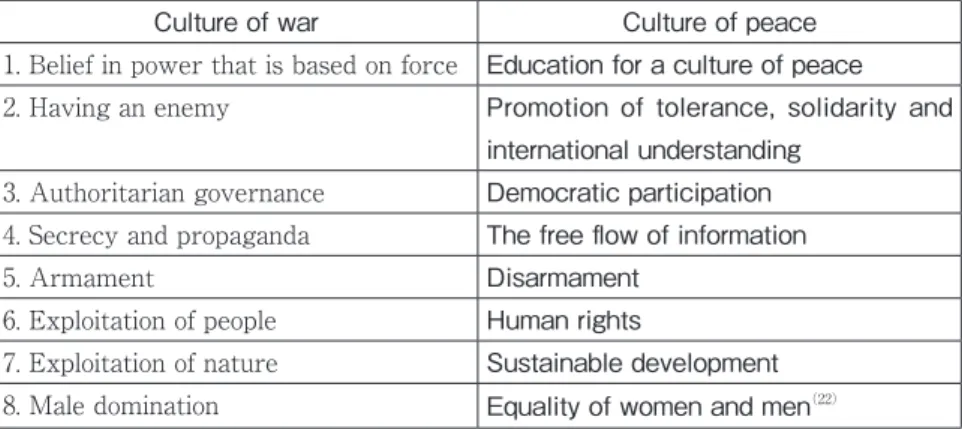
In response to these characteristics, the 1995 document put forward a comprehensive strategy for action which was subsequently presented to the UN General Assembly in 1997. Following a lengthy process of consultation, two General Assembly resolutions supporting international efforts directed towards the creation of a culture of peace were passed in October 1999.(21) The main objectives of this strategy are elucidated in Table
(19) 19 Ibid, p.9. (20) 20 Ibid, p.10.
2. In order to counter the negative effects of a culture of war, the 1995 strategy empha-sised the necessity of concerted action to be carried out in the following areas:
Table 2: Areas of action to create a culture of peace
Culture of war Culture of peace
1. Belief in power that is based on force Education for a culture of peace 2. Having an enemy Promotion of tolerance, solidarity and
international understanding 3. Authoritarian governance Democratic participation 4. Secrecy and propaganda The free flow of information
5. Armament Disarmament
6. Exploitation of people Human rights
7. Exploitation of nature Sustainable development 8. Male domination Equality of women and men(22)
As clearly stipulated in this table, a principal priority of this strategy is education for
a culture of peace. In accordance with this thinking, the teaching of Peace Education is
understood to mean teaching that is explicitly aimed at working towards the creation of a culture of peace. It is this thinking which provides the second and third fundamental concepts of Peace Education.
2. Peace Education as a scholastic subject
With its intellectual foundation provided by the aforementioned three fundamental concepts, as an academic and pedagogical discipline Peace Education has experienced rapid growth in the last three decades, especially in the period since the end of the Cold War. Following directly from the socially progressive definition of peace as global jus-tice, where the telos of this definition is understood to be the establishment of a culture of peace, Peace Education represents education that is specifically intended to work
wards the realisation of this desirable condition throughout the world. As a conse-quence, in terms of an actual subject that can be taught within school curricula, Peace Education represents a subject which evinces a progressive social agenda.
In comparison to many of the subjects that make up 'standard' school curricula (sub-jects such as Mathematics, Chemistry or Geography, for example), in pedagogical terms Peace Education has had a relatively short history. Originally devised as a study of the causes of war and its prevention, it has developed into "the study of violence in all its manifestations, and education to counteract the war system for the creation of a peace system; a peace system on both the structural and individual level."(23)
Emerging as a distinct branch of the wider field of Peace Studies during the 1970s, many of the core conceptual components of Peace Education were developed through the writings and activities of the Peace Education Commission of the International Peace Research Association (IPRA).(24) During the Cold War era, in response to a
per-ceived need to bring the expanding body of thought and aspirations of Peace Studies to a wider audience, especially the younger generation, the energies of a number of aca-demics and educational practitioners were directed towards developing new pedagogi-cal methodologies that could work towards the creation of a culture of peace through education. At a fundamental level, this education aimed at moving beyond a mere ob-jective analysis of the causes of war and armed conflict, and sought to generate a new mode of thinking which could ultimately effect equitable social change. In other words, rather than simply promoting learning about peace, this education aimed at the specific promotion of learning for the creation of peace.(25) Owing to its progressive agenda,
since its initial introduction into the educational arena, the teaching of Peace Education
(23) Ardizzone, Leonisa (2001), "Towards Global Understanding: The Transformative Role of Peace Educa-tion", Current Issues in Comparative Education, Vol. 4, No. 1, p.8.
has on several occasions provoked considerable institutional resistance, including in the case of the United Kingdom under the conservative government of Margaret Thatcher.(26) With regard to the post-Cold War era, despite the major changes that have
occurred in the international arena since the collapse of the Soviet Union, there contin-ues to be significant resistance to the adoption of specific peace pedagogy that calls into question many of the fundamental structures of society.(27)
Nature of the subject
With regard to its intrinsic nature, Peace Education is a subject which advocates a holistic approach to learning that is related to the central theme of peace. Incorporating issues relating to human security, equity, justice and intercultural understanding, by means of the utilization of interactive pedagogical methodologies it seeks to promote ideas of global citizenship and planetary stewardship among students, and supports the forming of humane interpersonal relationships between them. It seeks to replace deep-ly-held convictions about the necessity of possessing armed forces and the ultimate threat of violence to protect national security (consequences of the pervasive culture of war) with a commitment to specific strategies to create peace in order to address the multifaceted forms of violence that exist throughout the world. It seeks to supplant the destructive images of war and violence that surround peoples' lives with dynamic im-ages of peace which can make the pursuit of non-violence an exciting prospect for the younger generation.(28)
In addition, the challenge of facilitating sustainable development throughout the
(25) Synott, John (2005), "Peace Education as an educational paradigm: review of a changing field using an old measure", Journal of Peace Education, Vol. 2, No. 1, p.12-14.
(26) Cox, Caroline and Scruton, Roger (1984), "Peace Studies - A Critical Survey", Occasional Paper No.7, Institute for European Defence and Strategic Studies.
(27) Ardizzone (2001), op. cit., p.10. (28) Harris (2002), op. cit., p.1-2.
world is incorporated in this thinking. This issue is addressed through the promotion of learning activities which seek to identify common ground between people of different races and cultures in order to pinpoint targets for cooperative action - meaning com-monly-perceived threats to the health and well-being of humankind and the planet. These targets include human rights abuses, famine, poverty, illiteracy, ignorance and environmental destruction. Ultimately, at its heart Peace Education functions to foster the "development of a planetary consciousness that will enable us to function as global citizens and to transform the present human condition by changing societal struc-tures".(29)
Delineating the field
With the ultimate aim of Peace Education being the establishment of a culture of peace, which in itself is clearly a broad and multifaceted objective, it is necessary to clarify how this can be specifically addressed within a scholastic context. However, as a number of recent academic studies have shown, this has not proven to be a straight-forward task.(30) School curricula which go by the name of Peace Education have been
identified in a great variety in classrooms around the world. As a consequence, efforts to delineate accurately the scope of what precisely Peace Education amounts to have proved problematic: what some practitioners call 'education for democracy', 'civic edu-cation', 'tolerance education' or 'human rights eduedu-cation', can all, arguably, claim to be education that is ultimately aimed at the establishment of a culture of peace. Due pre-cisely to its holistic nature, in the sense that discussions relating to the subject neces-sarily involve engagement with other academic fields such as history, political science, economics, sociology, ethics, ecology and so on, the task of providing a single
descrip-(29) Reardon (1988), op. cit., p.10.
(30) Burns, R. and Aspeslagh, R. (1996), "Peace education and the comparative study of education", in R. Burns and R. Aspeslagh "Three decades of peace education around the world: An anthology", New York, Garland. Bar-Tal, D. (2000), "The elusive nature of peace education", in G. Salomon and B. Nevo (Eds.) "Peace Education: the concept, principles and practices around the world", Mahwah, NJ: Erlbaum.
tion of what precisely Peace Education amounts to has thus proven difficult.
As the result of an analysis of over one hundred peace-related curricula being taught in the United States from the kindergarten to high school levels, Reardon (1988) con-cluded that "there are as yet no clear limits to, nor standards for, what is to be incon-cluded in Peace Education."(31) In order to address this difficulty, based on a detailed study of
the many and varied curricula currently going by the name of Peace Education in class-rooms around the world, Harris (2004) presented an analytical framework which iden-tified five specific content areas that have now become widely accepted as effectively constituting the discipline. These five areas are: International Education, Human Rights Education, Development Education, Environmental Education and Conflict Resolution Education. Their main areas of concern and principal philosophical architects are sum-marised below:
1. International Education - concerned with generating international understanding and a sense of global citizenship in order, principally, to eradicate war throughout the world; Betty Reardon, 1988.
2. Human Rights Education - the creation and implementation of international
agreements and legal frameworks to facilitate social justice; Immanuel Kant, 1970 (original work published in 1795), the Universal Declaration of Human Rights,
1948.
3. Development Education - the eradication of poverty and oppressive social structures through the removal of both direct and structural violence; Johan Gal-tung, 1969 and Paulo Freire, 1970.
4. Environmental Education - examining humanity's role and responsibilities with-in an with-integrated, livwith-ing biosphere; the pursuance of strategies aimed at facilitatwith-ing
sustainable development; Bowers, 1993 and Ahearn, 1994.
5. Conflict Resolution Education - developing individual self-esteem and interper-sonal negotiation skills in order to prevent conflict and violence in daily life; Maria Montessori, 1974.(32)
Part 2: Putting the theory into practice: the drive to introduce Peace Education into classrooms around the world
1. A growing discipline
Despite the undoubted difficulties that have existed with regard to defining how pcisely Peace Education should be delineated within a classroom context, a series of re-cent developments have taken place in the international arena which have significantly raised the profile of the subject. Notwithstanding the institutional opposition that the teaching of Peace Education has aroused on several occasions in the past, a concerted drive from a number of large and small organisations in the post-Cold War era has led to the successful introduction of the subject in a variety of educational contexts around the world.
In the closing decade of the 20th century, several large-scale campaigns were launched in support of Peace Education, including the aforementioned UNESCO cam-paign which culminated in the passing of the resolutions at the UN General Assembly. These resolutions, in addition to designating the year 2000 as "The International Year for the Culture of Peace", and the years 2001-2010 as "The International Decade for a Culture of Peace and Non-violence for the Children of the World", made a call for the introduction of the subject to school curricula worldwide. Further initiatives followed, both in the spheres of academia and in civil society, including the launching of the
Manifesto 2000 Movement(33) and the inauguration in 2004 of the first academic
publi-cation specifically dedicated to the field, The Journal of Peace Edupubli-cation. With regard to curriculum development, the publication in 2002 of a wide-ranging sample curricu-lum for the subject entitled "Learning to Abolish War" represented another significant milestone for the development of the discipline. This curriculum was produced under the auspices of the large-scale civil society movement The Hague Appeal for Peace, a body which has provided considerable support to the overall development of Peace Ed-ucation both in terms of theory and practical application.
2. The Hague Appeal for Peace
Prior to the commencement of the major international conference calling for peace which was organised in The Hague, the Netherlands, His Holiness the Pope sent the following message to one of the delegates: "May the century that has done so much for the expansion and improvement of weapons of war do something noble before it closes, namely, create the ways and means to make it possible for the voice of reason to assert itself in international conflicts."
It may be surprising to hear, but these words were not actually heard prior to the
Third Hague Appeal for Peace Conference that was held in 1999 and were not uttered
by Pope John Paul II. They were in fact spoken by Pope Leo XIII on the occasion of the First Hague Peace Conference held 100 years earlier in 1899.(34) On that occasion,
in response to an invitation from Tsar Nicholas II of Russia, 100 delegates from 26 countries gathered in The Hague to hold an international conference to discuss ways of halting the accelerating arms race. Held over a period of six weeks, the conference closed with the signing of an agreement in which the participating countries agreed to attempt to arbitrate international conflicts by means of negotiation instead of through
(33) http://www.unac.org/peacecp/manifesto.html (34) Pope Leo XIII, (1899), personal correspondence.
force of arms. Subsequently, a Second Hague Peace Conference was convened eight years later in 1907 at which both Tsar Nicholas and the then President of the United States, Theodore Roosevelt, attended. During this conference, many issues were dis-cussed relating to the international arbitration of armed conflicts and the theory and im-plementation of humanitarian law. It closed with a commitment on behalf of the parties to convene similar conferences henceforth every seven or eight years. However, with the outbreak of the First World War this progressive initiative was brought to an abrupt end, marking the start of what would then prove to be the most destructive period in human history.
In May 1999, on the centenary of the First Hague Peace Conference, in response to an appeal launched by a number of organisations including the International Peace Bu-reau, International Physicians for the Prevention of Nuclear War and the International Association of Lawyers Against Nuclear Arms, a group of almost 10,000 activists, gov-ernment representatives and community leaders gathered in The Hague to attend the largest international peace conference ever held. Organised on this occasion not by na-tional governments but by representatives of civil society, this conference brought to-gether representatives from a variety of backgrounds, including human rights and equality advocates, environmentalists, spiritual leaders, humanitarian and development workers and other peace activists, with the aim of discussing measures that could work towards the establishment of a culture of peace in the 21st century. The central objec-tive of The Third Hague Appeal for Peace was "raising in a serious and realistic way questions as to whether or not, at the end of unquestionably the bloodiest century in history, humanity could find a way to solve its problems without resorting to arms; [to question whether] war was still necessary or legitimate given the nature of weapons currently in arsenals and on drawing boards worldwide, and also whether or not civili-zation could survive another major war."(35)
In line with the thinking developed in the field of Peace Studies over the previous three decades, the conference defined the central concept of peace as meaning not only the absence of war between and within states, but also the presence of social and eco-nomic justice throughout the world. Wide-ranging discussions were held on issues re-lated to the central theme of how to eliminate war. Adopting a similar line of reasoning to the UNESCO campaign held earlier in the decade, these issues included: the exist-ence of racism, colonialism, poverty and other human rights violations; the limitation of military arsenals to a reasonable level for territorial defence; the elimination of all weapons of mass destruction including nuclear weapons; the establishment and utiliza-tion of specific conflict resoluutiliza-tion mechanisms; improvements in humanitarian law; and the creation of a culture of peace for the world's war-oppressed people.(36)
The central achievement of The Third Hague Appeal for Peace was the promulgation of a landmark document entitled "The Hague Agenda for Peace and Justice for the 21st Century" which contained 50 specific recommendations for both governments and civil society that aimed at the abolition of war and the promotion of peace.(37) With regard to
Peace Education, going beyond the general call for the introduction of the subject to school curricula that was made in the UN General Assembly resolutions, the Hague Agenda adopted a more strident declaration which called for the introduction of Peace Education as a compulsory curriculum subject to all levels of world education systems.
A culture of peace will be achieved when citizens of the world understand glo-bal problems, have the skills to resolve conflicts and struggle for justice
non-vi-(35) Documents from the proceedings of The Third Hague Appeal for Peace, available at: http://www.haguepeace.org/index.php?action=history&subAction=conf&selection=where (36) History of the Hague Appeal for Peace, available at:
http://www.haguepeace.org/index.php?action=history&subAction=conf%selection=when (37) "The Hague Agenda for Peace and Justice for the 21st Century" available at:
olently, live by international standards of human rights and equity, appreciate cultural diversity, and respect the Earth and each other. Such learning can only be achieved with systematic education for peace.(38)
In order to achieve this objective, in addition to calling for concerted action on the part of Ministries of Education around the world, the Agenda also called for the crea-tion of a special taskforce dedicated towards this end - a Global Campaign for Peace Education. This is the expanding organisation whose November 2010 bulletin was quoted in the introduction to this paper.
The Global Campaign for Peace Education
The Global Campaign for Peace Education emerged from the civil society energies that converged at the Third Hague Appeal conference in 1999. In response to a recog-nised need for a new phase in the development of Peace Education, the many peace ed-ucators who participated in the Hague event, including leading figures such as Betty Reardon, Ian Harris and Cora Weiss, launched the campaign as a key component of the Hague Agenda. In a similar respect to the way that other sectors of civil society regard-ed Peace Education as an essential element in the advancement of the Agenda, these peace educators saw within the Hague Appeal movement a potential arena for a new, global phase of Peace Education, one which could carry into the 21st century the theo-retical foundations of the field that had been developed during the latter decades of the 20th century. Within The Hague Agenda, it was clearly affirmed that "systematic edu-cation for peace" was an essential element within the strategy aimed at establishing a culture of peace. As a consequence of this thinking, in May 1999 an international net-work of peace educators was created to pursue the active development of the subject of Peace Education worldwide at both an academic and practical level.
(38) "The Hague Agenda for Peace and Justice in the 21st Century", 1999, p.5, http://www.haguepeace.org/index.php?name=agenda_english .
The Campaign focused the energies of many of the original pioneers of the field to-wards specific action which would work toto-wards the achievement of two key goals: i) to build public awareness and political support for the introduction of Peace Education into all spheres of education; and ii) to promote the education of all teachers to teach for peace. One of the most significant developments in this regard was the creation of a new, wide-ranging Peace Education curriculum for elementary, junior high and senior high levels entitled “Learning to Abolish War”. Written by Betty Reardon and Alicia Cabezudo, this three-volume curriculum was published free of charge by The Hague Appeal for Peace organisation in April 2002.(39)
3. A new and dynamic curriculum for Peace Education
"Learning to Abolish War" was generated out of a detailed synthesis of the many curricula going by the name of Peace Education being taught in classrooms around the world, and is now widely regarded as a standard text for the discipline.(40) In the text the
authors elucidate the theoretical rationale for the subject and present a comprehensive range of lesson plans for students at all levels of compulsory education which are based on specific objectives outlined in the Hague Agenda. The rationale is described in the following manner:
Comprehensive peace education is rooted in a holistic, dynamic view of peace and is explicitly value based. The two core values of comprehensive Peace Edu-cation are non-violence and social justice... The main purposes of Peace Educa-tion are the eliminaEduca-tion of social injustice, the renunciaEduca-tion of violence, and the abolition of war... Peace Education includes the development of peacemaking values, skills and knowledge. It aims at developing awareness of social and po-litical responsibilities, guiding and challenging learners to develop their own
(39) Reardon, B. and Cabezudo, A. (2002), "Learning to Abolish War", The Hague Appeal for Peace. (40) Cora Weiss, quoted in Reardon and Cabezudo, (2002), Book 1, p.4-5.
points of view on the problems of peace and justice. It encourages them to ex-plore possibilities for their own contributions to resolving the problems and achieving a culture of peace.(41)
In addition, the authors also elucidate the pedagogical framework in which they en-visage the specific lessons presented in the text will be adapted and applied in different educational contexts. Acknowledging that some educators will select particular lessons from the text and apply them directly to their own classrooms without making signifi-cant changes, they also describe and indeed encourage the adoption of an alternative approach through which aspects of individual lessons are applied to classrooms in a manner which is appropriate to that particular context.
The Campaign for Peace Education seeks to encourage the widest possible, age-appropriate, and culturally contextualised variety of modes and content in the subject. We believe that such culturally varied and community-relevant forms of Peace Education not only better serve the learners, but greatly enrich the entire field of Peace Education, increasing the possibilities of its being in-troduced into all learning environments throughout the world. While we argue for the universal need for Peace Education, we do not advocate the universaliza-tion and standardizauniversaliza-tion of approach and content. We believe that Peace Educa-tion in whatever forms it takes must be a fundamental part of the socializaEduca-tion process in which education plays a major role. Thus, we propose that Peace Ed-ucation be planned developmentally and sequentially throughout the stages of development of the child, adolescent and young adult.(42)
To summarise: building upon the philosophical foundations of the discipline
estab-(41) Ibid, p.19-20 (42) Ibid, p.17.
lished by leading peace scholars in the late 1960s, during the closing years of the Cold War many educators and other activists from a number of countries began to advance an overtly peace-focused pedagogy which sought not only to study but also to seek means to overcome many of the serious challenges facing the modern world. The ef-forts of these educators and activists found an opportunity to coalesce and gain mo-mentum within the large-scale campaigns of UNESCO and The Hague Appeal for Peace during the mid-to-late 1990s which placed the goal of introducing Peace Educa-tion into school and university classrooms around the world as a significant objective of their wide-ranging socially progressive agendas. As a result of the dynamic networks which were established through the activities of these campaigns, coupled with devel-opments such as the free distribution of highly-adaptable sample curriculum content such as that contained in "Learning to Abolish War" and the adoption of an open and interactive attitude towards curriculum development that is contextually appropriate, in the eyes of peace educators such as Barbara Wien, over the course of a relatively short period of time Peace Education has succeeded in expanding both as an academic and a scholastic discipline, and is now on the verge of reaching "critical mass" - that is to say potential widespread implementation across the international educational sphere.
Part 3: Steps on the path towards a culture of peace 1. Peace Education in a troubled 21st century world
With the fall of the Berlin Wall and the collapse of the Soviet Union at the beginning of the 1990s, a definite sense of optimism was felt in many parts of the world due to the fact that the risk of catastrophic nuclear war between the superpowers which had overshadowed the Cold War era seemed to have largely abated. However, as a result of the outbreak of a series of regional conflicts which occurred in the next few years, par-ticularly in regions such as the Balkans and Central Africa, by the middle of the decade a significant measure of this optimism had largely evaporated. Far from entering an era
in which war itself or the fear of war had become a thing of the past, it appeared that the world was becoming ever more fractious, divided and prone to outbreaks of shock-ing violence. This was the geopolitical climate that provided the backdrop for the cam-paigns of UNESCO and The Hague Appeal for Peace which were calling for urgent ac-tion in order to establish a culture of peace in the post-Cold War world. Subsequently, and only two years after the Third Hague Appeal for Peace Conference was held in 1999, the new millennium was marked by the devastating attacks of September 11th
2001 which threw the international community into yet further turmoil and conflict.
With regard to the contemporary world in the 2010s, the on-going wars in Afghani-stan and Iraq, coupled with other grave international dilemmas such as the continued humanitarian crisis in Darfur, the threat of destructive climate change caused by global warming, and the growing wealth disparity between rich and poor leading to increasing social disaffection, extremism and terrorism in several countries, these and other phe-nomena appear to characterise a world which seems to be ever further removed from the establishment of a culture of peace. In this troubled climate it would be natural to question the optimistic views of individuals such as Barbara Wien who are indicating that a significant expansion in the teaching of Peace Education around the world is im-minent. Were this to prove to be the case, one could justifiably ask 'what positive con-sequences could then be predicted in such a scenario?' With regard to this question, the author admits that he is in no position to forecast with any degree of certainty what possible large-scale socio-economic benefits could be expected from a significant in-crease in the teaching of Peace Education in classrooms around the world. However, he holds that he is in a position to draw attention to a growing body of highly-recommend-able source material for the subject which can clearly contribute towards one of the principal objectives of Peace Education as outlined above - that of surrounding young peoples' lives with dynamic images of peace which can make the pursuit of non-vio-lence an exciting prospect for the younger generation.(43)
2.Dynamic content for Peace Education classes
As emphasised in the aforementioned rationale to "Learning to Abolish War", Peace Education as both an academic field and a scholastic subject takes a holistic view of peace which consequently involves engagement with other fields. However, with regard to the actual delivery of the subject in a classroom context, despite the fact that many of the important issues raised within it are closely interrelated with each other on a va-riety of levels, an important priority for educators should be to clarify which specific area or issue is being discussed in each particular case in order to prevent students from becoming confused or overwhelmed by a surfeit of content. Consequently, in drawing attention to examples of recommendable content for Peace Education classes in the following cases, the author will restrict his focus to one of the five areas of the subject identified in Harris' framework (Harris, 2004)(44), that of the generation of
in-ternational understanding through the fostering of reconciliation in post-conflict sce-narios. In this context, four specific cases will be mentioned which emanate from cities that experienced severe devastation in the Second World War: the cities of Coventry in the United Kingdom, Dresden in Germany, and Hiroshima and Nagasaki in Japan.
Coventry
In the European theatre during the Second World War great destruction was visited upon a large number of cities across the continent, particularly as a result of large-scale air raids. During The Blitz of September 1940 - May 1941, many cities in the United Kingdom were attacked by the German Luftwaffe, including Coventry in the Midlands which suffered severe damage on the night of November 14th 1940. Both military and
civilian areas of the city were destroyed during the course of this raid, as was much of the city centre and also the Cathedral of St. Michaels. In the aftermath of the raid, as part of reconstruction efforts the residents, of Coventry quickly resolved to rebuild
(43) See Note 28.
their cathedral. However, following the inspiring leadership of the Provost, Richard Howard, it was decided that Coventry Cathedral should henceforth become a symbol of peace and reconciliation for peoples of all nations whose lives had been shattered by war. The rebuilding of Coventry Cathedral was completed in 1962 and its principal ministry as a Christian centre became the promotion of reconciliation. The building stands at the heart of a network of both religious and non-religious initiatives organised from the city which promote peace, non-violence and international understanding throughout the world.(45)
Dresden
During the Allied bombing campaign of Germany carried out between 1940-45, many German cities suffered comparable or even far worse damage that that inflicted upon Coventry. Arguably the most notable in this regard was the city of Dresden in eastern Germany which was attacked by the air forces of both Britain and the United States on the night of February 13th-14th 1945. The dropping of thousands of tonnes of
high explosive and incendiary bombs on the centre of Dresden combined to create a devastating fire storm which claimed the lives of at least 22,000 people. During the subsequent Cold War period, the government of the communist German Democratic Republic in whose territory Dresden was located prohibited the rebuilding of parts of the city, especially the iconic Protestant cathedral the Frauenkirche, in order to generate fear and hostility towards the 'militaristic and imperialist West.' However, following the collapse of the regime and subsequent reunification of Germany in 1990, a series of ini-tiatives were launched in Dresden to promote international understanding, one of which was the reconstruction of the Frauenkirche. This endeavour involved the city re-questing and receiving significant assistance from countries which had been former
en-(45) Hunter, Alan (2009), "The Message of Coventry's Cathedral", Featured Articles, Her Majesty's Forces, http://www.hmforces.co.uk/news/articles/537-the-message-of-coventrys-cathedral and
emies of Germany and which had suffered severely as a result of German aggression, especially the countries of Poland, France and the United Kingdom. Subsequently, thanks to the creation of a variety of interactive networks, both cultural, educational, religious and institutional - notably in this case Dresden's network of thirteen sister cit-ies which includes the city of Coventry, the city has become an important centre for ac-tivities promoting peace and international understanding in the post-Cold War world.(46)
Hiroshima and Nagasaki
While continuing to represent solemn reminders of perhaps the ultimate horror that mankind has devised to inflict death and misery upon other members of its species, at the same time the post-1945 stories of the cities of Hiroshima and Nagasaki also con-tain many inspiring elements which bear witness to the ability of the human spirit to overcome tremendous adversity and, in a spirit of forgiveness and solidarity, strive for a world in which war and suffering can become things of the past. The horrific effects of the atomic bombings of August 6th and 9th 1945 left over 200,000 people dead, large swathes of both cities in utter ruins and great numbers of those who survived fac-ing years of further sufferfac-ing due to radiation poisonfac-ing. However, the lives of the Hibakusha and the rebuilt cities of Hiroshima and Nagasaki simultaneously stand as powerful testimonies to mankind's will to survive and to create lives which have both dignity and hope. Since 1945, both cities have risen from little more than ashes to be-come modern metropolises that are recognised as International Cities of Peace and Culture, and in cooperation with other actors, the Hibakusha's on-going campaign for the abolition of nuclear weapons has, after many dark and dispiriting days during the Cold War, in recent years begun to achieve tangible progress. Several large-scale peace campaigns are based or have chapters in Hiroshima and Nagasaki, including the
May-(46) Short, J. (2005), "Proposals for the Future Development of Peace Education in Hiroshima City - Based on a Comparative Analysis of the Peace Education Curricula of Hiroshima and Dresden", Journal of Inter-national Development and Cooperation, Vol. 11, No. 1.
ors For Peace movement and the International Physicians for the Prevention of Nuclear War.(47) Moreover, the Christian legacy of the latter city provides an additional avenue
through which it can transmit its powerful message that is calling for peace and recon-ciliation.
Conclusion
In a world that is struggling to address not only the serious dilemmas mentioned above but many others which are threatening the health and happiness of much of the Earth's population, peace educators such as Barbara Wien and Betty Reardon argue that the need for the further expansion of Peace Education into more educational environ-ments is acute. The author is in complete agreement with this position. In a world where, especially in the rich countries of the 'North', the growing tendency appears to be for children and young people to be continually bombarded with images of conflict and violence from both a 'disaster-obsessed' 24 hour news media, on the internet and also in the increasingly ubiquitous world of video games, if meaningful progress on a path towards a more peaceful world is to be achieved, the author holds that it is vital that these young people have opportunities to see that the future of the world in which they are living is in fact a bright one. Peace educators must be able to meet the chal-lenge of not only explaining about the substantial progress that has been made in terms of, for example, fostering reconciliation between formerly implacable enemies and the importance of the further promotion of international understanding, but also
demon-strating the significant action that is currently underway in the international arena to
further these goals, and to which it is very likely that the enthusiasm and initiative of these young people can meaningfully contribute. This is the goal of the 'dynamic' Peace Education that Harris (2002) has in mind, and in the author's opinion the cases of the four cities mentioned above provide inspiring examples of it.
In the cases of Coventry, Dresden, Hiroshima and Nagasaki, despite having experi-enced terrible suffering and hardship during and after the worst conflagration in human history, their inhabitants have succeeded in rebuilding their lives, homes, businesses and communities and have created new identities for their rebuilt cities, at the heart of which can be clearly found the ideals of peace and reconciliation. Incorporating the great efforts of many sections of the community, this process has taken place over a pe-riod of over half a century and is continuing today. Furthermore, the experience of suf-fering and reconstruction has engendered a strong personal desire for reconciliation which has led to the creation of deep-rooted centres for such activity, which can be seen today in a variety of contexts. In the author's opinion, it is the both tragic and in-spiring stories of these cities that children and young people should learn about in classes of Peace Education, and it is the dynamic and on-going campaigns taking place in them which they should investigate in the hopes that they themselves may gain en-thusiasm with regard to making their own contributions towards the ultimate goal of creating a culture of peace.
References
・Ardizzone, Leonisa (2001), "Towards Global Understanding: The Transformative
Role of Peace Education", Current Issues in Comparative Education, Vol. 4, No. 1 ・Bar-Tal, D. (2000), “The elusive nature of peace education", in G. Salomon and B.
Nevo (Eds.) "Peace Education: the concept, principles and practices around the
world", Mahwah, NJ: Erlbaum
・Burns, R. and Aspeslagh, R. (1996), "Peace education and the comparative study of
education", in R. Burns and R. Aspeslagh "Three decades of peace education around
the world: An anthology", New York, Garland
・Cox, Caroline and Scruton, Roger (1984), "Peace Studies - A Critical Survey", Oc-casional Paper No.7, Institute for European Defence and Strategic Studies
Peace Research in Developing Nations", Proceedings of the International Peace Re-search Association Second Conference (Assen, The Netherlands: Koninklijke Van Gorcum & Comp.) vol. 2
・Galtung, Johan (1969), "Violence, Peace, and Peace Research", Journal of Peace Research Vol. 6
・Harris, Ian (2002), "Challenges for Peace Educators at the beginning of the 21st
Century", Social Alternatives, Vol. 21, No. 2
・Harris, Ian (2004), "Peace Education Theory", Journal of Peace Education, Vol. 1, No. 1
・Hicks, David ed. (1988), "Education for Peace", London Routledge
・Ishida, Takeshi (1969), "Beyond the Traditional Concepts of Peace in Different
Cul-tures", Journal of Peace Research, Vol. 6
・Kodama, Katsuya (2004), "History of the International Peace Research Association", IPRA Press
・Pannwitz, Rudolf (1950), "Der Friede", quoted in Rummel, Rudolph J. (1981), "Understanding Conflict and War, Volume 5: The Just Peace", Sage Publications ・Reardon, Betty (1988), "Comprehensive Peace Education: Educating for global
re-sponsibility", Teachers College Press, New York
・Reardon, B. and Cabezudo, A. (2002), "Learning to Abolish War", The Hague Ap-peal for Peace
・Sandy, Leo R. and Ray Perkins Jr. (2002), "The Nature of Peace and its
Implica-tions for Peace Education", The Online Journal of Peace and Conflict Resolution 4 ・Short, J. (2005), "Proposals for the Future Development of Peace Education in
Hi-roshima City - Based on a Comparative Analysis of the Peace Education Curricula of Hiroshima and Dresden", Journal of International Development and Cooperation, Vol. 11, No. 1
・Synott, John (2005), "Peace Education as an educational paradigm: review of a