While water shortages and the pollution of water resources are common problems around the globe, in China, the scale of these issues is immense. The demands of 1.3 billion people, together with a rapidly growing economy, have placed tremendous pressures on China’s water resources. These pressures have required new approaches to the ways water resources are managed. Many of these new approaches are representative of fundamental changes occur-ring within Chinese society, on issues such as property rights, community participation, im-proved environmental management and the shift towards market-based decision making.
Among all these changes, a key and funda-mental aspect to water resources management has been the development of a water rights sys-tem for allocating entitlements to water. In the past 30 years, China has developed a water rights framework part by part and step by step.
I
China’s water resources and water sector(1) Characteristics of Water Resources
China has enormous water resources but they are unevenly distributed in space and time. According to “National Water Resources Comprehensive Plan”, the water resources in China is 2840 km3, of which surface water
re-sources is 2740 km3 and groundwater resources is 821.9 km3.1) With the demography and
econ-omy, water resources in China have the following characteristics:
• Low per capita water resources: Water re-sources per capita are only one-third of the world average, with only about 2200 m3.
Water Rights
Development in China
Dajun Shen
School of Environment and Natural Resources, Renmin University of China / Professor
• Uneven temporal and spatial distribution of water resources: Owing to the geogra-phy, topogrageogra-phy, and monsoon-influenced climate, rainfall varies vastly from year to year and between seasons. In the south pre-cipitation in the wet years can be 4 times higher than in dry years. This ratio can be as high as 8:1 in the north.
• Distribution of water resources does not match population, cultivated land and eco-nomic distribution: two-thirds of China’s cultivated lands lies to the north of the Yangtze River, but only 19% of its water re-sources. In particular, the Yellow, Huai and Hai river basins – which account for one-third of China’s population and GDP – have only 7.7% of its water resources. Consequently the levels of water resource development differ significantly: extrac-tions in the Hai river basin exceed 90% of available water resources (including both surface and ground water) and in the Yel-low river basin 50%; development in the Yangtze and Pearl basins in the south is at less than 15%.
(2) Water resources problems
Under these characteristics, together with the fast social and economic development in the recent 30 years, China is facing critical wa-ter resources problems:
• Severe water conflicts between supply and demand: Based on normal demand levels and without over-drawing groundwater re-sources, the average annual water shortage in China is estimated to be 50 billion m3.2)
Water usage continues to fast increasing in urban domestic water and industrial sec-tors in the past 30 years and in the near
future. This has resulted in water conflicts between industry and agriculture, between urban and rural areas and between regions. • High water pollution: The total wastewater
discharge in 2008 was 75.8 billion tons,3)
more than twice that in 1980. Discharge levels are making it increasingly difficult to maintain water quality and are threatening drinking water supplies.
• Heavy water and soil erosion and a vulner-able natural environment: Thirty seven percent of China’s land area suffers from soil and water erosion. Since the 1950s, the area covered by lakes and wetlands has de-creased 15% and 26% respectively. Groundwater is overdrawn on average by 10 billion cubic meters per year, resulting in land subsistence and seawater intrusion.
(3) The trend of China’s water policy
Facing these critical problems, the challenge for water resources management is enormous. They must balance limited water supplies against the needs of the world’s largest popula-tion; demands for rapid economic growth with calls for improved environmental management; and moves towards a market-based approach to the allocation of water with a history of state ownership and strict government control of all resources.
Many of the fundamental changes that are occurring within Chinese society – the in-creased recognition of individual rights (in particular property rights), greater community participation in government decision-making, and the shift towards market-based decision making – are changes that are evident in a new world of water resources management in
Chi-na . S ome pro g ress ha s b e en made in incorporating these new philosophies within the water management framework, but many challenges lie ahead in the development and implementation of a water management system suitable for the “new” China.
The best example of this new approach is in the area of water rights. The development of a water rights system in China is seen as a key plank for addressing many of its existing prob-lems. This shift in philosophy is representative of many of the shifts occurring on a wider scale within China as part of the reform process. Again, some progress has been made in the de-velopment of water rights, but there is still much work to be done.
The 2002 Water Law of the People’s Repub-lic of China lays the foundations for improving the management of China’s water. It provides for a comprehensive planning framework, ad-dressing flood management, water resource allocation, demand planning, pollution control and other aspects of river basin management. Since the law’s passage in 2002, significant steps have been taken to implement its require-ments. The ‘water saving society’ initiative is being expanded across the country to improve water management and encourage water use ef-ficiency.
A 2006 State Council decree has formed the basis for establishing a uniform national ap-proach to water abstraction permit and charging for water use. The most significant is that 2011 upgrades water sector to an unprece-dented importance: 2011 No.1 Document of the Central Committee of Chinese Commu-nist Party and the State Council, and the Central Water Resources Conference raise “water resources” as “ the source of life, the
ele-ment of production and the basis of ecosystem”, and develop the most strict water resources management strategy in China, which requires to develop three redlines and relevant management systems. Among three redlines: the total water usage control redline, the water use efficiency control redline and the pollutant discharge redline, the total water us-age control redline is closely related to water rights or is the water rights.
In 2014, the Guidance on Deepening Water Sector Reform, implementing the water rights trade system in the 2013 Decision on Several Key Issues of Fully Deepening Reform on 3rd Session of 18th Central Committee of Chinese Communist Party, requires to develop and im-prove water rights system, in order to function better by market in water resources allocation and improve water use efficiency and effective-ness. The core of the water rights system is water rights clarification and transfer. The key tasks include fastening riverbasin water re-sources allocation, clarifying regional water rights, registering water use rights for users, pi-loting payment for water use rights for new industrial and service users, piloting water rights transfer, encouraging water rights trader among regions and users, exploring multiple water rights transfers mechanisms, and foster-ing water rights market and gradually developing water rights transfer platform at na-tional, riverbasin and regional levels. Following this document, Ministry of Water Resources (MWR) launched seven water rights pilot cases in China.
II
The Water RightsArrangements in China
2.1 Legal and Institutional Arrangements
The 2002 “Water Law” is the key legislation dealing with water rights. It provides a compre-hensive framework for water planning and for the allocation of water rights. The Law includes provisions on water resources ownership, rights of collectives to use water, water abstraction rights, water resource planning, water resources development and utilization, the conservation of water resources, water resources allocation, water use and savings, dispute settlement and administrative responsibilities.
The 2007 “Interim Method for Water Re-sources Allocation” provides a framework for riverbasin water resources allocation and regu-lation.
The 2006 “Regulation on Water Abstraction Permits and Water Resource Fee Collection (‘the Water Permit Regulation’) provides a framework for granting and managing water abstraction permits. Water permits are subject to the provisions of the 2003 “Law on Admin-istrative Permit”.
The MWR has the primary responsibility for water resources management. Under the 2002 “Water Law”, MWR is responsible for manag-ing water resources development, utilization, saving, conservation and flood prevention. It is responsible for the preparation of water plans (regional and basin, flood management, water allocation, water protection etc) and for the management of water abstraction permits.
The riverbasin water resources commissions in state major rivers/lakes are responsible for water resources management in the
jurisdic-tion, including drafting and implementing inter-provincial water resources allocation plan, and annual regulation plan and drought con-tingency plan, organizing to implement riverbasin water abstraction permits.
The water resources departments within the provinces are responsible for formulating and water resources allocation plan and implement-ing regulation plan in jurisdiction, and organizing to implement water abstraction per-mits.
2.2 Water Rights Framework
Water rights in China consists of three levels, as specified by relevant laws, regulations and guidelines including: the 2002 “Water Law”; the 2007 “Interim Measures for Water Re-sources Allocation”; the 2006 “Regulation on Water Abstraction Permit and Water Resourc-es Fee Collection and Management” (“the Water Permit Regulation”); the 2008 “Water Abstraction Permit Management Method” and the 1994 “Urban Water Supply Regulation” (Water Entitlements and Trading Project, 2006; Shen et.al, 2010). The three levels are:
• First, river basin and regional water alloca-tion and regulaalloca-tion: allocating water resources from river basins (national) to administrative regions (i.e. provinces, in-clud ing autonomous re g ions and municipalities, prefectures and counties). through water resources allocation plans and annual water resources regulation plans.
• Second, water abstraction management: al-locating water resources from the regional level to individual water abstraction units through the water abstraction permit sys-tem.
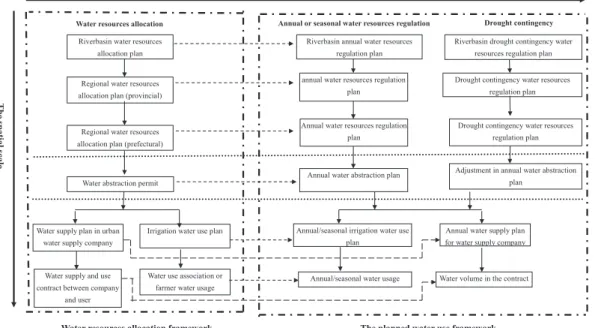
• Third, water use management in public wa-ter supply systems: including wawa-ter use allocation and management in irrigation districts and urban public water supply sys-tems (Figure 1).
(1) River basin and regional water resources allocation
The Water Law provides the overall frame-work for water resources allocation. The macro-allocation of long-term access to water resources in China is through “long- and medi-um-term water supply and demand plans”. As their names suggest, these plans broadly identi-fy demand for water over the longer term, as well as sources to meet those requirements.
Article 44 of the Water Law requires that long- and medium-term water supply and de-mand plans be drawn up on the basis of “the current supply and demand of water, plans for national economic and social development, river basin plans and regional plans and on the principle of coordinated supply and demand of water resources, comprehensive balancing of all interests, protection of ecology, strictly practic-ing of economy and rational development of water resources.”
Water resources are allocated in the shorter-term via water resources allocation plans. These plans are prepared at the river basin level, for the purpose of regulating runoff and storage of water, and based on the relevant river
hensive basin plan (the over-arching strategic plan for the basin) and the long- and medium-term water supply and demand plan (2002 Water Law, article 45).
For trans-provincial river basins, the water resources allocation plans, as well as drought contingency plans, are formulated by the appli-cable river basin management commission, together with relevant local (i.e. provincial) governments. The plans are then submitted to the State Council or its authorized department (normally MWR) for approval (2002 Water Law, article 45).
Other trans-regional water resources alloca-tion plans and drought contingency plans are formulated by the water administrative depart-ments of the governdepart-ments at the highest level necessary to have jurisdiction across the whole basin (e.g. for trans-prefecture basins, they are prepared by the provincial department), to-gether with relevant local governments.
Water resources allocation plans are the mechanism for sharing water resources be-tween different administrative regions within a river basin, thus identifying the share of the common resource available to those regions. Drought contingency plans typically operate in place of the water resources allocation plan during dry periods, with the trigger for their operation a threshold defined in the plan (2002 Water Law, article 45). Together, these plans provide a comprehensive basis for allocating water across the river basin and regions.
(2) Allocation of regional supply to water abstractors
The allocation of water resources by a region to water abstractors (i.e. individuals or legal en-tities) is managed through a water abstraction
permit system. Article 7 of the 2002 Water Law requires that the State implement a water abstraction permit system and Article 48 re-quires that “units” or individuals that directly take water from rivers, lakes or underground sources must first apply for a water abstraction permit. Exemptions from this requirement ex-ist, such as for taking a small quantity of water for domestic purposes and for watering live-stock.
The Water Permit Regulation regulates all water abstraction facilities, including sluices, dams, canals, water pumps, water wells, and hy-dropower stations.
The Water Permit Regulation requires that the permitting system, including the grant of permits, be consistent with the various water plans required under the 2002 Water Law. This includes the water resources comprehensive plan, river basin comprehensive plan, long- and medium-term water supply and demand plan and water function zoning. Most relevantly, the grant of a permit must be in accordance with the relevant water resources allocation plan, which, at least theoretically, set a cap on total abstractions.
In addition to considering the total volume available (as defined by the relevant plans), per-mit applications are considered against water use “quotas”, which are set by local water re-sources departments in conjunction with other relevant government agencies. These quotas recognized standard usage levels for certain in-dustries or crops.
The Water Permit Regulation addresses is-sues including:
• Responsibilities across different jurisdic-tions and departments for issuing permits (article 3). Notably, different provinces set
limits on the maximum volume for a per-mit that can be granted at different administrative levels depending on the source, the use, and the total volume to be extracted, and so on. In the extreme, ap-proval may be required from the central government, for example for projects of State significance;
• Priority of supply, with domestic supply given the highest priority (article 5). This builds on the requirements of the 2002 Water Law (article 21), which requires that the development of water resources should first satisfy the needs of the urban and ru-ral domestic users and “give overu-rall consideration to the agricultural, industrial and ecological environment need for water as well as to the need of navigation”; • The application and assessment process
(chapters II and III). In addition to the Water Permit Regulation, MWR and local water departments issue detailed technical guidelines governing the application and assessment of abstraction permits. There is also a process for certifying different insti-tutions (e.g. consultancy bodies) as competent to undertake assessments and prepare the water resources justification re-ports for consideration by the decision-making bodies; and
• The conditions that must be included on an abstraction license. These include a vol-ume, location, purpose, duration (between 5 and 10 years), water source, and discharge conditions (article 24).
The Regulation also prohibits the granting of abstraction permits under certain circumstanc-es. This includes:
• where it would increase water abstraction volumes in an area above the cap set by the water resources allocation plan;
• where significant harm might result to the water function zones (which define the purpose for which a water body is deemed suitable, e.g. as a drinking water source); • groundwater abstraction where the public
water supply network can meet its water need; or
• where the abstraction would cause signifi-cant harm to a third party or social public interests (article 20 (2), (3), (5) and (6)).
(3) Water resources allocation in irrigation districts and urban water supply systems
For the majority of water usage, water is ab-stracted by entities that hold the water abstraction permit and supply water (taken un-der the permit) to individual water users. This includes public water supply companies (in ur-ban regions) and the organizations responsible for the management and operation of irrigation districts. An allocation process typically exists for assigning water to users within these systems.
In irrigation districts, (often huge areas en-compassing thousands or tens of thousands of individual “farms”) water is typically allocated based on irrigation scheduling systems estab-lished during the design of the district. Generally, the scheduling system will be for-mulated according to reliability of supply, the irrigable land, crop patterns and crop require-ments (Calow, 2009; Water Entitlerequire-ments and Trading Project, 2007). In some of the old irri-gation districts, water scheduling and sharing arrangements have been in place for hundreds – even thousands – of years. In most instances,
the entitlements of individuals within the sys-tem are generally well understood, although often they are not documented or protected (Water Entitlements and Trading Project, 2006).
Urban water supply systems are generally more complicated. In addition to regulation via the water abstraction permit, a commercial contracting system is used for managing water supply and use. Typically, contracts will exist between the urban water abstractor, the water delivery company, the water treatment compa-ny, and the retail compacompa-ny, depending on the particular organizational structure in place. The 1999 Contract Law requires that a contract exist between water users and the water utility company. Normally, this will define the service standards and charging arrangements, includ-ing the required water pressure, water quality, tariff, metering, and so on. For non-residential users, the contract will also include a maximum volume (Shen & Cosier, 2009).
As part of the application process for a water abstraction permit, a public water supply orga-nization is required to identify the purpose of use, the quantity required, and the monthly use pattern. This information broadly identifies how the volume abstracted (and authorized under the permit) will be allocated within the public water supply system.
(4) Annual allocation of water
The framework described above outlines the mechanism for allocating long-term allocations of water resources, typically based on average annual or monthly volumes. Water abstraction and use each year is adjusted based on actual availability via a series of annual plans.
At the river basin or regional level, an annual water resources regulation plan is prepared based on the relevant water resources alloca-tion plans and annual inflow forecasts (as per Article 46 of the 2002 Water Law). This de-fines the water available to an administrative region in a particular year.
Similarly, the authorized water abstraction volume for a permit holder in a given year (or in some cases month) is determined according to the annual regulation plan, the forecasted inflow, water demands, and the approved vol-ume specified on the permit. Based on these elements, an annual water abstraction plan is developed to define the abstraction volume available to each permit holder.
Within irrigation districts, an irrigation wa-ter use plan is developed to manage seasonal water use. The 1999 “Guidelines on Technical Management of Irrigation and Drainage Proj-ect” requires that rotational water use plans for irrigation districts be formulated yearly, while a canal water use plan and a “grassroots” or field-level water use plan be formulated quarterly (or crop growing period). Rotational water use plans are developed based on the soil moisture, crop type, weather conditions, and so on.
Within urban water supply systems, because of the requirements for high reliability and se-curity, the annual water abstraction plan for an abstraction permit will normally set an annual volume that equals the volume specified in the permit (i.e. it will allow the water supply com-pany to take its full quota). This will allow the supply company to fully meet the urban water requirements in a normal year. During drought periods special contingency rules may apply, which will provide for rationing of water.
Figure 1 summarizes the basic water resources allocation framework in China. It shows the top-down hierarchy in place, reflecting alloca-tions made at the le vel of the b a sin organizations (e.g. the Yellow River Conser-vancy Commission) down through provinces and prefectures, and ultimately to the user lev-el. The left column reflects the long-term allocation of water rights, while the right shows the mechanism for allocating and regulating actual water on an annual or seasonal basis.
(5) Water Trading
Existing laws provide little direction in re-spect of trading of water rights. There are no legal restrictions on regional trading of water; however, there are also no mechanisms in place to specifically accommodate these kinds of trades.
At the permit level, the Water Permit Regu-lation provides that where a permit holder saves water (through changes to production processes, new technologies etc), the holder can transfer the water “with compensation”. This is the only kind of trade that is specifically allowed at the permit level. To date, the best examples of these transfers have involved water savings through the lining of irrigation chan-nels.
A few transfers have also occurred between regions, both on via amendments to water re-sources allocation plans and throug h contractual arrangements.
Some temporary transfers have occurred at the permit level between irrigation districts. These have mostly been informal arrangements, with some form of payment by the district pur-chasing the water.
At a farmer level, water trading is technically possible on a seasonal basis within the limited areas where water tickets have been introduced. In the Shiyang River Basin in Gansu Province, a few actual trades have occurred and a water rights trading App has been developed and ap-plied.
III
Challenges toimplementation of a water rights system
The existing framework contains most of the elements necessary for a sound water rights sys-tem – in terms of planning, permitting, management and monitoring. The administra-tive framework, while complicated due to the many levels of government, is functional and would be challenging to adjust.
However, there are significant elements with-in the current framework that require clarification and strengthening. These include:
• A lack of clarity of the rights, in terms of the rights afforded the holder of the enti-tlement;
• A lack of certainty of the entitlement: there are broad discretions in terms of decisions affecting what water will be available under the entitlement in any given year;
• A lack of consideration, and provision for, environmental water requirements;
• A lack of security: there are no clear provi-sions dealing with what happens where an entitlement is adversely affected;
• A lack of information and transparency of process, such as information on how water is allocated from year to year, the details of permits, monitoring of water abstractions etc. This information is often stored in
pa-per records by different agencies, and is difficult for other agencies or the public to access;
• A lack of adequate public participation – procedures for public participation during the initialization of rights, trading and management are not clearly defined. In addition, there are few rules that deal with water trading. Water trading is occurring often in the absence of clear rules about how and where trading should be permitted and with-out a robust entitlement system defining the product being traded. This presents risks to ex-isting users, those purcha sing water entitlements, the environment and more gener-ally to confidence in a future water rights system.
(1) Water Planning and Water Resources Allocation Plans
The hierarchy of water resources allocation plans is explicitly stated in the 2002 “Water Law” – it provides that regional plans are sub-ordinate to basin plans. However, there is no clear process for reconciling inconsistent plans. For example, where regional plans were com-pleted prior to the overarching basin plan, there is no agreed process for adjusting the re-gional plan to comply with the requirements of the basin plan.
Plans do not consistently provide water for in-stream environmental purposes. In southern China, where water is generally plentiful, envi-ronmental flows appear likely to be adequate, but often by default rather than design. In northern China, flows are limited and demand far outstrips supply and in these cases environ-mental needs are very much secondary to
consumptive requirements. There is generally an absence of quality information on the re-quirements of the in-stream environment.
Plans generally specify a volume of water available for consumption or abstraction by an administrative region. In some circumstances, especially in southern China, the availability of water is decided by the demand of the region, rather than the capacity of the river. Thus the plans do not so much provide a statement of the sustainable limits of the resource within a region, rather the permitted usage for the re-gion.
While plans are for long periods of time there is no indication of what rights might en-dure beyond that timeframe or at the least what process will be followed at that time in determining future rights. This is especially of relevance where regional trading occurs.
(2) Plan-Permit Connections
Plans do not provide a clear basis for making decisions on granting new permits. The avail-ability of water for an individual abstractor is determined on a case-by-case basis as part of the permit application process. This process of incremental licensing is likely to result in the erosion of reliability of supply to existing per-mit holders and/or the reduction of flows below levels required for ecological purposes. The issue arises due to the absence within plans of clearly defined guarantees of reliability of supply both for existing permit holders and the environment.
Water abstraction permits are specified as ab-straction volumes, while plans, particularly in the North, generally set limits based on con-sumption volumes. The total abstraction volume granted under permits will often
ex-ceed the available consumption volume, based on expected return flows. However, while in-formation on permitted return flows (and associated water quality issues) may be includ-ed on an abstraction permit, there is no obligation on a water abstractor to return this volume of water. Consequently, if a water ab-stractor finds another use for this water – for example by recycling and piping water directly to another user – this will increase the total water consumption, possibly beyond limits al-lowed on the allocation plan.
(3) Water Abstraction Permits
Not all water abstractors are captured within the permit system. In many cases water abstrac-tors do not hold permits (even though legally they should). This is particularly the case for ir-rig ation districts in southern China . Additionally, agricultural collectives do not re-quire a permit to take water from their own storages.
The rights attached to a permit are not clear-ly specified. Permits include a maximum monthly or seasonal volume, but no statement of reliability. Where water resource allocation plans include some statement of reliability, this often is limited to availability in an average year, but does not satisfactorily deal with avail-ability in dry years. There are no clear rules for determining what level of impact on an exist-ing user is acceptable (e.g. as a result of grantexist-ing of a new permit) nor is there a fixed process or principles for deciding how much compensa-tion is payable in the event of a management decision that adversely affects the water avail-able under the permit.
The volume specified on a permit may not reflect the actual volume of water used, which
may be considerably less. If users abstracted their total permitted volume, this would most likely increase the total volume of water taken, at the risk of taking consumption levels above those permitted by the regional water resources allocation plan. There appears to be an assump-tion within current planning and management arrangements that abstractors will maintain current levels of take, but there is no legal im-perative for them to do so.
The rules that determine the water available under the permit in any given year are not con-sistently defined and there can be significant discretion with the water resources manage-ment departmanage-ment in respect of how water is shared on an annual basis. During emergency periods (i.e. very dry years) there are not always clear arrangements in place for sharing of the limited available water. In some areas, contin-gency plans have been prepared to guide water sharing, but in other areas allocations are de-cided by the department based on some limited principles as to priority.
The duration of a permit holder’s rights is uncertain. Sometimes the permit’s approval documentation will state a period longer than the actual water licence, based on the life of the enterprise, but legally the government can re-voke permits when the licence expires without compensation. [Note the comments earlier that the term “water permit” is used to refer collectively to the permit documentation and its approval, as well as the water abstraction li-cence, with the licence granted for a period of 5-10 years, while the broader approval may be for longer (often the life of the project)]
Rights of permit holders beyond the term of the permit are uncertain. At the end of a proj-ect (or at least at the end of the original period
for the project), there are no clear rules govern-ing the rights of the permit holder: i.e. whether there is a right to renew the permit, a right to sell the permit to another user, or whether the rights revert wholly to the State to reallocate as it sees fit. While there is a general assumption that abstraction licences will be renewed dur-ing the life of the original project (and in practice licences are renewed), the criteria for deciding whether or not a licence is renewed or not are not always defined. This will become increasingly relevant where trading of permits occurs, especially where a water abstractor pur-chased their water right.
(4) Farmer-rights, Water Certificates and Water Tickets
Where a permit is granted to a management agency for an irrigation district, it is not clear on whose behalf the permit is held: that is, whether the agency holds it in its own right, or on a form of “trust”, for the farmers in the dis-trict. Consequently, where water is saved, it is uncertain to whom the benefits from the sav-ings should go – i.e. whether they should be used for the benefit of the farmers within the irrigation district, or whether they are available for the management agency to use as it sees fit. Where water is (in effect) allocated for distri-bution losses, the owner of this right should be identified.
This will increasingly become an issue if the role of the irrigation district management agencies evolves towards that of a commercial service provider. The role and responsibilities of the management agencies generally needs to be clarified, along with the issue of ownership of the district’s water abstraction permit.
At the farmer-level, there is little or no defi-nition of an individual’s right to water. Some trials have been done granting farmer-level rights, but the legal basis and enforceability of these rights is unclear.
Within irrigation districts, water supply ar-rangements are generally inflexible, with little scope for adjustment of the way or time at which water is supplied: farmers are usually committed from the start of the season in terms of when they will be supplied water. This reduces the scope for a market in different wa-ter products, which could be of inwa-terest to farmers looking to change crops, for example to high-value crops requiring more frequent watering.
The only genuine incentive for farmers to re-duce water consumption under the current arrangements is to reduce costs associated with their water supply. Options for trading of tick-ets or certificates (for example as a result of water savings) are limited to seasonal transfers to other farmers, and in practice there is little evidence of a demand for this type of trade. Limits on expansion of irrigated land, along with farmers generally having enough water for their existing land, is likely the major reason for the lack of temporary trading.
(5) Trading of Water Rights
Current trading systems are not formal, and have been developed ad hoc to accommodate specific types of trades (e.g. trades as a result of water saved through channel lining). In some cases these systems have not been designed to allow for the broader range of water trades that are likely to arise down the track. This is likely to result in increased (and unnecessary) com-plexity within the water rights system at a later
date to accommodate these historical anoma-lies.
In the absence of clear operational and water sharing rules, in some cases these rules have been incorporated within contracts for the sale of water entitlements, so as to provide a level of certainty to the purchaser. For example, a re-gion may have agreed to sell a volume of water to another region, and has contractually agreed both to sell the water, as well as agreed to the way in which water will be shared from the storage supplying the water. This has resulted in rules affecting the availability of water in a region (that is, rules in respect of resource man-agement issues) being included in what is essentially a private contract.
Contracts for the sale of water entitlements have often bundled supply arrangements and the maintenance of infrastructure along with the entitlement to water. Future dealings with these entitlements may require the unbundling of the right to water from the contractual obli-gations.
In some instances where the transfer of water permits has occurred, different rules apply to the transferred permits compared to the rules for other permits (e.g. in respect of transferring the right, the purpose for which the water can be used). The creation of different categories of rights is likely to complicate the management process in the future. For example, the require-ment that the permit revert to the original holder at the completion of the contract (e.g. 25 years in cases in Ningxia) will create compli-cations, such as identifying the original “owner” to whom the right reverts, when the original owner was not clear.
As discussed above, due to the way water re-sources allocation plans allocate water, there is
often an absence of a clear cap on the volume of water able to taken from water courses. Where there is capacity for additional water to be granted within a system (basin or aquifer), the absence of clarity in respect of the volume available for release and the process for releas-ing that water is likely to adversely affect the operation of a market.
Without an appropriate system for facilitat-ing farmer-level trades, transaction costs are likely to be prohibitively high, given the small volumes of water that will be traded.
(6) System capabilities to support water rights system
Information systems for managing permits are not of a high standard. Many systems are still paper-base. Copies of permits are held in various locations, with additional complica-tions arising because permits are issued at different levels of agencies, based on the scale of the proposal.
Hydrologic models are not generally avail-able for assessing the impacts of individual management decisions, such as decisions on al-locating regional resources, providing water for the environment, or granting or trading a per-mit and its impacts on third parties.
There is an absence of quality information on flow requirements of the in-stream environ-ment, which is necessary to set meaningful environmental flow targets.
Metering is being progressively implemented. However, there is still a high percentage of wa-ter abstractors that remain unmewa-tered. Metering of groundwater in particular is very limited, and remains a major barrier to effec-tive control of groundwater extractions. Metering will be particularly significant if
tem-porary markets in available water are to function.
Compliance issues are especially difficult in respect of groundwater extractions, owing to the huge number of groundwater bores.
Water accounting systems do not effectively match water use data, water flow data, and wa-ter permit data, with the information required for water planning, compliance and modeling purposes.
IV
Recommendations for implementingWater Rights
China has developed a water rights frame-work, but it is only a frameframe-work, not a sophisticated system. Therefore, a lot of places need to be improved in water resources man-agement system in China. The following are the key recommendations:
• Institutional building:
➢ Clearly define the role of the Central Government: the role of the State in managing water resources should be clearly defined, both in respect of its re-sponsibilities (such as to provide for in-stream environmental requirements for water) as well as the limits on its pow-ers.
➢ Clearly define the different roles of the central and regional government: The primary role of the central govern-ment should be one of standard setting and providing technical guidance. Re-g i ona l Re-g o vernm ents s h o u l d b e responsible for the micro-regulation of water resources.
➢ Separate institutional responsibilities: Separate institutions should be created to undertake service provision activi-ties, such as within irrigation districts. These agencies should have clearly de-fined responsibilities and standards should be set for the service they pro-vide to their customers. The water right held by these organisations, and the ba-sis on which they hold it, should be defined.
➢ Improve inter-agency cooperation: in-ter-agency cooperation should be improved, particularly in respect of re-sponsibilities for protection of water quality, and in coordinating monitor-ing and data sharmonitor-ing.
• Mechanism development
➢ Explore multiple water rights clarifi-cation pattern. Various kinds of water rights clarification methods in different water resources circumstances and wa-ter resources development situation shall be developed and explored, such as southern China with plentiful re-sources and northern China with shortage of resources, collective-owned ponds, consumption and abstraction in rights etc.
➢ Explore multiple trade mechanism. Various kinds of trading mechanism shall be explored and piloted at differ-ent scales, such as banking for small users, exchanges for extensive trades, and renting and overtake etc.
➢ Build compensation system for viola-tion of water rights. The compensaviola-tion and payment system shall be developed for water rights violations. If possible,
the compensation standard shall be de-veloped.
➢ Develop third-party impact assess-ment mechanism. The third-part impact of water rights trading, such as impact on water use, on social-econom-ic development, and environment and eco-system, shall be introduced.
➢ Improve inter-regional cooperation: regions should be encouraged to coor-dinate efforts, rather than acting in their own self-interests. Rights to water from shared sources should be defined, as should responsibilities for protecting water quality, including any associated costs.
➢ Improve consultation and public par-ticipation: mechanisms should be established to improve public aware-ness of water resources management issues and to promote their involve-ment in manageinvolve-ment decisions. In particular, water user associations should be reformed to provide a vehicle for representing the interests of farm-ers.
➢ Increase transparency: transparency of allocation and management deci-sions should be improved by setting requirements for reporting and making publicly available information and de-cisions in respect of water resources management.
• Legal improvement
➢ Allocations for environmental re-quirements: aquifer and in-stream environmental requirements for water should be identified, allocated and pro-tected.
➢ Improve definition and protection of rights: water rights, including the shar-ing and op erationa l r u les that determine actual availability of water, should be clearly defined. The duration of the right and the conditions under which the right or the rules can be al-tered should be set.
➢ Provide technical guidance and allo-cation principles for water resources allocation plans: guidelines for the de-velopment of water resources allocation plans should be developed to provide assistance to basin commissions and re-gions in preparing plans and allocating water rights. The guidelines should pro-vide an approach to ensure good plan-plan and plan-plan-permit links are established.
➢ Strengthen the water permit system: the Water Permit Regulation should be implemented to provide a consistent approach to the granting and manage-ment of water abstraction permits. Volumes allocated under permits should link to total volume control limits. Inconsistencies between con-nected rights that are specified as abstraction or consumptive volumes should be addressed.
➢ Define transfer rules: the circumstanc-es under which transfers of water rights can occur should be clearly defined, in-cluding which rights can be transferred, the approval process, and mechanisms for protecting against third-party im-pacts and imim-pacts on the environment. • Capacity Building
sys-tem. The authoritative and uniform registration system shall be developed nationally in order to promote water rights protection.
➢ Improve system tools: the technical tools – such as hydrological modelling, water accounting systems and water rights registration systems – should be developed.
References:
1. Carlow, R. & Howarth, S. E. (2009). Irrigation Develop-ment and Water Rights Reform in China. International Journal of Water Resources Development, Vol. 25, NO.2, pp 227-248.
2. Cosier, M. & Shen, D. (2009) Urban Water Manage-ment in China. International Journal of Water Re-sources Development, Vol. 25, NO.2, pp 249-268. 3. Shen, D. & Speed, R. (2009) Water Resources
Alloca-tion in PRC. InternaAlloca-tional Journal of Water Resources Development, Vol. 25, NO.2, pp 209-226.
4. Shen, D., Sun, X. (2010). Water Resources Allocation and Regulation: China’s Practice and Australian Expe-rience. China Water and Hydropower Publisher, Bei-jing.
5. Water Entitlements and Trading Project (2006) Water Entitlements and Trading Project, Phase 1. Australian Department of Environment, Water, Heritage and the Arts and the Chinese Ministry of Water Resources. China (in English and Chinese) (Canberra, Australian Department of Environment, Water, Heritage and the Arts). Available at: http://www.environment.gov.au/ water/action/international/wet1.html (accessed 24 September 2008).
6. Water Entitlements and Trading Project (2007) Water Entitlements and Trading Project, Phase 2. Australian Department of Environment, Water, Heritage and the Arts and the Chinese Ministry of Water Resources. China (in English and Chinese) (Canberra, Australian Department of Environment, Water, Heritage and the Arts). Available at: http://www.environment.gov.au/ water/action/international/wet2.html (accessed 24 September 2008).
Water Rights Development in China Dajun Shen
The paper develops water rights framework after the analyses of water resources, water sec-tor development, legal and institutional arrangement in China; analyzes challenges and provides the recommendations on water rights development in China.
The China's water rights system is a multi-level system, consisting of riverbasin water resources allocation, water abstraction permit and water use in public water supply system. But water rights in China lack of clarity, cer-tainty, security and transparency.
Therefore, institutional building, mechanism development, legal improvement and capacity building are all required to improve.