2017
その他(別言語等)
のタイトル
海外研修先希望に関する調査− 2017年国際観光学
部1∼3年生−
著者
Robson GRAHAM
著者別名
ロブソン グライアム
journal or
publication title
Journal of Tourism Studies
volume
17
page range
125-138
year
2018-03
URL
http://id.nii.ac.jp/1060/00009836/
Creative Commons : 表示 - 非営利 - 改変禁止 http://creativecommons.org/licenses/by-nc-nd/3.0/deed.jaSurvey about Study Abroad Preferences –
First to Third Year International Tourism Department 2017
Robson, GRAHAM
AbstractThe purpose of this short report is to survey first, second and third year student (n = 230) preferences
related to short study abroad courses. This was done to try and meet the needs of these students in future programs in the Faculty of International Tourism Management. Participants were surveyed on their degree of wanting to join programs, where those programs should be, what time of the year they should be held and the preferences for individual parts of the programs. The conclusion and suggestions follow in the final part of this paper.
Introduction
Over the past number of years, the Japanese government has encouraged universities to pursue goals of internationalization (Yonezawa, 2009). At the university level this has meant the introduction of English-only courses and increased competion to attract more overseas students. These English-only courses have become the mainstay of some of the more prestigious national and private universities in Japan. However, just providing home students English-only classes may not be enough to help students develop their intercultural awareness, so attention to this skill becomes necessary to enhance student learning (Baker, 2011).
One of the main tools that universities use to increase the internationalization of the student body is through offering study abroad courses. Being born and growing up in Japan shapes the learner to accept certain beliefs about society and learning in general. On the other hand, through exposure to different foreign cultures in the study abroad setting, learners can develop mutual understanding by interacting with people in those different cultures. In study abroad courses, participants learn, not only the language of the country, but its culture, too.
Study abroad experiences come in all shapes and sizes from one year down to three weeks to a month for the shorter programs. The shorter study abroad programs can provide students with an intercultural experience while at university by eliminating many of the obstacles that longer travel abroad study programs lead to (Arenson, 2003). As well as the benefits such as lower cost, getting credit for the courses taken, and the more fully activity-packed syllabuses, if programs are well structured they can help enhance students’ formal education and improve future employment opportunities (Smith and Mitry, 2008). The short study abroad programs can often be a gateway to longer study abroad in the
future.
The Faculty of International Tourism Management (formerly Faculty of Regional Studies - and in this paper referred to from now as the Tourism Faculty) at Toyo University is a faculty that believes in the benefits of study abroad programs both for its students and the university. At present, the Tourism Faculty offers a number of different study abroad programs to English-speaking countries such as to America and the United Kingdom. These programs run in conjunction with the all-university programs and actually sometimes work in direct competition against those programs.
Over the past few years the number of Japanese students studying abroad has declined (Bradford,
2015). Students often cite reasons such as the cost barrier and fears about their job-hunting upon returning to Japan. This trend has also been seen in programs in both university-wide and in the Tourism Faculty. It has been a while since students in the faculty were surveyed about the needs and wishes for study abroad courses. This paper sets out to address the measurement of those needs in the Tourism Faculty.
Methods
In order to measure the current Tourism Faculty students’ attitudes and thinking about short study abroad courses a questionnaire was devised.
Procedure
It was important to address a number of goals in the study abroad survey. These were related to specific courses currently on offer whose participant numbers had been falling thus far. It also contained what students felt was appropriate for any short study course that was on offer, including the individual elements such as type of accommodation, etc.
The questionnaire used was originally devised in Japanese by the author of this study. The author was helped by Japanese staff members of the committee than runs the programs available in the Tourism Faculty. It was made available during the month of June 2017 to first, second and third year students through the university’s intranet making it easy for students to access
and results to be collated. A shortened version showing the relevant questions used in this study can be seen in Appendix A.
Participants
During the course of the month, a total of 230 students accessed and completed the survey. The breakdown is as follows: First years = 181, second years = 31 and third years = 18. Of the second and third years, figure one shows the breakdown of the three tourism courses that they
belong to. Fig 1. Course division for 2nd
There was an equal number of students on the hospitality and tourism courses with less leisure course students. Overall, first years were the majority of participants. This may be a good situation as they are more likely to take part in short study abroad courses from now, and their needs may be slightly different from academic years above them.
Results and Discussion
The following results section will deal with each individual question in turn and also look at cross examination of data related to academic years and other variables to throw more light on the results.
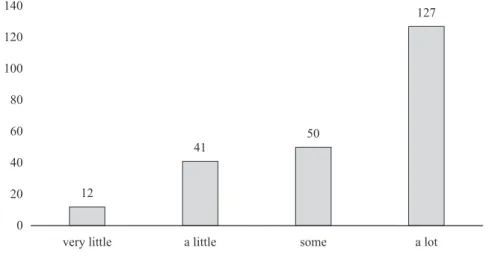
The first question deals with level of interest in study abroad and can be seen in Figure two. Overall there is a clear interest in study abroad activities in the faculty. Further examination of the results showed that for the first years 78% were above “some” and 59% stated that they were interested “a lot”
in overseas activities. That also matched the second years who recorded 80% at “some” and above. The third years had 6% of their group at “some” or above. Of the second years and above, the hospitality course had the largest percent of students choosing “a lot” at 52% of all the hospitality students.
This result is unsurprising because the Tourism Faculty by its very nature attracts students who are interested in study abroad. This is especially true for the hospitality course students who are often required to take international internships during their four years at university.
The next question looked at whether students actually had a tangible study abroad plan. In figure three, many students claim to actually have a plan to study abroad at 55%. In the first year that amounts to 76% actually having a plan. This answer may not underlie the complete picture as only a few people added the details of those plans in the corresponding free space. Answers recorded range from 12
instances of America (including the Pomona program), five for the Philippines and Ireland and three each for Australia and Cambodia, the last of which was clearly for one trip organized for a particular first year seminar class.
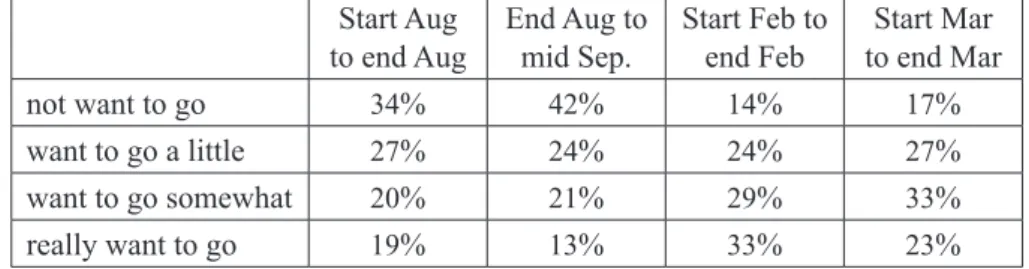
Table one shows what time of year students would like to take a short study abroad course. As can be seen, there is a large number that do not want to go in the summer vacation with more students preferring to study abroad in the spring vacation period.
In further analysis, it was revealed that of those selecting the “not want to go” and “want to go a little” at the start of August period, 61% were first years. For the end of August period, the same level of disagreement rose to 68% for 1st years, whereas for 2nd years it was 58%. For the early spring period,
62% of 1st and 64% of 2nd years indicated that they “want to go somewhat” or “really want to go.” The
last period, end of spring, showed a slighter lower percentage of above “want to go somewhat” for 1st
years at 56% and 51% for 2nd years. It is clear that spring courses are more preferable to the summer
short study abroad courses.
The next question looked at which time during the four years of university, students most wanted to go. Of the eight choices, counting a student first and second choice, the second year period was the most popular, with the spring period of the third year as the third most popular time for attending short study abroad programs.
In the free section after the above question (Ques 11), participants gave their reasons for choosing which time they preferred to do a short study abroad. Starting with the first year, many students (25) expressed that they did not want to do it in the first year because of taking tests. Along with having circle activities and wanting their own plan, taking tests was also a reason for not wanting to go in summer of either first or second year. Most first years preferred to go in the second year because they would be more confident in their English (17), were more used to university (11), and it would be before
job-Fig. 3. Level of agreement of actual plan fort study abroad (Ques. 4)
Table 1 breakdown of when students would like to do a short study abroad (Ques. 6-9)
Start Aug
to end Aug End Aug to mid Sep. Start Feb to end Feb to end Mar Start Mar
not want to go 34% 42% 14% 17%
want to go a little 27% 24% 24% 27% want to go somewhat 20% 21% 29% 33%
hunting starting in the third year (8). The second-year participants claimed that the third year would be better because it could help with their skills and confidence of doing job-hunting (5). On the other hand, the third years stated the end of the second year would have been better in order to have given more confidence for job-hunting (4). These results seem to point towards students being interested mainly in the spring vacation of the second year, before the third year and job-hunting starts in earnest. Summers are less preferable for short study abroad because of the students wanting to pursue qualifications, particularly those related to tourism.
Along with the Tourism Faculty, students can also choose from short programs on offer from the university-wide programs. If more students choose those programs, they will be less inclined to choose from Tourism Faculty courses. The next questions address the level of interest in the university-wide programs. Figure five indicated that a combined total of 47% agreed with either wanting to join
“somewhat” or “a lot.” However, of the available programs, only six students had actually joined a university-wide short program; those locations being in North America.
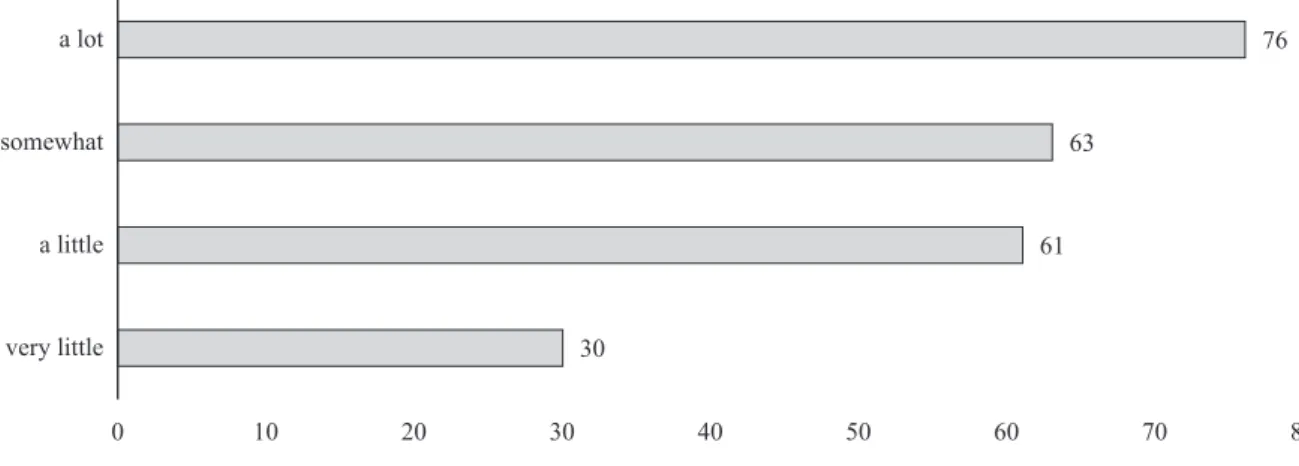
After looking at the university-wide programs, the next questions deal with the Tourism Faculty’s short programs. Figure six asks the level at which students want to take part in Tourism Faculty programs. Of those surveyed, 60% wanted to join a programs at or above the level of “somewhat,”
which is slightly higher than the amount for university-wide programs in the previous graph. Further analysis showed that when looking at times of year students wish to undertake short programs, students
Fig. 4. Preference of period for short study abroad (Ques. 10)
who had chosen both “really want to go” and want join tourism program “a lot” amounted to 78 people, a sizeable amount of students. It does appear, though, for this small population that the Tourism Faculty programs are more popular than the university-wide programs. Generally, the university-wide programs have more options, but tend to be at a higher price than the faculty programs. If the Tourism Faculty offers courses similar (in competition) to university-wide programs, it could be said that a large number of students from the Tourism Faculty would be interested in joining.
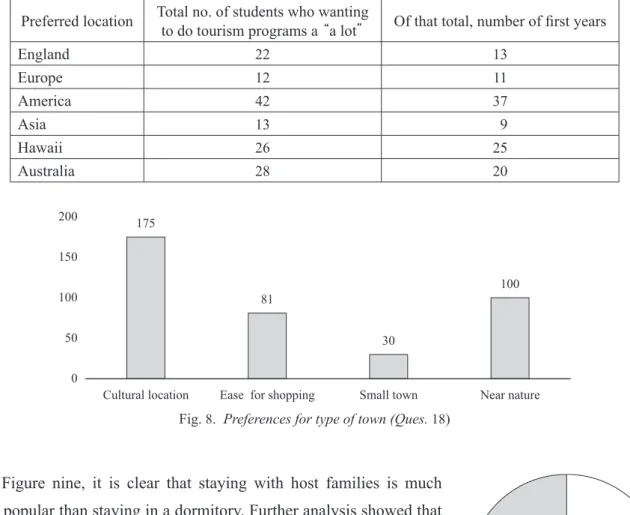
Staying with tourism programs, figure seven shows the locations students would like to visit for the short programs, with multiple answer possible. America was the most popular location, followed by Australia and England in third. The least popular choice was Asian locations. Students also indicated other locations, of which the most popular was Canada with 18 people interested and New Zealand behind that with five people interested in wanting to go there.
Additional inquiry into the data for this group analysis revealed a number of areas of interest among first years who signified that they were
“a lot” interested in joining a tourism program. Table two showed that
many first years are interested in America, and Hawaii, compared to other years, and the largest interest among first years who really want to do a short program is for America, Hawaii, Australia and England. Currently the American Tourism Faculty program in Pomona (California) is the most popular program, but there could still be a case for trying to relaunch the England program that failed to collect enough students this year.
In the next section, respondents answered questions about their preferences for conditions during a short study abroad course. Figure eight shows the students would prefer to stay in a cultural location; one with museums and other such facilities. Second most important is being located near nature, followed by ease of shopping. In a free space following that question, a few students also professed a wish for being near tourist spots and being in a safe location.
Fig. 6. How much do you want to join a tourism program (Ques. 15)
Fig. 7. which locations students
want to visit for short study abroad (Ques. 16)
In Figure nine, it is clear that staying with host families is much more popular than staying in a dormitory. Further analysis showed that the more students agree with wanting to join a tourism program, the higher number of students exist that prefer to stay in a homestay for the study abroad. This may be a slight problem in that currently the dormitory is the only accommodation available for both the England and American programs.
The next question deals with how students spend their time beyond actual study time during a short study abroad program. The most popular answer in figure ten was arranging one or two day excursions, and making the rest of the time free. Students did not want as much free time as possible, and at the end, they did not want a schedule that
left little space for free time. This answer seems to fit the general pattern of programs that the faculty currently offers.
Figure 11 looks at how students would like to spend their study time during the short study abroad program, with students choosing their top two preferences from among the six. By a long way, the students want to have classes concentrating on improving spoken ability. The next most popular answers show that students also want to study the four skills of English in unison, but have little interest in having lesson focusing mainly on reading and vocabulary. These results also seem to fit the general way that programs are currently organized.
Table 2 students who want to do a tourism programs in various locations
Preferred location Total no. of students who wanting to do tourism programs a “a lot” Of that total, number of first years
England 22 13 Europe 12 11 America 42 37 Asia 13 9 Hawaii 26 25 Australia 28 20
Fig. 8. Preferences for type of town (Ques. 18)
Fig. 9. Preferences for
accom-modation on study pro-gram(Ques. 20)
The next question looked at how students would prefer to receive information about study abroad programs. Figure 12, shows that overwhelmingly they prefer the Toynetace intranet system. However, the seminar teacher could also help in disseminating the information.
The following section of the survey focuses on one specific program in England. That program was new this year, but did not gather enough students, so it was deemed necessary to investigate further into some possible causes of this. Upon asking whether the participants had heard about the England
program during their orientation period before the semester started when such information was made available (Ques. 25), 51% said that they had, and 49% claimed they had not heard of it. Of the three years, almost all third year students said that had not heard about it, 60% of the second years made the same claim, compared to 30% of the first years who did not heard about the program during orientation.
Taking each question in turn in Table three, Ques. 26 asked if students wanted to go, but did not have enough information, for which 74% showed some kind of disagreement. The next item, Ques. 27, showed that 60% agreed that they wanted to go but felt their level was too low. The next item looked at wanting to go, but not having enough money, with the level of some kind of agreement being 70%. Ques. 29 asked if they did not choose to go because of a lack of interest in overseas activities for which,
Fig. 10. Preferences for free time/ schedule (Ques. 21)
Fig. 11. Preferences of how to spend study time (Ques. 22)
Fig. 12 How students want to get study abroad program info. (Ques. 23)
overwhelming, 93% disagreed in some form. The next item (Ques. 30) asked they if they did not want to go because they thought England was a little dangerous. It was found that 79% showed some sort of disagreement to this item. Lastly, in asking if they did not go because of a priority on getting qualifications, 58% had some kind of
agreement. After further analysis of this point, it was found that of those that agreed in some form to that item, 60% were first years and 65% were second years.
Generally, it could be said that students are not considering the England program because there is a perception that their level might not be high enough, and that they have little money for this kind of activity. Further, students wish to pursue qualifications in the summer, which is when the program was held (Ques. 10 & 11). Lastly, England may still be a viable destination for programs because it was not seen as dangerous, despite recent events in that country linked to terrorism.
The last section was an open question (Ques. 32), in which respondents could make any comments about study abroad they liked or felt relevant. There were some very enlightening comments made. These included study abroad Chinese students specifically asking for help with visa applications to certain countries that are easy for Japanese to visit. Other inquiries were from students who professed to have a lower level, but wanted to know how they could improve their current level of English in order to qualify for study abroad or even if there was any kind of bridge program that could satisfy the needs of students with that perceived lower English level.
Conclusion
Only 230 participants actually took part in this survey, and there were a small number of participants from the second and third year, so the results seem to be biased towards first years. Overall, there is a high interest in short-term study abroad programs and overseas activities in general within the faculty, which is an important factor towards building a more internationally aware student body.
The specific results shows that the summer is less popular with students than the spring vacation. Right now, the England program is in summer and it cannot be moved to the spring period. If the England program is to continue next year, there needs to be a large amount of marketing and other effort to have this program better known by students. The other result about timing of that program is in the second year; however, this is indicated by the first year participants. It appears when those first year students become second year students they may be less inclined to do study abroad, if they have not done it in the first year. All in all, it may not be a good idea to run the England program in the future.
A surprising result was that the faculty programs may have more appeal than the university-wide
Table 3 Reasons why people did not choose the England study abroad
program
disagree a
lot disagreemostly somewhatagree agree a lot
Ques. 26 52% 22% 20% 6% Ques. 27 29% 11% 21% 39% Ques. 28 22% 8% 21% 49% Ques. 29 86% 7% 5% 2% Ques. 30 63% 16% 17% 4% Ques. 31 30% 12% 20% 38%
programs. There are good and bad points of using the university-wide programs for the Tourism Facultys students. On the good side, it is a lot easier for the teachers who do not have to act as chaperones ’
on the programs and prepare activities both before and after the program. On the down side, students will not be able to take part in programs suited towards their major as those in the faculty provide. Right now the university-wide office has stopped a program in England. If it was decided to restart the England program, there would be less competition from the university-wide programs.
If there is a program that could meet the needs of many students in the faculty, it would be in Australia in spring, featuring communication skills and tourism study taking place in spring of the second year. There was such a program organized by the university as a whole, but the numbers have dwindled over the past few years. As it stands now, the American program could appeal to the first years, and a new program could appeal to second years. Whatever the decision, it is difficult to create / find a program that many students will like because of the individual preferences, needs involved in the decision making process, and finding the right timing of a program.
References
Arenson, K.W. (2003, November 17). Gains seen in short study-abroad trips. The New York Times. Retrieved July 1, 2010
from Lexis Nexis Online Database.
Baker, W. (2011). From cultural awareness to intercultural awareness: culture in ELT. ELT J, 66, 1, 62-70.
Bradford, A. (2015). Changing Trends in Japanese Students Studying Abroad. International Higher Education, 83, 22
-23. Available at https://ejournals.bc.edu/ojs/index.php/ihe/article/view/9086/8193
Robson, G. (2007). English language survey in Toyo Tourism Department. Journal of Tourism Studies, 6, 103-130. Robson, G. (2008). Needs analysis for communication classes at Toyo University. Journal of Tourism Studies, 7, 83-122. Smith, D. E. & Mitry, D.J. Benefits of study abroad and creating opportunities: The case for short-term programs.
Journal of Research in Innovative Teaching, 1, 236-246.
Yonezawa, A. (2009). The Internationalization of Japanese Higher Education: Policy Debates and Realities. Journal of High School Research, 9. Available at http://www.cshe.nagoya-u.ac.jp/publications/journal/no9/13.pdf#search=%27ja panese+government+universities+internationalization%27
Appendix A 短期留学についてのアンケート 1 年生 2 年生の皆さんのおかげで新学部が立ち上がり、これからますます観光学生のニーズに応 じて活動を進めたいと思います。そのため、今の観光学生に対して海外短期留学について聞きたい と思います。より良い学ぶ環境をつくるためアンケートの回答をよろしくお願いします ロブソン・グライアム 1 .学年 1 2 2 .2 年生の場合 : どのコースに所属している ツーリズム レジャー ホスピタリティ あまりない 結構あり 3 .海外活動に興味をどのぐらい持ちですか 1 2 3 4 4 .実際に海外に行くプランを立ていますか(ゼミ、ボランティアなど) あまりない 結構あり 1 2 3 4 5 .あればプランの詳細例えば、場所、いつ、どのくらい 海外短期留学プログラムに参加するにあたり、いつ行きたいですが 行きたくない・いけない 行きたい 6 .夏休みの上旬(8 月頭から 8 月末まで) 1 2 3 4 7 .夏休みの下旬(8 月末から 9 月中ほどまで) 1 2 3 4 8 .春休み最初のの上旬(2 月頭から 2 月末まで) 1 2 3 4 9 .夏休み最後の下旬(3 月頭から 3 月末まで) 1 2 3 4 10. もし海外短期留学プログラムに参加するとしたら、どのタイミングが一番望ましですか (自分に合う 2 か所) 1 年生 春 秋 2 年生 春 秋 3 年生 春 秋 4 年生 春 秋 11.上記の理由を明確にしてください
12. 東洋大学主催(観光学科のプログラムではなく国際センター)海外短期留学プログラムに参加 したいですか 参加したくない 参加したい 1 2 3 4 13.実際に東洋大学(国際センター)主催の海外短期留学プログラムに参加したことがある はい いえ 14.どこに行きましたか 15.これから観光学科・地域学科主催の海外短期留学プログラムに参加したいですか 参加したくない 参加したい 1 2 3 4 16.観光学部学海外短期留学プログラムに行きたいとすれば、どこが良い(自分に合う 2 か所) イギリス ヨーロッパ アメリカ アジア ハワイ オーストラリア 17.上記以外に特に短期留学で行きたい国があれば、記入してください 詳細 18. 観光学部海外短期留学プログラムに参加するとしたらどの町に行きたいですか (自分に合う 2 か所) 文化に触れあえる町(博物館・美術館がる) -買い物できる街 -小さい町(人口がつくない) -自然が近くにある町 19.その他 20.観光学部海外短期留学プログラムに参加するとしたら、どの様な宿泊施設に泊まりたいですか -ほかの日本人留学生と一緒に寮に泊まりす -ホストファミリーと一緒に家に泊まります
21.観光学部海外短期留学プログラムに参加するとしたらどのぐらいの自由行動をしたいですか -勉強以外に日帰り遊行を 1 回から 2 回お行いたい、あとは時間はほとんど自由です -勉強以外に、時間はほとんど自由です -勉強以外、プログラムの詳細がほとんど決まっています 22. 観光学部海外短期留学プログラムに参加するとしたらどのように時間を過ごしたいですか (自分に合う 2 か所) -英語学習-コミュニケーションを優先したい -英語学習-リディング・文法を優先したい -総合的に英語スキルを磨きたい -ほかの学部生と一緒に勉強したい -レベル別で勉強したい -できるだけエクスカーションを優先したい 23.観光学部海外短期留学プログラムについての情報はどのように伝えてほしいですか -東洋 HP - toyonetAce -ポスター(掲示板) -ゼミ指導教員 24.その他 25.オリエンテーション中に観光学部海外短期留学プログラムの説明を聞きましたか はい いえ 今年度のイギリスにあるプリマス大学のプログラムに参加したくない理由を教えてください そうではない 確かにそうです 26.行きたかったけれど情報がありませんでした 1 2 3 4 27.行きたかったけれど英語レベルが足りないと思いました 1 2 3 4 28.行きたかったけれどお金がありませんでした 1 2 3 4 29.海外活動に興味がありません 1 2 3 4 30.海外活動に興味がありません、イギリスは少し危ないと思いました 1 2 3 4 31.資格習得を優先したい 1 2 3 4 32.留学に関する上記に以外の希望・気になる点がありましたら、記入をお願いします