B21
Preliminary D4PDF project 100-member ensemble projection analysis over Japan
〇Temur KHUJANAZAROV, Yasuko OKADA, Shimura TOMOYA, Kenji TANAKA, Izuru TAKAYABU, Eiichi NAKAKITA
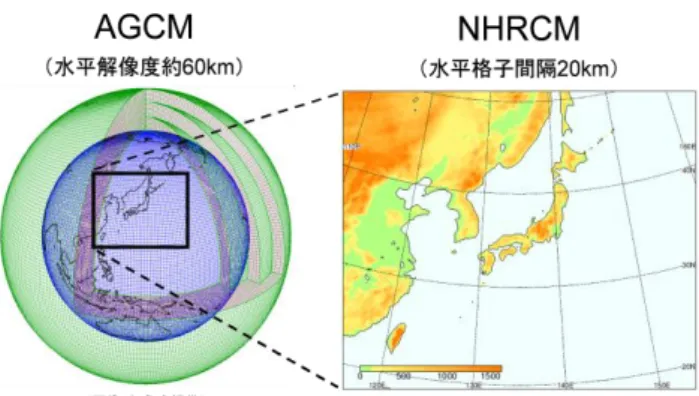
In effort to assess adaptation measures for the future climate impacts from the increased greenhouse gas outputs effects to the earth environment the database for Policy Decision making for Future climate change (d4PDF) was created. The project is developed under the Program for Risk Information on Climate Change (SOUSEI program) funded by the Ministry of Education, Culture, Sports, Science and Technology (MEXT). d4PDF database constitutes of more than 100 ensemble members of the simulation results of high resolution atmospheric model (GCM) with 60km resolution information, and a better 20km resolution results over Japan and surroundings (RCM) by Meteorological Research Institute (fig. 1). The database covers projections from 1950 to 2100, which enables various analysis of the past and virtual future climatic conditions over different scenarios. Large amount of ensemble members ensures better accuracy for the future change outcomes analysis.
The datasets primarily will be used to assess extreme events (typhoons, heavy rainfalls, droughts and others), for the impact assessment of the natural disasters and possible adaptation to foresee and plan protection measures for the future events. It will also provide necessary high resolution, statistically sound projections datasets for the impact assessment and adaptation measures under future scenarios included in the 5th Assessment Report of the Intergovernmental Panel on Climate Change (IPCC) for global warming over the climate around Japan at the end of the 21st century. In here scenarios from moderate (RCP 2.6) to extreme (RCP 8.5) are represented covering increase
of the average global surface temperature from 2°C to 4°C by year 2100 respectively (fig. 2). The data is targeted to be used by national and local governments, industry in the impact assessment of the global warming. However, it can also be used for many other goals. Such information can increase public discussion and awareness of the future climate and environment.
Fig. 1. Global and regional projections schemes
(Source: http://www.miroc-gcm.jp/)
Fig. 2. RCP scenarios presented in the d4PDF
database (Source: http://www.miroc-gcm.jp/)
Conducted overview covers ensemble members projection of climate change in Japan over 2050-2090 years. According to preliminary results precipitation will not increase significantly, although distribution and extreme events possibilities are increased. Several
research have already supported impact to the precipitation distribution and increased value of the heavy rainfall in all scenarios to almost 5% in future. According to the Ministry of Environment assessment of the data (http://www.env.go.jp/) average temperatures in Japan will increase for all scenarios, while winters will see larger differences compared to summers, non-precipitation days will be also increased from 11.5 to 13.9 days (fig. 3).
Fig. 3. Annual 10 year average temperature values;
top for 1960-1969 and down for 2090-2099.
In this research we would like to show preliminary results of the projections analysis of the temperature changes and rainfall over Japan and introduce d4PDF datasets usage and processing. This research has been supported by the SOUSEI project to recognize
importance of the climate change impact in future and provide additional information for the public.
Latest news and information of the d4PDF project and improvements in datasets can be found on the web-site http://www.miroc-gcm.jp/~pub/d4PDF. For datasets users can access d4PDF via the data server maintained by the Data Integration and Analysis System (DIAS) (http://www.diasjp.net/). Datasets are limited to non-commercial use and can be downloaded at no charge.