第 54 卷 第 5 期
2019 年 10 月
JOURNAL OF SOUTHWEST JIAOTONG UNIVERSITY
Vol.54 No.5
Oct. 2019
ISSN: 0258-2724 DOI:10.35741/issn.0258-2724.54.5.20
Research note
I
MPROVED
A
PPROACH FOR
I
DENTIFICATION OF
R
EAL AND
F
AKE
S
MILE USING
C
HAOS
T
HEORY AND
P
RINCIPAL
C
OMPONENT
A
NALYSIS
Hayder Ansaf
a, Hayder Najm
b, Jasim Mohammed Atiyah
c, Oday A. Hassen
d aImam Al-kadhum College (IKC), Computer Techniques Engineering Department,
[email protected]
b
Imam Al-kadhum College (IKC), Computer Techniques Engineering Department, Najaf, Iraq
[email protected]
cMinistry of Education. Slah AL Deen Education, Iraq.
[email protected]
d
University Technical Malaysia Melaka, Hang Taya, Melaka 76100, Malaysia,
[email protected]
Abstract
The smile detection approach is quite prominent with the face detection and thereby the enormous implementations are prevalent so that the higher degree of accuracy can be achieved. The face smile detection is widely associated to have the forensic of faces of human beings so that the future predictions can be done. In chaos theory, the main strategy is to have the cavernous analytics on the single change and then to predict the actual faces in the analysis. In addition, the integration of Principal Component Analysis (PCA) is integrated to have the predictions with more accuracy. This work proposes to use the analytics on the parallel integration of PCA and chaos theory to enable the face smile and fake identifications to be made possible. The projected work is analyzed using assorted parameters and it has been found that the deep learning integration approach for chaos and PCA is quite important and performance aware in the multiple parameters with the different datasets in evaluations.
Keywords: Chaos Theory, Face Smile Detection, Face Smile Predictions.
摘要 : 笑脸检测方法在面部检测中非常突出,因此存在大量的实现方式,因此可以实现更高的准确性。笑 脸检测与人们的脸部取证具有广泛的联系,因此可以进行将来的预测。在混沌理论中,主要策略是对单个 变化进行海绵状分析,然后预测分析中的实际面孔。此外,集成了主成分分析(PCA)可以更准确地进行 预测。这项工作建议使用对 PCA 和混沌理论的并行集成进行分析,以使笑容和假冒伪装成为可能。使用各 种参数对计划的工作进行了分析,结果发现,针对混沌和 PCA 的深度学习集成方法非常重要,并且在评估 中具有不同数据集的多个参数中,性能意识也很明显。 关键词: 关键词:混沌理论,笑脸检测,笑脸预测。
I.
I
NTRODUCTIONBiometric includes the analysis of the traits and features of a living creature whereby the
assorted key points can be trained and further analyzed. Face Recognition for Human Identification is a face recognition system in which the security experts input an image of the
person in question inside the system and the system will first preprocess the image which will cause unwanted elements such as noise to be removed from the image [1], [2]. After that, the system will then classify the image based on its landmarks for example, the distance between the eyes, the length of the jaw line, etc. Then, the system executes a search through the database to find its perfect match and display the output [3]. This work is focusing on implementing the system for criminal identification. Current practice of thumbprint identification which is simple and easy to be implemented can be a challenge by the use of latent thumbprint and sometimes cannot be acquired from the crime scene. The criminals have become cleverer and normally are very careful in leaving any thumbprint on the scene [4], [5].
This system encompassed face database and an image processing algorithm to match the face feed with faces stored in the database. There are two parts vital to the success of this system: detection and recognition [6], [7]. Face detection is one of the most important steps in a face recognition system and can be classified into four principle categories: knowledge based, feature invariant, template matching and appearance-based methods. In recognition, two stages are required: a training process and an evaluation process [8], [9]. In the training process, the algorithm is fed samples of the images to be learned and a distinct model for each image is determined while in the evaluation process, a model of a newly acquired test image is compared against all existing models in the database [10], [11]. Then the near corresponding model is acquired to determine whether the recognition is triggered. At this stage, a statistical procedure, the approach of simulated annealing is applied to a collection of face images to form a set of basis features, which is called a set of eigenfaces. Any human face can be considered to be a combination of these standard faces [12], [13].”
The performance of biometric system is evaluated from the following aspects: False match rate (FMR, also called FAR = False Accept Rate), False non-match rate (FNMR, also called FRR = False Reject Rate), Receiver operating characteristic or relative operating characteristic (ROC), Equal error rate or crossover error rate (EER or CER), Failure to enroll rate (FTE or FER), Failure to capture rate (FTC), Template capacity [14], [15]. Types of biometric evaluations include biological, morphological and behavioral ones. There is a specific set of features that must be present in the
biometric. Biometric Functions and Architecture include Verification, Identification, and Matching with Security and Accuracy, Feature Extraction, Training the Dataset, Decision Making Module, Predictive Mining Module and many others. The Advantages of a biometric system include identification accuracy, reduced administrative costs, convenience, accountability, difficulty to forge, return on investments, integration, effectiveness, security, scalability and profitability.
Face recognition refers to a process of identification of human face or faces similar to human face in a video or an image. Sometimes it is also referred to as the process of identifying images which are similar to each other, for example there is a database of 100 images of 10 individuals, each person can look up, down, sideways, can smile, can frown, etc. Thus, the designed system should be able to recognize a particular person having all the different expressions and also should be proficient in differentiating other person’s face. The face recognition technology has improved over the years but still there are some drawbacks. This work focuses on the integration of dynamic data and real time webcam based implementation for the Face Detection so that rich training of the model can be done with the higher degree of accuracy. The high level algorithm with the multilayered approaches for classification can be devised and implemented using big data based repository of the face images so that the multiple dimensions and features can be extracted with the deep evaluation and matching for higher degree of accuracy and predictions in minimum error factor [16], [17].
Face Detection is one of the key domains of research in digital image as well as real time video processing. In face analysis, there are assorted segments which are required to be investigated in terms of getting emotions and feelings of the person. These segments include lips, eyes, cheeks, ears, eye brows, nose and many others. Lips detection is used to analyze the emotions of the person in terms of sadness, happiness, frustrations and many others [18]-[25].
II.
T
HEA
IM OF THES
TUDYThe aim of this research is to present the PCA-based approach for the fake smile detection using chaos theory as the specialized computational methodology.
III.
C
HAOST
HEORY ANDP
RINCIPALC
OMPONENTA
NALYSIS(PCA)
FOR
S
MILED
ETECTIONChaos theory is based on the strategy that the single change in any system or phenomenon can modify the entire predictions. In case of face smile detection, chaos theory is quite important as the face smile is quite challenging to identify within the human traits [26], [27].
Figure 1. Fractals Analysis Patterns in Chaos Theory Figure 1 shows the fractal analysis patterns with the Chaos theory thereby the paradigm existence that even a single change in the system can modify the overall prediction. The fractal analysis is used to have the interiors and deep patterns of an object for further evaluations and predictive knowledge discovery.
Figure 2 depicts the pattern of human face and its relation to chaos theory which shows that a minor modification in the human face pattern can affect the future prediction patterns.
Figure 2. Face Features with Fractals Analysis in Chaos Theory
Figure 3. Golden Ratio Rule with the Chaos Theory.
The Golden Ratio rule and the Chaos-based
approach show patterns and demarcation
lines in the human face and the deep patterns
(Figure 3). Using this approach, the further
analytics is quite effective and performance
based.
IV.
R
ESEARCHM
ETHODOLOGY USINGD
EEPL
EARNING WITHC
HAOSAND
PCA
Chaos Theory with the Deep Learning is more accurate and performance aware flavor of machine learning in which the error rate is much less as compared to machine learning. Deep Learning is also known as Deep Structured Learning and Hierarchical Learning [28].
Figure 4 illustrates the approach of PCA-Based Integration with the dataset and makes it evident that the dataset is refined with the key features in the next stage so that cleaned and better implementation can be done with higher degree of accuracy.
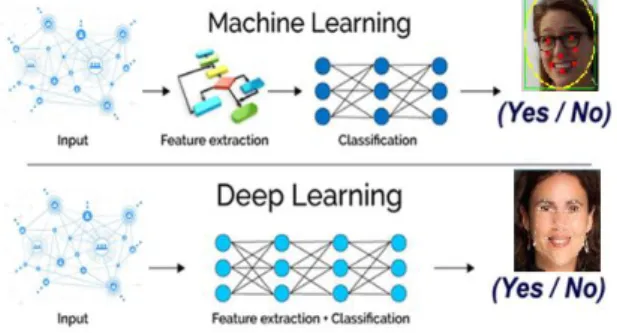
A data set is transformed and converted into a new data set containing linearly uncorrelated variables, known as Principal Components. With the integration of PCA and chaos theory with the association of deep learning, the higher degree of features can be evaluated [29]-[31]. Figure 5 explains the difference between machine learning and deep learning.
Figure 5. Difference between Machine Learning and Deep Learning
As shown in Figure 5, the process of feature extraction is separate from the input in case of machine learning. The researchers are required to work out and create separately feature extraction in case of machine learning using different mathematical formulations and scientific computations. The methods and approaches to feature extraction are integrated in case of deep learning, which makes the deep learning more accurate and smart.
Deep Learning libraries can be used for the research and development in assorted applications including criminal face detection, flying objects analysis, intrusion detection at international border, gesture recognition for criminal investigation, video forgery analysis, image tampering detection and many others in which the identification of specific patterns is required. Deep Learning libraries provide many models and approaches to prediction at the maximum accuracy level. Deep Learning and Transfer Functions in Keras include:
1. Activation Function or Transfer Function is used to determine the output of node
2. The output of neural network is determined like yes or no.
3. It maps the resulting values in between 0 to 1 or -1 to 1, etc. (depending upon the function).
4. Loss Functions
A loss function (or objective function, or optimization score function) is one of the two parameters required to compile a model:
fromkeras import losses
model.compile(loss='mean_squared_error', optimizer='sgd')
• for binary_crossentropy: sigmoid activation, scalar target
• for categorical_crossentropy: softmax activation, one-hot encoded target
• If it is a multiclass problem, use categorical_crossentropy.
5. Rectified Linear Unit (ReLU) is needed in Deep Convolutional Networks.
The sigmoid and hyperbolic tangent activation functions cannot be used in networks with many layers due to the Vanishing Gradient Problem. ReLU overcomes the vanishing gradient problem, allowing models to learn faster and perform better. ReLU is default activation when developing MLP and CNN. The model takes less time to train or run. Since ReLU is zero for all negative inputs, it is likely for any given unit to not activate it at all (For Missing Data or Data Sparsity). ReLU is h=max(0,a)h=max(0,a), where a=Wx+ba=Wx+b. Sparsity arises when a≤0. The downside for being zero for all negative values is a problem called “dying ReLU.” ReLU Neurons essentially die for all inputs and remain inactive no matter what input is supplied, here no gradient flows.
V.
B
ENCHMARKING OFF
EATUREP
OINTS FROMPCAP.
To work with any dataset in any domain, it is required to have the benchmark dataset and carry out rigorous testing and evaluation of the assorted iterative runs. The feature points of the datasets are taken with the focus towards the penetration level-based benchmarking using neurons-based training datasets.
VI.
R
ESULTS OF THEM
AINS
TAGESOF THE
P
ROPOSEDA
PPROACH.
1. Generate the Training Data and Read Input Image (I1).
a. Log the Intensity Values in Matrix Ai
2. Prepare the SMILE-based keys of human faces
3. Create and Maintain of INHERENT File for human face dimensions
4. Apply the chaos and PCA approach for a finite sequence of data points in terms of a sum of cosine methods oscillating at different frequencies.
a. Integration of the Limit b. Fitness Values
6. Implement SIFT (I1) =>Fetch FP1 (Key
Points).
a. Apply Real Time Keys from web cam b. Form Real Time Dataset in the back end database
7. Log the Key Points in Matrix Bi
Bi=FP[Ii]
a. Apply Deep Key Points
b. Carry out cavernous pixel intensity evaluation
8. Log the Pixel Position of Ai in a separate
Matrix Pi
a. Store Pixels with the Key Points b. Match the Intensity Level
9. Apply hash based limit technique on FPi
and log in the matrix Hi (Hidden Layer)
10. Carry out testing and analysis of the image for human face recognition
a. Copy/Move any block from Ii and
relocate to other position.
b. Identify the relocation of Pixel
11. Associate the new received image as Recognized or Not Recognized
12. Apply Steps 1(a), 2 … 10
13. Carry out empirical investigation of I1
with If in association with Matrix Hi to analyze
the multiple forgery
14. If (Status == 0) print and terminate with the message “Human Face Not Detected”.
Otherwise print and terminate with the message “Human Face Detected”
15. Apply algorithmic approach for Key Points Detection and Percentage
a. Prediction Outcome b. Percentage of Prediction
Figure 6 explains these results and outcome. Figure 6 shows the platform of Jupiter Notebook for the implementation of algorithm on the cloud based environment for face analytics. The source code is uploaded in the environment to extract the real time results and analytics.
Figure 6. Execution of Chaos on Cloud.
Figure 7 depicts the process of deep learning and training using Big Data and MapReduce-based technology which can improve the overall accuracy of the predictions.
Figure 7. Flow of Approach
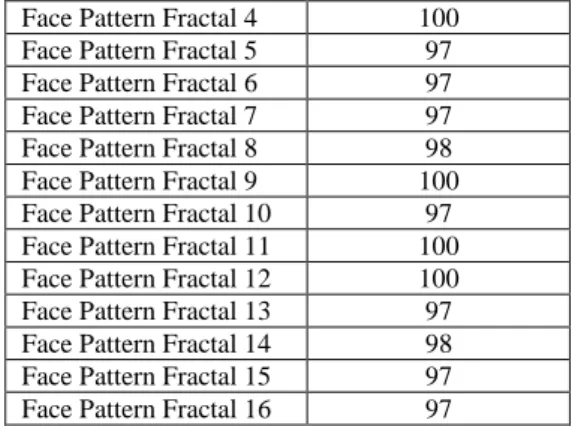
Table 1 shows the accuracy achieved by the proposed system.
Table 1.
Accuracy achieved by the proposed system.
Face Pattern Fractal Accuracy Achieved Face Pattern Fractal 1 97 Face Pattern Fractal 2 98 Face Pattern Fractal 3 98 Face Images from Angles
Feature Extraction
Face Texture, Marks and Lips
Map Reduce for Parallel Analytics Big Data Repository Maintenance Integration of Deep Training of Data Analytical Patterns from Face and Lips
Matching Similar Faces and Threshold Analysis Fetching Angle based Dynamic Expression s Logs Accuracy Predictions of Face Repository Acceptance Rate of the Results and Predictions Execute, Log Results of New Approach Forensic Evaluation of Big Data of Faces Logs Big Data Simileaity Uniqueness Accuracy Precession Time Energy
Face Pattern Fractal 4 100 Face Pattern Fractal 5 97 Face Pattern Fractal 6 97 Face Pattern Fractal 7 97 Face Pattern Fractal 8 98 Face Pattern Fractal 9 100 Face Pattern Fractal 10 97 Face Pattern Fractal 11 100 Face Pattern Fractal 12 100 Face Pattern Fractal 13 97 Face Pattern Fractal 14 98 Face Pattern Fractal 15 97 Face Pattern Fractal 16 97
Figure 8 demonstrates the outcomes of the projected approach with higher degree of accuracy which is consistent with the results and can be further used for the evaluation of the parameters.
Figure 8. Accuracy Evaluations
The value of loss is a scalar value that we attempt to minimize during our training of the model. The lower the loss, the closer our predictions are to the true labels. Both loss and val_loss should be decreased and Accuracy (acc and val_acc) should be increased. The value of acc is the accuracy of training set; val_acc is the measure of how good the predictions of your model are. Training loss is the average of the losses over each batch of training data.
The results presented in this research work have enormous parameters including the reduced
error factor and higher degree of accuracy. The presented results are quite accuracy aware with the use of Principal Component Analysis (PCA) that is one of the high performance approaches. The patterns from the datasets including the face analytics are used for the higher degree of performance for the face smile detection.
VII.
C
ONCLUSIONFace Smile Detection is one of the key areas of research and the methodology of smile detection is very prominent with face recognition; and in this manner the huge executions are predominant so the higher level of precision can be accomplished. Face smile identification is generally related to the measurable data of individuals’ faces with the goal that the future expectations should be possible. In mayhem hypothesis, the primary system is to have the huge examination on the single change and after that to anticipate the real faces in the analysis. Furthermore, the reconciliation of Principal Component Analysis (PCA) is coordinated to have the forecasts with more precision and expectations. This work has the examination on the parallel coordination of PCA and chaos hypothesis with the goal that the face smile and phony recognizable pieces of proof should be possible. The anticipated work is broken down onto grouped parameters and it was found that the profound learning combination approach for disorder and PCA is very significant and execution mindful in various parameters with the distinctive datasets in assessments.