College Students’ Opinions of Proofreading
Marks in English Composition Classes
1.Introduction
This paper examines the results of a survey about students opinions of the specific proofreading marks used for corrective feedback in English composition classes in the English Department of Hokusei Gakuen University, Sapporo. At this university, students are required to take two years of English composition classes. Each class meets once a week for 90 minutes, with a total of 30 classes in the academic year(two 15-week semesters).In both years, the students are divided randomly into fi ve classes with approximately 25 students in each class. The classes are taught in computer labs, and students write all assignments on a computer. All students use the same textbook, one textbook in the fi rst year and a diff erent textbook
College Students Opinions of Proofreading Marks in
English Composition Classes
Peter G
RAY Contents 1.Introduction 2.Method 2.1 Participants 2.2 Procedure3.Results and Discussion of Part A
4.Results and Discussion of Part C
5.Results and Discussion of Part B 5.1 Question 1 5.2 Question 2 6.Conclusion Appendix 1 Appendix 2 [Abstract]
A survey given to 205 university students majoring in English and enrolled in required English composition classes shows four main results.(a)Students find the proofreading marks used at the university easy to understand.(b)Students opinions of the proofreading marks change very little throughout their two years of study.(c)For a variety of reasons, most students desire comprehensive teacher corrective feedback.(d)Students are aware of many resources that they can use to learn on their own, but it is unclear how often or how well students actually use those resources. Being aware of student opinions about corrective feedback can help composition teachers use it more eff ectively.
of the second semester, they write one short essay. In second-year classes, students write academic essays, usually four to five paragraphs in length, and learn basic research and documentation practices. Both fi rst and second-year classes focus on academic writing, and the students learn various rhetorical modes such as defi nition, narrative, comparison-contrast, cause-eff ect, and opinion.
The composition teachers are given a general set of guidelines concerning class goals, homework assignments, and classroom procedures; however, each teacher decides the order and pace at which his class will use the textbook and also decides the specific topics of homework assignments. Two procedures that all the composition teachers follow are(1)to have students submit writing assignments twice, fi rst as a rough draft, on which the teacher provides corrective feedback, and then as a fi nal copy, and(2)to use a set of standardized proofreading marks when giving corrective feedback. The same standardized proofreading marks are used in all fi rst and second-year classes.
The 15 simple proofreading marks(Appendix 1)were devised by the composition staff specifi cally for the students at this university. Five of the marks allow the teachers to directly correct a mistake, and these are used when the teachers feel that a mistake is too diffi cult for students to correct on their own. The other ten marks point out a mistake and give a hint about how the mistake should be corrected. Students must then think of the correct answer on their own. In addition to using these standardized proofreading marks, teachers also write general comments about content and organization on students rough drafts.
A survey(Appendix 2)was given to all fi rst and second-year composition students in order to investigate three things.(a)How easy do the students fi nd the proofreading marks to understand?(b)Do students opinions of the proofreading marks change from their fi rst to second year?(c)What are the students opinions of teacher corrective feedback in general?
2.Method
2.1 ParticipantsThe survey was answered by fi rst and second-year English Department students who were enrolled in required composition classes. All of the students were Japanese nationals who attended local Japanese schools from elementary through high school before entering university, although a small percentage of them had lived abroad in an English speaking country from six months to one year before entering university. Approximately 84% of the students were female and 16% were male.
2.2 Procedure
The survey was given to the students in January 2013, near the end of the 2012 academic year. Students were given 15 minutes in class to complete the survey. A total of 205 students (109 fi rst-year; 96 second-year)did the survey, although a few of them did not answer all the questions. The number of students who did the survey was less than the total enrollment because some students were absent on the day that the survey was given.
3.Results and Discussion of Part A
In Part A of the survey, students were asked to rate nine proofreading marks using a fi ve-point Likert Scale from Easy to Understand (1)to Hard to Understand (5).Table 1 shows the proofreading marks in the order that students rated them from easiest to hardest to understand, describes the type of mistake that each mark is used for, gives the number on which it appeared on the survey, and shows the average score given to that mark by all students.
Table 1 Rating of Proofreading Marks from Easiest to Hardest
Order Type of Mistake(No. on Survey) Average Score 1 Capitalization(1) 1.28 2 Spacing(2) 1.42 3 Missing Word(7) 1.63 4 Spelling(4) 1.71 5 Grammar(5) 1.76 6 Word Order(9) 1.81 7 Punctuation(3) 1.83 8 Garbled Sentence(8) 2.39 9 Word Choice(6) 2.49
Generally, the students rated the proofreading marks as easy to understand. Seven of the marks were given a score between 1 and 2, and the most diffi cult one received the score of 2.49. There was only a .55 point spread in the diffi culty of the seven marks which students rated as the easiest to understand, but a .56 point jump between those marks and the last two marks. One possible reason for this diff erence is that both No. 8(garbled sentence)and No. 6(word choice)mark mistakes in which students have written something that they think is correct but which they must completely rewrite, requiring students to think again from scratch rather than simply changing a word or phrase that is partially correct.
Figure 1 compares how first and second-year students rated these nine proofreading marks and also shows the average score of all students. Students in both years rated the marks similarly with only small differences between the two years. Second-year students rated all the marks as somewhat easier to understand than the fi rst-year students with the exceptions of No. 2 (spacing) and No. 7 (missing word), which fi rst-year students rated as slightly easier.
Figure 1
These results suggest three things. (a) The students quickly learn the proofreading marks in their first year, and they find these marks generally easy to understand. (b) The students opinion of the proofreading marks changes very little during their two years of taking composition classes. These two results confirm the general experience of the composition teachers, who find that the proofreading marks are easy to teach to first-year students, and that using standardized marks for both first-years eliminates confusion when students have a different teacher in their second year. (c) Students find some of the proofreading marks more difficult to understand than others. Being aware of which proofreading marks the students fi nd more diffi cult to understand should help the teachers use these marks more eff ectively.
4.Results and Discussion of Part C
Part C of the survey was designed to see if there was a correlation between how easy to understand the students rated the marks and how well students could actually make corrections using the marks, so this part will be discussed before Part B. The students were asked to correct a paragraph in which mistakes were marked with eight of the nine proofreading marks in Part A. Proofreading mark No. 8 (garbled sentence) was not included because it was thought to be too unnatural for students to correct. Generally, students write a
garbled sentence when they know what they want to say in Japanese but can t express their idea in English due to lack of vocabulary or weak syntactical knowledge. Asking students to guess the meaning of a garbled sentence written by someone else seemed too diffi cult a task to be a useful question. There were 15 mistakes in the paragraph in Part C, and the mistakes corresponded to the proofreading marks in Part A as shown in Table 2.
Table 2 Correspondence between Part A Marks and Part C Mistakes
Part A Marks Part C Mistakes 1. Capitalization 1, 8 2. Spacing 4 3. Punctuation 9, 15 4. Spelling 2, 6 5. Grammar 3, 11 6. Word Choice 7, 12, 14 7. Missing Word 5, 13 8. Garbled Sentence Not used 9. Word Order 10
Part C was graded and then the percentage of times students could not correct the indicated mistakes was calculated. Figure 2 shows the results of fi rst and second-year students and the average of all students.
Somewhat surprisingly, the first-year students corrected the mistakes better than the second-year students for all eight marks that were tested. It had been expected that just as the second-year students had rated the proofreading marks as slightly easier to understand in Part A, they would be able to make more corrections in Part C. Why did this happen? Perhaps the fi rst-year students were just better. Perhaps the second-year students didn t take the survey as seriously as the fi rst-year students and made more careless mistakes. Perhaps some other dynamics were at play. To know if these results were an anomaly or a consistent pattern, this questionnaire would have to be given over the course of several years.
Table 3 compares student opinions of the proofreading marks in Part A, from easiest to understand (1) to most diffi cult (9), and their ability to correct mistakes that were indicated with the same marks in Part C, from most correct (1) to least correct (8). There was a high degree of correspondence between the students opinion of a mark and their ability to use the mark to make corrections. The two largest diff erences were with No. 4 (spelling), which the students rated as easier to understand but had trouble correcting, and No. 9 (word order), which the students rated as more diffi cult to understand but corrected fairly well.
Table 3 Comparison of Part A Rating and Part C Corrections
Proofreading Mark Part A Rating Part C Corrections
1. Capitalization 1 1 2. Spacing 2 2 3. Punctuation 7 6 4. Spelling 4 7 5. Grammar 5 5 6. Word Choice 9 8 7. Missing Word 3 3
8. Garbled Sentence Not used
9. Word Order 6 4
The students found question 7 in Part C the most diffi cult. It was a wrong word question in which they had to correct the clause but many people also see a special church service. Most students wrote a variant of see such as watch or look rather than a correct verb such as go to or attend. This question may have been particularly diffi cult because go to church is not a culture specifi c idea for Japanese students, even though it is a common phrase in most English speaking countries. Although this one question may have skewed the results a bit, according to this survey, and according to the teachers general experience in grading papers, wrong word is consistently one of the hardest types of mistakes for students to correct. This would suggest that lack of vocabulary is one of the biggest weaknesses that Japanese students have as writers.
Part C of the questionnaire was too limited a sample to determine with full accuracy which types of mistakes students fi nd the most diffi cult to correct, though the results mirrored the general experience of the teachers. A more accurate method would be to compare the
rough drafts and final copies that students submit throughout a given period of time and tabulate the mistakes students are able to correct.
5.Results and Discussion of Part B
Part B of the survey had three questions that were intended to ask students to look beyond the proofreading marks and think about teacher correction and learning to write in general. Because Question 3 does not apply directly to teacher correction, those results are not discussed in this paper.
5.1 Question 1
In Question 1, the students circled a percentage to indicate how much teacher correction they wanted, and then they wrote free answers to explain their choice. The average amount of correction desired by all students in each year diff ered by only one point: 83% for fi rst-year students and 84% for second-rst-year students; however, there was great variety between individual students.
The results indicate that these students want and expect teachers to correct most of the mistakes in their writing. It is diffi cult to know how much of this attitude is formed before students enter university and now much of it is formed due to the way university composition classes are taught. However, for teachers, several issues seem relevant. If students want a lot of correction, what is the best way to give them corrective feedback that actually helps them improve their writing? And closely related to this, how quickly can students be expected to internalize and correctly use the knowledge gained from corrective feedback? How much do teachers want students to rely on teacher correction? If teachers want students to rely less on teacher correction, how can that attitude be fostered, and how can students learn to use the necessary tools to be become more autonomous learners?
Table 4 shows the results of the students free answers to Question 1. The answers have been paraphrased and grouped together in similar ideas, and the number of fi rst and second-year students that wrote each idea is indicated. Some students wrote more than one idea, and some students didn t write a reason for their choice. This rather long list shows the variety of opinions that students have about the process of learning to write in English.
Table 4 Students Answers to Part B, Question 1
Students who want 100% correction (52% of all students)
Answers Year 1 Year 2
I want to write correctly/perfectly. 18 15 I can t fi nd all mistakes by myself. 15 12 It helps me. I learn from my mistakes. 4 9 I want to study hard/improve. 4 8 I don t want to remember mistakes. 3 2 Correction by native speaker is best. 2 1 Teachers correct mistakes clearly. 1 1 Teachers should correct mistakes. 1 1 Students who want 80% correction (27% of all students)
Answers Year 1 Year 2
I should learn to correct (some) by myself. 8 12 I can t fi nd all mistakes by myself. 4 7 I want to write correctly/perfectly. 5 2 I want to improve my writing. 3 2 Too much correction hurts my confi dence. 2 1 Think by myself. Teacher isn t always correct. 0 3 I don t want to remember mistakes. 2 1 It helps me. I learn from my mistakes. 0 2 Correcting everything is hard for teachers. 1 0 Students who want 60% correction (11% of all students)
Answers Year 1 Year 2
I should learn to correct (some) by myself. 3 7 I can t fi nd all mistakes by myself. 3 3 I want to learn from my mistakes. 1 1 Teacher corrections don t help students. 1 1 Too much correction hurts my confi dence. 1 1 Students who want 40% correction (7% of all students)
Answers Year 1 Year 2
I should learn to correct by myself. 5 5 I can t fi nd all mistakes by myself. 1 1 I want to learn from my mistakes. 1 0
I m not good at grammar. 1 0
Students who want 20% or 0% correction (3% of all students)
Answers Year 1 Year 2
I should learn to correct by myself. 3 2
Just over half (52%) of the students said they want their teacher to correct 100% of their mistakes. The reasons students listed for this opinion fall into three basic categories. First, students have a desire to improve their writing ability, with many of them describing their ultimate goal as becoming correct or perfect. This opinion presents a delicate problem for teachers. How can teachers harness students enthusiasm for learning while at the same time helping them set realistic goals for their two years of university composition classes?
Perfection is impossible; noticeable improvement is the goal.
The second most mentioned reason for desiring 100% correction was the feeling that without a teacher s help students cannot find or correct many of their writing errors. This reason seems to be a realistic assessment of their own ability, and it points out the responsibility that teachers have to intelligently use corrective feedback in such a way as to help students improve their writing skills.
The final main reason students listed for wanting 100% correction was the belief that making mistakes is like coming to a fork in the road of learning. Going down one path, students can learn from their mistakes and improve. Going down the other path, students will memorize mistakes and eventually fossilize them. Although this belief does not take into consideration the amount of time and repetition often necessary for ESL learners to internalize new language, it is how many Japanese ESL students seem to approach learning English. The next group of students (27%) said that they wanted the teacher to correct about 80% of their mistakes. Interestingly, the most common reason listed for this was that they wanted to learn to correct some mistakes on their own. This reason was not written by any of the students who wanted 100% correction, but it was the most common reason listed by the students who desired from 80% to 0% correction. This seems to indicate that many students are open to the idea of learner autonomy and see it as an educational goal.
The other reasons listed by students who desired 80% correction mirrored the reasons listed by the students who wanted 100% correction: the desire to write correctly, the realization that the teacher can help them, and the opinion that mistakes can lead to either improvement or fossilization of problems. One new idea in this group was that students said they might be discouraged by seeing too many corrections.
A total of 20% of the students said that they wanted from 60% to 0% correction. Their answers were similar to those of the students who choose 80%. Perhaps they wanted less correction because they had a stronger desire to be able to learn on their own.
5.2 Question 2
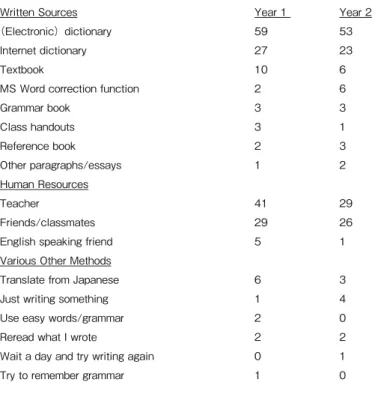
Table 5 shows the students free answers to the question, If you are not sure how to write something correctly, how do you try to find the correct way to write it? Students could write more than one answer, and a total of 200 students wrote 357 ideas. The variety of answers on this list shows that students are aware of many methods for learning on their own. After the answers were tallied, they were divided into three groups: (a) written resources, (b) human resources, and (c) various other methods; and the number of students who wrote each answer is indicated.
Table 5 Answers to Part B, Question 2
Written Sources Year 1 Year 2
(Electronic)dictionary 59 53
Internet dictionary 27 23
Textbook 10 6
MS Word correction function 2 6
Grammar book 3 3 Class handouts 3 1 Reference book 2 3 Other paragraphs/essays 1 2 Human Resources Teacher 41 29 Friends/classmates 29 26
English speaking friend 5 1
Various Other Methods
Translate from Japanese 6 3
Just writing something 1 4
Use easy words/grammar 2 0
Reread what I wrote 2 2
Wait a day and try writing again 0 1
Try to remember grammar 1 0
In the fi rst group of answers, most students wrote dictionary, but it can be assumed they meant electronic dictionary because nearly all of the students at this university have an electronic dictionary. Students are also aware of and have access to many Internet dictionaries and translation sites (specifi c ones mentioned include Aruku, Lang-8, Eijiro, and ALC), but they may not be utilizing them eff ectively. A fair number of students also listed textbooks as a resource, but although the two composition textbooks used at this university are good sources of information about paragraph/essay structure and the writing process, they offer only limited help for grammar and vocabulary problems.
In the second group of answers, the teacher was the person most students said they turned to for help. Friends and classmates were a close second to teachers, and this seems to indicate that students are willing to ask each other for help. This suggests that well designed small group activities and peer feedback sessions could be an integral part of composition classes.
The opinions expressed by the students in their answers to Part B, Questions 1 and 2, suggest several general types of educational activities concerning corrective feedback that might be useful in composition classes. (a) Doing some type of survey or brainstorming activity which asks students how much correction they want, and then discussing this issue in class, might heighten students awareness of the possibilities and the limitations of teacher corrective feedback. (b) Using class time to introduce, explain, and let students practice using various on-line resources could be effective in fostering learner independence. Just telling students that certain resources are available is not eff ective; students can benefi t most from
guided practice in using each resource. (c) Actively incorporating peer feedback activities into classes could also help develop student autonomy.
6.Conclusion
A survey such as this serves two purposes. (a) The teachers at the university where the survey was given receive valuable, detailed information about the methods they are using from the students they are teaching. (b) Other teachers can compare the educational system and the student opinions described in this paper with their own classroom situations and students, perhaps fi nding useful ideas that either confi rm their educational methods or help them to devise alternative methods.
For the composition teachers at this university, the results of Part A of the survey confirm their general impression that the standardized proofreading marks, which they devised specifically for these students, are an easy-to-understand and appropriate tool for the students. Part C of the survey illustrates the well-known fact that students are not able to correct all mistakes even if the mistakes are clearly pointed out. Also, the surprising result that first-year students corrected mistakes better than second-year students makes the teachers wonder which factors besides the use of these proofreading marks may have contributed to these results. The students answers to Part C give the teachers a clear idea of why these students generally want extensive corrective feedback, and they provide detailed information that might help the teachers devise other educational activities that will foster student autonomy. For teachers of diff erent students in other educational situations, it is hoped that certain details in the results of this survey will provide them with ideas that help them remain innovative in their teaching and open to the opinions of their students.