認知負荷軽減を指向した再構成型概念マップにおける⾃動レイアウ
トと記憶保持におけるトレードオフ
Automatic Layout in Closed Concept Map for Cognitive Load
Reduction and The Trade-off in Memory Retention
Pedro Gabriel Fonteles Furtado¹
*平島宗
¹
林雄介
¹
Pedro Gabriel Fonteles Furtado¹
Tsukasa Hirashima¹
Yusuke Hayashi¹
¹
広島⼤学
¹ Hiroshima university
Abstract: Concept maps construction has been used to improve reading comprehension. One specific type of concept map made possibly by software use are closed concept maps. When building closed concept maps, users build the maps from a given set of pieces. However, the large number of pieces can overwhelm the working memory of the users, who also have to manage the layout of the maps. This work proposes Airmap, a closed concept map interface that attempts to solve these problems by adding an automatic layout function to closed concept map construction. Past experiment results are summarized.
1 Introduction
Comprehending information is important when reading for learning. It is a process of connecting the information presented in the text to prior knowledge. When education moves on to comprehension-related skills instead of earlier reading skills like word recognition, some students start falling behind[1, 2]. This problem happens more often in readers from low-income families[3]. Concept maps have been successful in improving reading [4, 5, 6, 7, 8]. A concept map is a graphical tool used to represent knowledge. It is composed of concepts and of links between the concepts. One explanation of how concept maps help comprehension is the idea that they provide a template, which helps organizing and structuring information[9]. Another explanation is that graphical structures, like a concept map, are closer to the macrostructure of a text, which makes it easier to understand[10]. Furthermore, building the map allows students to continuously process the
*連絡先:広島⼤学⼯学部情報⼯学科
〒 739-0046 広島県東広島市
E-mail: [email protected]
concepts [11].
Another point of concern when learning from read-ing is retention. Information not only has to be com-prehended, it also has to be retained so that students can use it later. Concept map use has also been said to improve retention, with mechanisms similar to how it aids in comprehension, such as aiding in knowledge or-ganization and continuous processing[9, 11, 10]. One study found that fifth-grade students who created a concept map had higher post-test scores after a two-week retention period[12]. Another study, also fea-turing fifth graders, found that students who used a concept map to visualize an electronic portfolio out-performed students who visualized the same portfolio through a tree structure after a three-day retention period[13]. A meta-analysis of studies using concept maps reported that concept maps were effective for both retention and transfer[14]. This holds true for both studying through map construction and through map visualization.
Computer-based tools have been used in previous research [15, 16, 17]. Normally, in concept mapping, students have to create and label the concepts and links by themselves. However, some of these tools ask students to assemble the map from pre-generated and
人工知能学会研究会資料 SIG-ALST-B901-14
pre-labeled concepts and links instead[18, 19]. These maps are called closed concept maps because the set of maps that can be created is finite.
The map building process for closed concept maps can create a situation where the student is overwhelmed by the amount of information provided on the screen. In this situation, the student has to understand, organize, and connect the links and nodes that somebody else defined. This can put a heavy load in the working memory of the student. This load is called the cognitive load. Different learning activities impact cognitive load differently, which in turn impact learning performance[20].
It is possible to reduce cognitive load by changing the design of the tool[21]. Changing how information is organized in the screen or automatizing parts of the activity are examples of design changes that can im-pact cognitive load. Also, comparing different inter-faces which incur different types of cognitive load has the potential to reveal information about how exactly the activity affects learning. No study so far, to the best of our knowledge, has attempted to reduce the cognitive load in concept map building interfaces and measure how it affects different aspects of learning, despite the potential for optimizing the map building process and for revealing new aspects of learning from concept maps.
This work describes Airmap, an interface for build-ing concept maps from pre-existbuild-ing parts focused on reducing cognitive load. Airmap employs a combina-tion of automated layout and informacombina-tion separacombina-tion. The work also describes past results of experiments involving Airmap. This is an ongoing effort on ex-ploring different closed concept map interfaces and how they affect learning[22].
2
Methodology
In this section Airmap will be introduced, alongside how it attempts to reduce cognitive load.
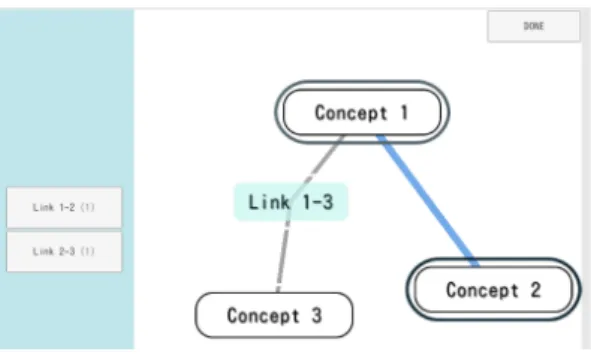
The interface of Airmap can be seen in Figure 1. On the right side of the screen, Concept 1, Concept 2 and Concept 3 are the nodes of the concept map. Users can select nodes, which will have frames around them. In the figure, Concept 1 and Concept 2 are selected. Furthermore, when two concepts are selected, they
図1 The interface of Airmap
become connected by a thick line. The user can then choose a link to connect those two nodes. The user chooses links from the link menu positioned in the left side of the screen. In the figure, Concept 1 and Concept 3 are already connected by link ”Link 1-3”.
When users wish to disconnect two nodes they can do so by clicking on the link that connects them. This erases the link and returns the nodes to their previous unconnected state. The user is then free to reuse that link label to connect other nodes.
Unlike other concept map building tools, the user is not burdened with managing the layout of the concept map. In fact, in Airmap the user cannot manage the layout. The algorithm used to handle the layout is a type of force-directed graph drawing algorithm[23]. The implementation used can be found in [24].
3
Comparative Analysis with
Kit-Build Concept Map
Experiments have been done comparing Kit-build to Airmap[22]. Kit-build is a closed concept map in-terface where the students have to manage the layout of the map[25, 18]. The experiments measured cog-nitive load metrics and reading comprehension met-rics. Results showed that Airmap has significantly lower cognitive load than Kit-build. Furthermore, re-sults show that Airmap is not significantly different than Kit-build in immediate reading comprehension. However, Kit-build outperforms Airmap after a two-week retention period. Results suggest that the cog-nitive load reduced is useful for improving retention of knowledge. As such, Airmap may be better suited for understanding a subject, while Kit-build is more useful for commiting information to memory.
4
Conclusion
Concept maps and closed concept maps are effec-tive learning methods. However, closed concept map construction can overwhelm the working memory of students. This work proposes Airmap, an interface which uses automated layout and information sepa-ration to lower the cognitive load when building the maps. The automated layout uses a physics based al-gorithm to automatically organize the concepts and links.
Results obtained in past experiments suggest that Airmap is successful in reducing cognitive load. It also suggests that Airmap is useful for comprehending in-formation but not to enhance retention. Currently, an analysis of what type of information and learning context benefit most from the use of Airmap is being performed. Furthermore, the process of map building is being used to further examine learning gains. That is, intermediary artifacts created during the building process are being used to explain the learning mechan-ics from map building. These analyses have the po-tential to improve learning from closed concept maps in the future.
5
Acknowledgments
This work was partially supported by JSPS KAK-ENHI Grant Number 17H01839 and 19H04227.
参考⽂献
[1] E. D. Hirsch, “Reading comprehension requires knowledge̶of words and the world,” American
Educator, vol. 27, no. 1, pp. 10–13, 2003.
[2] B. Moss, “Making a case and a place for effec-tive content area literacy instruction in the ele-mentary grades,” The Reading Teacher, vol. 59, no. 1, pp. 46–55, 2005.
[3] J. S. Chall and V. A. Jacobs, “Writing and read-ing in the elementary grades: Developmental trends among low ses children,” Language arts, vol. 60, no. 5, pp. 617–626, 1983.
[4] B. Usman, R. Mardatija, and S. S. Fitriani, “Us-ing concept mapp“Us-ing to improve read“Us-ing com-prehension,” English Education Journal, vol. 8,
no. 3, pp. 292–307, 2017.
[5] Z. Riahi and N. Pourdana, “Effective reading comprehension in efl contexts: Individual and collaborative concept mapping strategies,”
Ad-vances in Language and Literary Studies, vol. 8,
no. 1, pp. 51–59, 2017.
[6] K.-E. Chang, Y.-T. Sung, and I.-D. Chen, “The effect of concept mapping to enhance text com-prehension and summarization,” The Journal of
Experimental Education, vol. 71, no. 1, pp. 5–23,
2002.
[7] J. Sánchez, A. Cañas, and J. Novak, “Concept map: a strategy for enhancing reading compre-hension in english as l2,” CMC 2010, p. 29, 2010. [8] E. F. Guastello, T. M. Beasley, and R. C. Sina-tra, “Concept mapping effects on science content comprehension of low-achieving inner-city sev-enth graders,” Remedial and special education, vol. 21, no. 6, pp. 356–364, 2000.
[9] A. J. Cañas and J. D. Novak, “The theory un-derlying concept maps and how to construct and use them,” Práxis Educativa, vol. 5, no. 1, pp. 9–29, 2010.
[10] T. A. Van Dijk, W. Kintsch, and T. A. Van Dijk,
Strategies of discourse comprehension. Academic
Press New York, 1983.
[11] B. B. Armbruster and T. H. Anderson, “Map-ping: Representing informative text diagram-matically,” in Spatial learning strategies. El-sevier, 1984, pp. 189–209.
[12] P. Kim and C. Olaciregui, “The effects of a con-cept map-based information display in an elec-tronic portfolio system on information processing and retention in a fifth-grade science class cover-ing the earth’s atmosphere,” British Journal of
Educational Technology, vol. 39, no. 4, pp. 700–
714, 2008.
[13] M. Willerman and R. A. Mac Harg, “The con-cept map as an advance organizer,” Journal of
research in science teaching, vol. 28, no. 8, pp.
705–711, 1991.
[14] J. C. Nesbit and O. O. Adesope, “Learning with concept and knowledge maps: A meta-analysis,”
Review of educational research, vol. 76, no. 3, pp.
413–448, 2006.
[15] P.-L. Liu, C.-J. Chen, and Y.-J. Chang, “Effects
of a computer-assisted concept mapping learn-ing strategy on efl college studentsʼenglish read-ing comprehension,” Computers & Education, vol. 54, no. 2, pp. 436–445, 2010.
[16] W. Reader and N. Hammond, “Computer-based tools to support learning from hypertext: con-cept mapping tools and beyond,” in Computer
Assisted Learning: Selected Contributions from the CAL’93 Symposium. Elsevier, 1994, pp. 99–
106.
[17] L. Anderson-Inman and L. Zeitz, “Computer-based concept mapping: Active studying for ac-tive learners,” The computing teacher, vol. 21, no. 1, 1993.
[18] T. Hirashima, K. Yamasaki, H. Fukuda, and H. Funaoi, “Kit-build concept map for automatic diagnosis,” in International conference on
artifi-cial intelligence in education. Springer, 2011, pp. 466–468.
[19] P.-H. Wu, G.-J. Hwang, M. Milrad, H.-R. Ke, and Y.-M. Huang, “An innovative concept map approach for improving students’ learning performance with an instant feedback mecha-nism,” British Journal of Educational
Technol-ogy, vol. 43, no. 2, pp. 217–232, 2012.
[20] J. Sweller, “Cognitive load theory, learning dif-ficulty, and instructional design,” Learning and
instruction, vol. 4, no. 4, pp. 295–312, 1994.
[21] T. Grunwald and C. Corsbie-Massay, “Guide-lines for cognitively efficient multimedia learning tools: educational strategies, cognitive load, and interface design,” Academic medicine, vol. 81, no. 3, pp. 213–223, 2006.
[22] P. G. F. Furtado, T. Hirashima, and Y. Hayashi, “Reducing cognitive load during closed concept map construction and consequences on reading comprehension and retention,” IEEE
Transac-tions on Learning Technologies, 2018.
[23] T. M. Fruchterman and E. M. Reingold, “Graph drawing by force-directed placement,” Software:
Practice and experience, vol. 21, no. 11, pp. 1129–
1164, 1991.
[24] W. G. La, “juhgiyo/epforcedirectedgraph.cs,” Mar 2017. [Online]. Available: https://github.com/juhgiyo/EpForceDirectedGraph.cs [25] T. Hirashima, K. Yamasaki, H. Fukuda, and
H. Funaoi, “Framework of kit-build concept map for automatic diagnosis and its preliminary use,”
Research and Practice in Technology Enhanced Learning, vol. 10, no. 1, p. 17, 2015.