INTRODUCTION
It is well known that the measurement of the flow rate of saliva (1 - 4) and the contents of various proteins in saliva (5 -12) are useful for clarifying the physiological functions of saliva and also useful for estimating the pathophysiological state of oral diseases and systemic diseases (13 -17).
Saliva is involved in the defense mechanism of oral cavity by various mechanisms (18). Of the salivary
components, many proteins are related to local host defense. We are aiming to develop an effective oral care method for preventing the occurrence of aspi-ration pneumonia and oral infection in aged subjects who can not eat well due to dysphagia, dementia and consciousness disturbance, without lowering the biological anti-infectious activity of saliva. In Japan, a considerable part of these patients are receiving nutrients and fluids via a naso-gastric tube or percutaneous gastrostomy tube. We con-sidered that it is important to clarify the character-istics of change of the salivary protein profile in these patients, in order to perform oral care suit-able for each subjects.
Spitting, suction and swab (adsorbent) method are
ORIGINAL
Effect of saliva collection method on the concentration of protein
components in saliva
Fumiko Michishige
1, Kyoko Kanno
1, Sumiko Yoshinaga
1, Daisuke Hinode
2, Yozo Takehisa
3,
and Susumu Yasuoka
31
Department of Fundamental Nursing, School of Health Sciences, The University of Tokushima, Tokushima, Japan ;2
Department of Preventive Dentistry, Institute of Health Biosciences , The University of Tokushima Graduate School, Tokushima,Japan ; and3
Hakuai Kinen Hospital, Tokushima, Japan
Abstract : In order to clarify how we collect saliva for analyzing salivary protein in aged subjects who can not eat well, we compared the effects of suction, spitting and the swab saliva collection method on the yield of protein components in saliva samples from normal volunteers. The saliva collected by suction, spitting and the swab method were designated as, Saliva I, II and III, respectively.
The saliva volume collected by Saliva I was about 2-fold greater than that by of Saliva II and III. This is mainly due to the fact that saliva secretion was stimulated by the suction itself. The content of total protein, S-IgA, trypsin-like activity and human airway trypsin-like protease (HAT) were almost the same in Saliva I and II, and significantly lower in Saliva III than in Saliva I and II. Kallikrein activity was almost the same in Saliva I, II and III. The concentration of each total protein, S-IgA, kallikrein activity, trypsin activity and HAT in Saliva I were significantly positively correlated with that in Saliva II.
These results indicate that we can obtain information of change of salivary protein by analyzing saliva collected by suction method, although this method caused the stimulation of saliva to some extent. J. Med. Invest. 53 : 140-146, February, 2006
Keywords : saliva, S-IgA, kallikrein, trypsin-like enzyme, saliva collection
Received for publication November 30, 2005 ; accepted January 18, 2006.
Address correspondence and reprint requests to Fumiko Michishige, Department of Fundamentel Nursing, School of Health Sciences, The University of Tokushima, Kuramoto-cho, Tokushima 770-8509, Japan and Fax : +81-88-633-9038.
The Journal of Medical Investigation Vol. 53 2006 140
reported as methods for collecting whole saliva (19). Navazesh summarized that of these methods, the spitting method is recommended for both unstimulated and stimulated whole saliva collec-tion, but the suction and swab method introduced some degree of stimulation, and thus are not rec-ommended for unstimulated whole saliva collection. However, most of our subjects could not spit saliva well. Therefore, we needed to collect saliva from these subjects by the suction method or swab method. Human airway trypsin-like protease (HAT) was found in the human sputum (20). Recent reports suggested that HAT is involved in the local defence of airway (21-23). Recently, we found that saliva contains HAT (unpublished).
From these backgrounds, in the present work we compared the concentrations of total protein and specific protein components (S -IgA, kallikrein, trypsin-like protease and HAT) in the saliva samples obtained by the three saliva collection methods in healthy subjects, in order to clarify the difference of the effect of these saliva collection methods on the yield of proteins contained in saliva, and thus to clarify which is a suitable method as a saliva collection method to analyze the characteristics of change of the salivary protein profile in the patients with various diseases.
MATERIALS AND METHODS
Reagents and AntibodiesRecombinant HAT (rHAT) and two different rabbit polyclonal antibodies against rHAT were supplied by the Teijin Institute for Bio-Medical Research (Tokyo, Japan). Streptavidin-horse radish peroxidase conjugate was purchased from Biosource (Camarillo, CA). Bovine serum albumin (BSA) was obtained from Sigma (St. Louis, MO, USA). Boc-Phe-Ser-Arg- 4-methyl-coumaryl-7-amide (MCA) and Pro-Phe-Arg-MCA were obtained from the Peptide Institute (Osaka, Japan). Peroxidase-conjugated rabbit anti-human secretory component antibody, goat affinity purified antibody to human IgA (α chain) and purified human secretory IgA from colostrums were obtained from Dako (Glostrup, Denmark), Cappel TM (Durham NC) and ICN Pharmaceuticals (Aurora,OH), respectively.
Subjects
Saliva samples were obtained from 10 nonsmoker female volunteers aged 20-22 years old.
Before collecting the saliva, written informed consent was obtained from all subjects after a full
explanation of the procedures involved. The ex-perimental procedure was approved by the Ethics Committee of Tokushima University Hospital.
Collection of samples
Collection of whole saliva samples were performed under resting conditions in a quiet room during the afternoon, between 14:00 and 15:00, at least 1 h after eating. Saliva samples were collected from each subject by following three different methods.
Method I, suction method : Saliva was collected by suction using a saliva aspiration set, which consisted of an aspiration catheter, a trap (Type P, 10Fr, Termo, Tokyo) and a low-pressure continuous aspirator (SeaStar Corporation, Kyoto). Saliva was collected via the catheter, the tip of which was inserted into the floor of mouth, by gentle continuous suction for 5 min. Saliva flow rate (ml/min) was estimated by meas-uring the volume of saliva collected.
Method II, the spitting method or direct expec-toration method : Subjects were asked to collect saliva in their mouths and to spit it into a sterile plastic dish with a diameter of 6 cm for 5 min, according to the method of Nagler and Hershkovich (12).
Method III, Swab method using the Salivette! collection kits (Sarstedt, Numbrechet, Germany) (4, 7, 10): A neutral, non-covered cotton roll was placed under the tongue of each subject for exactly 5 min, the subject being asked not to swallow saliva in the period. Then the roll was returned to a Salivette, and the Salivette was centrifuged at 5000 g for 5 min at 4℃. The resulting aliquots were pipetted into ana-lytical test tubes.
We obtained saliva samples by the above three methods from each subject, in order of Method I, II and III, in an interval of 15 min between each method. Saliva samples were kept in a deep freezer at‐80℃ until use.
Measurement of total protein
The protein concentration was measured according to the method of Lowry et al.(24) with BSA as a standard. Assay of protease activity
Trypsin-like activity was measured according to the method of Yasuoka et al.(20). Briefly, the assay mixture (1.5ml), containing 50 mM Tris-HCl (pH8.6), Boc-Phe-Ser-Arg-MCA (100µM, BSA at 100µg/ml) and 100µl of the test sample, was incubated at 37℃ for 60 min, and the reaction was stopped by the addition of 1 ml of 30% acetic acid. The fluorescence intensity of the released aminomethyl-coumarin (AMC)
was measured with a fluorescence spectrophotometer (F-3010 Hitachi Co, Japan) at 440 nm with excitation at 380 nm. The amount of AMC released was calculated from a standard curve. One unit of enzyme was defined as the amount that produced 1µmole of AMC per min. Kallikrein activity was also measured by the fluorometry described above with Pro-Phe-Arg-MCA as a substrate. Saliva samples were mixed with 9 volumes of physiological saline and homogenized using an IKA homogenizer (IKA-Werke, Ultra-Turrax T8) for 1 min in ice-bath. Trypsin-like and kallikrein activity were measured using 100µl and 20µl, respectively, of the whole homogenate as an enzyme solution.
Enzyme-linked immunosorbent assay (ELISA) for HAT Coating of a 96-well plate for ELISA (Microlon, high binding,Greiner bio-one, Frickenhausen, Germany) with primary antibody was carried out at 4℃ over-night, using a rabbit polyclonal anti - rHAT antibody. Blocking of the plate with 1 % BSA was then carried out at room temperature for 3 hours. The plate, which contained 50µl each of test sample and secondary bioti-nylated rabbit polyclonal anti-rHAT antibody solution per well, was left to stand at 4℃ overnight. Then, the plate that contained 100µl of a streptavidin-horse radish peroxidase conjugate solution per well, was incu-bated at room temperature for 1 hour. Finally, the plate that contains 100µl of 0.023% tetramethylbenzidine dihydrochloride dihydrate(TMBZ・HCl)/2.5mM H2O2, was incubated at room temperature for 30 min. The reaction was terminated with 100µl of 1 N H2SO4 per well, and the absorption at 450 nm was measured using a microplate reader (Model 550, Bio-Rad).
The test samples were diluted 100-400 fold with PBS/2 % Triton X-100/0.6 % SDS.
Measurement of S-IgA
The S -IgA content was measured by a sandwich ELISA with a minor modification of the method of Takizawa et al. (25).In this ELISA, a goat anti-human IgA (α-chain) antibody and peroxidase-conjugated rabbit anti-human secretory component antibody were used as the primary antibody and secondary antibody, respectively. Human S -IgA from human colostrums was used as a standard.
Statistical analysis
Data represent the mean±SD. The significance of
differences between flow rates and protein concentrations in the saliva samples collected by each saliva collection method was tested by the Fisher’s protected least significant difference. Statistical significance was
established at the p<0.05 level. The significance of correlation between protein concentrations or protein contents in the saliva samples by each collection method was tested using Pearson’s correlation coefficient. Statistical analysis was done by Stat View 5.0 (SAS Institute, Inc., USA).
RESULTS
Volume of saliva
The mean saliva volume (ml/min) collected by the suction method ( 0.79±0.28) was significantly
(about 2-fold) larger (p<0.01) than that by the spitting method (0.40±0.19) or the swab method (0.38±0.18).
The mean saliva volume collected by the spitting method was almost the same as that in the cotton roll method.
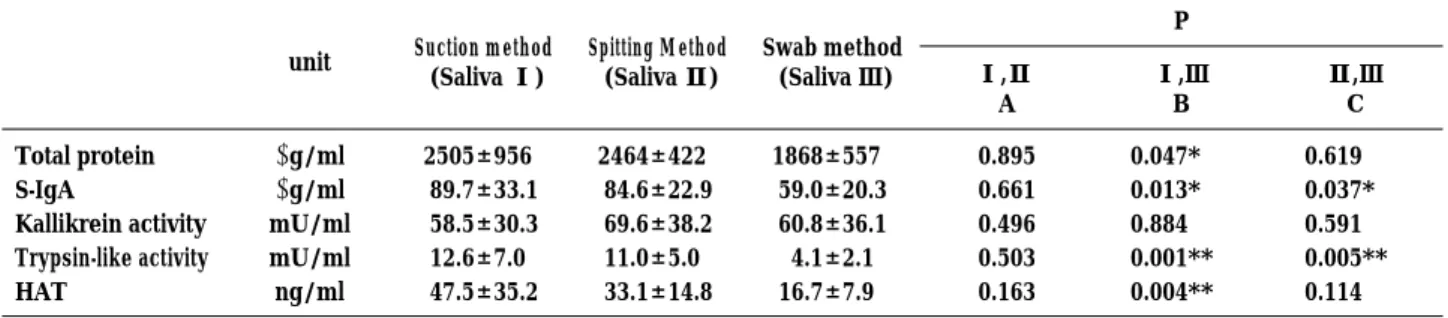
Contents of total protein, S-IgA, kallikrein activity, trypsin-like activity and HAT in the saliva samples collected by different methods (Table 1)
The saliva samples collected by the suction, spitting and swab method, were named Saliva I, Saliva II and Saliva III, respectively.
In the Saliva I, the mean values of total protein concentration (!/ml), S -IgA concentration (!/ml), kallikrein activity (mU/ml), trypsin -like activity (mU/ ml) and HAT concentration (ng/ml) are 2505±956,
89.7±33.1, 58.5±30.3, 12.6±7.0 and 47.5±35.2,
re-spectively.
As shown in Table 1, each mean value of the total protein concentration, S-IgA concentration, trypsin-like activity and HAT concentration were not significantly different between Saliva I and II, but were significantly lower in the Saliva III compared with Saliva I or Saliva II.
The HAT concentration in the individual saliva samples collected by three different methods are shown in Fig.1.
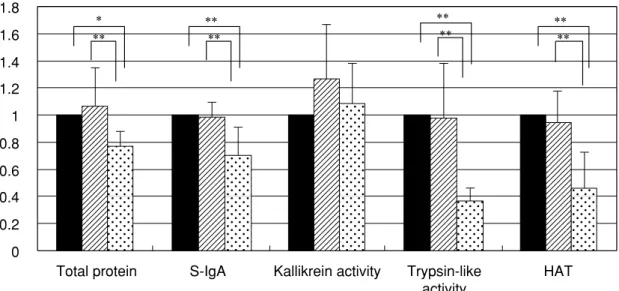
In Saliva I, the HAT concentration was significantly positively correlated with the trypsin-like activity (r=0.94, p=<0.0001). The HAT concentration was correlated with the trypsin-like activity in Saliva II (r=0.57, p=0.084) and Saliva III (r=0.61, p=0.059) (Fig. 2). In contrast with the other proteins tested, the mean value of the kallikrein activity was not significantly different among the saliva samples I, II and III (Table 1). The mean ratios of each protein component content in Saliva III to that in Saliva I were 0.45 in HAT concentration, 0.36 in trypsin-like activity, 0.70 in S-IgA, 0.76 in total protein, and 1.08 in the kallikrein activity,
F. Michishige, et al. Saliva collection method and protein 142
as shown in Fig 3. The ratios of of each protein component content in the Saliva III to that in Saliva II were similar to the III/I ratios.
Relationship between contents of each protein component in the Saliva I and II
As shown in Table 2, each correlation coefficient (r) between each content of total protein, S -IgA, kallikrein activity, trypsin activity and HAT in Saliva I and II, were 0.71, 0.72, 0.79, 0.63 and 0.79, respectively, and thus each content of total protein, S -IgA, kal-likrein activity, trypsin activity and HAT in Saliva I were significantly positively correlated with that in Saliva II.
DISCUSSION
Table 1. Contents of total protein, S-IgA, kallikrein activity, trypsin-like activity and HAT in the saliva samples collected by suction, spitting and swab methods
unit Suction method (Saliva Ⅰ) Spitting Method (Saliva Ⅱ) Swab method (Saliva Ⅲ) P Ⅰ,Ⅱ A Ⅰ,Ⅲ B Ⅱ,Ⅲ C Total protein S-IgA Kallikrein activity Trypsin-like activity HAT µg/ml µg/ml mU/ml mU/ml ng/ml 2505±956 89.7±33.1 58.5±30.3 12.6±7.0 47.5±35.2 2464±422 84.6±22.9 69.6±38.2 11.0±5.0 33.1±14.8 1868±557 59.0±20.3 60.8±36.1 4.1±2.1 16.7±7.9 0.895 0.661 0.496 0.503 0.163 0.047* 0.013* 0.884 0.001** 0.004** 0.619 0.037* 0.591 0.005** 0.114 Values are means±SD * p<0.05 ** p<0.01
The saliva samlples collected by suction, spitting and swab method, were designated as saliva I, II and III, respectively. A : Saliva I versus Saliva II, B : Saliva I versus Saliva III, C : Saliva II versus Saliva III
Fig. 1.HAT concentrations of the saliva samples collected by three different methods
The saliva samples collected by the suction, spitting and swab method, were designated Saliva I, II and III, respectively. Horizontal lines show mean values. **p<0.01
Fig. 2.Relationship between the trypsin-like activity and HAT con-centration in the saliva samples collected by suction, spitting and the swab method
The trypsin-like activity was measured by a fluorometric method with Boc-Phe-Ser-Arg-MCA as a substrate, and the HAT content was measured with an ELISA. Circles ; individual data, n=10
In the present study, we selected S-IgA, kallikrein, and trypsin-like protease as salivary proteins, in addition of total protein level. S-IgA is one of major proteins in the saliva, and major immunoglobulin related local humoral immunity of mucous membrane (26). Kallikrein is known to be present in relatively high levels in salivary glands (27-28), and its activity in the saliva are often measured to examine the phathophysiologi-cal states of oral and systemic diseases (14,15,17). There are few reports that analyze the trypsin-like activities in saliva. As described in the Introduction, HAT is a novel trypsin-like protease found in the human airways (20), and we found that saliva samples from normal volunteers contain HAT, and that the trypsin-like activity in the saliva samples is mainly due to HAT. Moreover, the immunohistochemical analysis showed that the HAT protein was found specifically in the ducts of human salivary glands, indicating that HAT in the saliva is derived from salivary glands (umpublished data).
In the analysis of the saliva samples of normal subjects, the saliva volume collected using the suction
method was about 2-fold greater than that of the spitting method and swab method. This is mainly due to the fact that saliva secretion was stimulated by the suction itself. Navazesh and Christensen reported that the suction methods introduced some degree of stimu-lation of saliva production (29).
In the present study, the total protein contents and each protein component in the saliva samples were expressed as the concentration per ml. Using gel filtration and ELISA for HAT, we have found that the trypsin-like activity in the saliva samples of normal volunteers is mainly due to HAT (unpublished data). In the present study, the trypsin-like activity was positively correlated with the HAT concentration in all of Saliva I, II and III. This result supports the above-described results.
As shown Table 1, the content of each S-IgA, trypsin-like activity and HAT were almost the same in Saliva I and II, and significantly lower in Saliva III than in Saliva I and II. The degree of difference between Saliva I or II and Saliva III was different in each protein component, the difference being the most prominent in the trypsin-like activity and HAT concentration ; the contents of trypsin-like activity and HAT in Saliva III were about half of those in Saliva I and II, while the S-IgA concentration of Saliva III was about 70 % of those of Saliva I and II. Most likely, the lower content of certain proteins in Saliva III than in Saliva I and II is thought to be caused by the following two mechanisms in the swab method : 1) The cotton roll adsorbs some parts of these proteins when it is placed in the mouth, and the degree of adsorption of proteins by the cotton roll differs between each protein. 2) Some parts of these proteins in Saliva III were precipitated when the cotton Fig. 3.The ratios of each protein content of Saliva II and Ⅲ to that of Saliva I
Bars show mean values, and horizontal lines SD. * p<0.05 ** p<0.01
Table 2. Correlation of content of total protein, S-IgA, kallikrein activity, trypsin-like activity and HAT between Saliva I and Saliva Ⅱ
Protein Correlation coefficient p Total protein S-IgA Kallikrein activity Trypsin-like activity HAT 0.71* 0.72* 0.79** 0.63* 0.79** 0.032 0.015 0.003 0.045 0.004 Significance of correlation between two saliva samples was tested by Pearson’s correlation coefficient. * p<0.05 ** p<0.01
F. Michishige, et al. Saliva collection method and protein 144
roll was centrifuged in the Salivette at 5000 g for 5 min at 4℃. Both the degree of adsorption of proteins by the cotton roll and that of the precipitation of proteins are thought to differ between each protein.
To contrast to the trypsin-like activity and HAT, the kallikrein activity was not significantly different among the saliva samples I, II and III. This is considered to be mainly due to the fact that the loss of salivary kallikrein by the above-described two mechanisms is very slight.
The present results of the analysis of the saliva samples of normal subjects indicated that the yield of salivary proteins is lower and more variable in the saliva samples collected by the swab method than in those by the spitting method and suction method, supporting the idea that the swab method was found to be the least reliable of the known saliva collection methods (19). If all of the subjects whose saliva samples we are aiming to analyze, can spit saliva well, it is thought that it is better to collect their unstimulated saliva samples using the spitting method, because the stimulation of saliva secretion is more slight in the spitting method than in the suction method. As described in the Introduction, we are planning to clarify the characteristics of salivary protein change of the aged subjects who can not eat well due to various kinds of diseases. In most of these subjects, we can not collect saliva using the spitting method, because most of these subjects can not spit saliva well. Accordingly, we need to collect saliva from these subjects using the suction method or swab method. However, many of these subjects can not keep well the cotton swab, and the swab method is not reliable as described above. Ultimately, we have to collect saliva using the suction method from these subjects.
The concentration of each total protein, S -IgA, kal-likrein activity, trypsin activity and HAT in Saliva I were significantly positively correlated to that in Saliva II. These results indicate that we can obtain infor-mation of the change of salivary protein by analyz-ing the saliva samples collected usanalyz-ing the suction method, as we can by analyzing the saliva samples col-lected using the spitting method, although the former method caused some extent of stimulation of saliva during its collection.
Finally, these results indicated that the analysis of proteins in saliva samples collected by the suction method is useful to obtain information of changes of salivary protein profiles in oral and systemic diseases of the aged subjects who can not eat or spit saliva well.
ACKNOWLEGEMENTS
This study was supported by a Grant-in-AID for Scientific Research (C) No.15592234 from the Ministry of Education, Science, Sports and Culture of Japan.
REFERENCES
1. Pedersen W, Schubert M, Izutsu K, Mersai T, Truelove E : Age-dependent decreases in human submandibular gland flow rates as measured umder resting and post-stimulation conditions. J Dent Res 64(5) : 822-825, 1985
2. Tylenda CA, Ship JA, Fox PC, Baum BJ : Evali-ation of submandibular salivary flow rate in dif-feent age groups. J Dent Res 67(9) : 1225-1228, 1988
3. Percival RS, Challacombe SJ, Marsh PD : Flow rates of resting whole and stimulated parotid saliva in relation to age and gender. J Dent Res 73 (8): 416-420, 1994
4. Bourdiol P, Mioche L, Monier S : Effect of age on salivary flow obtained under feeding and non-feeding conditions. J Oral Rehabilitation 31 : 445-452, 2004
5. Smith DJ, Joshipura K, Kent R, Taubman A : Effect of age on Immuomnglobulin content and volume of human labial gland saliva. J Dent Res 71:1891-1894, 1992
6. Kugler J, Hess M, Haake D : Secretion of salivary immunoglobulin A in relation to age, saliva flow mood states,secretion of albumin, cortisol, and catecholamines in saliva. J Clinical Immunol-ogy 12(1) : 45-49, 1992
7. Lenander-Lumkari M, Johansson I, Vilja P, Samaranayake LP : New saliva collection methods and saliva composition : a study of two Salvette! kits. Oral Diseases 1 : 86-91, 1995
8. Proctor GB, Carpenter GH : Chewing stimulates secretion of human salivary secretory immu-noglobulin A. J Dent Res 80(3) : 909-913, 2001 9. Huang CM : Comparative proteomic analysis of human whole saliva. Arch Oral Biol 49:951-962, 2004
10. Ussher M, West R, Evans P, Steptoe A, McEwen A, Clow A, Hucklebridge F: Acute reduction in secretory immunoglobulin A following smoking cessation. Psychoneuroendocrinology 29:1335 -1340, 2004 11. Nagler RM, Hershkovich O, Lischinsky S, Diamond E, Reznick AZ : Saliva analysis in the clinical setting an underused diagnostic tool. Journal of
vertigative Medicine 50(3)214-25, 2002 12. Nagler RM, Hershkovich O : Relationships between
age, drugs, oral sensorial complaints and salivary profile. Archives of Oral Biology 50 : 7-16 2005 13. Fink H, Tegelberg A, Lagerlof F : Influence of the time of measurement of unstimulated human whole saliva on the diagnosis of hyposalivation. Archives of Oral Biology 50 : 553-559, 2005 14. Arnold WH, Bartholmes P, Senkel H, Roodenburg JL,
Roder R : Kallikrein activity of patients with in-flammatory and hyperplastic diseases of the mucous membrane. Adv Exp Med Biol 247A : 385-387, 1989
15. Beeley JA, Khoo KS:Salivary proteins in rheu-matoid arthritis and Sjogren’s syndrome: one-dimensional and two-dimensioral electropho-retic studies. Electrophoresis 20:1652 -1660, 1999 16. Leivovitz A, Nagler R, Plotnikov G, Habot B, Segal R : Biochemical, immunological and en-zymatic components of saliva in prolonged naso-gastric-fed elderly patients. Clinical and Ex-perimental Research 16 : 457- 460, 2004 17. Rosatelli TB, Roselino AM, Dellalibera-Jovilliano R,
Reist ML, Donald EA : Increased activity of plasma and tissue kjallikreins, plasma kininase II and salivary kallikrein in pemphigus foliaceus (fogo selvagem) Clin Laboratory Invest 152 : 650 - 657 2005
18. Mandel ID: The functions of saliva. J Dent Res. 66 : 623 -627, 1987
19. Navazesh M : Methods for collecting saliva. Annals New York Acad Sci 694 : 72-77, 1993
20. Yasuoka S, Ohnishi T, Kawano S, Tsuchihashi S, Ogawara M, Masuda K, Yamaoka K, Takahashi M, Sano T: Purification, characterization of a novel trypsin-like protease found in the human airway. Cell Mol Biol 16 : 300 -308, 1997
21. Chokki M, Yamamura S, Eguchi H, Masegi T,
Horiuchi H, Tanabe H, Kamimura T, Yasuoka S : Human airway trypsin-like protease increases mucin gene expression in airway epithelial cells. Am J Respir Cell Mol Biol 30 : 470 - 478, 2004 22. Miki M, Nakamura Y, Yasuoka S : Human
air-way trypsin-like protease (HAT) enhances syn-thesis of interleukin-8 in bronchial epithelial cells. Proc Airway Secretion Res IV : 45 - 54, 2002 23. Matsushima R, Takahashi A, Nakaya Y, Maezawa H, MikiM, Nakamura Y, Fumitaka Ohgushi F, Yasuoka S : Human airway trypsin-like protease stimulates human bronchial fibroblast prolif-eration in a protease-activated receptor-2 de-pendent pathway. Am J Physiol, (in press) 24. Lowry OH, Rosebrough N, Farr A, Randall R :
Protein measurement with the Folin phenol reagent. J Biol Chem 93 : 265 -275, 1951 25. Takizawa N, Ohba Y, Nagashima A, Tsunoda R,
Okayama K, Okamura M, Sasaki K, Muroyama R, Komuro T, Takei M, Takei T: Forensic examination for secretory IgA. Detection by ELISA. Nichi-Dai Sigaku 61 (in Japanese) : 741-750, 1987 26. Marcotte H, Lavole MC:Oral microbial ecology
and role of salivary immunoglobulin A. Microbiol Mol Biol Rev 62 : 71-109, 1998
27. Orstavik TB, Brandizaeg P, Nustad K, Pierce JV: Immunohistochemical localization of kallik-rein in human pancreas and salivary gland. J Histochem Cytochem 28 : 557-562, 1980 28. Schachter M, Peret MW, Moriwaki C, Rodrigues
JA : Localization of kallikrein in submandibu-lar gland of cat, guinea pig, dog, and man by the immunoperoxidase method. J Histochem Cytochem 28 : 1295 -1300, 1980
29. Navazesh M, Christensen CM : A comparison of whole mouth resting and stimulated salivary measurement procedures. J Dent Res 61 : 1158 -1162, 1982
F. Michishige, et al. Saliva collection method and protein 146