neuropsychiatry inpatients
Author(s)
Higaonna, Miki; Iramina, Mika; Kajiki, Yorie; Odo, Sumie
Citation
琉球医学会誌 = Ryukyu Medical Journal, 37(1-4): 51-59
Issue Date
2018
URL
http://hdl.handle.net/20.500.12001/24351
INTRODUCTION
Patients with psychiatric disorders are at a higher risk of both injurious and non-injurious falls compared to medical-surgical patients during hospitalization1). In addition to the common risk factors for falls, such as impaired balance and mobility and co-morbid medical conditions2), the
psychiatric diseases, psychotropic medications, and higher activity levels make psychiatric patients more prone to falls3). Moreover, patients with psychiatric disorders are often restricted from commonly used fall-prevention methods (e.g. low-low beds and a movement monitor connected by a code, walking aids, handrails in bathrooms) to prevent them from harming themselves or others4, 5).
A study in the National Health Service mental
ABSTRACT
The fall risks of patients hospitalized for psychiatric disorders are often assessed using fall risk assessment tools that are not validated for psychiatric inpatients. This study aimed to assess the predictive validity of a modified Japanese Nursing Association (JNA) fall risk assessment tool and its short forms at different observation points (7, 14, 21, and 28 days) among patients admitted to a neuropsychiatry ward in a Japanese university hospital. This study utilized a retrospective cohort design. Participants were patients aged≧15 years, who were admitted between February 20, 2009 and December 31, 2016. Incident reports were reviewed to identify falls. The predictive validity was assessed using the area under the receiver operating characteristics curve, sensitivity, specificity, and positive and negative likelihood ratios at the cut-off points of≧6 and≧7 for the modified risk assessment tool,≧3 and≧5 for the short-form ver. 1, and≧4 and≧5 for the short-form ver.2. We found that neither the modified JNA tool, nor its short versions, achieved optimal sensitivity and specificity values of greater than 0.70 among 1,003 patients (median age 41 years, 71% women). The area under the receiver operating characteristics curves showed the highest values at the 7-day observation point in all three tools. The findings from this study suggest that fall risk assessment tools with sufficient predictive validity in non-psychiatric settings may not achieve an equivalent level of validity among psychiatric patients, and a different cut-off point may need to be considered. Ryukyu Med. J., 37 (1~4) 51~60, 2018
Key words: inpatient falls; neuropsychiatry; nursing assessment; reproducibility of results
1)School of Health Sciences, Faculty of Medicine, University of the Ryukyus
2)Nursing department, University of the Ryukyu Hospital
3)Nursing department & Safety management office, University of the Ryukyu Hospital
(Received on January 23, 2018, accepted on February 23, 2018)
Miki Higaonna1), Mika Iramina2), Yorie Kajiki3), Sumie Odo2)
The predictive validity of a modified Japanese Nursing Association
fall risk assessment tool and its short-forms
among neuropsychiatry inpatients
Corresponding Author: Miki Higaonna, Gerontological Nursing, School of Health Sciences, Faculty of Medicine, University of the Ryukyus, 207 Uehara, Nishihara 903-0215, Okinwa, Japan. Tel: +81-98-895-3331, E-mail: [email protected]
51
health trusts of England and Wales revealed that a variety of fall risk assessment tools were used, but none of the tools has been validated in psychiatric inpatients6). Fall risk assessment tools developed for the non-psychiatric population might not capture the crucial fall risk factors for psychiatric patients3, 4), such as higher mobility level; frequent fluctuation in cognitive, behavioral, and mental state; and side effects of multiple medications to treat psychiatric illnesses and co-morbidities3).
The Edmonson Psychiatric Fall Risk Assessment Tool7) and the Wilson-Sims Fall Risk Assessment Tool8) are the only tools published in the literature that have been developed specifically for hospitalized patients with psychiatric disorders. Edmonsonʼs tool includes nine risk factors: age, mental status, elimination, medications, diagnosis, ambulation/ balance, nutrition, sleep disturbance, and history of falls7). Edmonsonʼs tool was validated by a study of 138 patients, evaluated in two acute psychiatric wards at a US hospital, and revealed a sensitivity of 0.63 and specificity of 0.85, which provides better predictive validity than the Morse Fall Scale, a six-item tool that was designed to predict the fall risk level of patients in acute care hospitals, long-term care facilities, and rehabilitation hospitals7). The Wilson-Sims Fall Risk Assessment Tool was pilot-tested in 50 patients, including two fallers, and demonstrated a sensitivity of 1.00 and a specificity of 0.63, similar to results obtained with the Hendrich II Fall Risk Model, an eight-item tool that was developed for patients in acute care hospitals8).
The majority of Japanese hospitals have adopted the Japanese Nursing Association (JNA) fall risk assessment tool9). The university hospital in this study uses a modified version of the JNA tool, which demonstrated good predictive validity in patients admitted to the non-psychiatric wards10). However, the validity of the tool with respect to the patients admitted to the neuropsychiatric ward has not been evaluated.
Our primary objective was to assess the predictive validity of a modified JNA fall risk assessment tool and its short forms (ver. 1 and 2) in patients with psychiatric disorders. Since studies have suggested that the predictive validity values varied by the length of observation10, 11), we calculated predictive validity values at observation points of 7-, 14-, 21-, and 28-days according to the period of routine re-assessment at the study hospital.
METHODS
Study design, setting, and participants
This study was a retrospective cohort design and was conducted in a neuropsychiatry ward (40 beds) at a university hospital in Japan. The ward is a locked ward and treats not only the patients with acute psychiatric conditions, but also patients with neuropsychiatric disorders who are pregnant or in labor, undergoing surgeries, and who have other medical conditions.
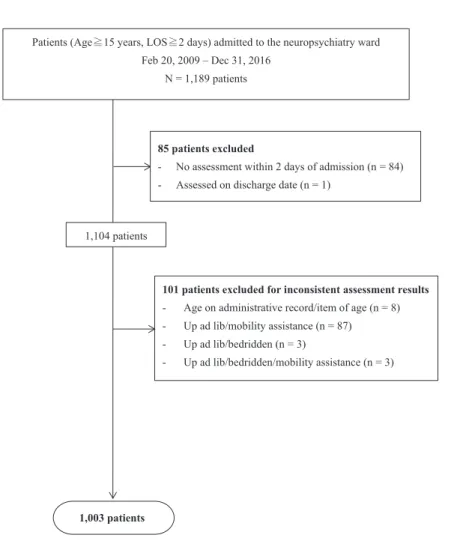
Patients 15 years and older with lengths of stay of≧2 days and admitted to the neuropsychiatry ward from February 20, 2009 to December 31, 2016 were included. We excluded patients with no documented fall risk assessment within two days of admission, patients assessed on the discharge date, and patients with inconsistent assessment results (Fig. 1).
Measures
The instruments used in this study were: a modified version of the JNA fall risk assessment tool10) and its two versions of the short-form12) (Table 1). The modified JNA tool consisted of 37 items, but we excluded two items, “age ≦9 years old” and “infantʼs development stage”, from the analyses because this study included patients aged≧15 years. Two versions of the short-form of JNA consisted of 17 items that were developed in previous studies in non-psychiatric inpatients12). The modified JNA tool and short-form ver. 2 demonstrated both sensitivity and specificity of greater than 0.70 and better predictive validity than ver. 1 (sensitivity 0.78 and specificity 0.69) in non-psychiatric patients at a university hospital12).
Definition and identification of fall events The operational definition of a fall was a free-text description of any of the following: patients found lying/sitting on the floor, reported falls, patients lowered to the floor by hospital staff when transferring, patient dropped/slid from bed/chair, patient unintentionally leaned to the bed or bedrails from a sitting position, and healthcare professionals using the word “fell” or “fell down”. Two researchers independently reviewed all the descriptions in the incident reports to exclude false reports and intentional falls, but we included falls that noted a possibility of false-fall claim or intentional drop to the floor unless reporting health professionals definitively determined the event to be a non-fall. Falls that occurred between February 20, 2009 and January 28, 2017 were
Patients (Age≧15 years, LOS≧2 days) admitted to the neuropsychiatry ward Feb 20, 2009 – Dec 31, 2016
N = 1,189 patients
1,003 patients
101 patients excluded for inconsistent assessment results
- Age on administrative record/item of age (n = 8) - Up ad lib/mobility assistance (n = 87) - Up ad lib/bedridden (n = 3)
- Up ad lib/bedridden/mobility assistance (n = 3) 1,104 patients
85 patients excluded
- No assessment within 2 days of admission (n = 84) - Assessed on discharge date (n = 1)
Fig.1 Flowchart of patient selection
Note: LOS refers to the length of hospital stay. Up ad lib refers to patientsʼ ability to get up freely in the ward.
Modified JNA tool Short-form Cont. Modified JNA tool Cont. Short-form
ver. 1 ver. 2 ver. 1 ver. 2
Age ≧ 65 years Analgesics X X
Fall history X X Laxatives X
Visual impairment X X Diuretics
Hearing impairment Chemotherapy
Impaired extremities X Antiparkinsonian
Bone/joint problems X Hypnotics/tranquilizers X X
Muscle weakness X X Antihypertensive
Up ad lib Toileting ≧ 2x per night X X
Unstable when standing/walking X X Urinary/bowel incontinence X X Mobility assistive devices X X Requiring toileting assistance
Requiring mobility assistance X X Commode chair use X X
Bedridden, but able to move extremities Rehabilitation
Cast, IV lines, or tubes Anemia/orthostatic hypotension
Restless/anxious Decreased strength X
Forgetful X X Surgery within 3 days
Impaired judgment/understanding X X Hesitant to use a call light X X Unable to use a call light Does not like to depend on othersNew to the hospital environment X X JNA: Japanese Nursing Association; IV: intravenous.
Note: Items “age ≦ 9 years old” and “infantʼs development stage” of the modified JNA tool were excluded from these analyses because this study included patients aged ≧ 15 years.
Table 1 Items in the modified JNA tool and the short-forms
53
identified by the electronic incident report system. Data collection
The hospitalʼs information systems department extracted and created the database of newly admitted patients and their fall risk assessment results from the electronic charting system. One of the researchers (Kajiki) obtained falls/fallers information from the incident reporting system and created a database. The principal investigator combined these two databases for the analyses. Statistical analysis
The categorical variables regarding patient characteristics and risk assessment items are reported as frequencies and proportions. Numeric variables not normally distributed were described by medians and first and third interquartiles. Variables between fallers and non-fallers were tested using Pearsonʼs χ2 test (Yateʼs correction applied when appropriate) or Mann-Whitneyʼs test.
For the predictive validity, we used the receiver operating characteristics (ROC) curves, the area under the ROC (AUC), sensitivity, specificity, and positive and negative likelihood ratios (LRs). The validity values were examined at 7-, 14-, 21-, and 28-day observation points. We interpreted results of sensitivity and specificity>0.70 to be sufficient as fall-risk assessment tools13). Initially, the validity values were calculated at the optimal cut-off points determined in the previous study10, 12) as≧6 for the
modified JNA tool,≧3 for the short-form (ver. 1), and≧4 for the short-form (ver. 2). We also identified the optimal cut-off points for psychiatric patients and calculated the validity values.
Statistical tests were performed using SPSS ver. 19 (IBM Corp, Armonk, NY) or MedCalc ver. 13.0 (MedCalc Software, Ostend, Belgium). The level of statistical significance was set at P<0.05, and 95% confidence intervals (CIs) were calculated where applicable.
Ethical considerations
The study protocol was approved by the Ethics Committee for Epidemiological Research at the researchersʼ university. The Declaration of Helsinki and the Japanese guideline14) were followed. Informed consent was waived according to this guideline; however, we posted a notification of the research in the hospital to ensure patients of the opportunity to “opt-out” of the study.
RESULTS
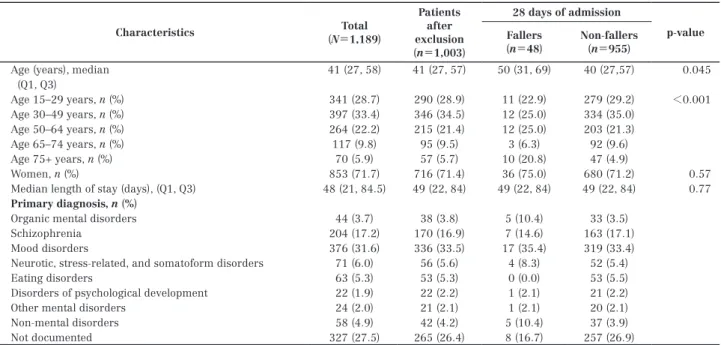
Among 1,189 patients admitted, 169 falls by 114 patients were reported (2.3 falls per 1,000 patient days; proportion of fallers 9.6%) during their hospital stay. Patientsʼ characteristics are described in Table 2. Eighty-four percent of the patients were aged <65 years; 71.7% were women. After excluding 186 patients
Characteristics (N=1,189)Total Patients after exclusion (n=1,003) 28 days of admission p-value Fallers (n=48) Non-fallers(n=955)
Age (years), median 41 (27, 58) 41 (27, 57) 50 (31, 69) 40 (27,57) 0.045 (Q1, Q3) Age 15–29 years, n (%) 341 (28.7) 290 (28.9) 11 (22.9) 279 (29.2) <0.001 Age 30–49 years, n (%) 397 (33.4) 346 (34.5) 12 (25.0) 334 (35.0) Age 50–64 years, n (%) 264 (22.2) 215 (21.4) 12 (25.0) 203 (21.3) Age 65–74 years, n (%) 117 (9.8) 95 (9.5) 3 (6.3) 92 (9.6) Age 75+ years, n (%) 70 (5.9) 57 (5.7) 10 (20.8) 47 (4.9) Women, n (%) 853 (71.7) 716 (71.4) 36 (75.0) 680 (71.2) 0.57 Median length of stay (days), (Q1, Q3) 48 (21, 84.5) 49 (22, 84) 49 (22, 84) 49 (22, 84) 0.77
Primary diagnosis, n (%)
Organic mental disorders 44 (3.7) 38 (3.8) 5 (10.4) 33 (3.5) Schizophrenia 204 (17.2) 170 (16.9) 7 (14.6) 163 (17.1) Mood disorders 376 (31.6) 336 (33.5) 17 (35.4) 319 (33.4) Neurotic, stress-related, and somatoform disorders 71 (6.0) 56 (5.6) 4 (8.3) 52 (5.4) Eating disorders 63 (5.3) 53 (5.3) 0 (0.0) 53 (5.5) Disorders of psychological development 22 (1.9) 22 (2.2) 1 (2.1) 21 (2.2) Other mental disorders 24 (2.0) 21 (2.1) 1 (2.1) 20 (2.1) Non-mental disorders 58 (4.9) 42 (4.2) 5 (10.4) 37 (3.9) Not documented 327 (27.5) 265 (26.4) 8 (16.7) 257 (26.9)
Q1: first quartile; Q3: third quartile
according to the studyʼs exclusion criteria (Fig. 1), 1,003 patients (median age 41 years, 71.4% women; median length of stay 49 days) were used to evaluate the tools. One-third of the patients were admitted for the treatment of mood disorders, such as depression and bipolar disorder. Forty-two patients (4.2%) were admitted primarily for the treatment of non-mental disorders; however, they were admitted to the neuropsychiatry ward for their comorbid mental disorders. There were
23, 37, 41, and 48 fallers in the 7-, 14-, 21-, and 28-day observation samples, respectively.
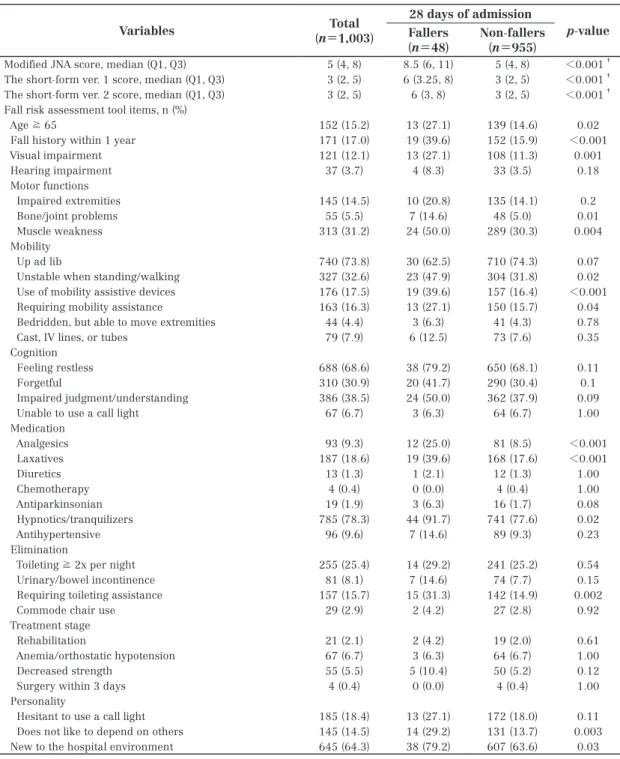
The median scores of the modified JNA, short-form ver. 1, and short-short-form ver. 2 were 5, 3, and 3, respectively. Fallers demonstrated significantly higher scores than non-fallers upon assessment by all three tools. Fourteen items of the assessment tool demonstrated a significantly larger proportion among fallers than non-fallers (Table 3). The AUCs
Variables (n=Total1,003) 28 days of admission p-value Fallers (n=48) Non -fallers (n=955)
Modified JNA score, median (Q1, Q3) 5 (4, 8) 8.5 (6, 11) 5 (4, 8) <0.001†
The short-form ver. 1 score, median (Q1, Q3) 3 (2, 5) 6 (3.25, 8) 3 (2, 5) <0.001†
The short-form ver. 2 score, median (Q1, Q3) 3 (2, 5) 6 (3, 8) 3 (2, 5) <0.001†
Fall risk assessment tool items, n (%)
Age ≧ 65 152 (15.2) 13 (27.1) 139 (14.6) 0.02 Fall history within 1 year 171 (17.0) 19 (39.6) 152 (15.9) <0.001 Visual impairment 121 (12.1) 13 (27.1) 108 (11.3) 0.001 Hearing impairment 37 (3.7) 4 (8.3) 33 (3.5) 0.18 Motor functions Impaired extremities 145 (14.5) 10 (20.8) 135 (14.1) 0.2 Bone/joint problems 55 (5.5) 7 (14.6) 48 (5.0) 0.01 Muscle weakness 313 (31.2) 24 (50.0) 289 (30.3) 0.004 Mobility Up ad lib 740 (73.8) 30 (62.5) 710 (74.3) 0.07 Unstable when standing/walking 327 (32.6) 23 (47.9) 304 (31.8) 0.02 Use of mobility assistive devices 176 (17.5) 19 (39.6) 157 (16.4) <0.001 Requiring mobility assistance 163 (16.3) 13 (27.1) 150 (15.7) 0.04 Bedridden, but able to move extremities 44 (4.4) 3 (6.3) 41 (4.3) 0.78 Cast, IV lines, or tubes 79 (7.9) 6 (12.5) 73 (7.6) 0.35 Cognition
Feeling restless 688 (68.6) 38 (79.2) 650 (68.1) 0.11 Forgetful 310 (30.9) 20 (41.7) 290 (30.4) 0.1 Impaired judgment/understanding 386 (38.5) 24 (50.0) 362 (37.9) 0.09 Unable to use a call light 67 (6.7) 3 (6.3) 64 (6.7) 1.00 Medication Analgesics 93 (9.3) 12 (25.0) 81 (8.5) <0.001 Laxatives 187 (18.6) 19 (39.6) 168 (17.6) <0.001 Diuretics 13 (1.3) 1 (2.1) 12 (1.3) 1.00 Chemotherapy 4 (0.4) 0 (0.0) 4 (0.4) 1.00 Antiparkinsonian 19 (1.9) 3 (6.3) 16 (1.7) 0.08 Hypnotics/tranquilizers 785 (78.3) 44 (91.7) 741 (77.6) 0.02 Antihypertensive 96 (9.6) 7 (14.6) 89 (9.3) 0.23 Elimination
Toileting ≧ 2x per night 255 (25.4) 14 (29.2) 241 (25.2) 0.54 Urinary/bowel incontinence 81 (8.1) 7 (14.6) 74 (7.7) 0.15 Requiring toileting assistance 157 (15.7) 15 (31.3) 142 (14.9) 0.002 Commode chair use 29 (2.9) 2 (4.2) 27 (2.8) 0.92 Treatment stage
Rehabilitation 21 (2.1) 2 (4.2) 19 (2.0) 0.61 Anemia/orthostatic hypotension 67 (6.7) 3 (6.3) 64 (6.7) 1.00 Decreased strength 55 (5.5) 5 (10.4) 50 (5.2) 0.12 Surgery within 3 days 4 (0.4) 0 (0.0) 4 (0.4) 1.00 Personality
Hesitant to use a call light 185 (18.4) 13 (27.1) 172 (18.0) 0.11 Does not like to depend on others 145 (14.5) 14 (29.2) 131 (13.7) 0.003 New to the hospital environment 645 (64.3) 38 (79.2) 607 (63.6) 0.03
JNA: Japanese Nursing Association; IV: intravenous; Q1: first quartile, Q3: third quartile. Analysis using Pearsonʼs χ2 test except where indicated.
†
Mann-Whitney U test
Table 3 Fall risk assessment tools and falls within 28 days of admission
55
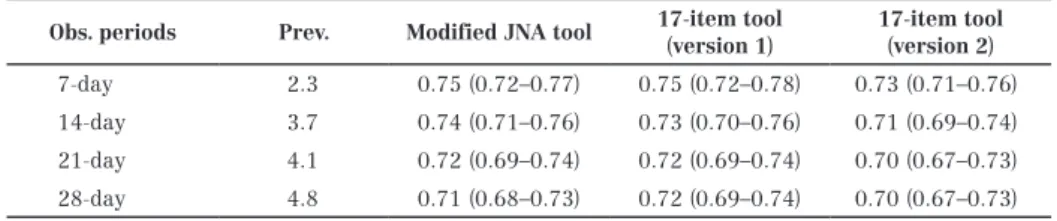
were highest at the 7-day observation point for the modified JNA tool (0.75) and the short-form ver. 1 (0.75) and ver. 2 (0.73) among the four observation points (Table 4). The AUC of the modified JNA and the short-form ver. 1 and ver. 2 did not differ significantly in any of the observation points (Fig. 2).
Predictive validity indices at the 7-day observation points using the optimal cut-off points for non-psychiatric and psychiatric patients are depicted in Table 5. The modified JNA tool exhibited sensitivity of 0.91, specificity of 0.54, positive LR of 2.00, and negative LR of 0.16 at the optimal cut-off
Obs. periods Prev. Modified JNA tool 17-item tool (version 1) 17-item tool (version 2)
7-day 2.3 0.75 (0.72–0.77) 0.75 (0.72–0.78) 0.73 (0.71–0.76) 14-day 3.7 0.74 (0.71–0.76) 0.73 (0.70–0.76) 0.71 (0.69–0.74) 21-day 4.1 0.72 (0.69–0.74) 0.72 (0.69–0.74) 0.70 (0.67–0.73) 28-day 4.8 0.71 (0.68–0.73) 0.72 (0.69–0.74) 0.70 (0.67–0.73)
Obs. periods: observation periods; Prev.: prevalence of fallers; JNA: Japanese Nursing Association
Table 4 Area under the receiver operating characteristics curves (95%
confidence interval) at 7-, 14-, 21-, and 28-day observation points
a. 7-day observation point b. 14-day observation point
c. 21-day observation point d. 28-day observation point
Fig.2 Receiver operating characteristic (ROC) curves of the modified Japanese Nursing Association tool and its
short forms (version 1 and 2)
Note: Differences in AUCs between the modified JNA tool and the short forms (version 1 and 2) using Pearsonʼs chi-square test:
modified JNA and ver. 1 (p = 0.78) or ver. 2 (p = 0.60) in 7-day observation samples; modified JNA and ver. 1 (p = 0.67) or ver. 2 (p = 0.24) in 14-day observation samples; modified JNA and ver. 1 (p = 0.97) or ver. 2 (p = 0.54) in 21-day observation samples; modified JNA and ver. 1 (p = 0.58) or ver. 2 (p = 0.84) in 28-day observation samples.
point for non-psychiatric patients (≧6); sensitivity of 0.78, specificity of 0.64, positive LR of 2.20, and negative LR of 0.34 at the optimal cut-off point for psychiatric patients (≧7). Similar to the modified JNA tool, the optimal cut-off points for both the short-form ver. 1 and ver. 2 were one or two points higher than the cutoff point for non-psychiatric patients. Neither the modified JNA tool nor the short forms demonstrated a sensitivity or specificity of>0.7.
DISCUSSIONS
The modified JNA tool and its short-forms exhibited the best overall predictive validity at the 7-day observation point. A greater balance of sensitivity and specificity values were seen at scores of 1-2 points higher than the optimal cut-off point for non-psychiatric inpatients. However, even at the best cut-off point for the psychiatric population, the modified JNA tool and its short-forms did not achieve the recommended values for clinical use13).
The modified JNA tool was more sensitive (0.78 vs. 0.63) but less specific (0.64 vs. 0.85) at the cut-off point of≧7 than the reported values for the Edmonson Psychiatric Fall Risk Assessment Tool (EPFRAT)7) although the overall predictive validity value cannot be compared because no AUC value was reported. The EPFRAT might have resulted in a higher specificity than that in the current study because it placed greater weight on a score of increasing cardiac or psychotropic medication and/ or receiving PRN medication for psychiatric symptoms or pain within 24 hours, poor nutrition,
and sleep disturbance.
Similar to the study hospital, fall-risk assessment tools developed for medical-surgical patients or the geriatric population are often used for psychiatric inpatients1, 2, 6, 15). Particularly for patients in the psychiatric ward of a general hospital, a fall risk assessment tool used hospital-wide may be preferable for assessing risk factors related to medical-surgical treatment because patients are often admitted that require treatment of their medical conditions, in addition to the management of psychiatric conditions. This study found that the optimal cut-off point for psychiatric patients was higher than that for non-psychiatric patients, consistent with findings of a study by Bugajski et al.16). A large proportion of psychiatric patients marked for several items such as up ad lib, restlessness, hypnotics/tranquilizers, and new to the hospital environment, might have contributed to the higher scores in psychiatric patients that probably resulted in a lower specificity in this patient population.
Fourteen items revealed a significant association with falls, and all of them except an item termed “new to the hospital environment” were common to the study conducted in the non-psychiatric wards10, 12). These findings could be interpreted to reveal that psychiatric inpatients in the study hospital mostly share the same risk factors with non-psychiatric patients.
Unexpectedly, no items reflective of cognitive impairment were associated with falls even though healthcare professionals commonly identified that fluctuations in cognition, behavior, and mental status are important risk factors specific to the
Variables Modified JNA tool 17-item tool (version 1) 17-item tool (version 2) cut-off ≧ 6 cut-off ≧ 7 cut-off ≧ 3 cut-off ≧ 5 cut-off ≥ 4 cut-off ≥ 5
Sensitivity 0.91 0.78 0.91 0.78 0.82 0.69 (95% CI) (0.72–0.98) (0.56–0.92) (0.72–0.98) (0.56–0.92) (0.61–0.95) (0.47–0.86) Specificity 0.54 0.64 0.39 0.66 0.56 0.66 (95% CI) (0.51–0.57) (0.61–0.67) (0.36–0.42) (0.63–0.69) (0.52–0.59) (0.63–0.69) +LR 2.00 2.20 1.50 2.33 1.88 2.08 (95% CI) (1.7–2.3) (1.7–2.8) (1.3–1.7) (1.8–2.9) (1.5–2.3) (1.6–2.8) -LR 0.16 0.34 0.22 0.33 0.31 0.46 (95% CI) (0.04–0.6) (0.2–0.7) (0.06–0.8) (0.2–0.7) (0.1–0.8) (0.2–0.8)
+LR: positive likelihood ratio; -LR: negative likelihood ratio; CI: confidence interval; AUC: area under the receiver operating characteristic curve; JNA: Japanese Nursing Association
Table 5 Predictive validity indices in 7-day observation point at the optimal
cut-off points for non-psychiatric and psychiatric patients
57
psychiatric patients3). This may be related to the differences in the age groups of the patients. The study by Wynaden et al. described fall risk factors for older adults with mental health conditions3), but the majority of fallers (72.9%) in this study were aged<65 years. Studies examining fall risk factors for non-geriatric, psychiatric patients are scarce, but complex medication regimens may have contributed more than cognitive impairments in the non-geriatric population17). Moreover, the items in the modified JNA are not representative of the degree or severity of symptoms. Restlessness, observed in nearly 70% of this patient population, was not always accompanied by physical movement and sometimes was expressed only verbally (e.g. frequent use of call-light or shouting out loudly).
The overall predictive validity presented as the AUC did not differ significantly between the modified JNA tool and the short-forms. Yet, ver. 1 classified fallers into a high-risk group more accurately than ver. 2 at a cut-off point of≧5 with the same specificity values. Since the proportion of fallers taking laxatives was more than two-times that of non-fallers, the inclusion of laxatives on ver. 1 might have influenced this result. No incident reports in this study claimed that laxatives were a contributing factor in patient falls, but several of them claimed that hypnotics and/or antipsychotics were contributing factors. In fact, 91% of inpatients and 100% of the fallers who were taking laxatives were also taking hypnotics and/or tranquilizers. Therefore, some background factors in the patients taking laxatives probably contributed to the falls as opposed to the laxatives or their side effects18). For example, antipsychotics and antidepressants were significantly associated with constipation requiring laxative use in psychiatric inpatients19). Medications to treat schizophrenia, bipolar disorder, and depression have been shown to increase the risk of falls among older adults20). The findings from this study suggest that the ingestion of psychiatric medications rather than laxatives should be addressed in the fall risk assessment of psychiatric inpatients as complex medication regimens in non-geriatric, psychiatric inpatients might be a crucial risk factor for falls17). Furthermore, nurses should pay close attention to psychotropic medication changes, dosage changes, or PRN administrations, because they may contribute to a higher risk of falls21) and may distinguish the high-risk fallers
among the patients who are on psychotropic medications. The information can be incorporated in a fall-risk assessment tool, similar to Edmonsonʼs tool, or added as “nurseʼs clinical judgement” when the tool is planned to be used in other clinical areas.
Our study has some limitations. First, the results are not generalizable to patients in geriatric psychiatric wards and non-acute psychiatric wards because the study was conducted in a single ward of a university hospital where both geriatric and non-geriatric patients were admitted. Second, because falls were identified based on submitted incident reports, approximately 25% of falls could have been overlooked22). This could underestimate the sensitivity and overestimate specificity.
CONCLUSIONS
The modified JNA fall risk assessment tool and its two versions of short-forms demonstrated the best predictive validity at the 7-day observation point, but they were inferior to the optimal values for use in the clinical setting. Fall risk assessment tools showing sufficient predictive validity in non-psychiatric settings may not achieve an equivalent level of validity among psychiatric patients. If fall risk assessment tools developed for medical-surgical patients or older adults are used in psychiatric wards, nurses are encouraged to discuss the need for evaluating their tool for its validity in order to advance evidence-based nursing practice.
ACKNOWLEDGEMENTS
The hospitalʼs information systems department extracted patientsʼ background information and fall risk assessment results from the hospitalʼs administrative records and nursing documents. This study was partly supported by the Japan Society for the Promotion of Science KAKENHI Grant # 24792397. The authors declare no conflict of interest.
REFERENCES
1) Yates K. M. and Creech Tart R.: Acute care patient falls: evaluation of a revised fall
prevention program following comparative analysis of psychiatric and medical patient falls. Appl Nurs Res. 25(2): 68-74, 2012.
2) Scanlan J., Wheatley J. and McIntosh S.: Characteristics of falls in inpatient psychiatric units. Australas Psychiatry. 20(4): 305-308, 2012.
3) Wynaden D., Tohotoa J., Heslop K., and Al Omari O.: Recognizing falls risk in older adult mental health patients and acknowledging the difference from the general older adult population. Collegian. 23(1): 97-102, 2016.
4) Lee A., Mills P. D. and Watts B. V.: Using root cause analysis to reduce falls with injury in the psychiatric unit. Gen Hosp Psychiatry. 34(3): 304-311, 2012.
5) Quigley P. A., Barnett S. D., Bulat, T. and Friedman Y.: Reducing falls and fall-related injuries in mental health: a 1-year multihospital falls collaborative. J Nurs Care Qual. 29(1): 51-59, 2014.
6) Narayanan V., Dickinson A., Victor C., Griffiths C. and Humphrey D.: Falls screening and assessment tools used in acute mental health settings: a review of policies in England and Wales. Physiotherapy. 102(2): 178-183, 2016. 7) Edmonson D., Robinson S. and Hughes L.:
Development of the Edmonson Psychiatric Fall Risk Assessment Tool. J Psychosoc Nurs Ment Health Serv. 49(2): 29-36, 2011.
8) Van Dyke D., Singley B., Speroni K.G. and Daniel M.G.: Evaluation of fall risk assessment tools for psychiatric patient fall prevention: a comparative study. J Psychosoc Nurs Ment Health Serv. 52(12): 30-35, 2014.
9) Japanese Nursing Association. Standard of Nursing Practice. 2007. Japanese Nursing Association Press, Tokyo. (in Japanese).
10) Higaonna M.: The predictive validity of a modified Japanese Nursing Association fall risk assessment tool: a retrospective cohort study. Int J Nurs Stud. 52(9): 1484-1494, 2015.
11) Bentzen H., Bergland A. and Forsen L.: Diagnostic accuracy of three types of fall risk methods for predicting falls in nursing homes. Aging Clin and Exp Res. 23(3): 187-195, 2011. 12) Higaonna M., Odo S., Kajiki Y. and Iramina M.: A
short form of the modified Japanese Nursing Associationʼs fall-risk assessment tool. Ryukyu
Medical Journal. 37: 29-40, 2018.
13) Oliver D., Daly F., Martin F. C. and McMurdo M. E.: Risk factors and risk assessment tools for falls in hospital in-patients: a systematic review. Age Ageing. 33(2): 122-130, 2004.
14) Ministry of Health, Labour and Welfare, Ministry of Education, Culture, Sports, Science and Technology. Ethical guidelines for medical and health research involving human subjects. 2014. (in Japanese).
15) Powell-Cope G., Quigley P., Besterman-Dahan K., Smith M., Stewart J., Melillo C., Haun J. and Friedman Y.: A qualitative understanding of patient falls in inpatient mental health units. J Am Psychiatr Nurses Assoc. 20(5): 328-339, 2014.
16) Bugajski A., Lengerich A., McCowan D., Merritt S., Moe K., Hall B., Nelson D. and Brockopp D.: The Baptist Health High-Risk Falls Assessment: one assessment fits all. J Nurs Care Qual. 32(2): 114-119, 2017.
17) Knight M. and Coakley C.: Fall risk in patients with acute psychosis. J Nurs Care Qual. 25(3): 208-215, 2010.
18) Bloch F., Thibaud M., Dugue B., Breque C., Rigaud A. S. and Kemoun G.: Laxatives as a risk factor for iatrogenic falls in elderly subjects: myth or reality? Drugs Aging. 27(11): 895-901, 2010.
19) Jessurun J. G., van Harten P. N., Egberts T. C., Pijl B. J., Wilting I. and Tenback D. E.: The effect of psychotropic medications on the occurrence of constipation in hospitalized psychiatric patients. J Clin Psychopharmacol. 33(4): 587-590, 2013.
20) Ruxton K., Woodman R. J. and Mangoni A. A.: Drugs with anticholinergic effects and cognitive impairment, falls and all-cause mortality in older adults: a systematic review and meta-analysis. Br J Clin Pharmacol. 80(2): 209-220, 2015.
21) Echt M. A., Samelson E. J., Hannan M. T., Dufour A. B. and Berry S. D.: Psychotropic drug initiation or increased dosage and the acute risk of falls: a prospective cohort study of nursing home residents. BMC Geriatr. 13: 19, 2013.
22) Toyabe S.: Characteristics of inpatient falls not reported in an incident reporting system. Glob J Health Sci. 8(3): 17-25, 2015.
59