Studies on the Formation-process and the
Germination-promotion of Seeds in the Bird of
Paradise (Strelitzia reginae BANKS)
著者
YAHIRO Masaki, ONJO Michio, ISHIHATA Kiyotake
journal or
publication title
南海研紀要
volume
5
number
2
page range
107-125
URL
http://hdl.handle.net/10232/15654
Studies on the Formation-process and the
Germination-promotion of Seeds in the
Bird of Paradise (Strelitzia reginae BANKS)
Masaki YAHIRO*, Michio ONJO* and Kiyotake ISHIHATA**
Abstract
Firstly, the developing-process of the capsules and the seeds in the bird of paradise was investigated mainly in measure, and secondly, some physical and
chemical treatments for germination-promotion in seeds were conducted. In the applied
physical and chemical treatments, no effects of germination-promotion for seeds were recognized, excepting the cone, sulfuric acid treatments.
Introduction
The bird of paradise is a perennial plant, native to South Africa, belonging to
family Musaceae.2023' Japanese "Gokurakuchoka" is the translation of English "bird of
paradice", and because of the resemblance of colour and form of the flower to the
wing of the bird of paradise from New Guinea, such name was given. Its cultivation flourishes in South Africa of native land, Europe, Middle and South America, New
Zealand, Hawaii and California, and Japan. The plant was introduced to Japan in the
5th year of Meiji (1872), and now the cultivation has been carried out in ChibaPrefecture, Izu Islands, Shikoku country and southern country of Kyushu.
As the
flower is in possession of an exotic singular colour and form, not wilting for long
time, the fame of the flower is getting higher both as cut-flower and as potted-plant.
As to the methods of propagation, the seed-propagation and the vegetative-propagation of roots-separating have been practiced until now. The seed is a hard
seed, subsequently the germination-percentage is low and the period up to germination
is rather long. In the studies on the improvement of germination-percentage and the promotion of germination, the methods of cone, sulfuric acid treatment, and of
combination of cone, sulfuric acid treatment and the treatment of the several
chemical substances have been conducted, respectively.
Laboratory of Tropical Crop, Faculty of Agriculture, Kagoshima University, 21-24 Korimoto 1-Chome,
Kagoshima 890, Japan.
Ibusuki Experimental Botanic Garden, Faculty of Agriculture, Kagoshima University, 1291 Zicho Ibusuki, Kagoshima 891-04, Japan.
108 Yahiro: Studies on the Formation-process
In the present experiments; firstly, the developing-processes of the capsules and the seeds in the bird of paradise were investigated mainly in measure, and secondly, some physical and chemical treatments for seeds were conducted. Two purposes in these germinationexperiments were the confirmations of the methods of germination -promotion and of breaking-method of water-unpenetration, which were to be
adopted for replacing of cone, sulfuric acid treatment.
Material and Methods
(Exp. 1) Formation-process of capsules and seeds
Using a bird of paradise (about 20 years old) cultivated in the Ibusuki Experi mental Botanic Garden, Kagoshima University, the formation-process of capsules and seeds was investigated mainly in measure. As the plant of the bird of paradise is of a cross fertilization, a cross pollination was conducted artificially. Every day during the period of October 2 to October 5 in 1982, the cross pollination was conducted as to the first small flower and the second small flower (156 flowers in total) which were flowered up to the noon of the day. The seeds with capsules were collected in the intervals of one week in the first one month and forwardly in the intervals of one month ; the longitudinal and cross sizes and the fresh weights of the capsules and seeds
were measured, and the exterior and interior observations of seeds were conducted
too. 7 individuals of capsule and 50 seeds from capsules of 7 individuals were selected
at random from the collected-individuals, and the mean values in measure were
obtained. From November to March in the next year, all the field was put under
covering by a vinyl house without heater.
(Exp. 2) Effects of cone, sulfuric acid treatments on the dormancy-breaking in seeds The seeds on which the cross pollination was conducted artificially in September in 1982, were collected in May 1983 and were used in the experiments. From November 1982 to March 1983, the whole field was put under covering by a vinyl house without heater; and further, all the capsules were covered with double sheets of newspaper for keeping warmth. The collection of seeds was conducted together with the capsules, and thereafter the seeds were taken away from them. The seeds were preserved in a desiccator without chemicals in the room temperature. On and after the Exp. 3, the same seeds were used again. The seeds of 100 grains per one plot were put into the beaker of 500 ml, and 200 ml of marketing cone, sulfuric acid was poured into the beaker and the cone, sulfuric acid in the beaker was agitated with glass stick with constant speed. Times of the cone, sulfuric acid treatment were referred to the Ishihata's reportn), with the adoption of 0, 1, 3, 5, 7 and 9 minutes, and the seeds treated were washed up with tap water for 30 minutes. The seeds were put into a shale of 9 cm in each plot, and were disinfected with ethyl alcohol of 70 % for 30 seconds, and, next, with the solution of corresive sublimate of 0.2% for 2 minutes. The seeds were immediately washed with sterilized water and made to imbibe the sterilized water for 12 hours in room temperature. The seeds were put into a test tube containing 8 ml of agar culture medium of 0.9 %, and one seed per one test tube was put in, and the test tubes were stoppered with cotton. The test
tubes were put into a thermostat kept at 25°C, and the germination-investigation was conducted every day for 25 days. Elongation of 5 mm of radicle was regarded as a standard measure of germination. All the operations were conducted sterilizedly, the sterilized water and the culture medium being sterilized with high pressure of 1.05 kg/ cm2 for 30 minutes. All the other implements were sterilized by dry-heating at 150°C
for 6 hours.
(Exp. 3) Effects of the seed-clothes removed treatment on the dormancy-breaking in
seeds
At the position of germination-pore the seed of bird of paradise is in possession of some seed-clothes which are fatty and hairy, originating in placenta. The seed-clothes were removed perfectly from seeds by pincette, and after the seeds were immersed into water for 12 hours, germination-test was conducted similar to the
Exp. 2.
(Exp. 4) Effects of heating-treatments on the dormancy-breaking in seeds (1) Dry-heating-treatments
After the seeds were put into a dryer kept at 50°C or 70°C for one week or two
weeks, the treated seeds were immersed into water for 12 hours and thereafter
germination-test was conducted similar to the Exp. 2. (2) Iron-plate-treatments by heating
A iron-plate was heated sufficiently with gas burner, and the seeds were put on the heated-iron-plate, the iron-plate was shaken with high speed, and
heating-treatments were conducted for 0, 10, 20, 30, 40 and 50 seconds. Thereafter, the
germination-test was conducted similar to the Exp. 2.
(3) Hot-water-treatments
The seeds were put into boiling-water at 100°C for 0, 10, 20, 40 and 60 seconds, and after that the treated seeds were immersed into water, germination-test was couducted similar to the Exp. 2.
(Exp. 5) Effects of dormancy-breaking treatments on the water-imbibition in hard seeds As to the respective treatments from Exp. 2 to Exp. 4, the treatments for seeds were conducted for the fixed periods of treatment as shown in Table 2. After these treatments, the seeds were put into aqueous solution of jodjodkalium of 1 % for 12 hours, and then, were washed up with tap water, put under air-drying in the room temperature and the seeds were cut with a knife. By the colour of cut surface of endosperm was judged the imbibition degree of water in seeds.
(Exp. 6) Effects of the alternate temperature on the germination in seeds after the dormancy-breaking treatment carried out with cone, sulfuric acid
After the treatment made with cone, sulfuric acid for the seeds, the treatment of the alternate temperature was conducted for the purposes of improving the germination-percentage and germination-speed. After the treatment of cone, sulfuric acid was conducted for 5 minutes, the seeds were put into the test tubes containing agar culture medium, similar to the Exp. 2. The most usual method of the alternate
temperature, namely, temperature-treatments of the period of 6 hours at 30° C,
followed by those of that of 18 hours at 20°C, were given alternately to the seeds in the test tubes, with the conduction of the germination-test. Treatments of constant
110 YAHIRO: Studies on the Formation-process
temperature at 20°C or 30°C were adopted as the control.
(Exp. 7) Effects of oxygen treatment on the germination in seeds after the
dormancy-breaking - treatment
For the purposes of improving the germination-percentage and germination-speed,
an oxygen treatment was conducted to the seeds. The seeds treated with cone, sulfuric
acid for 5 minutes, were sterilized and were made to imbibe the sterilized water similar to the Exp. 2. The seeds were put into flask of 300 ml containing filter paper and filled with sterilized water of 10 ml, and then oxygen of 99% in purity was made to flow from oxygen bombe into the flask containing seeds, after that the flasks were shut. Both the control (air gas) and the treated-plot were put into a thermostat kept at 25°C. Investigation of germination was conducted every day for 30 days. 5 flasks were used in one plot, in both the control and the treatment. Oxygen gas was exchanged at the intervals of 2 days (7 times in total).
(Exp. 8) Effects of the treatments of the several chemical substances on the germination in seeds after the dormancy-breaking-treatment
To attain the two purposes of improving both the germination-percentage and the germination-speed, the seeds were immersed into aqueous solution of the several
chemical substances after the treatment of cone, sulfuric acid. After the treatment of
the cone, sulfuric acid for 5 minutes to seeds, the seeds were immersed into the following aqueous solution of gibberellin (GA) of 100 ppm, benzyladenine (BA) of 100 ppm, potassium nitrate of 0.2%, thiourea of 0.2%, oxygenated water of 0.3%, ethrel of 100 ppm and GA of lOOppm-f BA of 100 ppm for 12 hours, respectively. After the immersion, germination-test was conducted similar to the Exp. 2.
Experimental results
(Exp. 1) Formation-process of the capsules and the seeds
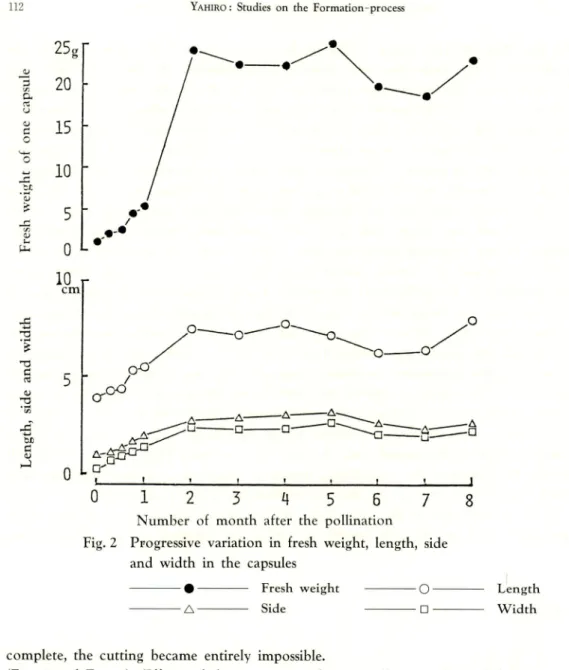
The number of month after pollination, and the results of measurement in the capsules and seeds, were shown in Fig. 2 and Fig. 3. Mean-temperature in the culture field was shown in Fig. 1. In the capsules, firstly, fresh weight and longitudinal and cross sizes increased rapidly up to the 2nd month after pollination. But, after the 2nd month from the pollination, fresh weight and size were kept nearly constant. Colour of the capsules began to change from green to brown in the 4th month after the pollination. In the 5th month, about one quarter of the upper part of the capsules changed to brown. In the 6th month, more than one half of the upper part of the capsules changed to brown, and in this period, the top part of the capsules got to be slightly split, too. In the 8th month when the seeds were ripened probably, the splitting of the capsules reached half of the capsules.
Secondly, the seeds increased rapidly up to the 2nd month after the pollination similar to the cases of capsules. The fresh weight further increased up to the 5th month and thereafter began to be decreasing gradually. The size kept itself equal after the 2nd month, and decreased slightly after the 6th month. In the Photo. 3, the seeds were arranged in the order of the number of month after the pollination.
In the Photo. 4, cut-surface in the seeds of the Photo. 3 was shown. After the
collection of the seeds, they were fixed in FAA solution. In the 2nd month after the pollination, the size became nearly the same as that of the ripened seeds in the 8th month. Up to the period of the 2nd month after the pollination, the colours of
the seed-clothes and the seed-coat were noted to be white, and the accumulation of
starch in the endosperm was not observed yet entirely, and the part of the endosperm was filled with an aqueous solution, no development of the embryo being recognized. In the 3rd month, the seed-clothes and seed-coat were white, but the accumulation of starch in the endosperm was brought forth in the inner part of the seed-coat. In the 4th month, the colour of the coat was still white, but the colour of the seed-clothes became yellowish in the top part. Adding to this, the accumulation of starch in the endosperm was almost completed, leaving a center part. In this period (in the 4th month after the pollination), the embryo was developed in the degree of 3 mm in the inner part of the germination-pore. In the 5th month, the colour of the seed-clothes turned into yellow in the entire part, the seed-coat turning into brown. In this period, the embryo was developed up to the length of 6 nam, and the accumulation of starch in the endosperm was almost completed in the entire part. In the 6th month, the colour of the seed-coat turned into dark brown, the size of the embryo becoming almost similar to the embryo of the ripened seeds (in the 8th month). In the 7th month, the colour of the seed-colthes turned into nearly Orange colour which was similar to that of the ripened seeds, the seed-coat becoming black brown. In the 8th month, the colour of the seed-clothes turned to orange one, the seed-coat becoming black. Up to the 6th month after the pollination, it was possible to cut the seed-coat by a razor, but in the 7th month, the cutting of the seed-seed-coat became fairly impossible, and in the 8th month in which the ripening of the seeds became
30°c
20
10
1 15 1 15 1 15 1 15 1 15 1 15 1 15
'82 Oct. Nov. Dec. '83 Jan. Feb. Mar. Apr. Fig. 1 Mean-temperature in the cultivation-vinylhouse
1 16
112
25gr
20 15 a 10 en (LI -a § T3 s J 0 LYahiro : Studies on the Formation-process
1 2 3 4 5 6
Number of month after the pollination
Fig. 2 Progressive variation in fresh weight, length, side and width in the capsules
• Fresh weight O
A Side •
7
Length
Width
complete, the cutting became entirely impossible.
(Exp. 2 and Exp. 3) Effects of the treatments of cone, sulfuric acid or of the removal of the seed-clothes, on the dormancy-breaking in seeds
The results were shown in Table 1. In the treatments for 3 or 5 minutes of cone,
sulfuric acid, the germination of seeds was observed on 6th day after the treatments. In the treatment of the removal of the seed-clothes, the germination was commenced on the 13th day and in the control on the 19th day. Throughout the period of the investigation, the germination-percentage was the highest in the treatment of cone. sulfuric acid for 5 minutes and was the lowest in the control (0 min.). On the 25th day of the last day in the investigation of the germination, the order of the high-germination-percentage was 5 mins, 3 mins, 7 mins, 9 mins, removal of seed-clothes, 1 min, control (0 min), respectively.
(Exp. 4) Effects of the heating-treatments on the dormancy-breaking
0.5 0.4 0.3 S 0.2 0.1 0 10 p-X 5 •S - a a ^ •-•-•' 0 1 2 3 4 5 6 7
Number of month after the pollination
Fig. 3 Progressive variation of fresh weight,
length and side in the seeds
0 Fresh weight,
O Length, A Side
at 100°C, no effects of the dormancy-breaking in seeds was recognized, the results being omitted.
(Exp. 5) Effects of the treatments of dormancy-breaking on the imbibition of water
in hard seeds
The results were shown in Table 2. In the seeds of non-treatment, the coloration
of 6% was observed in starch, in the endosperm at the part of the germination-pore, and accordingly the imbibition of water was recognized. In the treatment of cone,
sulfuric acid for 5 mins and 9 mins, the coloration of 100% was observed at the
entire part in the endosperm. The coloration of 64% was observed in the treatment for 7 days at 70°C in the dry- heating ; and in the iron-plate-heating treatment for
50 seconds, it was 48 %, and in the hot-water treatment for 60 seconds, it was 42 %,
and each part of the coloration was noted in the part of the germination-pore. Adding to this, in the treatment of the removal of the seed-clothes, the coloration (water imbibition) of 32% was observed in the part of the germination-pore.
114 Yahiro : Studies on the Formation-process
Table 1. Effects of cone, sulfuric acid treatments and seed-clothes
removal-treatment on the dormancy-breaking in the seeds.
Periods of treatment — -(minutes) 5 6 7 8 9 10 11 12 13 14 15 16 17 18 19 20 21 22 23 24 25 0 0 0 0 0 0 0 0 1 2 4 6 7 7 7 2 7 12 14 15 15 16 16 16 18 22 22 24 25 25 13 14 21 24 26 29 34 39 40 40 41 43 43 46 48 48 , 1i 24 30 32 38 42 47 50 53 53 54 55 56 56 57 57 57 14 17 21 31 34 36 36 38 40 40 41 41 42 42 43 43 13 14 18 20 22 22 26 29 33 33 33 33 34 33 34 0 0 1 1 1 1 3 3 9 11 18 21 26 27 30
Number of day after being put into a thermostat at 25°C
0 (Control) 0% 0 0 0 0 0 1 0 0 0 1 1 2 3 0 2 2 4 9 13 5 0 2 4 7 15 24 7 0 0 3 7 8 14 9 0 0 1 6 9 12 Removal of seed-clothes 0 0 0 0 0 0
Table 2. Imbibition of water and part in imbibition of the seeds put under the dormancy-breaking treatment.
Treatment
Non- treatment
Ratio of coloration
in seeds (%) Part ctf coloration
Part in the
germination-pore
Cone, sulfuric acid
t r e a t m e n t
1 min. 24 //
5 mins. 100 Whole surface of seeds
9 mins. 100 ll
Dry-heating
50°C, 3 days 8 Part in the
germination-pore 7 days 24 II 70°C, 3 days 10 ii 7 days 64 ii Iron-plate-heating t r e a t m e n t s 30 sees. 38 ii 50 sees. 48 n Hot water (100°C) t r e a t m e n t 20 sees. 30 ii 60 sees. 42 ii Seed-clothes removal 32 ii t r e a t m e n t
Coloration-ratio in seed after being immersed into 1 % jodjodkalium
dormancy-breaking-treatment
In both the treatment and the control, no effective germination was obtained, and
accordingly the results were omitted.
(Exp. 7) Effects of oxygen treatment on the germination in seeds after the
dormancy-breaking - treatmentIn both the treatment and the control, the effective germination was not obtained, Table 3. Effects of the immersion into the chemical-solutions on the germination in
the seeds put under dormancy-breaking-treatment by cone, sulfuric acid
for 5 minutes.
Solutions of Number of day after incubation at 25°C chemicals 6 7 8 9 10 11 12 13 14 15 16 17 21 25 GA 100 ppm 0% 0 2 4 4 6 6 12 14 18 18 18 18 18 BA 100 ppm 0 0 0 0 0 0 0 0 0 2 2 2 2 2 KNO30.2% 0 0 4 4 4 6 8 10 16 18 22 22 22 22 Thiourea 0.2% 0 0 0 0 2 4 6 10 14 16 16 18 18 18 H2O20.3% 0 0 0 0 0 0 0 0 0 0 2 2 2 2 Ethrel 100 ppm 0 2 4 4 4 4 6 10 14 16 18 18 20 20 GA .100 ppm + BA 100 ppm 0 0 0 0 0 0 4 6 6 6 6 6 6 6 Water (control) 0 4 4 4 6 6 6 8 8 8 10 14 16 16
Method of dormancy - breaking : cone, sulfuric acid treatment for 5 minutes
and accordingly the results were omitted.
(Exp. 8) Effects of the treatments of the several chemical substances on the germination
in seeds after the dormancy-breaking-treatment by cone, sulfuric acidThe results were shown in Table 3. In the ethrel plot and the control plot, the
germination was observed firstly on the 7th day, after the seeds were put into a
thermostat kept at 25°C.
No increase of the germination-percentage after the 17th
day was recognized, excepting the case of the control. In the treatment-plots of BA,
H202 and GA + BA, the germination-percentage was slight, being 2%, 2%, and 6%,
respectively, even on the 25th day at the thermostat.
In the treatment-plots of GA,
KNO3, thiourea, ethrel, and in the control-plot, the germination-percentage was
showed to be about 20%.Synthetic discussion
Prior to the synthetic discussion, some considerations on the structures of the
flower and on the pollination were conducted.
The flower of the bird of paradise
cultivated in the Ibusuki Experimental Botanic Garden, Kagoshima University was
showed in the Photo. 5. ® and (2) in the Photo. 5 are sepals of the orange colour
116 Yahiro : Studies on the Formation-process 00 p=-« *&
*
V
IT) COPhoto. 1 Ripe seeds
CM
o»
oo
Photo. 3 Progressive development in seeds after the pollination (Number of the week and month)
Photo. 4 Progressive development (cross-cut surface) in the seeds after the pollination. (Number of the week and month)
Photo. 5 Structure of flower 0 Sepal in possession of orange colour (2) Corolla in possession of purple colour (3) Futsuenpo Photo. 6 Structure of flower (opening to a side) © Pistil (5) Stamen X
flower is formed with sepal and corolla, and the 4-5 small flowers are contained in
the "Futsuenpo" (© in the Photo. 5), and the successive risings of the small flowers
supply the basis which will make them unwithering for a long time. In the Photo. 6,
the corolla is opened on both sides. @ and © in the Photo. 6 are pistil and stamen,
respectively ; and the white powder on the stamen are pollens. The bird of paradise
is a plant of the cross fertilization; and in- the native of South Africa, the cross
fertilization is conducted by small birds, but in Japan such birds are not discovered,
and ordinarily the corolla is fixed to be shut, accordingly the pollination by insects
can hardly be realized.
Therefore, in order to obtain any seeds, the performance of
artificial pollination is indispensable. After the pollination, a basal part of the small
flower begins to swell, and shortly after that a capsule having three chambers containing
seeds develop.In the Exp. 1, the fresh weight and the size of capsules were nearly constant after
the progress of two months after the pollination. This results show that the development
of the capsule was finished in the 2nd month after the pollination. In the seeds, a conspicuous increase of the size was recognized up to the 2nd month, and thereafter
the size was kept nearly constant. While, the fresh weight of the seeds increased up to
the 5th month and thereafter decreased gradually. On these results, it was assumed
that the volume of the seeds was fixed in the early period of the development, and
thereafter the inner substances got to be filled.
This consideration was supported by
the inner observation. In this experiment, the degree and the period of the development
in the embryo were ascertained, therefore, in future, the period of the hardening in
the seed-coat may be studied.In the Exp. 2, the effects of the treatments of cone, sulfuric acid and sulfuric acid
were discovered already in sweet potato19', Ipomoea obscura HASSK8), Charlock (Sinapis
arvensis L.)7), Penngift Grownvetch (Coronilla varia L.)3) and so on. The most effective period is quite variable in accordance with the kinds of the plant, and in the seeds of Ipomoea obscura HASSK8', such high germination-percentage as 98 % was obtained even by the treatment of such long time as 180 mins. In the seed of the bird of
paradise, the highest effect got out of the treatment of 5 mins was reported by Ishihata
(1976)11'. It was assumed that the lower germination-precentage of the treatments of
one or three minutes was due to the negligible stripping of the seed-coat by the
treatment of cone, sulfuric acid. These results were supported by the fact that judging
from the result of water-imbibition in the Exp. 5, the water-imbibition from all the surfaces of the seed-coat occurred in the treatment of 5 mins, but in the treatment of one min. no water-imbibition from the seed-coat was brought forth. Conversly, in the treatments of such long period as 7 or 9 mins, the germination-percentage turned to be lower: and from the above results it was assumed that by the effect of the
strong stripping of the seed-coat, the cone, sulfuric acid was made to be penetrated
into the seed, and the embryo and others might be put on the exertion by the injury.
In the present experiment, the result similar to that of Ishihata's report (1976)u) in
which the treatment of cone, sulfuric acid for 5 mins was most effective to the
dormancy-breaking of the seeds, was obtained. In the previous various kinds of the seed, higher germination-percentage counting over 80% by the treatment of cone.
120 Yahiro: Studies on the Formation-process
sulfuric acid were reported, but in the seed of the bird of paradise, even in the case when the penetration of 100 % of water was brought forth, such slight germination-percentage as 57 % was only obtained. From this, it was assumed that in the bird of paradise, some germination-inhibition factors are existent in the seed besides the hard
seed-coat.
In connection with the Exp. 4 in the dry-heating treatments, the method of breaking the unpenetration of water was conducted in alfalfa, sweet clover and red clover, with the recognition of those effects181. In the alfalfa, the high germination-percentage was obtained by the treatment of one hour at 87°C, but beyond one hour, the germination-percentage began to be decreasing181. In the other dry-heating experiment in alfalfa, the treatment of 30-60 mins at 70°C-75°C was most effective91. The dry-heating treatments have been used in dormancy-breaking to the seeds. In the experiment of the dormancy-breaking using the seeds of weed, the germination-percentage of more than 90% was obtained by the dry-heating treatment of 14 days at 50°C or 60°C14). When considered with the condition of water imbibition in the present experiment, even if the water imbibition occurred, no germination of seeds was recognized, accord ingly it was assumed that all the seeds of the treatments were died. In the present experiment, although the temperatures used in the dry-heating treatment were nearly the same ones as were used in the breaking of unpenetration of water in other hard seeds ; as the time of the treatment of the seeds in the bird of paradise was longer by 7 or 14 days, in future the treatment of the short time may be required. In the heating treatment of iron-plate in the Exp. 4, a method of rolling the seeds on the slanted iron-plate heated with gas-burner was adopted by Luden et al. (1957)151. In this experiment, the highest effect of germination-promotion was obtained in case of 510°C in the surface temperature of iron-plate. In the present experiment, although the surface temperature on the iron-plate could not be measured, in case of exceeding 55-60 seconds in the time of the treatment, the seeds bumped and split, the embryo which was exposed and the seeds were made to be burned, accordingly, although the treatment of the seeds was conducted within 50 seconds, no occurrence of germination was brought foth, and it was assumed that the seeds of the treatments were died. The treatment of hot-water at 100°C in the Exp. 4 was also applied to the breaking of the unpenetration of water for seeds, similarly to the case of dry-heating. Immer sions into hot water at 100°C for 30 seconds31 in Penngift Crownvetch (Coronilla varia L.) and for 2 minutes1' in Red bud (Cercis candensis L.) were the most effective. In the present experiment, the treatment time within one minute for seeds was adopted, but no germination of the seeds was obtained, although in the Exp. 5, the volume of water-imbibition in the seeds increased obviously. From this fact, it was assumed that similarly to the cases in the treatment-results of dry-heating and iron-plate-heating the seeds were died. Although it was anticipated by the authors that the treatments of dry-heating, iron-plate-heating and hot-water at 100°C should replace the dangerous chemicals like cone, sulfuric acid, removing the difficulty in the treatment of a lot of seeds, it happened that the seeds of the bird of paradise were weak to heating, compared with previous hard seeds; and so the seeds were enforced to be died, accordingly the anticipation could not be realized.
In connection with the Exp. 5, it was reported by Christiansen (1959)6) that in the
seed of the wild cotton between the hardened seeds and unhardened seeds there was
a difference anatomically as might be seen in opening or unopening of the part of chalaza in the germination-pore, and further the treatment of one minute at 80 °C made the shut-condition broken at the part of chalaza. Moreover, in Lupine (Lupinus angustifolius) the water-imbibition was brought forth in the part of hilum by the treat ment of sulfuric acid51. In the present experiment, some water-imbibition from the germination-pore (6%) was observed in the colorinating experiment carried out with
the use of solution of jodjodkalium in the seeds of the bird of paradise.
As this
result was consistent with the germination-percentage of the control in the Exp. 2, it
was assumed that in the seed in the bird of paradise, the opening and the shutting in
the part of the germination-pore should control the penetration of water, playing a
part as a factor in the inhibition of germination. As stated before, the seed of the birdof paradise is in possession of some peculiar seed-clothes in the part of the
germination-pore. It was reported by Ishihata11' that the existence of the seed-clothes was hardly
related with germination in the seeds. In the present experiment, a higher
germination-percentage in comparison with the control was obtained in the treatment of the removal
of seed-clothes, and also in the Exp. 5, the number of the seeds of water-imbibition
increased ; and further the number of the seeds of water-imbibition was equal to the
germination-percentage in the removal of seed-clothes. From the above mentionedfacts, it was assumed that both the opening and the shutting of the germination-pore
and the existence of the seed-clothes were related with the restriction of the penetration
of water.
In the treatment of one minute with cone, sulfuric acid, the percentage of
water-imbibition in seeds and the germination-percentage of the seeds were lower than those in the treatment of the removal seed-clothes. From the above mentioned facts, it was assumed that in the treatment of one minute with cone, sulfuric acid, the seed-clothes were entirely remained. Moreover, farmers cultivating the bird of paradise have experimentiarily observed the fact that in the removal of the
seed-clothes the germination-percentage of seeds was higher and the germination uniformity
was better than those of the intact seeds. Accordingly, seeding have been carried out after the removal of seed-clothes. In the present experiment, in which the method of
the removal of seed-clothes was adopted, the effect of germination-promotion on the
seeds was recognized clearly. Excepting the treatment of cone, sulfuric acid lasting more
than 5 minutes, the water-imbibition occurred in the part of the germination-pore.
In future, a discovering of some methods in which no loss of germination-force in the seeds should be brought forth and the germination-pore should be kept open, will
be realized.
In connection with the Exp. 6, the germination-promotion of seeds in a lot of
plants have been brought forth by the alternate temperature treatments. But, the range
of the alternate temperatures, and the suitable lasting periods in low and high temper
atures were various161. For example, in Crimson Clover the highest effect of alternate temperature was to be obtained in the range extending from 16°C to 33"C or from 11°C to 21 °C in the intervals of 12 hours211. Generally, the alternate temperatures of 8 hours at 30°C and of 16 hours at 20°C have been used161. In the present experiment,
122 YAHIRO: Studies on the Formation-Process
the method of the above mentioned universal alternate temperature was used under the condition of imbibition of water after the treatment of cone, sulfuric acid was
applied to seeds, but the germination of seeds was hardly obtained, not excluding the control. In future, the adoption of various ranges of temperature and various combina tions the period should be realized.
In the Exp. 8, immersion into the chemical-solutions was conducted after the penetration of chemicals was promoted with the treatment of cone, sulfuric acid applied
for 5 minutes. It has been known that in the seeds of Yellow Foxtail (Setaria lutescens
(Weigel) Hubb.), the treatment of cone, sulfuric acid applied for 30 mins previously to GA-treatment, gave a change to the palea and the lemma, and promoted a penetration of hormone into the seeds; accordingly, the germination-promotion of GA to seeds was clarified14). The effects of chemicals adopted in the present experiment on the germination-promotion for seeds have been made known in the following papers. In the gibberellin (GA), the effect of the germination-promotion covering the three concentrations of 10~2M, 10~3M and 10"4M in the 9 species of the 11 species in the weeds was discovered by Holm et al. (1972)10). In GA-treatment of 2000mg 1_1 in the seed charlock, the germination-percentage increased with the increase of the time of immersion7). In benzyladenine (BA), the treatment was effective to the germination
in the seeds in Yellow Foxtail, and moreover, the addition of GA showed higher
germination-percentage14). In ethrel, higher germination-promotion was recognized in the immersion-treatment of 500, 1000 and 2500 ppm applied for 24 hours to the seeds of strawberry12). Potassium nitrate has been used widely in the seed-inspection as a chemical of germination-promotion applicable to seeds, and in Celosia cristata L., Digitalis purpurea L. and Chenopodium album some effects higher than any other treatments were obtained17). Thiourea and oxygenated water have been used as the chemicals of germination-promotion in seeds. In thiourea, it was reported by Holm et al. (1972)10) that the germination-promotion effect was recognized in the 9 species of the 11 species of weed-seeds. Moreover, it was reported by Brennan at al4). that some effect of the germination-promotion was recognized in the dormant seeds of Ragweed (Ambrosia artemisiiforia L.). In the oxygenated water in paddy rice, a considerable effect (30%-* 92%) of the germination-promotion was noted in the ones immersed into the solution of the concentration of 0.3 % for 6 hours17). In the present experiment, in spite of the fact that whole effective cnocentrations of chemicals were used, no effect of the germination-promotion was obtained irrespective of the kinds of the chemicals. Conversely, the effects of germination-inhibition were recognized in BA (100 ppm), H2O2(0.3%) and GA (lOOppm) + BA (lOOppm). As mentioned previously, the effective concentrations and the effective periods of the immersion in the chemicals are various in accordance with the varieties of the plant, accordingly it is not possible to fix whether chemicals used in the present experiment are effective to the bird of paradise or not. In future, various concentrations and various periods in the immersion into the chemicals should be attempted.
In connection with the Exp. 8, in the hardened seeds, it has been known that the seed-coat inhibits the penetration of water as well as the penetration of oxygen2). In the seeds of Charlock, the higher germination-percentage was obtained in accordance
(with the increasing of the pressure of oxygen71. Moreover, in the seeds of Acer pseudoplatanus L., a high germination-promotion was brought forth by O2- treatment for intact seeds, and the further effect was recognized by being harmed on the
seed-icoat221.
In the seeds of Ragweed, the effect of treatment by oxygen was hardly
recognized41. In the present experiment, no effect of oxygen-treatment carried out after the treatment with cone, sulfuric acid was recognized. However, from the two facts, namely, the one that the germination of seeds was hardly obtained even in the control and another that the germination-percentage in the control with the experiment became lower, it was assumed that either the decline of germination-force during preservation of seeds occurred, or the seeds entered into the second dormancy due to some unknown cause. The reason why the decline of germination-force in the seeds occurred, was left unclarified ; and in future some change might be brought in the method of storage and the variation of germination-force with progress of the time after the collection of the seeds should be investigated.
From the Exp. 2 to the Exp. 8, the physical and chemical treatments were conducted for bringing a germination-promotion in the seeds of the bird of paradise, aiming at increasing the germination-percentage and further at improving the germination-speed. But these two aims were left unaccomplished. From the present experiments, in the seed of the bird of paradise the hardness in the seed-coat (unpenetration of water) was assumed to be the first factor in the prevention of germination for seeds, but it was suggested that other factors of the prevention of germination might be in existence ; accordingly in future more detaild studies should be put into practice.
Summary
Firstly, in the seeds of the bird of paradise, concerning the capsules and the seeds within them the progress of the development was investigated. Secondly, the effects of the physical and chemical treatments for seeds on the germination-promotion were investigated. The results were shown in the following :
(1) Capsules containing the seeds developed rapidly up to the 2nd month after the artificial pollination, and thereafter the development was not to be observed. (2) Seeds developed rapidly till the 2nd month after the artificial pollination, similar
to the case of capsules, and thereafter the development of the size was not to be observed, but a repletion of the contents was recognized.
(3) Embryo developed to the length of 3 mm in the 4th month after the pollination, in the 5th month developing the length of 2/3 of that in the perfect seeds, in the 6th month, to the length of that in the approximately perfect ones.
(4) Of the various periods of treatment the treatment of cone, sulfuric acid carried out for 5 minutes was noted to be most effective for the promotion of germination. (5) The removal of the seed-clothes was slightly effective for the promotion of
germination.
(6) In the treatments of dry-heating, iron-plate-heating and hot-water at 100°C, no germination was obtained, and probably the seeds might have been died.
124 Yahiro: Studies on the Formation-process
(7) In the treatment of alternate temperature carried out for 8 hours at 30°C and in that for 16 hours at 20 °C after trie treatment of cone, sulfuric acid made for 5 minutes, no germination-promotion of the seeds was recognized.
(8) In the oxygen-treatment after the treatment of cone, sulfuric acid carried out for 5 minutes, no effect of germination-promotion of seeds was recognized. (9) In the treatment of immersion into the solutions of gibberellin (lOOppm),
benzyladenine (lOOppm), potassium nitrate (0.2%), thiourea (0.2%), oxygenated
water (0.3%), ethrel (lOOppm) and gibberellin (lOOppm) + benzyladenine (100 ppm), respectively, after the treatment of cone, sulfuric acid performed for 5 minutes, no effect of germination-promotion was obtained.(10) In the seed of the bird of paradise, the hardness of the seed-coat (unpenet ration of water) was noted to be the first factor in the prevention of germination in seeds, but it was suggested that other factors effective for the prevention of
germination might be in existence.
10
n
References
Afanasiev, M. 1944: A study of dormancy and germination of seeds of Cercis canadensis. J. Agr. Res., 69 (10), 405-420.
Ballard, L. A. T. 1973: Physical barries to germination. Seed Sci. & Technol.,
1, 285-303.
Brant, R. E. et al. 1971: Effect of chemical and physical treatment on hard seed of Penngift Crownvetch. Crop Soi., 11, 1-6.
Brennan, T. et al. 1978: Interaction of oxygen and ethylene in the release of Ragweed seeds from dormancy. Bot. Gaz., 139 (1), 46-49.
Burns, R. E. 1959: Effect of acid scarification of Lupine seed impermeability.
Plant Physiol., 34 (2), 107-108.
Christiansen, M. N. et al. 1959: Seed coat structural differences that influence water uptake and seed quality in hard seed cotton. Agron. J., 51 (10),
582-584.
Edwards, M. M. 1968: Dormancy in seeds of Charlock II. The influence of the seed coat. J. Exp. Bot. 19 (60), 583-600.
Hardcastle, W. S. 1978: The influence of temperature and acid scarification duration on Ipomoea obscura Hassk. seed germination. Weed Res., 18 (2), 89-91.
Hayakawa, R. et al. 1976: Variation in the rate of hard seed among Alfalfa ecotypes and methods of hard seed elimination. Res. Bull. Hokkaido National
Agr. Exp. Station., 116, 43-52.
Holm, R. E. et al. 1972: Weed seed germination responses to chemical and physical treatments. Weed Sci., 20 (2), 150-153.
Ishihata, K. 1976: Studies on the promoting germination and the growth of seedling in Strelitzia reginae Banks. Mem. Fac. Agr. Kagoshima Univ., 26, 1-15.
12) Iyer, C. R. et al. 1970: Ethrel for breaking dormancy of strawberry seeds. Curr,
Sci., 39, 271-272.
13) Knight, W. E. 1965: Temperature requirement for germination of some Crimson
Clover lines. Grop Sci., 5, 422-425.14) Kollman, G. E. et al.: Hormonal aspects of seed dormancy in Yellow Foxtail.
Weed Sci., 20 (5), 472-477.
15) Luden, A. O. et al. 1957: The effect of high temperature contact treatment on hard seeds of Alfalfa. Agron. J., 49 (3), 151-153.
16) Nakamura, S. 1979: Germination-physiology in agriculture and forestry seeds (3).
Agr. and Hort, 54 (12), 1545-1550..17) Nakamura, S. 1980: Germination-physiology in agriculture and forestry seeds (11). Agr. and Hort., 55 (10), 1294-1300.
18) Rincker, C. M. 1954: Effect of heat on impermeable seeds of Alfalfa, Sweet Clover. Agron. J., 46 (6), 247-250.
19) Steinbauer, C. E. et al. 1937: Methods of scarifying Sweet Potato seed. Proc.
Amer. Soc. Hort. Sci., 35, 606-608.
20) Takada, M. 1970: The most recent horticultural dictionary, 2685-2686.
21) Taylorson, R. B. et al. 1977: Accelerated after-ripening for overcoming seed dormancy in grass weeds. Weed Sci., 25 (6), 473-476.
22) Webb, D. P. et al. 1972: Seed dormancy in Acer pseudoplatanus L. :The role of the covering structures. J. Exp. Bot., 23 (77), 813-829,