老化に伴うラットの味覚嗜好性の変化
著者
原田 秀逸, 三浦 裕仁
雑誌名
鹿児島大学歯学部紀要
巻
35
ページ
11-19
発行年
2015
別言語のタイトル
Changes of gustatory preference with age in
the rat
老化に伴うラットの味覚嗜好性の変化
原田 秀逸・三浦 裕仁
鹿児島大学大学院医歯学総合研究科 先進治療学専攻 生体機能制御学講座 口腔生理学分野
Changes of gustatory preference with age in the rat
Shuitsu Harada, Hirohito Miura Department of Oral Physiology,
Kagoshima University Graduate School of Medical and Dental Sciences, 8-35-1 Sakuragaoka, Kagoshima 890-8544, Japan
ABSTRACT
The effect of aging on taste were compared between the preference and neural responses from the greater superficial petrosal nerve (GSP) innervating the soft palate and the chorda tympani nerve (CT) innervating the fungiform papillae in the young (5-12 weeks) and aged (19-22 months) Sprague Dawley rat. A two-bottle preference test revealed that younger rats significantly preferred 0.001 M 5'-inosine monophosphate (IMP), 0.01 M mono sodium glutamate (MSG), and binary mixtures of 0.001 M IMP + 0.01 M MSG than deionized water. However, aged rats showed no significant preference to these umami solutions. Among the other four basic taste stimuli, there was no significant difference in preference between young and aged rats. Regardless of the age of the rat, neural responses from the GSP and CT produced robust integrated responses to all three umami solutions the same as used in the two-bottle test. These results indicate that the lack of preference to umami in aged rats is occurred in the central nervous system, suggesting that the loss of preference to umami taste in aged rats may be caused by homeostatic changes in the brain.
Key words: taste, aging, umami, neural information, preference はじめに 老化に伴って,ヒトでは四基本味である甘味,苦味, 酸味,塩味の全ての閾値が上がるという報告1),苦味 と酸味に対する味覚強度だけが減少する2-5),あるい は苦味対する味覚強度だけ減少する6-8)という報告が ある。さらに,甘味と塩味の閾値は老化によって変わ らない4, 5, 8, 9) という報告もあり,老化が味覚におよぼ す影響は明確ではない。一方,うま味に対する味覚感 受性の老化に伴う変化については,グルタミン酸ナト リウム (MSG) に対する味覚閾値が老人では5.04倍上 昇するという報告10)があるが,若者と老人の間では, うま味の好ましい味の濃度には差が無いという報告11) もあり明確ではない。このように,報告によって味覚 に対する感受性が異なる原因は,対象グループの年齢 構成,口腔の健康状態,薬物使用の有無などによる可 能性が指摘されているし1),老化に伴う嗅覚の減退が およぼす影響も無視できない12)。 ラットの行動実験では蔗糖 (Suc) と食塩 (NaCl) に 対する嗜好性は年齢の増加と共に閾値が上がるが,塩
原田 秀逸・三浦 裕仁 12 酸キニーネ (QHCl) に対しては変化しない13)。しか し,C57BL/6J と 129X1/SvJ マウスでは,年齢によっ て味覚嗜好性はほとんど変化しない14)。また,動物の うま味嗜好性が年齢によって変化するか否かは明らか にされていない。 味覚情報は口腔内部位によって異なる3つの主要な 味覚神経を介して中枢へ伝えられる。茸状乳頭味蕾は 鼓 索 神 経 (chorda tympani nerve, CT), 軟 口 蓋 (soft
図1 うま味と甘味刺激に対する嗜好性に対する味覚神経切断の影響。A は非条件付け,B ~ H はうま味に対して忌避 条件付けした後,GSP, CT, 舌咽神経 (GL) 両側切断によってうま味物質,甘味に対する忌避の程度が変化するかを調べ た。0.1 M MSG + 0.01 M IMP 混合液によりうま味忌避条件付けを行ったが,うま味物質が Na 塩であり,条件付けの際 の Na 味の効果を減退するために 5x10⁻⁵ M アミロライドを加えた。切断した味覚神経は B: CT, C: GSP, D: GL, E: 切断神
経なし , F: GSP+GL, G: CT+GL, H: CT+GSP。エラーバーは標準誤差を示す。0.1 M MSG+0.01 M IMP, 0.1 M MSG+0.01 M guanosine 5'-monophosphate (GMP), 0.03 M IMP, 0.03 M GMP, 0.3 M MSG, and 0.3 M monopotassium glutamate (MPG), 0.1 M Suc, 0.5 M Suc, 0.25 M L-alanine。(Sako et al., Physiol. Behav., 200020) から )
palate, SP) 味蕾は大錐体神経 (greater superficial petrosal nerve, GSP),舌奥の有郭乳頭および葉状乳頭味蕾の 一部は舌咽神経 (glossopharyngeal nerve, GL) によって 支配されている15-19)。うま味情報は,ラットでは主に 軟口蓋を支配する GSP と舌茸状乳頭味蕾を支配する CT によって中枢へ伝えられることを著者らは明らか にした (図1)。そこで,本研究では,老化に伴う味 覚の変化,特にうま味嗜好性の変化のメカニズムを解 明するためにラット GSP と CT に注目して実験を行っ た。 材料および方法 2-1 実験動物 動物は,雄ラット (Sprague Dawley, 若齢 : 5~12 週 , 老齢 : 19~22ヶ月) を用いた。二瓶選択法による嗜好 実験の後に,GSP および CT からの神経応答解析実験 を行った。全ての動物実験は,鹿児島大学動物実験規 則に従い,動物実験委員会の許可を得て実施した。 2-2 二瓶選択法嗜好実験 実験には若齢 (5~12 週, n = 7) および老齢 (21~ 22ヶ月, n = 4) の雄ラットを用いた。動物はポリカー ボネートのケージに1匹ずつ入れ,固形餌 (CE-7, Clea Japan, Inc.) を自由に摂取させた。実験室温およ び試験液の温度は22±1℃に維持し,08:00~20:00の 昼夜サイクルにした。リッキング行動で流量を制御す るステンレス製の吸い口 (直径4.7 mm, 東洋理工) を 付けた2本のガラス瓶で溶液を提示した。2本の吸い 口間の水平距離は3cm とした。 嗜好実験スケジュール (表1) は,実験開始から第 1期間は,脱イオン水 (DW) を入れた試験瓶1本の みを24時間,4日間提示して,吸い口からの摂水を学 習させた。第2期間の4日間は,DW を入れた試験瓶 2本を08:00から20分間,20:00から20分間提示し,そ れ以外は絶水状態にした。吸い口の位置効果を避ける ために,2本の試験瓶は1日2回の提示開始時に左右 を入れ替えた。第3期間は,試験溶液と DW を同時 に08:00から20分間提示し,左右の試験瓶を入れ替え て20:00から20分間提示し,それぞれの消費量を2日 間測定した。第4期間は,DW を入れた試験瓶2本を 08:00に20分間,20:00に20分間,1日測定した。その 後は試験物質を変えて期間3, 4を繰り返した。 試験溶液は,0.1 M NaCl, 0.3 M Suc, 0.01 M HCl, 0.001 M QHCl, 0.001 and 0.003 M 5'-inosine monophosphate (IMP), 0.01and 0.03 M mono sodium glutamate (MSG), 0.001 M IMP + 0.01 M MSG 混合物 , 0.003 M IMP + 0.03 M MSG 混合物を用いた。 嗜好率は,次の式により求めた。 嗜好率 = 2 × a/(a + b) - 1; a = 試験溶液の摂取量, b = DW の摂取量 2本の試験瓶の試験溶液と DW の間に有意差があ るか否かを Student’s t-test で検定した。 2-3 神経応答記録実験 若齢 (5~12 週, n = 7) および老齢 (21~22ヶ月, n = 9) の雄ラットを用いた。GSP と CT の分離方法につ いては,別の論文で述べた21, 22)。神経束からのインパ ルス応答は増幅して積分し (時定数0.3 sec),1mm/ sec のスピードでサーマルアレイ・レコーダーに描記 した21)。DW および刺激液は直径2mm のポリエチレ ンチューブで刺激領域に1ml/sec で流した。刺激部位 を DW で常時洗浄し,三方向電磁バルブで10秒間刺 激液に切り替えた。刺激液の濃度は切り替え後1秒以 内にその最大濃度に達した。 用いた刺激液は,0.1 M NaCl, 0.5 M Suc, 0.01 M HCl, 0.01 M QHCl, 0.001 and 0.003 M IMP, 0.01 and 0.03 M MSG, および0.001 M IMP + 0.01 M MSG 混合物 , 0.003 M IMP + 0.03 M MSG 混合物を用いた。DW 洗浄液お よび刺激液は20 ± 1℃で与えた。
CT 応答は,Na 塩である IMP and MSG の Na+に対
表 1 嗜好実験スケジュール 期間 試験瓶 提示時間 日数 備考 1 DW1本 24時間 4 licking 学習 2 DW2本 08:00-08:20, 20:00-20:20 4 licking 学習 3 DW1本 , 試験溶液1本 08:00-08:20, 20:00-20:20 2 左右入れ替え 4 DW2本 08:00-08:20, 20:00-20:20 1 5以降 期間3,4を繰り返す 08:00-08:20, 20:00-20:20
原田 秀逸・三浦 裕仁 14
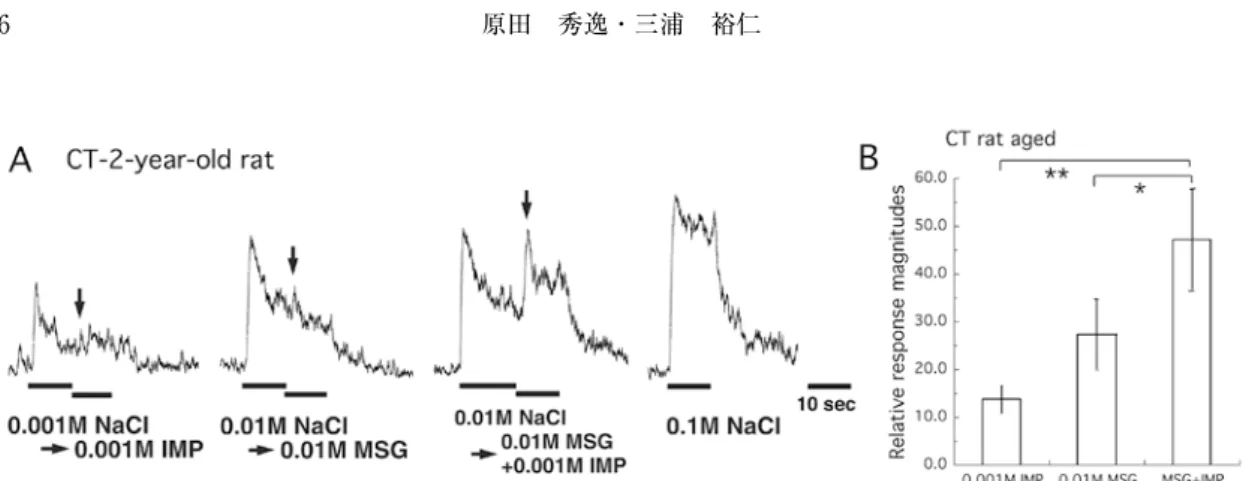
して大きな積分応答を引き起こし,うま味応答をマス クしてしまうので,うま味刺激と同一濃度の NaCl で 10秒間前順応してからうま味刺激を与えた。0.001 M NaCl 前順応後0.001 M IMP, 0.01 M NaCl 前順応後 0.01 M MSG,また,0.001 M IMP + 0.01 M MSG の混合物 刺激には0.011 M ではなく0.01 M NaCl で前順応した。 GSP および CT 積分応答の基線からの初期の phasic 応答値を測定し,標準刺激 (0.1 M NaCl) に対する phasic 応答値に対する比率を%で表した。うま味物質 に対する CT 応答では,10秒間の NaCl 前順応後の tonic 応答からの応答の大きさ (図5矢印) を測定し た。 2-4 血液検査 若齢 (8週齢 , n = 5) および老齢 (19ヶ月齢 , n = 5) ラットについて,血漿総蛋白質,血漿アルブミン,血 漿 尿 素 窒 素, ク レ ア チ ニ ン, 血 糖 レ ベ ル を SPOTCHEM EZ (SP-4430, ARKRAY USA, Edina, Minnesota) を用いて測定した。
2.5 統計解析
行動解析は,刺激溶液と DW との間の摂取量に差 があるか否かを Student’s t-test で検定した。神経生理 学実験で得られたデータは3種のうま味刺激に対する 応 答 に つ い て,two-way ANOVA お よ び Bonferroni/ Dunn を用いて有意差の検定を行った。 結 果 3-1 二瓶選択法嗜好実験 二瓶選択法嗜好実験の結果,若齢および老齢ラット の両方とも0.001 M QHCl を有意 (p < 0.0005) に忌避 し,0.3 M Suc を 有 意 に ( 若 齢 p < 0.0005, 老 齢 p < 0.005) 好んだ。うま味溶液 0.001 M IMP, 0.01 M MSG, 0.001 M IMP + 0.01 M MSG については,若齢ラットは 強い嗜好性を示した (p < 0.0005) が,老齢ラットは嗜 好性を示さなかった (図2)。 図2 四基本味およびうま味刺激に対する二瓶選択法で得られた嗜好率。若齢ラット (5~12 週齢, n = 7) および老齢ラッ ト (21~ 22月齢, n = 4) から得られた結果。エラーバーは標準誤差を示す。米印は試験溶液と DW 間の摂取量の Paired t-test による有意差を示す;***p < 0.0005, **p < 0.005, *p < 0.05。(Miura et al., Neurosci. Lett., 2014 23)から )
3.2 GSP および CT からの神経応答記録実験 若齢ラットの結果と同様に20),四基本味,うま味物 質に対して,老齢ラットで明瞭な GSP 応答を生じた (図3, 4)。また,0.001 M IMP + 0.01 M MSG 混合物 刺激は,有意な増強効果を示した (図4)。CT 応答で は,NaCl (0.001, 0.01, 0.1 M NaCl) は10秒の前順応開 始時に大きな応答を生じ (図5-A),NaCl 前順応10秒 後に与えたうま味物質は明瞭なうま味応答 (図5A 矢 図 3 若齢 (8週齢, 上段 ) および老齢 (24月齢, 下段 ) ラット GSP から得られた,0.003 M IMP, 0.03 M MSG, 0.003 M IMP + 0.03 M MSG 混合物 , 0.5 M Suc, 0.1 M NaCl および DW で刺激した場合の積分応答の一例。刺激は 10 秒間与えた。(Miura et al., Neurosci. Lett., 2014 から23))
図 4 老齢ラット (21~24月齢, n = 4) ラット GSP から得られた 0.01 M HCl, 0.01 M QHCl, 0.5 M Suc, 0.001 M IMP, 0.01 M MSG および 0.001 M IMP + 0.01 M MSG 混合物に対する積分応答の平均値。0.1 M NaCl phasic 応答を 100 とした相対値。 エラーバーは標準誤差。米印は post hoc test による有意差を示す;**p < 0.005,*p < 0.05。(Miura et al., Neurosci. Lett., 2014 23) から )
原田 秀逸・三浦 裕仁 16 印) を生じた。以前の若齢ラットでの実験結果20)と同 様に,老齢ラットで,0.001 M IMP + 0.01 M MSG うま 味混合刺激に対して CT 応答においても有意な増強効 果が認められた (図5)。 3.3. 血液検査 老齢ラットの生理学的状態を若齢ラットと比較する ために,血液検査を行った。結果は,総血漿蛋白およ びクレアチニンレベルは若齢と老齢ラット間で差が無 かったが,血漿アルブミン (p < 0.05),尿素窒素 (p < 0.05),血糖値 (p < 0.005) は老齢ラットの方が若齢 ラットより有意に低かった (図6)。
図 5 A: 老齢 (24月齢 ) ラット CT から得られた,0.001 M NaCl 前順応後の 0.001 M IMP, 0.01 M NaCl 前順応後の 0.01 M MSG, 0.01 M NaCl 前順応後の 0.001 M IMP + 0.01 M MSG 混合物 , 0.1 M NaCl 単独で刺激した場合の積分応答の一例。順 応および刺激はそれぞれ 10 秒間与えた。B: 老齢ラット (21 ~ 24 月齢 , n =5) CT から得られた 0.001 M IMP, 0.01 M MSG, and the binary mixture of 0.001 M IMP + 0.01 M MSG 混合物に対する積分応答の平均値。0.1 M NaCl phasic 応答を 100 とした相対値。エラーバーは標準誤差。米印は post hoc test による有意差を示す;**p < 0.005, *p < 0.05。(Miura et al., Neurosci. Lett., 2014 23) から )
図 6 若齢 (8週齢, n = 5) および老齢 (19月齢 ) ラットの血液検査結果。T-Pro: 総血漿タンパク質 , Alb: 血漿アルブミン , BUN: 血漿尿素窒素 , Cre: クレアチニン , Glu: 血糖 . エラーバーは標準誤差。米印は pst hoc test による有意差を示 す ; **p < 0.005, *p < 0.05。(Miura et al., Neurosci. Lett., 2014 23) から )
考 察 うま味は出生後から摂食行動の重要な手がかりとな る。母乳は遊離グルタミン酸に富み24, 25),ヒト新生児 は MSG に対して強い嗜好性を示す26)。著者らは,味 覚神経を切断したラットの行動解析によって,3種の 主要な味覚神経の中で,うま味情報が主に GSP と CT を介して運ばれることを明らかにした20)。本研究は, ヒトと同様に若齢ラットは IMP, MSG および IMP と MSG の混合物に対して強い嗜好性を示すが,老齢 ラットのうま味物質に対する嗜好性が消失することを 明らかにした。 うま味嗜好性が消失しているにも関わらず,老齢 ラットで GSP と CT の両神経共に,IMP の混合によっ て現れる MSG+IMP のうまみ相乗効果の特徴27)をも つ,うま味神経応答を生じた。Suc に対する応答と同 様に,IMP, MSG および IMP + MSG 混合物に対して 若齢ラットでも老齢ラットでも GSP から大きな応答 が得られ,このことは,うま味情報は老化に関係なく 脳へ運ばれていることを示している。 うま味とは対照的に,甘味は若齢ラットのみなら ず,老齢ラットでも強い嗜好性を生じさせた。Tas1r ファミリーの特定の組み合わせが甘味あるいはうま味 受容体として機能する。すなわち,うま味は Tas1r1と Tas1r2,甘味は Tas1r2 と Tas1r3のヘテロダイマーであ る28)。このように,うま味と甘味は,味蕾の同じ味覚 受容体のサブユニットを共有しているから,神経生理 学実験および行動実験の両方において老化の影響は同 じであることが予測される。しかしながら,本研究結 果で,老齢ラットはSucを有意に好むのにも関わらず, 若齢ラットで観察されたうま味に対する嗜好性が老齢 ラットでは消失した。 タンパク質あるいは必須アミノ酸の L リジン(Lys) を欠乏した餌で飼育したラットは,Lys, グリシン, NaCl の消費量が増加するが,うま味物質に対する嗜 好性は増えない。しかし,それらの欠乏から回復する とうま味物質に対する嗜好性は現れる27)。本実験で は,総血漿タンパク質は若齢ラットと老齢ラットの間 で差が無く,病的な飢餓の兆候がないことを示し,老 齢ラットにおけるうま味物質に対する嗜好性の減少は 血漿タンパク質のレベルとは関係ないと考えられる。 血糖の影響について,血糖値が低下すると摂食行動 が惹起する29)。本実験では,血糖値は老齢ラットで若 齢ラットよりも低く,同様の雄ラットの老化に伴う血 糖値の低下の報告がある30)。一方,食物摂取とエネル ギー消費は老化と共に減少する31)。老齢ラットで血糖 値が低いにも関わらず,逆に食物摂取が低下している 関係は,他の制御機構の関与が関与していると考えら れる。食欲には多くのニューロペプチドやホルモンが 関与しており,それらの効果が老化に伴い変化する可 能性を示唆している32-34)。成ラットで,saccharin 甘味
溶液摂取は視床下部の orexin-A と NPY の mRNA レベ ル が 増 加 さ せ,orexin-A, NPY, melanin-concentrating hormone (MCH) の脳室内投与 (intracerebro ventricular, ICV) は saccharin 摂取を増加させる32)。orexin-A, NPY
および ghrelin の ICV 注入は4月齢および11月齢ラッ トの食物摂取を濃度依存的に増加させる31)。一方,老 化ラット (24~27月齢) では,ghrelin は効果は小さく なるが食物摂取を増加させる。しかし,orexin-A と NPY はどの濃度でも食物摂取を刺激しない31)。これ らの報告から,甘味とうま味の間の味覚嗜好に対する 老化の影響の違いは,ニューロペプチドの寄与の違い に基づく可能性が考えられる。すなわち,うま味物質 に対する嗜好行動は,ghrelin ではなく,orexin-A と NPY のような効果は老齢ラットでは有効ではない因 子を介していると考えられる。うま味の神経情報は CT と GSP 神経によって脳に送られるのに,うま味に 対する嗜好性は惹起されず,一方,Suc に対する嗜好 は老齢ラットでも有効な ghrelin あるいは別のニュー ロペプチドによって媒介される可能性が考えられる。 謝 辞 本研究は,一部,平成17~18年度 うま味研究会研 究助成金によって行った。 参考文献
1. Mojet, J., Christ-Hazelhof, E., Heidema, J.: Taste perception with age: Generic or specific losses in threshold sensitivity to the five basic tastes? Chem. Senses, 26, 845-860, 2001
2. Bartoshuk, L. M., Rifkin, B., Marks, L. E., Bars, P.: Taste and aging. J. Gerontol., 41, 51-57, 1986
3. Cowart, B. J.: Relationships between taste and smell across the adult life span. Ann. New York Acad. Sci., 561, 39-55, 1989
原田 秀逸・三浦 裕仁 18
sucrose, NaCl, citric acid and caffeine. Neurobiol. Aging., 2, 315-318, 1981
5. Murphy, C., Glilmore, M. M.: Quality-specific effects of aging on the human taste system. Percep. Psychophys., 45, 121-128, 1989
6. Mojet, J., Heidema, J., Christ-Hazelhof, E.: Taste perception with age: Generic of specific losses in supra-threshold intensities of five taste qualities. Chem. Senses, 28, 397-413, 2003
7. Schiffman, S. S., Sattely-Miller, E. A., Graham, B. G., Erickson, R. P.: Taste perception of monosodium glutamate (MSG) in foods in young and elderly subjects. Physiol. Behav., 56, 265-275, 1994
8. Stevens, D. A., Lawless, H. T.: Age-related changes in flavor perception. Appetite, 2, 127-136, 1981
9. Warwick, Z. S., Schiffman, S. S.: Sensory evaluations of fat-sucrose and fat-salt mixtures; relationship to age and weight status. Physiol. Behav., 48, 633-636, 1990 10. Schiffman, S. S., Frey, A. E., Luboski, J. A., Foster, M.
A., Erickson, R. P.: Taste of glutamate salts in young and elderly subjects: Role of inosin 5’-monophosphate and ions. Physiol. Behav., 49, 843-854, 1991
11. Mojet, J., Christ-Hazelhof, E., Heidema, J.: Taste perception with age: pleasantness and its relationships with thresold senitivity and supra-threshold intensity of five taste qualities. Food Quality Preference, 16, 413-423, 2005
12. Doty, R. L., Shaman, R., Dann, M.: Development of the university of Pennsylvenia smell identification test: A standardized microcapsulated test of olfactory function. Physiol. Behav., 32, 489-502, 1984
13. Thaw, A. K.: Changes in taste threhold over the life span of the Sprawue-Dawley rat. Chem. Senses, 21, 189-193, 1996
14. Tordoff, M. G.: Taste solution rreferences of C57BL/6J and 129X1/SvJ Mice: Influence of age, sex, and diet. Chem. Senses, 32, 655-671, 2007
15. Cleaton-Jones, P.: Histological observations in the soft palate of the albino rat. J. Anat., 110, 39-47, 1971 16. Fish, H. S., Malone, P. D., Richter, C. P.: The anatomy
of the tongue of the domestic Norway rat. I. The skin of the tongue; the various papillae; their number and distribution. Anat. Rec., 89, 429-440, 1944
17. Guth, L.: The effects of glossopharyngeal nerve transection on the circumvallate papilla of the rat. Anat.
Rec., 128, 715-731, 1957
18. Miller, I. J., Jr. Gustatory receptors of the palate. In: Katsuki, Y., Sato, M., Takagi, S. F., Oomura, Y., editors. Food intake and chemical senses. Tokyo: University Tokyo Press; 1977. p. 173-185.
19. Miller, I. J., Jr. , Spangler, K. M.: Taste bud distribution and innervation on the palate of the rat. Chem. Senses, 7, 99-108, 1982
20. Sako, N., Harada, S., Yamamoto, T.: Gustatory information of umami substances in three major taste nerves. Physiol. Behav., 71, 193-198, 2000
21. Harada, S., Smith, D. V.: Gustatory sensitivities of the hamster’s soft palate. Chem. Senses, 17, 37-51, 1992 22. Harada, S., Yamamoto, T., Yamaguchi, K., Kasahara, Y.:
Different characteristics of gustatory responses between the greater superficial petrosal and chorda tympani nerves in the rat. Chem. Senses, 22, 133-140, 1997 23. Miura, H., Ooki, M., Kanemaru, N., Harada, S.: Decline
of umami preference in aged rats. Neurosci. Lett., 577, 56-60, 2014
24. Kurihara, K.: Glutamate: from discovery as a food flavor to role as a basic taste (umami). Am. J. Clin. Nutr., 90 (Supple), 719S-722S, 2009
25. Rassin, D. K., Sturman, J. A., Guall, G. E.: Taurine and other free amino acids in milk of man and other mammals. Early Human Develop., 2, 1-13, 1978 26. Steiner, J. What the neonate can tell us about umami. In:
Kawamura, Y., Kare, M. R., eds. Umami: A Basic Taste. New York: Marcel Dekker; 1987. pp. 97-123.
27. Torii, K., Mimura, T., Yugari, Y. Biochemical mechanism of umami taste perception and effect of dietary protein on the taste preference for amino acids and sodium chloride in rats. In: Kawamura, Y., Kare, M. R., editors. Umami: A basic taste. Kawamura, Y., Kare, M. R. eds. New York: Marcel Dekker; 1987. pp. 513-563.
28. Damak, S., Rong, M., Yasumatsu, K., Kokrashvili, Z., Varadarajan, V., Shiying Zou, Jiang, P., Ninomiya, Y., Margolskee, R. F.: Detection of sweet and umami taste in the absence of taste receptor T1r3. Science, 301, 850-853, 2003
29. Schwartz, M. W., Woods, S. C., Porte, D., Seeley, R. J., Baskin, D. G.: Central nervous system control of food intake. Nature, 404, 661-671, 2000
L., Deziel, M. R., Marinucci, L. N., Kumar, D.: Effects of aging, diet, and sex on plasma glucose, fructosamine, and lipid concentrations in barrier-raised Fischer 344 rats. J Gerontol., 48, B184-190, 1993
31. Akimoto, S., Miyasaka, K.: Age-associated changes of appetite-regulating peptides. Geriatr Gerontol. Int., 10 (Supple.1), S107–S119, 2010
32. Furudono, Y., Andoa, C., Yamamoto, C., Kobashi, M., Yamamoto, T.: Involvement of specific orexigenic neuropeptides in sweetener-induced overconsumption in rats. Behav. Brain Res., 175, 241-248, 2006
33. Morton, G. J., Cummings, D. E., Baskin, D. G., Barsh, G. S., Schwartz, M. W.: Central nervous system control of food intake and body weight. Nature, 443, 289-295, 2006
34. Yamamoto, T.: Central mechanisms of taste: Cognition, emotion and taste-elicited behaviors. Jpn. Dent. Sci. Rev., 44, 91-99, 2008