AN EXPERIMENTAL ESTIMATION IN THE RECOVERY
FACTOR OF MICROCHANNEL GAS FLOW BY MEASURING
THE ADIABATIC WALL TEMPERATURE
著者
SHIGEISHI Takayuki, HONG Chungpyo, ASAKO
Yutaka, KATANODA Hiroshi
journal or
publication title
The Research Reports of the Faculty of
Engineering, Kagoshima University
volume
61
page range
4-4
year
2019
MIGRATE2018:209481
AN EXPERIMENTAL ESTIMATION IN THE RECOVERY FACTOR
OF MICROCHANNEL GAS FLOW BY MEASURING THE
ADIABATIC WALL TEMPERATURE
Takayuki Shigeishi *
1, Chungpyo Hong
1, Yutaka Asako
2, Hiroshi Katanoda
11Kagoshima University, 1-21-40 Korimoto, Kagoshima, 890-0065 Japan
[email protected], [email protected], [email protected]
2University Technology Malaysia, Jalan Sultan Yahya Petra 54100 Kuala Lumpur, Malaysia
Abstract
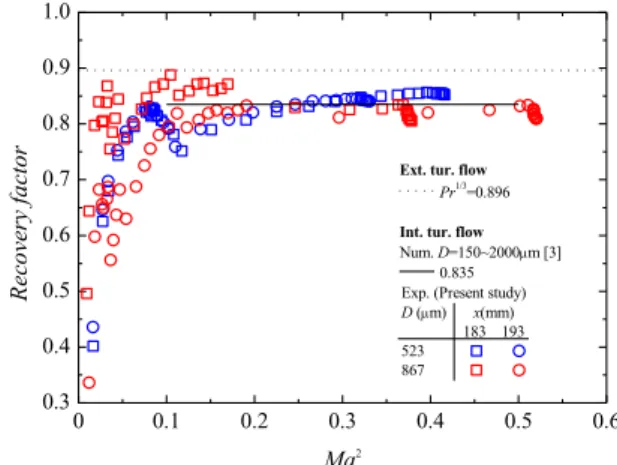
An estimation in the recovery factor of micro gas flows by measuring the adiabatic wall temperatures is important for micro electro mechanical system (MEMS) as a non-testing method. Therefore the proposal methodology to estimate the recovery factor which is the ratio of the difference between adiabatic wall and bulk temperatures to the kinematic temperature is developed for a gas in a micro-tube for a wide range of Reynolds upto a turbulent gas flow regime. A recovery factor for the flow around the plate (external flow) has been proposed using a function of Prandtl number and Mach number by numerous researchers. In the present study, recovery factors for laminar and turbulent flow in micro-tubes (internal flow) were obtained using numerical simulations based on the arbitrary Lagrangian-Eulerian method. The LB1 turbulence model was used for the turbulent flow case. The compressible momentum and energy equations with the assumption of an ideal gas were solved. The recovery factor was also experimentally obtained by measuring the adiabatic wall temperature and the bulk temperature in a micro-tube whose external wall is covered with a foamed polystyrene (Fig. 1). The experiments were performed using three stainless micro-tubes of D = 523, 867 µm. The numerically and experimentally obtained recovery factors were compared with empirical correlation in the literature (Fig. 2).
Fig. 1 Schematic of experimental setup Fig. 2 Recovery factor as a function of Ma2
* Corresponding author 0 0.1 0.2 0.3 0.4 0.5 0.6 0.3 0.4 0.5 0.6 0.7 0.8 0.9 1.0
Exp. (Present study)
D (µm) x(mm) 183 193 523 867 Recovery factor Ma2
Ext. tur. flow Pr1/3=0.896
Int. tur. flow Num. D=150~2000µm [3]