
象鼻虫上科5種類の染色体
7
0
0
全文
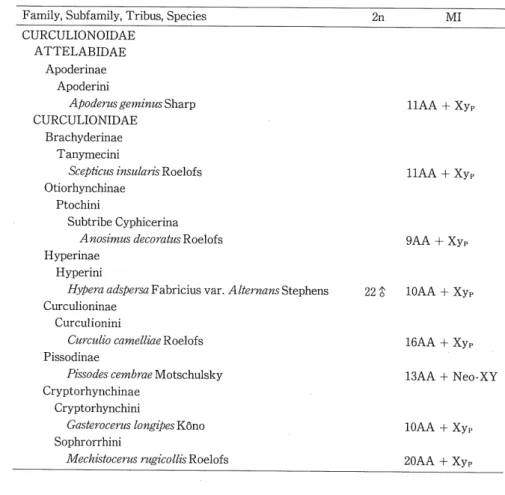
(2) Journal of Hokkaido University of Education (Section II B) Vol. 34, No. 2 March. 1984. -it^iiair^N.S^ (Us 2 ^B) ^34^ ^2^- • Bgffi59^3J:!. The Chromosomes of 8 Species of the Curculionoidea (Coleoptera). Yasushi TAKENOUCHI Biological Laboratory, Sapporo College, Hokkaido University of Education, Sapporo 064. ^ F^ ^ : ^^A±^8@^)^/fa/fr. w?i(±wmw^w^ Abstract The chromosomes of one Attelabid weevil and seven Curculionid weevils were studied. The results are summarized in Table 1. With the exception of a single species with Neo-XY, the other seven species have an Xy? sex-determining mechanism.. The chromosomes of a comparatively large number of insects belonging to the Curculionoidea have been studied, because this family includes Curculionid weevils in which 72 parthenogenetic species or races have been found. This parthenogenetic factor in connected with. polyploidy and has consequently attracted the attention of many cytogeneticists. This time, I have had a chance to study the chromosomes of an Attelabid weevil and seven Curculionid weevils. This paper reports the details.. Materials and Methods One Attelabid weevil and seven Curculionid weevils (Table 1) belonging to six subfamilies of the Curculionidae were studied. The insects have been collected over the past seven years.. The source of the weevil is given in the description of each species. Testes were usually squashed according to Smith's (1943) procedure and stained in basic fuchsin-methyl green (Smith & Takenouchi, 1969).. (D.
(3) 36. Yasushi TAKENOUCHI. Table 1. Summary of chromosome determinations in 8 Japanese weevil species. 2n. Family, Subfamily, Tribus, Species. MI. CURCULIONOIDAE ATTELABIDAE Apoderinae. Apoderini 11AA + Xyp. Apodenis gemimis Sharp. CURCULIONIDAE Brachyderinae Tanymecini. 11AA + Xyp. Scepticns insnlaris Roelofs Otiorhynchinae Ptochini Subtribe Cyphicerina. 9AA + Xyp. Anosimns decoratns Roelofs Hyperinae. Hyperini Hypera adspersa Fabricius var. Alternans Stephens. 22^ lOAA+Xyp. Curculioninae. Curculionini. 16AA + Xyp. Curculio camelliae Roelofs Pissodinae. 13AA + Neo-XY. Pissodes cembrae Motschulsky Cryptorhynchinae Cryptorhynchini. 10AA + Xyp. Gasterocenis longipes K6no. Sophrorrhini. 20AA + Xyp. Mechistocerus rugicollisRoelofs. Observations Apoderus geminus Sharp (Fig. 1) One male, captured on Mt. Sankaku near Sapporo, was investigated. The first metaphase. shows 12 bivalents (Fig. 1). Among the complement, two bivalents are much larger while the seriation of the size of the others is quite gradual. The smallest one forms a typical parachute (Xyp). Scepticus insularis Roelofs (Fig. 2) A single male was captured together with 13 triploid females in Okumiomote, Niigata Prefecture, and the male was studied. It had 12 bivalents at the first metaphase (Fig. 2). The seriation of the size of the elements is quite gradual. The smallest bivalent has a parachute shape and is therefore the sex-determining pair.. Anosimus decoratus Roelofs (Fig. 3) A single male from Tochinoki Pass, Imajo-cho, Nanjo-gun, Fukui Prefecture, was studied.. It contained several excellent first metaphases showing 10 bivalents (Fig. 3). The seriation of size of the bivalents is quite gradual, one of the smaller bivalents forming a typical parachute. (2.
(4) The Chromosomes of the Curculionoidea 37. (Xyp). Hypera adspesa Fabricius var. alternans Stephen (Figs. 4 and 5) Nine males from Esachi, Soya-gun, Hokkaido, were studied. One male contained an. excellent spermatogonium showing 22 chromosomes (Fig. 4). The smallest element may be the y and a small sized metacentric chromosome may be the X. Most likely, the other elements are meta- or submetacentric chromosomes. The first metaphases showed 11 bivalents (Fig. 5). Among the complement, four bivalents are much larger while the others are nearly same size,. ^? ^. the smallest one forming a typical parachute (Xyp).. -.^Sfe. ^p. ^)& n. r. 2. 3. •^ - -9. ^v/ <^ ''<-. ^ ^9^ ^ yo'a'. ^7 ^® ^ 4. ^ »^,» \'% -^a". ^ w ^ ^ ^ ^ ® ^y ^. A» ^ <:' \ '/'. ^ '•' ^y ^-B. '..'' Neo-XT. Fig. 1. First metaphase of Apodems gemimis Sharp. Fig. 2. First metaphase of Scepticzis insularis Roelofs. Fig. 3. First metaphase of Anosimzis decoratiis Roelofs. Figs. 4. and 5. Chromosomes of Hypera adspersa Fabricius var. Alternans Stephen. 4. Spermatogonial metaphase. 5. First metaphase. Fig. 6. First metaphase of Czircidio camelliae Roelofs. Fig. 7. First metaphase of Pissodes cembrae Motschulsky. Fig. 8. First metaphase of Gasterocerus longipes Kono. Fig. 9. First metaphase of M.echistocenis rugicollis Roelofs. A bar shows 10 m/^.. (3).
(5) 38 Yasushi TAKENOUCHI. Curculio camelliae Roelofs (Fig. 6) A single male obtained from Mt. Norishiro, Fukui City, was studied. The first metaphase shows 17 bivalents comprising 16 autosomal pairs and a typical Xy parachute. The size seriation of the bivalents is gradual ; the Xyp is the smallest one. There are at least four ring bivalents.. Pissodes cembrae Motschulsky (Fig. 7) Two males collected from the Experimental Plantation of Tokyo University, Furano City, Hokkaido, were studied. They provided many first metaphases. The first spermatocyte metaphases consists of 13 autosomal bivalents and a heteromorphic Neo-XY sex pair (Fig. 7). With the exception of the sex pair there are three extremely large ring bivalents while the size seriation of others is gradual.. Gasterocerus longipes Kono (Fig. 8) A single male obtained from BushQfa-ike, Fukui City, was studied. Eleven bivalents were observed at the first metaphase, 10 being autosomal, while the X of the sex-determining Xyp pair is as large as the smallest autosome (Fig. 8). The seriation of the bivalent size is quite gradual.. Mechistocerus mgicollis Roelofs (Fig. 9) A single male captured from Kamishika, Niigata Prefecture, was studied. The first metaphase shows 21 bivalents (Fig. 9). Two bivalents are large and the size seriation of the other smaller autosomes is gradual. The parachute is the sex determining pair, and the Xy? is not the smallest one in the complement.. Discussion The chromosome survey of bisexual curculionid weevil species, excluding the parthenogenetic species, so far covers about 400 species and subspecies. Apodems gemimis showed a new chromosome formula, HAA+Xyp, in the genus Apoderus,. although six other species in the genus have already been chromosomally studied (Takenouchi, 1955, 1958b, 1963, 1973, 1976). Sceptictis insularis has four parthenogenetic races but the diploid bisexual male shows lOAA+Xyp and in one case lOAA+Xyyp (Takenouchi, 1968, 1969). A single male here sudied shows a new chromosome formula, HAA+Xy? ; this was probably caused by centric fission as has been found in a Catapiomis gracilicornis male (Takenouchi, 1976b). Anosimus decomttis has also a new chromosome formula, 9AA+Xyp, in the tribe Ptochini. The. other two formulae are lOAA+Xy? and 14AA+Xyp (Takenouchi, 1955, 1958b, 1973, 1979). Hypera adepesa Fabricius var. alternans Stephan has 2n=22 and lOAA+Xyp. These results correspond with those of four Hypera species so far studied (Takenouchi, 1955, 1958a, b, 1963, 1972). The numbers may be the standard number for the genus Hypera. Curctdio camellinae shows the chromosome formula, 16AA+Xyp, which is similar to that of Curculio minutissimus and is the highest chromosome number in the genus Curculio so far. (4).
(6) The Chromosomes of the Curculionoidea 39. known (Takenouchi, 1974). Pissodes cembrae is the only species in the genus Pissodes, with the chromosome formula 13AA+Neo—XY. According to Smith and Virkki (1978), more than 19 species have been studied and all of them without exception have a XYp sex determining pair. Gasterocerus longipes was the first species studied cytologically in this genus as well as in the tribe Chryptorhynchini. The chromosome formula was found to be lOAA+Xyp. A fourth species of the tribe Mechistocerus, M. mgicollis, was investigated and was found to have 20AA+Xyp, which is the first record of a new chromosome formula for the genus (Takenouchi, 1958b, 1973, 1979).. Acknowledgements The author is grateful to Dr. Katsura Morimoto, Kyushu University, for the identification of species. Thanks are also due to Dr. Kintaro Baba, the director of Kurokawa Hospital,. Niigata Prefecture, to Dr. Hiroyuki Sasaji, Fukui University, to Dr. Yoichi Sakamoto, Rakunogakuen University, Ebetsu, Hokkaido, and to Dr. Naoto Muramoto, La Salle High School, Hakodate, for the donation of the materials used in the study.. References. Smith, S. G. 1943. Techniques for the study of insect chromosomes. Can. Entomol. 75 : 21—34. Smith, S. G. & Takenouchi, Y. 1969. Chromosomal polymorphism in Pissodes weevils ; Further on incompatibility in P. terminalis. Can. J. Genet. Cytol. 11 : 761-782. Smith, S. G. & Virkki, N. 1978. Animal Cytogenetics 3—Insecta ^: Coleoptera pp366. Gebruder Borntraeger. (Berlin, Stuttgart). Takenouchi, Y. 1955. A chromosome survey in thirty species of weevils (Curculionidae, Coleoptera). Jap. J. Zool. 11 : 425-441. Takenouchi, Y. 1958a. A further chromosome survey in thirty species of weevils (Curculionidae, Coleoptera). Jap. J. Zool. 12 : 139-155. Takenouchi, Y. 1958b. Further survey of the chromosomes in curculionid weevils (Coleoptera). Jpn. J. Genet.. 33 : 162-175. Takenouchi, Y. 1963. A further investigation on the chromosomes in twenty-three species of weevils. (Curculionidae, Coleoptera). J. Hokkaido Gakugei Univ. 2nd Ser. 13 : 160—175. Takenouchi, Y. 1968. A chromosome study on bisexual and parthenogenetic races of Scepticiis insularis Roelofs (Curculionidae : Coleoptera). Jpn. J. Genet. 43 : 377—382.. Takenouchi, Y. 1969. The Xyyp sex determining mechanism found in ScepUcus insularis Roelofs (Curculionidae : Coleoptera). Jpn. J. Genet. 44 : 189—190. Takenouchi, Y. 1972. A chromosome study on four species of the genus Hypera (Coleoptera, Curculionidae). J. Hokkaido Univ. Educ. Section IIB, 23 : 1-6. Takenouchi, Y. 1973. A revised study of the chromosomes of twenty-four species of Japanese weevils. (Coleoptera : Curculionidae). Genetica 44 : 621—632. Takenouchi, Y. 1974. A study of the chromosomes of thirty four species of Japanese weevils (Coleoptera : Curculionidae). Genetica 45 : 91—110.. (5).
(7) 40 Yasushi TAKENOUCHI Takenouchi, Y. 1976a. Chromosome survey in twelve species of bisexual weevils (Coleoptera : Curculionidae) in KyQshu, Japan I. La Kromosorfto II—1 : 1—7.. Takenouchi, Y. 1976b. A study of chromosomal dimorphism in Catapionns gracilicornis Roelofs (Curculionidae : Coleoptera). Jpn. J. Genet. 51 : 179-283. Takenouchi, Y. 1979. The chromosomes of thirty-seven weevil species from Japan (Coleoptera : Curculionidae). Entom. Gen. 6 : 7—23.. (6).
(8)
図

関連したドキュメント
Keywords: continuous time random walk, Brownian motion, collision time, skew Young tableaux, tandem queue.. AMS 2000 Subject Classification: Primary:
The main purpose of this paper is to show, under the hypothesis of uniqueness of the maximizing probability, a Large Deviation Principle for a family of absolutely continuous
As an application, we present in section 4 a new result of existence of periodic solutions to such FDI that is a continuation of our recent work on periodic solutions for
Using a method developed by Ambrosetti et al [1, 2] we prove the existence of weak non trivial solutions to fourth-order elliptic equations with singularities and with critical
Then it follows immediately from a suitable version of “Hensel’s Lemma” [cf., e.g., the argument of [4], Lemma 2.1] that S may be obtained, as the notation suggests, as the m A
This paper presents an investigation into the mechanics of this specific problem and develops an analytical approach that accounts for the effects of geometrical and material data on
discrete ill-posed problems, Krylov projection methods, Tikhonov regularization, Lanczos bidiago- nalization, nonsymmetric Lanczos process, Arnoldi algorithm, discrepancy
While conducting an experiment regarding fetal move- ments as a result of Pulsed Wave Doppler (PWD) ultrasound, [8] we encountered the severe artifacts in the acquired image2.
