Japan Advanced Institute of Science and Technology
JAIST Repository
https://dspace.jaist.ac.jp/Title JAIST-COE News Vol.2 No.3 Author(s)
Citation
Issue Date 2006
Type Others
Text version publisher
URL http://hdl.handle.net/10119/3788 Rights
Vol. 2 No. 3
Winter 2006
Guest Column 1:
Events Driven Approach for Supporting
Real-Time Management of Complex
Systems
Janusz Granat National Institute of Telecommunications, Szachowa 1, 04-894 Warsaw andInstitute of Control and Computation Engineering, Warsaw University of Technology, 00-665 Warsaw, Poland
Management and modeling of complex systems is a challenging area of research. One of the approaches to modeling such systems is event
driven modeling and management of a complex
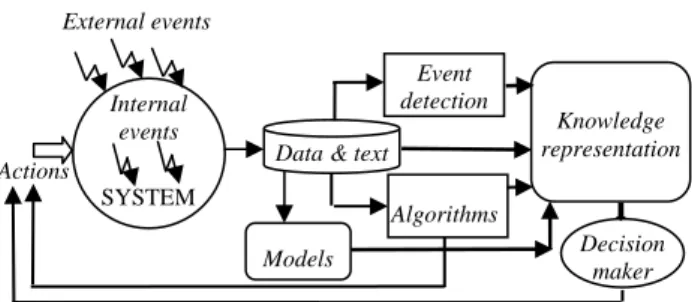
system. The application of the concept of event to systems modeling has been applied for modeling of discrete systems, of stochastic systems, etc. However, most of the existing modeling approaches use only information about the type of event and the time when an event occurs. Contemporary information systems store much richer information about events, in both structured and unstructured forms. Structured information is stored in databases in the form of tables. Unstructured information is stored in various forms of textual or even visual information. Both types of information should be considered and used to analyze and predict events in more advanced events driven modeling approaches. Figure 1 shows the basic components of an event driven modeling framework: the system that is influenced by external and internal events, data and textual information about the system and about events, models, algorithms, event detection algorithms, knowledge representation, description of decision maker behavior and actions.
In order to build models or algorithms we have to store the data about the system and the events. Continued on page 2
Guest Column 2:
Knowledge-Based Management in
Uncertain Environment
Fumiko SeoProfessor of Emeritus, Kyoto University (Kyoto Institute of Economic Research)
Introduction
Changes of business environments of companies have recently become very rapid, due to a great progress achieved in various technical fields along with the development of information technologies.
The environmental changes for the corporate management have also been becoming great. The consciousness on the consumer’s benefit is enhanced and varied. In addition, a new concept of Corporative Social Responsibility (CSR) is becoming more important as the measure for evaluating the corporate values.
Continued on page 5
Inside this Issue page 3:
Researcher Column: Creativity towards
Innovation page 8:
♦ COE Center News
COE NEWS
JAPAN
ADVANCED INSTITUTE OF SCIENCE AND TECHNOLOGY 1990
Newsletter of the Center for Strategic Development of Science and
Technology, Japan Advanced Institute of Science and Technology (JAIST)
JAIST-COE News
Winter, 2006
Strategic Development of Science and Technology
2
Event Driven Approach… (con’t)Figure 1. Basic components of the modeling
framework
The existence and the proper quality of data are crucial to any further steps. We can distinguish primary data that are stored in relational databases and preprocessed data that are prepared for specific modeling tasks, as well as data stored in one central database and data stored in distributed databases. The designer of an information system can apply event based system design approach; this leads to well structured databases containing information about events. The importance of using textual information about events is also growing. Recently, also video sequences are becoming an important source of data for event discovery.
The models use mathematical formulas to
describe the behavior of the system. In the case of the presented framework, the models describe dependencies between events and observable variables. Various models can be considered, such as stochastic models, temporal relationships, temporal sequence associations, etc. The algorithms in Figure 1 are understood as algorithms that work with analytical models as well as algorithms for event mining or event processing. A key to understanding events is the knowledge what might have caused them and at which time the events can happen.
Event mining can be defined as a process of finding:
frequent events, rare events, unknown events (if their occurrence can be deduced from an observation of the system), correlation between events, the consequences of an event and what caused the event. There is a special class of algorithms for event detection. We distinguish two classes of algorithms: event detection based on numerical and categorical data analysis and event detection by analysis of textual information. The results of algorithms, data and textual information go to the block called knowledge representation, where a unifying representation of the results is provided. However, the results constitute a rather simple form of knowledge; here, there is a place for introducing contextual knowledge and more advanced algorithms that support knowledge
creation and management. This includes, for example, knowledge about the consequences of events. The ability to track event causality and consequences is an essential step toward on-line decision support and constitutes an important challenge for new algorithms for event mining. The models, algorithms, and data provide the decision
maker with important knowledge about the system.
Then the decision maker can specify various actions that will be applied in the system and reduce the influence of events on the system. The information about actions should be also stored in a computerized form; this will help later the evaluation of consequences of the chosen actions. In some cases the results of the algorithms can be directly applied to the system (for example, in so called event based control algorithms).
Internal events External events
SYSTEM
Actions Data & text Models Event detection Algorithms Decision maker Knowledge representation
Recently, the focus is on real-time decision support what requires a new class of the data processing, new analytical algorithms as well as modeling approaches. The actions have to be taken immediately after an event occurred. The delay may cause the fault of the system or significant economic losses. It should be stressed that we can distinguish a broad spectrum of various types of events that will often require dedicated algorithms and approaches. However, the framework presented above will help in the generalization of specific methods and algorithms. Moreover, this framework may help in integration of achievements in event based modeling in different scientific disciplines. At this time there are separate developments in temporal data mining, stochastic systems, event based control etc. The combination of these approaches might significantly improve the design of new algorithms.
The approach presented here has various applications in business monitoring, network management, intrusion detection, fault detection etc. Here we present selected examples of event driven modeling: events monitoring, event processing networks, events in environmental scanning, event based control, temporal sequence associations for rare events, event mining and events in alerting systems. There is also research on events monitoring in given environment. Diverse sensor networks are applied for events monitoring. Sensor networks are systems containing many sensing elements endowed with computation, communication and motion that can work together in order to provide information about events in an environment. In such a case we obtain information about the type of event, the time and location of events. Diverse control algorithms are used for positioning mobile sensors in response to a series of events. Many monitoring problems can be also stated as the problem of detecting a change in the parameters of a system called event detection.
Another important concept are Event Processing
Networks (EPN) Such networks consist of Event
Processing Agents called event sources, event processors and event viewers. EPN have been applied for computer network monitoring. The events sources were middleware sniffers. The aggregated information about events has been displayed by viewers and additionally has been used for event mining.
This concept has been also applied for solving business problems. Business organizations are working on an improvement of the analysis of the external environment and influences of this environment on the performance of the organization.
Environmental scanning is a new term and it means
the acquisition and use of the information about events, trends, and relationships in an external environment. In this case the methods of dealing with unstructured information about events are especially important.
In event based control the sampling of data is event-triggered instead of time-triggered. Contemporary control equipment includes event-based PID controllers; such an approach reduces CPU utilization. The event-triggered PID controller is a nonlinear system of hybrid nature.
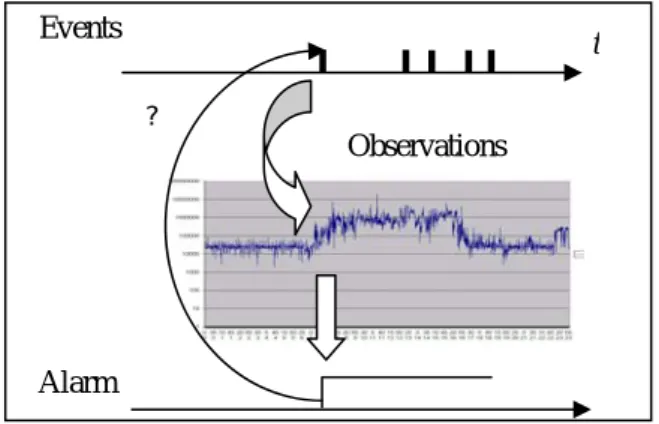
Figure 2 Events and observations
In many cases we have to monitor and analyze rare events such as credit card frauds,
network faults etc. However, if we store the data about the system in the database it is very difficult to identify rare events. In this case the events are characterized by type of event and the time of occurrence of the event. Temporal sequence associations for rare events can be applied to solve this problem.
New opportunities result from the large amount of data that is stored in various databases.
Event mining becomes a challenging area of
research. Here we focus on formulating the event mining tasks that rely on observations of the system and concern internal and external events. Figure 2 shows interrelations between events, observation of the system that is given in form of time series and alarms. Sometimes, it is impossible to observe the events directly. In such cases the data are stored in databases in form of time series. This data represents observations of the system in selected points. The observations are analyzed by the system and alarms are generated in case of abrupt changes in the values of observations. In the next step another algorithm finds the events that caused changes in the system.
The following tasks of algorithms can be considered:
• For significant change of observation find the events that are the reasons of this change Events
t
Alarm ?
Observations
• Predict future events by analyzing changes of observations
• Predict changes of observations after an event occurs
As we see, there are diverse applications of event based modeling as well as various methods of and approaches to event analysis. The modeling framework presented here might help in developing more advanced event driven modeling. We have stressed the importance of a new direction of research called event mining.
JAIST-COE News
Winter, 2006
Strategic Development of Science and Technology
4
Researcher Column:
Creativity towards Innovation
Totok Hari WibowoJAIST COE Center
1-1 Asahidai, Nomi, Ishikawa 923-1292, Japan [email protected]
Introduction
A different stream of study of innovation considered the patterns of innovation within organizations and attempted to link to the concept of
self-actualizing individual. Innovation in this
perspective is seen very much as a personal trait, a
self-efficacy that allows individuals to remain in
control, self-motivated, effective and innovative in most situations.
Management science, on the other side, put emphasis more on leadership roles in changing the organizational structure, organizational culture, and employees’ motivations so that change and innovation could be introduced more easily, with the view that there is one best way to run any organization and to create innovation. These ideas offer the potential to describe organizational functioning in creating innovations in terms of patterns rather than merely as the product of innovation decisions that achieved pre-determined outcomes. Our research attempts to expand the notion of innovation occurring in patterns by developing some hypotheses and performing analyses.
Methodology
With the purpose to investigate the value of interrelating the individual and the collectivity, we identify innovation patterns created in different
individual motivation, organizational culture and environments. This approach allows us to observe at
one time three major forces that influence innovations and to explore the nature of the patterns formed. For this purpose, we defined the criteria for the three dynamics based on the following hypotheses, (1) Innovation occurs in patterns; (2) How people are motivated, the culture of an organization and the magnitude of challenge are key relationships in determining patterns of innovation; (3) Innovation patterns predict the creativity of the ideas considered, the implementation environment and challenges to be faced, and the fate and impact of innovations.
Criteria for the Three Dynamics
Criteria for Individual Motivation,
Organizational Culture, and Challenge are given
below:
Motivation. Intrinsic task motivation is to be
created through: (1) meaning (value of work goal or purpose), (2) competence (efficacy), (3) self-determination (autonomy in initiation and continuation of work, plus self-determined goals), (4) impact (influence on work outcomes. As the variety of definitions for motivations show, individual motivation is not static. Extrinsic motivation include: (1) productivity (efficiency), (2) service-enhancement, (3) organizational control, and (4) risk avoidance, (5) influenced by individual, job, work environment, and external environments, (6) arbitrary rewards and goals. What motivates someone in one personal state and one environment will not be identical to what motivates them in another, but individuals tend to have patterns of motivation–to be typically intrinsically or extrinsically motivated.
Organizational Culture. A bottom-up culture is
characterized by: (1) Empowered relations, (2) Decentralization, (3) Organizational slack (excess capacity), (4) Professional/people and task/business cultures, (5) Emphasis on interpersonal communication patterns, (6) Some degree of democratic control in the workplace. A top-down
culture is characterized by: (1) Hierarchical relations
and a focus on the control or authority structure (2) Centralization and formalization (3) Role and power cultures (4) Emphasis on formal communication patterns, (5) Emphasis on structure, (6) Provision of direction to innovate from above.
Challenge. Challenge basically has two aspects, risk
and relative advantage, and can be distinguished between a minor challenge and a major challenge.
The Patterns
The pattern of innovation incorporates the dynamics of individuals, organizational culture and
challenge into patterns as can be seen in the table on
page 7.
Extrinsically motivated innovations are often oriented to solving problems. The innovations are either programmed ahead of time or introduced in response to stress, distress, or any other stimulus from environment. The crises and political factors have been identified created extrinsic motivation. When innovations of minor challenges are created in a top-down culture in combination with extrinsic motivation, reactive innovation results.
The mixture of a top-down culture and major challenge with extrinsic motivation forces innovation on employees and produces imposed
innovation.
Knowledge-Based Management… (cont’d)
These environmental changes are bringing much uncertainty into the business management, which is confronting more complex decision problems. The knowledge-based management is introduced as a method for coping with this situation; in particular, much progress is expected in the area of the management of technology (MOT).
In relation to MOT, the theory of the Knowledge-Creating Company has been presented by Nonaka and Takeuchi, which is based on the concept of the tacit knowing of Polanyi and includes a knowledge creation process called the SECI spiral. An extension of this concept to the model called Creative Space was also given in this area (Wierzbicki and Nakamori 2004). This paper discusses the knowledge-based management in business firms from the points of view of corporate management along with technology management in uncertain business environments and examines an advanced method for coping with the multicriteria aspects of the corporate management in the changing environments.
Knowledge-Based Management
The concept of knowledge in the corporate management is composed of two aspects: the knowledge on technology and the knowledge on corporate management. On this foundation, the concept of knowledge-based management also has two aspects: technical and managerial.
Recently, much attention is paid to managerial aspects of the technical development in companies. The standardization in the design for the parts of a product has evolved to the group technology (GT) in working sites. More recent development is the concept of modular approach as a design rule and its consolidation, which has been evolved to the construction of the modular-cluster type architecture in industrial markets. One of the powers of the modularity is its optional property: in the construction of module architecture, diverse options can be easily considered. A special type of modular-cluster architecture, in which the needs and requests of customers should be taken in account, is called ORMDA (Option Rich Module Design Architecture). This new trend in the product development corresponds to the changing environment for marketing, which is switching increasingly from the product-oriented to the customer-oriented or society-oriented on the foundation of CSR. In this sense, the technology management cannot be separated from the corporate management. Decision making for treating this complex managerial problem should be performed
at the top level of organizational decision hierarchy in the corporation.
On the other hand, the final goal of the corporate management is becoming also more complex. First, in the rapidly changing business environments, the time effects are introduced into the profit-seeking activity. The concept of the net present value discounted with the time factor has been advocated in the context of the Discounted Cash-Flow (DCF) or Value Creation Management (VCM). More recently, however, the enhancement of the quality of corporate management is attracting increasingly much concern for the stakeholders and publics. The components of the corporate values are becoming more complex and multivariate; this leads to multi-objective decision problems. According to the increase of consumers’ knowledge and self-awareness, the CS for the corporate activity in the technology development is composed of diverse elements, such as its environmental effects, safety for human living, convenience for users, benefits for stakeholders, disclosure to public, accountability and compliance of the corporation, etc. The requirements of consumers concerning the products development are becoming much more rigorous. In result, the corporate management cannot be considered separately from the technology management.
The concept of the knowledge-based management should be constructed on the both phases, technical and corporate, with their integration. The concept of advanced corporate management will be constructed as the strategic decision making while facing the changing business environments.
Contents of MOT concept
MOT can be constructed, from the point of view of CS, on several factors:
• Technology assessment for new products. The priority in the choice of the technology is put on the user-oriented consideration, which includes the environment-oriented considerations. Technology development for the new products is thus combined with the “social-in” as well as “market-in” marketing and should avoid “marketing myopia,” or “product myopia” coming from the classical product-oriented way of thinking. This leads to the concept of the Social Responsible Investment.
• Market positioning of new products with
particular benefits. The quality of products has
been enhanced largely due to the general permeation of “de facto standard” in the
JAIST-COE News
Winter, 2006
Strategic Development of Science and Technology
6
advanced industrial markets. This situation leads to severe market competition for the subsidiary or fringe benefits in the new products, such as service systems for customers, convenience in use, quick response to users’ requests or questions, reliability of the company, brand, etc. Physical quality of the products is only one of elements to be secured. Market positioning of a particular benefit of a new product leads to the strategic decision problems with multi-objective aspects.
• Finding the core competence of a corporation. Product positioning in an industrial market is combined with the establishment of the core competence of the company. The concept of the core competence is not only related to technological aspects, but also to managerial aspects. Therefore, corporate management cannot pursue simply the financial indices, such as price earning ratio (PER), price book-value ratio (PBR), etc. The ISO 9000 series propose the concept of Quality Management System (QMS) for corporations in coordination with the ISO 14000 series, where the point of view of the customers’ satisfaction has been addressed. QMS is composed of the eight rules: 1) customer focus, 2) leadership by the top management, 3) involvement of people (employers), 4) process approach, not procedural, 5) systems approach to management, 6) continual improvement, 7) factual approach to decision making, 8) mutually beneficial supplier relationship. The requirements of ISO 9001:2000 and ISO 9004:2000 for QMS are (i) quality management system, (ii) manager’s responsibility, (iii) operational management of resources, (iv) product realization, (v) measurement, analysis and improvement.
• Introducing the time elements under
uncertainty. The time element in the corporate
management, which involves uncertainty, is included as an intrinsic factor in the strategic decision making. The role of the enterprise risk management (ERM) is also increased.
On the above considerations, the concept of the corporate value in MOT has multi-objective characteristic involving uncertainty, which is different from multivariate problems. For coping with such decision problems, appropriate analytical tools should be developed in an operational way.
Methodological Discussions
Decision analysis can treat consistently the multi-objective properties of decision problems in uncertain environments. Traditionally decision analysis is based on the expected utility hypothesis which includes the evaluation techniques of the utility functions and probability distributions. The utility function is constructed for measuring the preference of decision consequences with a common scaling unit. The probability distribution is constructed for measuring the chance of occurrence of an event. Both of the concepts are constructed on the probability measure with the cardinal scale. Finally the expected utility function is evaluated and used for the numerical comparison of decision alternatives. Decision analysis is used for decision support not as normative, nor descriptive, but as prescriptive approach.
The theoretical extension to multi-objective decision analysis is called multiattribute utility theory (MAUT). MAUT presents a method for the heuristic construction of the multiattribute utility function (MUF), which includes the devices for a hierarchical configuration of multiple objectives, the value trade-off experiments between attributes, sequential nesting procedures into MUF, and sensitivity analysis.
Recent development is with embodying uncertainty in MAUT, resulting in the multi-objective decision analysis under uncertainty which constructs the expected multiattribute utility function (EMUF). New computer software developed for this purpose is called MIDASS (Multi-objective Interactive Decision Analysis Support Systems), (see Seo, Nishizaki and Hamamoto 2004). MIDASS finally constructs and evaluates EMUF as a measure for evaluating gambles with multiple objectives. The main characteristics of MIDASS includes:
(1) Methodological integration of multi-objective decision analysis with the probability evaluation and final derivation of EMUF.
(2) Methodological assistance with consistency checks in the evaluation processes.
(3) Functional independence. Parts of MIDASS can be operated independently of each other. (4) Data independence. Database of MIDASS is
constructed independently of program operations and is preserved separately for each job.
(5) Preservation of evaluation results. MIDASS preserves all the results of evaluation if they are not deleted.
(6) “Fool proof” property. Messages for alarming and confirming user’s operation appear frequently in every stage of the evaluation.
For an empirical use of this method, diverse application fields will be examined in more detail, such as in real investment decisions, which will be left still to be reconstructed from the points of view of the multi-objective decision problems under uncertainty.
References
Wierzbicki, A. P. and Nakamori, Y. (2006) Creative Space: Models of Creative Processes for the Knowledge Civilization Age, Springer.
Seo, F., Nishizaki, I. and Hamamoto, H. (2004) Development of Multi-objective Interactive Decision Analysis Support Systems for Strategic Use, Presented at the INFORMS Annual Meeting, Denver. October 27.
Creativity towards Innovation (cont’d)
Table of Innovation Patterns Based on Motivation, Culture and Challenge Dynamics Innovation Pattern Motivation Culture Challenge
Reactive Extrinsic Top-down Minor
Active Extrinsic Bottom-up Minor
Necessary Extrinsic Bottom-up Major
Imposed Extrinsic Top-down Major
Proactive Intrinsic Bottom-up Minor
Continuous Intrinsic Bottom-up Major
Buy-in Intrinsic Top-down Minor
Transformational Intrinsic Top-down Major
Extrinsic motivation can also occur in bottom-up cultures, though one of the objectives of such cultures is often to induce and facilitate intrinsic motivation. This combination could occur, for example, when exterior forces such as budget deficits affect on organizational units. Although in such a situation staffs are not intrinsically motivated, they can organize to deal with the challenge in a bottom-up fashion. This unusual combination of extrinsic motivation with a bottom-up culture produces active innovation when combined with minor challenge. Extrinsic motivation combined with a bottom-up culture and major challenge produces necessary innovation.
Intrinsic motivation produces different kinds of behavior: There is more problem- seeking and more problem-solving at the local level than when people are extrinsically motivated. Intrinsically motivated innovations oriented toward problem finding often grow out of looseness in the organization. They result from personal initiative, when individuals have or create the time to focus on something besides their immediate work: In such cases, the individual takes steps to deal with organizational problems either because the problem interests them or because the process to solve the
problem interests them. A combination of intrinsic motivation with a bottom-up culture and minor challenge produces proactive innovation. Proactive innovation can also be seen as problem focused, but the creation of solutions before agreement to solve the problem has been achieved within the organization places it in a less-convergent, active, problem-solving category.
The combination of intrinsic motivation with a top-down culture and minor challenge creates buy-in
innovation. In an environment where individuals are
intrinsically motivated but there is a top-down culture and major challenge, transformational
innovation is created. Intrinsic motivation combined
with a bottom-up culture and major challenge creates continuous innovation. In continuous innovation major change is created both through cumulative minor changes and through periodic major changes.
Conclusion
An idea is not an innovation - an innovation does not exist until it has been successfully implemented. Long-term survival of an innovation depends on its becoming internalized and institutionalized, and is bound up with the political
JAIST-COE News
Winter, 2006
Strategic Development of Science and Technology
8
climate. The impact and fate of these patterns would be an appropriate next issue for consideration.
The advantage of a model that integrates motivation, environment and magnitude of challenge is that it points to where an organization may have problems, and in which of these three domains it may need to act in order to encourage innovation.
Future research should focus on analyzing additional cases to confirm the existence of each
pattern and to address whether the patterns are different in their outcomes.
References
[1] Boden, Margaret, A. (Ed.). (1996).
Dimensions of creativity. Cambridge,
Massachusetts: MIT Press
[2] Rickards, Tudor. (1999). Creativity and the
management of change. Oxford: Blackwell.
COE Center News
♦ Dr. Homei Miyashita joined the Center as postdoctoral researcher as of April 1, 2005.
JAIST-COE News is published by the Center for Strategic Development of Science and Technology, Japan
Advanced Institute of Science and Technology, 1-1 Asahidai, Nomi, Ishikawa 923-1292, Japan.
Questions, comments, article proposals and for more information about the JAIST-COE News, contact Totok Hari Wibowo at [email protected], tel. +81-761-51-1790 or go to the link: www.jaist.ac.jp/coe/index.htm Articles in this newsletter are based on a variety of sources. Signed articles reflect the views of the author. Unsigned articles are prepared by the editorial staff, which is solely responsible for their content.