2
標本問題におけるブートストラップ
$t$検定
統数研
江金芳(Jin
Fang Wang)*
千葉大 田栗正章
(Masaaki
Taguri)\dagger
概要
Possibilities of testing two means through nonparametric bootstrap
approaches are discussed. The naive bootstrap by resampling the
ob-served empirical distributions is useless in estimating null distributions.
In simple random sampling, limited numerical investigations suggest
re-samples should be drawn from the originalsamples mixed, with or
with-out proper transformations. In stratified sampling,theeffects of location
transformation on both size and power are also investigated through
Monte Carlo simulations. Application is made to the historical
two-sample problem ofDarwin on crossed- and self-fertilized plant data.
Key Words: Alternative hypothesis; Location-aligned bootstrap; Mixed
boot-strap; Monte Carlo simulation; Stratification.
1
Introduction
The main task of testing statistical hypotheses is to find null distributions of
test statistics. For testing $H_{0}$
:
$\mu_{1}=\mu_{2}$, the equality of two means, based upon, forinstance, the statistic
$T= \frac{\overline{X}-\overline{Y}}{\sqrt{s_{x}^{2}/m+s^{2}\mathrm{Y}/n}}$, (1)
requires finding $H_{0}(t)$, the distribution of$T$, when $\mu_{1}=\mu_{2}=\mu_{0}$ is assumed to be
true. In (1), $\overline{X},\overline{Y},$$s_{X}^{2}$ and $S_{Y}^{2}$ are sample means and variances of the i.i.d.
ran-dom variables$X_{1},$$\cdots,X_{m}$ from distribution $F(\mu_{1})$ and $Y_{1},$ $\cdots,Y_{m}$ from distribution
$G(\mu_{2})$, respectively.
If$F$ and $G$ botharenormal with commonvariances, then the null distributionof
$T$ is $t_{m+n-2},$ $t$-distribution with degrees offreedom $m+n-2$. The trouble is that if
*統計数理研究所 〒106東京都港区南麻布4-6-7 $\mathrm{e}$-mail:wang@ism$.\mathrm{a}\mathrm{c}$.ip
$T$ isto be used and observations$x_{1},$$\cdots,$ $x_{m}$ and $y_{1},$$\cdots$ ,$y_{n}$ display nonnormality how
we should approximate the null distribution of $T$. The problem does not have an
exact solution even in the normalcase withheterogenous variances, which is refered
to as the Behrens-Fisher problemin the literature. Bootstarp isa naturalcandidate
in this kind of situations.
The naive bootstrap suggests estimating $H_{0}(t)$ by $\overline{H}_{0}(t)$, the distribution of
$T^{*}= \frac{\overline{X}-\overline{Y}^{*}}{\sqrt{S_{X}^{*2}/m+S_{Y}*2/n}}$, (2)
where $\overline{X}^{*},\overline{Y},$ $S_{x^{2}}*$ and $S_{Y}^{*2}$ are sample means and variances of the empirical
dis-tributions $F_{m}(x)$ and $G_{n}(y)$, based on the observations $x_{1},$$\cdots,$ $x_{m}$ and $y_{1},$$\cdots,$$y_{n}$,
respectively. Thisalgorithm failes catastrophicallyevenin the simplestnormalcases,
see next section.
Section 2 starts the investigations from this simple normal cases: $F$ and $G$ are
normal with possibly different variances. We propose the mixed bootstrap tests
that resample the pooled original data with and without transformations. Section
3 applies the mixed bootstrap tests to historical two-sample problem of Darwin,
yielding conclusions similar to those of classic analyses that the crossed plan may be
superiorto the self-fertilized. Section 4 considers more complicated situations when
$F$ and $G$ are normal mixtures and samples are drawn from each subpopulation.
Only location-aligned bootstrap is investigated in this case.
2
Mixed
bootstrap
tests
The failure of the naive $\mathrm{b}_{\mathrm{o}\mathrm{O}}\mathrm{t}_{\mathrm{S}\mathrm{t}\mathrm{a}}\mathrm{r}\mathrm{p}(\mathrm{S}\mathrm{e}\mathrm{c}\mathrm{t}\mathrm{i}\mathrm{o}\mathrm{n}1)$lies in the obvious fact that the
bootstrap estimate $\overline{H}_{0}(t)$ does not reflect the mechanism that
$H_{0}(t)$ is produced
un-der the constraint $\mu_{1}=\mu_{2}$. One way ofachievingthis is to redefine the $\overline{X},$$\overline{Y}^{*},$ $S_{x^{2}}^{*}$
and $S_{Y}^{*2}$in (2) to be the samplemeans andvariancesofrespectiveempirical
distribu-tions $\hat{F}_{m}(x)$ and $\hat{G}_{n}(y)$, putting mass $1/m$ and $1/n$ on $x_{1’ m}^{*}\ldots,$$x*$ and
$Y_{1}^{*},$
$\cdots,$$Y_{n}^{*}$,
which are randomly drawn with replacement from
$\{\mathcal{Z}_{1}, \cdots, Z_{m}+n\}=\{_{X\cdots,x_{m};}1,y_{1}, \cdots, y_{n}\}$. (3)
Let$X$ and$Y$comefromthenull$F=N(\mu_{0}, \sigma^{2}),$ $G=N(\mu_{0}, \sigma^{2})$. Let$m=n=5$ .
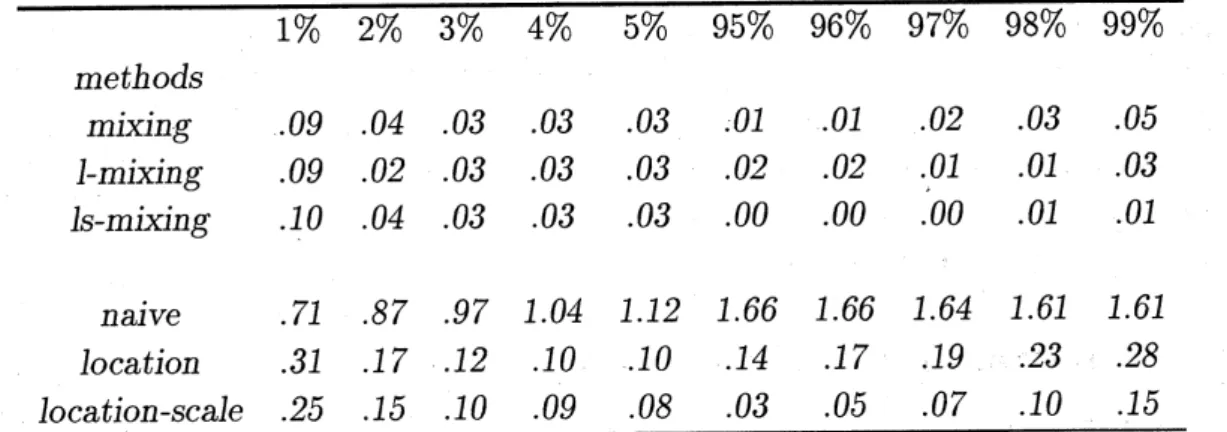
Then $H_{0}(t)=t_{8}$ The first row of Table 1 shows the relative errors of the mixed
bootstrap in approximating the lower and upper quantiles of $t_{8}$. As a comparision,
the fourth row corresponding to the naive bootstrap test is also displyed.
The idea of mixing isnot entirelynew. Boos, Janssenand Veraverbeke(1989)
dis-cussesthe pooled bootstrap tests for testing homogeneityof scales, which essentially
the same
mean
is by location transformation. Efron and Tibshirani($1993$, pp.224)suggests that the bootstrap samples be drawn from $\{x_{1}’’, \cdots, x_{m}\}$ and $\{y_{1}’, \cdots, y_{n}’\}$,
where the $x’\mathrm{s}$ and $y’\mathrm{s}$ are location adjusted. They are defined as $x_{i}’=x_{i}-\overline{x}+\overline{z}$
and $y_{i}’=y_{i}-\overline{y}+\overline{z},$ where $\overline{x}$ and $\overline{y}$ are the respective sample means and
$\overline{z}$ is the
pooled mean. The fivth rowof Thable 1 shows that this does not work well enough.
The location-scale transformation, by redefining the $x’\mathrm{s}$ and $y’\mathrm{s}$ as $x_{i}’=(x_{i}-\overline{x})/S_{x}$
and $y_{i}’=(yi^{-\overline{y})}/S_{x}$, where $S_{x}$ and $S_{y}$ arethe sample standard errors, improves the
location transformation, but only mildly, see the last row of Table 1. The second
and the third row ofTable 1 compare the mixed bootstrap tests when location or
location-scaletransformation is applied before mixing, with simple mixed bootstrap
test(first row). The results are essentially the same, with moderate improvements
by including transformations.
Table 1 Errorsin approximatingthetails ofthe null distribtionbysixbootstrap
tests. The null distribtion of$T$under nomalitywithhomogeneous scales, is$t_{5+5-2}=$
$t_{8}$. The bootstrap tests use data from a “local alternative”, $N(1,1),$
$N(\mathrm{O}, 0.9^{2})$. 1% 2% 3% 4% 5% 95% 96% 97% 98% 99% methods mixing .09 .04 .03 .03 1-mixing .09 .02 .03 .03 $l\mathrm{s}$-mixing .10 .04 .03 .03 .03 .01 .01 .02 .03 .05 .03 .02 .02 .01 .01 .03 .03 .00 .00 .00 .01 .01 naive .71 .87
.97
1.04 1.12 1.66 1.66 1.64 1.61 1.61 location .31 .17 .12 .10 .10 .14 .17.19
.23. .28$\underline{loc\mathrm{a}}$
tion-scale.25.15.10.09.08.03.05.07.10.15
Notes: $(l)The$ figu$\mathrm{r}es$ are $rel$ative errors defined by $|(w-\hat{w})/w|,$ $w$ and
$\hat{w}$ stands
for th$e$ true value and approximate value respectively; (2)$mixi\mathrm{n}g,$
$\mathit{1}$-mixing and
ls-mixin$g$stand for th$e$mixed bootstrap, mixed bootstrap afterlocation and
location-scale transformation, respectively; naive, location and location-scale stand for th$e$
$\mathrm{n}$onmixed bootstrap, nonmixed bootstrap with location and location-scale
$t$
rans-formation, respectivelyj (3)$Th\mathrm{e}$ bootstrap values are averages during 100 repeated
$s$ampling, with each bootstrapped 200 times.
Similarfeaturesare observedfromTable 2, where thenull distribution of$T$based
on $F=N(\mu_{0}, \sigma_{1}^{2})$ and $F=N(\mu 0, \sigma_{2}^{2}),$ $\mu 0=1,$ $\sigma_{1}^{2}=1,$ $\sigma_{2}^{2}=4$ are approximated by
Table2 Errors in approximatingthe tails ofthe null distribtionbysix bootstrap
tests. The null distribtion of $T$ is defined by assuming $X\sim N(1,1)$ and $Y\sim$
$N(1,2^{2})$, sample sizes
$m=n=5$
. The bootstrap tests use data from a “localalternative”, $N(1,1),$$N(2,2^{2})$. 1% 2% 3% 4% me$th_{\mathit{0}}\mathrm{d}_{S}$ mixing .08 .08 .05 .02 1-mixing .09 .08 .04 .03 $ls$-mixing .03 .07 .04 .01 5% 95% 96% 97% 98% 99% .03 .06 .06 .07 .06 .06 .02 .06 .06 .06 .06 .08 .02 .05 .04 .04 .03 .02 naive 1.64 1.38 1.38 1.40 1.40 .79 .74 .67 .62 .46 location .34 .19 .18 .18 .17 .23 .25 .28 .32 .48
$\underline{loc\mathrm{a}}$
tion-scale.11.03.04.05.03.02.01.03.07.13
Notes: $(l)The$ figures are relative errors defined by $|(w-\hat{w})/w|,$ $w$ and $\hat{w}$ stands
for the $tr\mathrm{u}e$ value and approximate $\mathrm{r}^{\gamma}\mathrm{a}lue$ respecti
$\iota^{\gamma}\mathrm{e}ly,\cdot(\mathit{2})\mathrm{m}ix\mathrm{j}ng,$ $\mathit{1}$
-mixing and
ls-mixingstand for the mixed bootstrap, mixed bootstrap after location and
location-scale transformation, respecti$\mathrm{r}^{r}\mathrm{e}ly,\cdot$ naive, location and location-scale stand for th
$\mathrm{e}$
nonmixed bootstrap, nonmixed bootstrap with location and location-scale
trans-formation, resp$\mathrm{e}cti\gamma \mathrm{e}ly,\cdot(\mathit{3})Th\mathrm{e}$ bootstrap values are averages during 100 repeated
sam.pling,
with $e\mathrm{a}ch$ bootstrapped 200 times; (4)$Then\mathrm{u}\mathit{1}\mathit{1}$ distribution isapproxi-mated by 5,000 Monte Carlo trials.
3
Bootstrap Tests
of
Darwin’s
Zea Data
Table 3 shows data obtained by Darwin(1876), who investigated whether there
exists superiority of the crossed plantsover the self-fertilized. The data shown here
concernsonly$\mathrm{z}\mathrm{e}\mathrm{a}$, oneout of the
seven
plantsexperimentedbyDarwin. The problemis to test the null hypothese $H_{0}$ : $\mu_{X}=\mu_{Y}$ against the alternative $H_{1}$ : $\mu_{X}>\mu_{Y}$,
where $\mu_{X}$ and $\mu_{Y}$ represent the mean height of the crossed and the self-fertilized
$\mathrm{z}\mathrm{e}\mathrm{a}$, respectively.
While the nonmixed bootstrap with location transformation applied to the zea
datagives one-sided achievedsignificance level$(\mathrm{a}.\mathrm{S}.1.)$ 0.043, the simple mixed
boot-strap has a.s.l. 0.012, providing much stronger evidence against the null hypothesis
that there is no difference between the crossed and self-fertilized $\mathrm{z}\mathrm{e}\mathrm{a}$. In mixing
is done after location transformation, the a.s.l. decreases to 0.006, indicating even
more discrepancy between the two kinds of$\mathrm{z}\mathrm{e}\mathrm{a}$. Location-scale transformation does
not have much effect in the mixing case(with a.s.l. 0.011), but reduces the a.s.l. to
bootstrap samples in the mixed and nonmixed cases, respectively. For
compari-sion, the two-sided a.s.l.’s of some conventional nonparametric tests, namely the
median, Wilcoxson and permutation test are 0.001, 0.003 and 0.024, respectively,
see Takeuchi and Ohasi(1981) for details.
Table 3 Darwin’s observations on-the grouth rates ofthe crossed and
self-fertilized $\mathrm{z}\mathrm{e}\mathrm{a}$. Numbers are expressed in eighthsof an inch.
$NO\acute{T}ES$: The data can be found in Fisher($\mathit{1}\mathit{9}\mathit{6}\mathit{0}$, pp.30), which are divided into bloks
of sizes (3,3,5,4), corresponding to each pot. For exampl$\mathrm{e},$
$(\mathit{1}\mathit{8}\mathit{8},\mathit{9}\mathit{6},\mathit{1}\mathit{6}\mathit{8})$ and (139,
163, 160) are from pot 1, and (168, 177,184, 96) and (144, 102, 124, 144) are from
pot 4, etc.
4
Stratified
Sampling
In this section,we treatgeneralstratifiedproblems, assuming$F(x)= \sum_{l=1}LF_{l}(w_{l}x)$
and $G(y)=\Sigma_{h=1}^{H}p_{h}G_{h}(y)$. Here each $F_{l}(x)(l=1, \cdots , L)$ and $G_{h}(y)(h=1, \cdot*\cdot , H)$
represent the l- and h-th stratum distribution functions and $w_{l}(l=1, \cdots, L)$ and
$p_{h}$$(h=1, \cdots , H)$ are the corresponding stratum weights, subject to
$\Sigma_{l=1}^{L}w_{l}=$
$\sum_{h=1}^{H}p_{h}=1$. We only consider the location-aligned bootstrap test.
4.1
The model
Suppose data $\{X_{l1}, \cdots,x_{l}ml\}(l=1, \cdots, L)$ and $\{y_{h1}, \cdots, y_{hn_{h}}\}(h=1, \cdots, H)$,
are observed from each stratum $F_{l}$ and $G_{h}$, respectively. Let $\sum m_{l}=m,$ $\sum n_{h}=n$.
The sample means$\overline{x}_{l}=\sum x_{li}/m_{l}$ and$\overline{y}_{h}=\sum y_{hi}/n_{h}$ are unbiased estimatesforeach
stratummean $\mu_{lX}$ and$\mu_{hY}$, which, combined together, formunbiased
$\mathrm{e}\mathrm{s}\mathrm{t}\mathrm{i}\mathrm{m}\mathrm{a}\mathrm{t}\mathrm{e}\mathrm{s}\overline{x}^{s}=$
$\sum w_{l^{\overline{X}}lX}$ and $\overline{y}^{s}=\sum p_{h\overline{y}_{hY}}$ for the total mean $\mu_{X}$ and $\mu_{Y}$ respectively. Hereafter we
only consider proportional allocation, i.e. $ml=wlm\dot{\mathrm{a}}\mathrm{n}\mathrm{d}nh=phn$.
Let $\hat{\sigma}_{lX}^{2}$ be the usual unbiased version of sample variances of each stratum
vari-ance
$\sigma_{lX}^{2}$. Wakimoto(1971) proved that$st \hat{\sigma}_{X}^{2}=\sum_{l=1}^{L}w_{l}\hat{\sigma}^{2}l..x+\sum^{L}wl(_{\overline{X}_{l}}l=1-\overline{X}^{S})^{2}-\sum_{=l1}w\iota L(1-wl)\hat{\sigma}_{l}^{2}X/m_{l}$
is unbiasedfor the total variance$\sigma_{X}^{2}$. Theunbiased estimator$st\hat{\sigma}_{Y}^{2}$ for$\sigma_{Y}^{2}$ issimilarly
The stratified version of the usual $t$-statistic becomes
$T_{st}= \frac{\overline{X}^{S}-\overline{Y}s}{\sqrt{st\hat{\sigma}_{x}^{2}/m+st\hat{\sigma}/2Yn}}$, (4)
based on which we are to test $H_{0}$
:
$\mu_{X}=\mu_{Y}$ against the alternative $H_{1}$ : $\mu_{X}>\mu_{Y}$.
To perform a test $\mathrm{b}\mathrm{a}s$ed on $T_{st}$, is to find, or to make a good approximation
of
$Q(F_{N}, G_{N})=Prob(T_{s}t\leq t)$, the nulldistribution function. To emphasize, we have
deliberately changedour notation using $F_{N}$ and $G_{N}$ in place of$F$ and $G$to represent
the two distributions under null hypothesis, i.e. $\mu_{X}=\mu_{Y}$.
Let $\hat{F}_{l}$ be the empirical
distribution function of the l-th stratum of $F$ putting
mass $1/m_{l}$ on each atom $x_{li}(i=1, \cdot \mathrm{v}\cdot, m_{l})$, and $\hat{G}_{h}$
similarly defined. Define $\hat{F}=$
$\Sigma_{l=1}^{L}w_{l}\hat{F}_{l}$ and $\hat{G}=\sum_{h=1}^{H}p_{h}\hat{G}_{h}$. The naive bootstrap draws i.i.d. stratified samples
with replacement from $\hat{F}$ and $\hat{G}$
, exactly in the same way as the original stratified
samples are drawn from $F$ and $G$, which is as useless as in the simple random case.
4.2
Location-aligned bootstrap
test
The location-aligned bootstrap test constitutes the followingsteps.
(1) Let $\overline{z}=(m\overline{x}^{S}+n\overline{y}^{s})/(m+n)$. Define the pseudo-observations for $l=$
$1,$
$\cdots,$$L$ and $h=1,$$\cdots,$$H$ by :
$x_{li}^{+}$ $=x_{li}-\overline{x}l+\overline{Z}/Lw_{l}$ $(i=1, \cdots, m_{l})$, $y_{hi}^{+}$ $=y_{hi^{-}}\overline{y}h+\overline{Z}/Hp_{h}$ $(i=1, \cdots, n_{h})$.
(2) Define pseudo-empirical distribution functions
$\hat{F}_{N}$ $=\Sigma_{l=1}^{L}w_{l}\hat{F}\iota N$,
$\hat{G}_{N}$ $=\Sigma_{h=1}^{H}ph\hat{G}_{hN}$,
where $\hat{F}_{lN}$ is the empirical
distribution function $\mathrm{p}\mathrm{u}\mathrm{t}\mathrm{t}\mathrm{i}\acute{\mathrm{n}}\mathrm{g}$
mass $1/m_{l}$ on each atom $x_{li}^{+}(i=1, \cdots, m_{l})$, and $\hat{G}_{hN}$ is similar.
(3) Define the bootstrap estimate of$Q(F_{N}, G_{N})$ by $Q(\hat{F}_{N},\hat{G}_{N})$, which is
fur-ther approximated by Monte Carlo means
$\frac{1}{B}\#\{T_{st}^{b*}\leq t\}$,
where $T_{st}^{b*}$ is the version of $T_{st}$, based on the b-th stratified samples from $\hat{F}_{N}$ and
$\hat{G}_{N},$ $\#$ stands for the number of the event within
$\{\}$ being true and $B$ is the number
of the whole procedure replicated. Several remarks are pertinent.
Remark 1 To reflect the null hypothesis, namely two distributions sharing the
null hypothesis does pose some restictions on the second order moments, as in the
case of approximating the $t$-distribition discussed in Section 2, proper adjustments
upto that order may to be prefered. Empirical variances may be adjusted in the
stratified case as following
$x_{li}^{o}$ $=[(x_{li^{-}}\overline{x}_{l})/S_{lx}](1/L\sqrt{w_{l}})+1/w_{l}L\sqrt{m}$ $(i=1, \cdots, m\iota)$, $y_{hi}^{o}$ $=[(y_{hi}-\overline{y}_{h})/s_{hy}](1/H\sqrt{p_{h}})+1/p_{h}H\sqrt{n}$ $(i=1, \cdots, n_{h})$.
Thistransformation is exact when $(m+1)/(n+1)=H/L$ , whichis satisfied, for
ex-ample, when $m=n$ and $L=H$. We will not considerlocation-scale transformation
in our Monte Carlo studies.
Remark 2 Confidence intervals based on asymptotically pivotal quantities tend
to be long-shaped. A 95% bootstrap-t confidence interval for the difference
be-tween the crossed and self-fertilized zea in Example 1 is (1.8, 32.3), compared with
the so-called nonparametric ABC interval(Efron and Tibshirani 1993), (5.5, 29.4).
Welch’s solution gives (3.1, 44.5), Fisher’s fiducial interval is (2.7, 39.1), compared
with $(13, 39)$ which is based on Wilcoxsontest($\mathrm{T}\mathrm{a}\mathrm{k}\mathrm{e}\mathrm{u}\mathrm{c}\mathrm{h}\mathrm{i}$ and Ohasi 1981, $\mathrm{p}\mathrm{p}.51^{-}89$).
One consequence ofthis is that $‘(t$-type” tests may tend to have lower power.
5
Monte Carlo Studies
Assume that the data do come from distributions satifying the null hypothesis
and $t_{0}$ is the observed value of the stratified $t$-statistic. The achieved significance
level,or$p$-value, Prob$(\tau_{St}>t_{0})$ undernullhypothesisdependssolelyon$t_{0}$, which has
theuniform distribution on $(0,1)$ if$t_{0}$ israndomlyobservedfrom thenull hypothesis.
We shall evaluate our bootstrap tests by checking the size, power and testing the
uniformity of the p-values.
Now the hypothesis $H_{0}$
:
$\mu_{X}=\mu_{Y}$ is to be tested against the alternative $H_{1}$ :$\mu_{X}>\mu_{Y}$, based on the location-aligned bootstrap test described in the previous
section. For simplicity, we assume $F$ and $G$ in the following simulations to be
mixtures of two normal populations, and $w_{l}=p_{l}(l=1,2)$. With noloss ofgenerality,
we fix $\mu_{Y}=1$ and varify the following quantities: coefficient of variations, $C_{X}=$
$\sigma_{X}/\mu_{X},$ $C_{Y}=\sigma_{Y}/\mu_{Y}$; ratio of (sub-)variances, $S_{X}=\sigma_{2X}^{2}/\sigma_{1}^{2}\mathrm{x}’ S_{\mathrm{Y}}=\sigma_{2Y}^{2}/\sigma_{1Y}^{2}$; and the effect of stratifications, $\rho_{X}^{2}=\Sigma_{l=1}^{2}(\mu_{1}X -\mu_{2X})^{2}/\sigma_{X}^{2},$ $\rho_{Y}^{2}=\sum_{l=1}^{2}(\mu_{1}Y$
-$\mu_{2Y})^{2}/\sigma_{Y}^{2}$. To fully specify $F$ and $G$we need one more condition, which is designed
so that the test is supposed to have approximate power (0.2, 0.4, 0.6, 0.8). This
constraint is derivedby approximatingthe bootstrap distribution of$T_{st}^{*}$ by thelimit
$N(0,\sigma^{2}(1-\rho Y)^{)N(}2A\sigma^{2}Y\mathrm{o}\mathrm{f}/n]\tau_{s/(}t\mathrm{u}_{2}\mathrm{n}\sigma_{X}\mathrm{d}/\mathrm{e}\mathrm{r}Hm+\sigma_{Y}^{2}0\mathrm{a}\mathrm{n}/n),$$\mathrm{a}\mathrm{n}\mathrm{d}\delta=(\mu X^{-}\mu_{Y}\mathrm{d}\delta,$$\sigma_{A}^{2})\mathrm{u}\mathrm{n}\mathrm{d}\mathrm{e}\mathrm{r}H1,)/\mathrm{W}\mathrm{h}\mathrm{e}_{2}\mathrm{r}\mathrm{e}\sigma\infty\sigma_{x}/m+\sigma_{Y}/2n2=(1.-\rho X)2\sigma_{x}/2m+$
Table 4shows relativegoodbehaviourofthelocatio-aligned bootstrap test,when
The lower half of this table displaysthe results ofthe same bootstrap test when the
stratified samples are treated as simple random samples, losses ofpower in the later
case are observed.
Table 4 10%-1evel location-aligned bootstrap tests applied to normal mixtures.
The sample sizes are $m=n=10$, effects of stratification, $\rho_{X}^{2}=\rho_{Y}^{2}=0.3$. The
bootstrap tests approximately achieve thenorminal level(O.l), and have reasonable
power. Lower half of the table corresponds to the stratified samples misused as
simple random samples.
$\overline{\mathrm{t}Veight(w_{1})}$
case $null(p)$ $alt_{1}$ $alt_{2}$ $alt_{3}$ $alt_{4}$0.3 $I$ .086(13.1) .164 .384 .524
.758
II .118(13.5) .150 .354 .512 .718 0.5 $I$ .080(6.4) .146 .312 .486 .722 II .094(4.8) .162 .278 .460 .682 0.7 $I$ .090(9.1) .138 .368 .540 .768 II .086(12.0) .186 .322 .520 .714 0.3 $I$ .070(13.0) .134 .322 .458 .710 II .078(8.7) .096 .276 .464 .630 0.5 $I$ .072(14.7) .130 .290 .496 .712 II .054(17.8) .132 .240 .414 .612 0.7 $I$ .060(22.4) .104 .312 .494 .736 II .044(24.8) .096 .202 .370 .598NOTES: (1) CaseI and II correspondto theparameter layou$tS_{X}=S_{Y}=0.5,$ $C_{X}=$
$C_{Y}=0.3$ and $S_{X}=S_{Y}=1,$ $C_{X}=0.3,$ $C_{Y}=0.8,$ $\mathrm{r}\mathrm{e}sp\mathrm{e}cti_{Ve}ly,\cdot(\mathit{2})$ values in $()$
are $p$-values of $\chi_{9}^{2}$ to test the uniformity of the a.s.l. in approximating th
$\mathrm{e}$ null
distributions, (90%,
95%)-percentiles
of$\chi_{9}^{2}$ being (14.7, 16.9); (3) The simulationsare based on
500
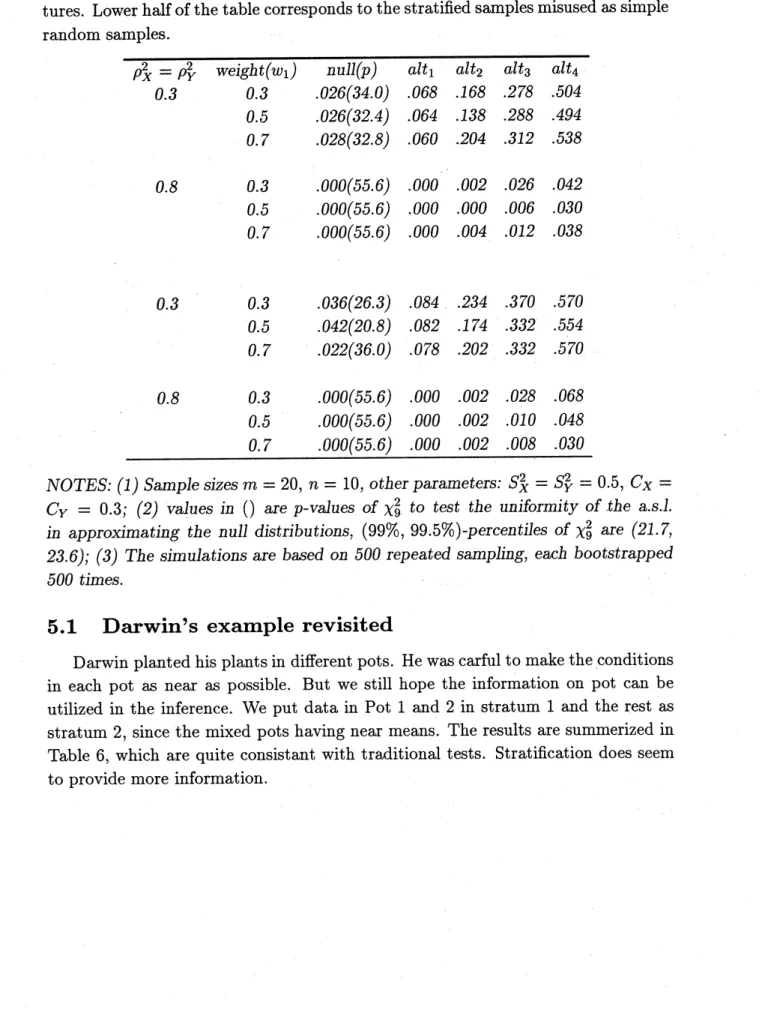
repeated sampling, each bootstrapped 500 times.Location-aligned bootstrap tests are however quite sensitive to the effects of
stratification $(\rho_{X}^{2}, \rho_{Y}^{2})$, and to the balance of samples, as can be seen from Table 5.
To improve, ideas like mixing may be incorporated, weleave the experiments as our
Table 5 10%-level location-aligned bootstrap tests applied to two normal
mix-tures. Lower half of the table corresponds to the stratified samples misused assimple
random samples. $\overline{\rho_{X}^{2}=\rho_{Y}^{2}\iota \mathrm{v}e\mathrm{j}ght(w1)null(p)alt_{1}alt2alt_{3}alt4}$ 0.3 0.3 .026(34.0) .068 .168 .278 .504 0.5 .026(32.4) .064 .138 .288 .494 0.7 .028(32.8) .060 .204 .312 .538 0.8 0.3 .000(55.6) .000 .002 .026 .042 0.5 .000(55.6) .000 .000 .006 .030 0.7 .000(55.6) .000 .004 .012 .038 0.3 0.3 .036(26.3) .084 .234 .370 .570 0.5 .042(20.8) .082 .174 .332 .554 0.7 .022(36.0) .078 .202 .332 .570 0.8 0.3 .000(55.6) .000 .002 .028 .068 0.5 .000(55.6)
.000
.002.010 .048
0.7
.000(55.6) .000.002 .008 .030
NOTES: (1) Sample sizes $m=20,$ $n=10,$ $oth$erparameters: $S_{X}^{2}=s_{Y}^{2}=0.\mathit{5},$ $C_{X}=$
$C_{Y}=0.3;(\mathit{2})$ values in $()$ are $p$-values of $\chi_{9}^{2}$ to test the uniformity of the a.s.l.
in approximating the $m\mathrm{z}\mathit{1}\mathit{1}$ distributions, (99%, 99.5%)-percentiles of$\chi_{9}^{2}$ are (21.7,
23.6); (3) The simulations are based on
500
repeated sampling, each bootstrapped500 times.
5.1
Darwin’s
example
revisited
Darwin planted his plantsin different pots. Hewas carful to make the conditions
in each pot as near as possible. But we still hope the information on pot can be
utilized in the inference. We put data in Pot 1 and 2 in stratum 1 and the rest as
stratum 2, since the mixed pots having near means. The results are summerized in
Table 6, which are quite consistant with traditional tests. Stratification does seem
Table 6. Bootstrap tests of the difference on growth rates between the
crossed-andself-fertilized$\mathrm{z}\mathrm{e}\mathrm{a}$. Thefiguresaretwo-sided achieved significance levels, obtained
from 200bootstrap samples. Other classical parametric and nonparametric testsare
alsoshown(Takeuchiand Ohasi, 1981). Among thesetests, themedian test has least
a.s.l., the corresponding 95% confidence interval is $(1\mathit{9}, 45)$, which is “significantly”
short. See Remark 2 od Section 4.2.
Method Type of Transformation asl
no transformation .505
stratiBed sampling location .000(.005)
location-scale .015(.005) simple no transformation .545 randon location .025(.010) $\frac{s\mathrm{a}mplingl_{\mathit{0}}C\mathrm{a}tion-_{8Ca}le.\mathit{0}\mathit{0}\mathit{5}(.\mathit{0}\mathit{0}5)}{N(\mu_{x},\sigma^{2}),N(\mu_{y},\sigma^{2}).\mathit{0}\mathit{2}}$ one-sample $t(d.f.=n- \mathit{1})$ .05 Wilcoxson .003 permutation .024 median .0014
NOTES: $(l)s_{tr}at\mathrm{a}$areformedbymixing Pot 1 and2, andPot2and$\mathit{3};(\mathit{2})N(\mu_{x}, \sigma^{2}),$ $N(\mu_{y}, \sigma^{2})$
stands for the method based the normal assumptions with homogeneous variancesj
one-sample$t(d.f.=n- l)$ forFisher’s one-sample$t$-testby properlypairing th$\mathrm{e}d\mathrm{a}t\mathrm{a}(See$
Fisher, 1960); Wilcoxson for Wilcoxson test; $p$ermutation for$p$ermutation test; and
median for median test; (3)$Figu\mathrm{r}es$ in bracketsare obtained from mixin
$g$ the
trans-formed data in simple random sampling, but only mixing the transtrans-formed data
within $e\mathrm{a}ch$population in stratifi$ed$ situations.
6
Discussions
Bootstrap tests are statistical procedures for seeking information about models
in one class(the null class), conditional on information about a different class($\mathrm{t}\mathrm{h}\mathrm{e}$
al-ternative class). In a strict sense, we neverhave direct information of the first class,
but always observe instead information of the latter class. “Validity” of the
trans-formations ofthe $ma\Gamma \mathrm{l}\mathrm{n}\mathrm{f}\mathrm{o}\mathrm{r}\mathrm{m}\mathrm{a}\mathrm{t}\mathrm{i}\mathrm{o}\mathrm{n}$ into the information we want,
obviously depends
参考文献
[1] Boos, D., Janssen, P. andVeraverbeke, $\mathrm{N}.(1989)$. Resamplingfrom centereddata
in the two-sample problerm, Journal
of
Statistical Planning and Inference, 21,327-345.
[2] Darwin, $\mathrm{C}.(1876)$, The
effects of
cross- andself-fertilisation
in the vegetablekingdom, London: John Murray.
[3] Efron, B. and Tibshirani, $\mathrm{R}.(1\mathit{9}\mathit{9}3),An$Introduction to the Bootstrap: Chapman
and Hall.
[4] Fisher, $\mathrm{R}.\mathrm{A}.(1\mathit{9}60)$, The Design
of
Experiments($7\mathrm{t}\mathrm{h}$ ed.), Edinburgh: Oliver and
Boyd.
[5] Takeuchi, K. and Ohasi,$\mathrm{Y}.(1981)$, Toketekisuisoku-2$hy_{\mathit{0}}honmondai$($\mathrm{i}\mathrm{n}$Japanese),
Tokyo: Nihonhyoronsya.
[6] Wakimoto, $\mathrm{K}.(1971)$, Stratified random sampling (I), Estimation ofthe