On
the
connection
formula
for the first
Painlev\’e
equation
–from
the
viewpoint
of
the
exact
$WKB$analysis
–.Yoshitsugu
TAKEI
Research Institute for Mathematical
Sciences
Kyoto University Kyoto, 606-01,
JAPAN
(
京油田裡厨
竹痔義次
)
1
Introduction.
In the workshop (held at the Research Institute for Mathematical Sciences,
Kyoto University during the period of April 26–28, 1995) I gave aseries of
lectures on the exact WKB analysis ofPainlev\’e transcendentswith a large parameter, the subject of my recent research jointly done with T. Kawai
(RIMS,Kyoto Univ.) and T.Aoki (Kinki Univ.). Startingwiththeexistence
offormal power series solutions $\lambda_{J}$ ofthe J-thPainlev\’e equation $(P_{J})(J=$
I,
.. .
, VI) and the definition ofturning points and Stokes curves for them, I explained the following topics mainly in my lectures:1. local equivalence between $\lambda_{\mathrm{I}}$ and $\lambda_{J}(J=\mathrm{I}\mathrm{I}, \ldots, \mathrm{V}\mathrm{I})$,
2. construction ofinstanton-type formal solutions $\lambda_{J,\alpha,\beta}$ of $(P_{J})$,
3. descriptionoftheconnection formula for $\lambda_{\mathrm{I}}$ in terms of the
instanton-type solutions $\lambda_{\mathrm{I},\alpha,\beta}$,
4. local equivalence between $\lambda_{\mathrm{I},\alpha,\beta}$and $\lambda_{\mathrm{I}\mathrm{I},\alpha,\beta}$
.
The formal power series solutions $\lambda_{J}$ and, in particular, their local
equiva-lence are discussed in [KT2] in detail, while the readers should be referred
concentrate our consideration on the topic 3, i.e., on theconnection formula for the first Painlev\’e equation.
There have beenseveralworksabout theconnection formula for the first
Painlev\’e equation. For example, some Russian mathematicians investigate
Painlev\’e equations by using their relationship with the isomonodromic de-formations of linear equations associated with them. (See e.g. [FIK], and references cited there.) In particular, Kapaev has performed asymptotic
analysis ofthe associatedlinear equation to obtain theleading coefficient of
the connection formula for the first Painlev\’e equation $([\mathrm{K}])$
.
On the otherhand, employing the so-called multiple-scale analysis, Joshi and Kruskal
study the first (and the second) Painlev\’e equation without resorting to the isomonodromic method $([\mathrm{J}\mathrm{K}1, \mathrm{J}\mathrm{K}2])$
.
..Now the purpose of our research is to discuss the Painlev\’e equation
$(P_{J})$ in a unified manner through the exact WKB analysis (cf. [Tke]). As
a matter offact, as is shown by the local equivalence between $\lambda_{\mathrm{I}}$ and $\lambda_{J}$,
the first Painlev\’e equation $(P_{\mathrm{I}})$ can be regarded as a canonical equation
near a simple turning point of $(P_{J})$ from the viewpoint of the exact WKB
analysis(just like the Airyequationin thecaseoflinear ordinarydifferential equations of second order). This, being one of the supporting evidences for
the possibility of such a unified treatment of $(P_{J})$, implies that explicit
analysis of$(P_{\mathrm{I}})$ should be a crucially important step for the determination
oftheconnectionformula for$(P_{J})$ nearasimpleturning point. Todetermine
the explicit form ofthe connection formula for $(P_{\mathrm{I}})$, we shall compute the
Stokes multipliers of the linear equation associated with $P_{\mathrm{I}}$ by using the
exact WKB analysis; to be more specific, we shall employ not only the Voros theory $([\mathrm{V}])$ but also Kapaev’s idea$(1\mathrm{K}])$ to overcomethe difficulty of
the double turning point whose appearance is a characteristic phenomenon
in our theory (cf. [KT1, $\mathrm{K}\mathrm{T}2]$). At the present stage the results we have
obtained so far are not satisfactory enough (in the sense that the explicit
formulas are obtained only for the leading term, not for arbitrarily higher
orders), althoughwe hope our method will giveus a complete answer in the near future.
By the way, we also note the following fact here; the number of the formal power series solutions $\lambda_{J}$ is exactly equal to the numberof the local
charts, which are constructed explicitly by Takano et al., of ‘the space of initial values for $(P_{J})$’ (due to Okamoto, cf. [Tka]). As I mentioned at the
end of the lectures, ourdream (just a dream in the true sense) is that this coincidence is not accidentalat all but may be akey property in considering
also that this dream will be realized in some future.
In ending this introduction, the author would like to thank Professor
T. Kawai and ProfessorT. Aoki for their many valuable suggestions and the
stimulating discussions withthem. A partof thiswork waspreparedduring the author’s stay at the Isaac Newton Institute for Mathematical Sciences
supported by the joint research project ($‘ \mathrm{I}\mathrm{n}\mathrm{f}\mathrm{i}\mathrm{n}\mathrm{i}\mathrm{t}\mathrm{e}$ Analysis
and Geometry”
between the Newton Institute and RIMS, which is sponsored by the Royal Society and the Japan Society for the Promotion of Science.
2
Basic
part of the
exact
WKB
analysis
for
$(P_{\mathrm{I}})$.
–A brief
review.
First ofall, to fix our notations, let us review the basic part of the exact WKB analysis for the first Painlev\’e equation.
The concrete form of the equation is given by the following:
(1) $\frac{d^{2}\lambda}{dt^{2}}=\eta^{22}(6\lambda+t)$,
which is equivalent to the following Hamiltonian system:
(2) $\{$
$\frac{d\lambda}{dt}$
$=$ $\eta\frac{\partial I\mathrm{f}_{\mathrm{I}}}{\partial\nu}$, $\frac{d\nu}{dt}$
$=$ $- \eta\frac{\partial IC_{\mathrm{I}}}{\partial\lambda}$,
where $IC_{\mathrm{I}}=\nu^{2}/2-(2\lambda^{3}+t\lambda)$
.
Here and in what follows$\eta$ denotes a large
parameter. We also denote the polynomial $6\lambda^{2}+t$ by $F_{\mathrm{I}}(\lambda, t)$
.
As iswell-known,the equation (1) (or rather thesystem (2)) represents the condition
for isomonodromic deformations of the following Schr\"odinger equation in
the
sense
of [JMU] (see [O] and [KT2] also):(3) $(- \frac{\partial^{2}}{\partial x^{2}}+\eta^{2}Q_{\mathrm{I}}(X, t, \eta).)\psi(x, \iota, \eta)=0$,
where the potential $Q_{\mathrm{I}}$ is given by
Observing this concrete form of the equation, we can easily find that the system (2) (hence the equation (1) also) has the $\mathrm{f}\mathrm{o}\mathrm{l}1_{0}\mathrm{w}\mathrm{i}\mathrm{n}\mathrm{g}\mathrm{f}-1\mathrm{o}\mathrm{r}\mathrm{m}\mathrm{a}1$power series solution, which is denoted by $(\lambda_{\mathrm{I}}, \nu_{\mathrm{I}})$, with respect to
$\eta$ :
(5) $\{$
$\lambda_{1}$ $=$ $\lambda_{0}(\iota)+\eta-1\lambda_{1}(t)+\eta-2\lambda_{2}(t)+\cdots$ ,
$\nu_{1}$ $=$ $\nu_{0}(t)+\eta-1\nu_{1}(t)+\eta-2\nu_{2}(t)+\cdots$
.
An important point is that the requirement $(\lambda_{1}, \nu_{\mathrm{I}})$ should be a solutionof
(2) forces its leading term $(\lambda 0, \nu_{0})$ to satisfy the algebraic equations
(6) $F_{\mathrm{I}}(\lambda \mathrm{o}(t),t)=0$ and $\nu_{0}(t)=0$
and also the other terms $(\lambda_{j}, \nu_{j})(j\geq 1)$ to be determined recursively from
$(\lambda_{0}, \nu_{0})$
.
In particular, for $\lambda_{\mathrm{I}}$ the odd order terms all vanish identically andeveryeven order termcan be expressed in the following way:
(7) $\lambda_{2j}=c_{j}(-\frac{t}{6})^{(5j)/2}1-$ $(j=0,1,2, \cdots)$,
where $\{c_{j}\}$ is a series of constants defined by
(8) $\{$
$c_{0}$ $=$ 1, $c_{1}=- \frac{1}{12^{3}}$, $c_{2}=- \frac{49}{2\cdot 12^{6}}$,
$c_{j}$ $=$
$\frac{25}{12^{3}}(j-1)2c_{j}-1-\frac{1}{2}k,l+l_{-,\geq}-j\sum_{k}2c_{k}c_{l}$
$(j\geq 3)$
.
(Similarly all of the odd orderterms $\mathrm{i}\mathrm{d}\mathrm{e}\mathrm{n}\mathrm{t}\mathrm{i}_{\mathrm{C}}\mathrm{a}\mathrm{l}\mathrm{i}\mathrm{y}$vanish for
$\nu_{\mathrm{I}}.$) As is always
the case with singular perturbations, the recursive formula (8) makes $\lambda_{\mathrm{I}}$
diverge. To give an analytic meaning to $\lambda_{\mathrm{I}}$, we
consider.
its Borel sum, which is the central object ofour discussion in this report.In [KT2] we have defined the turning points and the Stokes curves for formal power series solutions of$(P_{J})$
.
In thecaseof the equatin (1), i.e., thefirst Painlev\’e equation, the origin $t=0$ is the unique turning point (which
is simple) and the Stokes curves become the following:
(9) $\{t\in C;{\rm Im}\int^{t}0\sqrt{\frac{\partial F_{\mathrm{I}}}{\partial\lambda}(\lambda_{0}(t),\iota)}dt=0\}$ ,
namely$\{t\in C;{\rm Im}(-t)5/4\}=0$, five straightlinesemanating fromtheorigin. Note that the turning points and theStokescurvesfor$\lambda_{\mathrm{I}}$ thusdefined havea
close relationship with those of the associated Schr\"odinger equation (3)$-(4)$ (see Proposition 1 in
\S 4.1
below). This relationship (and, in the case of the first Painlev\’e equation, the concrete analysis of the Borel transform of $\lambda_{\mathrm{I}}$to be done in the subsequent section as well) explains the reason why the Borelsum of$\lambda_{\mathrm{I}}$ isexpected to have a discontinuityon the Stokes curves, as we shall see later.
Our goal in this report is to present, as explicitly as possible, the
con-nection formula describing the discontinuity of the Borel sum of $\lambda_{\mathrm{I}}$ on a
Stokes curve. Recalling the definition of the Borel resummation, we may
easily guess that the connection formula should be described in terms of
the ‘instanton-type’ solutions introduced in [KT1] first. As a matter of fact, in [AKT3] we have constructed the following formal solutions $\lambda_{\mathrm{I},\alpha,\beta}$ of
the equation (1) with two free parameters by employing the multiple-scale analysis:
(10) $\lambda_{\mathrm{I},\alpha,\beta}=\lambda 0(t)+\eta\lambda_{1}-1/2-+\eta 1/2(t, \eta)\lambda 1(t, \eta)+\cdots$,
where the leading term $\lambda_{0}(t)$ is the same as that of $\lambda_{\mathrm{I}}$, i.e., $\lambda_{0}(t)=s^{1/2}$
$(s=-t/6)$, the sub-leading term $\lambda_{1/2}(t, \eta)$ is given by
(11) $\lambda_{1/2}(t, \eta)=(12\lambda 0)^{-1}/4[\alpha \mathit{8}^{5\alpha\beta}/2e^{\mathcal{T}}+\beta S^{-5\alpha\beta/\tau}2e^{-}]$
with $\alpha$ and $\beta$ being arbitrary complex numbers and
(12) $\tau=\eta\int_{0}^{t}\sqrt{\frac{\partial F_{\mathrm{I}}}{\partial\lambda}(\lambda_{0}(t),t)}dt=-\frac{48\sqrt{3}}{5}(-\frac{t}{6})^{5}/4\eta$,
and the higher order terms $\lambda_{j/2}(t, \eta)(j\geq 2)$, which are determined
recur-sively from $\lambda_{0}(t)$ and $\lambda_{1/2}(t, \eta)$, have the following form:
(13) $\lambda_{j/2}(t, \eta)=\sum_{=k0}^{j}\lambda_{j}^{(j}/2)e-2k(\iota)(j-2k)_{\mathcal{T}}$
.
Remark. Although it is possible to introduce more arbitrary constants into the formal solution $\lambda_{\mathrm{I},\alpha,\beta}$ in determining $\lambda 2((2\iota_{-}1)/t, \eta)$ for every
pos-itive integer $l$, we assume throught this report that all of them are zero
except $(\alpha, \beta)$ contained in the expression (11) of$\lambda_{1/2}(t, \eta)$
.
In fact, for ourpurposes it is sufficientto consider such a simple case due to the distinctive homogeneity (with respect to $t$ and
$\eta$) that the solution
equation (1) enjoys. For the details concerning these solutions see [AKT3,
\S 1],
where the other Painlev\’e equations are also discussed.Furthermore, if we assume one of the free parameters, say $\beta$, to be zero,
thenwe find that the ‘negative instanton-terms’ (i.e., the terms $\lambda(t)e^{(j-}2k$)$\tau$
with$j-2k<0$ in the expression (13)of$\lambda_{j/2}(t, \eta))$ allvanish and the formal
solution $\lambda_{\mathrm{I},\alpha,0}$ can beexpressed in another way, namely
(14) $\lambda_{\mathrm{I},\alpha_{:}}0$
. $=\lambda(0)+\eta^{-1}\lambda/2(1)e+\mathcal{T}\eta\lambda 2)e+-1(2\mathcal{T}\ldots$ ,
where each $\lambda^{(j)}=\sum_{k\geq 0}\eta^{-k}\lambda_{j}^{(+}/2$$(t)kj$) is a formal power series of$\eta^{-1}$
.
Inparticular, $\lambda^{(0)}$ coincides with the formal power series solution $\lambda_{\mathrm{I}},$ $\lambda^{(1)}$
has the form
(15) $\lambda^{(1)}=\alpha(12\sqrt{s})^{-1/4}[1-\frac{15}{4}(12\sqrt{s})^{-5/1]}2\eta+-\ldots$,
and the other $\lambda^{(j)}(j\geq 2)$ are determined recursively. (A similar expression
is possible also for $\lambda_{\mathrm{I},0,\beta}.$) This particular solution $\lambda_{\mathrm{I},\alpha,0}$ (or $\lambda_{\mathrm{I},0,\beta}$), which
is nothing but the solution discussed in $[\mathrm{K}\mathrm{T}1, \S 3]$, should be an important
ingredient of theconnectionformula for$\lambda_{\mathrm{I}}$
.
Inthesequelwetryto determinethe explicit form (or, equivalently, the explicit value of the constant $\alpha$ (or
$\beta))$ of the solution that appears in the connection formula for $\lambda_{\mathrm{I}}$
.
3
Analytical
structure
of the Borel transform and
the
connection
formula for
$\lambda_{\mathrm{I}}$.
Before discussing the Stokes multipliers of the linear equation (3)$-(4)$, we
investigate some analytical properties ofthe Borel transform of $\lambda_{\mathrm{I}}$ without
applying the isomonodromic method. The content of this section is
essen-tially the same as that of$[\mathrm{K}\mathrm{T}1, \S 3]$
.
Let $\lambda_{\mathrm{I},B}(t, y)$ denote the Borel transform of $\lambda_{\mathrm{I}}$
.
Since the Borel sum of $\lambda_{\mathrm{I}}$ is defined as a Laplace integral$\eta\int_{0}^{\infty}e^{-y\eta}\lambda_{\mathrm{I}},B(t, y)dy$,
it is reasonable to guess that the Borel sum of $\lambda_{\mathrm{I}}$ may have a discontinuity
we denote by $\phi(t_{*})$, lies on the positive real axis and that it should satisfy
the followingconnection formula there:
(16) $\lambda_{\mathrm{I}}arrow\lambda_{\mathrm{I}}+e^{-\phi(t)\eta}\tilde{\lambda}+\cdot$
.
,.
Here $\tilde{\lambda}$
corresponds to (the Borel sum of) the singular part of $\lambda_{\mathrm{I},B}(t, y)$
at the singular point $y=\phi(t)$
.
(In (16) we use the same symbol $\lambda_{\mathrm{I}}$ todesignate its Borel sum also.) Inthis mannerthe analytical structure of the
Borel transform$\lambda_{\mathrm{I},B}$ (i.e., thelocation of its singular points andits singular
part at every singular point) completelydetermines the explicit form of the connection formula for $\lambda_{\mathrm{I}}$
.
On the other hand, we find that the right-hand side of (16) has the
same form as that of one parameter instanton-type solutions defined by
(14). As a matter of fact, it must be one of the instanton-type solutions
due to the “uniqueness” of this kind of solutions ($[\mathrm{K}\mathrm{T}1$, Theorem 3.1]) and
to the homogeneity of $\lambda_{\mathrm{I}}$
.
This implies, under the assumption of the Borelsummability of$\lambda_{\mathrm{I}}$, that the explicit description of instanton-type solutions
explained in
\S 2
should be translated into the corresponding information on the analytical structure of $\lambda_{\mathrm{I},B}$ and as a consequence the connectionformula for$\lambda_{\mathrm{I}}$ should bedetermined completelyexceptoneconstant
$\alpha$ which
is contained in the expression (14)$-(15)$ of one parameter instanton-type
solutions.
From now on let us investigate theanalytical structure of $\lambda_{\mathrm{I},B}$ by using
its relationshipwiththe explicitdescription of instanton-type solutions and
try to fix the undetermined constant $\alpha$ mentioned above. By the definition
the explicit form of$\lambda_{\mathrm{I},B}$ is the following:
(17) $\lambda_{\mathrm{I},B}(t, y)=\sum_{j=0}\frac{c_{j}}{(2j)!}\infty(-\frac{t}{6}\mathrm{I}^{(1-\mathrm{s}}j)/2y^{2j}$,
where the coefficient $c_{j}$ has already been defined by (8). Taking the
homo-geneity of$\lambda_{\mathrm{I}}$ and
$\lambda_{\mathrm{I},B}$ into account, werewrite (17) as follows:
(18) $\lambda_{\mathrm{I},B}(t, y)=(-\frac{t}{6})^{1}/\sum_{j=0}^{2\infty}d_{j}zj$,
where
It follows from the recursive formula (8) that the series $\{d_{j}\}$ satisfies, for
example, the following estimate:
(20) $C4^{j} \frac{(j-1)!^{2}}{(2j)!}\leq|d_{j}|\leq 4^{j+1}\frac{j!^{2}}{(2j+2)!}$ $(j\geq 1)$
where $C$ is a positive constant. By using this estimate (20) we can readily
verify that the sum $\sum d_{j}z^{j}$ converges for small $z$ and that its radius of
convergenceis equal to 1. Furthermore, since $d_{j}$ is negative for every$j\geq 1$,
the point $z=1$ is a singular point of $\sum d_{j}z^{j}$
.
This immediately impliesthat for each fixed $t\neq 0$ the Borel transform $\lambda_{\mathrm{I},B}(t, y)$ defines an analytic
function near $y=0$ and has a singularity at $y= \pm\frac{48\sqrt{3}}{5}(-t/6)5/4$ which
is denoted by $\pm\phi_{\mathrm{I}}(t)$ hereinafter. The location of this singularity exactly
coincides (except the sign) with the one predicted by the explicit form of
instanton-type solutions (14) (cf. (12)). As the singular part of $\lambda_{\mathrm{I},B}(t, y)$
at this singular point $y=\phi_{\mathrm{I}}(t)$ corresponds to the coefficient $\eta^{-1/2}\lambda^{(}1$) of $e^{\tau}=e^{-\phi_{1}(t)}\eta$ in the expression (14), we canfurther expect that the function $\sum d_{j}z^{j}$ should have the following local expression near the singular point
$z=1$:
(21) $\sum d_{j}z^{j}=(1-Z)^{1}/2f(Z)+\mathit{9}(z)$
where $f$ and $g$ are holomorphic functions in a neighborhood of$z=1$
.
Asa matter of fact, $(1 -z)^{1/2}f(Z)$ (or, more precisely, the discontinuity of $(-t/6)^{1/2}(1-z)^{1/2}f(z))$ corresponds to the Borel transform of $\eta^{-1/2}\lambda^{(1)}$
.
(The term $(1-z)1/2$ essentiallycomes from $\eta^{-1/2}.$) In particular, it follows
from this correspondence that the undetermined constant $\alpha$ in the
connec-tion formula for $\lambda_{\mathrm{I}}$ is connected with the value of $f(z)$ at $z=1$ by the
relation $\alpha=i\sqrt{5\pi}/12\mu(\mu=f(z)|_{z=}1)$
.
(Note that, strictly speaking, thisrelation is correct except the sign. The sign may depend not only on the
choiceof various branches butalsoon which Stokescurves we areconsidering
at.)
Thus our remaining task is to fix the value $\mu=f(1)$
.
Let us recallthat the exponent $j\tau/\eta$ of “instantons” $e^{j\tau}$
in (14) represents the location ofsingular points of$\lambda_{\mathrm{I},B}(t, y)$
.
On the other hand, it follows from (12) thatthe possible value of$j\tau/\eta$isonly anintegral multipleof$\phi_{\mathrm{I}}(t)$
.
This stronglysuggests that the point $z=1$ should be the uniquesingular pointof $\sum d_{j}z^{j}$
on its circle of convergence. Let us now assume this fact for the moment.
Then it enables us to apply the Darboux method to the analytic function
$z=1$ (hence $f_{0}=\mu$) and consider the function
$F_{N}(_{Z})= \sum_{j=0}d_{j}z-\infty j(1-Z)1/2k\sum_{=0}^{N-1}fk(Z-1)^{k}$
for a positive integer $N$
.
It follows from the above assumption and theexpression (21) that the holomorphic function $F_{N}(z)$ in $\{z\in C;|z|<1\}$
defines an $N$-times continuously differentiable function on the unit circle $\{z\in C;|z|=1\}$
.
Hence the coefficient of the Taylor expansionof $F_{N}(z)$ at$z=0$, which is explicitly given by
$d_{j}- \sum_{k=0}^{N-1}(-1)j+kf_{k^{\frac{\Gamma(k+3/2)}{j!\Gamma(k+3/2-j)}}}$,
becomes $O(j^{-M})$ for an arbitrarily given positive number $M$ providing $N$
is sufficiently large, as it is at the same time the Fourier coefficient of the
$2\pi$-periodic $C^{N}$ function $F_{N}(e^{i\theta})$
.
Since $(j!\Gamma(k+3/2-j))^{-1}=O(j^{-k-}3/2)$holds for every non-negative integer $k$, this immediately implies
(22) $\mu=f_{0}=\lim_{jarrow\infty}(-1)^{j}d_{j}\frac{j!\Gamma(3/2-j)}{\Gamma(3/2)}$
.
Combining(22)andtherecursive formula for$\{d_{j}\}$ (cf. (8) and(19))together,
we thus obtain the followingexpression of$\mu$:
(23) $\mu=\lim_{jarrow\infty}\mu j$
with $\{\mu_{j}\}$ being defined by the following:
(24) $\{$
$\mu_{0}$ $=$ 1, $\mu_{1}=\frac{4}{25}$ $\mu_{2}=\frac{392}{1875}$
$\mu_{j}$ $–$ $\frac{(2j-2)^{2}}{(2j-1)(2j-3)}\mu_{j-1}$
$+ \frac{1}{2}\sum\frac{(2k-1)!!(2k-3)!!(2l-1)!!(2l-3)!!}{(2j-1)!!(2j-3)!!}\mu_{k}\mu_{l}$
$k+l^{--j}k,l\geq 2$
$(j\geq 3)$
(where $(2n-1)!!=(2n-1)\cdot(2n-3)\cdots\cdot 1$). A numerical computation of
(23)$-(24)$ shows, for example,
(Note that for the numerical computation of$\mu$ it is better to use some error
estimate together since the convergence of (23)$-(24)$ is considerablyslow.)
The conclusion of this sectioncanbe summarized as follows: Thestudy
based on the relationship between the analytical structure of the Borel transform $\lambda_{\mathrm{I},B}$ and the explicit descriptionof instanton-type solutions tells
us that under several assumptions such as the Borel summability of $\lambda_{\mathrm{I}}$
etc. we have the following connection formula for $\lambda_{\mathrm{I}}$ on each Stokes curve
$\{t\in C;{\rm Im}(-t)^{5/4}=0\}$:
(26) $\lambda_{\mathrm{I}}$ $arrow$ $\lambda_{\mathrm{I},\alpha,0}$
$=$ $\lambda_{\mathrm{I}}+\eta\lambda-1/2(1)-e\phi 1(\iota)\eta+\eta\lambda-1(2)e-2\mathrm{I}(\iota)\eta+\emptyset\ldots$,
where
(27) $\phi_{\mathrm{I}}(t)$ $=$ $\frac{48\sqrt{3}}{5}s^{5/4}$ $(s=- \frac{t}{6})$,
(28) $\lambda^{(1)}$
$=$ $i \sqrt{\frac{5\pi}{12}}\mu(12\sqrt{s})^{-1/4}[1-\frac{15}{4}(12\sqrt{s})-5/2-1]\eta+\cdots$,
and the other $\lambda^{(j)}(j\geq 2)$ are determined recursively. (On some Stokes
curves
the formula (26) holds with $\lambda_{\mathrm{I},\alpha,0}$ being replaced by $\lambda_{\mathrm{I},0,\beta}.$) Theconstant $\mu$ is the limit ofthe series $\{\mu_{j}\}$ defined by (24).
4
Isomonodromic
deformations of the associated
linear equation and the
connection
formula for
$\lambda_{\mathrm{I}}$
.
Inthe precedingsection wehavepresented a characterization ofthe undeter-mined constant and deterundeter-mined the explicitform ofthe connection formula for $\lambda_{\mathrm{I}}$ in a quite satisfactory manner. However we have to admit that the
exact valueofthe constant is still notfixed; we can compute it only
numer-ically. In this section we consider our problem by using the relationship of
the equation (1) with isomonodromic deformations of the associated linear equation (3)$-(4)$ and try again to fixthe constant explicitly.
4.1
Preliminaries.
First ofall, let us substitute
$(\lambda_{0}(t)=\sqrt{-t}/6)$ into the linear equation (3)$-(4)$
.
After the substitution the potential $Q_{\mathrm{I}}$ becomes the following:(30) $Q_{\mathrm{I}}$ $=$ $4x^{3}+2tx-(4\lambda_{0}^{3}+2t\lambda_{0})+\eta^{-1}(N^{22}-12\lambda 0\Lambda)$
$- \eta^{-3/2}(4\Lambda^{3}+\frac{N}{x-\lambda_{0}}\mathrm{I}+\eta^{-2_{\frac{-N\Lambda+3/4}{(x-\lambda_{0})^{2}}+}}\cdots$
.
Now our strategy is as follows: We first compute a pair of two
inde-pendent Stokes multipliersofthe linear equation (3)$-(30)$ by employing the
exact WKB analysis due to Voros [V] (see [DDPI] and [AKT2] also). Since a double turning point naturally appears in our situation, we also make
use ofa local reduction theorem of [AKT3], based on Kapaev’s idea $([\mathrm{K}])$,
near the double turning point. As a consequence we will obtain an explicit description of the Stokes multipliers, which actually are infinite series of
$\eta^{-1/2}$ with their coefficients being functions of $t$, A and $N$
.
Then we solve(
$‘ \mathrm{i}\mathrm{s}\mathrm{o}\mathrm{m}\mathrm{o}\mathrm{n}\mathrm{o}\mathrm{d}\mathrm{r}\mathrm{o}\mathrm{m}\mathrm{i}\mathrm{C}$ equations” (i.e., equations that require these Stokes
multi-pliers to beconstant) for A and$N$, regarding$t$ and
$\eta$ as parameters, to seek
solutions of the first Painlev\’e equation (1). If we perform this procedure
in two adjacent Stokes regions (i.e., sectorial regions surrounded by Stokes
curvesfor $\lambda_{\mathrm{I}}$) respectively, the connection formula for$\lambda_{\mathrm{I}}$ will be determined
explicitly. $\mathrm{W}$
Before starting the computation ofStokesmultipliers, let us make
some
important remarks concerningthe WKB-theoretic structure of the equation (3)$-(30)$ here.First, since the top term $Q_{0}$ of $Q_{\mathrm{I}}$ is factorized as
$Q_{0}=4x^{3}+2tx-(4\lambda_{0}^{3}+2t\lambda_{0})=4(x-\sqrt{s})2(X+2\sqrt{s})$,
where $s$ denotes $-t/6$ as usual, the equation (3)$-(30)$ has a double turning
point at $x=\sqrt{s}$
.
This is really an unpleasant feature; the existence ofa double turning point prevents us from employing the Voros theory to
computethe Stokes
mul.t
ipliers. Wewilldiscuss how to deal with this double turning point in the next subsection.Second, in connection with this double turning point, the Stokes
geom-etry (i.e., the turning points and the Stokes curves) of the linear equation
(3)$-(30)$ is controlled by that of the Painlev\’e equation (1) in the following
manner:
Proposition 1 (i) At the turning point
for
$\lambda_{\mathrm{I}}$ ($i.e.$, at $t=0$) the doublelinear equation (3)$-(\mathit{3}\mathit{0})$ collapse to one point.
(ii) On each Stokes curve (9)
for
$\lambda_{\mathrm{I}}$ the two turning points $\sqrt{s}and-2\sqrt{s}$are connected by a Stokes curve
of
the equation (3)$-(so)$.
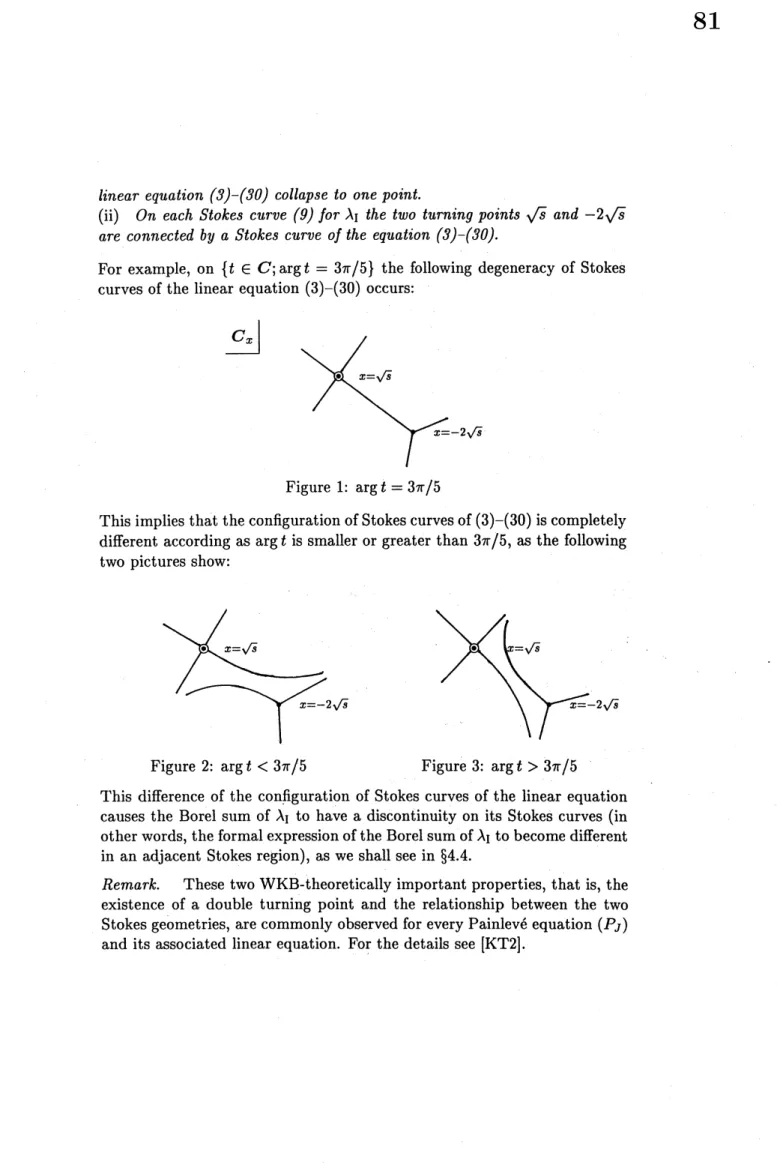
For example, on $\{t\in C;\arg t=3\pi/5\}$ the following degeneracy of Stokes
curves
of the linear equation (3)$-(30)$ occurs:$\lrcorner C_{x}$
Figure 1: $\arg t=3\pi/5$
This implies that the configuration of Stokescurvesof(3)$-(30)$ is completely
different according as$\arg t$ is smaller or greater than $3\pi/5$, as the following
two pictures show:
Figure 2: $\arg t<3\pi/5$ Figure 3: $\arg t>3\pi/5$ This difference of the configuration of Stokes curves ofthe linear equation
causes the Borel sum of $\lambda_{\mathrm{I}}$ to have a discontinuity on its Stokes curves (in
other words,the formalexpressionof the Borelsumof$\lambda_{\mathrm{I}}$ to become different
in an adjacent Stokesregion), as we shall see in
\S 4.4.
Remark. These two WKB-theoretically important properties, that is, the existence of a double turning point and the relationship between the two Stokes geometries, are commonlyobserved for everyPainlev\’e equation $(P_{J})$
4.2
Canonical
formnear
the double turning point.In orderto compute theStokes multipliersof theequation (3)$-(30)$ we need
the connection formula for WKB solutions of(3)$-(30)$ on each Stokescurve
emanating from the double turning point $x=\sqrt{s}$
.
One problem is that thepoint $x=\sqrt{s}$ is not only a double turning point but also a singular point
of (higherorder terms of) the potential (30). To overcome this difficultywe make use of a local transformation theorem (Proposition 2 below) near the double turning point, which is based on Kapaev’s idea $(1^{\mathrm{K}}])$ and proved in
all orders (with respect to $\eta^{-1/2}$) in [AKT3]. In this subsection we study
the canonical equation whichappears in this local transformation theorem. See also [DDP2] for a generaltreatment of double turning points.
Nowlet us first state the local transformation theorem.
Proposition 2 There exist a neighborhood $U$
of
$x=\sqrt{s}$, aformal
series(31) $\zeta(x, t, \eta)=j=\sum^{\infty}0\zeta_{j}/2(_{X}, t)\eta-j/2$,
whose
coefficients
$\zeta_{j/2}(x, t)$ are holomorphic in $x\in U$ (and $al_{\mathit{8}}o$ in $t$), andformal
series(32) $E(t, \eta)$ $=$ $\sum_{j=0}^{\infty}E/2(ji)\eta^{-j}/2$,
(33) $\rho(t, \eta)$ $=$ $\sum_{j=0}^{\infty}\rho j/2(t)\eta^{-j}/2$,
so that the following
four
conditions aresatisfied:
(34) $\frac{\partial\zeta_{0}}{\partial x}$ nevervanishes,
(35) $\zeta_{0}(\sqrt{s}, t)=0$,
(36) $\zeta_{1/2}$identically vanishes,
(37) $Q_{\mathrm{I}}(x, t, \eta)=(\frac{\partial\zeta}{\partial x})^{2}[4\zeta(x, t, \eta)2+\eta^{-1}E(t, \eta)$
$+ \frac{\eta^{-3/2}\rho(t,\eta)}{\zeta(x,t,\eta)..-\zeta(\sqrt{s}+\eta^{-1/2}\Lambda,t,\eta)}$ $+ \frac{3\eta^{-2}}{4(\zeta(_{X},t,\eta)-\zeta(\sqrt{s}+\eta-1/2\Lambda,\iota,\eta))2}]$ $- \frac{1}{2}\eta^{-2}\{\zeta(x, t, \eta);x\}$,
where $\{\zeta;x\}$ denotes the Schwarzian derivative:
$\frac{\partial^{3}\zeta/\partial x^{3}}{\partial\zeta/\partial x}-\frac{3}{2}(\frac{\partial^{2}\zeta/\partial x^{2}}{\partial\zeta/\partial x})^{2}$
For the proof ofProposition 2we refer the reader to [AKT3]. In fact, itcan be verified inthe sameway as [AKT3, Theorem 3.1], although the situation is a little different in that here we assume only the relation (29) while in [AKT3] an instanton-type solution ofthe system (2) has already been sub-stituted into the potential $Q_{\mathrm{I}}$. Proposition 2 claims that in a neighborhood
of the double turning point $x=\sqrt{s}$the linear equation (3)$-(30)$ should be
transformed to the following canonical equation bythe transformation (31):
(38) $(- \frac{\partial^{2}}{\partial\zeta^{2}}+\eta^{2}Q\mathrm{c}\mathrm{a}\mathrm{n}(\zeta, t, \eta))\varphi(\zeta, t, \eta)=0$,
where
(39)$Q_{\mathrm{C}} \mathrm{a}\mathrm{n}=4\zeta 2E\eta^{-1}(+t, \eta)+\frac{\eta^{-3/2}\rho(t,\eta)}{\zeta-\eta^{-1/2}\sigma(t,\eta)}+\frac{3\eta^{-2}}{4(\zeta-\eta^{-1/2}\sigma(t,\eta))2}$
.
Here wehave denoted$\eta\zeta 1/2(\sqrt{s}+\eta^{-}1/2\Lambda, t, \eta)$by $\sigma(t, \eta)$ (whichis of order $0$
in $\eta$ by (35)$)$
.
Note that these formal power series$E(t, \eta),$$\rho(t, \eta)$and$\sigma(t, \eta)$,
which depend also on A and $N$, are not independent; they satisfy
(40) $E(t, \eta)=\rho(t, \eta)^{2}-4\sigma(t, \eta)^{2}$
(cf. [AKT3, Remark3.3]). Furthermorethey aredetermined uniquely in the construction ofthe transformation. For example, the explicit form of their
top order terms is given by
(41) $E_{0}$ $=$ $(3\sqrt{s})^{-}1/2(N^{2}-12\sqrt{s}\Lambda^{2})$, (42) $\rho 0$ $=$ $-(3\sqrt{s})^{-1/4}N$,
(43) $\sigma_{0}$ $=$ $(3\sqrt{s})^{1/4}\Lambda$
.
In particular, the formal power series$E(t, \eta)$ is related to the original
equa-tion (3)$-(30)$ (and hence canbe computed easily) by the following relation:
(44) $E(t, \eta)=4{\rm Res}_{x=\sqrt{s}\circ}S\mathrm{d}\mathrm{d}$
(cf. [AKT3, (3.33)]), where $S_{\mathrm{o}\mathrm{d}\mathrm{d}}$ denotes the generalized odd part (in the sense of [AKT3, Definition 2.1]$)$ of the solution $S$ of the Riccati equation
associated with the original equation (3)$-(30)$, that is, $S_{\mathrm{o}\mathrm{d}\mathrm{d}}=(S^{+}-S-)/2$
with$S^{\pm}$ being thetwo
formal power series solutions of the Riccatiequation. In the rest ofthis subsectin we discuss the connection formula for WKB
solutions of the canonical equation (38)$-(39)$
.
Let us denote the solutionof the associated Riccati equation by $T= \sum_{j\geq-2}\eta^{-j/2}\tau(j/2\zeta)$ and its
gen-eralized odd part by $T_{\mathrm{o}\mathrm{d}\mathrm{d};}$ for example, $\tau_{-1}=2\zeta$ and
$\tau_{-1/2}(\zeta)$ identically
vanishes. By the induction it can be readily verified that, for every $j\geq 0$,
$T_{j/2}(\zeta)$ contains terms with negative powers in $\zeta$ only and
(45) ${\rm Res}_{\zeta=}0T_{\mathrm{o}} \mathrm{d}\mathrm{d}={\rm Res}_{\zeta=0}(T_{\mathrm{o}\mathrm{d}\mathrm{d}}-\eta\tau_{-}1)=\frac{E(t,\eta)}{4}$
holds. Thus the following normalized WKB solutions of the equation
(38)-(39), which we use as a fundamentalsystem ofsolutions hereinafter, become well-defined:
(46) $\varphi\pm$ $=$ $\frac{\sqrt{2\eta}}{\sqrt{T_{\mathrm{o}\mathrm{d}\mathrm{d}}}}\zeta^{\pm E/4}$
$\cross\exp\pm\{\eta\int_{0}^{\zeta}\tau-1d\zeta+\int_{\infty}^{\zeta}(\tau_{\mathrm{o}\mathrm{d}\mathrm{d}}-\eta\tau_{-}1-\frac{E}{4\zeta})d\zeta\}$ ,
that is,
(47) $\varphi_{\pm}--\exp(\pm\eta\zeta 2)\zeta-1/2\pm E/4(1+O(\eta^{1}\zeta/2)-1)$
.
Note that the asymptotic behavior (47) uniquely determines the normaliza-tion of WKB solunormaliza-tions (in the formal sense). In what follows we consider
these WKB solutions $\varphi\pm \mathrm{i}\mathrm{n}$ the Stokes regions (Region I $\sim$ Region III)
indicated in Figure4.
Figure 4
(For ourpresent purposes, i.e., to determine the connection formula for $\lambda_{\mathrm{I}}$,
cutonthe negative imaginary axis and define a branchof$\zeta^{\pm E/4}$ etc. so that
$0<\arg\zeta<3\pi/2$ may be satisfied.
Now our task is to determine the connection formula for $\varphi\pm \mathrm{b}\mathrm{e}\mathrm{t}\mathrm{w}\mathrm{e}\mathrm{e}\mathrm{n}$
two adjacent regions ofRegion $\mathrm{I}\sim \mathrm{R}\mathrm{e}\mathrm{g}\mathrm{i}_{\mathrm{o}\mathrm{n}}$ III. To do so, we transform the
canonical equation (38)$-(39)$ into the Weber equation. As a matter of fact,
ifwe first define $\tilde{u}$ and $\tilde{v}$ by
(48) $\{$
$\tilde{v}$
$=$ $(\zeta-\eta^{-1}\sigma/2)^{1}/2\varphi$,
$\tilde{u}$ $=$ $( \zeta-\eta^{-1/-1}2\sigma)\{\frac{d}{d\zeta}\tilde{v}+\eta^{1/2}\rho\tilde{v}\}$,
and if we, after that, apply the lineartransformation
(49)
$=$
,we find
(50)
$\frac{d}{d\zeta}=\eta$
.
In particular, $u$ thus defined satisfies
(51) $\frac{d^{2}u}{d\zeta^{2}}=\eta^{2}(4\zeta 2\eta+-1(E+2))u$,
and the equation (51)
can
be transformed by the scaling $z=2\sqrt{\eta}\zeta$ oftheindependent variable into the Weber equation:
(52) $\frac{d^{2}u}{dz^{2}}+(\kappa+\frac{1}{2}-\frac{z^{2}}{4}\mathrm{I}u=0$,
where $\kappa=-E/4-1$
.
In other words, if for a solution $\varphi$ of the canonicalequation (38)$-(39)$ we define $u(z)$ by
(53) $\varphi(\zeta)$ – $u(z)^{\mathrm{d}\mathrm{f}}=^{\mathrm{e}} \frac{\sqrt{2}\eta^{1/4}}{\sqrt{z-2\sigma}}[2\frac{d}{dz}(\varphi(\frac{z}{2\sqrt{\eta}}))$
then the resulting function $u(z)$ satisfies (52), and conversely (54) $u(z)$ $\mapsto$
$\varphi(\zeta)^{\mathrm{d}}=^{\mathrm{e}\mathrm{f}}\frac{1}{4\eta^{1/2}\sqrt{\zeta-\eta^{-1/2}\sigma}}$
$\cross[\frac{1}{\rho-2\sigma}(-2\frac{du}{dz}+zu)+u]|_{z=2\sqrt{\eta}\zeta}$
transforms asolution ofthe Weber equation (52) to a solution of(38)$-(39)$
.
Let us denote the former correspondence by $u=\mathcal{G}\varphi$ and the latter by $\varphi=\mathcal{G}^{-1}u$
.
Making use of this equivalence between the canonical equationand the Weber equation, we compute the connection formula for $\varphi_{\pm}$ in the
following way:
It is well known that the Weber equation (52) has the following formal
solution denoted by$\overline{D_{\kappa}}(Z)$:
(55) $\overline{D_{\kappa}}(z)=e-z^{2}/4\kappa\sum^{\infty}Zn=0(-1)n_{\frac{\kappa(\kappa-1)\cdots(\kappa-2n+1)}{n!2^{n_{Z}2n}}}$
.
Similarly $\overline{D\kappa}(-Z)$ and $D_{\overline{-\kappa}-1}(\pm iz)$ also satisfy the equation. Now we pick
up two ofthem appropriately and regard them as afundamental system of solutions of (52) respectively in the Region $\mathrm{I}’\sim \mathrm{R}\mathrm{e}\mathrm{g}\mathrm{i}_{0}\mathrm{n}\mathrm{I}\mathrm{I}\mathrm{I}’$ in the complex
$z$-plane as is indicated below:
Here we choose a branch of$z^{\kappa}$ etc. so that the followingmay be satisfied in
each region:
$\{$
Region $\mathrm{I}’$ : $0<\arg z<\pi/2,$ $-\pi/2<\arg(-iz)<0$,
Region $\mathrm{I}\mathrm{I}’$: $-\pi/2<\arg(-Z)<0,0<\arg(-iz)<\pi/2$,
Region $\mathrm{I}\mathrm{I}\mathrm{I}’$ :
$0<\arg(-Z)<\pi/2,$ $-\pi/2<\arg(i_{Z})<0$
.
These formal solutions are important inthe sense that in every region they
correspond to the WKB solutions$\varphi\pm \mathrm{o}\mathrm{f}$the equation(38)$-(39)$ by the
trans-formation $\mathcal{G}$ defined $\dot{\mathrm{a}}$
bove. For example, a straightforward computation
shows that in Region $\mathrm{I}\ \mathrm{I}’$
(56) $\mathcal{G}^{-1}\overline{D_{\kappa}}(Z)=\frac{1}{\rho-2\sigma}(2\sqrt{\eta})^{\kappa}e^{-}\eta\zeta^{2}\zeta\kappa+1/2(1+o(\sqrt{\eta}\zeta)-1)$
.
This immediately implies
(57) $\mathcal{G}^{-1}\overline{D_{\kappa}}(z)=\frac{1}{\rho-2\sigma}(2\sqrt{\eta})^{\kappa}\varphi-=\frac{1}{\rho-2\sigma}(2\sqrt{\eta})^{-}E/4-1\varphi_{-}$
.
The other correspondences can be computed.in a similar manner (though it is necessary to pay some attention to the choice ofbranches). We write
down the complete list of them below:
(58) Region
I&I’
:$\mathcal{G}^{-1}\overline{D_{\kappa}}(z)$
$=$ $\frac{1}{\rho-2\sigma}(2\sqrt{\eta})-E/4-1\varphi_{-}$, $\mathcal{G}^{-1}D_{-\hslash-}1(-iz)$ $=$ $\frac{1}{2}e^{-i\pi E/8}(2\sqrt{\eta})^{E/}4-1\varphi+$,
(59) Region
II&II’
:$\mathcal{G}^{-1}\overline{D_{\kappa}}(-z)$ $=$ $- \frac{1}{\rho-2\sigma}e^{i\pi E//-}4(2\sqrt{\eta})-E41\varphi_{-}$,
$\mathcal{G}^{-1}D_{\overline{-\kappa}-}1(-iz)$ $=$ $\frac{1}{2}e^{-i\pi E/8}(2\sqrt{\eta})^{E/}4-1\varphi+$,
(60) Region
III&III’
:. $\mathcal{G}^{-1}\overline{D_{\kappa}}(-z)$
.
$=$ $- \frac{1}{\rho-2\sigma}e^{i\pi E//-}4(2\sqrt{\eta})-E41\varphi_{-}$, $\mathcal{G}^{-1}D_{\overline{-\kappa}-1}(iZ)$ $=$ $\frac{1}{2}e^{-3i\pi E/8}(2\sqrt{\eta})^{E/}4-1\varphi+\cdot$
On the other hand, according to the well-known asymptotic formula for the classical Weber function $D_{\kappa}(z)$ (cf. [BMP, Chapter 8.4]) we can
regard the Weber function $D_{\kappa}(z)$ (resp. $D_{\kappa}(-z)\underline{D}_{-\hslash-1},(\pm iz)$) as a Borel
sumoftheformal$\mathrm{s}\mathrm{o}\mathrm{l}\mathrm{u}\mathrm{t}\mathrm{i}_{0}\mathrm{n}\overline{D_{\kappa}}(Z)$(resp.$\overline{D_{\kappa}}(-Z),$ $D_{-}\kappa-1(\pm iz)$)ineachregion.
Furthermore, the well-known formulas (cf. [BMP, Chapter 8.2]) (61) $D_{\kappa}(z)$ $=$ $e^{i\pi\kappa}D_{\kappa}(-z)+ \frac{\sqrt{2\pi}}{\Gamma(-\kappa)}e^{i\pi(\kappa+}1)/2D-\kappa-1(-iz)$
(62) $D_{-\kappa-1}(-iz)$ $=$ $e^{-i\pi(\kappa+1)}D- \kappa-1(iZ)+\frac{\sqrt{2\pi}}{\Gamma(\kappa+1)}e^{-i\pi\kappa/}D_{\kappa}2(-z)$
for the Weberfunction $D_{\kappa}(z)$ then play a role ofthe connection formula for
theformal$\mathrm{s}\mathrm{o}\mathrm{l}\mathrm{u}\mathrm{t}\mathrm{i}_{0}\mathrm{n}\mathrm{s}\overline{D_{\kappa}}(z)$ etc. between
the $\mathrm{t}\mathrm{w}\underline{\mathrm{o}\mathrm{a}\mathrm{d}}\mathrm{j}\mathrm{a}\mathbb{C}\mathrm{e}\mathrm{n}\mathrm{t}$regions inquestion.
(Note that on the positive imaginary axis $D_{-\kappa-1}(-iz)$ is a subdominant
solution and so is $\overline{D_{\kappa}}(-Z)$ on the negative realaxis.)
Hence, combining the correspondences (58) $\sim(60)$ andthe classical
for-mulas (61)$-(62)$ together, we obtain the connection formula for the WKB
solutions$\varphi\pm \mathrm{o}\mathrm{f}$the canonicalequation (38)$-(39)$
.
Theresultis the following:Proposition 3 Let $\varphi_{\pm}^{\mathrm{I}}$ (resp. $\varphi_{\pm}^{\mathrm{I}\mathrm{I}},$ $\varphi_{\pm}^{\mathrm{I}\mathrm{I}\mathrm{I}}$) denote the Borel sum
of
$\varphi\pm in$ theRegion I (resp. II, III) (cf. Figure 4). Then we have thefollowing relation:
(63) $\{$ $\varphi_{+}^{\mathrm{I}}$ $=$ $\varphi_{+}^{\mathrm{I}1}$ $\varphi_{-}^{\mathrm{I}}$ $=$ $\varphi_{-+\frac{\rho-2\sigma}{2}\frac{\sqrt{2\pi}}{\Gamma(E/4+1)}}^{\mathrm{I}\mathrm{I}\pi E}e-i/4(2\sqrt{\eta})E/2\varphi_{+}^{\mathrm{I}\mathrm{I}}$, and (64) $\varphi_{+}^{\mathrm{I}\mathrm{I}}$ $=$ $\varphi_{+}-\mathrm{I}\mathrm{I}\mathrm{I}\frac{2}{\rho-2\sigma}\frac{\sqrt{2\pi}}{\Gamma(-E/4)}e)/2(i\pi(E+12\sqrt{\eta})-E/2\varphi_{-}\mathrm{I}\mathrm{I}\mathrm{I}$ $\varphi_{-}^{\mathrm{I}\mathrm{I}}$ $=$ $\varphi_{-}^{\mathrm{I}\mathrm{I}\mathrm{I}}$
.
4.3 Computation of the Stokes multipliers.
Making use of the connection formula of the canonical equation near the double turningpoint, i.e., Proposition3 verifiedin the preceding subsection,
and the Voros theory $([\mathrm{V}])$ aswell, wecomputethe Stokes multipliersof the
linear equation associated with the firstPainlev\’eequationin this subsection. For the sake of specification, in otherwords, inorder to fix the configuration ofStokescurvesand thebranch of various multi-valued functions, we restrict
ourconsiderations heretoaneighborhood of the Stokescurve$\{t\in C;\arg t=$
$3\pi/5\}$ for $\lambda_{\mathrm{I}}$
.
The other cases can be discussed in the same way.Now the equation we want to discuss is (3) with the potential $Q_{\mathrm{I}}$ given
by (30). To compute its Stokes multipliersweneedawell-normalizedformal
solution, which inoursituationcan be expressed in terms of WKB solutions
as follows:
(65) $\psi_{\pm}=\frac{\sqrt{2\eta}}{\sqrt{S_{\mathrm{o}\mathrm{d}\mathrm{d}}}}\exp\pm\{\eta\int_{-2\sqrt{s}}^{x}S_{-1}dX+\int_{\infty}^{x}(s_{\mathrm{o}\mathrm{d}\mathrm{d}\eta}-S-1)dx\}$ ,
where $S= \sum_{j>_{-}2}\eta^{-}s_{j/}2(j/2x)$ denotes the solution of the Riccati equation
associated $\mathrm{w}\mathrm{i}\mathrm{t}\overline{\mathrm{h}}(3)-(30)$and $S_{\mathrm{o}\mathrm{d}\mathrm{d}}$ designates its generalized odd part (cf.
[AKT3, Definition 3.1]$)$
.
For example, the top term $S_{-1}(x)$ is given by$S_{-1}(x)=2(x-\sqrt{s})^{\sqrt{x+2\sqrt{s}}}$
$(s=-t/6)$ whose branch is determined so that $\arg S_{-}1(X)=\pi/5$ may
be satisfied on the segment connecting $x=\sqrt{s}$ and $x=-2\sqrt{s}$ (which is nothing but a Stokes curve of the equation (3)$-(30))$ when $\arg t=3\pi/5$
(i.e., $\arg s=8\pi/5$ and$\arg\sqrt{s}=4\pi/5$). Notethat $S_{-1/2}$ identicallyvanishes
and $S_{j/2}=O(x^{-3}/2)$ (as $xarrow\infty$) holds for every$j\geq 0$
.
Hence thesolutions(65) are well-defined in the formal sense and, since
(66) $\int^{x}s_{-1(}X)dX$ $=$ 2$\int^{x}(x-\sqrt{s})(x+2\sqrt{s})1/2dx$
$=$ $\frac{2}{5}(x-3\sqrt{s})(X+2\sqrt{s})3/2$
holds (moduloconstants depending on$t$), theyhave thefollowingasymptotic
behavior as $xarrow\infty$:
(67) $\psi_{\pm}=x^{-3/4}\exp\{\pm\eta(\frac{2}{5}X5/2+\frac{t}{2}x^{1/2}\mathrm{I}\}(1+O(x^{-1/}2))$
.
Our next problem is to determine the connection formula for the nor-malized WKB solutions $\psi_{\pm}$ on a Stokes curve emanating from the double
turningpoint. We will solve this by using the local transformation between theequation (3)$-(30)$ inquestion and the canonicalequation (38)$-(39)$
pro-vided by Proposition 2. First let $\psi_{\pm}^{J}$ ($J=\mathrm{I},$ $\mathrm{I}\mathrm{I}$, III) denote the Borel sum
$\lrcorner C_{x}$
Figure 6: (A local picture near $x=\sqrt{s}.$)
Since the leading term (i.e., the geometric part) $\zeta_{0}(X, \iota)$ of the local
trans-formation (31) is definedby
(68) $\zeta_{0}(X, \iota)=(2\int_{\sqrt{s}}^{x}(x-\sqrt{s})(X+2\sqrt{s})^{1/2}dX)^{1}/2$ ,
$\lrcorner C_{x}$ $\llcorner C_{\zeta}$
$\zeta=\zeta_{0}(_{X}, t)$
Figure 7: Transformation$\zeta=\zeta_{0}(x, t)$
.
the Borel resummed WKB solution $\psi_{\pm}^{J}$ ($J=\mathrm{I},$$\mathrm{I}\mathrm{I}$,
III) should correspond
to $\varphi_{\pm}^{J}$ respectively under the transformation (31). As a matter of fact, it
follows from (37) that$\psi_{\pm}$ and$\varphi\pm \mathrm{s}\mathrm{a}\mathrm{t}\mathrm{i}\mathrm{S}\mathrm{f}\mathrm{y}$thefollowing relation in the formal sense:
(69) $\psi_{\pm}(x, t, \eta)=C_{\pm}(t, \eta)(\frac{\partial\zeta}{\partial x})^{-1/2}\varphi_{\pm}(\zeta(x, t, \eta), t, \eta)$,
form:
(70) $C_{\pm}(t, \eta)=\exp(\eta c^{(\pm)}-1(t))\sum_{0}^{\infty}\eta c_{-j}j=)-j/2(\pm)/2(\iota$
.
Therelation (69) together with the geometric picture of the transformation
$\zeta=\zeta_{0}(x, t)$ guarantees the correspondence between the Borelsums $\psi_{\pm}^{J}$ and $\varphi_{\pm}^{J}$ ($J=\mathrm{I},$ $\mathrm{I}\mathrm{I}$, III) (cf. [AKTI]). Furthermore, combining the relation (69)
with the connectionformula for $\varphi\pm(\mathrm{P}\mathrm{r}\mathrm{o}\mathrm{p}0\mathrm{s}\mathrm{i}\mathrm{t}\mathrm{i}_{0}\mathrm{n}3)$, weobtainthe following
connection formulafor $\psi_{\pm}$:
Proposition 4 The following
formulas
holdfor
the $\mathit{8}olutions\{\psi_{\pm}^{J}\}(J=$I, II, III)
of
the equation (3)$-(\mathit{3}\mathit{0})$:(71) $\{$ $\psi_{+}^{\mathrm{I}}$ $=$ $\psi_{+}^{\mathrm{I}\mathrm{I}}$ $\psi_{-}^{\mathrm{I}}$ $=$ $\psi_{-}^{\mathrm{I}\mathrm{I}}+a_{12}\psi^{\mathrm{I}\mathrm{I}}+$ and $\{$ $\psi_{+}^{\mathrm{I}\mathrm{I}}$ $=$ $\psi_{+}^{\mathrm{I}\mathrm{I}\mathrm{I}}+a23\psi^{\mathrm{I}\mathrm{I}\mathrm{I}}-$ $\psi_{-}^{\mathrm{I}\mathrm{I}}$ $=$ $\psi_{-}^{\mathrm{I}\mathrm{I}\mathrm{I}}$, where
(72) $a_{12}$ $=$ $\frac{C_{-}}{c_{+}}\frac{\rho-2\sigma}{2}\frac{\sqrt{2\pi}}{\Gamma(E/4+1)}e^{-i}(\pi E/42\sqrt{\eta})E/2$,
(73) $a_{23}$ $=$ $- \frac{c_{+}}{C_{-}}\frac{2}{\rho-2\sigma}\frac{\sqrt{2\pi}}{\Gamma(-E/4)}e^{i}(\pi(E+1)/22\sqrt{\eta})-E/2$
$=$ $\frac{c_{+}}{C_{-}}\frac{\rho+2\sigma}{2}\frac{\sqrt{2\pi}}{\Gamma(-E/4+1)}e^{i\pi(E1)}(+/22\sqrt{\eta})-E/2$
.
(To obtain the last expression of $a_{23}$ we have used the formula $\Gamma(1+\alpha)=$
$\alpha\Gamma(\alpha)$ and the relation (40).) As is obvious from Proposition 4, $C_{\pm}\mathrm{s}\mathrm{h}_{0}\mathrm{u}\mathrm{l}\mathrm{d}$
play an important role in our problem. These constants $c_{\pm}$ are uniquely
determined by the transformation (31) and, in principle, can be computed recursively just like $\rho$ and $\sigma$, although the actual computation is not easy
(especially for higher order terms). Here we only perform the calculationof
$c_{-1}^{(\pm)}(t)$ and $c_{0}^{(\pm)}(t)$, which is sufficient for the present purposes.
Lemma 1
(74) $c_{\pm}= \exp(\pm\eta\int_{-2\sqrt{s}}\sqrt{s}1s-d_{X})(4(3\sqrt{s})5/4)\mp E\mathrm{o}/4(1+o(\eta-1/2))$
Proof.
Let $S_{\mathrm{o}\mathrm{d}\mathrm{d},0}$ denote the part of order $0$ (with respect to $\eta^{-1/2}$) of $S_{\mathrm{o}\mathrm{d}\mathrm{d}}$.
By a straightforward computation we find$S_{\mathrm{o}\mathrm{d}\mathrm{d},0=} \frac{N^{2}-12\lambda_{0}\Lambda^{2}}{4(_{X-}\sqrt{s})\sqrt{x+2\sqrt{s}}}=\frac{(3\sqrt{s})^{1/2}E0}{4(x-\sqrt{s})\sqrt{x+2\sqrt{s}}}$
.
(Here we have used (41).) Since
$(3 \sqrt{s})^{1/2}\int x\frac{dx}{(x-\sqrt{s})\sqrt{x+2\sqrt{s}}}$ $=$ $\log\frac{\sqrt{x+2\sqrt{s}}-\sqrt{3\sqrt{s}}}{\sqrt{x+2\sqrt{s}}+\sqrt{3\sqrt{s}}}$
$=$
$\log\frac{x-\sqrt{s}}{(\sqrt{x+2\sqrt{s}}+\sqrt{3\sqrt{s}})^{2}}$,
we obtain
(75) $\psi_{\pm}=((x-\sqrt{s})^{\sqrt{x+2\sqrt{s}}})-1/2\exp(\pm\eta\int_{-2\sqrt{s}}xS_{-}1dX\mathrm{I}$
$\cross(x-OS\pm E\mathrm{o}/4(\sqrt{x+2\sqrt{s}}+\sqrt{3\sqrt{s}})^{\mp}E_{0}/2-(1+O(\eta 1/2))$
.
On the other hand, it follows from (47) and (68) that
(76) $( \frac{\partial\zeta}{\partial x})^{-}1/2\varphi_{\pm}(\zeta(X, b, \eta), t, \eta)$
$=( \frac{\partial\zeta_{0}}{\partial x})^{-}\exp\pm(\eta\zeta^{2}0+2\zeta_{0}\zeta 1)1/2\zeta_{0^{-1}}/2\pm E\mathrm{o}/4(1+O(\eta-1/2))$
$=((x- \sqrt{s})^{\sqrt{x+2\sqrt{s}}})-1/2\mathrm{x}\mathrm{e}\mathrm{p}(\pm\eta\int_{\sqrt{s}}xs_{-}1dX\mathrm{I}$
$\cross\exp(\pm 2\zeta 0\zeta 1)(\frac{\zeta_{0}}{x-\sqrt{s}})^{\pm E\mathrm{o}/}4)(X-\sqrt{s})^{\pm E\mathrm{o}/}4(1+o(\eta^{-}1/2)$
.
Let us compare (75) and (76). We have already known that $(\sqrt{x+2\sqrt{s}}+$
$\sqrt{3\sqrt{s}})^{\mp B\mathrm{o}/2}$and $\exp(\pm 2\zeta_{0}\zeta 1)(\zeta 0/(x-\sqrt{s}))^{\pm}E\mathrm{o}/4$differonly bya
multiplica-tive constant. (Thisis an immediate consequence of(69). Usingthe
differen-tial equationfor$\zeta_{1}$, we canconfirm this fact also byastraightforward
we can easily obtain (74). The last expression of(74) also follows from (66).
Q.E.D. Now the Stokes multipliersof the equation (3)$-(30)$ canbereadily
com-puted. First let us consider the case where $\arg t$ is smaller than$3\pi/5$
.
$\lrcorner C_{x}$
The configuration of Stokes curves (Figure 8) andProposition 4 implythat the connection matrix for $\psi_{\pm}$ corresponding to the transfer from Region A
to Region $\mathrm{B}$ should be the following triangular matrix:
(77)
Since the Borelsumof$\psi_{\pm}\mathrm{r}\mathrm{e}\mathrm{p}\mathrm{r}\mathrm{e}\mathrm{s}\mathrm{e}\mathrm{n}\mathrm{t}_{\mathrm{S}}$ atruesolution of the equation (3)$-(30)$
with the asymptotic expansion (67) in an appropriate sectorial region (with
the center at infinity), the matrix (77) is really one of the Stokes matrices
andits off-diagonalcomponent$a_{12}$ givesaStokesmultiplier. We denote this
Stokesmultiplier by $M_{AB}$ in what follows; namely
(78) $M_{AB}=a_{12}$ (if$\arg t<3\pi/5$ ).
Similarly, $\mathrm{c}\mathrm{o}\mathrm{n}\mathrm{s}\mathrm{i}\mathrm{d}\mathrm{e}\dot{\mathrm{r}}\mathrm{i}\mathrm{n}\mathrm{g}$ the connection matrix corresponding to the transfer
from Region $\mathrm{B}$ to Region $\mathrm{C}$, which is also a Stokes matrix and whose
off-diagonal element gives another Stokes multiplier (independent of the
previ-ous one) denoted by $M_{BC}$, we obtain the following:
(79) $M_{BC}--a_{23}$ (if$\arg t<3\pi/5$ ).
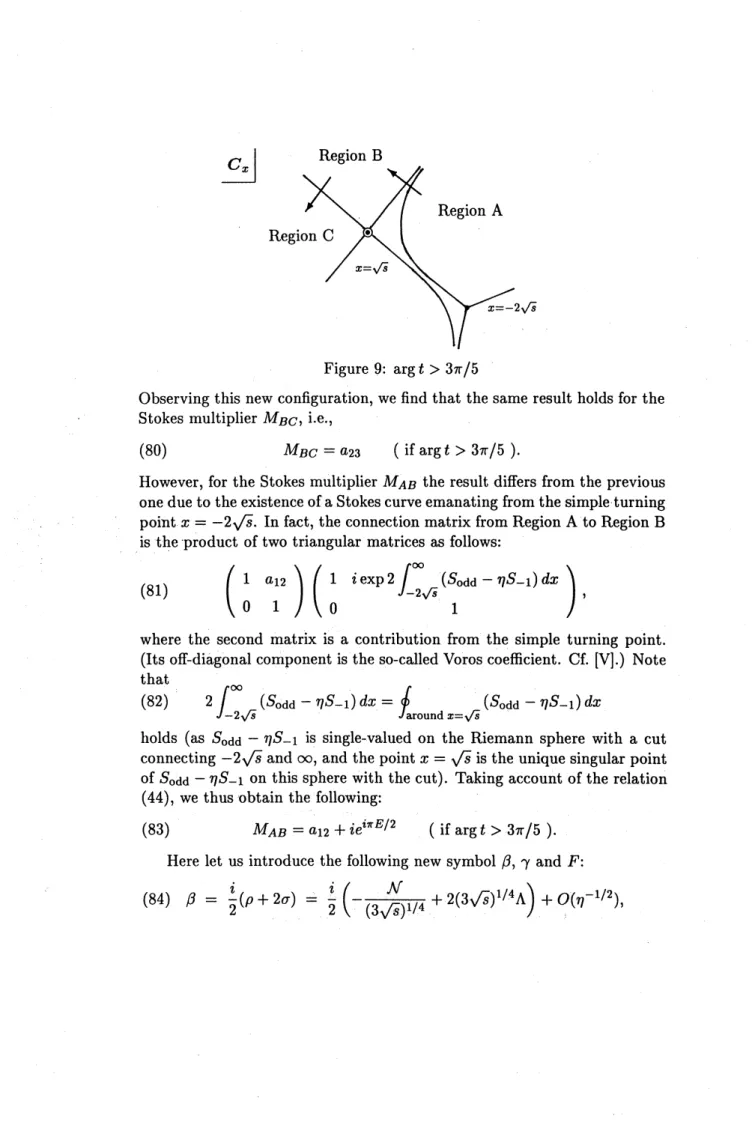
On theother hand, when$\arg t$ is greater than$3\pi/5$, the configuration of
$\lrcorner C_{x}$
Figure 9: $\arg t>3\pi/5$
Observing this new configuration, we findthat the same result holdsfor the Stokes multiplier $M_{BC}$, i.e.,
(80) $M_{BC}=a_{23}$ (if$\arg t>3\pi/5$ ).
However, for the Stokes multiplier $M_{AB}$ the result differs from the previous
onedue to the existence ofaStokescurveemanating from thesimpleturning
point$x=-2\sqrt{s}$
.
In fact,the connection matrix from Region A toRegion $\mathrm{B}$is theproduct oftwo triangular matricesas follows:
(81)
$(01$
$i \exp 2\int_{-}\infty 12\sqrt{s}(S1\mathrm{o}\mathrm{d}\mathrm{d}-\eta S-)dx)$ ,where the second matrix is a contribution from the simple turning point.
(Its off-diagonal component isthe
so-called
Voroscoefficient. Cf. [V].) Notethat
(82) 2$\int_{-2\sqrt{s}}^{\infty}(s_{\mathrm{o}\mathrm{d}\mathrm{d}\eta}-s_{-1})d_{X}=\oint_{\mathrm{a}\Gamma\circ \mathrm{u}\mathrm{n}}\mathrm{d}x=\sqrt{s}(S_{\mathrm{o}\mathrm{d}\mathrm{d}}-\eta S_{-1})d_{X}$
holds (as $s_{\mathrm{o}\mathrm{d}\mathrm{d}}-\eta S-1$ is single-valued on the Riemann sphere with a cut
$\mathrm{c}\mathrm{o}\mathrm{n}\mathrm{n}\mathrm{e}\mathrm{c}\mathrm{t}\mathrm{i}\mathrm{n}\mathrm{g}-2\sqrt{s}$and $\infty$, and the point $x=\sqrt{s}$is the unique singularpoint
of $s_{\mathrm{o}\mathrm{d}\mathrm{d}}-\eta S-1$ on this sphere with the cut). Taking account of the relation
(44), we thus obtain the following:
(83) $M_{AB}=a_{1}2+ie^{i\pi E/2}$ (if$\arg t>3\pi/5$ ).
Here let us introduce the following new symbol $\beta,$
$\gamma$ and $F$:
(85) $\gamma=\frac{i}{2}(\rho-2\sigma)=\frac{i}{2}(-\frac{N}{(3\sqrt{s})^{1/4}}-2(3\sqrt{s})^{1/}4\Lambda \mathrm{I}+O(\eta^{-1/2})$,
(86) $F= \log\{\frac{c_{+}}{C_{-}}e^{i\pi E/4-E/2}(2\sqrt{\eta})\}$
$=- \frac{48\sqrt{3}}{5}s^{5/4}\eta-\frac{E_{0}}{4}\log(263^{5}/2s\eta)5/4+\frac{i\pi E_{0}}{4}+o(\eta^{-1/2})$
.
(We have used (42), (43) and Lemma 1 to obtain the explicit form of the
leading term of each symbol.) Using these symbols, we can summarize the results obtained in this subsection as follows: The Stokes multipliers $M_{AB}$
and $M_{BC}$ (corresponding to the transfer from Region A to Region $\mathrm{B}$ and
from Region$\mathrm{B}$ toRegion $\mathrm{C}$ respectively) of the linear equation (3)$-(30)$ has
the followingexpression:
$(\arg t<3\pi/5)$
(87) $\{$
$M_{AB}$ $=$ $-i\gamma e^{(-F})_{\frac{\sqrt{2\pi}}{\Gamma(E/4+1)}}$
$M_{BC}$ $=$ $\beta e^{(i\pi E/+}\frac{\sqrt{2\pi}}{\Gamma(-E/4+1)}4F)$, $(\arg t>3\pi/5)$
(88) $\{$
$M_{AB}$ $=$ $ie^{i\pi E}-/2i \gamma e^{(}-p)\frac{\sqrt{2\pi}}{\Gamma(E/4+1)}$
$M_{BC}$ $=$ $\beta e^{(i\pi E/+}\frac{\sqrt{2\pi}}{\Gamma(-E/4+1)}4F)$
.
4.4
Connection
formula for $\lambda_{\mathrm{I}}$.
By the end ofthepreceding sectionwehave succeeded in computing(thefirst few terms of) a pair of Stokes multipliers of the linear equation associated
with the firstPainlev\’e equation. Making useofthis expressionoftheStokes
multipliers, we explicitly determine the connection formula for $\lambda_{\mathrm{I}}$ in the
following way:
Let us consider the followingequation (“$\mathrm{i}_{\mathrm{S}\mathrm{o}\mathrm{m}\mathrm{o}}\mathrm{n}\mathrm{o}\mathrm{d}\mathrm{r}\mathrm{o}\mathrm{m}\mathrm{i}_{\mathrm{C}}$equation”):
(89) $M_{AB}=m_{1}$ and $M_{BC}=m_{2}$,
where $m_{1}$ and $m_{2}$ are given complex constants. Note that $\{M_{AB}, M_{B}c\}$ is
every Stokes multiplier of (3)$-(30)$ can be expressed as a rational function
of $M_{AB}$ and $M_{BC}$ (cf. [K]). Since the Hamiltonian system (2) represents
the condition for isomonodromic deformations of(3)$-(30)$, we can obtain a
solutionof the system (2) (and, hence, of the first Painlev\’eequation (1)) by solving the equation (89) for Aand$N$with regarding$t$and $\eta$ as parameters
for anypair $(m_{1}, m_{2})$ ofcomplex numbers. Keeping this fact in mind, let us
first solve the equation (89) by using the explicit formula (87) of$M_{AB}$ and $M_{BC}$ to obtain a solution of the first Painlev\’e equation when $\arg t<3\pi/5$
.
Then we consider the same equation (89) with the other expression (88)
of $M_{AB}$ and $M_{BC}$
.
Although the expressions of the Stokes multipliers aredifferent for (87) and (88), the analytic continuation of the solution thus obtained in the region $\{t\in C;\arg t<3\pi/5\}$ should satisfy the equation
(89) with thesameconstants$m_{1}$ and$m_{2}$ inthe region $\{t\in C;\arg t>3\pi/5\}$
also. Therefore, ifwe solve the equation (89) with the same constants $m_{1}$
and$m_{2}$byusing(88),we canobtainanexplicit representationof the analytic
continuation oftheoriginal solutionin the region $\{\arg t<3\pi/5\}$ to the new
region $\{\arg t>3\pi/5\}$
.
In this way the connection formulaacrossthe Stokescurve $\{t\in C;\arg t=3\pi/5\}$ should be determined explicitly.
Asanexample, letusinvestigate thecase $m_{1}=m_{2}=0$ in greater detail.
When $\arg t<3\pi/5$, the equation $M_{AB}=M_{BC}=0$ immediately implies
(90) $\beta=\gamma=0$
.
Assuming A and$N$ have the expansion of the form
(91) $\{$
A $=$ $\Lambda_{0}+\eta^{-}\Lambda 1/2+1/2\ldots$
$N$ $=$ $N_{0+}\eta^{-1/2}N1/2+\cdots$,
we can easily solve the equation (90). The result is $\Lambda_{0}=N_{0}=0$ (cf. (84)
and (85)$)$ and the corresponding solution of the first Painlev\’e equation (1)
becomes the formal power series solution $\lambda_{\mathrm{I}}$
.
On the other hand, when$\arg t>3\pi/5$, we still have $\beta=0$ and hence
(92) $E=p^{2}-4\sigma^{2}=-4\beta\gamma=0$
follows from (40), (84) and (85). However, $\gamma=0$ does not hold. Instead we
have to solve the followingsystem of equations: (93) $\beta=0$ and $\sqrt{2\pi}e^{(-F)}\gamma=1$,
or, more explicitly,
(94) $\beta=0$ and $\gamma=\frac{1}{\sqrt{2\pi}}\exp(-\frac{48\sqrt{3}}{5}s^{5/}\eta 4)(1+O(\eta^{-}1/2))$
.
Ifweassumethe expansion(91)again and further regard$\exp(-48\sqrt{3}s^{5/4}\eta/5)$
as aquantity of order$0$in
$\eta$ (justlike in theconstruction of themultiple-scale
solution (10) discussed in [AKT3]$)$, the equation (94) implies
(95) $\Lambda_{0}=i\frac{1}{2\sqrt{\pi}}(12\sqrt{s})-1/4\exp(-\frac{48\sqrt{3}}{5}s^{5/}\eta 4)$ ,
that is,
(96) $\lambda=\sqrt{s}+\eta^{-}i\frac{1}{2\sqrt{\pi}}1/2(12\sqrt{s})-1/4\exp(-\frac{48\sqrt{3}}{5}s\eta 5/4)+\cdots$
.
This expression (96) of$\lambda$ should be the analytic continuation of $\lambda_{\mathrm{I}}$ in the
region $\{\arg t>3\pi/5\}$
.
Thus wehave explicitly determined the connection formula for$\lambda_{\mathrm{I}}$
across
the Stokes
curve
$\{t\in c_{;\arg}t=3\pi/5\}$ as follows:(97) $\lambda_{\mathrm{I}}$ $arrow$ $\lambda_{\mathrm{I},i/2\sqrt{\pi},0}$
$=$ $\sqrt{s}+\eta-1/2i\frac{1}{2\sqrt{\pi}}(12\sqrt{s})-1/4\mathrm{p}\mathrm{e}\mathrm{x}(-\frac{48\sqrt{3}}{5}s^{s/4}\eta)+\cdots$
.
In particular, by the comparison of (97) and (26) $\sim(28)$ we have
(98) $\mu=\sqrt{\frac{3}{5}}\frac{1}{\pi}=0.24656177\cdots$ ,
which coincides with theprevious numerical result (25) very accurately. This is our determination of the connection formula for $\lambda_{\mathrm{I}}$ by using the
isomonodromic method. In my opinion the isomonodromic method is more
powerful than the argument performed in the previous section (\S 3). (For example, it enables us to determine the undeterminedconstant $\alpha$ (or, more
specifically, $\mu$ in the formula (28)$)$ in a completely explicit manner.) We
hope that this method will determine the connection formula not only for
the formal power series solution $\lambda_{\mathrm{I}}$ but also for any multiple-scalesolution $\lambda_{\mathrm{I},\alpha,\beta}$ with two free parameters. (Here a free parameter means anarbitrary
functionorformalseries of$\eta^{-1/2}$ that is free from$t$
.
See Remark in\S 2
also.)However, to realize this expectation we have to compute the connection formula for WKB solutions of the associated linear equation nearthe double turning point $x=\sqrt{s}$, in particular the constants $C_{\pm}$ in (69)$-(70)$, up to
an arbitrarily higher order, and at the $\mathrm{p}\mathrm{r}.\mathrm{e}\mathrm{s}\mathrm{e}\mathrm{n}\mathrm{t}$stage this is still an open
problem.
References
[AKTI] T. Aoki, T. Kawai and Y. Takei: The Bender-Wu analysis and the Voros theory. Special Functions, Springer-Verlag, 1991, pp. 1-29.
[AKT2] –: Algebraic analysis of singular perturbations –on
ex-act WKB analysis –. S\^ugaku, 45 (1993), 299-315. (In Japanese.
English translation is to appear in S\^ugaku Expositions.)
[AKT3] –: WKB analysis of Painlev\’e transcendents with a large
parameter. II. –Multiple-scale analysis ofPainlev\’e
transcend.ents.
Preprint (RIMS-1038).
[BMP] A. Erd\’elyi et al.: Higher Transcendental Functions. Bateman
Manuscript Project (Vol. I, II, III). California Institute of Tech-nology, $\mathrm{M}\mathrm{c}\mathrm{G}\mathrm{r}\mathrm{a}\mathrm{W}$-Hill, 1953.
[DDPI] E. Delabaere, H. Dillinger and F. Pham: R\’esurgence de Voros et
p\’eriodes des courbes hyperelliptiques. Ann. Inst. Fourier (Greno-ble), 43 (1993), 163-199.
[DDP2] –: Exact semi-classical expansions for one dimensional
quantum oscillators. Pr\’epublications No. 398, Univ. Nice-Sophia-Antipolis, 1994.
[FIK] A.S. Fokas, A.R. Its and A.A. Kapaev: On theasymptotic analysis of the Painlev\’e equations via the isomonodromic method.
Nonlin-earity, 7 (1994), 1291-1325. ;
[JK1] N. Joshi and M.D. Kruskal: An asymptotic approach to the
con-nection problem for the first and the second Painlev\’e equations.
Phys. Lett., 130 (1988), 129-137.
[JK2] –: Connection results for the first Painlev\’e equation.
[JMU] M. Jimbo, T. Miwa and K. Ueno: Monodromy preserving defor-mation of linear ordinary differentialequations with rational coef-ficients. I. Physica D, 2 (1981), 306-352.
[K] A.A. Kapaev: Asymptotics of solutions of thePainlev\’e equation of
the first kind. Differential Equations, 24(1989), 1107-1115. $(^{r}\mathrm{b}\mathrm{a}\mathrm{n}\mathrm{S}-$
lated from the Russian original (1988).)
[KT1] T. Kawai and Y. Takei: WKB analysis and deformation of
Schr\"odinger equations. RIMSK\^oky\^uroku,No. 854, 1993, pp. 22-42.
[KT2] –: WKB analysis of Painlev\’e transcendents with a large parameter. I. To appear in Adv. in Math.
[O] K. Okamoto: Isomonodromic deformation and Painlev\’e equations,
and the Garnier systems. J. Fac. Sci. Univ. Tokyo, Sect. IA, 33
(1986), 575-618.
[Tka] K. Takano: His lecture at the workshop and his report in this
vol-ume.
[Tke] Y. Takei: On a WKB-theoretic approach to the Painlev\’e
transcen-dents. To appear in the Conf. Proc. “XIth International Congress of Mathematical Physics (Paris, 1994)”.
[V] A. Voros: The return of the quartic oscillator. The complex WKB