Inflections and singularities
on
parametric rational
cubic
curves
鹿大理 酒井 宙 (Manabu Sakai)
$E$ –mail: [email protected]–u.ac.$jp$
1 Introduction
Much attention has been recently been focused on a single- and vector-valued shape
preserving interpolation. There is a considerable literature on numerical methods for
generating shape preserving interpolation; see for example, Sakai
&Usmani
[5], Su&
Liu [7] and references therein. Parametric cubic curves and useful for generating
vector-valued ”visuallypleasing”, ”shape preserving” interpolantsto a set ofplanar data points.
A drawback of the parametric cubic curves is indicated the fact that unwanted inflection
pointsorsingularity may occur onthese segments. A way of overcoming this problem isto
consider nonlinearapproximation sets, forexample, exponentialsplines, lacunary splines,
rational splines or splines with variable additional nodes. The rational splines have been
of the forms: $\mathrm{q}\mathrm{u}\mathrm{a}\mathrm{d}\mathrm{r}\mathrm{a}\mathrm{t}\mathrm{i}_{\mathrm{C}}/1\mathrm{i}\mathrm{n}\mathrm{e}\mathrm{a}\mathrm{r},$ $\mathrm{c}\mathrm{u}\mathrm{b}\mathrm{i}\mathrm{c}/\mathrm{l}\mathrm{i}\mathrm{n}\mathrm{e}\mathrm{a}\mathrm{r},$ $\mathrm{q}\mathrm{u}\mathrm{a}\mathrm{d}\mathrm{r}\mathrm{a}\mathrm{t}\mathrm{i}_{\mathrm{C}}/\mathrm{q}\mathrm{u}\mathrm{a}\mathrm{d}\mathrm{r}\mathrm{a}\mathrm{t}\mathrm{i}_{\mathrm{C}}$, and $\mathrm{c}\mathrm{u}\mathrm{b}\mathrm{i}\mathrm{c}/\mathrm{q}\mathrm{u}\mathrm{a}\mathrm{d}\mathrm{r}\mathrm{a}\mathrm{t}\mathrm{i}_{\mathrm{C}}$.
For two consecutive data points $z_{i}(=(x_{i}, y_{i})),$ $i=0,1$ and assigned tangent vectors
$z_{i}’(=((x_{i}, y_{i})\prime\prime)$ at these points, we consider a”shape preserving” parametric rational cubic
curve $z(t)=((x(t), y(t)),$$0\leq t\leq 1$, of the form with a parameter $(p\geq 0)$:
(1) $z(t)=Z_{0}(1-t)+z1t+(z’-0z\Delta)\phi(t)+(\Delta_{Z}-z\prime 1)\phi(1-t)$
with $\triangle z=z_{1}-z_{0}$ and $\phi(t)=t(1-t)^{2}/\{1+pt(1-t)\}$. We can easily verify that this form
$z$ satisfies the interpolation relations: $z^{(k)}(0)=z_{0},$$\mathcal{Z}(k)((k)1)=z_{1}^{(k)},$$k=0,1$. A value of
$p=0$willlet $z$ beacubicspline while alarge value of$p$willlet $z$ bean unacceptable”flat”
interpolant. In Section 2, much algebraic manipulation gives the complete distribution
ofinflections and singularity on the curve segment (1). Its use allows us to ensure that
the curve $z$ ofthe form (1) is free from the inflections and singularity (or simply fair) if
$\lambda,$ $\mu\geq 1/(3+p)$ or$\lambda,$$\mu\leq 0$where $\lambda(=(z_{0}’\cross\triangle z)/(z_{0}’\cross z_{1}’))$and$\mu(=-(Z_{1}’\cross\triangle z)/(z’\cross Z’)01)$
the relative lengths of the tangent vectors at the end points with the usual vector product
$’\cross$ ’ where assume that $D(=z_{0}’\cross z_{1}’)\neq 0$, i.e., $z_{i}’,$$i=0,1$ are independent.
Hence, a large value of$p$ can always let the segment $z$ be fair if $\lambda\mu>0$. Another use
ofit also enables us to find another fair curve of the form (1) if $0<\kappa\leq(3+p)\lambda$ and
$0<\eta\leq(3+p)\mu$ where the tangent directions $y_{i}’/x_{i}’,$$i=0,1$ are fixed at the two end
points, and only the magnitudes of the tangents can be varied in scalar multiples $\eta$ and
2 On inflections and singularity
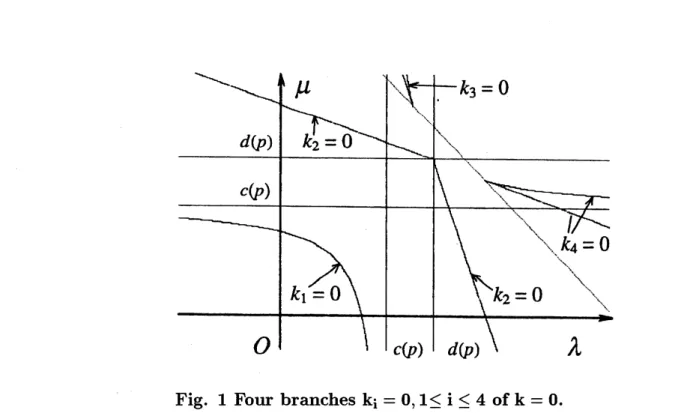
First we note Fig. 1 for $k(\lambda, \mu)=0$ given by the following equation (2):
(2) $k(=k(\lambda, \mu))=4\lambda^{3}\{(3+p)\mu-1\}+4\mu^{3}\{(3+p)\mu-1\}-3\lambda 2\mu 2$
$+\{(3+p)\lambda-1\}2\{(3+p)\mu-1\}2-6\lambda\mu\{(3+p)\lambda-1\}\{(3+p)\mu-1\}=0$.
Fig. 1 Four branches $\mathrm{k}_{\mathrm{i}}=0,1\leq \mathrm{i}\leq 4$ of$\mathrm{k}=0$
.
Inflections. We are now ready to determine the distribution of inflections on the curve
(1). Since $D(=z_{0}’\cross z_{1}’)\neq 0,$ $\Delta_{Z}(=z_{1}-z_{0})$ can be represented as $\Delta z=\mu z_{0}’+\lambda z_{1}’$ where
$(\lambda, \mu)(=C_{0}/D, -C_{1}/D)$ with $C_{i}=z_{i}’\cross\Delta z$.
Defining and doing a fairly lengthy calculation,
(3) $w(t)(=\{\phi’(t)\phi\prime\prime(u)+\phi’’(t)\phi(u)\})=2(1-3tu)(1+ptu)^{3},$$u=1-t$,
inflections of the curve (1) are determined by the equation:
(4) $(z’\cross z^{\prime/})(t)/D(=\lambda\{w(t)-\phi’’(t)\}+\mu\{w(u)-\phi\prime\prime(u)\}-w(t))=0,0<t<1$
or
(5) $\lambda(3u^{2}+pu^{3})+\mu(3t^{2}+pt^{3})+3tu-1=0,0<t<1$.
Letting $t$ be $1/(1+t)$, the above cubic equation (5) can be equivalently rewritten as
We consider several Cases $(\mathrm{a})-(\mathrm{d})$ depending on the values of $\lambda$ and
$\mu$, and for each
case we count the number $N$ of positive roots ofthe cubic equation (6) ( $=\mathrm{t}\mathrm{h}\mathrm{e}$ number
ofinflections on (1) $)$.
(a) $(\lambda-c(p))(\mu-c(p))=0$: In this case, (6) itself or (6) divided by $t$ reduces to a
quadratic equation. Hence, $N=1$ if $\lambda=c(p),$$\mu<c(p)$ or $\lambda<c(p),$$\mu=c(p)$ and $N=0$
if $\lambda=c(p),$$\mu>c(p)$ or $\lambda>c(p),$$\mu=c(p)$.
(b) $\lambda,$$\mu>c(p)$ or $\lambda,$$\mu\leq 0$: In this case, (6) has no positive root. Hence, $N=0$.
For the other cases than $(\mathrm{a})-(\mathrm{b})$, we make a Strum sequence $\{p_{i}(t)\}$ of the cubic
equation (6) for $a^{2}\neq 3b$:
$p_{0}(t)=t^{3}+at^{2}+bt+c(=-p_{0}’(t))=-3t^{2}-2at-b$
(7) $p_{2}(t)=2(a^{2}-3b)t+ab-9c$
$p_{3}(t)=-p_{1}\{(9c-ab)/(2a^{2}-6b)\}(=9k\{4(a^{2}-3b)^{2}\}$
in which
$a=3\lambda/\{(3+p)\lambda-1\},$$b=3\mu/\{(3+p)\lambda-1\},$$C=\{(3+p)\mu-1\}/\{(3+p)\lambda-1\}$
(8)
$k=4a^{3}c+4b^{3}+27c^{2}-18abc-a^{2}b^{2}$.
Let the integer valued function $s(t)$ bethe number of agreements in sign ofconsecutive
members of the sequence $\{p_{i}(t)\}$
.
Then, the theory of Strum sequences says that thenumbers ofroots in the interval $a<t\leq b$ is given by $s(b)-S(a)$
.
(c) $(\lambda-c(p))(\mu-c(p))<0$: In this case
assume
that $\mu<c(p)<\lambda$, the other case $\lambda<c(p)<\mu$ being similarly treated. Then, note that $a>0$ and $c<0$.
When $b<0$ and$k>0,$ $\epsilon=\mathrm{S}\mathrm{i}\mathrm{g}\mathrm{n}(ab-9c)<0\Rightarrow s(\mathrm{o})=3$ is contradictory to $s(\mathrm{O})\leq s(+\infty)$, and so $\epsilon>0$.
Table 1 shows that $N(=s(+\infty)-\mathit{8}(\mathrm{o}))=1$.
Table 1. The sequences of signs at $0$ and $\infty$ for $\lambda-c(p))(\mu-c(p))<0$.
$b\backslash k$ positive negative
positive $(-, -, +, +),$ $(+, -, ?,$ $+)$ $(-, -, +, -)(+, -, +*, -)$
negative $(-, +, \epsilon, +),$ $(+, -, +, +)$ $(-, +, ?, -)(+, -, +, -)$
*If$a^{2}-3b<0,$$s(+\infty)=1$ is contradictory to $s(\mathrm{O})(=2)\leq s(+\infty)$, and so $a^{2}-3b>0$.
(d) $0<\lambda,$$\mu<c(p)$: Note that $a<0,$ $b<0$, and $c>0$
.
In addition,$ab-9c<0$
if$k>0$as follows. If$ab-9c\geq 0$, i.e., $0<c\leq ab/9$, then we take $k$ as aquadratic equation
in $c$:
Table 2. The sequences of signs at $0$ and $\infty$ for $0<\lambda,$$\mu<c(p)$
.
$k$ positive negative
$(+, +, -, +),$$(+, -, +, +)$ $(+, +, ?, -),$$(+, -, +, -)$
Hence, $N=0$ or 2 for $k\geq 0$ or $k<0$ where the equation $k=0$ in (8) is equivalent
to the equationk $=0$ defined in Lemma 1, strictly speaking, the $k$ in (8) multiplied by
$\{(3+p)\lambda-1\}^{4}/27$ coincides with the $k$ in Lemma 1. For $a^{2}=3b$($\geq\Rightarrow \mathrm{n}\mathrm{o}$ case $(\mathrm{d})$ ), $p_{0}(t)=(t+a/3)^{3}+c-a^{3}/27$ , and so $N=1$ for the case (c). Since for $\lambda,$$\mu<c(p),$ $k=0$
is equal to $k_{1}=0$, we obtain
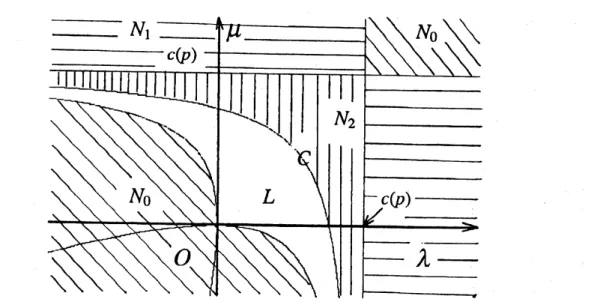
LEMMA 1 (inflections). If $(\lambda, \mu)\in N_{i},$$0\leq i\leq 2$, the curve (1) has $i$ inflections where
$N_{0}=$
{
$(\lambda,$$\mu)|\lambda,$$\mu\geq c(p)$ or $k_{1}(\lambda,$$\mu)\geq 0$},
$N_{1}=\{(\lambda, \mu)|(\lambda-c(p))(\mu-c(p))\leq 0$ or$\lambda=c(p),$$\mu<c(p)$ or $\lambda<c(p),$$\mu=c(p)\}$ and $N_{2}=\{(\lambda, \mu)|k_{1}(\lambda, \mu)<0, \lambda, \mu<c(p)\}$.
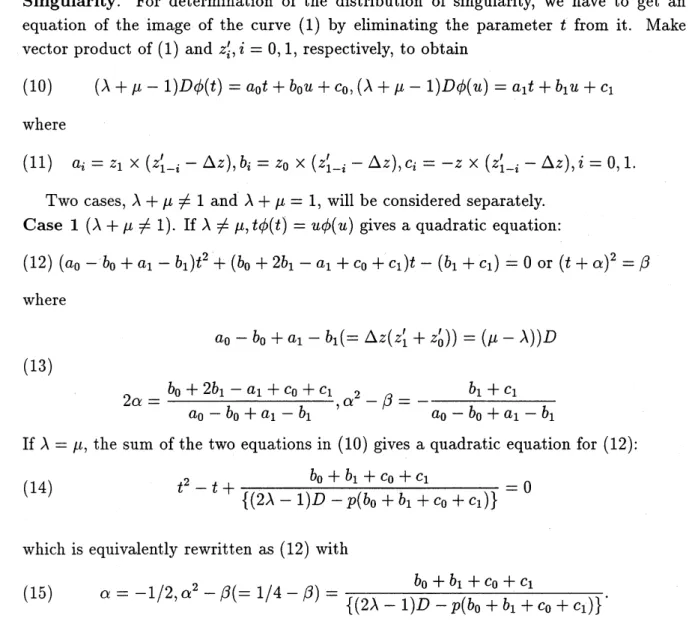
Singularity. For determination of the distribution of singularity, we have to get an
equation of the image of the curve (1) by eliminating the parameter $t$ from it. Make
vector product of (1) and $z_{i}’,$$i=0,1$, respectively, to obtain
(10) $(\lambda+\mu-1)D\phi(t)=a_{0}t+b_{0}u+c_{0},$$(\lambda+\mu-1)D\phi(u)=a_{1}t+b_{1}u+c_{1}$
where
(11) $a_{i}=z_{1}\cross(z_{1-i}’-\Delta z),$ $bi=z0\cross(_{Z_{1i}’}--\triangle z),$$c_{i}=-Z\cross(z_{1-i}’-\Delta z),$$i=0,1$. Two cases, $\lambda+\mu\neq 1$ and $\lambda+\mu=1$, will be considered separately.
Case 1 $(\lambda+\mu\neq 1)$. If $\lambda\neq\mu,$$t\phi(t)=u\phi(u)$ gives a quadratic equation:
(12) $(a_{0}-b_{0}+a_{1}-b_{1})t^{2}+(b_{0}+2b_{1}-a_{1}+c_{0}+c_{1})t-(b_{1}+c_{1})=0$or $(t+\alpha)^{2}=\beta$
where
$a_{0}-b0+a_{1}-b_{1}(=\Delta Z(_{Z_{1}}/+Z_{0})’)=(\mu-\lambda))D$
(13)
$2 \alpha=\frac{b_{0+}2b_{1^{-}}a_{1}+c_{01}+c}{a0-b0+a1-b1},$$\alpha^{2}-\beta=-\frac{b_{1}+c_{1}}{a_{0-}b_{0+a-b}11}$
If $\lambda=\mu$, the sum of the two equations in (10) gives a quadratic equation for (12):
(14) $t^{2}-t+ \frac{b_{0}+b_{1}+C_{0}+C_{1}}{\{(2\lambda-1)D-p(b0+b1+c_{0}+c_{1})\}}=0$ which is equivalently rewritten as (12) with
Hence, let $t^{*}=t+\alpha$ and eliminate the parameter$t^{*}$ (note $(t^{*})^{2}=t+\alpha$ ) from the second
equation in (10) to obtain the equation ofthe image ofthe curve (1):
(16) $\psi(x, y)=(A^{2}\beta-B^{2})=0$
where
(i) $A/D$ $=$ $-(\lambda+\mu-1+p\lambda)(\beta+3\alpha^{2}+2\alpha)+\lambda-(p/D)(2\alpha+1)(b_{1}+c_{1})$
(17)
(ii) $B/D$ $=$ $-(\lambda+\mu-1+p\lambda)(3\alpha\beta+\alpha^{3}+\beta+\alpha^{2})$
$+\alpha\lambda-(1/D)\{p(\alpha^{2}+\beta)+p\alpha-1\}(b_{1}+c1)$.
For$\lambda\neq\mu$, since $\lambda+\mu\neq 1\Leftrightarrow(z_{0^{-}}’\Delta z)\cross(z_{1}’-\Delta z)\neq 0,$$(Z_{1-i^{-}}\Delta z)\cross z=c_{i},$$i=0,1$in (11)
enable us to consider $(x, y)$ as functions of $(C_{0}, c_{1})$, and in addition the second and third
equationsin (13) (i.e., $2\alpha(\mu-\lambda)D=b_{0+}2b_{1}-a_{1}+c_{0}+C_{1}$ and $b_{1}+c_{1}=-(\mu-\lambda)(\alpha 2-\beta)D$)
$)$ enable $(C_{0}, c_{1})$ as $(\alpha,\beta)$. Then, the singularity of$\psi=0$ of$(\alpha,\beta)$ for $(x, y)$ is determined
by the system ofequations
(18) $\psi(\alpha, \beta)=\psi\alpha(\alpha,\beta)=\psi_{\beta}(\alpha,\beta)=0$
i.e.,
(19) $A^{2}\beta=B^{2},2AA_{\alpha}\beta=2BB_{\alpha},$$2AA_{\beta}\beta+A^{2}=2BB_{\beta}$
.
where by (13), $(b_{1}+c_{1})/D=-(\mu-\lambda)(\alpha 2-\beta)$ and so (17) reduce to
(i) $A/D$ $=$ $-(\lambda+\mu-1+p\lambda)(\beta+3\alpha^{2}+2\alpha)+\lambda+p(2\alpha+1)(\mu-\lambda)(\alpha^{2}-\beta)$
(20)
(ii) $B/D$ $=$ $-(\lambda+\mu-1+p\lambda)(3\alpha\beta+\alpha^{3}+\beta+\alpha^{2})$
$+\alpha\lambda+(\mu-\lambda)(\alpha 2-\beta)\{p(\alpha^{2}+\beta)+p\alpha-1\}$.
For $\lambda=\mu$, we consider $\psi(=A^{2}\beta-B^{2})$ as function of $(c0, c_{1})$ with $A,$ $B$ and $\beta$ defined
by (15) and (17). Then, the singuraity is determined by the system ofequations:
(21) $\psi(c_{0}, c_{1})=\psi_{C}0(_{C}0, c_{1})=\psi \mathrm{C}_{1}(c_{0,1}C)=0$
.
Here note that if there were any singularity (loop or cusp) on the curve segment (1),
two values of the parameter$t$ defined by the quadratic equation $(t+\alpha)^{2}=\beta$ must belong
to $(0,1)$, i.e.
where $\beta>0$ and $\beta=0$ correspond to aloop and cusp, respectively For (18) (i.e., (19))
and (21), two cases $A\neq 0$ and $A=0$, will be considered separately.
(a) $A\neq 0$: First we note $\beta\neq 0$ from (19). If$\lambda\neq\mu$ , from (19) we obtain the following
relations according to the sign of $B/A$:
(i) $B=A\sqrt{\beta},$$B_{\alpha}=A\sqrt{\beta}\alpha’=A2\sqrt{\beta}(B\beta-\sqrt{\beta}A\beta),$$B=2\beta(B\beta-\sqrt{\beta}A\beta)$
(23)
(ii) $B=-A\sqrt{\beta},$$B_{\alpha}=-A\sqrt{\beta}\alpha’ A=-2\sqrt{\beta}(B\beta+\sqrt{\beta}A_{\beta}),$ $B=-2\beta(B\beta+\sqrt{\beta}A_{\beta})$
For $23(\mathrm{i})(\Leftrightarrow B/A>0)$, by (20) $B_{\alpha}=A_{\alpha}\sqrt{\beta}$ reduces to
(24) $-(\lambda+\mu-1+p\lambda)(3\beta+3\alpha^{2}+2\alpha)+\lambda$ $+(\mu-\lambda)\{p(2\alpha+1)(\alpha^{2}-\beta)+2p\alpha(\beta+\alpha 2)+2\alpha(p\alpha-1)\}$ $=$ $\sqrt{\beta}\{-(\lambda+\mu-1+p\lambda)(6\alpha+2)+p(\mu-\lambda)(6\alpha^{2}-2\beta+2\alpha)\}$ From $A=2\sqrt{\beta}(B_{\beta}-\sqrt{\beta}A_{\beta})$
,
by (20) (25) $-(\lambda+\mu-1+p\lambda)(3\beta+3\alpha+22\alpha)+\lambda+p(\mu-\lambda)(2\alpha^{3}-2\alpha\beta+\alpha^{2}-\beta)$ $=2\sqrt{\beta}\{-(\lambda+\mu-1+p\lambda)(3\alpha+1)+p(\mu-\lambda)(\alpha-2\beta)-p(\alpha+\beta 2)-p\alpha+1\}$ $-2\beta\{p(\mu-\lambda)(-2\alpha-1)\}$.On subtracting from (24) to (25), we obtain a cubic equation in $\sqrt{\beta}(=u)$:
(26) $(u-\alpha)\mathrm{t}p(u-\alpha)2-p(u-\alpha)-1\}=0$
where for $23(\mathrm{i}\mathrm{i})(\Leftrightarrow B/A<0)$, we have only to change the coefficient of $\sqrt{\beta}$ in (26).
These cubic equations in $\sqrt{\beta}$ have no roots satisfying the required inequalities in (22),
i.e., $\beta<\alpha^{2}(-1/2\leq\alpha<0)$ or $\beta<(1+\alpha)^{2}(-1<\alpha<-1/2)$ where for $p=0,$ (26)
reduces alinear equation having no root satisfying (22). When $\lambda=\mu,$ (21) give
(27) $2AA_{c:}\beta+A^{2}\beta C_{\iota}=2BB_{c_{t}},$$i=0,1$
where by (17), $A_{c_{1}}-A_{c0}=-p(2\alpha+1),\beta_{c_{1}}-\beta_{c_{0}}=0,$$B_{c_{1}}-B_{c_{0}}=-p(\alpha+\beta 2+\alpha)+1$
Note that $\beta\neq 0$. If$\beta=0,$$A=0$ would come from (27) since $\beta=0$ gives $B=0$ and $\beta_{c_{1}}(=\beta_{c_{0}})=\{(2\lambda-1)D\}/\{(2\lambda-1)D-p(b_{0}+b_{1}+c_{0}+c_{1})\}^{2}\neq 0$ where $\lambda=\mu$ and
$\lambda+\mu\neq 1$. A difference oftwo equations (27) gives$p(2\alpha+1)A\beta=B\{p(\alpha^{2}+\beta)+p\alpha-1\}$.
Since $B=A\sqrt{\beta}$ for $A\neq 0$, we obtain the quadraic equation in $u(=\sqrt{\beta})$ being equal to
the quadratic factor in the braces in (26) where for $B=-A\sqrt{\beta}$, the coefficient of $\sqrt{\beta}$ is
to be changed. That is, in the case $A\neq 0$, the curve (16) does not have a singularity.
(22), while determining the singularity, we can assume that $\alpha^{2}-\beta\neq 0$ and $\alpha\neq 0$. On
making $20(\mathrm{i})\cross(\beta+\alpha^{2})-20(\mathrm{i}\mathrm{i})\cross(2\alpha)$,
(28) $\alpha^{2}-\beta=-\frac{\lambda+2\alpha(\lambda-\mu)}{\lambda+(1+p)\mu-1}(\neq 0)$
Substitute (28) into $17(\mathrm{i})$ for $\alpha^{2}-\beta$ to obtain
(29) $2 \alpha=\frac{(\lambda+\mu-1)(1-2\lambda)-p(4\lambda\mu-\lambda-\mu)-p^{2}\lambda\mu}{(\lambda+\mu-1)^{2}+p(4\lambda\mu-\lambda-\mu)+p^{2}\lambda\mu}(\neq 0)$
where the denominator of (29) is positive for $(\lambda, \mu)\neq(d(p), d(p))$. Eliminate $\alpha$ from
(28)$-(29)$ to obtain
(30) $4 \beta=\frac{4\kappa(\lambda,\mu)}{\{(\lambda+\mu-1)^{2}+p(4\lambda\mu-\lambda-\mu)+p^{2}\lambda\mu\}2}$
In addition, from (28)$-(29)$, note
(i) $\alpha^{2}-\beta=\frac{\lambda^{2}+\mu-\lambda\mu(3+p)}{(\lambda+\mu-1)^{2}+p(4\lambda\mu-\lambda-\mu)+p^{2}\lambda\mu}$
(31)
(ii) $(1+ \alpha)^{2}-\beta=\frac{\mu^{2}+\lambda-\lambda\mu(3+p)}{(\lambda+\mu-1)^{2}+p(4\lambda\mu-\lambda-\mu)+p^{2}\lambda\mu}$.
Herewe consider the case $\alpha\in(-1/2,0)$, the othercase $\alpha\in(-1, -1/2)$ similarly treated.
Then, (30)$-(31)$ imply that the singularity
occurs
if$\kappa(\lambda, \mu)\geq 0$ and in addition if(i) $(\lambda+\mu-1)(\mu-\lambda)>0(\Leftrightarrow-1/2<\alpha)$
(32) (ii) $\mu\{(2+4p+p^{2})\lambda-(1+p)\}>-2\lambda^{2}+(3+p)\lambda-1(\Leftrightarrow\alpha<0)$
(iii) $\lambda^{2}>\{(3+p)\lambda-1\}\mu(\Leftrightarrow\alpha^{2}>\beta)$
.
Next we consider the case $\lambda=\mu$, i.e.,$\alpha=-1/2$. Then, from $17(\mathrm{i}),$ $1/4-\beta=$
$-\lambda/\{(2+p)\lambda-1\}$ from which (i) $\beta=0(\Rightarrow \mathrm{a}\mathrm{c}\mathrm{u}\mathrm{s}\mathrm{P})\Leftrightarrow\lambda=1/(6+p)$ and (ii) $0<\beta<1/4$
$(\Rightarrow \mathrm{a}\mathrm{l}\mathrm{o}\mathrm{o}_{\mathrm{P}})\Leftrightarrow 0<\lambda<1/(6+p)$. Note that $(\lambda, \mu)=(1/(6+p), 1/(6+p))$ is on the first
branch $k_{1}=0$.
Case 2 $(\lambda+\mu=1)$ In this case, it is easy to show that neither inflection nor singularity
occurs.
Summarizing the above two cases, $\lambda+\mu\neq 1$ and $\lambda+\mu=1$, we obtain a lemma
concerning the distribution of the singularity on the curve (1).
LEMMA 2 (singularity). If$(\lambda, \mu)\in L$ or $C,\mathrm{t}\mathrm{h}\mathrm{e}\mathrm{n}$a loop or cusp occurs on the curve (1)
$C=\{(\lambda, \mu)|k_{1}(\lambda, \mu)=0\}$.
THEOREM. (Inflections and singularity). Assume that $\Delta z=\mu z_{0}’+\lambda z_{1}’$. Then,
Fig-ure 2 gives the distribution of inflections and singularity on the curve of the form (1)
with respect to $(\lambda, \mu)$ where $N_{i},$$0\leq i\leq 2$ represent the regions for which the curve has
$i$-inflections and no singularity.
REMARK. A larger value of$p$ for shape control might bring a larger interpolation
er-ror and the resulting curve would be an unacceptable ”flat” interpolant while a choice
of$p=0$ yields a fourth order interpolation ([9]). Therefore, Theorem 1 suggests us to
take $p=0$ for $\rho(=\min(\lambda, \mu))\geq 1/3$ and $p=1/\rho-3$ for $0<\rho<1/3$, respectively.
The following technique for eliminating the unwanted inflections and singularity on
the curve (1) (as is usual with the case $p=0$ ) has been also used ([7]). Suppose that
the tangent directions are fixed at the two end points, and only the magnitudes of the
tangents are allowed to be varied in scalar multiples $\eta$ and $\kappa(\eta, \kappa>0)$, respectively.
Since $C_{0}arrow\eta C_{0},$$C_{1}arrow\kappa C_{1},$$Darrow\eta\kappa D$, Theorem gives the following corollary concerning
the existence of the region $(\eta, \kappa)$ for which the corresponding curve (1) is fair.
COROLLARY (Theorem [7, p. 54]). Assume that $\lambda$ and
$\mu>0$. Then the curve of
the form (1) is fair for $0<\kappa\leq(3+p)\lambda$ and $0<\eta\leq(3+p)\mu$.
Fig. 2. Distribution of inflections and singularity.
Finally weconsider the different shapesof the curves with different values of$p$; see Fig.
$0,1$. Since $(\lambda, \mu)=(2/17,1/17),p=4.21$ and $p=14$ are an approximate value when a
cusp occurs and the proposed value in Remark, respectively.
Fig. 3. Different shapes of$\mathrm{c}\mathrm{u}\mathrm{r}\mathrm{v}\mathrm{e}$
(
segments with different values $p$
.
References
1. Delbourgo,R., Gregory, J.$\mathrm{A}.(1985)$: Shapepreserving piecewise rational interpolation.
SIAM J. Sci. Statist. Comput. 6, 967-976.
2. Sakai, M., Lop\’ez de Silanes, M. C. (1986): A simple rational splines and its application
to monotonic interpolation to monotonic data. Numer. Math. 50, 171-182.
3. Sakai, M., Schmidt, J. W. (1989), Positive interpolation with rational splines. BIT 29,
140-147.
4. Sakai, M., Usmani, R. (1990): On orders of approximation of plane curves by rational
splines. BIT 30,
735-741.
5. Sakai, M., Usmani, R.: On fair parametric rationalcurves (to appear in BIT).
6. Sp\"ath, H. (1990): Eindimensionale $\mathrm{S}\mathrm{p}\mathrm{l}\mathrm{i}\mathrm{n}\mathrm{e}-\mathrm{I}\mathrm{n}\mathrm{t}\mathrm{e}\mathrm{r}\mathrm{p}_{0}1\mathrm{a}\mathrm{t}\mathrm{i}\mathrm{o}\mathrm{n}\mathrm{S}- \mathrm{A}\mathrm{l}\mathrm{g}\mathrm{o}\mathrm{r}\mathrm{i}\mathrm{t}\mathrm{h}\mathrm{m}\mathrm{e}\mathrm{n}$. R. Oldenbourg
Verlag, Munchen.
7. Su, B-Q., Liu, D-Y. (1989): Computational Geometry-Curve and Surface Modeling.