PERIODIC
SOLUTIONS
FOR
FORCED
VAN
DER
POL
TYPE
EQUATIONS
CHIKAHIRO
EGAMI
ANDNORIMICHI
HIRANO
ABSTRACT. In the presentpaper,wewillseethataVan der Pol type equations has aperiodic
solution when theforcing term is periodic. By showing the results ofsomesimulations,we
illustrate periodicityofthe solutions. Wealso provethat aperiodic solution found nearthe
origin is arepellor. Key Words
Van der Pol type equation, Forcing term, Periodic solution, Banach space, Topological
(Leray-Schauder) degree, Repellor, Attractor, Subharmonic solution
1INTRODUCTION
Let $f$,$g$,$e:\mathrm{R}$$arrow \mathbb{R}$ becontinuous functions. The Lienard typeequation with forcing term
(L) $u_{tt}+f(u)u_{t}+g(u)=e(t)$ $t\in \mathrm{R}$
has been studied by many authors due to its adoption to awide variety of mechanical,
electrical, biological and economical systems. The equation (L) is usually called Duffing
type when $f(u)=\langle$,orVander Pol type when $g(u)=\eta u$, where $\langle$ and$\eta$
are
constants.In economics, there have been anumber of elegant mathematical treatments of
some
of the traditional business cycle theories e.g. the treatment of Kaldor’s model by Chang
andSmyth (1971) andSchinasi (1982) andofacomplete Keynesian system byTorre (1977).
Becauseof
one
dimensional relaxation oscillatorjustlikeVanderPol typewithoutanforcingterm, their treatments concentrated
on
the question of the existence of limit cycles andconsequently made
use
of the planar properties suchas
Poincare-Bendixson theory andJordan curve (cf. C. Chiarella [14, \S 2, \S 3,
\S 7],
K. Kawamata [15, pp.131-148]).Recently, $N$-dimensional extension of the equation (L) has been studied by several
au-that However it is not easy for $N\geq 2$ to obtain similar results as
one
dimensionalcases.
$N$-dimensionalexistence results forperiodicsolutions oftheforced Van der Poltype
are
notyet established until
now
in comparison with those of the forced Duffingtype (e.g.,see
[1]by J. Mawhin).
Throughout this paper,unless otherwiseexplicitly stated,$F$,$g:\mathrm{R}^{N}arrow \mathrm{R}^{N}$
a
$\mathrm{e}$continuousfunctions,and$e\in L^{2}(\mathbb{R};\mathbb{R}^{N})$isaperiodicfunctionwithperiod$T$
.
We consider theexistenceproblem forperiodicsolutions of the forced$N$-dimensional Van der Poltypeequationof the
form
(V) $u_{tt}+ \frac{d}{dt}F(u)+g(u)=e(t)$ $t\in \mathrm{R}$,
where $u(t)=(u_{1}(t),u_{2}(t)$,$\ldots$ ,$\mathrm{u}(\mathrm{t})$, and $u:(t)\in \mathbb{R}$ for each $t\in \mathrm{R}$ and each integer
$i\in[1, N]$
.
In the following section,
we
shall prove our main result for (V). We makeuse
of theLeray-Schauder degree theory(cf. N. G. Lloyd [12,
\S 4],
K. Masuda[21, \S 23,\S 24]).
Insection数理解析研究所講究録 1264 巻 2002 年 159-172
3,
we
give the results of the simulationsfor
some
concrete models. In section 4,we
provethat the periodic solution found
near
the origin by simulations in section3is repellor.2EXISTANCE
OF
PERIODIC
SOLUTIONS
In this section,
we
establish
an
existence result for periodicsolutionsof
(V). To stateour
result,
we
needsome
preliminaries.For$x,y$$\in L^{2}([0,\eta j\mathrm{R}^{N})$, let
us
definethat$|x|$ $=( \sum_{=1}^{N}x_{}^{2)^{1/2}},$ $||x||=( \int_{0}^{T}|x(t)|^{2}dt)^{1/2}$, $(x,y)$ $= \int_{0}^{T}.\sum_{\Leftarrow 0}^{N}x:(t)y_{\dot{*}}(t)dt$
.
Inthe folowing,
we
put$H=\{u\in L^{2}([0,T]j\mathrm{R}^{N}):"(0)=u(T),u_{t}\in L^{2}([0,T];\mathrm{R}^{N})\}$,
with the
norm
$||u||_{H}=(||u||^{2}+11\mathrm{u}11^{2})^{1/2}$
Wealso put
$\tilde{H}=\{u\in H:\int_{0}^{T}u(t)dt$ $=0\}$
.
Further,$\dot{g}\mathrm{v}\mathrm{e}\mathrm{n}$ aset $\Omega$,itsclosure is written$\overline{\Omega}$
, its boundary$\partial\Omega$
.
Our
mainresult is thefollowing,Theorem 2.1 Let
e
$\in H$.
If
$F(u)$ and$g(u)$ satisfy thefollow
.ng
conditions (Fl), (F2) and(Gl), then the$d|.ffe|\mathrm{e}nt|.al$ equation (V) has atleast
one
periodic solution with period T.(F1) $F(u_{1},u_{2}, \ldots,u_{N})=(\begin{array}{l}F_{1}(u_{1})F_{2}(u_{2})\vdots F_{N}(u_{N})\end{array})$ ,
where $F_{}\in C^{1}(\mathrm{R};\mathrm{R})$
for
each integer:$\in[1, N]j$(F2) $f_{}(0)<0$ and $\lim_{[\cdot 1arrow}\inf_{\infty}\frac{f_{}(s)}{s^{2}}>0$,
where $f_{}$ denotes$F_{j}’$
(G1) $g(u)=Au$ and $\det A\neq 0$,
$whm$ $A$ is a$N\mathrm{x}N$ constant matrix.
To prove Theorem 2.1
we
needsome
lemmata. However,we
omit thoseproofs here.Lemma 2.2 Suppose that(Fl), (F2) and (Gl). Let
e
$\in H$.
If
$u(t)$ isa
T periodic solutionof
thedifferential
equation (V), thenu $\in\tilde{H}$ and$||u||\leq 2T||u_{t}||$
.
Remark. For the inequality in Lemma 2.2, whichiscalled Poincare’s inequality,
we
can
havestill stricter evaluation (cf. C. P. Gupta, J. J. Nieto and L. Sanchez [3]). However, the
present evaluation is enough for lemmata in this paper.
Lemma 2.3 Let$\lambda_{0}\in(0, \min(_{\mathrm{T}}^{2\pi}, 1))$
.
Then the set$S_{1}= \{u\in H:u_{tt}+\frac{d}{dt}F(u)+\lambda Au=e(t)$
for
some
A$\in[\lambda_{0},1]\}$is bounded in$H$
.
Lemma 2.4 The set
$S_{2}=\{u\in H$: $u_{tt}+ \delta\frac{d}{dt}F(u)+\mathrm{X}$ Au$=6e(t)$
for
some
$\delta$$\in[0,1]\}$is bounded in $H$
.
Here, let
us
introduce the topological (Leray-Schauder) degreeand its properties. Definition 2.5 LetX be Banachspace, $D$ beabounded opensubset$ofX$ and$\mathcal{L}$bea
compactmapping from $\overline{D}$ into X.
If
$\mathcal{L}x\neq p$for
any $x\in\partial D$, then wedefine
the Leray-Schauder degreeof
$\mathcal{L}$ at$p\in X$ relative to $D$ to be $\deg(\mathcal{L}, D,p)$
.
The Leray-Schauder degree is known to have the following three properties.
(i) $\deg(I, D,p)=1$ for every$p\in D$, where I denotes identity mapping,
(ii) $\deg(\mathcal{L}, D,p)\neq 0$ implies $\mathcal{L}x=p$forsome $x\in D$
.
(iii) If$\mathcal{H}(\xi)$ is ahomotopyofcompact mapping with $\mathcal{H}(\xi)x\neq p$for any $x\in\partial D$ and any
$\xi\in[0,1]$,then $\deg(\dot{\mathcal{H}}(\xi), D,p)$ isindependent of$\langle$
.
Proof of Theorem 2.1 Let $B_{r}(0)$ be the open ball in $\tilde{H}$
centered at 0with radius$r$ $>0$
.
For each$\lambda\in[0,1]$ and$\delta\in[0,1]$,we
defineaoperator$\mathcal{T}(\lambda, \delta)$ :$\tilde{H}arrow\tilde{H}$ by$\mathcal{T}(\lambda,\delta)u=-\delta\int_{0}^{t}F(u(s))ds-\lambda\int_{0}^{t}\int_{0}.Au(\tau)d\tau ds+\delta\int_{0}^{t}\int_{0}.e(\tau)d\tau ds+C$,
where
$C= \delta\int_{0}^{T}F(u(s))ds+\lambda\int_{0}^{T}\int_{0}^{\epsilon}$ Au(r)$d \tau ds-\delta\int_{0}^{T}\int_{0}^{e}e(\tau)d\tau ds$
.
Because $\mathcal{T}(\lambda, \delta)$ is aintegral operator, $\mathcal{T}(\lambda, \delta)U$ is equicontinuous for any bounded subset
$U$ of$\tilde{H}$
.
Then $\mathrm{T}(\mathrm{A}, \delta)U$is relatively compact by Ascoli-Arzela theorem. Hence $\mathcal{T}(\lambda, \delta)$ is
a
compact operator. Furthermore,
we
put$\mathcal{H}(\xi)u=\{$
$\mathcal{T}(1-3(1-\lambda_{0})\xi, 1)u$ for $\xi\in[0, \frac{1}{3}]$ and$u\in\tilde{H}$,
$\mathcal{T}(\lambda_{0},2-3\xi)u$ for$\xi\in[\frac{1}{3}, \frac{2}{3}]$ and $u\in\tilde{H}$,
$\mathrm{T}(3\mathrm{A}\mathrm{O}(1-\xi), \mathrm{O})u$ for$\xi\in[\frac{2}{3},1]$ and $u\in\tilde{H}$
.
Then $\mathcal{H}(\xi)$ is ahomotopy ofcompact mappingon
$\tilde{H}$
.
It is obvious from the definition of
$\mathcal{H}(\xi)$ that $u$ is afixed points of$\mathcal{H}(0)$ if and only if$u$ is asolution of (V). We have by the
definition of$?t(\xi)$ that
$S_{1}=\{u\in\tilde{H}$ : $u=\mathcal{H}(\xi)u$ for
some
$\xi\in[0, \frac{1}{3}]\}$$S_{2}=\{u\in\tilde{H}$ :$u=\mathcal{H}(\xi)u$ for
some
$\xi\in[\frac{1}{3}, \frac{2}{3}]\}$.
Then by
Lemma
2.3
andLemma 2.4,we
have that there exists large$M_{0}$ such that$u\neq \mathcal{H}(\xi)u$ for any$u\in\partial B_{M_{0}}(0)$ andany $\xi$$\in[0, \frac{2}{3}]$
.
For$\langle$$\in[\frac{2}{3},1]$,we can see
thateach fixed point$u\in\tilde{H}$of$\mathcal{H}(\xi)$ satisfies(2.1) $u=-(3 \lambda_{0}(1-())\int_{0}^{t}\int_{0}.$ $\mathrm{v}(\mathrm{t})$$d\tau ds$$+C$
.
Then
we
immediatelyhave that $u=0$isthe unique solutionof (2.1),we
also have that$u\neq \mathcal{H}(\xi)u$ for any$u\in\partial B_{M_{0}}(0)$ andany$\xi\in[\frac{2}{3},1]$
.
While,
we
should just calculate $\deg(I-\mathcal{H}$(0)$, B_{M_{0}}(0),0)$ to consider the fixed pointproblem $u=\mathrm{H}(0)$
.
Since
$u\neq \mathcal{H}(\xi)u$for any$u\in\partial B_{M_{\mathrm{Q}}}(0)$and any $\xi\in[0,1]$, then by theproperty (iii) of degree,
$\deg(I-\mathcal{H}(0),B_{M_{0}}(0),\mathrm{O})=\deg(I-\mathcal{H}(1),B_{M_{0}}(0),\mathrm{O})=\deg(I,B_{M_{0}}(0),0)$
.
Using the property (i) of degree, $\deg(I,Bu_{0}(0),0)=1$
.
Therefore by the property (\"u) of degree,we
obtain that$H(0)$ has at leastone
fixed point in$\tilde{H}$, and Theorem2.1 is proved.
$\mathrm{O}$
3VAN
DERPOL
OSCILLATOR
Insection 3, We showed existence of periodic solution of(V). Then
we
would like tofindout whereaperiodic solution with period$T$ exits. In this section,we
introduce three concrete examples and illustrate the results of simulationsfor each model.3.1
PRELIMINARY
Wedefine three kinds ofperiodic solutions with mutuallydifferent character.
Definition 3.1 Letu $\in L^{2}([0,T]jR^{N})$ be aperiodicsolution with periodT
of
(V).If
thereexists aneighborhood U
of
$\Gamma=\{(u(t),u_{t}(t));$t$\in[0,T]\}$ such that$\lim_{tarrow+\infty}d((v(t),v_{t}(t))$,$\Gamma)=0$
for
each $(v_{0},v_{t0})\in U$,where $v(t)$ is a solution
of
(V) with initial value $(\mathrm{v}(0),\mathrm{v}\mathrm{t}(\mathrm{O}))=(\mathrm{v}0\mathrm{i}\mathrm{v}\mathrm{t}0)\in R^{N}\mathrm{x}R^{N}$ and$d(\cdot$,$\cdot$$)$ denotes usualEuclid distance, then$u$ is said to be attractive or attractor.
Definition 3.2 In contrast
of
Definition
31,if
there $\dot{\varpi}stsU$of
$\Gamma$ such that$\lim_{tarrow-\infty}d((v(t),v_{t}(t))$,$\Gamma)=0$
for
each $(v_{0},v_{t0})\in U$, then$u$ is saidto be repellor.Definition3.3
If
$u$ is a periodic solution with the integral multipleof
$T$, then $u$ is said tobe subharmonic solution
3.2
NORMAL
MODEL
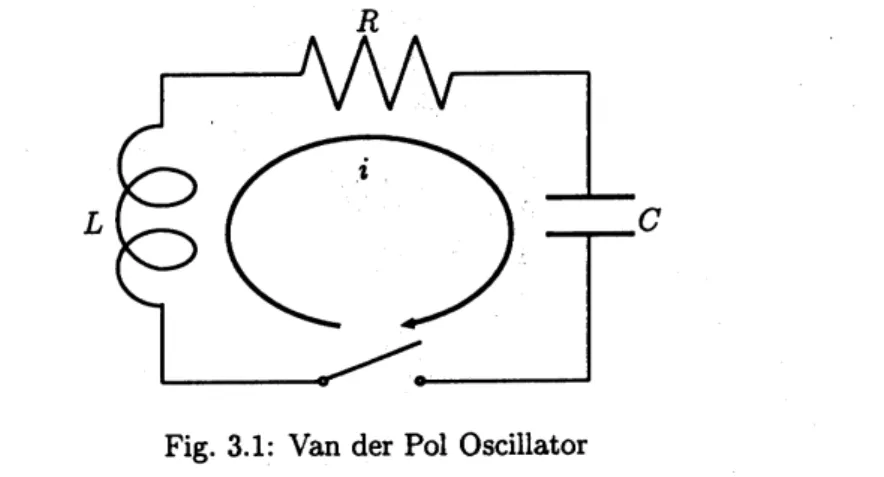
We first introduce the most basic oscillating circuit with anegative resistor devised by
Van der Pol. On Fig.3.1, $L$, $C$ and $R$ stands for inductance, capacitance and resistance,
$L$
Fig. 3.1: Van der Pol Oscillator
respectively. This$R$, iscalled negativeresistor,hasthe nonlinear property forcurrent $i$such
that
(3.1) $R(i)=-\prime 0+r_{1}i$%$r_{2}i^{2}$,
where$r_{0}$,$r_{1}$ and$r_{2}$ isnonnegative. Let$\tau$ be time. Thenthecircuit equation corresponding
toFig.3.1 is formalized by thefollowing
$Li_{\tau}+R(i)i+ \frac{1}{C}\int i(\tau)d\tau=0$
.
Differentiating above equation by $\tau$, wehave
$i_{\tau\tau}- \frac{1}{L}(r_{0}-2\mathrm{r}\mathrm{x}\mathrm{i}-3r_{2}i^{2})i_{\tau}+\frac{1}{LC}i=0$
.
Here, transforming $\tau$ into $\sqrt{LC}t$ andputting $i=\sqrt{\overline{3}r_{2}\prime[perp]}x$,
we
have(3.2) $x_{tt}-r_{0} \sqrt{\frac{C}{L}}(1-\frac{2r_{1}}{\sqrt{3r_{0}r_{2}}}x-x^{2})xt+x=0$
.
Put $\epsilon=\prime_{0}\sqrt{\frac{c}{L}}$
now.
Ifwe
suppose$r_{1}=0$, thenwe
obtain the Van der Poltypeequation(M1) $x_{tt}+\epsilon(x^{2}-1)\mathrm{x}\mathrm{t}+x=0$,
where $x(t)\in \mathrm{R}$
.
$\epsilon$ represents the nonlinearity of the system (M1) and (3.1) holds theessence
of Self-induced oscillation. Incase
that $\epsilon$ is equal to zero, (M1) is actually justa
linear oscillator. Itisknownasarelaxation oscillation that the solutions oftheautonomous
system (M1) have the unique limit cycle for each$\epsilon$
on
$(x,x_{t})$ plane by Poincare-BendixsonTheorem (cf. F. Verhulst [10,
\S 4.3]).
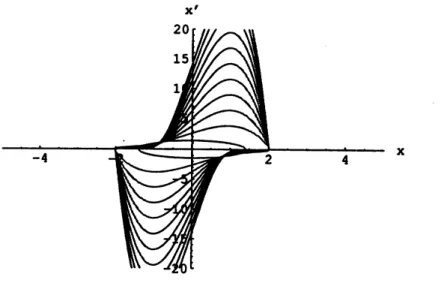
Fig.3.2 gives the $\omega$-limit set of the orbits. Where$\epsilon$ change from 0to 20 by 2step. The horizontal axis and the vertical axis indicates $x(t)$
and $x_{t}(t)$, respectively. We
can see
in Fig.3.2 the amplitude of limit cycle becomes largeas
$\epsilon$ grows. For example, the period of limit cycle for $\epsilon=2,\epsilon=6.5$ and$\epsilon$ $=15$ is about
7.63, 13.79and 26.80
$\mathrm{x}’$
$\mathrm{x}$
Fig.
3.2:
Limit Cycle3.3
FORCED MODEL
We next introduce the Van der Pol oscillator withexternalpower
source.
On
Fig.3.3, $E$isthevoltageof externalpower
source.
Using transformationsimilar to(3.2),we can
formulatethe circuit equationcorresponding toFig.3.3
as
follows(3.3) $x_{tt}-r_{0} \sqrt{\frac{C}{L}}(1-\frac{2r_{1}}{\sqrt{3r_{0}r_{2}}}x-x^{2})x_{t}+x=\sqrt{\frac{3r_{2}}{r_{0}}}\sqrt{\frac{C}{L}}E\mathrm{c}\mathrm{o}\mathrm{e}t$
Weput$\epsilon=r_{0}\sqrt{\tau c}$and$B=\sqrt{\underline{3}\mathrm{a}\mathrm{o}},\sqrt{\tau c}E$
.
Wecall$B$forcing coefficient. Ifwe
assume
$r_{1}=0$,thenwehave the forced Van der Poltype equation
(M2) $x_{tt}+\epsilon(x^{2}-1)x_{\mathrm{C}}+x=B$
coe
$t$.
We show three results of simulations of the model (M2). Then
we
have to seta
initial value
on
$[0, 2\pi]$ $\mathrm{x}\mathrm{R}^{N}\mathrm{x}\mathrm{R}^{N}$.
Let
us
set four initial values $(t_{0},x(t_{0}),x_{t}(t_{0}))$ at(0,0,0), (0,0,3),$(0,$$-1, 1)$and (0, 1,5). Let $\epsilon$ be fixed at 10.0 and $B$ be set at 2.0, 6.5
Fig.3.3: Van der Pol Oscillatorwith External power
source
and 15.0. It is rather
more
important forus
than the relation between initial values andorbits whether aperiodic solution exists
or
where aperiodic solutionwas
observedor
itsperiod. Fig.3.4, Fig.3.5 and Fig.3.6
are
3-dimensional plots and projections onto $t=0$ oftime series of$x$ and $x_{t}$ of (M2) in
case
that the amplitude of external force $B$ is weak 2.0,strong 15.0 and middle 6.5, respectively. In Fig.3.4,
we can
finda
$2\pi$-periodic repellor inthe region of$t<0$ which oscillate
near
the origin with small amplitude, anda
$6\pi$ periodicsubharmonicsolution in the region of$t>0$in which allfourorbitsreach. InFig.3.5,
we can
observe
a
$2\pi$-periodic attractor in the region of$t>0$in which allfour orbitswas
attractedas
time progresses. In the region of$t<0$,we can
hardly calculatebecausetheorbits divergeinstantly to infinityforall fourinitial values. Fig.3.6 gives acomplicatedstatethat
we
havearepellor in the region of$t<0$ and both
an
attractor and asubharmonic solution in theregion of$t>0$
.
$\mathrm{x}$ Fig. 3.5: Caseof$B=2$ $\mathrm{x}$ Fig. 3.5: Caseof$B=15$ $\mathrm{x}$ Fig. 3.6: Case of$B=6.5$165
Fig.3.7andFig.3.8
are
drawn in order to give clearly the orbitsofthree periodic solutions. Fig.3.7 is the 3-dimensional plotof$(t\mathrm{m}\mathrm{o}\mathrm{d} 2\mathrm{n}\mathrm{l}\mathrm{x}(\mathrm{t})\mathrm{J}\mathrm{x}\mathrm{t}(\mathrm{t}))$for large $|t|$sufficiently,and Fig.3.8 is its projection onto $t=0$.
In Fig.3.8,we
can
see
that the oscillation with the smallest amplitude is repellor, the orbit is attractor which oscillate by the inner side of the largestswing, and the orbit issubharmonic solution which also has the small amplitude crossing$x$
axis while oscillating with the largest amplitude.
$\mathrm{x}$
Fig. 3.7: InvariantSet for $|t|>>1$ Fig. 3.8: Periodic Solutions
In Fig.3.9, Fig.3.10 and Fig.3.11, $(t\mathrm{m}\mathrm{o}\mathrm{d} T,x(t))$
are
drawn for $t$ $\in[1W,20]$, $t\in$$[100,200]$ and$t\in[-2W, -1\mathrm{M}]$ to investigate the exact periodsofperiodicsolutions, where
$T=2\pi,2\pi$ and $6\pi$, respectively. In order to get the exact period,
we
have to choose $T$appropriately sothat the
curves
$(t \mathrm{m}\mathrm{o}\mathrm{d} T,x(t))$ may be overlapped atone.$\mathrm{t}$ $\mathrm{t}$
Fig. 3.9: Repellor Fig. 3.10: Attractor
$\mathrm{x}$
$\mathrm{t}$
Fig. 3.11: Subharmonic Soluti
on
3.4
COUPLED MODEL
WITHFORCING
TERMWe introduce the coupling model connected two oscillating circuits with external power
source.
Fig. 3.12: Coupled VanderPol Oscillator withExternal power
source
On the Fig.3.12, $c$ and $r$ represents the small capacitance added artificially and the
minuteresistance included in the leadportionof the circuit, respectively. Thecharacteristic
ofnegativeresistance is described by
$R_{n}(i)=-\mathrm{r}\mathrm{n}\mathrm{O}+rnli+r_{n2}i^{2}$ for $n=1,2$
.
Now
assume
$\sqrt{L_{1}C_{1}}=\sqrt{L_{2}C_{2}}$and put $i_{1}=\sqrt{3r_{12}r}" x$ and $i_{2}=\sqrt{\frac{r}{3}r_{22}2\mathrm{L}}y$.
By usingsame
transformation as (3.3), we havethe following circuit equation corresponding to Fig.3.12
$x_{tt}-r_{10} \sqrt{\frac{C_{1}}{L_{1}}}(1-\frac{2r_{11}}{\sqrt{3r_{10}r_{12}}}x-x^{2})x_{t}+x=\sqrt{\frac{3r_{12}}{r_{10}}}\sqrt{\frac{C_{1}}{L_{1}}}E_{1}\cos t$
$+ \frac{C_{1}}{c}(y-x)+r\sqrt{\frac{C_{1}}{L_{1}}}(y_{\mathrm{C}}-x_{t})$,
$y_{tt}-r_{20} \sqrt{\frac{C_{2}}{L_{2}}}(1-\frac{2r_{21}}{\sqrt{3r_{20}r_{22}}}y-y^{2})y_{t}+y=\sqrt{\frac{3r_{22}}{r_{20}}}\sqrt{\frac{C_{2}}{L_{2}}}$
a
$\cos t$$+ \frac{C_{2}}{c}(x-y)+r\sqrt{\frac{C_{2}}{L_{2}}}(x_{\ell}-y_{t})$
.
Here we put $k_{n}=\mathrm{C}\mathrm{n}/\mathrm{c}$, $\epsilon_{n}=r_{n0}\sqrt{\frac{c}{L_{\mathrm{n}}}}$ and $B_{n}=\sqrt{\frac{3}{r}\underline{r_{\mathrm{B}0}}l}\sqrt{\frac{c}{L_{n}}}E_{n}$
.
Ifwe
suppose$r_{n1}=0$,
$r\langle(1$, then
we
can build upour
main model$x_{tt}-\epsilon_{1}(1-x^{2})x_{t}+x=B_{1}\cos t+k_{1}(y-x)$,
(M3)
$y_{tt}-\epsilon_{2}(1-y^{2})y_{t}+y=B_{2}\cos t+k_{2}(x-y)$,
where
we
call $k_{n}$ couplingcoefficient.We show two results of simulations of the model (M3). Then
we
have to set ainitialvalue
on
$[0, 2\pi]$$\mathrm{x}\mathrm{R}^{N}\mathrm{x}\mathrm{R}^{N}\mathrm{x}\mathrm{R}^{N}\mathrm{x}\mathrm{R}^{N}$.
Let$\epsilon_{1}$,$\epsilon_{2}$ and $k_{1}$,$k_{2}$ befixedat 2.0,10.0 and 0.5, 0.3,
respectively. We suppose $B_{1}=B_{2}$
.
We first show
case
ofweak external force $B_{1}=B_{2}=1.5$.
Letus
set four initialval-ues
$(t_{0},x(t_{0}),x_{\ell}(t_{0}),y(t_{0}),y_{(}t_{0}))$ at (0,0,0,0,0), $(0, 0,$$-1, 0,$$-1)$, $(0,$$-2,$ $-5,$ $-1,$$-10)$ and$(0,$-2,$5,$-2.5,-10$)$
.
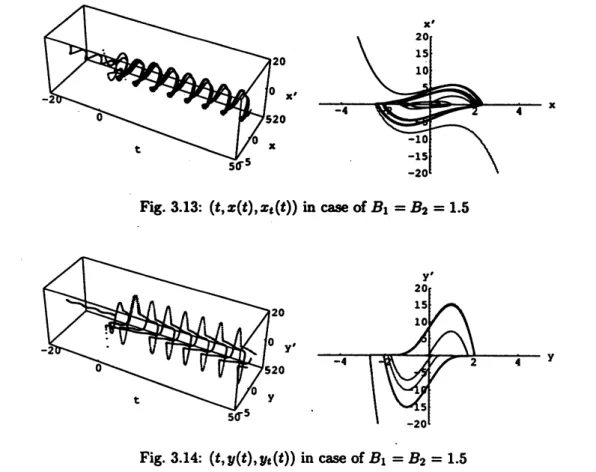
Fig.3.13 and Fig.3.14
are
time series plotting $(t,x(t),x_{t}(t))$ and $(t,y(t),y_{t}(t))$,respec-tively. In both Fig.3.13 and Fig.3.14,
we
can
observea
$2\pi$-periodic repellor in the regionof$t<0$ and
a
$6\pi$-periodic subharmonic solution in the region of$t>0$.
Then $x(t)$ of thissubharmonic solution in Fig.3.13
appears
like $2\pi$-periodic. But watching $y(t)$ in Fig.3.14,we
have itsperiod is$6\pi$.
Furthermore,
we
expectthat,even
if amodelwas
multidimensionalize, theamplitudeofeachvariabledepend
on
$\mathcal{E}$:of
each dimension. In this case, the amplitudeof$x(t)$ and$y(t)$depend
on
$\epsilon_{1}$ and $\epsilon_{2}$, respectively. However, ifwe
suppose that coupling coefficients4is
larger,then
we
may haveamore
complicated situation of the orbits.$\mathrm{x}$
Fig. 3.13: $(t,x(t),x_{l}(t))$ in
case
of$B_{1}=B_{2}=1.5$$\mathrm{y}$
Fig. 3.14: $(t,y(t),y_{t}(t))$ in
case
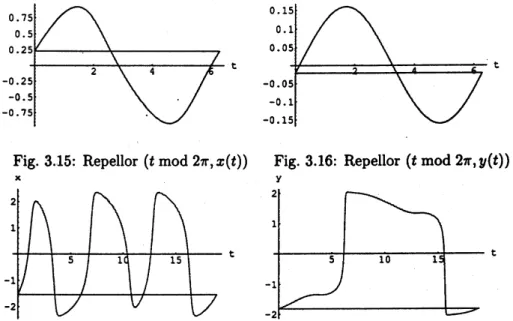
of$B_{1}=B_{2}=1.5$Fig.3.15, Fig.3.16 and Fig.3.17 Fig.3.18 give theperiodofrepellorand subharmonicsolution,
respectively. We
can
checkthat each periodis $2\pi$ and$6\pi$.
We next show
case
ofstrongexternalforce $B_{1}=B_{2}=15$.
Letus
set fourinitialvalues$(t_{0},x(t_{0}),x_{t}(t_{0}),y(t_{0})$,$y_{t}(t_{0}))$ at (0,0, 0, 0,0), $(0,$$-2,$ $-5,$ $-1,$$-10)$, $(0,$-2,$5,$-2.5,-10$)$ and
$(0, 3,$$-1, 3, 1)$
.
In Fig.3.19 and Fig.3.20,
we can
observea
$2\pi$-periodic attractor in the region of$t>0$like$B=15$ of
case
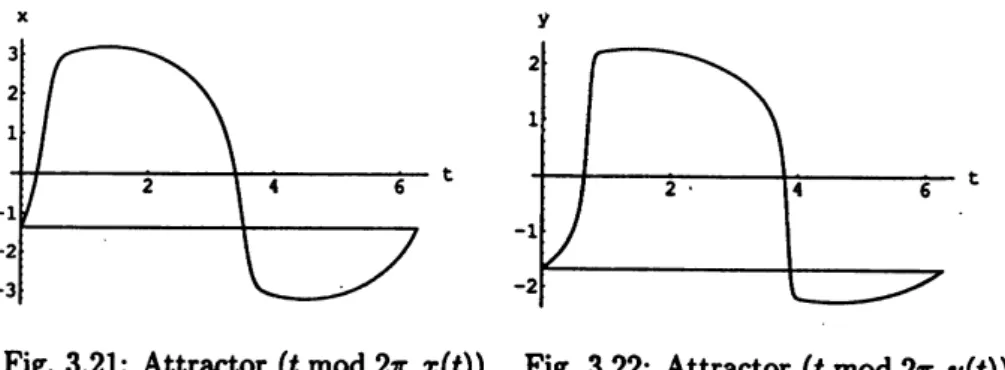
in the last section.In the region of$t<0$, the orbits diverge instantly toinfinityfor all four initial values.Fig.3.21 andFig.3.22givethe periodofattractor is $2\pi$
.
In the end, by the results of
some
simulations,we can
expect that forced Van der Polsystemhas
an
attractorincase
that theexternalforce isstrongor
arepellorincase
that theexternalforce is weak. But it is noteasytoinvestigate completely setting ofparameters for
$\mathrm{t}$ $\mathrm{t}$
Fig. 3.15: Repellor $(t\mathrm{m}\mathrm{o}\mathrm{d} 2\pi,x(t))$ Fig.
3.16:
Repellor $(t\mathrm{m}\mathrm{o}\mathrm{d} 2\pi, y(t))$$\mathrm{x}$ $\mathrm{y}$
t $\mathrm{t}$
Fig. 3.17: Subharmonic(t$\mathrm{m}\mathrm{o}\mathrm{d} 6\pi,x(t)$ Fig. 3.18: Subharmonic(t$\mathrm{m}\mathrm{o}\mathrm{d} 6\pi,y(t)$)
$\mathrm{x}$
Fig. 3.19: $(x(t),x_{t}(t))$ in
case
of$B_{1}=B_{2}=15$$\mathrm{y}$
Fig. 3.20: $(y(t),y_{\mathrm{C}}(t))$ in
case
of$B_{1}=B_{2}=15$$\mathrm{y}$
$\mathrm{t}$
$\mathrm{t}$
Fig. 3.21: Attractor$(t\mathrm{m}\mathrm{o}\mathrm{d} 2\pi,x(t))$ Fig. 3.22:
Attractor
$(t\mathrm{m}\mathrm{o}\mathrm{d} 2\mathrm{n}\mathrm{t}\mathrm{y}\{\mathrm{t}))$all
cases
that asubharmonic solution exists (e.g. regarding the results forone
dimensionalsystem,
see
J. E. Flaherty and F. C.Hoppensteadt [2]$)$.
4REPELLOR
In this section ,
we
prove that theperiodic solution foundnear
the originbysimulations insection 3isrepellor.
Proposition 4.1 Let$\rho$be asmall constant, $u\in L^{2}(R;R^{N})$ be
a
$T$-periodicsolutionof
(V)utsth $||u||\leq\rho$ and$A$ is
a
Hermite conjugate matrix. Then$u$ is a repellor.
Proof.
Usingcondition (F2),we
have that,there exists$\rho:>0$for $:\in[1,N]$ such that$f\dot{.}(u:)<0$ for $|u:|<\rho:$,
then put $\rho=\mathrm{n}\cdot \mathrm{n}:\epsilon[1,N1$$\rho:$
.
Putting$f(u)=(\begin{array}{llll}f_{1}(u_{1}) 0 00 f_{2}(u_{2}) 0\vdots \vdots \ddots \vdots 0 0 f_{N}(u_{N})\end{array})$ ,
we can
rewrite (V) to(4.1) $u_{tt}+f(u)u_{t}+Au=e(t)$
.
Let $u\in L^{2}(R_{j}R^{N})$ be
a
$T$periodic solution of (4.1) with $||u||\leq\rho$.
Further let $h$ bea
constant and$u+h\phi$ beasolution (4.1). Thenwe
have(4.2) $(u+h\phi)_{tt}+f(u+h\phi)(u+h\phi)_{t}+A(u+h\phi)$ $=e(t)$
.
By (4.1) and (4.2),
we
have$\phi_{tt}+\frac{f(u+h\phi)-f(u)}{h\phi}u_{t}\phi+f(u+h\phi)\phi_{t}+A\phi=0$
.
By letting $h$ g0to 0forthe equation above,
we
get the linearizedequation
(4.3) $\phi_{tt}+f(u)\phi_{t}+(f’(u)u_{t}+A)\phi=0$,
where$f’(u)$ is Hessian of$f(u)$
.
Herewe
rewritetheequationaboveas
asystemoffirstorderordinary equations of the form
(4.4) $(\begin{array}{l}\phi_{l}\chi_{t}\end{array})=(\begin{array}{ll}0 1-f’(u)u_{\mathrm{C}}-A -f(u)\end{array})(\begin{array}{l}\phi\chi\end{array})$
We consider the initial value problem of autonomous system (4.4) with $(\phi(0), \chi(0))=$
$(00, \chi_{0})\in \mathrm{R}^{N}\mathrm{x}\mathrm{R}^{N}$
.
We put $\Phi(t)=(\phi(t), \chi(t))$ for $t\geq 0$.
Then by Floquet’s theorem(e.g.,
see
[9,\S 1.4]
by F. C. Hoppensteadt),we
have that the fundamental solution $\Phi(t)$ of(4.4)
can
be written in the form$\Phi(t)=Q(t)\exp(\Lambda t)$,
where$Q(t)=\{q_{j}\}$ is amatrix such that each element $\mathrm{q}\mathrm{i}\mathrm{j}\{\mathrm{t}$)is
a
$T$-periodic function, and Ais aJordan matrix. To prove that $u$ isarepellor, it is sufficient to
see
that each eigenvalue$\lambda_{:}$ of Ais positive. Let
$\varphi$ isasolution of (4.3). Then
we
have$\varphi_{tt}+f(u)\varphi_{t}+(f’(u)u_{t}+A)\varphi=0$
.
Integrating the equation above
over
$[0, t]$,we
have$\varphi_{t}(t)+(f(u)\varphi)(t)+A\int_{0}^{t}\varphi(s)ds=\varphi_{t}(0)+(f(u)\varphi)(0)$
Here
we
put $\sigma=\varphi_{t}(0)+(f(u)\varphi)(0)$.
We alsoput $\phi(t)=\int_{0}^{t}\varphi(s)ds$.
Thenwe
have$\psi_{tt}+f(u)\psi_{t}+A\psi=\sigma$ for t $\geq 0$
.
Then multiplyingthe equality above by$\psi_{t}$ and integrating
over
$[0, t]$,we
get(4.5) $| \psi_{t}(t)|^{2}+(\langle A\psi(t),\psi(t)\rangle\rangle\geq|\psi_{t}(0)|^{2}+(\langle A\psi(0),\psi(0))\rangle+\frac{1}{2}\int_{0}^{t}|\psi_{t}(s)|^{2}ds+\langle\langle\sigma,\psi(t)-\psi(0)\rangle)$
.
where
we
put ($\langle x, y\rangle\rangle=\sum_{=1}^{N}.\cdot x:y$:for
$x$,$y\in \mathrm{R}^{N}$.
Suppose that there exists anegative eigenvalue $\lambda_{:}$ ofA. Then by choosing the initial value $(\varphi(0), \varphi_{t}(0))$ appropriately, we havethatforsome $D>0$,
$|\psi_{t}|\leq De^{\lambda:t},|\psi|\leq De^{\lambda:t}$ for all t $\geq 0$
.
This implies that $\lim_{tarrow\infty}|\psi_{t}(t)|^{2}+\langle\langle A\psi(t),\psi(t)\rangle\rangle=0$and $\lim_{tarrow\infty}\langle\langle\sigma,\psi(t)-\psi(0))\rangle=0$
.
This contradicts to (4.5). This completes the proof. $\square$
REFERENCES
[1] Jean Mawhin, An Extension
of
a Theoremof
A.C.Lazeron Forced NonlinearOscilla-tions, Journal of MathematicalAnalysis and Applications, Vo1.40,pp.20-29, (1972).
[2] J.E.Flaherty, F.C.Hoppensteadt, Frequency Entrainment
of
a Forced van der PolOs-cillator, Studies in Applied Mathematics, Vo1.58, pP.5-15, (1978).
[3] Duane W.Storti, Per G.Reinhall, Stability
of
in-phave and out-Of-phase modesfor
$a$pair
of
linearly coupled vander Pol oscillators, Nonlinear dynamics, PP.1-23, Serieson
Stability, Vibration and Control Systems. Series B, Vo1.2, World Scientific Publishing,
River Edge, NJ, (1997).
[4] Nguyen PhuongC\’ac, Periodic Solutions
of
a Li\’enardequation with forcing term, Non-linear Analysis, Vo1.43, pp.403415, (2001).[5] Chaitan P.Gupta, Juan J.Nieto, LuisSanchez, PeriodicSolutions
of
Some Lienard andDuffing Equations,Journal of Mathematical Analysis and Applications,Vo1.140,
PP.67-82, (1989).
[6]
Norman
Levinson, A Second OrderDifferential
Equation with Singular Solutions, An-nalsofMathematics, Vo1.50, No.1, pp.127-153, (1949).[7] M.L.Cartwright,J.E.Littlewood, SomeFo.eed Point Theorems, Annals of Mathematics,
V01.54, NO.1, pp.1-37, (1951).
[8] John Guckenheimer, Philip Holmes, “Nonlinear Oscillations, Dynamical Systems,and
Bifurcations ofVector Fields”, Applied Mathematical Sciences, 42,
Springer-Verlag,
(1983).
[9]
Frank
C.
Hoppensteadt, “AnalysisandSimulation
ofChaoticSystms” , AppliedMath-ematical Sciences, 94,Springer-Verlag, (2000).
[10] Ferdinand Verhulst “Nonlinear Differential Equations and Dynamical Systems”,
Springer-Verlag, (1990).
[11] Wolfgang Walter uOrdinary Differential Equations
n,
Springer-Verlag,
(1998).[12] N.G.Lloyd, “Degree Theory”, Cambridge UniversityPress, (1978).
[13] G.Hardy, J.E.Littlewood, G.P61ya, “INEQUALITIES”, Cambridge University Press,
(1934).
[14] Carl Chiarella, “The Elements of aNonlinear Theory of Economic Dynamics”,
Lec-tureNotae in
Economics
and Mathematical Systems, 343, Springer-Verlag, (1990).[15] Toru Maruyama, Wataru Takahashi, uNoffiinear and Convex Analysis in Economic
$\mathrm{T}\mathrm{h}\infty \mathrm{r}\mathrm{y}"$,LectureNotesinEconomicsandMathematical Systems,419,
Springer-Verlag, (1995).
[16] GianniRicci, KumaraswamyVelupillai, “Growth Cycles andMultisectoral Economics:
the Goodwin Tradition”, LectureNotesin Economics andMathematical Systems, 309,
Springer-Verlag, (1988). [17] 宮寺功, u 関数解析”,理工学社, (1972). [18] 青木利夫, 高橋渉, 平野載倫, u演習集合位相空間”, 培風館, (1985). [東] 浅田統一郎, u成長と循環のマクロ動学” , 日本経済評論社, (1990). [20] 佐藤力, u 非線形振動論$n$ , 基礎物理科学シリーズ, 2, 朝倉書店, (1970). [21] 増田久弥, u非線形数学”, 新数学講座, 15, 朝倉書店, (1985).
CHIKAHIRO
EGAMI\dagger AND NORIMICHI $\mathrm{H}\mathrm{I}\mathrm{R}\mathrm{A}\mathrm{N}\mathrm{O}^{\mathit{1}}$Division ofInformationMedia Environment Sciences,
Graduate SchoolofEnvironment and InformationSciences,
YokohamaNational University,
795 Tokiwadai, Hodogaya,Yokohama, Kanagawa,
2408501
E-mail address: \dagger chika@hiranolab.jks.ynu.ac.jp, hirano@math sci.ynu.ac.jp