Mean-square stability of numerical schemes
for stochastic differential systems
齋藤善弘 (岐阜聖徳学園大学)
YOSHIHIRO SAITO (Gifu Shotoku Gakuen University)
三井斌友 (名古屋大学)
TAKETOMO MITSUI (Nagoya University) Abstract
Stochastic differential equations (SDEs) represent physical phenomena dominated
by stochastic processes. As for deterministic ordinary differential equations (ODEs),
various numericalschemes areproposed forSDEs. We have proposed the mean-square
stability of numerical schemes for ascalar SDE, that is, the numerical stability with
respect to the mean-squarenorm. However we studied itfor onlyscalar SDEs because
of difficulty and complexity in SDE systems. In the present note we will consider a
2-dimensional linear system with one multiplicative noise andtry to analyze them.
1Introduction
We have proposed the numericalmean-square stability ($\mathrm{M}\mathrm{S}$-stability)for ascalar stochastic
differentialequation (SDE) with
one
multiplicative noise [7]. Howeverwe
studied it for onlyscalar SDEs. Komori and Mitsui $[4, 5]$ analyzed numerical $\mathrm{M}\mathrm{S}$-stability for a2-dimensi0nal
SDE with special case, that is, simultaneously diagonalizable
case.
In this notewe
$\mathrm{w}\mathrm{i}\mathrm{U}$ tryto analyze numerical $\mathrm{M}\mathrm{S}$-stability of the Euler-Maruyama scheme for general 2-dimensi0nal
SDE systems.
Consider the SDE ofItO-type given by
$\mathrm{d}X(t)=f(t,X)\mathrm{d}t+g(t,X)\mathrm{d}W(t)$ (1)
with $f(0,t)=g(0, t)=\mathrm{O}$ so that the steady state $X(t)=0$ is the equilibrium solution. The
Euler-Maruyama scheme for the discrete approximate solution $\{\overline{X}_{n}\}$ is
$\overline{X}_{n+1}=\overline{X}_{n}+f(t_{n},\overline{X}_{n})h+g(t_{n},\overline{X}_{n})\Delta W_{n}$
where $h$ and $\Delta W_{n}$ stand for the step-size and the increment of the Wiener process,
respec-tively. Then
we can
give the definition of the MS-stability.Definition 1Steady solution $X(t)\equiv \mathrm{O}$ is asymptotically stable in mean-square
if
$\forall\epsilon>0,$ $\exists\delta>0$; E$(||X(t)||^{2})<\epsilon$
for
all t $\geq 0$ and $||X_{0}||<\delta$and
$\exists\delta_{0}$;
$\lim_{tarrow\infty}$E $(||X(t)||^{2})=0$
for
all $||X_{0}||<\delta_{0}$数理解析研究所講究録 1265 巻 2002 年 89-99
Here the
norm
$||x||$ is the Euclideannorm
of avector $x\in \mathbb{R}^{2}$.
We willconsider three types of linear SDE systems, and try to analyzethem. In the next
section
we
describe the results of $\mathrm{M}\mathrm{S}$-stabilty for three types ofthe SDE system.Section
3shows theresults of numerical $\mathrm{M}\mathrm{S}$-stability of the Euler-Maruyama scheme corresponding
to results in Section 2. In Section 4we $\mathrm{w}\mathrm{i}\mathrm{U}$ show the numerical experiments confirming
our
stability analysis in Section
3.
FinaUywe
$\mathrm{w}\mathrm{i}\mathrm{U}$ describeour
conclusion andfuture aspects.2MS-stability
We will restrict the SDE (1) to
an
$\mathrm{I}\mathrm{t}\mathrm{t}\succ \mathrm{t}\mathrm{y}\mathrm{p}\mathrm{e}$ $2$-dimensional lnear SDE system withone
multiplicative noise, which has the form
$\{$
$\mathrm{d}X(\mathrm{t})$ $=DX(t)\mathrm{d}\mathrm{t}+BX(\mathrm{t})\mathrm{d}W(\mathrm{t})$,
$X(0)$ $=$ $1$. (2)
Here the real constant matrices $D$ and $B$
are
given by$D=\{\begin{array}{ll}\lambda_{1} 00 \lambda_{2}\end{array}\}$ , $B=[_{\beta_{2}}\alpha_{1}$ $\alpha_{2}\beta_{1}]$
.
Komori and Mitsui $[4, 5]$ analyzed $\mathrm{M}\mathrm{S}$-stabilty for SDE system (2) with
$\beta_{1}=0$ and $\beta_{2}=0$ (simultaneously diagonalizable case). We $\mathrm{w}\mathrm{i}\mathrm{U}$ consider
more
general SDE system,namely $\beta_{1}\neq 0$ and $\beta_{2}\neq 0$
.
Firstwe
$\mathrm{w}\mathrm{i}\mathrm{U}$ introduce the conventional and the logarithmicnorms
of matrices for stability analysis ofthe SDE system (2).Definition 2Corresponding to the vector
norms
$l^{1},$ $l^{2}$ and $l^{\infty}$ in $\mathrm{R}^{n}$, wedefine
thesetbor-dinate $mat\dot{m}$
nors
of
square $n\cross n$ matrix $A=(a_{1j}.)$ by$||A||_{1}= \max_{j}\{\sum_{=1}^{n}.\cdot|a_{j}.\cdot|\}$ , $||A||_{\infty}= \max.\cdot\{\sum_{j=1}^{n}|a_{j}.\cdot|\}$ ,
$||A||_{2}=$ $\{$maximum eigenvalue
of
$A^{T}A\}^{1/2}$Definition 3Logarithmic rnatrixnorm $\mu[A]$ (see [1, $\mathit{6}J$) is
defined
by$\mu[A]=\lim_{harrow 0+}(||I+hA||-1)/h$
where I is the unit matrix and h $\in \mathrm{R}$
.
For the matrix
norms
$||\cdot||_{1},$ $||\cdot||_{\infty}$ and $||\cdot||_{2}$, the folowing identitiesare
well known toevaluate the logarithmic
norms.
$\mu_{1}[A]=\max_{j}\{a_{jj}+\sum_{\neq \mathrm{j}}.\cdot|a_{j}.\cdot|\}$ , $\mu_{\infty}[A]=\mathrm{m}\mathrm{a}\ \cdot\{a.\cdot.\cdot+\sum_{j\neq:}|a_{j}.\cdot|\}$ ,
$\mu_{2}[A]=\mathrm{m}\mathrm{a}\mathrm{x}\mathrm{i}\mathrm{m}\mathrm{u}\mathrm{m}$ eigenvalue of $(A+A^{T})/2$
.
Let $P(t)=\mathrm{E}(X(t)X(t)^{T})$ be the $2\cross 2$ matrix-valued second moment of the solution of
(2). Then $P(t)$ obeys the initial value problem ofthe following matrix ordinary differential
equation (ODE)
$\frac{\mathrm{d}P}{\mathrm{d}t}=DP+PD^{T}+BPB^{T}$ $(t>0)$, (3)
with $P(0)=X_{0}X_{0}^{T}$
.
Due to the symmetry of the matrix $P$we
have its governing ODEs of3-dimensi0n
$\frac{\mathrm{d}\mathrm{Y}}{\mathrm{d}t}=\mathcal{M}\mathrm{Y}$ (4)
where
$\mathrm{Y}(t)=(\mathrm{Y}^{1}(t), \mathrm{Y}^{2}(t),$$\mathrm{Y}^{3}(t))$, $\mathrm{Y}^{1}(t)=\mathrm{E}(X^{1}(t))^{2}$, $\mathrm{Y}^{2}(t)=\mathrm{E}(X^{2}(t))^{2}$, $\mathrm{Y}^{3}(t)=\mathrm{E}(X^{1}(t)X^{2}(t))$.
We can readily obtain the following lemma owing to the logarithmic matrix norm $\mu$
.
Lemma 1The linear test system with the unit initial value is asymptotically MS-stable
$w.r.t$. logarithmic norm $\mu$
iff
$\mu(\mathcal{M})<0$
We will study $\mathrm{M}\mathrm{S}$-stability for the following three types of the test system. Drift matrix $D$
in (2) is fixed with real numbers $\lambda_{1}<\lambda_{2}<0$ and diffusion matrices $B$
are
eitherType $\mathrm{I}:\{\begin{array}{ll}\alpha 00 \alpha\end{array}\}$ , $\mathrm{T}\mathfrak{M}\mathrm{e}\mathrm{I}\mathrm{I}:\{\begin{array}{ll}0 \beta\beta 0\end{array}\}$ , or Type III : $\{\begin{array}{ll}\alpha \beta\beta \alpha\end{array}\}$ .
Here real numbers $\alpha$ and $\beta$
are
non-negative.Theorem 1In Type I the matrix in (4) is given by
$\mathcal{M}=\{\begin{array}{lll}2\lambda_{1}+\alpha^{2} 0 00 2\lambda_{2}+\alpha^{2} 00 0 \lambda_{1}+\lambda_{2}+\alpha^{2}\end{array}\}$
Henceforth
the stability criterion $w.r$.t. $\mu_{2},$ $\mu_{\infty}$ and$\mu_{1}$ yields$\max\{2\lambda_{1}+\alpha^{2},2\lambda_{2}+\alpha^{2}\}<0$. (5)
We employed the following identity to derive (5).
$\lambda_{1}+\lambda_{2}+\alpha^{2}=\frac{2\lambda_{1}+\alpha^{2}+2\lambda_{2}+\alpha^{2}}{2}$ (6)
Type $\mathrm{I}\mathrm{I}$ has the following
Theorem 2The
coefficient
matrix in Type $II$is given by$\mathcal{M}=\{\begin{array}{lll}2\lambda_{1} \sqrt{}^{2} 0\beta^{2} 2\lambda_{2} 00 0 \lambda_{1}+\lambda_{2}+\sqrt{}^{2}\end{array}\}$ ,
which implies the stability criterion $w.r.t$
.
$\mu_{\infty}$ and$\mu_{1}$ as$\max\{2\lambda_{1}+\beta^{2},2\lambda_{2}+\beta^{2}\}<0$.
Again
we
employed (6).Note that the condition represented by $\mu_{\infty}$ is asufficient condition for the
convergence
to the
zero
solution. We will show this through the folowing example.Example 1The combination with
$D=\{\begin{array}{ll}-100 00 -1\end{array}\}$
a
$\mathrm{d}$ $B=\{\begin{array}{ll}0 22 0\end{array}\}$yields
$\mathcal{M}=\{\begin{array}{ll}-200 4 04-2 000 -97\end{array}\}$ ,
whose logarithmic
norms are
$\mu_{\infty}(\mathcal{M})=2>0$ but $\mu_{2}(\mathcal{M})=-101+\sqrt{9817}<0$.
Finally
we
$\mathrm{w}\mathrm{i}\mathrm{U}$ study Type IIIas
thecomposition ofTypes Iand $\mathrm{I}\mathrm{I}$
.
We conclude with thetheorem.
Theorem 3 $\Phi eIII$has the
coefficient
$mat\dot{m}$given by$\mathcal{M}=\{\begin{array}{lll}2\lambda_{1}+\alpha^{2} \sqrt{}^{2} 2\alpha\sqrt\beta^{2} 2\lambda_{2}+\alpha^{2} 2\alpha\sqrt\alpha\sqrt \alpha\beta \lambda_{1}+\lambda_{2}+\alpha^{2}+\sqrt{}^{2}\end{array}\}$ ,
which brings the stability condition $w.r.t$
.
$\mu_{\infty}$ as$\max\{2\lambda_{1}+(|\alpha|+|\beta|)^{2},2\lambda_{2}+(|\alpha|+|\beta|)^{2}\}<0$
Note that the stability criterion for Type III is givenonly in$\mu_{\infty}$
.
3
$\mathrm{M}\mathrm{S}$-stability
of
Euler-Maruyama
scheme
We
now
ask what conditions must be imposed in order that the numerical solution $\{\overline{X}_{n}\}$ of(2) generated by anumerical scheme satisfies
$\overline{\mathrm{Y}}_{n}=\mathrm{E}|\overline{X}_{n}|^{2}arrow 0$
as
$narrow\infty$.
(7)When we apply anumerical scheme to (2) and calculate the components of the second
moment of$\overline{X}_{n}$,
we
obtain aone-step difference equation of the form$\overline{\mathrm{Y}}_{n+1}=\overline{\mathcal{M}}\overline{\mathrm{Y}}_{n}$ (8)
where
$\overline{\mathrm{Y}}_{n}=(\overline{\mathrm{Y}}_{n}^{1},\overline{\mathrm{Y}}_{n}^{2},\overline{\mathrm{Y}}_{n}^{3})$, $\overline{\mathrm{Y}}_{n}^{1}=\mathrm{E}(\overline{X}_{n}^{1})^{2}$,
$\overline{\mathrm{Y}}_{n}^{2}=\mathrm{E}(\overline{X}_{n}^{2})^{2}$, $\overline{\mathrm{Y}}_{n}^{3}=\mathrm{E}(\overline{X}_{n}^{1}\overline{X}_{n}^{2})$
.
We shall call $\overline{\mathcal{M}}$ the stability matrix of the scheme. Note that $\overline{\mathrm{Y}}_{n}arrow 0$
as
$narrow\infty$if
$||\overline{\mathcal{M}}||<1$. (9)
Definition 4The numerical scheme is said to be $MS$-stable $w.r.t$
.
$||\cdot||$if
it has$\overline{\mathcal{M}}$satisfying$||\overline{\mathcal{M}}||<1$
.
We will calculate the stabilitymatrices $\overline{\mathcal{M}}$ and $\mathrm{M}\mathrm{S}$-stability conditions w.r.t.
||.||
of theEuler-Maruyama scheme for Type I, II and III. Let $r(x)$ be $1+x$ in the following theorems.
Theorem 4For Type I we obtain
$\overline{A4}=\{\begin{array}{lll}r^{2}(\lambda_{1}h)+\alpha^{2}h 0 00 r^{2}(\lambda_{2}h)+\alpha^{2}h 00 0 r(\lambda_{1}h)r(\lambda_{2}h)+\alpha^{2}h\end{array}\}$ ,
which yields the stability condition w.r.t.
||.
$||_{2},$||.
$||_{\infty}$ and||.
$||_{1}$ as$\max\{(1+\lambda_{1}h)^{2}+\alpha^{2}h, (1+\lambda_{2}h)^{2}+\alpha^{2}h\}<1$
.
(10)The inequality
$r( \lambda_{1}h)r(\lambda_{2}h)+\alpha^{2}h\leq\frac{r^{2}(\lambda_{1}h)+r^{2}(\lambda_{2}h)+2\alpha^{2}h}{2}$ (11)
is
utilized
to derive the above result. Whenwe observe the left-hand side in the MS-stabilitycondition (10),
we
conclude to check the numerical $\mathrm{M}\mathrm{S}$-stability whether the pair $(\overline{h}, k)=$$(\lambda h, \alpha^{2}/\lambda)$ satisfying $|R(\overline{h}, k)|<1$ for every $\lambda_{1}$ and $\lambda_{2}$
.
Namely we should check $(\overline{h}_{1}, k_{1})=$$(\lambda_{1}h, \alpha^{2}/\lambda_{1}),$ $(\overline{h}_{2}, k_{2})=(\lambda_{2}h, \alpha^{2}/\lambda_{2})\in \mathcal{R}_{\mathrm{E}\mathrm{M}}$
.
Here $\mathcal{R}_{\mathrm{E}\mathrm{M}}$ is the $\mathrm{M}\mathrm{S}$-stability region of theEuler-Maruyama scheme in scalar
case.
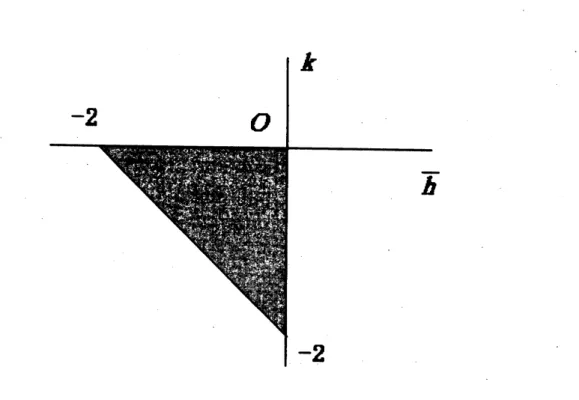
We will show the region in Fig. 1.Next
we
will focuson
Type $\mathrm{I}\mathrm{I}$.
We will calculate the $\overline{\mathcal{M}}$ and stability conditionas same
as
Type I.Theorem 5Type $II$has the stability $mat\dot{m}$ given by $\overline{\mathcal{M}}=\{$ $r^{2}(\lambda_{1}h)$ $\beta^{2}h$ 0 $\beta^{2}h$ $r^{2}(\lambda_{2}h)$ 0
00
$r(\lambda_{1}h)r(\lambda_{2}h)+\beta^{2}h$ ’ (12)which brings the stability condition w.r.t.
||.
$||_{\infty}$ and||.
$||_{1}$as
$\max\{(1+\lambda_{1}h)^{2}+|\beta^{2}h|, (1+\lambda_{2}h)^{2}+|\beta^{2}h|\}<1$
.
We result in stabilty function ofthe Euler-Maruyamascheme (scalar case), namely $R(\overline{h}, k)$
again applicable by $\overline{h}=\lambda h,$ $k=\beta^{2}/\lambda$ like
as
Type I.Finaly
we
try to analyze Type III.Theorem 6For $\Phi eIII$
we
have$\overline{\mathcal{M}}=[r^{2}(\lambda_{1}\beta^{2}hh)+\alpha^{2}h\alpha\beta hr^{2}(\lambda_{2}h)+\alpha^{2}h\alpha\beta h\beta^{2}hr(\lambda_{1}h)r(\lambda_{2}h)+(\alpha^{2}+\beta^{2})h2\alpha\beta h2\alpha\beta h]$ ,
which irnplies the stability condition $w.r.t$
.
$||\cdot||_{\infty}$as
$\max\{(1+\lambda_{1}h)^{2}+(|\alpha|+|\beta|)^{2}h, (1+\lambda_{2}h)^{2}+(|\alpha|+|\beta|)^{2}h\}<1$.
Like
as
Type Iand II,we
conclude that stabilityfunction of the Euler-Maruyama scheme(scalar case) $R(\overline{h},$k) again applicable with $\overline{h}=\lambda h,$ k $=(|\alpha|+|\beta|)^{2}/\lambda$
.
4Numerical
experiments
In this section
we
will show the confirmation forour
$\mathrm{M}\mathrm{S}$-stabilty of the Euler-Maruyamascheme through numerical experiments. We will describe four examples corresponding to
Type $\mathrm{I},$ $\mathrm{I}\mathrm{I}$, and III (2 examples)
as
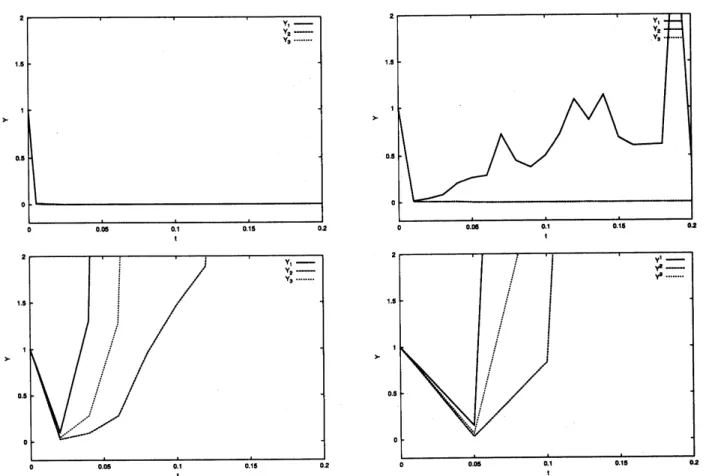
folows. Example 2(Type I)
$\mathrm{d}X=\{\begin{array}{ll}-200 00 -100\end{array}\}X\mathrm{d}t+\{\begin{array}{ll}10 00 \mathrm{l}0\end{array}\}X\mathrm{d}W(t)$ (13)
$h=0.005$, $(\overline{h}, k)=(-1, -0.5),$ $(-0.5, -1)$ : stable
$h=0.01,$ $(\overline{h}, k)=(-2, -0.5),$ $(-1, -1)$ : unstable
$h=0.02,$ $(\overline{h}, k)=(-4, -0.5),$ $(-2, -1)$ : unstable
$h=0.05,$ $(\overline{h}, k)=(-10, -0.5),$$(-5, -1)$ : unstable
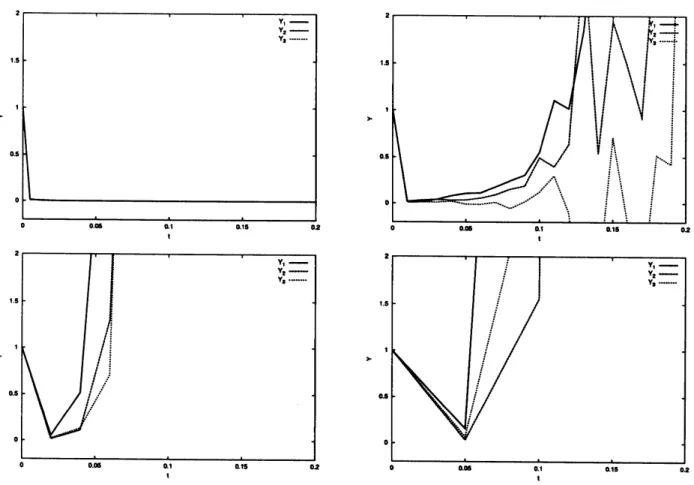
Example 3 $(\infty pe$ II)
$\mathrm{d}X=\{\begin{array}{ll}-200 00 -1\mathrm{O}\mathrm{O}\end{array}\}X\mathrm{d}t+\{\begin{array}{ll}0 1010 0\end{array}\}X\mathrm{d}W(t)$
$h=0.005$, $(\overline{h}, k)=(-1, -0.5),$$(-0.5, -1)$ : stable $h=0.01,$ $(\overline{h}, k)=(-2, -0.5),$$(-1, -1)$ : unstable $h=0.02,$ $(\overline{h}, k)=(-4, -0.5),$ $(-2, -1)$ : unstable $h=0.05,$ $(\overline{h}, k)=(-10, -0.5),$$(-5, -1)$ : unstable
94
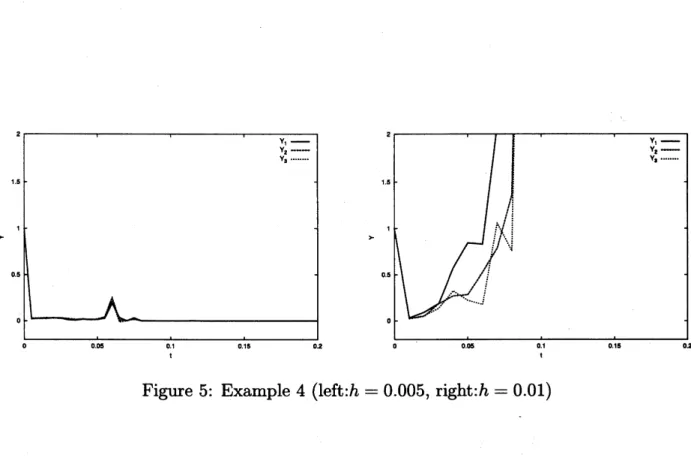
Example 4(Type III)
$\mathrm{d}X=\{\begin{array}{ll}-200 00 -100\end{array}\}X\mathrm{d}t+\{\begin{array}{ll}10 55 10\end{array}\}X\mathrm{d}W(t)$
$h=0.005$, $(\overline{h}, k)=(-1,$$-0.625)$,(-0.5, -1.25) : stable
$h=0.\mathrm{O}1,$ $(\overline{h}, k)=(-2$,-0.625$)$,$(-1,$ $-1.25)$ : unstable
Example 5(Type III)
$\mathrm{d}X=\{\begin{array}{ll}-200 00 -100\end{array}\}X\mathrm{d}t+\{\begin{array}{ll}5 1010 5\end{array}\}X\mathrm{d}W(t)$
$h=0.005$, $(\overline{h}, k)=(-1,$$-0.625)$, (-0.5, -1.25) : stable
$h=0.\mathrm{O}1,$ $(\overline{h}, k)=(-2,$$-0.625)$,$(-1,$ $-1.25)$ : unstable
We took the initial value $X(0)=(1,$ 1) and 10,000 samples. We will show the results of
Example 2to Fig. 2, Example 3to Fig. 3, Example 4to Fig. 4and Example 5to Fig. 5.
5Conclusions and Future
aspects
We extended numerical $\mathrm{M}\mathrm{S}$-stabilityfor ascalar SDE with one multiplicative noise to it for
a2-dimensional SDE system with
one
multiplicative noise. We will analyze $\mathrm{M}\mathrm{S}$-stability forgeneral pair ofthe matrices $D$ and $B$, and
more
dimensionalcase.
Andwe
will investigatethe relation of the $\mathrm{M}\mathrm{S}$-stability conditions in matrix norms, for example, between $||\cdot||_{\infty}$ and
$||\cdot||_{2}$
.
Acknowledgement
$\mathrm{s}$This work is supported by the Grant-in-Aidfor Scientific Research (A) ofJapan Society
for Promotion ofScience (JSPS) (No. 11304004).
References
[1] K. DEKKER and J. G. VERWER, Stability
of
Runge-Kutta methodsfor stiff
nonlineardifferential
equations, North-Holland, Amsterdam,1984.
[2] T. C. GARD, Introduction to Stochastic
Differential
Equations, Marcel Dekker, NewYork, 1988.
[3] P. E. KLOEDEN and E. PLATEN, The Numerical Solution
of
StochasticDifferential
Equations, Springer, Berlin, 1992.
[4] Y. KOMORI and T. MITSUI, Stable ROW-type weak scheme for stochastic differential
equations, Monte Carlo Methods and Applic., 1(1995), 279-300.
).] Y. KOMORI, Y.
sAITO
and T. MITSUI, Some issues in $d_{i}screte$ approimate solutiorfor
stochasticdifferential
equations, Computers Math. Applc., 28(1994), pp.269-278.
$)]\backslash$ J. D. LAMBERT, Numerical Methods
for
OrvlinaryDifferential
Systems, Wiley, NewYork,
1991.
7] Y.
SAITO
and T. MITSUI, Stability analysisof
numericalschemesfor
stochcnsticdiffer
$\cdot$ential equations, SIAM J. Numer. Anal., 33(1996), pp.
2254-2267.
Figure 1: $\mathrm{M}\mathrm{S}$-stability region of
Euler-Maruyama scheme
$1\mathrm{S}$ $\succ$ $\succ$ $\mathrm{Y},-\mathrm{Y},-\mathrm{Y}^{2}\cdots\cdots\cdot$ .
.
$\mathrm{o}s$ 0 ooe $01|$ $0\prime 5$ $\mathrm{o}z$Figure 2: Example 1(upper left:h $=0.005$, upper right:h $=0.\mathrm{O}\mathrm{l}$, lower left:h $=0.02$, lower
right:h $=0.05)$
$\prime s$ $\succ$ $\triangleright$ $\mathrm{Y}..-..\sim\acute{\mathrm{v}}_{*-}^{\prime-}$ . $0\mathrm{S}$ 0 0 $0\alpha$ $\alpha_{1}$ ’ $\propto\prime 5$ 02 $\succ$ $\succ$
Figure
3:
Example 2(upper left:h $=0.005$, upper right:h $=0.\mathrm{O}\mathrm{l}$, lower left:h $=0.02$, lowerright:h $=0.05)$
$\succ$
$\succ$
Figure 4: Example 3 (left:h$=0.005,$right:h $=0.\mathrm{O}\mathrm{l})$
2 $1B$ $\mathrm{Y}_{s}-\mathrm{Y}_{\acute{2}}---\mathrm{Y}-$ $\mathrm{o}s$ 0 0 ooe $0_{1}1$ 015 $\mathrm{o}s$
Figure 5: Example 4 (left:h $=0.005,$right:h $=0.\mathrm{O}\mathrm{l})$