牛乳アレルゲンのIgE エピトープ
著者
内藤 宙大, 山田 千佳子, 和泉 秀彦
雑誌名
名古屋栄養科学雑誌
号
4
ページ
67-72
発行年
2018-12-25
URL
http://id.nii.ac.jp/1095/00001278/
Creative Commons : 表示 - 非営利 - 改変禁止Nagoya Journal of Nutritional Sciences 第 4 号 2018年
はじめに
乳幼児期における食物アレルギーの原因食品
として牛乳の割合は高く、全年齢を対象として
も牛乳は鶏卵に次いで 2 番目に多い原因食品で
ある
1 )。一方で、牛乳はタンパク質、脂質、お
よび糖質をバランス良く含み、特にリン酸カル
シウム含量が高いことが知られている
2 )。その
ため、牛乳を除去していた牛乳アレルギー患者
において、身長への影響や骨密度の低下が報告
されている
3,4,5)。また、母乳(人乳)中には免
疫グロブリン(IgA, IgG, IgM)やラクトフェリ
ン、リゾチームなどの感染防御成分を含む
6 )。
しかし、
b
-ラクトグロブリン(
b
-LG)やカゼイ
ン(CN)は牛乳中に多量に含むものの、人乳
中にはほとんど含まれないため、ヒトにとって
異種性が高く、アレルゲンになりやすいとされ
る。この総説では牛乳中のアレルゲン性タンパ
ク質について、IgE 抗体認識エピトープ(以下、
エピトープ)部位を中心に構造や特性を解説する。
牛乳タンパク質の構造と特性
牛乳中のタンパク質は、pH4.6付近で沈殿す
るカード(curd)とその上清のホエイ(whey)
に大別される。カードに含まれる CN 画分は牛
乳タンパク質の約80% を占める。残りの約20%
がホエイであり、その約半分が
b
-LG、約20% が
a
-ラクトアルブミン(
a
-LA)である。CN は 4
つの CN 成分(
a
s1-,
a
s2-,
b
-,
k
-CN)から成り、
牛乳中では30~300nm の粒径を持つミセルと
して存在する
7,8,9)。これらの CN 成分は全く異な
るタンパク質であり、CN 成分間は相同性が低
く
10)、それぞれのもつ特性は異なる。
筆者らは、牛乳アレルギーの診断時には各種
混合物として検査される CN を、CN 成分ごと
に特異的 IgE 抗体価を解析した。まず、牛乳に
対して、牛乳アレルギー患者血清中の IgE 抗体
を使用したイムノブロットによりアレルゲンを
定性解析したところ、CN、
b
-LG、
a
-LA が検出
された(Fig. 1A)。さらに、牛乳から
a
s1-、
b
-、
《総説》
牛乳アレルゲンの IgE エピトープ
内藤宙大 山田千佳子 和泉秀彦
名古屋学芸大学大学院栄養科学研究科Fig. 1 Immunoblot analysis showing IgE-binding proteins in cow’s milk. CBB-stained SDS-PAGE gel showing the composition of proteins (A left). Proteins recognized by IgE in patient’s serum with cow’s milk allergy (A right). B showing casein specific IgE levels from patient’s sera with cow’s milk allergy (n=39). Significant differences are indicated by different lowercase letters (a, b) and determined by one-way ANOVA tests (p<0.001).
k
-CN を分離し、特異的抗体価を ELISA にて測
定した(Fig. 1 B)。
a
s1-CN 特異的 IgE 抗体価
が高かった患者 1 名を対照(100%)としたとき、
a
s1-,
b
-,
k
-CN の吸光度(mean±SD)は、それ
ぞれ39.01±27.44、36.70±28.35、11.56±13.73%
であり、
k
-CN に比べ
a
s1-,
b
-CN により強く感
作することが示唆された。これらのタンパク質
について以下にまとめた。
カゼイン
ウシ
a
s1-CN は 8 残基のリン酸化 Ser を持ち、
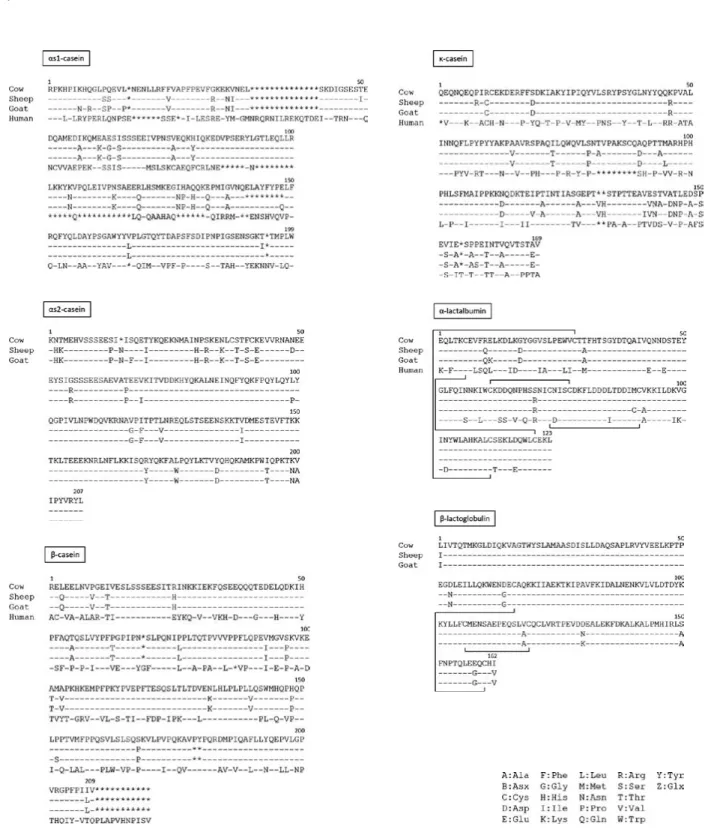
199残基からなるタンパク質である(Fig. 2)
10)。
多くの哺乳動物で同定されているが、牛乳と人
乳中の
a
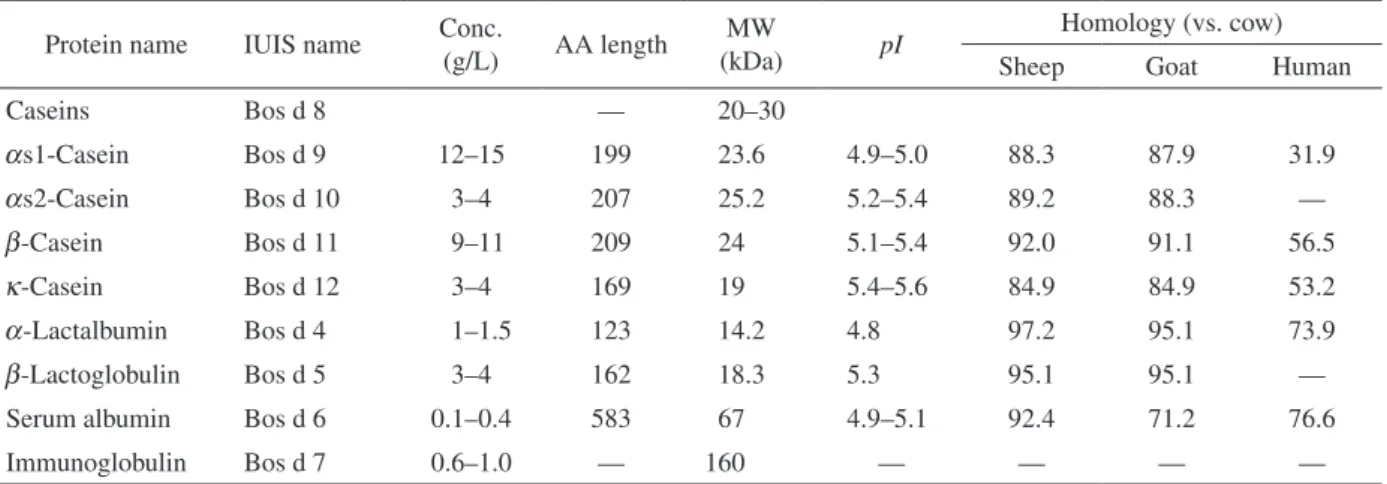
s1-CN の相同性は31.9% であり(Table
1)
10,11,12)、ウシ
a
s1-CN はヒトにとって異種性が
高いタンパク質だと考えられる。山羊乳中では
a
s1-CN の割合は少ないが、ウシ
a
s1-CN と相
同性が高いために、山羊乳やそれを原料とする
シェーブルチーズもアレルギー症状を呈する可
能性がある。また、牛乳中において、ウシ
a
s1-CN は s1-CN 成分の中で最も多く含む。さらに、
これまでに、Chatchatee らはアミノ酸(amino
acid:
AA)17-36、39-48、69-78、83-102、109-120、123-132、139-154、159-174、173-194がヒ
ト IgE 抗体によって認識されると報告したよう
に
13)、エピトープ部位が多いことも特徴の一つ
である。また Nakajima-Adachi らは C 末端領域
の AA181-199がエピトープ部位だと示した
14)。
さらに、AA19-30、93-98、141-150(Spuergin
ら、1996)
15)、AA6-20、11-25、126-140、171-185(Cong ら、1999)
16)、AA28-50(Cerecedo
ら、2008)
17)もエピトープ部位だと報告された。
これらのように、ウシ
a
s1-CN は含有量が多い
ことや、エピトープ部位が多岐にわたること
からアレルゲン性が高いとされている。また、
a
s1-CN は立体構造をとらない上に、
b
-CN とと
もに分子内に Cys を持たないため加熱による
抗原性の変化は期待できない。さらに、Caco-2
細胞を使用した細胞内輸送の研究では、消化管
プロテアーゼによる分解を受けやすい CN は、
b
-LG や OVA に比べ細胞内での分解は受けにく
いということが明らかとなった
18)。また、
a
s1-CN の AA8-22、80-90、91-100を含む断片を保
持したまま Caco-2 細胞を通過するということ
も示された
18)。
ウシ
a
s2-CN は、11残基のリン酸化 Ser と 2 残
基の Cys を持ち、207残基からなるタンパク質
である(Fig. 2)
10)。
a
s2-CN は人乳中には存在
しないタンパク質である。これまでに
AA83-100、143-158、157-172、165-188
19)、AA1-20、13-32、67-86、181-207(Cerecedo ら、2008)がエピ
トープ部位だと報告されてきた。しかし、牛乳
中における割合は少なく、これまで
a
s1-CN と
一括りにされ
a
-CN として解析されてきた。そ
のため、
a
s2-CN に焦点を当てた研究が少なく、
アレルゲン性については不明である。
ウシ
b
-CN は、 5 残基のリン酸化 Ser を持
ち、209残基からなるタンパク質である(Fig.
2 )
10,20)。ヒツジ、ヤギおよびヒトの
b
-CN と
Table 1 Cow’s milk proteins
Protein name IUIS name Conc. (g/L) AA length (kDa)MW pI Homology (vs. cow)
Sheep Goat Human Caseins Bos d 8 — 20–30 as1-Casein Bos d 9 12–15 199 23.6 4.9–5.0 88.3 87.9 31.9 as2-Casein Bos d 10 3–4 207 25.2 5.2–5.4 89.2 88.3 — b-Casein Bos d 11 9–11 209 24 5.1–5.4 92.0 91.1 56.5 k-Casein Bos d 12 3–4 169 19 5.4–5.6 84.9 84.9 53.2 a-Lactalbumin Bos d 4 1–1.5 123 14.2 4.8 97.2 95.1 73.9 b-Lactoglobulin Bos d 5 3–4 162 18.3 5.3 95.1 95.1 — Serum albumin Bos d 6 0.1–0.4 583 67 4.9–5.1 92.4 71.2 76.6 Immunoglobulin Bos d 7 0.6–1.0 — 160 — — — —
牛乳アレルゲンの IgE エピトープ
ウシ
b
-CN の相同性は、それぞれ92.0、91.1お
よび56.5である(Table 1)
11)。エピトープ部
位 と し て、AA1-16、45-54、55-70、83-92、
107-120、135-144、149-164、167-184、185-208(Chatchatee ら、2001)
21)、AA25-50、52-74、154-173(Cerecedo ら、2008)
16)が示され
た。伊藤らは、ヒト好塩基球活性化試験により、
b
-CN のアレルゲン性は
a
-CN よりも高いと報告
した
22)。
g
-CN は
b
-CN の分解産物であり、
g
1-,
g
2-, 及
び
g
3-CN はそれぞれ
b
-CN の
AA29-209、106-209、108-209に対応する。
k
-CNは糖鎖を持ち、ミセルの外側を覆うよう
に存在する。
a
s1-,
a
s2-,
b
-CN はカルシウムで凝
集沈殿するが、
k
-CNはこれらの凝集体を可溶化
する働きを持つ。また、チーズの製造に用いら
れるレンネット(キモシン)は、
k
-CN の Phe-105
と Met-106の間を特異的に切断する。その結果、
ミセルの疎水性が高まり凝集沈殿しチーズの原
型となる。
k
-CN の分解物のうち、Phe-105を含
む N 末端側のペプチドをパラ-
k
-CN、Met-106
を含む C 末端側のペプチドをグリコマクロペプ
チドといい、親水性のグリコマクロペプチドが
切り離されることで、カゼインミセルの表面の
疎水性が 2 倍になることが分かっている
9 )。ま
た、パラ-
k
-CN よりもグリコマクロペプチドに
対して IgG1抗体を産生しやすいということが
動物実験レベルで明らかとなっている
23)。
さらに、分子内に Cys を持ち(Fig. 2 )
20,24)、
加熱によりホエイタンパク質と SS 結合を形成
することが報告されている
25,26)。そのため、ホ
エイタンパク質の他にも他食品との相互作用も
期待される。ウシ
k
-CN は169残基からなるタン
パク質であり、ヒツジ、ヤギおよびヒトの
k
-CN
との相同性は、それぞれ84.9、84.9および53.2で
ある(Table 1)
11)。これまでに、AA9-26、21-44、47-68、67-78、95-116、111-126、137-148、
149-166(Chatchatee ら、2001)
21)、AA34-53
(Cerecedo ら、2008)
16)がエピトープ部位だと
示された。
カゼインホスホペプチド(CPP)は、腸内に残
存し、リン酸カルシウムの不溶化を阻止し、カ
ルシウムの吸収を促進する
27)。CPP は CN の分
解物であり、一部はトリプシンの消化物として
その一次構造も明らかにされている
28)。
a
s1-CN
の AA43-79、
a
s2-CN の AA1-32、46-70、およ
び
b
-CN の AA1-28が同定され、いずれの CPP
も Ser-Ser-Ser-Glu-Glu の基本構造の C 末端ある
いは N 末端側に直接もしくは数残基おいて Ser
を持つ AA 配列を含むペプチドである。いずれ
のペプチドもこれまでに報告されたエピトープ
部位を含む。
ホエイ
ウシ
a
-LA は、123残基からなり、分子内に 8
残基の Cys を持ち、それらが 4 組のジスルフィ
ド結合(AA6-120、28-111、61-77、73-91)を
形成する(Fig. 2)
29)。 4 つの
a
-ヘリックス構
造(AA5-11、23-34、86-98、105-111)と 3 つ
の3
10-ヘリックス構造(AA18-20、78-80、115-118)を持つタンパク質
30)で、リゾチームとの相
同性が見られる
31)。ヒツジ、ヤギおよびヒトの
a
-LA とウシ
a
-LA の相同性は、それぞれ97.2、
95.1および73.9である(Table 1)
11)。エピトー
プ部位として AA1-19、15-34、45-64、60-79、
90-109、105-123(Hochwallner ら、2010)
29)、
AA1-16、13-26、47-58、93-102(Järvinen ら、
2001)
32)が示された。
ウシ
b
-LG は、162残基からなり、分子内に 5
残基の Cys を持ち、そのうち 4 つがジスルフィ
ド結合(66-160、106-119)を形成し立体構造を
とる(Fig. 2)
33,34)。分子内に 9 つの
b
-シート構
造(AA16-27、41-50、52-61、66-76、80-84、
89-99、101-110、116-124、146-151)と 1 つの
a
-ヘリックス構造(AA130-140)をもつ球状タ
ンパク質である
35)。血液中のレチノール結合タ
ンパク質との相同性がある。
b
-LG は、消化性
が低く、人乳中には存在しないことから異種性
が高くアレルゲンになりやすい。これまでに、
AA58-77(Cerecedo ら、2008)
16)、AA1-16、
31-48、47-60、67-78、75-86、127-144、141-152(Järvinen ら、2001)
32)がエピトープ部位と
して示された。
ウシ血清アルブミン(BSA)は、主要なアレ
ルゲンではないが、免疫グロブリンとともに牛
肉中にも含まれるため、それらに反応する牛乳
アレルギー患者は、牛肉に対してもアレルギー
症状を呈する可能性がある
11)。しかし、BSA や
免疫グロブリンは加熱によりアレルゲン性が低
下する
36)。
また、Natel らは2D-イムノブロット法により
a
s2-CN、
k
-CN、BSA、IgG およびラクトフェ
リン(LF)に対して、牛乳アレルギー患者血清
(20検体)中の IgE 抗体が、それぞれ90、50、45、
95および50% の割合の検体で反応するという結
果を示した
37)。一方で、主要アレルゲンである
a
s1-CN、
b
-CN、
b
-LG および
a
-LA に対して IgE
抗体の反応した割合は、それぞれ55、15、45お
よび 0 % であり、これまで主要アレルゲンとさ
れてこなかったタンパク質が、主要アレルゲン
と同等もしくはそれ以上の割合で反応した。
牛乳アレルゲンの IgE エピトープ
他にも乳中には、乳脂肪球皮膜(milk fat
globule membrane, MFGM)タンパク質、酵素
類などのタンパク質が存在するが、アレルゲン
性は報告されていない。また、乳糖との反応に
より生成した乳糖付加
b
-LG(Lac-LG)を用い
て、ウサギを免疫したところ、乳糖と反応させ
た血清アルブミンやオボアルブミンのような異
種の乳糖付加タンパク質に対する抗体も産生さ
れると、大谷と鴇田が報告した
38,39)。つまり、タ
ンパク質に付加された乳糖がハプテン様抗原と
して免疫系に認識されていることを示唆してい
る。
まとめ
牛乳中のタンパク質とヒツジやヤギの乳中の
タンパク質の相同性は高いが、人乳中のタンパ
ク質とは相同性が低く、牛乳はヒトにとって異
種性が高いことが明らかである。すなわち、牛
乳に感作してしまうとヒツジやヤギの乳にもア
レルギー反応を呈する可能性がある。
最近では、IgG4抗体がアレルギー反応に対
して抑制性の働きをもつ抗体だと考えられてい
る。想定される抑制機序は、IgG4抗体がアレル
ゲンと結合し、肥満細胞上の IgE 抗体とアレル
ゲンの結合を防ぐという機序と、アレルゲンと
結合した IgG4抗体が肥満細胞上の抑制モチー
フ(immunoreceptor tyrosine-based inhibitory
motif, ITIM)をもつ受容体である Fc
g
RIIb を
介して、脱顆粒に対する抑制性のシグナルが働
くという機序である。どちらの機序であっても
IgG4抗体エピトープと IgE 抗体エピトープを比
較する必要があり、IgG4抗体エピトープの解析
が注目されている。このように、アレルゲンの
エピトープだけでも未だに不明な点が多く、今
後様々な研究が必要とされる。
参考文献
1 ) 日本小児アレルギー学会食物アレルギー委員会. 食物アレルギー診療ガイドライン2016. 協和企画. 2016 2 ) 文部科学省:日本食品標準成分表2015年版(七訂). 20153 ) Mukaida K, Kusunoki T, Morimoto T, et al. The effect of past food avoidance due to allergic symp-toms on the growth of children at school age. Allergol. Int. 2010; 59: 369–374.
4 ) Nachshon L, Goldberg MR, Schwartz N, et al. De-creased bone mineral density in young adult IgE-mediated cow’s milk-allergic patients. J. Allergy Clin. Immunol. 2014; 134: 1108–1113.
5 ) Jensen VB, Jørgensen IM, Rasmussen KB, et al. Bone mineral status in children with cow milk al-lergy. Pediatr Allergy Immunol. 2004; 15: 562–565. 6 ) 山内恒治,久原徹哉. 腸管免疫と乳タンパク質. ミ
ルクサイエンス. 2008; 56: 199-208.
7 ) Waugh DF, Creamer LK, Slattery CW, et al. Core polymers of casein micelles. Biochemistry, 1970; 9: 786–795.
8 ) Walstra P. On the stability of casein micelles. J. Dairy Sci., 1990; 73: 1965–1979.
9 ) 小野伴忠. 乳タンパク質におけるカルシウム動態 とその応用. ミルクサイエンス. 2005; 54: 53–62 10) Ah-Leung S, Bernard H, Bidat E, et al. Allergy to
goat and sheep milk without allergy to cow’s milk. Allergy. 2006; 61: 1358–1365.
11) Restani P, Ballabio C, Di Lorenzo C, et al. Molecu-lar aspects of milk allergens and their role in clini-cal events. Anal Bioanal Chem. 2009; 395: 47–56. 12) König S, Altendorfer I, Saenger T, et al. Ser71 of
as1-casein is phosphorylated in breast milk — Evi-dence from targeted mass analysis. Mol Nutr Food Res. 2017; 61: 1700496.
13) Chatchatee P, Järvinen KM, Bardina L, et al. Iden-tification of IgE- and IgG-binding epitopes on as1-casein: Differences in patients with persistent and transient cow’s milk allergy. J Allergy Clin Immu-nol. 2001; 107: 379–383.
14) Nakajima-Adachi H, Hachimura S, Ise W, et al. Determinant analysis of IgE and IgG4 antibodies and T cells specific for bovine as1-casein from the same patients allergic to cow’s milk: Existence of as1-casein–specific B cells and T cells characteris-tic in cow’s-milk allergy. J Allergy Clin Immunol. 1998; 101: 660–671.
15) Spuergin P, Mueller H, Walter M, et al. Allergenic epitopes of bovine as1-casein recognized by hu-man IgE and IgG. Allergy. 1996; 51: 306–312. 16) Cong YJ, Yi H, Qing Y, et al. Identification of the
critical amino acid residues of immunoglobulin E and immunoglobulin G epitopes on as1-casein by
alanine scanning analysis. J Dairy Sci 2013; 96: 6870–6876
17) Cerecedo I, Zamora J, Shreffler WG, et al. Mapping of the IgE and IgG4 sequential epitopes of milk al-lergens with a peptide microarray-based immuno-assay. J Allergy Clin Immunol. 2008; 122: 589–594. 18) Busse PJ, Järvinen KM, Vila L, et al. Identification
of sequential IgE-binding epitopes on bovine as2-casein in cow’s milk allergic pattients. Int Arch Allergy Immunol. 2002; 129: 93–96.
19) Sakurai N, Nishio S, Akiyama Y, et al. Apical-to-basolateral transepithelial transport of cow’s milk caseins by intestinal Caco-2 cell monolayers: MS-based quantitation of cellularly degraded a- and b-casein fragments. J. Biochem. 2018; 1–13
20) Järvinen KM, Geller L, Bencharitiwong R, et al. Presence of functional, autoreactive human milk-specific IgE in infants with cow’s milk allergy. Clin Exp Allergy. 2012; 42: 238–247.
21) Chatchatee P, Järvinen KM, Bardina L, et al. Iden-tification of IgE and IgG binding epitopes on b- and k-casein in cow’s milk allergic patients. Clin Exp Allergy. 2001; 31: 1256–1262.
22) 伊藤靖典,下村真毅,徳永郁香,他. 日本人牛乳ア レルギー児における好塩基球活性化試験を用いた b-カゼインの即時型アレルゲン性についての検討. アレルギー. 2014; 63: 1330–1337.
23) Morin S, Bernard H, Przybylski-Nicaise L, et al. Allergenic and immunogenic potential of cow’s milk b-lactoglobulin and caseins evidenced without adjuvant in germ-free mice. Mol Nutr Food Res. 2011; 55: 1700–1707.
24) Bai WL, Yin RH, Dou QL, et al. Molecular charac-terization and phylogenetic analysis of a yak (Bos grunniens) k-casein cDNA from lactating mam-mary gland. Mol Biol Rep. 2011; 38: 2711-2718. 25) Hae Dong Jang and Harold E Swaisgood. Disulfide
bond formation between thermally denatured b-lactoglobulin and k-casein in casein micelles. J Dairy Sci 1990; 73: 900–904
26) Anema SG. On heating milk, the dissociation of k-casein from the k-casein micelles can precede inter-actions with the denatured whey proteins. J Dairy Res. 2008; 75: 415–421.
27) Naito H, Kawakami A, and Imamura T. In vivo formation of phosphopeptide with Calcium-binding property in the small intestinal tract of the rat fed on casein. Agric Biol Chem 1972; 36: 409–415. 28) Manson W, Annan WD. The structure of a
phos-phopeptide derived from b-casein. Arch Biochem Biophys. 1971; 145: 16–26.
29) Hochwallner H, Schulmeister U, Swoboda I, et al. Visualization of clustered IgE epitopes on a-lactalbumin. J Allergy Clin Immunol. 2010; 125: 1279–1285.
30) Polverino de Laureto P, Scaramella E, Frigo M, et al. Limited proteolysis of bovine a-lactalbumin: Isolation and characterization of protein domains. Protein Sci. 1999; 8: 2290–2303.
31) Brew K, Castellino FJ, Vanaman TC, et al. The complete amino acid sequence of bovine alpha-lactalbumin. J Biol Chem. 1970; 245: 4570–4582. 32) Järvinen KM, Chatchatee P, Bardina L, et al. IgE
and IgG binding epitopes on a-lactalbumin and b-lactoglobulin in cow’s milk allergy. Int Arch Al-lergy Immunol. 2001; 126: 111–118.
33) Halliday JA, Bell K, and Shaw DC. The complete amino acid sequence of feline b-lactoglobulin II and a partial revision of the equine b-lactoglobulin II sequence. Biochim Biophys Acta. 1991; 1077: 25–30.
34) Loch JI, Molenda M, Kopeć M, et al. Structure of two crystal forms of sheep b-lactoglobulin with EF-loop in closed conformation. Biopolymers. 2014; 101: 886–894.
35) Song CY, Chen WL, Yang MC, et al. Epitope map-ping of a monoclonal antibody specific to bovine dry milk: involvement of residues 66–76 of strand D in thermal denatured b-lactoglobulin. J Biol Chem. 2005; 280: 3574–3582.
36) Werfel SJ, Cooke SK, and Sampson HA. Clinical reactivity to beef in children allergic to cow’s milk. J Allergy Clin Immunol. 1997; 99: 293–300.
37) Natale M, Bisson C, Monti G, et al. Cow’s milk allergens identification by two-dimensional immu-noblotting and mass spectrometry. Mol Nutr Food Res. 2004; 48: 363–369. 38) 大谷 元,鴇田 文三郎. 乳糖存在下における加熱 b-ラクトグロブリンの天然および二次的抗原性. 日 本畜産学会報. 1980; 51: 711–716. 39) 大谷 元,鴇田 文三郎. b-ラクトグロブリンとラク トースの褐変反応物中の糖部分の抗原性への寄与. 日本畜産学会報. 1982; 53: 344–350.