
トップページ - 横浜国立大学学術情報リポジトリ
22
0
0
全文
(2) 横浜国際社会科学研究 第 11 巻第 6 号(2007年 2 月). 56 (648). economic development. All of these issues hurt the poor directly and indirectly, and lead the poor to get poorer. Chapter I Governance’s Concept and Good Governance Recently the terms governance’ and good governance’ are being increasingly used in development literature. A dramatic change has come in public administration and the paradigm shift towards good governance and sustainable developments. Day by day, the intellectuals, bureaucrats and civil society members are accepting the sprit of the concept and conceptualizing it in their own experience and environment. The concept of governance has been around in both political and academic discourse for a long time, referring in a generic sense to the task of running a government, or any other appropriate entity for that matter. In this regard the general definition provided by Webster’s Third New International Dictionary1) is of some assistance, indicating only that governance is a synonym for government, or the act or process of governing, specifically authoritative direction and control . This interpretation specifically focuses on the effectiveness of the executive branch of government. 2) The contribution of Goran Hyden to bring greater clarity to the concept of governance needs special attention.. He elevates governance to an umbrella concept to define an approach to comparative politics ; an approach that fills analytical gaps left by others. Using a governance approach, he emphasizes the creative potential of politics, especially with the ability of leaders to rise above the existing structure of the ordinary, to change the rules of the game and to inspire others to partake in efforts to move society forward in new and productive directions . Most international organizations and bilateral agencies have developed their own definition of governance. Some have adopted a very specific strategy and policy (The United Nations Development Program (UNDP), Asian Development Bank (ADB)). Others have limited themselves to defining the concept. The Development Assistance Committee (DAC) of the Organization for Economic Cooperation and Development (OECD) has developed guidelines on participatory development and good governance. These guidelines reflect their current thinking on the principles and strategy to be applied and the action to be taken in this area. UNDP has developed a fairly broad strategy and policy linking public-sector management, governance and sustainable human development. The development banks have focused mainly on the social and economic aspects of the concept of governance. The European Union and The European Bank for Reconstruction and Development (EBRD) have broader visions in which governance includes political dimensions, such as human rights and democracy. The Institute on Governance has established the following definition: Governance comprises the institutions, processes and traditions which determine how power is exercised, how decisions are taken and how citizens have their say. Thus, governance is not the sole concern of government, but of all those involved in decision making. Defining Good Governance’ Since 1978, due to un-international standardized management, World Bank has proposed a political term called good governance’. And today, within the public management discipline or profession good governance has been regarded as an aspect of the New Paradigm in Public Administration which emphasizes the role of public managers in providing high quality services that citizens value; advocates increasing managerial autonomy, particularly by reducing central agency controls; demands, measures and rewards both organizational and individual performance; and is receptive to competition and open-minded about which public purpose should be performed by public servants as opposed to the private sector3). In general sense good governance means an ideal governing system that is inevitable for political, economic, social and cultural development of a country. Ideal governing system means the ideal orientation of a state that works best to achieve self-reliance, sustainable development and social justice and the ideal function of government that operate most.
(3) Good Governance in Cambodia(Soksreng TE). (649). 57. efficiently. When talking about good governance, it refers to the working relation among the three organs of the state and actions of the executive branch of the state. In operation terms these refer to enjoyment of fundamental human rights, independence of judiciary, abiding by the rule of law, transparency, accountability, predictability, effectiveness and efficiency of the government. Presently, there are two distinct streams were identified to conceptualize the term Good Governance: The Academic stream and the Donor driven framework4). The academic stream of Governance has been largely concerned with developing a better understanding of different ways in which power and authority relations are structured in different contexts ── thus focusing on different modes of inter-penetration of state-civil society relations. In contrast, the donor-directed and policy-oriented discourse on governance has rather been focused on statemarket relations and more specifically on state structures designed to ensure accountability, due processes of law, and related safeguards. The academic discourse is being primarily oriented towards better analysis and understanding of the institutional linkages between state and society in different contexts, the donor-driven discourse rather being geared towards enhancing policy effectiveness and conceptually preparing the terrain for policy intervention. In particular, there are two rubrics under which the emergence and evolution──as well as the possible eclipse──of notions of good governance’ might be considered further. There is first the question of how universal are standards of good governance put up by the Western donor community. In regard to this, the standards in reality in the first place do not seem to go very deep; thus, it could be argued, their universality may not reach very far either. Second, and more importantly standards of good governance’ in principle are conceivable within different socio-cultural and political contexts, and would constitute a rich field for political anthropology or political science and inspired by some degree of cultural sensitivity5). Good governance is therefore, among other things, participatory, transparent, predictability and accountable, in order to ensure that political, social and economic priorities are based on a broad consensus in society, and that the voice of poorest and most vulnerable are heard in the decision-making processes regarding the allocation of resources. Four Pillars of Good Governance A number of multilateral organizations (e.g. UNDP, World Bank, OECD) and bilateral organizations have reflected on the elements of good governance and on their relation to development. Multilateral organizations generally equate good governance with sound economic management based on (i) Accountability; (ii) Participation; (iii) Predictability; and (iv) Transparency6). However, there are some bilateral donors who are not satisfied with this narrow economic definition of good governance. They would like at least five more elements to be included as an essential part of good governance, namely (i) democratization; (ii) human rights; (iii) the rule of law; (iv) cuts in military expenditure and (v) probity7). According to the World Bank, the instrumental nature of governance, however, implies that the following four governance pillars are universally applicable regardless of the economic orientation, strategic priorities, or policy choices of the government. The four components of governance are accountability, transparency, predictability and participation. Accountability is the capacity to call officials to account for their actions. Effective accountability has two components: answerability and consequences . Answerability is the requirement to respond periodically to questions concerning one’s official actions. There is also a need for predictable and meaningful consequences , without which accountability is only a time consuming formality. In addition, both internal (administrative) and external accountability are needed. Particularly under the dramatic improvements in information and communication technology, external accountability through feedback from service users and the citizenry can now be obtained at low cost and for a.
(4) 58 (650). 横浜国際社会科学研究 第 11 巻第 6 号(2007年 2 月). greater variety of government activities, and is an essential adjunct to improving efficiency and effectiveness of public service delivery. Transparency entails low cost access to relevant information. Reliable and timely economic information is a must for the public (normally through the filter of responsible media). It is essential not only that information be provided, but also that it be relevant and understandable. Predictability results primarily from laws and regulations that are clear, known in advance, and uniformly and effectively enforced. Lack of predictability makes it difficult for the public officials to plan for the provision of services. Predictability of government economic actions is also needed as an indicator on which the private sector can rely to make its own production, marketing and investment decisions. Most importantly to be predictable, the application of economic regulations must be effective, fair and uniform. Participation is needed to obtain reliable information and to serve as a reality check and watchdog for government action. Among other things, participation by external entities is needed as a spur to government operational efficiency, and feedback by users of public services is necessary for monitoring access to and quality of the services. Inter-linkages among four pillars of governance Conceptually, the four elements of governance indicated above tend to be mutually supportive and reinforcing. Accountability is often related to participation, and is also the ultimate safeguard of predictability and transparency. In the absence of accountability to affected groups, even predictable decision making of autonomous government agencies may result in the latter placing agency interests above those of the former. Similarly, transparency and information openness can not be assured without legal frameworks that balance the right to disclosure against the right of confidentiality, and without institutions that accept accountability. Again, predictability in the functioning of the legal framework would be helpful for ensuring the accountability of public institutions. At the same time, predictability also requires transparency, because without information about how similarly placed individuals have been treated, it may be difficult to ensure adherence to the rule of equality before the law. Finally, a transparent system facilitates governmental accountability, participation, and predictability of outcomes. Chapter II Aspects of Governance and Poverty Situation in Cambodia Review of Governance Historical Background In order to support the chapters that follow, this chapter begin with a brief history of the Cambodia’s political and economic regimes which based on the research of ADB and Cambodia Development Resources Institute and Kato and others in its publication of Cambodia: Enhancing Governance for Sustainable Development attaching with a brief table (Table 1) to show the different types of governance models in different regimes. Then provides a governance structure of the public sector to show how Cambodian people exercise their power through the three separate branches. 8) Cambodia under Sihanouk’s Peacetime, 1953 1970 Having been under French colony for almost a century ,. Cambodia gained its national independence on 9 November 1953 after the Super-power suffered its greatest Indochina defeat with the battle of Dien Bien Phu. Since then, Cambodia has experienced many drastic changes in its authority trends, political and economic regimes. Under the first constitution9), Cambodia was governed by a monarchy with two parliaments──the National Assembly and the Popular Assembly10) ──elected by general elections. All powers emanated from the king. The first constitution was amended in 1957 and became the second constitution. It guaranteed Cambodians a number of basic rights, such as freedom of speech and the right to stand for election to parliament11). In the late 1960s Prince Sihanouk became less influential and social cohesion began to erode12). To expand the role of the state in the economy, he implemented a nationalization policy, which forced many foreign companies out of Cambodia,.
(5) Good Governance in Cambodia(Soksreng TE). (651). 59. Table 1 Transition of Political, Legal, and Economic Systems in Cambodia Era System. Legal System. Political System. Political Power. Economic. Pre 1953. French based Civil Code and Judiciary. Under the French Protectorate. Held by the French. Colonial Type. 1953 1970 (The Kingdom of Cambodia. French based Civil Code and Judiciary. Constitutional Monarchy. Held by Prince N. Sihanouk as PM. Market and then Nationalization. 1970 1975 (Khmer. French based Civil Code. Republic. Held by Lon Nol. Market, war. Republic). and Judiciary. 1975 1979. Legal System destroy. All previous systems abolished,. Khmer Rouge. Agrarian, centrally. economy. (Democratic. extreme Maoist. Kampuchea). agro-communism. planned. 1979 1989 (The. Vietnamese-oriented. Communist party, central. Cambodian People. Soviet Style. People’s Republic of. model. committee and local committee. Party. central Planning Liberalized central. Kampuchea) 1989 1993 (The State. Greater economic rights. of Cambodia) 1993 present (The Kingdom of. French based Civil Code combined with common. Cambodia). law in certain sectors. Communist party, central. Cambodian People. committee and local committee. Party. planning. Constitutional Monarchy. Shared between FUNCIPEC and CPP. Transition to a market Economy. Source: Compiled from Chandler (1991) and Cambodia Investment Guide (May 1999). Source: Cambodia: Enhancing good governance for sustainable development, chapter 3, p. 5. ADB 2000.. and seriously disrupted the development of a market economy. Cambodia into Maelstrom 1970 1975 An American-supported coup d’etat by General Lon Nol ousted Prince Sihanouk from power on 18 March 1970 while he was in Moscow on a state visit. In October the same year, a new regime called the Khmer Republic came into being with General Lon Nol as president13). Then a new constitution was promulgated to stipulate a multiparty political system and democratic principles. The president held all executive power and commanded the armed forces. The parliament included the National Assembly and Senate, with members elected by general elections. The courts were independent and monitored by a supreme court. Meanwhile Prince Sihanouk went to Beijing and mobilized forces to fight against this US-backed government. Communist forces in Cambodia, which had existed since 1968, joined Prince Sihanouk to form the National United Front of Kampuchea with the support of North Viet Nam. Initially, the tough, rigidly indoctrinated peasant army of the Cambodian People’s National Liberation Armed Forces led by Pol Pot and the Khmer Rouge (KR) were allies, but they soon split off on their own. The regime became increasingly unstable when the civil war spread and the economy began to deteriorate. Cambodia under Pol Pot, 1975 1979 In April 1975 the KR expelled Lon Nol and established Democratic Kampuchea regime, under the leadership of Pol Pot. Immediately following the takeover, Phnom Penh was evacuated, and the entire population of the country’s urban areas was forced to move to rural areas and work in agriculture. This regime implemented a Maoist communist system entailing an extreme form of collectivism. The three branches of government──the Executive, The Legislature, and the Judiciary──were unified under a single institution, the Central Committee14). The market economy and business activities were completely abolished, and there was neither money nor trade. Like Joseph Stalin in the late 1920s and in the 1930s, Pol Pot initiated a purge of his opponents, both imagined and real. In terms of the number of people liquidated in relation to the total population, the KR terror was far bloodier than Stalin’s. Many educated civil servants, professionals, and military officers were executed. People wearing glasses, seen as a symbol of higher education, were killed. During the three years and eight.
(6) 60 (652). 横浜国際社会科学研究 第 11 巻第 6 号(2007年 2 月). months of rule by the KR, Cambodia’s traditional systems such as social norms, communities and families through the pursuit of collectism were destroyed, and 1.7 million people were reportedly killed or starved to death15), and brought Cambodia to Year Zero . Cambodia under People Republic of Kampuchea 1979 1989 The Pol Pot regime ended when Vietnamese troops and Cambodian resistance forces crossed into Cambodia and drove the KR from power on 7 January 1979. KR forces withdrew from Phnom Penh, but continued to occupy areas along the Thai-Cambodian border and continue the civil war. They also continued to hold Cambodia’s seat at the United Nations (UN). The Vietnamese established a regime in Cambodia called the People’s Republic of Kampuchea (PRK), and appointed Heng Samrin to lead the PRK as head of state and president of parliament. The Council of Ministers was the government. The Heng Samrin regime was effectively controlled by the communist party, the People’s Revolutionary Party of Cambodia, which evolved into the Cambodian People’s Party (CPP). Cambodian People’s Revolutionary Committees at the provincial, district, and communal levels were the local governing bodies responsible for implementing the Central Committee’s decisions and directives. The Central Committee also set up a court system, and most current judges and prosecutors were appointed under the PRK regime16). With the civil war continuing, most people lived near or below subsistence levels. Reconciliation between Prince N. Sihanouk and Prime Minister Hun Sen began in 1987. The final contingent of some 50,000 Vietnamese troops withdrew from Cambodia in April 1989, the constitution was amended in 198917), and the State of Cambodia emerged. The State of Cambodia and UNTAC, 1989 1993 On October 23, 1991, the four main political factions signed the Paris Peace Accord and a comprehensive settlement giving the UN full authority to supervise a cease-fire, repatriate the displaced Khmer along the border with Thailand, disarm and demobilize the factional armies, and to prepare the country for free and fair elections. Prince Sihanouk, President of the Supreme National Council of Cambodia (SNC), and other members of the SNC returned to Phnom Penh in November 1991, to begin the resettlement process in Cambodia. On March 16, 1992, the UN Transitional Authority in Cambodia (UNTAC) arrived in Cambodia to begin implementation of the UN Settlement Plan. UNTAC grew into a 22,000-strong civilian and military peacekeeping force to conduct free and fair elections for a constituent assembly The Kingdom of Cambodia 1993 Present Cambodia’s first-ever democratic elections were held in May, 1993, supervised by a large UN peacekeeping mission. Royalists won the largest bloc of national assembly seats (58 out of 120); Hun Sen’s CPP came in second, and a coalition government with co-premiers──Prince Ranariddh and Hun Sen ── was formed. The government administration remained populated largely by bureaucrats who had operated under the Hun Sen regime. A new constitution reestablished the monarchy, and in September 1993, N. Sihanouk became king. Following fighting in July, 1997, between the factions of Hun Sen and Ranariddh, Hun Sen’s forces declared victory and Ranariddh fled the country; he was replaced as first premier by Ung Huot. Prince Ranariddh returned to Cambodia in March 1998, and became an opposition candidate in the legislative elections held in July. Hun Sen’s CPP was the official winner of the disputed election (with 64 seats out of 122), and he became the sole premier and Ranariddh became the president of the national assembly. Hun Sen has since further consolidated his control of the country. On July 27th, 2003, the third national elections were held, the ruling CPP won a clear majority, beating its nearest rival Funcinpec. But the CPP lacked the two-thirds majority required by the constitution to form a new government. Funcinpec then forged an alliance with another opposition group, the Sam Rainsy Party, to block attempts to form a new coalition. The country drifted for almost a year, based on a caretaker government unable to sign any new aid agreements and with no functioning parliament. In order to end the political wrangling, Hun Sen finally clinched a new coalition deal with Ranariddh. As part of the compromise, there has been a huge increase in government posts, including no fewer than seven deputy prime ministers. The changes appear to stem from a request by Funcinpec, which only won 26 seats in the National Assembly. Funcinpec.
(7) Good Governance in Cambodia(Soksreng TE). (653). 61. insisted on increasing the number of ministerial posts. The cabinet alone now has 180 members, up from a previous 80. Meanwhile, all 24 Sam Rainsy Party parliamentarians have boycotted the National Assembly completely, claiming the other two parties violated constitutional procedures in forming the new government. Finally on July 15th, 2004 Cambodia’s legislature formally approved Hun Sen as prime minister. On October 14th 2004, Prince Norodom Sihamoni was chosen as the new monarch of the country by the nine-member Royal Council following his father king Norodom Sihanouk announced abdication on fragile health a week earlier in Beijing. He is the second king for the Cambodian nation in 60 years. Governance Structure of the Public Sector The Constitution. 18). of Cambodia provides the people of Cambodia to exercise their powers through a three separate. branches (Figure 1) of public sector as the followings: 19) The Legislature Cambodia adopted a bicameral (two-chamber) parliament which holds legislative power . The. more powerful lower house is called the National Assembly and was established in 1993. It possesses the rights to approve laws, in particular with regard to the national budget, state planning, loans and lending, the creation, change or annulment of taxes, administrative accounts, amnesties, treaty or international conventions, and declaration of war. The National Assembly currently consists of 123 elected members who serve five-year terms. Members are chosen through popular elections in which people over 18 years of age are entitled to vote. The upper house, or Senate, was created by a constitutional amendment in 1999. The 61-member Senate serves as an advisory body to the National Assembly; it has the power to recommend amendments to legislation passed by the National Assembly, but the lower house can reject the recommendations on a second vote. Although members of the first Senate were appointed based on the 1998 election results, future senators will be elected. The first Senate term is set at five years but subsequent terms will be six years. The Executive Executive power rests with the Government of Cambodia, which directs the civil administration and armed forces. The Council of Ministers is the Government of Cambodia. There are currently 25 line ministries under the Council of Ministers, and as a part of compromise between the two parties (CPP and Funcinpec). Cambodia’s territory consists of 20 provinces and 4 municipalities whose governors are appointed by the Government. Each province is further divided into districts and each district into communes. Similarly, each municipality is divided into sections, each section into quarters. The Judiciary There are four distinct components of the judiciary: the Constitutional Council, formed in 1998; the Supreme Council of Magistracy, established in 1994; the courts; and the prosecutors. The Constitutional Council safeguards the constitution and decides cases involving the election of National Assembly and Senate members. The Supreme Council is the prime guardian of the judiciary’s independence and is the only body empowered to discipline and appoint judges and prosecutors. The Supreme Court and Appellate Court are located in Phnom Penh, and each province and municipality has lower courts. There is also a military court. As of 1999 Cambodia had 120 judges and 65 prosecutors20). Governance Weaknesses in Cambodia Some areas of governance weaknesses in Cambodia are perceived through the following points: Limited Role in Legislative Process and Shortage of Financial and Human Resource The power to initiate legislation rests jointly with the prime minister and members of the National Assembly and Senate. To date these two bodies have played a limited role in drafting legislation. Most draft legislation originates with the Government of Cambodia. The National Assembly has simply tended to review and enact bills drafted by the Government, often.
(8) Kampuchea). 1989-1993 (The State. Greater economic rights. of Cambodia). 1993-present (The Kingdom of. French based Civil Code combined with common. Cambodia). law in certain sectors. Communist party, central. Cambodian People. Liberalized central. committee and local committee. Party. planning. Constitutional Monarchy. Shared between FUNCIPEC and CPP. Transition to a market Economy. Source: Compiled from Chandler (1991) and Cambodia Investment Guide (May 1999).. Source: for sustainable development, chapter 3, p.65.号(2007年 ADB 2000. 2 月) 62 Cambodia: 11 巻第 横浜国際社会科学研究 第 (654)Enhancing good governance. Figure 1 Governance Structure of the Public Sector. THE KING. EXECUTIVE. Council of Ministers Prime Minister. 7 Deputy Prime Ministers*. JUDICIARY. LEGISLATIVE. National Assembly. 9 commissions. Senate. Constitutional Council. 9 commissions. 15 senior ministers*. Ministries. Interior Commerce Economy & Finance Information Health Environment Education Planning Rural Development Tourism Culture and Religious Justice. Supreme Council of Magistracy. Supreme Court. Court of Appeals. National Defense Land Mgt, Urbanization & Construction Parliamentary relations & Inspection Foreign Affairs & Int’l Cooperation Industry, Mines & Energy Agriculture, Forestry & Fisheries Work & Vocational Training Social affairs Cultural and Fine Arts Post & Telecommunication Public Works & Transport Women’s & Veteran’s Affairs Water Resources & Meteorology. Provincial and Municipal Courts. Military Court. Source: Cambodia: Enhance good governance for sustainable development. ADB 2000. *. �. The number is updated in 2004.. without being given sufficient time and lacking the requisite expertise. Also the legislature rarely receives copies of regulations or decisions by the Government or ministries related to laws enacted. This contributes to imbalance in the system of checks and balances. This imbalance is partly associated with a shortage of financial and human resources available for the National Assembly and Senate compared with the Government. Such shortages are particularly noticeable with respect to technical and financial expertise. The National Assembly and Senate receive little technical assistance from donors compared with the Government. Ultimately, this will adversely affect the quality of good governance. Lack of Independence in the Judicial System From a governance point of view, an independent Judiciary is vital to a working system of checks and balances among government branches21). If the Judiciary is susceptible to pressures from.
(9) Good Governance in Cambodia(Soksreng TE). (655). 63. the other branches of power, the Legislature and the Executive are left unchecked, and are unlikely to be accountable to people. The public loses trust in the Judiciary, creating incentives to resolve conflicts in other ways, the rule of law will erode. Although the Cambodian Government recognizes such problem and initial steps have been taken, serious discussions at the national level are needed. Cambodia’s judicial system is still weak and struggles to deal with the demands placed upon it. Both the civil and military courts are subject to political pressure and allegations of corruption in criminal cases are commonplace. Cambodia’s Constitution states in Chapter 11 that the judiciary shall be an independent power, which shall guarantee and uphold impartiality and protect the rights and freedoms of the people. Article 130 states clearly that judicial power shall not be granted to the legislative or executive branches of government. The Constitution states that the King is the guarantor of judicial independence, assisted by a body called the Supreme Council of Magistracy (SCM), which shall be established by an organic law which shall determine its composition and functions. 22). . Serious questions remain about. this council’s independence. As in many of Cambodia’s institutions, appointees have political affiliations. The SCM has yet to demonstrate that it has either the will or the ability to protect the independence of the judiciary. However, it is the only institution which has the power to take disciplinary actions against judges and prosecutors. The Minister of Justice is also a member of the Council, thus violating the constitutional provisions for the separation of executive and judicial powers in Cambodia. If the decisions of the judiciary are simply intervened by other branches a culture based on the protection of human rights and the rule of law will not be able to develop in Cambodia. Lack of Independent Accountability Institutions The presence of well-functioning independent accountability institutions such as courts and audit offices is one important prerequisite of good governance. These institutions play a critical role as checks and balances to the authorities holding power. They contribute significantly to the accountability and transparency of public institutions. Any attempts to fight corruption in the public sector will be extremely difficult unless accountability institutions are in place and carrying out their assigned responsibilities properly. Within the Executive branch, the Cambodian Government has two levels of accountability institutions: (i) a newly established Ministry of Parliamentary Relations and Inspection; and (ii) inspection departments within each ministry. Despite their important functions, these institutions have only limited independence at best as institutions within the Executive branch. Thus, one key structural problem in public finance is the lack of an independent audit authority with powers to carry out external audits of the Government. High Level of Corruption The issue of corruption is closely linked to the absence of transparency. Corruption exists at all levels in Cambodian society despite government policies and measures to combat and reduce it. The major impediment to reducing corruption is the incomplete implementation of good governance and transparency in Cambodia. The effects of corruption take both concrete and less tangible forms. At the most basic level, corruption results in inefficient management of public resources and governmental decision-making based upon the personal gain of those in positions of power rather than the public welfare. Among the immediate results of this unprincipled behavior in a developing country like Cambodia are such basic things as reduced levels of health, education, and infrastructure. Beyond these immediate effects, corruption corrodes the basis for trust between public officials and the public they are supposed to serve, thus undermining and preventing the further development of the foundations of democracy itself. Thus for example, the corrupt practice of vote-buying illustrates the commonly held conviction that once candidates are in power, they will act in their own personal interests anyway, so the voter quite reasonably expects little beyond the price of his or her vote. The Government’s inability to effectively manage public resources is aggravated by the weak system of public administration, which in turn is partly a result of corrupt hiring and promotion practices based upon patronage and payoffs rather than merit, work output, or success in achieving pronounced government objectives, whether in the realm of poverty reduction or elsewhere. Clearly such a system is incapable of responding to the people’s needs, when in fact those needs are even taken into account..
(10) 64 (656). 横浜国際社会科学研究 第 11 巻第 6 号(2007年 2 月). Low Salary Scale and Lack of Organizational for Service Delivery The problem of low salaries has a devastating impact on the functioning of the public sector, and spillover effects on other domains such as civil society and media. Likewise, it has serious implications for ongoing public sector reforms since inadequate public salaries affect all sectors. If the low salary scale issue is not addressed properly in the overall reform process, there is a high risk that this will remain a major obstacle to all governance reforms. In the area of public administration, lack of organizational for service delivery is a major structural issue. In addition to raising salaries of civil servants, civil administrative needs sound organizational structures and institutional arrangements if its service delivery is to be more effective and efficient. Weak Public Administration and Poor Governance Good governance relates to the efficient management of public resources. In the context of Cambodia the government’s ability to effectively manage public resources is constrained by a weak public administration. The civil service is overstaffed, and there is a low level of technical and managerial capacity. Poor public administration and weak governance have exacerbated uncertainty in the business environment, while embryonic and yet poorly maintained infrastructure keeps operation costs high. Increasingly, labor disputes are adding to the already high costs in the formal sector, deterring foreign investment. It is true that success or failure in the implementation of reforms depends on the quality of governance. Poor governance is the constraint for the healthy growth of the economy, especially of the private sector. Weak governance also means weak state institutions, which constrain the implementation of laws, leading to loss of credibility and confidence among investors, businessmen, the international community and also Cambodian citizens in the government. High Centralized Administration Structure The Government maintains a highly centralized structure of civil administration. Under the current system, provincial governors are appointed by the Government. There is no local civil administration directly representing the people. Provincial governments hold little authority for revenue-expenditure decision making. They act merely as administrative units, disbursing expenditures as delegated by relevant line ministries of the central Government23). Local administration is not given enough financial or managerial autonomy to respond to the needs of local communities. The current centralized civil administration does little to encourage participation of local people or administrators in the decision-making process. This has pointed to the importance of decentralization and de-concentration if the Government is to improve good governance, particularly at local levels. Unfortunately, the current sub-national administration lacks a coherent legal basis. The Constitution says nothing about the powers and responsibilities of provincial, district, commune or village administration. The National Assembly has passed no law on the responsibilities of sub-national administration or government. The only legal texts that exist are various administrative orders such as sub-decrees, prakas24), and circulars issued by the Council of Ministers and Ministry of Interior. There have been no elections at the province, district or commune levels to establish locally elected representative bodies. Insufficient Funds for Decentralization Experience from every country where decentralization has been tried points to the fact that the commune councils will struggle to establish legitimacy if they are insufficiently funded. Providing adequate funding to 1621 commune councils presents a massive challenge and raises strong concerns on probity. Decentralization will only address important issues of official corruption and financial mismanagement if commune councils are transparent, and accountable to the people who elected them. Downward accountability for local administration is a new phenomenon in Cambodia, with officials traditionally only accountable upwards to higher levels of government. The proportional representation voting system, and the participation of political parties in commune administration, will do little to promote the downwards-accountability of commune councilors. Accountability and transparency might also be compromised if the unallocated and centrally appointed commune clerks are afforded too much power, or if commune officials use their positions, or the resources of the commune council, for personal benefit. These problems could be significant if systems for resource allocation and distribution are not paid careful attention..
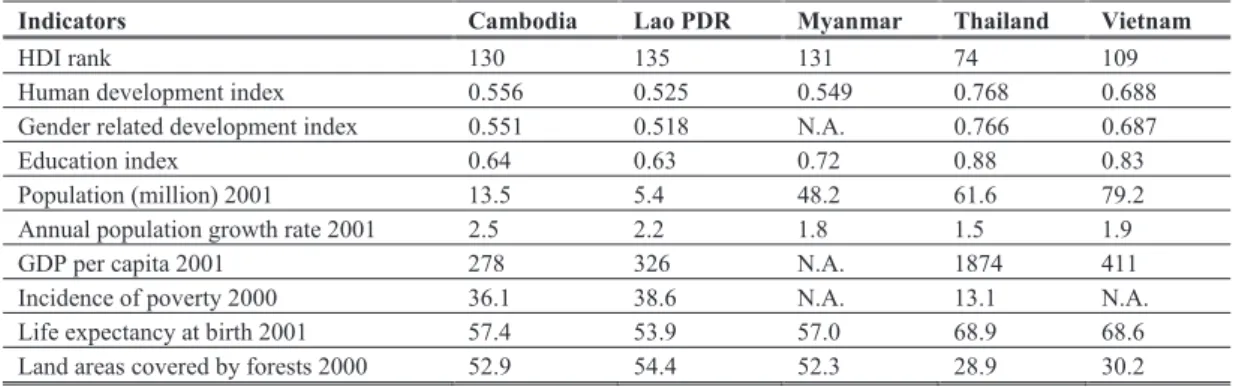
(11) Good Governance in Cambodia(Soksreng TE). (657). 65. Table 2 Key development indicators of Cambodia s neighbor countries Indicators. Cambodia. Lao PDR. Myanmar. Thailand. Vietnam. HDI rank Human development index Gender related development index Education index Population (million) 2001 Annual population growth rate 2001 GDP per capita 2001 Incidence of poverty 2000 Life expectancy at birth 2001 Land areas covered by forests 2000. 130 0.556 0.551 0.64 13.5 2.5 278 36.1 57.4 52.9. 135 0.525 0.518 0.63 5.4 2.2 326 38.6 53.9 54.4. 131 0.549 N.A. 0.72 48.2 1.8 N.A. N.A. 57.0 52.3. 74 0.768 0.766 0.88 61.6 1.5 1874 13.1 68.9 28.9. 109 0.688 0.687 0.83 79.2 1.9 411 N.A. 68.6 30.2. Source: Human Development Report, 2003, UNDP.. Poverty Situation in Cambodia According to the UNDP Report, Cambodia is ranked 130th out of 175 countries in the human development index, just below Lao PDR and Myanmar (Table 2). This has slightly improved over the period 1990 2000 moving from 0.501 to 0.543. It has a gender development index of 0.537, the lowest in Asia, and a human poverty index of 43.3 percent. Life expectancy in Cambodia is only 56.4 years. Adult literacy rate is 67.8 percent. Clearly, Cambodia’s socio-economic indicators are not good. Cambodia’s per capita GDP in the year 2001 was US$259. Among other factors prolonged civil conflicts, internal displacement and discriminatory development processes are the main causes of poverty in Cambodia. It is now widely recognized that poverty is a multidimensional problem and should be viewed in broader context that merely in terms of low levels of consumption and income. Lack of food, uncertainties about access to natural resources, powerlessness and hopelessness, social exclusion, lack of education, etc. are all dimensions of poverty. Poverty in Cambodia is widespread with some 36 percent of the Cambodian population living below the poverty line of US$0.46 0.63 at the exchange rate in 1999. Generally people move in and out of poverty, which makes definition of poverty lines and better knowledge about cyclical, seasonable and unexpected shock important. Current level of poverty largely results from high vulnerability. Poverty Line The Government of Cambodia defined the poverty line as a sum of minimum food and non-food expenditure. This minimum food expenditure is defined as the food poverty line . Minimum food expenditure is the total amount of the food basket covering daily minimum food energy requirements per capita──2,100 kcal. This minimum food energy requirement in Cambodia is within the range of the WHO/FAO definition of the daily minimal energy per capita in developing countries ── between 2,000 kcal and 2,400 kcal. Based on the daily minimum food energy requirement per capita ── 2,100 kcal, the Government of Cambodia defined the food basket and its component items and prices referring to the result of 93/94 Cambodia Socio-economic Survey (CSES). Since then, although the food component prices were adjusted, this food basket has been applied under 1997 CSES and 1999 CSES. As for minimum non-food expenditure, the 1993/94 CSES did not show unit values for non-food items, thus a regression approach was used to calculate the allowance for non-food items of households on the food poverty line. In 1997 and 1999, the non-food.
(12) 66 (658). 横浜国際社会科学研究 第 11 巻第 6 号(2007年 2 月). Table 3 Monetary Value of Poverty Lines Sector. Food Poverty Line Riel US$. Overall Poverty Line Riel US$. Phnom Penh Other Urban Rural. 1,737 1,583 1,379. 2,470 2,093 1,777. 0.45 0.41 0.35. 0.63 0.54 0.46. Source: A Poverty Profile of Cambodia 1999 (Ministry of Planning).. Table 4 Headcount Indices Region. Phnom Penh Other Urban Areas Rural Areas Cambodia. 1993/94 OPL 11.4 36.6 43.1 39.0. FPL 6.2 19.6 21.9 20.0. 1997 (Adjusted) OPL FPL 11.1 3.4 29.9 15.4 40.1 20.0 36.1 17.9. 1999 (Round 2) OPL FPL 9.7 3.3 25.2 13.7 40.1 12.1 35.9 11.5. 1999 (Both Rounds) OPL FPL 14.6 5.2 42.4 28.4 56.1 31.5 51.1 28.9. Source: A Poverty Profile of Cambodia 1999 and a Poverty Profile of Cambodia 1997 (MOP).. poverty line was calculated from the non-food consumption of individuals whose total consumption was within 10% above or below the value of the food poverty line. The recent poverty line per person per day based on the 1999 CSES are as follows (Table 3): 2,470 Riel (US$0.63) Phnom Penh, 2,093 Riel (US$0.54) in other urban areas (provincial capitals except Phnom Penh) and 1,777 Riel (US$0.46) in rural areas, respectively. Poverty Indicators In Cambodia, population under the poverty line is defined as the poor. The Head count index (Table 4) shows a declining trend between 39.0% in 1993/94 and 36.1% in 1997, while a significant decline was not found between 36.1% in 1997 and 35.9% in 1999. The poverty gap showed a steady decline trend between 9.2% in 1993/94 to 8.7% in 1997, and between 8.7% in 1997 and 6.5% in 1999. As for the squared poverty gap, while there was no significant decline between 1993/94 (3.1%) and 1997 (3.1%), a declining trend is found between 1997 (3.1%) and 1999 (2.0%). Although the interpretation of this trend is rather complicated, it is not too much to say that the overall poverty situation between 1993/94 and 1999 in Cambodia had been improved. As for regional disparities in terms of poverty indicators, disparities of the head count index between Phnom Penh and other urban areas were becoming narrower. The head count index in other urban areas was 2.6 times higher in 1999 than in Phnom Penh, while 3.2 times in 1993/94. However, disparities of the head count index between Phnom Penh and rural areas were widening. The head count index in rural areas was 4.1 times higher than in Phnom Penh in 1999, while 3.8 time in 1993/94. In 1999, 90% of the population under the poverty line was concentrated in rural areas. This, rural poverty is one the major concerns in the context of overall poverty reduction in Cambodia. Cause and Characteristics of Poverty in Cambodia In Cambodia, the long period of destructive conflict and instability is probably the main root contributor to the widespread poverty that currently exists. Indeed, those who were displaced, maimed, orphaned, or widowed by the.
(13) Good Governance in Cambodia(Soksreng TE). (659). 67. conflict face the greatest hardships. Damage to infrastructure (particularly irrigation systems), land mines, and other security threats contributed to low agricultural production. Execution of educated Cambodians during the Khmer Rouge era contributed to the low levels of human capital that hamper the effective delivery of social and government services. An additional factor has been the rapid population growth in the 1980s and 1990s and the resulting rise in the number of dependants per household. The Cambodian poor, as defined by low incomes and low consumption bundles, generally tend to have less access to productive resources. For example, poorer villages tend to be located where there is less access to natural resources or where there are lower quality natural resources (e.g., less productive land in areas more vulnerable to flood and drought). Moreover, the poorer villages have less access to markets, infrastructure, economic services, and political power. Richer villages tend to be closer to industrial or commercial enterprises such as brick and tile manufacturing in the northwestern part of the country. Finally, poorer villages tend to have no access to basic educational services or basic health services. As a result of inadequate access to resources and services, poorer villages tend to depend more on agriculture activities whereas richer villages are more diversified, with trading as the most important economic activity. About 90 percent of the poor belong to households that rely on agriculture as the primary source of income. These people often suffer from basic food insecurity, manifested as seasonal hunger in the months prior to the major harvest, sometimes leading to a cycle of indebtedness that ends in loss of farm assets such as land. The poor tend to have larger families living under one roof, with younger children and higher dependency ratios (ratios of nonworking to working household members). In part because of greater proximity to health and education services, richer villages have higher educational achievement and health care utilization rates. Poorer villages have higher rates of illiteracy and higher levels of gender disparity in literacy. Richer villages pay higher school fees and have a lower student/teacher ratio. Poverty in Cambodia is characterized by low income and consumption, poor nutritional status, low educational attainment, less access to public services including school and health services, less access to economic opportunities, vulnerability to external shocks, and exclusion from economic, social and political processes. The relatively high prevalence of HIV/AIDS in Cambodia is an additional challenge to the current human development situation. Chapter III Good Governance and Poverty Reduction The links between good governance and poverty reduction Making the linkage between good strategies for poverty reduction and improvements better governance is essential to the success of country’s target. The empirical research in a number of countries establishes that where there is weak governance this reinforces poverty25). Knack and Keefer establish a linkage in their research between measures of trust and civic cooperation and economic growth26). La Porta’s work establishes a relationship between trust and efficiency of the judiciary, corruption, bureaucratic quality, tax compliance and civic participation27); The Voices of the Poor study conducted in 60 countries in 2000 found that the common element that ties the poor together was lack of power and voice28). The impact of poor standards of governance in fact usually falls most heavily on the poor. Poor people are generally excluded from the institutions that put in place plans, policies and rules determinative of their rights and obligations; that make decisions that affect their lives; and which allocate and administer public resources to programs affecting them. Whether it is through inefficient service delivery; through unfavorable policy settings; through inappropriate allocations of public resources away from socially useful goods such as education; through corruption; or through the inability to enforce their legal rights──the poor are often the most adversely affected by poor governance. Unlike people on higher incomes, poor people often lack the power and the resources to respond effectively to weak.
(14) � � �. Figure 2 Linkages in Poverty Reduction. Civil and Social Order. Contract and Institutional Rules and Regulations. Good Governance. Effective Market. Pro-poor investment. growth and Poverty Intervention. � �Pro� � p�oor. � � �. � � � �. Poverty Reduction. � �. Strategic Pillars. Goal. I N T E R V E N T I O N S. Social Development. * Rural Finance. -Railways -Inland Waterways *Energy. *Infrastructure Investments *Public Private Partnerships *Private Sector Interventions. * Agribusiness Development * Agricultural Research. State Level Operations Across Sectors Extended to Poorer States. -Power -Gas. * Rural Infrastructure. -Roads. *Other Sector Reforms. * Water Mgt and Irrigation. DEVELOPMENT *Transport. DEVELOPMENT *Financial Sector Reforms. Figure 3 ADB s Poverty Reduction Strategy. *Public Resource Management. * Tax Administration. INFRASTRUCTURE. PRIVATE SECTOR. AGRICULTURE AND RURAL DEVELOPMENT. - Environment - Gender. FISCAL CONSOLIADTION. - Health / Education. * Urban Infrastructure * Cross Cutting Interventions. (Human Poverty Reduction). * Core Governance Interventions. � �. * State Level Reforms. * Fiscal Consolidation * Sector Reforms. Pro-Poor Growth (Income Poverty Reduction). Good Governance. (Leverage Development Impact). Poverty Reduction. ADB Operational Strategy. 68 (660). 横浜国際社会科学研究 第 11 巻第 6 号(2007年 2 月).
(15) Good Governance in Cambodia(Soksreng TE). (661). 69. governance29). Good governance for poverty reduction comprises, among other matters: focusing poverty reduction resources and creating accountability in the use of public funds in the interests of the poor, building national capacities for pro-poor policy formulation and implementation, improving administration and private sector participation for better services delivery to the poor, shifting decision making nearer to the poor and helping the poor to organize themselves, preventing corruption as it affects the poor most, strengthening the rule of law with clearly pro-poor enforcement procedures, and 30) involving, in a participatory way, a diversified range of stakeholders including NGOs representing the poor .. However, where some of these elements of good governance are not present and there are difficulties in governance such as through lack of information and weak enforcement of rules, this is likely to be because the institutional environment is weak. Thus, the most effective manner in which the government can play its role in facilitating greater socio-economic development and bringing prosperity is by seeking ways of enhancing an increase in productivity, efficiency and effectiveness. Good governance not only promotes a sound development management system but it is the critical foundation for long-term sustainable socio-economic development for the nation. The conceptual framework in Figure 2, developed by ADB, shows that poverty reduction rests on a foundation of civil and social order, good governance, and institutional rules, effective markets, and pro-poor growth and focused poverty intervention. Weaknesses toward the bottom of this framework, such as weak governance, hurtthe poor in two broad ways: first, they weaken the effectiveness of markets, and thus hold down economic growth. Cross national research has shown that growth in the overall economy is on average accompanied by the same growth in the income of the poor31). Without strong growth, there is little chance of reducing poverty; and second, weak governance hurts the poor through non-economic channels. Growth and human development does not automatically trickle down to benefit the poor. This needs to empower the poor, by targeting the structures that create poverty. The quality of governance at the central and local level is often the crucial link to make poverty reduction effective. Implementation of a range of strategies to reduce poverty, which includes the improvement of governance as an integral and critical part, is thus required to overcome the disadvantage suffered by the poor. The work of donor agencies also suggests that in pursuing the range of strategies that are needed to reduce poverty, one main pillar must be improvements in governance. By way of example, figure 3 describes the three strategic pillar approach taken by the ADB32). Applying the Four Pillars of Good Governance to Poverty Reduction If the four pillars of governance that was provided in chapter one is complied with, government is likely to be efficient in the use of resources and also more effective in the sense of better achieving desired program outcomes. Thus in applying these principles: Accountability, can be promoted through mechanisms for requiring that responses be made in respect of institutional conduct, and through appropriate incentives, good supervision, and high levels of citizen participation; Transparency, can be promoted by regular publication and dissemination of information, as well as through enhanced feedback loops among citizens, official, and policy makers; Participation, can be promoted through mechanism that enable citizens to be more involved in the conduct of government, particularly through the implementation of appropriate decentralization policies; and.
(16) 横浜国際社会科学研究 第 11 巻第 6 号(2007年 2 月). 70 (662). Predictability, can be promoted through consistent application of rules and policies. Applying these pillars impinges very directly on the issue of what are the outcomes that are being achieved in empowerment of the poor in the sense of increasing their ability to contribute to the Government; to avail themselves of government services; to take advantage of economic and social opportunities that are available to them; and to do so in an environment in which their security is protected and their rights can be enforced. Chapter IV Governance Reforms for Supporting Poverty Reduction Cambodia’s Vision of Good Governance In the context of good governance, the Cambodian Government’s vision is to have a socially cohesive, educationally advances, and culturally vibrant Cambodia without poverty, illiteracy and ill health whereby all Cambodian citizens live in harmony with a decent living free from hunger, inequity and disparity, exclusion, and vulnerability. Poverty reduction effort has developed out of the Government’s experience since the three decades of conflict ended its formation and the Government has sought to reduce poverty alongside other development goals like peace and stability. Governance is good when it is effective, efficient and when the participation, interests, and livelihood of the governed are the prime motives of the leaders’ actions at every level of society. Good governance is not only a matter of government, but also a situation of multiple crisscrossing relationships in which different and various actors in the public and private sectors at national and international levels play various roles, sometimes mutually reinforcing and complementary, sometimes conflicting, but always following the same principles and practices that are agreed as constituents of good governance. Current Development of Governance Reforms in Cambodia Legal and Judicial Reform Some progress has been made to reform the country’s legal and judicial sector. Yet, the Government is determined to accelerate the pace now that key foundations are in place. The strategy for legal and judicial reform has been approved by the Government in June 2003. Important laws were enacted to complement the legal framework, from laws relating to human rights to law on investment, trade and commerce and laws in support for natural resources management. Starting from January 2003, the government increases remuneration of judges and prosecutors. The Civil Code and Procedures and the Penal Code and Procedures are being readied for submission to the National Assembly and Senate. Judicial reform has been identified by the Investment Climate Survey as critical for providing enabling environment for private sector development and poverty reduction. Improved access to justice and judicial service for the poor constitutes a remedy to address injustice and reverse their poverty situation. The complexity of the problems is also caused by the three decades of wars, with the warrior’s mentality of some segments of the population, rapid transformation of the society leading to the change in values and virtues, and more importantly the change in legal system from a mixed French and Cambodian laws into the Anglo-Saxon laws. There are only a small number of Cambodian legal expert who are working in the sector. Thus this requires substantial technical and financial assistance from the international community and the efforts of the Cambodian government. With low budget for the court, one cannot expect too much in terms of improve efficiency. Moreover, law enforcement is still a challenge. It is difficult to enforce laws predictability and transparent when the salary of the enforcement officers is much lower than a minimum subsistence level. Administrative Reform The National Program for Administration Reform (NPAR) was adopted in 1999; the program is designed to turn the Administration and the Civil Service into forceful partners in the implementation of the Government agenda. The NPAR is a multi-year program to adapt the Administration to the needs and means of the.
(17) Good Governance in Cambodia(Soksreng TE). (663). 71. Nation. It defined overarching goals for public administration reform. These goals were to: (1) make public institutions more efficient, (2) transfer responsibilities to local governments, (3) improve management of the civil service, and (4) select civil servants to carry out reforms quickly. The program is articulated in three phases: setting the foundations to sustain the course, reorganization and redeployment, strengthening capacity and developing human resources. Phase 1 of the program is for all practical purpose completed. It was designed to achieve five major results: to document and control the composition and distribution of the Civil Service workforce, to develop essential instruments to manage and motivate personnel, to assess needs of ministries relating to corporate services (back office), to complete preparatory work to move the Administration closer to citizens, and strengthen the capacity to plan and manage the reform. The remuneration and classification regimes have been overhauled. Targeted allowances more conducive to performance were introduced to address urgent needs in education, health and senior management. Further initiatives, such as the Priority Mission Group program, have been readied for implementation. The council for Administration Reform has undertaken sets of studies to investigate ways and means to accelerate pay and employment reforms to improve access to administrative public services (e. g. one stop windows). The review of Capacity Building Strategy for the Civil Service is underway and the strategy expects to be articulated and approved in the following years. Anti-Corruption The Government of Cambodia’s anti-corruption efforts are sweeping, yet expectations are frustrated. Many initiatives in the Governance Action Plan directly address root causes of corruption. Significant advances were made in the management of government revenues and expenditures and in the management of natural resources. A Draft Anti-corruption law was submitted to the National Assembly for adoption. Cambodia joined the Anticorruption Action Plan for Asia and the Pacific. Recognizing that rigorous control on revenue collection and expenditure management is essential for fighting corruption, the government has strengthened the check and balance mechanism such as the National Audit Authority (NAA) and inspection functions of the line ministries. The NAA will work with the Internal Audit Unit of the line ministries to have the Damocles sword hung over the decision makers and improve the monitoring of performance of government ministries and agencies. At the same time the government has expanded the scope of implementation of the Public Procurement Sub-decree to all ministries in order to improve governance. In this regard, adopting a new law would not mean too much if there is no change in the enforcement of rules and regulations. To combat widespread corruption that may undermine Cambodia’s further economic and social development, the Cambodian government has committed to the following goals: (1) increasing the risks associated with engaging in corrupt activities in the public sector and (2) making public officials more accountable for their behavior. In its Governance Action Plan, the Cambodian government described two broad themes for fighting corruption: setting standards and strengthening enforcement and scrutiny. Given the widespread nature of corruption in Cambodia, many actions to fight corruption are also part of other more general reforms, such as those involving public finance, the legal framework and the judiciary, and public administration. Decentralization and Local Governance Reform The Government started decentralization reform since 1996, with piloting of the Seila33) Program, based on the bottom-up, integrated, participatory, decentralized rural development. This will allow active community participation in grassroots institutions and increase to ownership of development projects, by shifting decision-making and accountability closer to individuals, households and communities. This process enabled a greater percentage of available development resources to be programmed or leveraged to support locally identified priorities. However, only in 2002 that political decentralization took place in the form of elected commune councils with discretionary and delegated powers. In 2003, a number of regulations were adopted and a series of training were conducted to build up capacity of the commune and Sangkat councils to ensure effective decentralized governance. In this regard, the government has made significant progress in creating a legal framework for decentralization at the.
(18) 72 (664). 横浜国際社会科学研究 第 11 巻第 6 号(2007年 2 月). commune level. At present, there are only few resources controlled by the commune councils leading to an extremely low level of implementation of services and investment because the communes depend mostly on the block grant transfer from the central government. The delayed disbursement of the Government in 2003 has undermined the delivery of development projects at the grassroots level in 2003. However, it would be misleading to judge the progress of commune decentralization from the fiscal performance in 2003. The main problem rested with the revenue shortfalls and cash shortages, caused by the impacts of the Anti-Thai Riots, the outbreak of SARS (Severe Acute Respiratory Syndrome) and the political uncertainty in the lead up and in the aftermath of the general elections. Thus the challenge is to ensure predictable and timely release of funds, partly through the development of commune own resources. The key activities in 2004 included the following: ensure full transfer of the block grant to the commune budget review the existing rules and regulations of the commune financial system, explore appropriate formula for developing own source revenue, local contribution and tax sharing for the commune budget build up institutional capacity of the commune councils. The Government is conscious that there are certain limits developing commune own source revenue or tax sharing arrangements, as not all the communes are endowed with taxable resources. Moreover, the current size of the communes is not optimal for management. The government is also moving ahead in implementing de-concentration reforms by preparing an Organic Law to define the role of the province and district. The challenge is to ensure the delegation of increased responsibility from the line ministries to the province and their provincial departments. Considerable progress has already been made through individual initiative by the line Ministries including the Priority Action Plan (PAP) Ministries, Education, Health, Agriculture and Rural Development as well as Ministry of Urban Planning, Land Management and Construction to better define a framework under which de-concentration of services can more coherently develop. Considerable Strategies for Reducing Poverty Although the incidence of poverty is high at 36 percent, on average the poor are living close to the poverty line, there is considerable potential for poverty reduction through broad based growth that includes those sectors where the poor derive a livelihood. There is also significant potential for reducing the risk of falling into poverty through disaster prevention and improving national preparedness and responses to natural disasters. Accelerating growth in the rural economy would result in the biggest reduction in poverty because its incidence is highest there and inequalities are lowest, an important consideration given that economic growth will benefit some more than others. In addition to creating the macro conditions for faster growth, further inroads into poverty will require supplementary government interventions aimed more directly at the causes of poverty. Given limited resources and weak implementation capacity, the Government efforts should focus on implementing those measures that have the dual benefits of both promoting growth and reducing poverty. This includes initiatives to: (a) enhance state effectiveness, (b) develop physical infrastructure emphasizing rural areas, (c) increase investment in human resources, particularly in women and children with also a rural focus. Notwithstanding that such interventions will have more benefits on larger groups of the poor than hitherto; some of the poor in rural and urban areas (e.g. disabled, aged, children and many single women) may still be excluded from the development process, requiring that such groups of the poor receive special attention. In addition, the development process must deal with the unexpected, notably the harm done to the fragile welfare of the poor and the health of the economy as a result of natural disasters. The results of the PPA confirm the relevance of such strategic interventions that have the overall aim of promoting.
(19) Good Governance in Cambodia(Soksreng TE). (665). 73. opportunities, reducing vulnerabilities, strengthening capabilities and generating empowerment of the poor. The temptation to view poverty reduction as solely a Government responsibility needs to be revised in light of the ongoing and desired expanding role of the private sector. With accelerated economic liberalization and structural reform it is imperative to begin defining a role for the private sector in poverty reduction. Nevertheless, there is much that the Government can do, not least improving governance, which would facilitate private sector development, but it is important to be realistic about what can be achieved and how rapidly. In the past, the Government has revealed limited capacity to deliver education, health, nutrition and other services of a sufficient quality and in appropriate forms to benefit the poor. In the medium-term, the extension of services to underserved rural populations must be undertaken in a sequence determined by relative cost effectiveness and fiscal affordability. In the long-term, the Government anticipates that its efforts to generate a higher economic growth path will raise the tax capacity of the economy and allow public provision of basic services to the whole population. However, growth and the strengthening of revenue raising capacity will not be sufficient unless and until key governance reforms are put in place. Conclusion This study begins with the discussion on the term Governance’ and its concepts provided by various international organizations, agencies, research institutions and scholars. Then it briefly provides governance’s historical background of Cambodia to show the different types of governance models in six different regimes together with the current governance structure of the public sector to show where Cambodian people can exercise their power through. Moreover, it tries to examine some areas of governance weaknesses that the Government is facing; and stresses how those weaknesses may impact on the poor. Additionally it focuses on exploring the link between good governance and poverty reduction; and tries to match the four pillars of good governance to the poverty reduction. Last but not least, it presents Cambodia’s vision of good governance and its development objectives; and examines the current development of governance reforms, and addresses some potential strategies that the Government should implement to alleviate the poverty problem. The failures of accountability and transparency and the slow progress towards the rule of law represents a serious failure of governance for which Cambodia’s poor pay a heavy price. The poor suffer the most from physical insecurity and lack of access to justice. Poor governance weakens the ability of the state to deliver basic public goods, for example essential services that are crucial to the investments needed in the human capital of the poor. The poor are particularly helpless in the face of corruption. They depend disproportionately on public goods and are often unaware of what they are required to pay for public services, allowing the corrupt to trade on their ignorance. Such poor governance has lead to a slight declination of poverty in Cambodia over the last decade. This trend is encouraging, and a number of challenges will need to be addressed in the years to come. Economically, there is a need to ensure that the growth process is increasingly pro-poor, generating benefits for those in most need. Politically, all necessary reforms must be pursued, along with the decentralization process. On the social front, measures of effective social protection need to be strengthened and human capacities reinforced. More generally, institutional changes must be pursued to strengthen the role of civil society and the private sector in the development process and good governance effectively mainstreamed in public life. It is clear that poverty and hunger eradication require a better management, sound strategies and multifaceted response incorporating economic, social as well as political issues. The Government of Cambodia well recognizes the importance of good governance in reducing poverty that implementing reform of governance must be one of the key strategies to promote economic growth and to create resources for poverty alleviation, and this requires extensive reforms with a sustained emphasis on strengthening accountability through public administration reform, promoting inclusiveness through participatory planning processes,.
図



関連したドキュメント
Answering a question of de la Harpe and Bridson in the Kourovka Notebook, we build the explicit embeddings of the additive group of rational numbers Q in a finitely generated group
Maria Cecilia Zanardi, São Paulo State University (UNESP), Guaratinguetá, 12516-410 São Paulo,
Then it follows immediately from a suitable version of “Hensel’s Lemma” [cf., e.g., the argument of [4], Lemma 2.1] that S may be obtained, as the notation suggests, as the m A
In our previous paper [Ban1], we explicitly calculated the p-adic polylogarithm sheaf on the projective line minus three points, and calculated its specializa- tions to the d-th
Applications of msets in Logic Programming languages is found to over- come “computational inefficiency” inherent in otherwise situation, especially in solving a sweep of
Our method of proof can also be used to recover the rational homotopy of L K(2) S 0 as well as the chromatic splitting conjecture at primes p > 3 [16]; we only need to use the
This paper presents an investigation into the mechanics of this specific problem and develops an analytical approach that accounts for the effects of geometrical and material data on
While conducting an experiment regarding fetal move- ments as a result of Pulsed Wave Doppler (PWD) ultrasound, [8] we encountered the severe artifacts in the acquired image2.
