離散方程式の予測への応用
(Application ofdiscrete equationsto forecasting)NTTサービスインテグレーション基盤研究所 佐藤大輔 (Daisuke SATOH)
NTT
Service
Integration Laboratories
1
Introduction
From the end of the 1990’s, discrete integrable
equations have been appearing in many fields, e.g., algorithms and traffic flow [17, 18, 19, 20, 34]. Discrete integrable systems
are
expectedto be applied to engineering.
Forecastingis important in engineering. The
making of decisions in various industries is
heavily reliant on forecasting. Forecasting is
the dominant factor in decisions
on
how manyfinished products should be made, how much
stock should be prepared and
so on.
In thepast there has been
a
tendency for forecasts tobe unduly optimistic. This has produced
some
serious problems. Therefore, the accuracy of
forecasting is ofgreat importance.
Growth
curve
modelsare
used forforecast-ing in many fields, e.g., ecology [3, 25, 35],
agriculture [26], life sciences [13], marketing
[1, 12], and software reliability growth models
(SRGMs) [14, 22, 36]. To forecast the ceiling,
weestimate parameters of the differential
equa-tion which provides the growth
curve
model.The differential equations which
are
usedgen-erallyhave exact solutions. Intheconventional
method, the differential equation’s parameters
are
estimated by usingan
ordinary forwardor
central difference equation
as
itsapproxima-tion. Generally, the ordinaryforward
or
centraldifference equation does not have an exact
so-lution. Therefore, the difference equation does not
conserve
the properties of the differentialequation.
Although
a
growthcurve
model haspracti-cal applications,
one
generally known point isthat the model does not provide accurate
pa-rameterestimatesusingthe dataavailable
dur-ing the early phases ofthe process being
fore-cast. The conventional method is only capable
ofproviding
accurate
estimates of parametersat the end of the phase. For forecasting to be
ofpractical value, accurate estimates must be
obtained early in the phase.
In this paper, the application of discrete
in-tegrable equations to forecasting is discussed.
We focus
on
discrete integrable analogues ofthe logistic equation, the Gompertz equation,
and the Riccati equation forforecasting in two
fields: marketing andSRGM.Theremainder of
thispaperis organized
as
follows. FromSect. 2to Sect. 4 and in
Sect.
6,we
consider the fore-casting of numbers of software faultsor
soft-ware
failures throughan
SRGM.In Sect. 2,
we
describe discrete analogues ofthe logistic
curve
model [30], which has beenobserved in the testing of software systems
[23, 27]. The model is described by either of
two difference equations, which
were
proposedbyMorishita [15] and Hirota [5,6], respectively.
We will
see
that both models yield accuratepa-rameter estimates,
even
when there is onlya
small amount of input data from actual
soft-ware
testing.Although the logistic
curve
model isone
ofthe S-shaped SRGMs, S-shaped software
relia-bility growth for actual projects is often
more
closely described by the Gompertz
curve
thanby the logistic
curve
[2, 8, 21]. In Sect. 3,we
consider the Gompertzcurve as an
SRGM.Firstly,
we
propose adiscrete Gompertzequa-tion [28] that has
an
exact solution. We willsee
that the proposedmodelprovidesaccurate
esti-mates of parameters, enabling prediction early
in the testing phase of when the software will
be fit for release.
There is
a
furtherproblemforsoftwareengi-数理解析研究所講究録 1302 巻 2003 年 116-136
neers
and managers: they have had littleguid-ance astowhich models
are
likely to be best fora
particular application. InSect. 4,we
proposea
criterion [31], together witha
discrete SRGM,for determining the absolute worth of
a
model.In Sect. 5, we consider the Bass model,
which is the main impetus underlying behind
the recent diffusionresearch in marketing. The
author has previously proposed adiscrete form
of the Bass model [29]. This model provides
more
accurate estimates of parameters thanis possible with the conventional Bass model.
Furthermore, parameter estimation of the
dis-crete Bass model
overcomes
the threeshort-comings of parameter estimation by the
con-ventional (continuous) Bass model: the
time-interml bias, standard error, and
multicolin-earity.
The proposed models yield accurate
aeti-mates ofparameters,
even
fromsmall amountsofinput data. These models, however,
are
deterministic equations,
so
they do not yield dis-tributions oftheestimates. In Sect. 6,we
Pro-pose
a
discrete stochastic logistic equation thathave
an
exact solution and describean
SRGMthat is based
on
this equation. This modelyields distributions of
an
estimate along withthe aetimatae themselves.
Finally, in Sect. 7,
we
summarizethe raeultsof this paper.
2
Logistic
curve
model
2.1
Conventional
logisticcurve
model
The logistic
curve
model is describedas
$\frac{dL(t)}{dt}=\frac{\alpha}{k}L(t)(k-L(t))$
,
(1)where $L(t)$ is the cumulative number of
soft-ware
failures occurred upto testing time $t$ and$\alpha$ and $k$
are
constant parameters to beesti-mated through regression analysis.
A solution ofEq. (1) is given by
$L(t)= \frac{k}{1+m\exp(-\alpha t)}$, (2)
where $k>0,$ $m>0,$and$\alpha>0.$ The parameter
$k$ represents the total number of potential
soft-ware
failures occurringover an
infinitely longduration
or
the initial number of faultsinher-$\mathrm{e}\mathrm{n}\mathrm{t}$ in the software system.
2.1.1 Conventional parameter
estima-tion 1
Regression analysis is generally used to
esti-mate total numbers of potential software fail-ures, although there is
a
further conventional method of estimation, which is described inSect. 2.1.2.
We take the following regression equation:
$\mathrm{Y}_{n}=A+BL_{n}$, (3)
where
$t_{n}$ $=$ $n\delta$, (4)
$L_{n}$ $=$ $L(n\delta),$ and (5)
$\mathrm{Y}_{n}$ $=$ $\frac{\frac{L_{n\dagger 1}-L_{n-1}}{2\delta}}{L_{n}}$
.
(6)Here, $\delta$ is
a
constant difference interval.Givenregressioncoefficients$\hat{A}$
and $\hat{B},$ where
$\hat{A}$
means
the vaJue of $A$as
aetimated throughregressionanalysis, aetimates of the parameters
$k,$$\alpha,$ and$m$
can
be obtainedas
$\hat{k}$ $=$ $\frac{\hat{A}}{\hat{B}’}$ (7) $\hat{\alpha}$ $=$ $\hat{A}$, and (8) $\hat{m}$ $=$ $\frac{\sum_{n=1}^{N}(\hat{k}-L_{n})}{\sum_{n=1}^{N}(L_{n}\exp(-\hat{\alpha}t_{n}))}$.
(9) These estimataedependon
thedifferenceinter-$\mathrm{v}\mathrm{a}\mathrm{l}\delta,$ because Eq. (6) depends
on
$\delta$.
The accuracy of estimatae thus derived is
said to be poorwhen thereareonly afew data
points. For accuracy,
we
require data pointsup to at least
one
point after the point ofin-flection $(t_{n}= \underline{1}_{\mathrm{L}}\mathrm{o}m_{-,L_{n}}\alpha=\frac{k}{2}).$ We
can
judgewhether the obtained data includae the point
ofinflection by checking whether
or
not $\frac{\overline{k}}{2}<L_{n}$is satisfied, where $\overline{k}$
is predicted empiricauy
or
statistically.
For the estimatae of parameters to be
reli-able, the following condition must be
satisfied:
$w\overline{k}<L_{n}$, (10)
where $\overline{k}$
is predicted empirically
or
statistically2.2
Discrete
logisticcurve
models
and $w$ is
a
constant parameter, the value ofTwo discrete analoguesofthedifferential
equa-which is empirically chosen from the range 0.6
tion (1) for the logistic
curve
model haveal-to 0.8 [14].
ready been proposed. We propose a regression
equation that is appropriate for the estimation
2.1.2 Conventional parameter estima- ofparameter for use with these equations.
tion 2
Another conventional method of estimation is
based
on a
modified exponentialcurve
model[24]. This model is described
as
$y=cf$ ba. (11)
We rewrite the logistic
curve
modelas
$\frac{1}{L(t)}=\frac{1}{k}+\frac{m}{k}\exp(-\alpha t)$
.
(12)This equation is in the form of the modified
exponential
curve
model.When it is possible to place
a
model inthis form, parameters $a,b,$ and$c$
are estimated
throughthefollowingmethodof estimation. At
first,
we
divide thedata set into three subsets,each of which has the
same
number of datapoints. If the number of data points is not $\mathrm{a}$
multiple of three,
we
discard the firstone or
two points. Then
we
sum
up the data in eachsubset. Finally, parameters $a,$$b,$ and $c$
are
ob-tained as,
$a$ $=$ $( \frac{S_{3}-S_{2}}{S_{2}-S_{1}})$ , (13) $b$ $=$ $(S_{2}-S_{1}) \frac{a-1}{(a^{n}-1)^{2}}$, (14)
$c$ $=$ $\frac{1}{n}\{S_{1}+(S_{1}-S_{2})\frac{1}{a^{n}-1}\},$ (15)
where$S_{1},$ $S_{2},$ and $S_{3}$ represent thesummations
of all elements of the first, second, and third
subsets of the data, respectively, and $n$
repre-sents the numberofdata points in each of the
subsets.
We then obtain estimates ofthe parameters
$k,$$\alpha,m$ byusing these estimators:
$k$ $=$ $\frac{1}{c’}$ (16)
$\alpha$ $=$ $-\log a,$ and (17) $m$ $=$ $\frac{b}{c}$
.
(18)2.2.1 Discrete logistic
curve
model withMorishita’s equation
Morishita [15] proposed the followingequation
as a
discrete form ofEq. (1):$L_{n+1}-L_{n}= \delta\frac{\alpha}{k}L_{n\dagger 1}(k-L_{n})$
.
(19)It has
an
exact solution:$L_{n}= \frac{k}{1+m(1-\delta\alpha)^{t}\star}$, (20)
where $t_{n}=n\delta$
.
Let $\alpha_{\mathrm{c}}=\alpha$ in Eq. (2), and let $\alpha_{dm}=\alpha$ in
Eq. (20). Comparing$\mathrm{E}\mathrm{q}\mathrm{s}$
.
(2) and (20),we
get$\alpha_{\mathrm{c}}=-\frac{1}{\delta}\log(1-\delta\alpha_{dm})$
.
(21)Toderive theregression equation for the
pa-rameters $k,\alpha_{dm},$ and $m,$
we
rewrite Eq. (19)as
$\mathrm{Y}_{n}=A+BL_{n+1}$, (22) where $\mathrm{Y}_{n}$ $=$ $\frac{L_{n+1}}{L_{n}}$, (23) $A$ $=$ $\frac{1}{1-\delta\alpha_{dm}’}$ (24) $B$ $=$ $- \frac{\delta\alpha_{dm}}{k(1-\delta\alpha_{dm})},$ and (25) $t_{n}$ $=$ $n\delta$.
(26)Parameters $k,$ $\alpha,$ and $m$
are
estimated by$\hat{k}$
$=$ $\frac{1-\hat{A}}{\hat{B}}$, (27) $\delta\hat{\alpha}_{dm}$ $=$ $1- \frac{1}{\hat{A}}$, (28)
$\hat{m}$ $=$ $\frac{\sum_{n=1}^{N}(\hat{k}-L_{n})}{\sum_{n=1}^{N}(L_{n}(1-\delta\hat{\alpha}_{dm})^{n})}$, (29) where$\hat{A}$and$\hat{B}$
are
the aetimates ofparameters
$A$ and $B,$ respectively.
$\mathrm{Y}_{n}$ in Eq. (22) is independent of the
differ-ence interval $\delta,$ because $\delta$ is not used in this
equation. The estimates of$\hat{k},$ $\delta\hat{\alpha}_{dm},$ and $\hat{m}$
are
the
same
whatever value of$\delta$ we choose.2.2.2 Discrete logistic curve model with
Hirota’s equation
Hirota $[5, 6]$ discretized Eq. (1)
as
$L_{n+1}-L_{n}= \delta\frac{\alpha}{k}L_{n}(k-L_{n+1})$
.
(30)He gave this exact solution:
$L_{n}= \frac{k}{1+m(\frac{1}{1+\delta\alpha})\# t}$, (31)
where $t_{n}=n\delta$
.
Let $\alpha_{dh}=\alpha$ in Eq. (31). Comparing Eqs.
(2) and (31),
we
get$\alpha_{\mathrm{e}}=\frac{1}{\delta}\log(1+\delta\alpha_{dh})$
.
(32)To derive the regression equation for
param-eters $k,$$\alpha,$ and $m,$
we
rewrite Eq. (30)as
$\mathrm{Y}_{n}=A+BL_{n+1}$, (33) where $\mathrm{Y}_{n}$ $=$ $\frac{L_{n+1}}{L_{n}}$, (34) $A$ $=$ $\delta\alpha_{dh}+1$, (35) $B$ $=$ $- \frac{\delta\alpha_{dh}}{k},$ and (36) $t_{n}$ $=$ $n\delta$
.
(37) The estimates of parameters $k,$ $\alpha,$ and $m$are
given
as
by $1-\hat{A}$ $\hat{k}$ $=$ $\overline{\hat{B}}$, (38) $\delta\hat{\alpha}_{dh}$ $=$ $\hat{A}-1$, (39) $\hat{m}$ $=$ $\frac{\sum_{n=1}^{N}(\hat{k}-L_{n})}{\sum_{n=1}^{N}(L_{n}(\frac{1}{1+\delta\alpha_{\hat{d}h}})^{n})}$, (40)where$\hat{A}$and $\hat{B}$
are
the aetimatesofparameters
$A$ and $B,$ respectively.
$\mathrm{Y}_{n}$ in Eq. (33) is independent of the
differ-ence
interval $\delta$ because $\delta$ is not used in Eq.(33). The
same
estimates of $\hat{k},$ $\delta\hat{\alpha}_{dh},$ and $\hat{m}$are obtained, whatever value of$\delta$ we choose.
The regression equation (33) is the
same as
Eq. (22). Moreover, the
same
estimate of k isgiven by both equations. Though the estimate
of $\alpha$ depends on discrete equations, both
dis-crete equations yield the
same
estimate of $\alpha_{c}$.
The
same
estimate ofm is obtained because$1- \delta\alpha_{dm}=\frac{1}{1+\delta\alpha_{dh}}=\exp(\alpha_{c})=\frac{1}{\hat{A}}$
.
(41)Therefore, the models with Morishita’s and
Hi-rota’s equations both give the
same
vaJue$\mathrm{o}\mathrm{f}L_{n}$.
2.3
Parameter
estimation in
the
$1\mathrm{r}$gistic
curve
models
We compared the accuracy of parameter
esti-mation for the first conventional logistic
curve
model and the discrete logistic
curve
modek.To compare only the accuracy of parameter
estimation,
we
evaJuated the performance ofthe parameter estimates when the data
repre-sented an exact solution of the logistic
equa-tion. We did not consider the second
conven-tional method of parameter estimation,
as
$\mathrm{d}\triangleright$scribed inSect. 2.1.2, because it inherently $\mathrm{r}\mathrm{e}$
produced the target values ofthe parameters
when given data that
were
an
exactsolutionofthe logistic equation.
We prepared data that represented exact
so-lutions ofthe logistic equation for
a
set ofpe-riods ($t=0$ to 21). We set $k=100,$ $\alpha=0.8$,
and $m=999$
as
the target values. This datawas
inflected at the point where $t^{*}=8.63$ and$L(t^{*})=50.$ In
our
eduation,we
setthediffer-ence
intervalto 1. Weanalyzedfour sets ofthisdata: the three data sets that covered
an
datauP to (i) the ceiling $(t=0,1, \ldots,21),$ $(\mathrm{i}\mathrm{i})$ just
after the point of inflection $(t=0,1, \ldots,9)$,
(iii) just before the point of inflection $(t=$
$0,1,$$\ldots,$$8),$ and (iv) the set of the first three
data points(t $=0,1,2$).
The results of
our
comparisonare
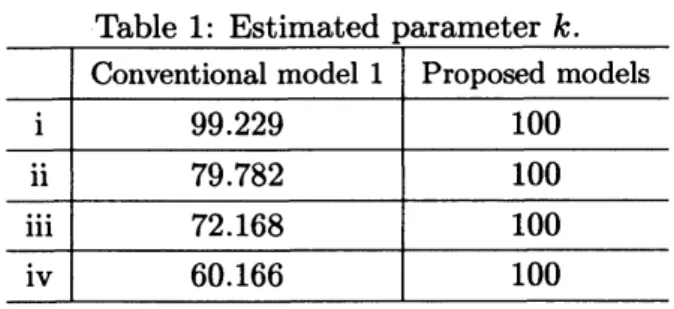
shown inTable 1. Since
we
usedan
exact solutionas
the input data,
an
accurate method ofaetima-tion shouldreproduce the parametersthat gen-erated this solution. Table1shows that the
proposed modek estimated $k$ correctly,
even
when the data set only consisted of the first
Table 1: Estimated parameter k.
Conventional model 1 Proposed models
$\mathrm{i}$ 99.229 100 $\mathrm{i}\mathrm{i}$ 79.782 100 $\mathrm{i}\mathrm{i}\mathrm{i}$ 72.168 100 $\mathrm{i}\mathrm{v}$ 60.166 100
four points. Theconventional model had lower
accuracy, despite the
use
of exact solutions to the differential equationas
data values. Aswas
earlierstated, theconventional model is
gener-ally known to providepoorestimates of the
pa-rameters in the situation represented by data
sets (iii) and (iv), $\mathrm{i}.\mathrm{e}.,$ when the data set does
not include the data points around the point of inflection. Empirical studies have shown that
stable and robust estimates of the parameters
of SRGMs, such
as
the logisticcurve
model,cannot be obtained without using data points
that
cover
thepointof inflection and satisfyEq.(10), $\mathrm{i}.\mathrm{e}.,$$w\overline{k}<L_{n}.$ Even when dataset (ii)
was
used, the conventional method provided
esti-mates the parameter values that
were
neitherstable nor robust,
even
though set (ii) bothin-cludes the point of inflection and satisfies Eq.
(10).
We evaluated the discrete logistic
curve
$\mathrm{m}\mathrm{o}\mathrm{d}-$els
on an
actual data set to show that theyare more
appropriate touse
than theconven-tional model. The data
were
debugging datafor
an
item ofsoftware. We evaluated the pa-rameter aetimatesgiven both with alldata andwith only that data available early in the
test-$\mathrm{i}\mathrm{n}\mathrm{g}$phase. In
our
evaluation,we
set$\delta$ equalto
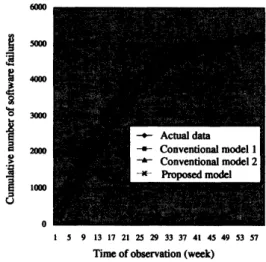
1. Figure1 showsresults for the ‘all data’ case;
we see
that having all of the data leads to allthree models fitting the actual data very well.
Moreover, the discrete logistic
curve
modelshave the important advantage of providing
ac-curate parameter estimates early in the testing
phase
as
wellas
atthe endofthe testing phase.Therefore, the accuracy of
an
SRGM’$\mathrm{s}$param-eter estimates early in the testing phase is
an
important aspect ofits utility
as an
estimator.The
accuracy
of parameter $k$ is especiallyim-portant, because this parameter indicates the
15 $\alpha$ $\infty$ $u$ 43 $\infty$ 57 $u$ 71 $7l$ $u$ $n$ $\mathfrak{B}$
Time of observ#on
Figure 1: Comparison the three models with
actual data.
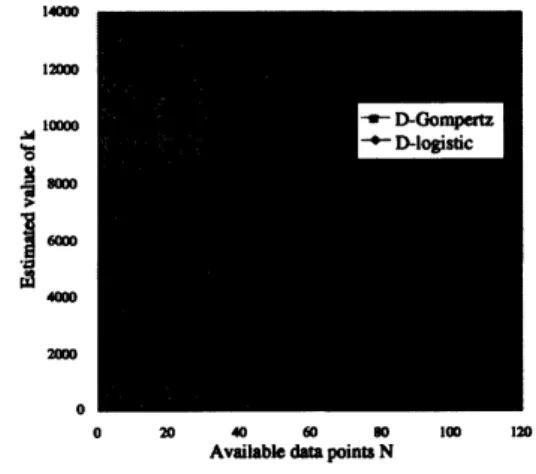
Figure 2: Parameter estimates of$k$
.
potentialfault content of the software system.
To compare the conventional and proposed
modelsin terms ofthis property,
we
estimatedvalues of $k$ from increasing number of data
points, starting with asmall amount of data
ffom the earlier part of the testing phase. As
is shown in Fig. 2, the values of$k$estimated by
the proposed modelswerestabler than those
es-timated by the conventional models. Since the
proposed models provide
more
accurateesti-mates of parameter values ffom small amounts
ofdatagatheredearly inthe testing phase, they
providebetter estimatesof totalnumbersof$\mathrm{p}\mathrm{c}\succ$
tential software failures, $k,$ early in the testing
phase.
3
Gompertz
curve
model
3.1
Conventional
Gompertz
curve
model
The Gompertz
curve
model is describedas
$\frac{dG(t)}{dt}=G(t)(\log a)(\log b)b^{t}$ (42)
or
$\frac{dG(t)}{dt}=(\log b)G(t)\log\frac{G(t)}{k}$, (43)
where $G(t)$ is the cumulative number of
soft-ware
failures detected up to atesting time $t$.
By integrating either equation and assuming
that $G(0)=ka,$ $G(t)$ can be written as
$G(t)=ka^{b^{t}}$
$(k>0,0<a<1,0<b<1)$
,(44)
where $a,$ $b,$ and $k$
are
parameters whosecon-stant valuae
are
estimated by using regressionanalysis. Parameter $k$ repraeents the total
number of software failures with the potential
to
occur over an
infinitely long periodor
theinitial fault content in the softwaresystem:
$G(t)arrow k(tarrow\infty)$
.
(45)3.1.1 Conventional parameter estima-tion 1
Regression analysis is generally used to
esti-mate total numbers ofpotential software fail-ures, although
we
also have the conventionalmethod of estimation that is shown in
Sect.
3.1.2.
The following regression equation is
ob-tained:
$\mathrm{Y}_{n}=A+Bn$, (46)
where
$\mathrm{Y}_{n}$ $=$ $\log(\frac{G_{n+1}-G_{n-1}}{2\delta G_{n}})$ , (47) $A$ $=$ $\log((\log a)(\log b)),$ and (48)
$B$ $=$ Jlog$b$
.
(49)Givenregraesioncoefficients$\hat{A}$
and$\hat{B}$
, where$\hat{A}$
means
the parameter $A$as
estimated throughregression analysis,
we
have these estimatorsfor parameters $a,$ $b,$ and $k$:
\^a $=$ $\exp(\frac{\delta\exp\hat{A}}{\hat{B}})$ , (50)
$\hat{b}$
$=$ $\exp(\frac{\hat{B}}{\delta}),$ and (51)
$\hat{k}$
$=$ $\frac{\sum_{n=1}^{N}G_{n}}{\sum_{n=1}^{N}\hat{a}^{\hat{b}^{\delta n}}}$
.
(52)These estimates depend
on
thedifferencein-terval $\delta,$ because $\mathrm{Y}_{n}$ in Eq. (46) depends
on
J.We
can
choose any valueas
$\delta.$ Therefore, theestimates
are
entirely dependenton
the specificvalue of$\delta$
.
Theaccuracyof thaeeestimatesispoorwhen
there
are
onlya
few data points. We need data up to at leastone
point afler the point ofin-flection to get accurate aetimates. Afurther condition must be satisfied:
$w\overline{k}<G_{n}$, (53)
where $\overline{k}$
and $w$
are
thesame as
in thecase
ofthe logistic
curve
model.3.1.2 Conventional parameter $\mathrm{e}\mathrm{s}\mathrm{t}\mathrm{i}\mathrm{m}\mathrm{a}-$
tion 2
(55)
The other method of aetimation is the
same as
that ofSect. 2.1.2. The Gompertz
curve
modelcan
be rewrittenas
$\log G(t)=\log k+(\log a)b^{t}$
.
(54)This equation is in the form of the modified
exponential
curve
model.Parameters $k,a,$ and $b$
are
aetimatedas
$k= \exp[\frac{1}{n}\{S_{1}+\frac{S_{1}-S_{2}}{a^{n}-1}\}]$ ,
$a= \exp(\frac{(S_{2}-S_{1})(a-1)}{(a^{n}-1)^{2}})$
,
and(56)$b= \frac{S_{3}-S_{2}}{S_{2}-S_{1}}$, (57)
where$S_{1},$ $S_{2},$ and $S_{3}$ representthe summations
of thefirst, second, and thirdsets
as
defined inSect. 2.1.2 of data, respectively, and $n\mathrm{r}\mathrm{e}\mathrm{p}\mathrm{r}\triangleright$
sents the numberofdata points in each set.
121
3.2
Discrete Gompertz equation
We propose adiscrete analogue ofEq. (42) for
the Gompertz
curve
model:$G_{n+1}=G_{n}( \frac{G_{n}}{k})^{\delta\log b}$ (58)
The exact solution of this equation is
$G_{n}=ka^{(1+\delta\log b)^{n}}$, (59)
where
$k>0,0<a<1,$
and $\frac{1}{e}<b^{\delta}<1$.
Equation (59)
satisfies
Eq. (45) givenany
$\delta$:$G_{n}arrow k(narrow\infty)$
.
(60)3.3
Discrete
Gompertz
curve
model
From Eq. (58), the regression equation is $\mathrm{o}\mathrm{k}$
tained:
$\mathrm{Y}_{n}=A+B\log G_{n}$, (61)
where
$\mathrm{Y}_{n}$ $=$ $\log G_{n+1}-\log G_{n}$, (62) $A$ $=$ $-\delta(\log b)(\log k),$ and (63)
$B$ $=$ Jlog$b$
.
(64)Using Eq. (61),
we can
estimate parameters$k,$ $a,$ and $b$:
$\hat{k}$
$=$ $\exp(-\frac{\hat{A}}{\hat{B}})$ , (65)
\^a $=$ $\exp(\frac{\sum_{n_{-}^{-1}}^{N\underline{G}_{\mu}}1\mathrm{o}\mathrm{g}k}{\sum_{n=1}^{N}(1+\delta 1\mathrm{o}\mathrm{g}\hat{b})^{n}}),$and(66)
$\hat{b}$
$=$ $\exp(\frac{\hat{B}}{\delta})$ , (67)
where\^a, $\hat{b},$ and $\hat{k}$
are
the estimatedvaluesof$a$,
$b$, and$k,$ $\mathrm{m}\mathrm{d}\hat{A}$ and $\hat{B}$
are
theestimated valuesof$A$ and $B$ in Eq. (61).
$\mathrm{Y}_{n}$ in Eq. (61) is independent of difference
interval $\delta$ because $\delta$ is not used in Eq. (61).
Hence,the estimates of$\hat{k},$ \^a, and$\delta\log\hat{b}$
are
thesame, regardless of
our
choice of value for $\delta$.
Therefore, Eq. (59) is determined uniquely for
any vdue of$\delta$
.
We evaluated the performance in
parame-$\mathrm{t}\mathrm{e}\mathrm{r}$estimationbythediscrete Gompertz model
when given data that
was
an
exact solutionof the Gompertz equation. We did this by
comparing the accuracy of the parameters
es-timated by the conventional Gompertz
curve
model 1 and by its discrete form.
Torestrictourcomparison totheaccuracyof
parameterestimation. We used parameter
val-$\mathrm{u}\mathrm{e}\mathrm{s}$ of$k=100,$ $a=0.01,$ and $b=0.5$
as
targetvalues in preparingdata thatrepresented exact
solutions ofEq. (43) for
a
set ofperiods $(t=0$to 25). This data
was
inflected at the pointwhere $t^{*}=2.20325$ and $G(t^{*})=36.7879441$
.
We analyzed three sets of this data: they covered the data up to (i) the ceiling $(t=$
$0,1,$$\cdots,$$25),$ $(\mathrm{i}\mathrm{i})$ just affer the point of
inflec-tion $(t=0,1,2,3)$ , and (iii) just before the
point of inflection $(t=0,1,2)$
.
The result of the comparisons is shown in
Table 2. The value of$k$
as
estimated by usingthe proposed discretemodel matchedthetarget
value for all three data sets.
Since
we
usedan
exact solutionas
thein-put data,
an
accurate method of aetimationshould reproduce the parameters that
gener-ated this solution. Rble 2 shows that the
pro-posed model estimated $k$ correctly,
even
whenthe data did not include the point of
inflec-tion. The accuracy of conventional modell
was
poor, despite the
use
ofexact solutions to the differential equationas
data valuae. Thecon-ventional model is generally known to provide
poor estimates of the parameters in the
situ-ation represented by data set (iii), $\mathrm{i}.\mathrm{e}.,$ when
the data set does not include the data points
around the point of inflection.
Even when data set (ii)
was
used, theesti-mates of parameters provided by the
conven-tional method
were
neither stablenor
robust,even
though this set does include the point ofinflection and satisfies Eq. (53).
Table 2: Estimated parameter $k$
.
Conventional model 1 Proposedmodel
$\mathrm{i}$
99.631
100Conventional model 1 Proposedmodel
$\mathrm{i}$
99.631
100 $\mathrm{i}\mathrm{i}$78.159
100
$\mathrm{i}\mathrm{i}\mathrm{i}$46.529
1003.4
Model evaluation with actual
data
We used actual data in evaluating the discrete
Gompertz
curve
model. We evaluated thepa-rameter estimates both with all data and with
the data available early in the test phase. We
used the
same
dataas
had been used byMit-suhashi [14].
The time scale $\delta$ is not used in the
regres-sion equation of the proposed discrete model,
but is used in the equation of the first
con-ventional method. Therefore,
we
have tocare-fullyselect the value of time scale$\delta$ for the
con-ventional model, since the estimates produced
by the model depend
on
this value. Thisde-pendence
can cause
problems. For example,$k=9.03079E+11$ when the value oftime scale
$\delta$ is equal to 1.
In this evaluation,
we
set $\delta$ equal to 0.1 forthe conventional model, and $\delta$ equal to 1for
the proposed model. As is shown in Fig. 3,
the first conventional model and the discrete
model fitthe actualdataverywell. The second
conventional model is inferior tothe other two.
15 9 13 17 21 25 29 33 37 41 45 49 53 57
Time ofobservation(week)
Figure 3: Comparison of bothmodels with
ac-tual data.
However, the provision of accurate
parame-$\mathrm{t}\mathrm{e}\mathrm{r}$ estimates by
a
model is muchmore
impor-tant early in the test phase than at theend of
the test phase. Therefore,
an
importantcrite-rion for evaluating
SRGMs
is theaccuracy
ofthe parameter estimates they provide early in
the testing phase. We compared both $\mathrm{m}\mathrm{o}\mathrm{d}-$
els
on
this criterion by estimating values forparameter $k$ from increasing amount of data,
starting with only the first small portion of
data. As shown in Fig. 4, the values estimated
by the proposed modelwere stabler than those
estimated by both conventional models. The
proposedmodelprovides
more
accurateparam-eter values with the first small amount ofdata,
so it provides a better way of estimating the
number of potential softwarefaultsearlyin the
testing.
0
Timeof observation(week)
Figure 4: Estimate of parameter $k$
.
4Criterion
for
determining
the absolute worth of
$\mathrm{a}$model
Ashas been shown in the previous sections, the
proposed discrete models
are
capable ofpre-dicting totalnumbers ofpotentialsoftware
fail-ures
on
the basis ofdata gathered early in thetest phase $[28, 30]$
.
In predicting total numbersofpotential
soft-ware
failures, determining which model is themost appropriate model for
use
early in thetesting phase is the next importmt and diffi-cult task $[7, 16]$
.
Weproposethe following
as a
meaeure
of theappropriateness ofmodels [31]:
$C= \frac{1}{N}\sum_{\dot{l}=1}^{N}’(.\frac{X_{1}-\hat{X}_{1}}{X_{*}}.\cdot)^{2}$, (68)
where $N$ denotes the number of available data
points,
X.
$\cdot$theactual data of the$i\mathrm{t}\mathrm{h}$data point,with$\hat{X}_{i}$its valueasestimated byan SRGM.
Al-though
error
is usually evaluatedas
themean
squared error (MSE), the $\mathrm{M}\mathrm{S}\mathrm{E}$ is not fit for
determiningthe appropriateness of models
be-cause
it is significantly affected by the abso-lute values of the data. The proposed criterion,however, is not significantly affected by the
ab-solute values of the data; rather, it is affected
by the ratios between values of the data and
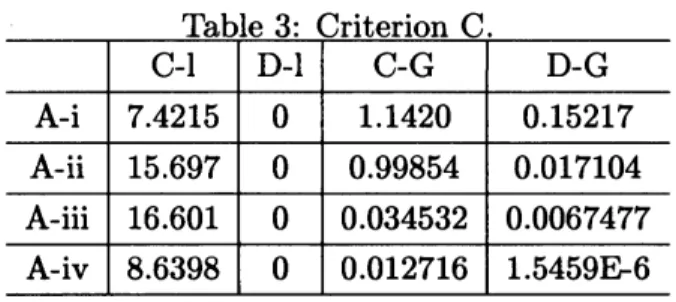
estimates. C-l D-l C-G D-G A-i 7.4215 0 1.1420 0.15217 A-ii 15.697 0 0.99854 0.017104 A-iii 16.601 0 0.034532 0.0067477 A-iv 8.6398 0 0.012716 1.5459E-6
4.1
Evaluation
on
data
sets
that
rep-resent exact
solutions
4.1.1 Data set $\mathrm{A}:$ The log\’istic equation
We analyzed the performance of the models
thus for considered
on
thesame
four data setsas
those in Sect. 2.The result of the comparisons among the
models is shown in Table 3, where C-l denotes
the conventional logistic
curve
model 1 inSect.2.1.1, D-l denotes the discrete logistic
curve
model of
Sect.
2.2,C-G
denotes theconven-tional Gompertz
curve
model 1 of Sect. 3.1.1,and D-G denotes the discrete Gompertz
curve
model ofSect.
3.3.
The discrete logisticcurve
model matched all the four sets of the data.
This model reproduces the vaJues of the
pa-rameters of the exact solution when the exact
solution is used
as
the input data [30]. Thus,the values of criterion $\mathrm{C}$ in this
case were
allexactly
zero.
The conventional logisticcurve
model would be expected to provide
a
better fitin termsof criterion $\mathrm{C}$ because each data set of
(A-i),
...,
(A-iv)was
composed of exactsolu-tions ofthe logistic equation. However, for all
data sets of (A-i), $\ldots,$ (A-iv), the conventional
logistic
curve
model provideda
poorer fit thanthe conventional Gompertz
curve
model,as
isshown inTable 3.
We then used each model to estimate $k,$ the
initial fault content. The results of
compari-son
are shown in Table 4. The value of $k$as
estimated by using the discrete logistic
curve
model matched the target value for all of the
four data sets. The estimates of $k$ provided
by the conventional logistic
curve
modelbe-came more
accurateas
the number ofavajl-able data points increased. Thus, in this case,
Table 3: Criterion C.
the estimate provided by using data set (A-i)
gave agood approximation to thetarget value.
Thediscrete and conventional Gompertz
curve
models,
on
the other hand,were
much lessac-curate than the discrete and conventional $1\mathrm{e}\succ$
gistic
curve
models. Thiswas
thecase
for allfour data sets. Given the
same
target valueof parameter $k,$ the first several values of
an
exact solution to the Gompertz equation
in-crease
faster than thoseofthe logistic equation.Hence, estimates by the Gompertzmodels
were
much larger than the target value.
Table 4: Estimated parameter $k$
.
C-l D-l
C-G
D-GA-i
99.23
10088.11
200.0
A-ii 79.78 100 47.24 $1.175\mathrm{E}+6$
A-iii 72.17 100 $1.449\mathrm{E}+7$ $9.702\mathrm{E}+8$
A-iv 60.17 100 $1.198\mathrm{E}+84$ $1.855\mathrm{E}+184$
4.1.2 Data set $\mathrm{B}:$ The Gompertz
equa-tion
In this case,
we
used thesame
data sets, (B-i),(B-ii), and (B-iii),
as
had been used in Sect. 3.Comparative results forthe models
are
giveninTable5. ThediscreteGompertz
curve
modelmatched all three data sets. The discrete
Gom-pertz
curve
model reproduces thevalues of theparameters of
an
exact solution when thatex-actsolution provides the input data [28]. Thus,
the corresponding values of criterion $\mathrm{C}$
were
all exactly
zero.
Table 5 shows that thedis-crete and conventional logistic
curve
modelsprovided
a
poorer fit in terms of criterion $\mathrm{C}$than did the discrete and conventional
Gom-pertz curve models. This was the case for each
data set in (B-i), $\ldots,$ (B-iii). This result is
rea-sonable because thedata setsarefromanexact
solution to the Gompertz equation.
Table 5: Criterion C. C-l D-l C-G D-G B-i 0.3346 0.014542.195E-4 0 C-l D-l C-G D-G B-i 0.3346 0.01454 2.195E-4 0 B-ii 1.141 0.01154 0.02100 0 B-iii
46.93
1.644E-32 0.27970
We used each model in estimating $k.$ The
comparative results
are
given in Table 6. Thevalues of $k$ estimated by the discrete
Gom-pertz
curve
model from all the three data setsmatched the target value. Estimates of $k$
provided by the conventional Gompertz
curve
model became
more
accurateas
the number ofavailable data points increased. Thus, in this
case, the estimate provided by using data set
(B-i) gives
a
good approximation to the targetvalue. However, the discrete and conventional
logistic
curve
modelswere
much less accuratethan the discrete and conventional Gompertz
curve
models. Thiswas
thecase
for all thethree data sets.
Table 6: Estimated parameter $k$
.
C-l D-l C-G D-G B-i 96.30 97.27 99.63
100
C-l D-l C-G D-G B-i 96.30 97.27 99.63100
B-ii 31.4455.36 78.16
100
B-iii12.85 38.46 46.53
100
4.2
Evaluation
on
actual data
sets
4.2.1 Data set $\mathrm{C}$:Actual data set 1
We compared only the discrete logistic curve
model and the discrete Gompertz
curve
modelby using the
same
actual data set [30]as was
used in Sect. 2, because both models yield
ac-curate parameter estimates in the
case
of datathat representexact solutions,
as
was
shown bythe previous comparisons.
Figure 5: Criterion value $\mathrm{v}\mathrm{s}.$ number of
avail-able data points.
We evaluatedthe parameterestimatae for
au
of the data and for only that data available
early in the test phase. We then used the
ae-timated parameters to calculate duae for
cri-terion C. As is shown in Fig. 5, the discrete
logistic
curve
model produced lower valuae for$\mathrm{C}$ thanthe discrete Gompertz
curve
modelover
the whole test phase.
We estimated $k$
.
The comparative resultsare
shown in Fig.6.
The estimated valuesare normalized on the total number of actual
software failurae. The discrete logistic
curve
model provided
more
accurate parameteresti-mates. Moreover, this model providedaccurate
estimates throughout the rmge shown in the
figure.
Figure 6: Estimates ofparameter $k$
.
4.2.2Data
set
$\mathrm{D}$:Actual data set2We used the same actual data set [14] as was
used in Sect. 3. As
was
shown in Sect. 3, thediscrete Gompertz
curve
model fit the actualdatavery well [28].
020 40 60
Avmlable data points$\mathrm{N}$
Figure 8: Estimates of parameter $k$
.
imitation. By introducing $F(t)= \frac{N(t)}{k},$ where
$F(t)$ is the fraction of potential adopters who
Figure 7: Criterion value $\mathrm{v}\mathrm{s}.$ number of avail- have adopted the product by time
$t,$ the Bass
able data points. model can be restated as
We evaluated the parameter estimates for all the data and for only that the data available
early in the test phase. We then used the
es-timated parameters to calculate values for
cri-terion C. As is shown in Fig. 7, the discrete
Gompertz
curve
model produced lower valuesfor$\mathrm{C}$thanthe discrete logistic
curve
modelover
the whole test phase.
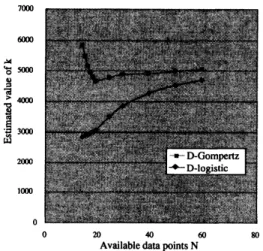
We usedeach modeltoestimate $k.$ The
com-parative results
are
shown in Fig.8.
Thedis-crete Gompertz
curve
model providedthemore
accurate parameter estimates. Moreover, this
model provided accurate parameter estimates
ffom quite early in the taet phase.
5
Bass model
5.1
Bass model and conventional
pa-rameter
estimations
Bass [1] suggaeted that the following
differen-tial equation
can
be used to represent thedif-fusion process:
$\frac{dN(t)}{dt}=(p+\frac{q}{k}N(t))(k-N(t))$, (69)
where $N(t)$ is the cumulative number of
adopters at
a
time$t,$ $k$is theceiling,$p$istheco-efficient ofinnovation, and$q$isthecoefficient of
$\frac{dF(t)}{dt}=(p+qF(t))(1-F(t))$
.
(70)If$N(0)=0,$ simply integrating both sides of
equation (69) gives
us
the followingdistribu-tion function to represent the time-dependent
aspect ofthe diffusion process:
$N(t)=k( \frac{1-e^{-(p+q)t}}{1+\mathrm{g}e^{-(p+q)t},p})$
.
(71)Equation (71) yields the S-shaped diffusion
curve
captured by the Bass model.A number of procedures for $\infty \mathrm{t}\mathrm{i}\mathrm{m}\mathrm{a}\mathrm{t}\mathrm{i}\mathrm{n}\mathrm{g}$ the
parameters$p,$ $q,$ $\mathrm{m}\mathrm{d}k$ of the Bass model have
been suggested. Mahajan et al. [11] compared
the performance of four $\mathrm{p}\mathrm{r}\mathrm{o}\mathrm{c}\mathrm{e}\mathrm{d}\mathrm{u}\mathrm{r}\mathrm{a}\mathrm{e}-\mathrm{t}\mathrm{h}\mathrm{e}$
ordi-nary
least squares (OLS) [1], maximumlike-lihood estimation (MLE) [32], nonlinear least
squarae (NLS) [33], and algebraic estimation
(AE) [10] $\mathrm{p}\mathrm{r}\mathrm{o}\mathrm{c}\mathrm{e}\mathrm{d}\mathrm{u}\mathrm{r}\mathrm{a}\mathrm{e}-\mathrm{o}\mathrm{n}$several sets of data.
They concluded that $\mathrm{N}\mathrm{L}\mathrm{S}$ yielded better
pre-dictionsaswell
as
more
valid estimates ofstan-dard
error
forthe parameter aetimates. Ontheother hand, the
OLS
is the easiest toimple-ment. Therefore,
we
$\mathrm{w}\mathrm{i}\mathrm{u}$ look at the OLS and$\mathrm{N}\mathrm{L}\mathrm{S}$ procedurae in detail in the following two
sections.
5.1.1 Ordinary least squares procedure
The OLS procedure involves estimation of the
parameters by taking the discreteor regression
analogue of the differential equation (69). The
regression equation is given as
$X(i)=\alpha_{1}+\alpha_{2}N(ti-1)+\alpha_{3}N^{2}(t_{i-1})$, (72) where $X(i)$ $=$ $N(ti)-N(ti-1)$, (73) $\alpha_{1}$ $=$ $pk$, (74) $\alpha_{2}$ $=$ $q-p$, and (75) $\alpha_{3}$ $=$ $-q/k$. (76)
Given regression coefficients $\hat{\alpha}_{1},\hat{\alpha}_{2},$ and $\hat{\alpha}_{3}$,
theestimates of parameters$p,$ $q,$ and$k$
are
easyto obtain: $\hat{p}$ $=$ $\frac{-\hat{\alpha}_{2}+\sqrt{\hat{\alpha}_{2^{2}}-4\hat{\alpha}_{1}\hat{\alpha}_{3}}}{2}$ , (77) $\hat{q}$ $=$ $\frac{\hat{\alpha}_{2}+\sqrt{\hat{\alpha}_{2^{2}}-4\hat{\alpha}_{1}\hat{\alpha}_{3}}}{2},$ and (78) $\hat{k}$ $=$ $\frac{-\hat{\alpha}_{2}-\sqrt{\hat{\alpha}_{2^{2}}-4\hat{\alpha}_{1}\hat{\alpha}_{3}}}{2\hat{\alpha}_{3}}$
.
(79)The main advantage of the OLS estimation
procedureis that it is easy to implement.
However, the$\mathrm{O}\mathrm{L}\mathrm{S}$procedurehas three
short-comings [32]. Firstly,
as
is clear ffomEq. (72),in the presence of only
a
few data points andthe likely multicolinearityofvariables $(N(t_{\dot{\iota}-1})$
and $N^{2}(t_{\dot{\iota}-1})),$
one
may obtain parameteresti-mates that
are
unstableor
possess wrongsigns(examples [4, 32, 33]). Secondly, the standard
errors
of the estimatesare
not available sinceparameters $p,$$q,$ and $k$
are
nonlinearfunctionsof $\alpha_{1},\alpha_{2},$ and $\alpha_{3}$
.
Theerror
term, however,does contain the net effect of
au
sources
ofer-$\mathrm{r}\mathrm{o}\mathrm{r}.$ Thirdly, the derivative of $N(t)$ which is
obtained at $t:-1$ by the right-hand side of Eq.
(73) will always be overestimated for time
in-tervalsbefore the point of inflection and
under-estimated after that. That is,
a
time-interval bias is present in theOLS
approach since dis-crete time-series dataare
used to aetimate $\mathrm{a}$continuous-time model.
$1\hat{\alpha}_{1}>0,\hat{\alpha}_{2}>0$, and$\hat{\alpha}_{3}<0$because$\hat{p},\hat{q}$,and
$\hat{k}$are positive.
5.1.2 Nonlinear least squares
estima-tion
The nonlinear least squares estimation
proce-dure suggested by Srinivasan and Mason [33]
was designed to
overcome some
of theshort-comings of $\mathrm{M}\mathrm{L}\mathrm{E}$ procedure [32], which itself
was
designed toovercome
the shortcomings ofthe
OLS
procedureof Schmittlein andMahajan[32]. Fromthe cumulativedistributionfunction
given by
$F(t)= \frac{1-e^{-bt}}{1+ae^{-u}}$, (80)
Srinivasan
and Mason suggest that parameterestimates $\hat{p},\hat{q},$ and
$\hat{k}$
can
be obtained byus-$\mathrm{i}\mathrm{n}\mathrm{g}$the following expression for the number of
adopters$X(i)$ inthe $i\mathrm{t}\mathrm{h}$ timeinterval $(t:-1,t:)$:
$X(i)=k(F(t_{\dot{l}})-F(t:-1))+\mu:$, (81)
where Pi is
an
additiveerror
term. Basedon
Eq. (81), parameters $p,q,$ and $k$ and their
asymptotic standard
errors can
be directlyae-timated.
The $\mathrm{N}\mathrm{L}\mathrm{S}$ procedure
overcomes
thetime-intervaJ bias present in the $\mathrm{O}\mathrm{L}\mathrm{S}$ procedure.
Furthermore, since the
error
term may becon-sidered to represent the net effect of sampling
errors, excluded variables (such
as
economicconditions and marketing mix variables), and
$\mathrm{m}\mathrm{i}\mathrm{s}$-specification of the density function, the
derived standard
errors
for the parameterae-timates may be
more
realistic. However, sincethe$\mathrm{N}\mathrm{L}\mathrm{S}$procedure employs various search
rou-tines in estimating the parameters, parameter
estimates may sometimes be very slow to
con-vergeor
may not converge, the final estimatesmay be sensitive to the initial dues for $p,q$,
and $k$,
or
the procedure may providea
non-global optimum.
5.2
Discrete Bass model
We propose
a
discrete Bass model, which is $\mathrm{a}$form of
a
discrete Riccati equation [5]. The dis-crete Bass model enablesus
toforecast thedif-fusion innovation without using
a
continuous-time Bass model, because the discrete model
has
an
exact solution.The discrete Bass model is described
as
fol-lows:
$\frac{N_{n+1}-N_{n-1}}{2\delta}$
$=p(k- \frac{N_{n+1}+N_{n-1}}{2})$
14
$( \frac{k}{2}(N_{n+1}+N_{n-1})-N_{n+1}N_{n-1})$.
(82)The exact solution to equation (82) is written
as
$N_{n}=k( \frac{1-(\frac{1-\delta(q+p)}{1+\delta(q+p)})^{\frac{n}{2}}}{1+p\mathrm{f}\mathrm{l}(\frac{1-\delta(q+p)}{1+\delta(q+p)})^{\frac{n}{2}}})$, (83)
where $n=7t.$ This equation has also appeared
in work
on
SRGM [37].Applying $\mathrm{O}\mathrm{L}\mathrm{S}$ to the discrete Bass model
is easy because the model is basically
a
time-discrete equation. The $\mathrm{O}\mathrm{L}\mathrm{S}$ procedure is the
simplest method of parameter estimation for
the discrete Bass model. In the continuous
Bass model, the forward difference equation,
which acts
as
aregression equation inthe $\mathrm{O}\mathrm{L}\mathrm{S}$procedure, is
an
approximation of thediffer-ential equation. However, in the discrete Bass
model, themodel itselfis directly applied
as
theregression equation. Moreover,
a
solution ofthe discrete Bassmodel providesthe
same
val-$\mathrm{u}\mathrm{e}\mathrm{s}$
as
asolution of the continuous Bass modelthrough the following equations:
$p_{d}=\kappa p$, (84) $q_{d}=\kappa q$, (85)
$\kappa=\frac{1}{\delta(\mathrm{p}+q)}(\frac{1-\exp(-2(q+p))}{1+\exp(-2(q+p))})$ , (86)
where $p_{d}$ and $q_{d}$
mean
$p$ and $q$ in Eq. (83),respectively.
Wepropose two regression models. The first
is the following equation:
$S_{n}=2(a+b(N_{n+1}+N_{n-1})+cN_{n+1}N_{n-1})+\epsilon(n)$, (87) where $S_{n}=N_{n+1}-N_{n-1}$, (88) $a=kp$, (89) $b=\mathrm{L}^{-}A2$ ’ (90) $c=-k\mathrm{A}$, (91)
$\epsilon(n)$ : error, and $E[\epsilon(n)]=0$
.
(92)Given regression
coefficients2
$a,$ $b$, and $c$,pa-rameter estimates $\hat{p},\hat{q},$ and $\hat{k}$
are
easilyob-tained as follows:
$\hat{p}$ $=$ $-b+\sqrt{b^{2}-ac}$, (93) $\hat{q}$ $=$ $b+\sqrt{b^{2}-ac},$ and (94) $\hat{k}$
$=$ $\frac{-b-\sqrt{b^{2}-ac}}{c}$
.
(95)The other regression model is the following
equation: $M_{n}=A+BN_{n-1}+C(N_{n+1}-N_{n-1})+\epsilon(n)$, (96) where $M_{n}=N_{n+1}N_{n-1}$, (97) $A=\underline{k}_{f,q}^{2}$, (98) $B= \frac{k(q-p)}{q}$, (99) $C= \frac{k(q-p-1)}{2q}$, (100)
$\epsilon(n)$ : error, and $E[\epsilon(n)]=0$
.
(101)Given regression$\mathrm{c}\mathrm{o}\mathrm{e}\mathrm{f}\mathrm{f}\mathrm{i}\mathrm{c}\mathrm{i}\mathrm{e}\mathrm{n}\mathrm{t}\mathrm{s}^{3}A,$$B$
,
and $C$,
pa-rameter estimates $\hat{p},\hat{q},$ and $\hat{k}$
are
easily $\mathrm{o}\mathrm{k}$tained
as
follows:$\hat{p}$ $=$ $\frac{-B+\sqrt{B^{2}+4A}}{2B-C}$, (102) $\hat{q}$ $=$ $\frac{B+\sqrt{B^{2}+4A}}{2B-C},$ and (103) $\hat{k}$
$=$ $\frac{B+\sqrt{B^{2}+4A}}{2}$
.
(104)These procedures have the advantage of
sim-plicity, which is also provided by parameter
estimation through the
OLS
procedure in thecontinuous Bass model.
Applying the $\mathrm{N}\mathrm{L}\mathrm{S}$procedure to the discrete
Bass model is also relatively easy, because the
discrete Bass model has
an
exact solution (83).We propose two $\mathrm{N}\mathrm{L}\mathrm{S}$ procedures for the
dis-crete Bass model. One of these providae
esti-mated parameter $\hat{p},\hat{q},$ $\mathrm{m}\mathrm{d}\hat{k}$ by using the
fol-lowing expressions for the number ofadopters
$X_{n}$ in the $n\mathrm{t}\mathrm{h}$ time intervaJ:
$X_{\hslash}=N_{n+1}-N_{n-1}+\mu_{\hslash}$, (105) $2a>0,$ $b>0$, and $c<\mathrm{O}$ because$\hat{p},\hat{q}$, and $\hat{k}$ are poeitive.
$3A>0,$ $B>0,$ and$C<\mathrm{O}$ because$\hat{p},\hat{q},$ and
$\hat{k}$ are poeitive.
where $\mu_{n}$ is
an
additiveerror
term.The other $\mathrm{N}\mathrm{L}\mathrm{S}$ procedure for the discrete
Bass model is the following equation:
$\mathrm{Y}_{n}=N_{n+1}N_{n}+\nu_{n}$ (106)
where $\mathrm{Y}_{n}$ is the ratio between the number of
adopters at the $n\mathrm{t}\mathrm{h}$ time-step and that at the
$(n+1)\mathrm{s}\mathrm{t}$ time-step.
These procedures have the advantage of
al-lowing the direct estimation of the
asymp-totic standarderrorsof theparameters,
as
doesthe $\mathrm{N}\mathrm{L}\mathrm{S}$ procedure with the continuous Bass
model. Moreover, since the
error
termsintheseprocedures may be considered to represent the
net effect of sampling errors, excluded
vari-ables, andmis-specificationof thedensity
func-tion,thederived standard
errors
for theparam-eter estimatesmay be
as
realisticas
those ofthe$\mathrm{N}\mathrm{L}\mathrm{S}$procedure for the continuous Bass model.
Either of the$\mathrm{O}\mathrm{L}\mathrm{S}$procedures in the discrete
Bass model
overcomes
the three shortcomingsof the $\mathrm{O}\mathrm{L}\mathrm{S}$ procedure in the continuous Bass
model: the time-interval bias, standard error,
and multicolinearity.
When
we use
the discrete Bass model toavoid using thecontinuousmodelin forecasting
the diffusion of innovation, there is
no
time-interval bias because the model is
a
discretemodel. Ehrthermore,
even
ifthe discrete Bassmodel is regarded
as
only the procedure usedto obtain the parameters for the continuous
model, the $\mathrm{O}\mathrm{L}\mathrm{S}$ procedures do not suffer ffom
a
time-interval bias becausea
solution of thediscrete Bass model gives the
same
valuesas a
solution of the continuous Bass model,
as
wasalready stated in this section.
$\mathrm{R}\mathrm{o}\mathrm{m}$ Eq. (82), Eq. (87) is equivalent to Eq.
(105), and Eq. (96) is equivalent to Eq. (106)
under
no
constraints. Therefore, thesame
pa-rameter estimation is done through both
Pro-cedures in the discrete Bass model. This is
a
significant advantageof the discrete Bass model
because
we can
getthe global optimum through$\mathrm{O}\mathrm{L}\mathrm{S},$ and then apply $\mathrm{N}\mathrm{L}\mathrm{S}$to obtain the
stm-dard
error.
By using both procedures together,we
overcome
their shortcomings in separateap-plication. That is, thestandarderror of the
re-sults of the OLS procedureis obtained through
the $\mathrm{N}\mathrm{L}\mathrm{S}$ procedure. Equations (87) and (96)
overcome
the three shortcomings of$\mathrm{N}\mathrm{L}\mathrm{S}:$ thatfinal parameter estimates
are
sensitive to theinitial values of$p,q$, and$k$, that parameter
esti-mates may sometimes beveryslow toconverge
or
may not converge at all, and that theop-timum provided by the procedure may not be
global.
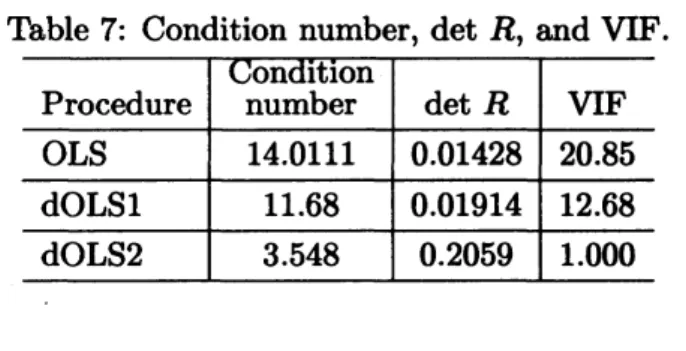
Table 7 shows the condition number, the
de-terminant ofcorrelation matrix$R,$and the
vari-ance
inflation factors (VIFs) for threeproce-dures: the conventional $\mathrm{O}\mathrm{L}\mathrm{S}$procedure (OLS),
discrete analogue 1 of the $\mathrm{O}\mathrm{L}\mathrm{S}(87)$ (dOLSl),
and discreteanalog2 oftheOLS (96) $(\mathrm{d}\mathrm{O}\mathrm{L}\mathrm{S}2)$,
where
we
chose the exact solution $(p=0.002$,$q=1,$ $m=100)$ to differential equation (69)
as
the data from every period ffom $t=0$ to$t=11.$ The $\mathrm{V}\mathrm{F}$ in the conventional
OLS row
is the VIF of the variable $N(t_{\dot{*}-1})$ in Eq. (72).
$\mathrm{R}\mathrm{o}\mathrm{m}$ the definition of the $\mathrm{V}\mathrm{F},$ the value of
the $\mathrm{V}\mathrm{F}$ of the variable $N(t:-1)$ is the
same as
that of the $\mathrm{V}\mathrm{I}\mathrm{F}$ of the other variable, $N(t:)^{2}$
.
The $\mathrm{V}\mathrm{I}\mathrm{F}$ in the dOLSl
row
is the VIF of thevariable $(N_{n+1}+N_{n-1});$ the $\mathrm{V}\mathrm{I}\mathrm{F}$inthe $\mathrm{d}\mathrm{O}\mathrm{L}\mathrm{S}2$
row is the $\mathrm{V}\mathrm{F}$ of the variables $N_{n-1}$ in Table
7. $\mathrm{d}\mathrm{O}\mathrm{L}\mathrm{S}2$ excludes the problem of
multicolin-earity. Therefore, with this procedure, awrong
signfor
a
parametersuggests that the obtaineddata is not appropriate for the Bass model.
Table 7: Condition number, $\det R$, and VIF.
on
ltl0nProcedure number $\det R$ $\mathrm{V}\mathrm{I}\mathrm{F}$
Procedure number
on
ltlon $\det$ $R$ VIF$\mathrm{O}\mathrm{L}\mathrm{S}$
14.0111
0.01428 20.85
dOLSl 11.68
0.01914
12.68$\mathrm{d}\mathrm{O}\mathrm{L}\mathrm{S}2$ 3.548 0.2059 1.000
5.3Parameter estimation
The accuracy of the parameter aetimate pro-vided by the conventional
OLS
procedure $\mathrm{m}\mathrm{d}$the two OLS procedures in the discrete Bass
model
was
compared. Tocomparetheaccuracyof the parameter estimatesonly,
we
choee datawhich satisfy theexact solution $(p=0.002,$$q=$
$1,$$k=100)$ ofdifferential equation (69) in
ev-$\mathrm{e}\mathrm{r}\mathrm{y}$ periodffom $t=0$to$t=11$ (the
same
dataas was
usedinthe previous section). Thisdatahas apoint of inflection where $t^{*}=6.2022$ and
$N(t^{*})=49.9$
.
We analyzed three sets of data;data 1: the data up to the point just before
the point of inflection $(t=0,1, \cdots, 6),$ data 2:
the data uP to the pointjust after the point of
inflection $(t=0,1, \cdots, 7)$,and data3:thedata
up tothe ceiling $(t=0,1, \cdots, 11)$
.
The resultsofcomparisonofthe conventional
OLS, dOLSl and $\mathrm{d}\mathrm{O}\mathrm{L}\mathrm{S}2$procedures
are
givenin Table 8. Both dOLSl and $\mathrm{d}\mathrm{O}\mathrm{L}\mathrm{S}2$ provide
accurate estimates. Since
we
used the exactsolution to provide the data,
an
accuratepro-cedure should reproduce the values of the
pa-rameters of the exact solution. Table
8
showsthat bothdOLSland$\mathrm{d}\mathrm{O}\mathrm{L}\mathrm{S}2$reproduced $k$
per-fectly,
even
when the data did not include thepoint of inflection and there
were
fewer thaneight data points.
Table 8: Estimatedparameter $k$
.
Data set OLS dOLSl $\mathrm{d}\mathrm{O}\mathrm{L}\mathrm{S}2$
Data set OLS dOLSl $\mathrm{d}\mathrm{O}\mathrm{L}\mathrm{S}2$
data 1 55.71
100
100
data 2 71.61 100 100
data 3 97.27
100
100
The accuracy of the conventional $\mathrm{O}\mathrm{L}\mathrm{S}$
$\mathrm{p}\mathrm{r}\sim$
cedure is poor daepite the fact that the data
is drawn ffom
an
exact solution of thediffer-ential equation. In particular, the conventional
OLS procedureyields poorestimates of the
pa-rameters with data 1. This is consistent with
the findingsof Heeler and Hustad [4] and
Srini-vasan
andMason [33]. Through empiricalstud-$\mathrm{i}\mathrm{e}\mathrm{s}$,they found thatstableandrobust estimates
of the parameters of the basic diffusion $\mathrm{m}\mathrm{o}\mathrm{d}-$
$\mathrm{e}\mathrm{l}\mathrm{s}$ cannot be obtained unless
one
uses
at leasteight data points, within which the point of
inflection falls. The estimates of parameters
with data 2
were
$\mathrm{a}\mathrm{k}\mathrm{o}$not accurateenough,even
though data 2satisfies the above condition.
Whenever adata set is aset from
an
exactsolution of Eq. (69), the dOLSl and $\mathrm{d}\mathrm{O}\mathrm{L}\mathrm{S}2$
procedures reproduce all values of the
param-eters, $\mathrm{i}.\mathrm{e}.,$ $k,$
$p$, and $q;$ theoretically, this is
because the solution ofEq. (82) is the
same
as
that of Eq. (69) through $\mathrm{E}\mathrm{q}\mathrm{s}$.
(84), (85),and (86). This is independent of the number of
data points and the values of the parameters.
However, the conventional$\mathrm{O}\mathrm{L}\mathrm{S}$proceduredoes
not reproduce values of the parameters and de
pends
on
the number of data points,as
shownin Table 8, because regression Eq. (72) does
not have
an
exact solution and gives onlyan
approximation ofthe Bass model.
We also evaluated the discrete Bass model
on
actual data. This datawas
thesame as
that used by Mahajan etal. [11], which
was on
the data diffusion of
seven
products:room
airconditioners, color televisions, clothes dryers,
ultrasound, mammography, foreign language,
and accelerated
program.
Theseseven
prod-ucts represent
a
diverse set of innovations, andthusof sets ofdata, for all of which
a
minimumofeight annual data points covering the peak
(point of inflection), is available. In addition,
these products have been used extensively in the diffusion modeling literature to illustrate
the application of alternative diffusion models
or
estimation procedures [1, 9, 32, 33].To compare the predictive performance of
the four estimation procedures, the OLS and the $\mathrm{N}\mathrm{L}\mathrm{S}$ procedure in the continuous Bass
model and the two
OLS
procedures in thedis-creteBass model, resultsrelatedto
a
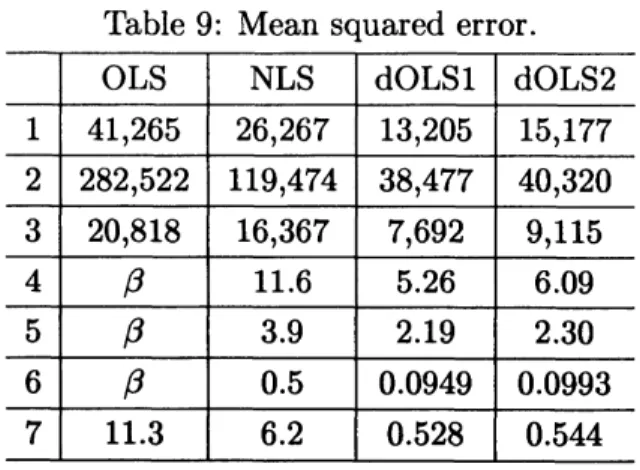
statisticoffit (MSE)
are
given inRble9.
The numbers(1,2, $\cdots,$ $7$) in the left column repraeent,
raepec-tively,
room
air conditioners, color televisions,clothesdryers, ultrasound, mammography,
for-eign language, and accelerated program. The
statistics of fit for $\mathrm{d}\mathrm{O}\mathrm{L}\mathrm{S}2$ is not directly
com-parable with thoseofthe other estimation$\mathrm{p}\mathrm{r}(\succ$
cedures, because the
error
term of $\mathrm{d}\mathrm{O}\mathrm{L}\mathrm{S}2$ isdifferent from the error terms ofthe other
es-timation procedures. However, from $\mathrm{E}\mathrm{q}\mathrm{s}$
.
(87)and (96), the
error
term $\epsilon(n)$ maybe regardedas
following$\epsilon(n)=\frac{k}{q}\epsilon(n)$
.
(107)Therefore,
we
compared the fit statistics of$\mathrm{d}\mathrm{O}\mathrm{L}\mathrm{S}2$ with those of other procedures by
us-$\mathrm{i}\mathrm{n}\mathrm{g}$this equation.
Ofthefourprocedures (the OLS, $\mathrm{M}\mathrm{L}\mathrm{E},$$\mathrm{N}\mathrm{L}\mathrm{S}$,
and $\mathrm{A}\mathrm{E}$ procedures in the continuous Bass
model), the $\mathrm{N}\mathrm{L}\mathrm{S}$ procedure provides the best
fit to the data [11]. Mahajan et al. stated
that, if
we assume
global optimum parameterTable 9: Mean squared
error.
$\mathrm{O}\mathrm{L}\mathrm{S}$ $\mathrm{N}\mathrm{L}\mathrm{S}$ dOLSl $\mathrm{d}\mathrm{O}\mathrm{L}\mathrm{S}2$
OLS NLS dOLSl $\mathrm{d}\mathrm{O}\mathrm{L}\mathrm{S}2$
1 41,265 26,267 13,205 15,177 2 282,522 119,474 38,477 40,320 3 20,818 16,367 7,692 9,115 4 $\beta$ 11.6 5.26 6.09 5 $\beta$ 3.9 2.19
2.30
6 $\beta$ 0.5 0.0949 0.0993 711.3
6.20.528
0.544
OLS $\mathrm{N}\mathrm{L}\mathrm{S}$ dOLSl $\mathrm{d}\mathrm{O}\mathrm{L}\mathrm{S}2$
1 0.0170
0.0094
0.0139
0.0107
2 0.0357 0.01850.02448
0.02194
3
0.0196 0.0136
0.01790
0.014322
4 $\beta$0.0013 -0.01755
-0.02826
5 $\beta$0.0004 -0.02501
-0.030308
6 $\beta$0.0019
-0.0249-0.02871
70.0120 0.0007 -0.01825
-0.0215363estimates, the $\mathrm{N}\mathrm{L}\mathrm{S}$ procedure should, by
defi-nition, provide the best fit in terms of the
mean
squared
error
[11]. However,a
comparison ofthe statistics of fit in Table 9 indicates that
both dOLSl and $\mathrm{d}\mathrm{O}\mathrm{L}\mathrm{S}2$ provided
a
better fittothe data than did the$\mathrm{O}\mathrm{L}\mathrm{S}$or$\mathrm{N}\mathrm{L}\mathrm{S}$interms of
mean
squarederror.
Thefit statistic ofdOLSlwas
the best of all. A $\beta$ in Table 9 indicatescases
where the $\mathrm{O}\mathrm{L}\mathrm{S}$ procedure yielded anin-correct sign for the regression coefficient $\hat{\alpha}_{1}$ in
the regression equation.
Table 10: Parameter estimates of$k$
.
$\mathrm{O}\mathrm{L}\mathrm{S}$ $\mathrm{N}\mathrm{L}\mathrm{S}$ dOLSl $\mathrm{d}\mathrm{O}\mathrm{L}\mathrm{S}2$ $1$ $17.1\mathrm{E}6$ $18.7\mathrm{E}6$ $18.0\mathrm{E}6$ $17.1\mathrm{E}6$
$2$ $35.5\mathrm{E}6$
.
$39.7\mathrm{E}6$ $39.1\mathrm{E}6$ $38.4\mathrm{E}6$ $3$ $15.3\mathrm{E}6$ $16.5\mathrm{E}6$ $16.19\mathrm{E}6$ $15.3\mathrm{E}6$OLS $\mathrm{N}\mathrm{L}\mathrm{S}$ dOLSl $\mathrm{d}\mathrm{O}\mathrm{L}\mathrm{S}2$
1 $17.1\mathrm{E}6$ $18.7\mathrm{E}6$ $18.0\mathrm{E}6$ $17.1\mathrm{E}6$
2 $35.5\mathrm{E}6$
.
$39.7\mathrm{E}6$ $39.1\mathrm{E}6$ $38.4\mathrm{E}6$3 $15.3\mathrm{E}6$ $16.5\mathrm{E}6$ $16.19\mathrm{E}6$ $15.3\mathrm{E}6$
4 $\beta$ 167.4 187.2 180.2
5 $\beta$ 111.4 122.1 121.2
6 $\beta$
37.6
40.139.6
7
63.6
64.4
65.5
65.1
Tables 10 and 11 show the parameters
esti-mated by the OLS, $\mathrm{N}\mathrm{L}\mathrm{S},$ dOLSl, $\mathrm{m}\mathrm{d}\mathrm{d}\mathrm{O}\mathrm{L}\mathrm{S}2$
procedures. Again, $\beta$ indicates where the
OLS
procedure yielded
an
incorrect sign for there-gression coefficient $\hat{\alpha}_{1}$ in the regression
equa-tion. The results for the parameter estimates
in Table 11 show that bothdOLSl and $\mathrm{d}\mathrm{O}\mathrm{L}\mathrm{S}2$
providedthewrongsignforthe regression
coef-ficient$a$in Eq. (87) andforthe regression
coef-ficient $A$ in Eq. (96) forultrasound,
mammog-raphy, foreign language, and accelerated $\mathrm{p}\mathrm{r}x$
gram. Both $a$ in Eq. (87) and $A$ in Eq. (96)
are
the regression coefficients of the constantterm.
Table 11: Parameter estimates of$p$
.
A wrong sign in Table 11, however, doesnot
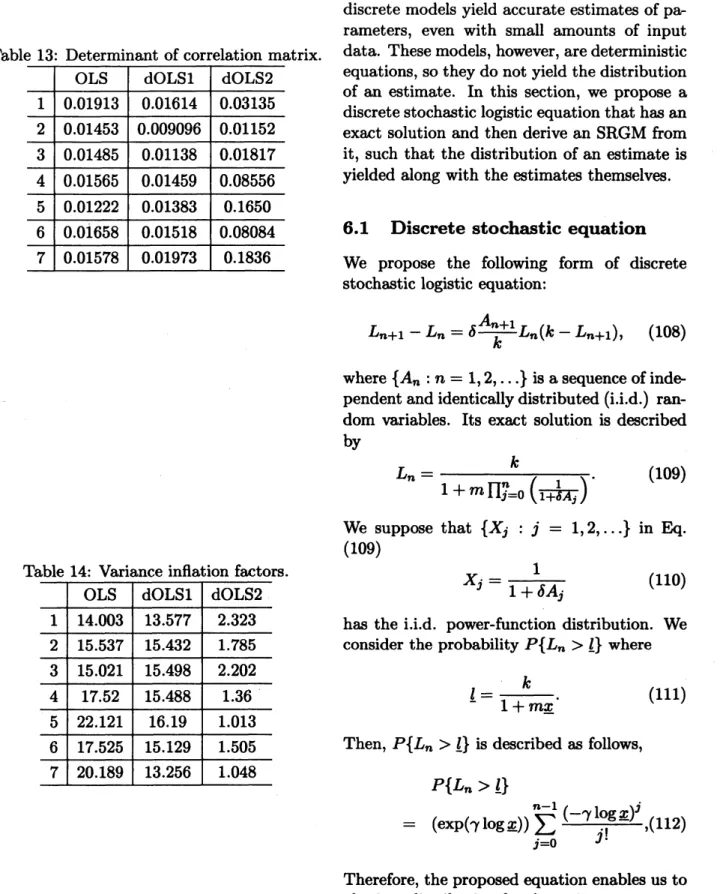
indicate multicolinearity. Tables 12, 13, and
14, respectively, show the condition number,
determinantof the correlationmatrix, and
vari-ance
inflation factors for each product. These tables show that there isno
multicolinearity in $\mathrm{d}\mathrm{O}\mathrm{L}\mathrm{S}2.$ Cases where the wrong signswere
applied havesmaller condition numbers, larger
determinants of the correlation matrices, and
smaller VIFs than the
cases
that had the rightsigns. Therefore, the wrong sign
on a
parame-$\mathrm{t}\mathrm{e}\mathrm{r}$ suggests that the obtained data is not
ap-propriate for the Bass model.
Table 12: Condition number. OLS dOLSl $\mathrm{d}\mathrm{O}\mathrm{L}\mathrm{S}2$
1 11.943 12.615 7.743
2 13.321 15.768 10.123 3
13.145
14.499
9.723OLS dOLSl $\mathrm{d}\mathrm{O}\mathrm{L}\mathrm{S}2$
1 11.943 12.615 7.743 2 13.321 15.768 10.123 3
13.145
14.499
9.723 413.380
13.436 4.513 5 14.982 13.648 3.703 6 13.132 13.213 4.700 7 13.546 11.7363.503
131
6
$\mathrm{D}_{\acute{1}}\mathrm{s}\mathrm{c}\mathrm{r}\mathrm{e}\mathrm{t}\mathrm{e}$stochastic logistic
curve
model
Table 13: Determinant of correlation matrix.
OLS dOLSl $\mathrm{d}\mathrm{O}\mathrm{L}\mathrm{S}2$
1
0.01913
0.01614
0.03135
2 0.01453
0.009096 0.01152
3
0.01485
0.01138
0.01817
OLS dOLSl $\mathrm{d}\mathrm{O}\mathrm{L}\mathrm{S}2$
1
0.01913
0.01614
0.03135
2 0.014530.009096 0.01152
30.01485
0.01138
0.01817
4
0.01565
0.01459
0.08556
5 0.012220.01383
0.1650 60.01658
0.01518
0.08084
7 0.015780.01973
0.1836Asshown intheprevious sections, theproposed
discrete models yield accurate estimates ofpa
rameters,
even
with small amounts of inputdata. These models, however,
are
deterministicequations, sotheydo not yield the distribution
of
an
estimate. In this section,we
propose $\mathrm{a}$discretestochasticlogistic equation that has
an
exact solution and then derive
an
SRGM
fromit, such that the distribution of
an
estimate is yielded along withthe estimates themselves.6.1
Discrete
stochastic equation
We propose the following form of discrete
stochastic logistic equation:
$L_{n+1}-L_{n}= \delta\frac{A_{n+1}}{k}L_{n}(k-L_{n+1})$, (108)
Table 14: Variance inflation factors.
OLS
dOLSl $\mathrm{d}\mathrm{O}\mathrm{L}\mathrm{S}2$where $\{A_{n} : n=1,2, \ldots\}$is
a
sequence ofinde-pendentand identically distributed (i.i.d.)
ran-$\mathrm{d}\mathrm{o}\mathrm{m}$ variables. Its exact solution is daecribed
by
$L_{n}= \frac{k}{1+m\prod_{j=0}^{n}(\frac{1}{1+\delta A_{\mathrm{j}}})}$
.
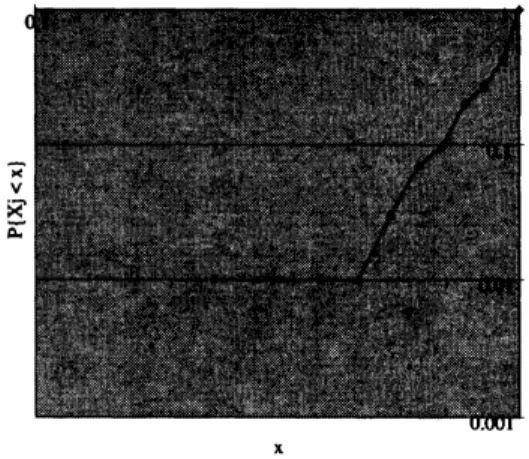
(109)We suppose that $\{Xj : j=1,2, \ldots\}$ in Eq.
(109)
$X_{j}= \frac{1}{1+\delta A_{j}}$ (110)
$\mathrm{O}\mathrm{L}\mathrm{S}$ dOLSl $\mathrm{d}\mathrm{O}\mathrm{L}\mathrm{S}2$
1
14.003
13.5772.323
2 15.537 15.432 1.7853
15.021
15.498
2.202
4 17.52 15.4881.36
5 22.121 16.191.013
617.525
15.129 1.505 7 20.189 13.2561.048
has the i.i.d. power-function distribution. We
consider the probability $P\{L_{n}>\underline{l}\}$ where
$\underline{l}=\frac{k}{1+m\underline{x}}$
.
(111)Then, $P\{L_{n}>\underline{l}\}$ is described
as
follows,$P\{L_{n}>\underline{l}\}$
$=$ $( \exp(\gamma\log\underline{x}))\sum_{j=0}^{n-1}\frac{(-\gamma 1\mathrm{o}\mathrm{g}\underline{x})^{j}}{j!},(112)$
Therefore, the proposed equationenables
us
toobtain
a
distribution for the estimate ata
step$n$