Conditions
for
$k$-connected
graphs to
have a
contractible
edge
Kiyoshi
Ando
National
Institute of
Informatics
JST
ERATO
Kawarabayashi Large Graph
Project
[email protected]
Abstract
An edge
of
$k$-connected graph $i\mathcal{S}$ said to be $k$-contractibleif
the $con-$traction
of
it results in a $k$-connected graph. When $k\leq 3$, eachk-connected graph on more then $k+1$ vertices has a $k$-contractible edge.
When $k\geq 4$, there are infinitely many $k$-connected graphs with no
k-contractible edge
for
each $k$.
Hence,if
$k\geq 4$, we can not expect the$exi_{\mathcal{S}}tence$
of
a $k$-contractible edge in a $k$-connected graph with no $con-$dition. In this note, we give a
brief
survey onsufficient
conditionsfor
$k$-connected graphs to have a $k$-contractible edge. We also give some
recent new results on this topic.
1
Introduction
In this note, we deal with finite undirected graphs with neither loops nor
multiple edges. For
a
graph $G$, let $V(G)$ and $E(G)$ denote the set of verticesof $G$ and the set of edges of $G$, respectively.
For
an
edge $e\in E(G)$, let$V(e)$ stand for the set of end vertices of $e$
.
For a
vertex $x\in V(G)$,we
write$N_{G}(x)$ for the neighborhood of $x$
.
Moreover, for a subset $X\subset V(G)$, let$N_{G}(X)= \bigcup_{x\in X}N_{G}(x)-X$
.
We denote the degree of $x\in V(G)$ by $deg_{G}(x)$,namely $deg_{G}(x)=|N_{G}(x)|$
.
We denote the set of vertices of degree $i$ by $V_{i}(G)$.
We denote the minimum degree of $G$ by $\delta(G)$. For a subset $X$ of $V(G)$, the
subgraph induced by $X$ is denoted by $G[X]$
.
If there is no ambiguity,we
write$X$ for $G[X]$
.
Fora
subgraph $A\subset G$, if there isno
ambiguity,we
write $A$ for$V(A)$
.
Let $K_{n},$ $P_{n}$ and $C_{n}$ be the complete graphon
$n$ vertices, the pathon
$n$vertices and the cycle on $n$ vertices, respectively. Let $G$ and $H$ be two graphs.
Let $G\cup H$ and $G+H$ denote the union of$G$ and $H$, and the join of $G$ and $H,$
respectively. Let $K_{4}^{-}$ be the graph obtained from $K_{4}$ by removing
one
edge,that is $K_{4}^{-}=K_{2}+2K_{1}$. If $G$ has no $H$
as
a subgraph, then $G$ is said to beH-off
If $G$ hasno
$H$as
an
induced subgraph, then $G$ is said to be $H$-free.
Ifgraph $G$,
a
subset $S\subseteq V(G)$ is said to bea
cutset if $G-S$ is disconnected. $A$cutset $S$ is said to be an $i$-cutset if $|S|=i.$
Let $k$ be
an
integer such that $k\geq 2$.
Let $G$ bea
$k$-connected graphand let
$e=xy$
be an edge of $G$.
We consider the following operationon
$G$
.
Delete both $x$ and $y$, and addnew
vertex $z$ and join $z$ to each vertex in$N_{G}(x)\cup N_{G}(y)-\{x, y\}$. We call this operation contraction of $e=xy$ and
we
write the resulting graph by $G/e$
.
An edge $e$ of $G$ is said to be $k$-contractibleif the contraction of it results in
a
$k$-connected graph. Ifan
edge $e$ of $G$ isnot
contractible,then
it is said to be $k$-noncontractible.
Weobserve
thatan
edge $e\in E(G)$ is $k$-noncontractible if and only if there is a $k$-cutset $S$ suchthat $V(e)\subset$ S. A $k$-connected graph $G$ is said to be contraction critically
$k$-connectedif $G$ has
no
$k$-contractible edge. A $k$-cutset $S$ is said to be trivialifthere is
a
vertex $x\in V_{k}(G)$ such that $S=N_{G}(x)$.
$G Gle Glf$
Fig.
1:
Contractible
edgeIn Fig. 1, $G$ is 3-connected, $e$ is
a 3-noncontractible
edge of $G$ and $f$ isa
3-contractible edge of$G.$
If $k\geq 4$, then
we
cannot expect the existence ofa
contractible edge ina
k-connected graph with
no
condition. We consider conditions for a $k\sim$connectedgraph to have
a
$k$-contractible edge. We say $k$-sufficient condition’ fora
condition for
a
$k\mapsto$connected graph to havea
$k$-contractible edge.2
Degree
$k$-sufficient conditions
A
fragment $A$ isa
non-empty union of components of$G-S$
, where $S$ isa
$k$-cutset of $G$ for which $V(G)-(AUS)\neq\phi$.
Mader [11], [12] showedthat every contraction critically $k$-connected graph has a fragment $A$ whose
neighbourhood contains
an
edge for which $|A| \leq\frac{1}{2}(k-1)$.
Bygeneralizing methods ofMader, Egawa [4] provedthat
every
contractioncritically $k$-connected graph has a fragment $A$ such that $|A| \leq\frac{1}{4}k$, and gave
the following minimum-degree $k$-sufficient condition. He also showed that the
bound is sharp.
Theorem 1 Let $k\geq 2$ be
an
integer, and let $G$ be a $k$-connected graph with$\delta(G)\geq\lfloor\frac{s}{4}k\rfloor$
.
Then $G$ hasa
$k$-contractibte edge; unless $k=2$or 3
and $G$ isisomorphic to $K_{k+1}.$
Kriesell [8] extended Theorem
1
and proved the following degree-sum $k-$Theorem
2Let
$G$ bea
$k$-connected graphfor
which$\deg(v)+\deg(w)\geq 2\lfloor\frac{5}{4}k\rfloor-$$1$,
for
anypair$v,$ $w$of
distinct verticesof
G. Then $G$ containsa
$k$-contractibleedge.
Solving
a
conjecture in [8],Su
and Yuan [13] proved the following strongerresult.
Theorem 3 Let $G$ be
a
contraction-critical $k$-connected graph with $k\geq 8.$Then $Gha\mathcal{S}$ two adjacent venlices
$v,$ $w$
for
which $\deg(v)+\deg(w)\leq 2\lfloor\frac{5}{4}k\rfloor-2.$The
following interesting result is alsodue
to Kriesell [10].Theorem 4 For
every
$k\geq 1$, there exists a number $f(k)$for
which every$k$-connectedgraph with average degree at least $f(k)$ has
a
$k$-contractible edge.In [10], he showed that $f(k)\leq ck^{2}\log k$ for
some
constant $c$, and posed thefollowing conjecture.
Conjecture A There exists
a
constant $c$for
which everyfinite
$k$-connectedgraph with average degree at least$ck^{2}$ has
a
$k$-contractible edge.Another problem is to determine the best value of $f(k)$, for
a
given valueof $k$
.
Up to now,we
haveno 5
contraction critical graph whoseaverage
degreeexceeds $\frac{25}{2}$
.
Hence
we
pose
the following.Conjecture $B$ The average degree
of
every5
contraction criticalgraph is $le\mathcal{S}S$than $\frac{26}{2}.$
If Conjecture $B$ is true, the bound $\frac{25}{2}$ is sharp. We construct
a
series of5-connected graphs whose average degree tend to $\frac{25}{2}$
.
To construct the5-connected graphs,
we
introduce
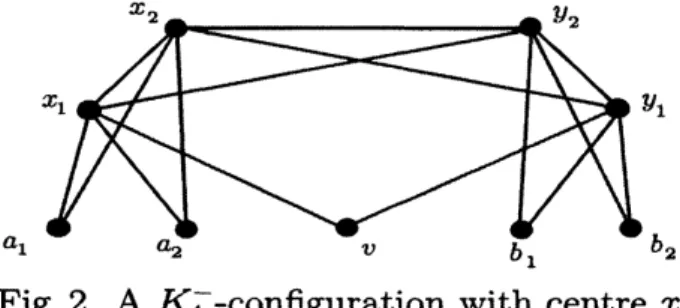
$K_{4}^{-}$-configuration.Let
$S=\{a_{1}, a_{2}, v, b_{1}, b_{2}\}$be
a 5-cutset
ofa
5-connected graph $G$, and let $A$ bea
component of$G-S$
such that $V(A)\underline{\subseteq}V_{5}(G)$, $|V(A)|=4$, and $G[A]\cong K_{\overline{4}}$ say, $A=\{x_{1}, x_{2}, y_{1}, y_{2}\},$
with edges within $A$ and between $A$ and $S$ exactly
as
in Fig. 2; theremay
beedges between the vertices of$S$
.
We call this configuration, $G[V(A)\cup S]$,a
$K_{4}^{-}-$configuration with centre $v$
.
Note that $\{x_{1}, x_{2}, y_{1}, y_{2}\}\subseteq V_{5}(G)$ and that theedgesin Fig. 2 otherthan$vx_{1}$ and $vy_{1}$
are
all trivially 5-noncontractible.More-over,
we
can find
two nontrivia15-cutsets, $\{x_{1}, x_{2}, v, b_{1}, b_{2}\}$ and $\{y_{1}, y_{2}, v, a_{1}, a_{2}\}$that contain $V(vx_{1})$ and $V(vy_{1})$, respectively. Hence all edges in Fig. 2
are
5-noncontractible. Note finally that if there is
an
edge between vertices of $S,$then it is -noncontractible, since $S$ is
a
5-cutset of $G.$Let $P$ be
a
suitable integer which is divisible by10.
Then,. by the resultsdue to Hanani(1961),
we can
find $\ell(P-1)/20$ many copies of$K_{5}$’s whose edgesets partitions $E(K_{\ell})$
.
We apply $K_{4}^{-}$-attachingon
each $K_{6}$ and let $G_{\ell}$ be theresulting graph. Then $G_{\ell}$ is contraction critically 5-connected. Let $\xi$ denote
the number of $K_{4}^{-}$-attachings in $G_{\ell}$
.
Thenwe
observe that $\xi=\frac{1}{10}\frac{\ell(\ell-1)}{2}\approx\frac{l^{2}}{20}$and $|V(G_{\ell})|=4 \cross\xi+\ell\approx\frac{l^{2}}{5}$
.
Moreoverwe
observe that $|E(G_{l})|=|E(K_{l})|+$ $15 \cross\xi\approx\frac{5\ell^{2}}{4}$.
Hencewe
have$\lim\ellarrow\infty$ (Avrage degreeof
$G_{\ell}$) $= \lim_{larrow\infty}\frac{2|E(G_{\ell})|}{|V(Gp)|}=$$\frac{25}{2}$
.
This seriesof
graphs shows that $f(5)$ does not exceed the value $\frac{25}{2}.$3
Forbidden-subgraph
$k$-sufficient conditions
From Mader’s result that every contraction critically $k$-connected graph has
a
&agment
$A$whoseneighbourhood containsan
edge for which $|A| \leq\frac{1}{2}(k-1)$,we
can see
that ‘triangle-free’ isa
$k$-sufficient condition; Thomassen [14] pointedout this condition.
Theorem 5 Every $k$
-connected
triangle-free graph hasa
$k$-contractible edge.The following result due to Egawa, Enomoto
and
Saito
$|5$] givesa
boundon
the number of $k$-contractible edges ina
$k$-connected triangle-free graph.Theorem 6 Every $k$-connected triangle-free graph with $n$ vertices and $m$ edges
contains $\min\{n+\frac{3}{2}k^{2}-3k, m\}k$-contractible edges.
From Theorem
5
we
know thatevery
contraction critically $k$-connectedgraph has triangles. The following result due to Kriesell [9] is
a
substantialimprovement
on a
bound $\frac{1}{3}n$ found by Mader [12].Theorem 7 Let $G$ be
a
$k$-connected graphof
order $n$ withno
contractibleedges. Then $G$ contains at least $\frac{2}{3}n$ triangles.
In view of Theorem 6,
a
$k$-connected ‘triangle-free’ graph has manyk-contractible edges, indicating the possible existence of
a
weaker $k$-sufficientcondition involving forbidden subgraphs.
In this direction, Kawarabayashi [7] showed the following.
Theorem 8 For
an
odd integer $k\geq 3_{f}$ every $K_{1}+(K_{2}\cup P_{3})-0ff$$k$-connectedgraph has a $k$-contractible edge.
Since
$K_{1}+(K_{2}\cup P_{S})$ contains $K_{3}$, Theorem8
isan
extension of Theorem 5when $k$ is odd.
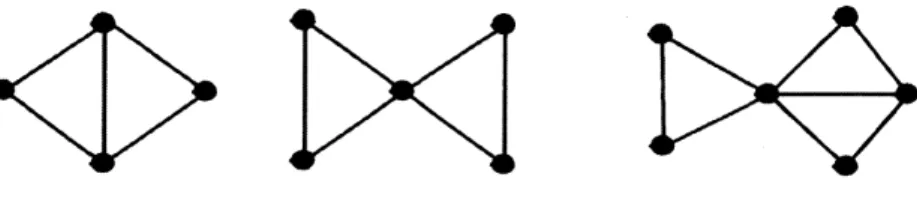
Recall $K_{\overline{4}}=K_{2}+2K_{1}$
.
We call the graph $K_{1}+2K_{2}$ a bowtie.Ando, Kaneko, Kawarabayashi and Yoshimoto [2] proved that every $k-$
connected bowtie-offgraph has
a
$k$-contractible edge.Fig.3. $K_{4}^{-}$, bowtie and $K_{1}+(K_{2}\cup P_{3})$
Theorem
9
is alsoan
extension of Theorem5.
Since
$K_{1}+P_{4}$ containsa
bowtie, the following Theorem10
isan
extensionof Theorem 9 (see [6]).
Theorem 10 Let $k\geq 5$, and let $G$ be
a
$k$-connected $(K_{1}+P_{4})-0ff$graph.If
$G[V_{k}(G)]i_{\mathcal{S}}$
bowtie-off
then $G$ hasa
$k$-contractible edge.ThefollowingTheorem 11 isanother extension ofTheorem
5
(see [3]). Notethat if
$s=t=1$
, then Theorem 11 is equivalent to Theorem5.
Also note that$K_{4}^{-}\cong K_{2}+2K_{1}$’ and ‘bowtie $\cong K_{1}+2K_{2}’$; hence $K_{2}+sK_{1}$ and $K_{1}+tK_{2}$
may be regarded
as a
generalized $K_{4}^{-}$ anda
generalized bowtie, respectively.Theorem 11 For $k\geq 5$, take two $po\mathcal{S}itive$ integers $\mathcal{S}$ and$t$ with
$s(t-1)<k.$
If
a
$k$-connected graph $G$ contains neither $K_{2}+sK_{1}$nor
$K_{1}+tK_{2_{J}}$ then $G$contains
a
$k$-contractible edge.We cannot replace the condition
$s(t-1)<k$
by $s(t-1)\leq k$ in Theorem11.
4
Some
$k$-sufficient conditions
involving
degree
and
forbidden
subgraph
Theorems 5,
10
and 11 deal with forbidden-subgraph $k$-sufficient conditions.On the other hand, Theorem 1 gives
a
minimum-degree $k$-sufficientcondi-tion. However, if
we
restrict ourselves toa
class of graphs that satisfysome
forbidden-subgraph conditions, then
we
may relax the minimum-degree boundinTheorem 1. The followingforbidden-subgraph condition relaxesthe
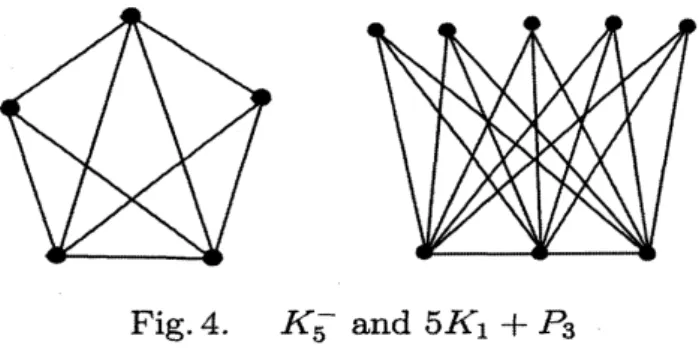
minimum-degree bound (see [3]). Let $K_{5}^{-}$ be the graph obtained from $K_{5}$ by removing
one edge.
Theorem 12 For $k\geq 5$, let $G$ be
a
$k$-connected graph which contains neither$K_{5}^{-}$
nor
$5K_{1}+P_{3}$.
If
$\delta(G)\geq k+1$, then $G$ has a $k$-contractible edge.Notethatif$k\geq 5$, then $\lfloor\frac{s}{4}k\rfloor\geq k+1$
.
Since there isa
$k$-regular contractioncritically $k$-connectedgraphwhich contains neither$K_{5}^{-}$
nor
$5K_{1}+P_{3}$,we
cannotreplace $\delta(G)\geq k+1$ by $\delta(G\rangle\geq k$ in Theorem 12. In this sense, the
minimum-degree bound in Theorem 12 is sharp.
Yangand
Sun
[15] present thefollowingas a
counterpartofa
Kawarabyashi’sFig. 4. $K_{5}^{-}$ and $5K_{1}+P_{3}$
Theorem 13 Let $G$ be
a
$K_{\overline{4}}$-off
$k$-connected graph with $k\geq 5$.If
$V_{k}(G)$ isindependent, then $G$ has
a
$k$-contractible edge.The degree condition of Theorem 13, $V_{k}(G)$ is independent’ is equivalent
to the condition that $d_{G}(W)\geq 2k+1$ for any connected subgraph $W$ of
$G$ with $|W|=2’$
.
Herewe
consider themore
general degree condition that$d_{G}(W)\geq f(k)$ for
any
connected subgraph $W$ of $G$ with $|W|=m’.$Using
a
condition ofthis type,we
have the following (see [1]).Theorem 14 Let$G$ be
a
$k$-connectedgraph with$k\geq 5$ having neither$K_{1}+C_{4}$nor $K_{2}+(K_{1}\cup K_{2})$
.
If
$\deg_{G}(W)\geq 3k+1$for
any connected subgraph $W$of
$G$ with $|W|=3$, then $G$ has
a
$k$-contractible edge.Fig.
5.
$K_{1}+C_{4}$, bowtie and $K_{2}+(K_{1}\cup K_{2})$Note that both $K_{1}+C_{4}$ and $K_{2}+(K_{1}\cup K_{2})$ contains $K_{4}^{-}$
.
And thede-gree condition )
$\deg_{G}(W)\geq 3k+1$ for any connected subgraph $W$ of $G$ with
$|W|=3$’
is much weaker than the degree condition that $V_{k}(G)$ isindependent‘.
Hence Theorem
14
extends both degree and forbidden-subgraph conditions ofTheorem
13.
Yang and Sun [16] also present the following result.
Theorem 15 Let $k$ be
an
integer such that $k\geq 5$, and let$G$ be $a(K_{1}+C_{4})$-off
$k$-connected graph.
If
$d_{G}(W)\geq 2k+2$for
any connected subgraph $W$of
$G$with $|W|=2$, then $G$ has
a
$k$-contractible edge.Conjecture $C$
Let
$k$ bean
integer such that$k\geq 5$, and let $G$ be $a(K_{1}+C_{4})-$off
$k$-connected graph.If
$d_{G}(W)\geq 2k+1$for
any connected subgraph $W$of
$G$with $|W|=2$, then $G$ has a $k$-contractible edge.
The conjecture $C$ is still open, however
we
obtain the following weakerresult, which is
an
extensionof Theorem
15.
Theorem 16 Let $k$ be
an
integer such that$k\geq 5$, and let$G$ be $a(K_{1}+C_{4})$-off
$k$-connected graph.
If
$d_{G}(W)\geq 3k+2$for
any connected subgraph $W$of
$G$with $|W|=3$ , then $G$ has a $k$-contractible edge.
References
[1] K. Ando, Some degree and forbidden subgraph conditions for
a
graph tohave
a
$k-$-contractible edg, Discrete Math. in print.[2] K. Ando, A. Kaneko, K. Kawarabayashi and K. Yoshimoto, Contractible
edges and
bowties
ina
$k$-connected graph,Ars Combin. 64
(2002),239-247.
[3] K. Ando and K. Kawarabayashi,
Some
forbidden subgraph conditions fora
graph to havea
$k$-contractible edge, Discrete Math. 267 (2003), 3-11.[4] Y. Egawa, Contractible edgesin$n$-connectedgraphs withminimum degree
greater than
or
equal to $\frac{5n}{4}$, Graphs Combin.7
(1991),15-21.
[5] Y. Egawa, H. Enomoto and A. Saito, Contractible edges in triangle-free
graphs, Combinatorica 6 (1986),
269-274.
[6] K. Kawarabayashi, Note on $k$-contractible edges in $k$-connected graphs,
Australas. J.
Combin.
24 (2001),165-168.
[7] K. Kawarabayashi,
Contractible
edges and triangles in $k$-connectedgraphs, J. Combin. Theory (B) 85 (2002),
207-221.
[8] M. Kriesell, A degree
sum
condition for the existence ofa
contractibleedge in a $\kappa$-connected graph, J. Combin.
Theow
(B)82 (2001), 81-101.[9] M. Kriesell, Triangle density and contractibility, Combin. Probab.
Com-put. 14 (2005),
133-146.
[10] M. Kriesell, Average degree and contractibility, J. Graph Theory 51
(2006),
205-224.
[11] W. Mader, Disjunkte Fragmente in kritisch $n$-fach zusammenh gende
Graphen, Europ. J. Combin. 6 (1985),
353-359.
[12] W. Mader, Generalizations of critical connectivity of graphs, Discrete
[13] J.
Su
and X. Yuan, Anew
degreesum
condition for the existence ofa contractible edge in
a
$\kappa$-connected graph, J. Combin. Theory (B)96
(2006),
276-295.
[14] C. Thomassen, Non-separating cycles in $k$-connected graphs, J. Graph
Theory
5
(1981),351-354.
[15] Y. Yang and L. Sun,
Contractible
Edges in $k$-Connected
Graphs withSome Forbidden Subgraphs, Graphs Combin. 30 (2014),